Monthly Archives: June 2020

Wednesday Weed – Corncockle

Corncockle (Agrostemma githago)

Dear Readers, it isn’t often that one comes across a plant that is ‘more or less extinct’ in the UK according to Harrap’s Wildflowers, but here it is – a corncockle, in full bloom. Of course, it hasn’t just popped up by magic – someone has planted a packet of wildflower seeds and very pretty they are too, a mixture of poppies and cornflowers and scented mayflower. But it was the corncockle that caught my eye, because it has been one of humankind’s companions since the Iron Age, and is now gone.

Corncockle was one of the weeds that used to pop up when ever a field was sown. It’s an annual, so it relied on being harvested with the crop and re-sown with the seed saved from the previous year. It was so common that for centuries it was regarded as a pest, as it was said to make bread taste bitter.   According to Roy Vickery’s Folk Flora, there was a whole ceremony in Herefordshire on Easter Day based around the separating of the corncockle seeds from the seed corn:

At Easter the rustics have a custom of corn-showing. Parties are made to pick out cockle from the wheat. Before they set out they take with them cake and cider, and, says my informant, a yard of toasted cheese. The first person who picks the first cockle from the wheat had the first kiss of the maid and the first slice of cake’.

Sadly, as humans got better at cleaning the seed that they saved, and more prone to use broad-based herbicides, so corncockle became rarer, with its decline starting to be noticed from the 1950’s onwards.

Nowadays, you might occasionally come across it in fields which have not become heavily industrialised, or which have been recently ploughed, turning up the seeds. However, you are more likely to see it, as I did, in a tiny urban meadow planted by someone who wants to see some wildflowers.

Corncockle is part of the Caryophylaceae or campion family, and is instantly recognisable because those long green sepals (the part of the flower that used to protect and encase the bud) protrude a long way beyond the petals. Those green ‘teeth’ gave it the delightful name of ‘Puck the Goblin’ in Sussex. As you might expect for a plant with such a long association with humans, it has a whole variety of vernacular names: in Dorset it was known as ‘little-and-pretty’, in Northumberland it was called ‘hard heads’, in Somerset it was ‘cockles’, and in Scotland ‘popille’. However, even though it has been here for such a long time, it is still not ‘native’, and is classed as an archaeophyte (a plant which arrived in the UK before 1500 CE).

There was a bit of a kerfuffle a few years ago when the TV programme Countryfile sent out packets of wild flower seeds which contained corncockle: the plant was described as ‘poisonous’ and in Royal Wootton Bassett a patch of seedlings planted by the local Brownies was fenced off to prevent a calamity. It is true that if you ate large quantities of the seeds (as in the aforementioned poisoned bread), you might suffer a stomach ache and vomiting, but that’s about as far as it goes. Plus, as the plant contains the soap-creating chemicals called saponins, it apparently tastes awful. The Daily Mail and Daily Express have a lot to answer for for their scaremongering about this plant and many others: our gardens are full to busting with poisonous plants, from yew and foxgloves to poppies and lilies, not to mention daffodil bulbs. Our children are much more likely to be mown down by a car than they are poisoned by a plant, especially if they are taught not to put random things in their mouths once they are old enough to understand. Harrumph!

In spite of being poisonous, corncockle was also used extensively in folk medicine – like many mildly toxic plants, it was useful as a treatment for intestinal worms (though no doubt you had to get the dosage right). It has been used to treat jaundice, oedema, constipation and gastritis, and the powdered seeds mixed with honey were used as an expectorant and a diuretic. Like so many wild plants it was both blessing and curse, depending on how it was used, and who was using it. In the Language of Flowers it was seen as representing gentility, innocent charm and daintiness, and was considered to be a good luck charm for a woman.

And finally, here’s something a bit different. The Moravian composer Leos Janacek (please forgive the absence of accents on some of the letters, my keyboard is not obliging me at the moment), had a deep passion for folk poetry and songs – he believed that

the dance song should choke in sweat, in people’s vapour and steam, while the melancholy weeping of the bride should be reflected in wedding songs.

He wrote a number of songs with plant names, and one of them was ‘corncockle’ (otherwise known as ‘into the woods’), which definitely sounds like a song that could be sung in a barn once the crop had been gathered in. . You can have a listen to it below, but you might want to hang on for the next track, too, called ‘Guelder Rose’, which is a deeply romantic tune. See what you think!

Moravian Folk Poetry by Janacek – Corncockle


Sunday Quiz – Tricky Trees – The Answers

Dear Readers, didn’t we do well again! First place this week goes to Sarah, with 17/18 correct, take a gold star! Fran and Bobby Freelove were very close behind with 16/18, and then we have Alittlebitoutoffocus with 11/18 and Andrea with 9/18. Thanks to everyone for taking part, and I hope you enjoyed it!

Dear Readers, let’s see how you did! The correct answers are below.

1.b.iii

2.e.vi

3.d.i

4.f.ii

5.h.vii

6.a.iv

7.g.viii

8.c.v

See the photos for more details!

Photo One by Innocenceisdeath / CC BY-SA (https://creativecommons.org/licenses/by-sa/3.0)

1) London plane fruit (b)

Photo Two by Sycamore (Acer pseudoplatanus) - fruit cc-by-sa/2.0 - © Evelyn Simak - geograph.org.uk/p/5798921

2) Sycamore samaras (winged seeds) (e)

Photo Three by This illustration was made by Matthieu SontagEnglish: This photo has been taken by Matthieu Sontag (User:Mirgolth) and released under the licenses stated below. You are free to use it for any purpose as long as you credit me as author, Wikimedia Commons as site and follow the terms of the licenses. Could you be kind enough to leave me a message on this page to inform me about your use of this picture.Example: Photo : Matthieu Sontag, Licence CC-BY-SA.Français : Cette photo a été prise par Matthieu Sontag (User:Mirgolth) et placée sous les licences ci-dessous. Vous êtes libre de la réutiliser, pour n'importe quelle utilisation, tant que vous me citez en tant qu'auteur, Wikimedia Commons en tant que site et suivez les instructions des licences. Pourriez-vous avoir l'amabilité de me laisser un message sur cette page pour m'informer de votre utilisation de cette image.Exemple : Photo : Matthieu Sontag, License CC-BY-SA.Vous souhaitez faire apparaitre cette photo sans crédit ? Contactez moi ! If you want to use the photo without credit, please contact me. / CC BY-SA (https://creativecommons.org/licenses/by-sa/3.0)

3) Ash leaves (d)

Photo Four by Alvesgaspar / CC BY-SA (http://creativecommons.org/licenses/by-sa/3.0/)

4) Lime leaves (f)

Photo Five by David Hawgood / Beech mast on trees, Cockshoots picnic site

5) Beech leaves and mast (h)

Photo Six by Chiswick Chap / CC BY-SA (https://creativecommons.org/licenses/by-sa/3.0)

6) Hornbeam leaves (a)

Photo Seven by Mehmet Karatay / CC BY-SA (https://creativecommons.org/licenses/by-sa/3.0)

7) Pendunculate oak leaves (g)

Photo Eight by MPF at the English language Wikipedia / CC BY-SA (http://creativecommons.org/licenses/by-sa/3.0/)

8) Silver birch catkins (c)

Part Two – Identify the same trees from some more difficult bits!

Photo i) by Philip Halling / Ash tree buds

i) Ash twigs and buds

Photo ii) by Sten / CC BY-SA (https://creativecommons.org/licenses/by-sa/3.0)

ii) Lime buds

iii) London plane bark

iv) Hornbeam bark

Photo Five by Chris Reynolds / Bark on Old Silver Birch tree

v) Silver birch bark

Photo Six by gailhampshire from Cradley, Malvern, U.K / CC BY (https://creativecommons.org/licenses/by/2.0)

vi) Sycamore leaves with tar spot fungus

Photo (vii by © El Grafo / CC-BY-SA-3.0 / CC BY-SA (https://creativecommons.org/licenses/by-sa/3.0)

vii) Beech bud

Photo viii) by Bj.schoenmakers / CC0

viii) Knopper gall on pedunculate oak.

An extra point for recognising the tar spot fungus and another one for the knopper gall.

Thanks everyone! Hope you enjoyed it, and all comments gratefully accepted as always.


A Windy Walk in St Pancras and Islington Cemetery

Dear Readers, during the lockdown one of the highlights of my week has been a walk around the local cemetery. It’s only open to visitors at the weekend from 10 a.m. to 3 p.m., and Sunday is generally very busy, so Saturday it is. Today was overcast and breezy, and indeed we even got a drop of the wet stuff for the first time in weeks. Still, I love seeing the way the plant life is changing.

The cow parsley has given way to the hogweed, so I know that spring is officially over.

Hogweed (Heracleum sphondylium)

And all the meadow flowers, the ox-eye daisies and the red campion, are in full flower in the wild part of the cemetery.

Ox eye daisy (Leucanthemum vulgare) and red campion (Silene dioica)

The dock is doing well too. This one is about seven feet tall.

Curled dock (Rumex crispus)

There is one little patch of red valerian that reminds me so much of Dorset, where it grows out of every wall.

Red valerian (Centranthus ruber)

The red clover is in full bloom.

Red clover (Trillium pratense)

The tormentil is growing all over the sunnier graves.

Tormentil (Potentilla erecta)

The elder is magnificent this year. I have never seen so many flowers. You can smell the gooseberry twang of the blossom from 2 metres away (if you are socially distancing 🙂 )

Elder (Sambucus nigra)

I have become intrigued with what thistles look like when you photograph them from above. It’s as if a whole new world has opened up.

Spear thistle (Cirsium vulgare)

Creeping thistle (Cirsium arvense)

Spear thistle (Cirsium vulgare)

And here is something fairly unusual – goat’s rue, a member of the pea family, but with white flowers rather than the usual lilac ones.

Goat’s rue (Galega officinalis)

It’s fascinating to see how the seasons are moving on. In the space of less than a fortnight, the shining cranesbill has flowered, and the foliage has turned a stunning crimson.

Shining cranesbill (Geranium lucidum)

The salsify has changed from attractive purple flowers to big fluffball seedheads.

Salsify (Tragopogon porrifolius)

The white flowers of the firethorn are changing into bright orange berries. It will definitely be worth checking for waxwings here in the winter, for some reason they love the fruit of this shrub.

Firethorn (Pyracantha coccinea)

It sometimes feels as if the cemetery is the only place around here open enough to really see the sky. My Mum, after she’d been slaving away at some embroidery or crochet, would often go outside to ‘stretch her eyes’. I know what she meant.

And then onwards. Past the first patch of this year’s yarrow (new to me, anyhow), and past the strangely sculptural flowers of the teasel.

Yarrow (Achillea millefolium)

Teasel (Dipsacum fullerum)

But here’s a surprise. Who should be sitting next to the tiny stream (which has been reduced to a trickle by the lack of rainfall) but a very handsome mallard drake? I thought he would scoot off as we approached but instead he sat there, looking very pleased with himself, whilst standing on one leg.

And then we turned for home. How I love the woody pathways on the route back to the entrance gate. I always keep an eye open for foxes, but they seem few and far between this year. I suspect that they are about much more during the week, when there are fewer visitors.

How I love the cemetery! I find such peace there; even though Dad isn’t even interred yet, and his ashes will stay in Dorset, I can somehow feel his presence here. He was always at home amongst plants and trees, and in another life I think he’d have been a gardener, or a farmer. He was never happier than when he was digging up potatoes, preferably without his shirt on and with the sun blazing down. Wherever he is now, I hope that there are beans and strawberries for him and Mum to pick.


Sunday Quiz – Tricky Trees

Dear Readers, as last week’s quiz was a bit of a doozy, I am going for something a little closer to home this week. Firstly, see if you can identify the trees from the photos below (multiple choice as usual). And then, see if you can identify them from some other, trickier part – buds/twigs/bark/parasite!

Part One – Identify the tree in spring and summer.

So, if you think tree 1) is a hornbeam, your answer will be 1)a)

Photo One by Innocenceisdeath / CC BY-SA (https://creativecommons.org/licenses/by-sa/3.0)

1)

Photo Two by Sycamore (Acer pseudoplatanus) - fruit cc-by-sa/2.0 - © Evelyn Simak - geograph.org.uk/p/5798921

2)

Photo Three by This illustration was made by Matthieu SontagEnglish: This photo has been taken by Matthieu Sontag (User:Mirgolth) and released under the licenses stated below. You are free to use it for any purpose as long as you credit me as author, Wikimedia Commons as site and follow the terms of the licenses. Could you be kind enough to leave me a message on this page to inform me about your use of this picture.Example: Photo : Matthieu Sontag, Licence CC-BY-SA.Français : Cette photo a été prise par Matthieu Sontag (User:Mirgolth) et placée sous les licences ci-dessous. Vous êtes libre de la réutiliser, pour n'importe quelle utilisation, tant que vous me citez en tant qu'auteur, Wikimedia Commons en tant que site et suivez les instructions des licences. Pourriez-vous avoir l'amabilité de me laisser un message sur cette page pour m'informer de votre utilisation de cette image.Exemple : Photo : Matthieu Sontag, License CC-BY-SA.Vous souhaitez faire apparaitre cette photo sans crédit ? Contactez moi ! If you want to use the photo without credit, please contact me. / CC BY-SA (https://creativecommons.org/licenses/by-sa/3.0)

3)

Photo Four by Alvesgaspar / CC BY-SA (http://creativecommons.org/licenses/by-sa/3.0/)

4)

Photo Five by David Hawgood / Beech mast on trees, Cockshoots picnic site

5)

Photo Six by Chiswick Chap / CC BY-SA (https://creativecommons.org/licenses/by-sa/3.0)

6)

Photo Seven by Mehmet Karatay / CC BY-SA (https://creativecommons.org/licenses/by-sa/3.0)

7)

Photo Eight by MPF at the English language Wikipedia / CC BY-SA (http://creativecommons.org/licenses/by-sa/3.0/)

8)

a) Hornbeam (Carpinus betulus)

b) London plane (Platanus x hispanica)

c) Silver birch (Betula pendula)

d) Ash (Fraxinus excelsior)

e) Sycamore (Acer pseudoplatanus)

f) Lime (Tilia x europaea)

g) Pedunculate (English) Oak (Quercus robur)

h) Beech (Fagus sylvatica)

Part Two – Identify the same trees from some more difficult bits!

For this part, we have to recognise the same trees from the bits that remain after the summer, which is a bit on the tricky side.

So, if you thought photo one was a hornbeam, and that the twigs in photo i) are also hornbeam, your answer is 1)a)i)

Photo i) by Philip Halling / Ash tree buds

i)

Photo ii) by Sten / CC BY-SA (https://creativecommons.org/licenses/by-sa/3.0)

ii)

iii)

iv)

Photo Five by Chris Reynolds / Bark on Old Silver Birch tree

v)

Photo Six by gailhampshire from Cradley, Malvern, U.K / CC BY (https://creativecommons.org/licenses/by/2.0)

vi)

Photo (vii by © El Grafo / CC-BY-SA-3.0 / CC BY-SA (https://creativecommons.org/licenses/by-sa/3.0)

vii)

Photo viii) by Bj.schoenmakers / CC0

viii)

As always, put your answers in the comments by 5 p.m. UK time on Monday – the answers will be posted on Tuesday. Two extra points if you can tell me what is going on in photos vi) and viii).

NB Write your answers down before you look at the comments if you don’t want to be influenced by those speedy peeps out there 🙂


Garden Bird Titbits

Jackdaw ( Corvus monedula)

Dear Readers, I have just acquired (yet another) new book. This one is ‘Garden Birds’ by Mike Toms, and it’s in the much beloved New Naturalist series. So, I thought I would share some of its wisdom with you, in the form of a single fact about some of my favourite garden birds.

Jackdaw

Unlike most birds, Jackdaws start to incubate their eggs part-way through the laying process rather than when all the eggs have been laid, which leads to chicks of different sizes being in the nest at the same time. The oldest, largest chicks are most likely to be fed, so in times of shortage, the youngest chicks will probably die (though when pickings are good all will probably survive). When there isn’t much food about, the male chicks (who are larger than the females) are most likely to die because they require more calories. Broods produced at the end of the season when conditions were poor were also more likely to have more female chicks both hatched and reared.

It seems to be the case in many species that when times are hard, nature favours females.

Young starling (Sturnus vulgaris)

Starling

A major food for starlings during the breeding season is the larvae of craneflies (leatherjackets) – I often see the birds marching across Muswell Hill Playing Fields, probing about for these tasty morsels. Changes in agricultural management, largely due to the use of sheep rather than cattle for grazing, and the draining of meadows and wetlands where adult craneflies used to congregate, are thought to be responsible in part for the decline in numbers of starlings by 89% between 1967 and 2015. An additional pressure has been changes in building regulations, and the movement towards plastic rather than wooden barge boards (the boards used on the gable end of a house), which means that new houses are significantly less friendly to nesting birds than old ones.

Goldfinch (Carduelis carduelis)

Goldfinches

Goldfinches in the wild feed on the seeds of plants such as thistle and teasel, and while they might at first have been attracted to gardens by the provision of nyjer seeds, there seems to be a pattern emerging whereby they prefer sunflower seeds to nyjer when both are offered. This is certainly something that I’ve noticed in my garden, and I’d love to know if you’ve seen something similar! In the wild, goldfinches apparently prefer seeds that are still under-ripe and ‘milky’.

Robin (Erithacus rubecula)

Robin

Robins are prone to nesting very low down in a shrub, and sometimes even nest on the ground. This makes them one of the three most vulnerable garden species to cat predation (the other two are the house sparrow and the dunnock). However, they are very wary around their nests: they have been seen to drop the food that they are carrying for nestlings if they think they are being watched, and may even make a visit to a ‘false site’ to confound the observer. This seems to me to show that robins have a ‘theory of mind’ – they have a sense of what the watcher might be thinking (i.e. that they want to know where the nest is) and act accordingly to protect it.

Collared Dove (Streptopelia decaocto)

Collared Dove

The first pair of collared doves bred in the UK in 1955. Today, there are 990,000 breeding pairs. This remarkable expansion has been powered, in part, by the collared dove’s ability to breed year round: a pair can squeeze as many as five breeding attempts into a single year. Each nest holds only two chicks, but these are much more likely to survive than a larger brood. The species is also making headway in North America, where 50 birds escaped from a bird breeder in the Bahamas. Some soon turned up in Florida, and they are currently advancing north and west.

House sparrow

House sparrow

In house sparrows, the dominance of a male within the colony is indicated by the size of the black ‘bib’ under his throat. More dominant males not only do proportionately more of the work of nest-building, provisioning and incubation than small-bibbed males, they also do more in the way of defending the nest from predators, probably another good reason that females tend to choose more dominant males as partners. A higher proportion of the nestlings in the nests of large-bibbed males fledge, too.

And a second fact that I cheekily wanted to sneak in: sparrows make a ‘chirrup’ call when they find a food source that is large enough to be shared, but stay silent when there’s only enough for them. Very sensible!

Blue Tit (Cyanistes caerulus)

Blue Tit

Although you might think that you’re seeing the same couple of blue tits on your bird feeders, studies on ringed birds have shown that you might in fact be seeing up to a hundred different individuals – blue tits in the region will make a ‘tour’ of the local gardens, dropping in for a quick bite at each one. This really shows up the importance of the continuity of habitats – blue tits are reluctant to cross busy roads or other unsuitable habitat, but will happily make a short hop from tree to tree.

Blackbird (Turdus merula)

In a few weeks’ time, there will be a sudden drop in the bird activity in the garden. Many species will be moulting and taking a hard-earned rest after the breeding season, but some blackbirds take off on holiday – many will move into the countryside to feast on berries. However, some just seem to fancy a change of scene: one ringed blackbird bred in a garden in Norfolk but spent her winters in a Devon garden every year, probably to escape the wind that blows in straight from the Steppes.

Incidentally (says she, sneaking in yet another second fact) blackbirds will eat tadpoles, pulling them out of the pond and bashing them on the ground. The birds will also be struggling to find enough earthworms to eat at the moment, as the soil is so dry and the worms will be keeping a very low profile. You might want to do some watering (or watch after rain) and see what happens.

So, that’s just a few garden birds. What a great book! The New Naturalists never let me down. I am waiting with great anticipation for one on ‘Ponds and Puddles’ that is promised for 2022. I think I will have to keep working until I’m eighty simply to fund my book buying.

Friday Book – Europe’s Dragonflies by Dave Swallshire and Andy Swash

Dear Readers, every month when I get paid I allow myself a small indulgence in the form of a book, and it will come as no surprise to regular readers that it’s usually something to do with nature. For June, I have gifted myself Europe’s Dragonflies. Why, you might ask, did I not go for one that was just about the dragonflies of the UK? Well, just lately I am filled with a great urge to travel (probably because I can’t), and I find myself dreaming of the bogs on the Hochgurgl path in Austria, or the sunlit, dusty gorges of southern Crete.

Hochgurgl path, July 2019

If I’d been paying attention in Austria, for example, and if it had been sunnier, I might have seen the Alpine Emerald (Somatochlora alpestris)  with its bright-green eyes and, if I took a quick trip to the Lech valley, I could find the only European representatives of the Siberian Bluet (Coenagrion hylas) – the remainder of the species are found, not surprisingly, in Siberia. It’s noted that this last species has rather more black on its body than other members of the genus, probably to help it warm up.

Siberian bluet

If I went to Corsica or Sicily, I might see the black pennant (Selysiothemis nigra), whose body is completely black. I am not sure how that fits in with the black-for-warming-up thesis, but most adult dragonflies don’t live for very long, and it’s only the male who is night-hued (in nature, males are often more expendable than females).

Black pennant

In southern Spain I might spot a violet dropwing (Trithemis annulata), surely one of the most colourful dragonflies of the lot. The males adopt what is known as the ‘obelisk position’ with their abdomen straight up in the air when it’s hot, maybe to limit exposure to the heat.

Violet dropwing

In southern Greece I might find the only example of the Greek Goldenwing (Cordulegaster helladica), which haunts the Castalian spring at Delphi. On Rhodes, I might find the magnificent emperor (Anax immaculifrons) with its blue eyes and six-inch wingspan. On Crete, I might stumble across the Cretan spectre (Boyeria cretensis), who prefers fast-flowing rivers, and who lays their eggs in moss or tree-roots overlooking the water.

Greek goldenwing

But if I went to the Azores, I would find the only population of parthenogenic dragonflies anywhere in the world: the citrine forktail (Ischnura hastata). The bright-yellow males are what gives the species its name, but these are not found in the Azores – presumably, long ago, a female was blown across the Atlantic from the Americas, where the species normally lives, and somehow adapted by being able to reproduce without mating. The females start off bright orange, but become duller over time. When the scientist in Jurassic Park suggests that ‘nature will find a way’, he had no idea how right he was.

Citrine forktail

So, this book is full of wonders. There are damselflies that look like dragonflies, dragonflies that migrate over the Himalayas and the Indian Ocean to breed in East Africa (the wandering glider (Pantala flavescens)) and who may crop up in Europe as their offspring make the return journey, and dragonflies in every colour of the rainbow. I am not surprised that many birdwatchers make the switch to the dragonfly (Odonata) family – these creatures are relatively easy to spot and identify (though don’t get me started on blue damselflies), and can be watched through binoculars. Plus, some of them are extremely confiding – I remember a common darter landing on my arm and using it as a perch for half an hour a few years ago.

There is also something about dragonflies that is unsettling (after all, H.R. Giger used the mouthparts of a dragonfly as inspiration for his creature in Alien). As I’ve noted before, when you’re circled by an emperor you have no doubt that you’re being observed and summed up. Some of them are large enough to be disconcerting at close quarters, and they are certainly too big to pop under a glass and remove from a room. They remind me that a lot of wildness can be contained in a small package, and I am very glad to witness and admire them as something that seems to sum up the spirit of wet and billowy places, of unpeopled woods and gently-bubbling bogs.


A Weedy Walk in Muswell Hill

Prickly sow thistle (Sonchus asper)

Dear Readers, today I walked over to the Halifax Building Society in Muswell Hill to finalise the last transfers from Dad’s bank account, so that I could tie up his estate. What a journey it’s been! I must have been on the phone for a full day during the past two weeks trying to find someone who would close his account so that I could distribute the funds and pay his final debts. Every single person that I’ve spoken to has been lovely, and none of them have been able to make it happen. How hard is it to close an account? Very hard, as it turns out, especially in the middle of a lockdown. So I walk over to my local branch, and the staff sorted it all out in fifteen minutes.

I’m in tears at the end of it, partly with relief, but partly because this is it, almost the last thing that I can do for Dad. He and Mum were always so responsible with money – Mum’s idea of a ‘blow-out’ spending spree was to buy two teeshirts in different colours, or a packet of three Magnum ice creams. I think of how Dad would always insist on paying me for my train fare when I went to visit them, pulling out the notes with hands that were numb with peripheral neuropathy. The dialogue always went the same way:

Me: You don’t have to do that Dad, I love coming to visit you and Mum.

Dad: I know I don’t have to, but I want to. Here! (Shaking the money in my direction)

The woman who has been helping me asks if my Dad had been very sick, so I tell her a little bit about him, and notice that her eyes are welling up too.

‘I lost my Dad a year ago’, she says.

And we both stand there helpless. I suspect in another world we’d have hugged, but all we can do in this one is share a moment of fellow-feeling. Perhaps that’s enough, under the circumstances.

And on the way home, I find solace in the weeds, as usual. Nobody at the council has been out with the weed-killer, so there are a great variety of plants taking advantage of the scant soil at the bottom of the walls. The houses along Queen’s Avenue are splendid, but many of them were hotels, so now they stand empty and unloved, all the sadder because a lot of money has been spent on some of them over the past few years. I have taken all these photos on my phone, so please forgive the quality of some of them!

A positive ocean of Phlomis in the front garden of one of the hotels

Weeds seem to fall into a variety of categories. There are the usual suspects, such as the sow thistle in the first photo. Then there are Muswell Hill specialities, such as the mallow which seems to pop up around here, but in few other places locally – I suspect someone planted it in a garden and it’s been advancing forth ever since.

Common mallow (Malva sylvestris)

There is ivy-leaved toadflax growing out of the nooks and crannies. This is one of my favourite weeds, and it seems to be doing well this year, maybe because it doesn’t mind the dry conditions, being something of an Alpine plant in habit. The photo has overexposed a bit, but the flowers were much paler than usual.

Ivy-leaved toadflax (Cymbalaria muralis)

And here we have a veritable forest of sow thistle. Although this has to be the most raggedy, insect-bitten sad-looking weed of the lot, it is such a survivor, and those yellow flowers turn into a mass of wind-blown seeds which will soon be populating the rest of the street.

I have always been very fond of sun spurge (Euphorbia helioscopia) with its exotic acid-yellow flowers, and here it is, growing amongst the knotgrass (Polygonum aviculare agg.) I am not quite sure about the other plants, they look almost like tree saplings – does anyone have any bright ideas?

And here is some caper spurge, which I suspect has jumped the wall from the neighbouring gardens, alongside some nipplewort.

Caper spurge (Euphorbia lathyris)

And here is another garden escape – one  of the multi-coloured decorative grasses that have become so popular over the past few years. I think that a row of these along the bottom of a wall might actually be rather attractive. What do you think?

And the most surprising bottom-of-the-wall plant of all was this one, a stone’s throw away from Muswell Hill in the rather classy Twyford Estate.

I rather think that this might be a baby false acacia (Robinia pseudoacacia), self-seeded from its parent opposite. I seem to remember that a huge clump of these seedlings were turning into a small forest on the corner of the road, blocking the view of the drivers trying to turn left. I imagine that at some point this little chap will also meet with his demise.

Of course, fancy street trees are not the only trees that pop up in unexpected places. There are some sycamores finding themselves very at home on the alleyway next to All Saints’ Church, along with some cherry laurel and a smidgen of bramble.

And there is a small field of wall barley just along the way too.

And so, nature is cheerfully flourishing as the lockdown (more or less) continues. It’s a reminder that life goes on in spite of our personal griefs and problems. At some point the weed-spray man will reappear, with his tank of toxic chemicals and his lack of protective equipment, but in the meantime, plants are literally making hay while the sun shines. And I, for one, find it strangely comforting.

Wednesday Weed – Yellow Flag Iris

Yellow iris (Iris pseudacorus)

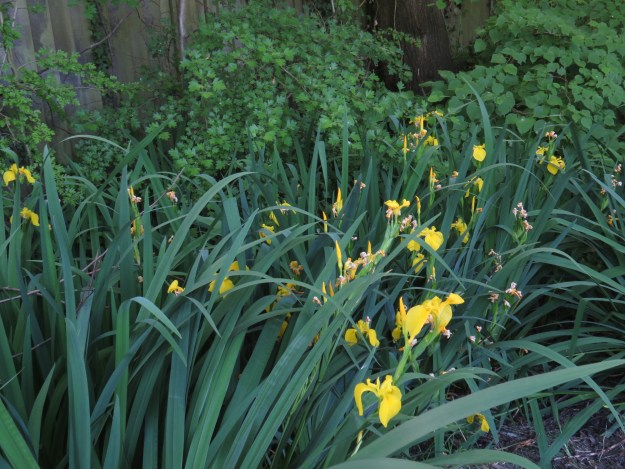
Dear Readers, round by the tennis courts in Cherry Tree Wood there is a place which is damp and muddy almost all year round. Some say that this is actually where the Mutton Brook arises before it makes its way through Hampstead Garden Suburb and eventually into the Dollis Brook. Whatever the truth of it is, I have never seen such a fine batch of yellow irises  (Iris pseudacorus) as are there this year. They are the colour of butter, and those strange flowers are decorated with faint landing pads to show the hoverflies and bees exactly where to go to pollinate them.

I have some of these plants in the garden too, and the flowers are fleeting, appearing in the morning and sometimes gone by late in the afternoon. Still, I am not complaining – this is only the second year that they have flowered, and they are better than last year, when I only had a single bloom. For all its delicate beauty, it can be a bit of a thug – it is counted as an invasive species along the whole west coast of North America, and in New England as well. You can see how a stand of this plant would soon squeeze out everything else.

In the UK, the plant has a host of vernacular names, including butter-and-eggs, ducks’ bills, queen of the meadow and soldiers-and-sailors. Regular readers will be delighted to hear that this is yet another plant that’s considered to be unlucky if you bring it into the house: Roy Vickery speculates that it’s because the plant grows in treacherous, boggy areas. However, in Guernsey it was used to strew the path in front of a bride as she made her way to church on her wedding day, so it’s not all bad. In Shetland, irises are known as ‘segs’, which comes from the Anglo-Saxon word for a sword, an obvious reference to the blade-shaped leaves. Biting a ‘seg’ meant that you would develop a speech impediment such as a stammer. Goodness knows what it all means, except that people do love a good story, and plants are so often vehicles for such things.

The roots of yellow iris can be used to make a dye: in the Western Isles the dye is said to be black, and sometimes used as ink, while in Shetland it’s blue-grey or dark green. The flowers can be used to produce a dye too, while the leaves made a green dye that was used to colour Harris tweed. In short there’s a veritable rainbow of potential colours in the various parts of this plant.

Medicinally, yellow iris was used as a cathartic – it contains chemicals which can cause dermatitis, and is said to be mildly toxic to cats and dogs. However, it’s been used for everything from toothache to cramp and, if ground into snuff, was said by one Dr Thornton to have ‘cured complaints of the head of long standing in a marvellous way’.

Furthermore, it is said to have cured a pig following a bite from a mad dog. With all these medicinal uses, it’s no wonder that the Roman word for the plant was consecratix, because it was used for purification ceremonies.

It’s often thought that the yellow iris was the origin of the fleur-de-lys, symbol of French kings and boy scouts. The Frankish king, Clovis, was said to have replaced the three toads on his flag with three fleur-de-lys as a symbol of Christian purity. Later legends have the name ‘fleur-de-lys’ being a corruption of the phrase ‘flower of Louis’, for King Louis IX. However, it might also refer to the River Leie in Flanders, where yellow irises grew in great profusion. For me it will always be a symbol of the scout movement. How I remember trying to join the Cub Scouts as a child because the Brownies seemed a bit wet. Oh, the shame of being rejected at such a young age!

Photo One byBy Bedford Master - This file has been provided by the British Library from its digital collections. It is also made available on a British Library website.Catalogue entry: Add MS 18850, Public Domain, https://commons.wikimedia.org/w/index.php?curid=10099222

King Clovis of the Franks receiving the fleur-de-lys (British Library, public domain)

Although Claude Monet was famous for his paintings of waterlilies at his garden in Giverney, he was not averse to yellow irises either: I love how, in the painting below, the citrus-lemon colour of the flowers is offset by the blue-green of the leaves. Although the painting is not photo-realistic, it gives a real sense of the coolness of the plant – whenever I look at them, I seem to smell the freshness of water and see the faintest glance of a dragonfly out of the corner of my eye.

Yellow irises by Claude Monet (painted 1914-1917) (Public Domain)

And finally, a poem. I think a lot of us are coming back to the sounds of nature during the lockdown, hearing the birds singing early in the morning, and the thrum of bees. Sadly, here in East Finchley the builders are back and the road (which was closed for some sewage works) is now open, so the rumble of vans is ever present. Nonetheless, things are still quieter than they were, and I find myself quieter inside too. I hope that you enjoy this as much as I did.

Glencolmcille Soundtrack by Moya Cannon

All day long, as I climbed,

in sunshine, up to the holy well,

then on to the Napoleonic watchtower,

and halted behind it, on a headland

tramped brown by sheep, to watch the sea

carve slow blue paths through cliffs and skerries,

May’s soundtrack played on and on-

bee-hum, the high meheh of hill-lambs,

the lifted songs of larks in warm grass

and later, near the court tomb in the valley,

the cuckoo’s shameless call.

When did I forget it,

mislay it or roll it up,

this tapestry of sound

which pleasures us

by spilling hawthorn hedges

in whin-scented summer,

as pools of yellow iris

are conjured out of wet fields

and late bluebells, vetch and fern

capture the ditches?


Sunday Quiz – Little Critters – The Answers!

Good morning everyone! I completely forgot to post the winners this week – just blame it on Covid Brain. So, congratulations to Mike at Alittlebitoutoffocus for the best overall score of 9/16, and to Sarah for the best score on British mammals with 8/8. Well done to both! But next week I think we’ll do something plant-related. Watch this space….

Dear Readers,

Here are the answers to my most fiendish quiz so far.

Part One

Photo One by By Peter Trimming - https://www.flickr.com/photos/peter-trimming/6583159839/, CC BY 2.0, https://commons.wikimedia.org/w/index.php?curid=29980115

1) e)  Red squirrel (Sciurus vulgaris)

Photo Two by Bouke ten Cate / CC BY-SA (https://creativecommons.org/licenses/by-sa/4.0)

2) a) Edible dormouse (Glis glis)

Photo Three by Danielle Schwarz / CC BY-SA (https://creativecommons.org/licenses/by-sa/3.0)

3)h)  Hazel dormouse (Muscardinus avellanarius)

Photo Four by Dunpharlain / CC BY-SA (https://creativecommons.org/licenses/by-sa/4.0)

4)c) Brown rat (Rattus norvegicus)

Photo Five by Peter Trimming from Croydon, England / CC BY (https://creativecommons.org/licenses/by/2.0)

5)g) Water vole (Arvicola amphibius)

Photo Six by Bj.schoenmakers / CC0

6)b) Harvest mouse (Micromys minutus)

Photo Seven by Sandy Rae from Scotland, UK / CC BY (https://creativecommons.org/licenses/by/2.0)

7)f) Wood mouse (Apodemus sylvaticus)

Photo Eight by Soricida / CC BY-SA (https://creativecommons.org/licenses/by-sa/3.0)

8) d) Common shrew (Sorex araneus)

Part Two

Photo Nine by By François Trazzi. - François Trazzi., CC BY-SA 3.0, https://commons.wikimedia.org/w/index.php?curid=178597

9)f) Alpine marmot (Marmota marmota) ii) Alpine Europe

Photo Ten by By Gunnar Ries - Self-photographed, CC BY-SA 2.5, https://commons.wikimedia.org/w/index.php?curid=2070525

10) d) Black-tailed prairie dog (Cynomys ludovicianus) iv) US great plains 

Photo Eleven by Alina Fisher / CC BY (https://creativecommons.org/licenses/by/4.0)

11). e) Vancouver Island marmot (Marmotta vancouverensis) i) Vancouver Island, Canada

Photo Twelve by © Hans Hillewaert

12) h) Cape ground squirrel (Xerus inauris) vii) Southern Africa

Photo Thirteen by By Charles J Sharp - Own work, from Sharp Photography, sharpphotography, CC BY-SA 4.0, https://commons.wikimedia.org/w/index.php?curid=90109042

13) a) Meerkat (Suricata suricatta) vii) Southern Africa

Photo Fourteen by By Karunakar Rayker - originally posted to Flickr as The Pika, CC BY 2.0, https://commons.wikimedia.org/w/index.php?curid=8707451

14) b) Large-eared pika (Ochotona macrotis) vi) Mountain regions of Asia

Photo Fifteen by By The original uploader was Brian.gratwicke at English Wikipedia. - Transferred from en.wikipedia to Commons., CC BY 2.5, https://commons.wikimedia.org/w/index.php?curid=3435406

15) c) Rock cavy (Kerodon rupestris) v) Eastern Brazil

Photo Sixteen by By Jason Pratt - originally posted to Flickr as Southern Hairy-nosed Wombat, CC BY 2.0, https://commons.wikimedia.org/w/index.php?curid=7669805

16) g) Southern hairy-nosed wombat  (Lasiorhinus latifrons) iii) Australia

So, what did you think folks? Too hard? Too easy? Too many rodents? All feedback greatly received.


My Top Ten Favourite Blogs

Dear Readers, as most of us have a little more time to peruse the world of the blogosphere at the moment, I thought that I’d include a quick rummage through some of my favourite blogs. No doubt I’ll have missed some, so do let me know if your blog, or one that you like, is not included, and I’ll do a follow-up post at some point.

London Blogs

I have to start with a shout-out to The Gentle Author’s blog, Spitalfields Life. If it hadn’t been for this extraordinary writer, I’m sure that Bugwoman’s Adventures in London would never have come to fruition. Spitalfields Life has appeared every day  since 2009, in spite of the writer breaking his arm and having a bout of Covid-19. The pieces vary from rallying cries to protect London businesses and landmarks such as the Whitechapel Bell Foundry, loving portraits of local Spitalfields characters, paeons to the cats that the Gentle Author has shared their life with (and in particular I recommend this eulogy to Mr Pussy, the Gentle Author’s beloved friend) and a whole range of posts on the strange, the wonderful and the heroic that make Spitalfields such an extraordinary place. If you have the slightest interest in London, or people, or indeed cats you should shimmy on over to Spitalfields life and sign up for your daily dose of wonder.

One of the people that I met on the Gentle Author’s blog course back in 2014 has a wonderful blog of his own –A London Inheritance.  The author’s father lived in London and, from 1946 to 1954 he took many photographs of the city. The author used these photographs as a starting point for his blog, looking at what had changed, and what remained the same. His explorations of various London locations are full of interest, and it’s fascinating to see what he uncovers. Here, for example, are his father’s photographs of the Royal Festival Hall, taken after the closure of the Festival of Britain in the 1950s, and the same locations today. Not all the locations are so famous, though: I loved his post about the Westferry Road Newsagent, all boarded up and awaiting demolition. The author also a great passion for London’s transport network, and one can often find him underground, exploring Tube stations with the London Transport Museum’s Hidden London team. Here, for example, he is at Moorgate and having a very interesting time. Again, head on over and sign up if you love London. 

Blogs from Other Places

Something Over Tea is written by Anne, who lives in South Africa and writes about the animals and plants that she sees around her. She also writes about tea, though, like many of us, she also includes posts on whatever takes her fancy – recent pieces have included musings on South African English, the meaning of the word ‘diurnal’, and a particularly poignant piece about the last drive through town before lockdown. I always get a real sense of what it’s like to actually live in South Africa from Something Over Tea, and I find it endlessly interesting.

And if you fancy going somewhere mountainous, A Little Bit Out of Focus is written by Mike, who lives in Switzerland. This is where I go to get my Alpine ‘fix’, especially as this year I won’t be able to make my annual pilgrimage to Obergurgl. Mike’s photographs of the meadows with their flowers and butterflies almost makes up for it, and if you fancy some snow to cool down with, there’s plenty of it here. Much as the Norwegian Blue Parrot in Monty Python’s ‘dead parrot’ sketch was ‘pining for the fjords’ so I am pining for the Alps, but A Little Bit Out of Focus reminds me that they are still there, coronavirus or not.

Gardening Blogs

The Hospice Gardener is a wonderful blog written by Jim Nicholson, who has been gardener at the Wigan and Leigh Hospice since 2016. At the moment, Jim is mostly working on his own because of the need for social isolation, but how splendid the gardens look even so! And this has been a difficult year for Jim in other ways too. But I love to see how the gardens are getting on, and I hope that everything is going well.

The Cow Parsley Diaries is a new-ish blog by Claire, who is creating a garden on heavy clay in Sheffield. Her garden, like mine, is north-east facing, and so I am looking to her for inspiration! Her photos are lovely, and the blog is currently encouraging me to think about paeonies, and about increasing my small number of brunnera, which seem to be happy in the shade. I look forward to her posts with relish.

Nature

I have long been a follower of Andrea Stephenson’s blog Harvesting Hecate – like me, she aims to combine word and image, and her writing is intensely personal. I loved her piece about the coming of the lockdown, but all of her work manages to conjure a deep spirit of place. She is deeply attuned to the movement of the seasons, and to the signs that nature is constantly transforming. I especially loved her evocation of the long, hot summer that we had last year. This is a blog to savour, rather than to rush through.

I have been following Jacqueline Durban on her blog Radical Honey for several years, and I love the way that she blends the natural world, spirituality and political and ethical action effortlessly, almost as if they were the same thing (and who is to say that they aren’t?). She has written many, many beautiful pieces, but I would like to commend this piece, on dying alone in the time of coronavirus. It helped me so much in the days following the death of my father, even though I was lucky enough to be able to be with him. Sometimes a piece of writing takes wing, and this is one such piece. When you’ve read it, you might want to look at one of Jacqueline’s many pieces on the Crossbones Graveyard. There is some remarkable writing to explore on Radical Honey. I hope you enjoy it and find it as stimulating and thought-provoking as I do.

And finally in this Nature section, Miles King’s A New Nature Blog  is, as he describes it, about  ‘the intersection between nature, politics and the way we value nature (or don’t.)’ I find his posts interesting and informative. Here, for example, is a discussion on the way that footpaths are being closed during the pandemic, and where this way of behaving comes from. Here is a post on the pandemic and our food supply.  And here is a post on how the libertarians in the Tory Party primed us for the disaster that is the current handling of the pandemic. I don’t always agree with everything that Miles says, but oh what a change it makes to read someone who is informed and thoughtful. Highly recommended.

Books

I think that the mark of a book review is whether it’s a good read even if you’ve never read the book, and Gert Loveday’s Fun with Books scores highly in this regard. Whatever ‘Gert and Gert’ (actually sisters Joan Kerr and Gabrielle Daly) are writing about, it’s entertaining, and often laugh-out-loud funny. They are responsible for about 30% of my weekly Kindle bill, and that’s a lot, believe me. Recently, I loved their review of ‘The Chiffon Trenches’, Andre Leon-Talley’s memoir of his time as Creative Director at Vogue, which included the delightful snippet that:

‘Karl Lagerfeld travelled with a suitcase full of his favourite bread. When he was on one of his diets, he would chew it then spit it out. It did wonders for his weight loss.’

Sometimes the Gerts save me money, though. I wouldn’t bother to buy Lionel Shriver’s latest book ‘The Motion of the Body Through Space‘ after their review, though it was worth reading for their philosophy on exercise:

In spite of the title of this book, what is completely ignored by this writer (who herself is due for knee surgery and known to do the odd 500 sit ups) is the joy of moving the body through space. Walking, running, bike riding, swimming, dancing, skiing, ice-skating; many are the activities people do just because they love the feeling of it. Not to be thin, not to beat others or boost their flagging self-esteem, but just for the sheer joy of it.

The Gerts belong to this club, no other.’

With such good sense, who could resist hanging out with the Gerts?

So, I hope that there is something here for everybody to enjoy. And maybe it will inspire some folk who are still paddling in the shallow end to think about creating a blog of their own? You never know where this blog business will take you, but I can guarantee an interesting ride, excellent company, and the joy of sharing what you care about with others. You can’t put a price on that.