Monthly Archives: December 2020

Winter Wonderland 5

Title Photo by James Petts from London, England, CC BY-SA 2.0 <https://creativecommons.org/licenses/by-sa/2.0>, via Wikimedia Commons

Christmas pudding! (Title Photo)

Dear Readers, are you a brussels sprout boffin? A parsnip partisan? A cranberry celebrant? Let’s see what you know about the foods that go to make the average UK Christmas dinner add a whopping 5200 calories to your intake.

Just match the food fact to the photograph. So, if you think that the parsnip is named after a French monk,  your answer is 19) A

As you will remember, I started the quiz  on the 19th December and will finish on Christmas Eve (24th December) – answers for the whole quiz will need to be with me by 5 p.m. UK time on Monday 28th December.

If you missed yesterday’s quiz, just search the blog for ‘Winter Wonderland’ and this should bring you up all parts of the quiz. I am also going to include the links for the whole quiz on Christmas Eve, just in case you are bored after eating mince pies and watching It’s A Wonderful Life for the umpteenth time.

Christmas Food Facts

A) Which Christmas food was named after the French monk living in North Africa at the start of the 20th Century who discovered how to crossbreed it?

B) Which Christmas food was so valued by the Romans that the Emperor Tiberius received it as part of his tribute from Germany?

C) Which Christmas food has the highest density of the element Selenium, with a one ounce serving providing ten times the recommended daily requirement of an adult?

D) Which Two of these Christmas foods should you avoid eating in large quantities if you’re on blood-thinning medication, due to its high level of Vitamin K?

E) The flowers of which Christmas food are said to resemble the head of a water bird?

Photo Nineteen by Jonathunder, CC BY-SA 3.0 <https://creativecommons.org/licenses/by-sa/3.0>, via Wikimedia Commons

Question 19 – Parsnips

Photo Twenty by Eric Hunt, CC BY-SA 3.0 <http://creativecommons.org/licenses/by-sa/3.0/>, via Wikimedia Commons

Question 20 – Brussel sprout

Photo Twenty One by Muffet, CC BY 2.0 <https://creativecommons.org/licenses/by/2.0>, via Wikimedia Commons

Photo 21 – Cranberries

Photo Twenty Two by carol, CC BY-SA 3.0 <http://creativecommons.org/licenses/by-sa/3.0/>, via Wikimedia Commons

Question 22 – Clementine

Photo Twenty Three by Jean Marconi from Brasil, CC BY 2.0 <https://creativecommons.org/licenses/by/2.0>, via Wikimedia Commons

Question 23 – Brazil Nuts

New Scientist – Highlights of 2020 Part One

Title Photo from https://www.newscientist.com/article/mg24833132-300-image-of-fairy-penguins-watching-melbourne-lights-wins-photo-prize/

Two Fairy Penguins at St Kilda Pier, Melbourne, Australia – winner of Oceanographic Magazines ‘Ocean Photography Awards’ 2020. The photographer is Tobias Baumgaertner (Title Photo)

Dear Readers, whilst 2020 has been in many ways the gift that just keeps giving, New Scientist has kept me fascinated and amused with its stories of wildlife and plants, both extinct and extant. This lovely photo of two Fairy Penguins (Eudyptula minor) seems so appropriate for this time somehow. Fairy Penguins (also known as Little Penguins) are, indeed, little – they only stand just over a foot tall. This pair would stand and watch the twinkling lights of Melbourne for hours, according to the photographer Tobias Baumgaertner. The Fairy Penguin colony at St Kilda Pier numbers about 1400 individuals, but the penguins in the photo wanted a few minutes away from the bustle of the colony.

And while we’re on the subject of photography, the world’s largest digital camera, which will form part of the sensor array at the Vera C.Rubin Observatory in Chile, was tested by taking the largest photograph every taken – this 3.2 gigapixel photo of a romanesco cauliflower. The camera is powerful enough to take a detailed photo of a golf ball 24 kilometres away, and will eventually be part of a project that will survey the southern sky for the next ten years.

Photo Two from https://www.newscientist.com/article/2253897-this-3-2-gigapixel-cauliflower-is-the-largest-photograph-ever-taken/

The largest photo ever taken (Photo Two) from the SLAC National Accelerator Laboratory

Now, if you go out for a walk during lockdown in the UK, you are more likely than ever to spot some of these most unlikely creatures – red-necked wallabies.

Photo Two by By Noodle snacks (https://www.jjharrison.com.au/)Bennett's Wallaby) - Own work, CC BY-SA 3.0, https://commons.wikimedia.org/w/index.php?curid=12200847

Red-necked wallaby (Notamacropus rufogriseus) (Photo Three)

Wild wallabies have been spotted on the UK on at least 100 occasions during the past decade, according to a study by Holly English at University College Dublin. Originally from Eastern Australia and Tasmania, these animals were popular in collections all across the UK, and have thrived when they’ve managed to jump over the fence. There is a population of about 1750 individuals on the Isle of Man, a breeding population on Inchconnan Island in Loch Lomond which were set free by their owner in the 1940’s, and English believes that there might also be wallabies breeding in Cornwall and the Chilterns.

The native habitat of these wallabies is surprisingly not that different from the warmer, wetter parts of the UK (and of course everywhere is getting warmer and probably wetter with climate change).

There was also a small population in the Peak District, but these died out in about 2009 following big winter storms.

Generally wallabies are not thought to present any problems with regard to native UK species, but they have become invasive in New Zealand, so one to watch I think.

You can read the whole article here.

And finally, Johan Hermans, a botanist from Kew Gardens thinks he may have found ‘the world’s ugliest plant’ in Madagascar. The orchid lives in deep shade in the leaf-litter of a forest in the south-eastern part of the country.  Gastrodia agnicellis’s species name, which means ‘little lamb’, refers to its woolly root, and the idea that the flower looks a bit like a lamb’s tongue.

Hermans expected the flower to smell unpleasant – many forest-floor orchids are pollinated by flies, and so smell like decaying flesh. However, this one has ‘a fresh citrussy smell’, and Hermans says that we still don’t know how the plant reproduces. It spends most of its time underground and only emerges to flower and disperse its seeds. Let’s hope that this strange plant, which grows only in a tiny area of the south-eastern forest, where deforestation and burning for agriculture are a constant threat, will survive.

Photo Four by Rick Burian. Taken from https://www.newscientist.com/article/2263273-newly-discovered-orchid-species-labelled-the-ugliest-in-the-world/

Gastrodia agnicellis (Photo Four)

Photo Credits

Title Photo from https://www.newscientist.com/article/mg24833132-300-image-of-fairy-penguins-watching-melbourne-lights-wins-photo-prize/ by Tobias Baumgaertner

Photo Two from https://www.newscientist.com/article/2253897-this-3-2-gigapixel-cauliflower-is-the-largest-photograph-ever-taken/  by SLAC National Accelerator Laboratory

Photo Three By Noodle snacks (https://www.jjharrison.com.au/)Bennett’s Wallaby) – Own work, CC BY-SA 3.0, https://commons.wikimedia.org/w/index.php?curid=12200847

Photo Four by Rick Burian. Taken from https://www.newscientist.com/article/2263273-newly-discovered-orchid-species-labelled-the-ugliest-in-the-world/


Winter Wonderland 4

Title Photo by By User:Fir0002 - Own work, GFDL 1.2, https://commons.wikimedia.org/w/index.php?curid=7175042

Rainbow Lorikeet (Title Photo)

Dear Readers, enough of all this snowy bleakness! In winter there’s often rain and sometimes the sun blasts through and creates a rainbow for us. So today your mission, should you choose to accept it, is to name the birds shown below, one for each colour of the rainbow. And to be extra mean, I am not going to give you any names, though I hope they won’t too difficult. They come from all over the world, so fingers crossed there will be something here for everyone.

As you will remember, I started the quiz  on the 19th December and will finish on Christmas Eve (24th December) – answers for the whole quiz will need to be with me by 5 p.m. UK time on Monday 28th December.

If you missed yesterday’s quiz, just search the blog for ‘Winter Wonderland’ and this should bring you up all parts of the quiz. I am also going to include the links for the whole quiz on Christmas Eve, just in case you are bored after eating mince pies and watching It’s A Wonderful Life for the umpteenth time.

Onwards!

Rainbow birds

Photo Twelve by By FWS - USFWS website, Public Domain, https://commons.wikimedia.org/w/index.php?curid=10586270

Question 12

Photo Thirteen by By Almir Cândido de Almeida - https://www.flickr.com/photos/almircandido/4744381560/, CC BY 2.0, https://commons.wikimedia.org/w/index.php?curid=11044242

Question 13

Photo Fourteen by By Andreas Trepte - Own work, CC BY-SA 2.5, https://commons.wikimedia.org/w/index.php?curid=38974913

Question 14

Photo Fifteen by Bernard Spragg. NZ from Christchurch, New Zealand, CC0, via Wikimedia Commons

Question 15

Question 16

Photo Seventeen by Dawn Scranton from Cornwall, Ontario, Canada, CC BY 2.0 <https://creativecommons.org/licenses/by/2.0>, via Wikimedia Commons

Question 17

Photo Eighteen by _paVan_ from Singapore, Singapore, CC BY 2.0 <https://creativecommons.org/licenses/by/2.0>, via Wikimedia Commons

Question 18

A Winter Walk in East Finchley Cemetery

The view along Cypress Avenue

Dear Readers, Christmas was pretty much cancelled for lots of people yesterday at 4 p.m. in the UK, just as most people had stocked up on food for the people who were allowed to travel to see their relatives for five days over the holidays. Instead, in areas with Tier 4 (pretty much all of the south-east including London) no household mixing is allowed (unless you have formed a support bubble) and everything except essential retail is closed. In other parts of the country, 2 households can mix on Christmas Day only. If you’re in Tier 4 you shouldn’t travel to lower tiers, but of course everyone jumped onto a train or into a car and headed off to escape the lockdown which started at midnight last night. My heart goes out to everyone who had made plans and wanted to finally be with the ones they loved after this terrible year. The numbers of cases are frightening, though. My main ire is with the powers that be, who have ignored calls from scientists for London to be completely locked down since October. Only a few days ago, Boris Johnson was mocking Kier Starmer when he called for household mixing restrictions to be cancelled.

Anyhow, here we are. For me personally it makes very little difference, what with having no parents left. We were planning a quiet Christmas, and that’s exactly what we’ll have. I am planning to get out for a walk whenever the weather cooperates even a tiny bit, however, and so today we found ourselves back in East Finchley Cemetery (which confusingly is largely owned by Westminster City Council). Maybe it’s this Westminster connection rather than the Barnet one which makes it such a posh place – everywhere is well manicured and there are a plethora of graves with extravagant headstones. Angels and Celtic crosses abound.

I found this headstone particularly interesting – I’ve not seen anything like it before. The wheel at the bottom looks like a Buddhist symbol for the wheel of reincarnation, but I’m not sure about the boss in the middle – could it be a lotus? Let me know if you have any thoughts, I haven’t included the details of the person buried because there weren’t any clues, and also I try not to be too personal out of respect.

There is some very fine carving, particularly of plants, as in the headstones below. What patience must have been required to create them!

But what I like most are the ones that are intensely personal. Have a look at this cricket-themed gravestone, for example.

And who was ‘Harry’? And why is this all that is on his gravestone? Did his family run out of money to put more details, or was his name all that you needed to know about him? So many mysteries….

And then there is that magnificent Italianate crematorium which is still largely fenced off, and probably will be until the pandemic is over.

But look at the trees! This is the home of some fine Cedars of Lebanon, some of which are covered in pine cones this year.

A gnarled and ancient-looking tree  has what looks to me very much like home for a woodpecker – I will have to check it later in the year to see if anyone has taken up residence.

Small flocks of redwings go twinkling away as soon as I get within a hundred metres. Was there ever a shyer thrush? I am even prouder of my devastatingly good portrait captured in the other cemetery yesterday.

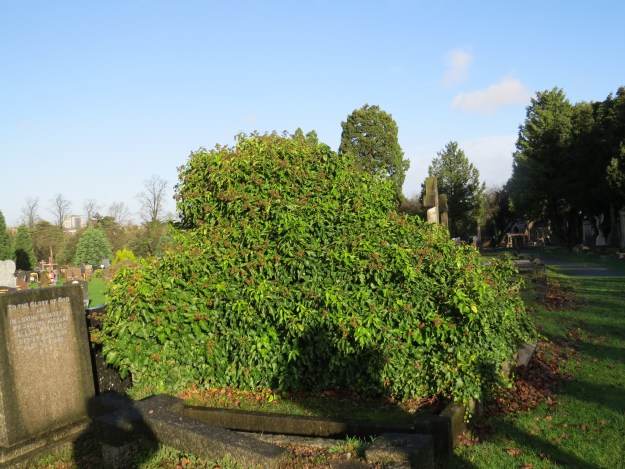
I am very fond of this fine angel who is one of a row of very fine tombs beside the entrance. I think that the ivy rather enhances the overall effect.

But before I forget, here is a rather surprising sight. It’s 46 degrees and the middle of December, and yet, on Bedford Road in East Finchley, two bumblebees are collecting pollen from Mahonia- these are not queens, but workers. The nests of buff-tailed bumblebees sometimes survive throughout the winter these days – normally all the adults except the queens, who hibernate, die. But you can clearly see the pollen in the leg baskets in the second photo – a queen at this time of year would just be gathering nectar to keep herself fed until she started laying eggs in the spring. These workers still have a nest to go back to, and if we don’t have severe weather, who knows but that they might survive right through? The impacts of climate change are unpredictable, for sure.


Winter Wonderland 3

Title Photo 3 from http://www.china.org.cn/environment/2015-12/01/content_37201707.htm

Siberian Tiger tracks (Title Photo 3)

Dear Readers, it looks very unlikely that we’ll have a white Christmas this year, but even so I thought I’d see how good we are at identifying animals from the tracks that they leave behind. As usual, just match the photo to the animal!

As you will remember, I am doing a short quiz starting on the 19th December and finishing on Christmas Eve (24th December) – answers for the whole quiz will need to be with me by 5 p.m. UK time on Monday 28th December.

If you missed yesterday’s quiz, just search the blog for ‘Winter Wonderland’ and this should bring you up all parts of the quiz.

Winter Footprints

Which animals left these footprints? Match the photo to the animal, so if you think the footprints in Question 8 were left by an otter, your answer is 8) A)

A) Otter

B) Badger

C) Hare

D) Fox

Photo Eight By DooferKiin - Own work, CC BY-SA 4.0, https://commons.wikimedia.org/w/index.php?curid=57543187

Question 8

Photo Nine by © Copyright Michael Graham and licensed for reuse under this Creative Commons Licence.

Question 9

Photo Ten by © Copyright Mary and Angus Hogg and licensed for reuse under this Creative Commons Licence.

Question 10

Photo 11 by https://www.flickr.com/photos/133222863@N03/32681499362/

Question 11


Winter Wonderland 2

Dear Readers, I do love a bit of festive folklore, so here are three questions for today. As you will remember, I am doing a short quiz starting yesterday and finishing on Christmas Eve (24th December) – answers for the whole quiz will need to be with me by 5 p.m. UK time on Monday 28th December.

If you missed yesterday’s quiz, just search the blog for ‘Winter Wonderland’ and this should bring you up all parts of the quiz.

Christmas Plant Folklore

Here we go! Which of the plants pictured below:

A) Is actually known as ‘Christmas’ in Cornwall?

B) Is considered to be unlucky if brought into the house except between Christmas Eve and Twelfth Night?

C) Was believed to flower at Christmas because it grew from a staff planted by Joseph of Arimithea?

D) Was believed to flower on Old Christmas Eve (5th January), particularly in the Isle of Man?

Just match the plant to the folklore. So, if you think the plant known as ‘Christmas’ is Hawthorn, your answer is 4) A.

Photo Four by By Tom Ordelman - Own work, CC BY-SA 3.0, https://commons.wikimedia.org/w/index.php?curid=2276835

Question 4) Hawthorn (Craetagus monogyna)

Photo Five by By Hectonichus - Own work, CC BY-SA 3.0, https://commons.wikimedia.org/w/index.php?curid=35718694

Question 5) Sweet Cicely (Myrrhis odorata)

Photo Six by Rosser1954, CC BY-SA 4.0 <https://creativecommons.org/licenses/by-sa/4.0>, via Wikimedia Commons

Question 6) Ivy (Hedera helix)

Question 7) Holly (Ilex aquifolium)


A December Walk in St Pancras and Islington Cemetery

Dear Readers, so we waited for a gap between showers for our trot around the cemetery this week, and were blessed with some much needed sunshine after a week when it felt a bit as if the sun never really got above the horizon. Still, only two days to the winter solstice, and after that the light starts to creep back. Even so, there’s something wonderful about the long shadow at this time of year.

Today I was mostly noticing the ivy, which is bowed down with berries this year. They remind me a little of cat’s eyes at this stage, before they ripen and turn black. Every tree seems to be full of flapping woodpigeons gorging themselves on the fruit.

Ivy berries

In some places, such as in the first photo, the ivy has completely engulfed the grave, and I imagine that there isn’t anyone left to remove it. Families die out, or move away. You could see it as sad, but I rather like the way that nature is reclaiming some places, turning a human-made monument back into a habitat for bees and birds.

A bit more ivy encroachment

I took my usual walk through the woodland graveyard area to say hello to the swamp cypress, who is nearly bald now.

And I also had to say hello to the Tibetan cherry. That polished bark makes me happy every time I see it.

The cemetery was very busy today, as it always is in the run-up to Christmas, when everyone is intent on visiting the graves of their loved ones and making sure that they are neat and tidy. The shop outside was doing a roaring trade in holly wreathes and potted poinsettias. The cemetery itself is open right through Christmas, so I foresee a positive sea of red and green decorations by the end of it. After all, lots more people will be staying at home what with this blessed pandemic, and it is probably going to be easier and safer for many folk to visit their dead relatives than their living ones.

At this point, an angel seems appropriate.

I can already see the faintest stirrings of next spring – this silver birch has a magenta halo of new growth already brightening the outermost twigs.

And I was intrigued by this tree planted in a traffic island close to the exit onto the North Circular Road. I’m thinking it’s probably a Paperbark Birch (Betula papyrifolia) but feel free to tell me if I’m wrong! I’m never sure if I actually like the effect on these trees where the outer bark peels away – it always looks a little sore and unkempt to me. I do like the different shades of pink and green though.

On we go. I am seeing redwings, those little migratory thrushes who fly in from Scandinavia every year, but they are so shy that it’s difficult to get a photo. They seem to love the ivy, but I have a suspicion that their real favourite food is yew – in the other cemetery over on East End Road I have seen them systematically working through a huge yew hedge. Still, I did manage to capture this unique photo. Yes, I know it needs a little work but it does at least show that caramel underwing (‘redwing’ always seems a bit of an overstatement to me).

As we headed into one of the paths through the yew trees, we did a little dance with a lovely man who was tending one of the graves. The ‘dance of two metres’ has become second nature to us East Finchley folk since the lockdown, and I’d say that probably 80% of people are practicing social distancing most of the time. When we’d passed one another, I noticed this little chap in the fork of a tree. I’ve been hoping to see an owl in the cemetery for some time – a friend found a dead one a few weeks ago, and saw a tawny owl sitting on a gravestone a few years ago, so I’m fairly sure that they’re about. But until I see a real one, this will do. Looking at the photo now, I wish I’d had a closer look at what he was made of – he seems to blend into the tree seamlessly, as if made with lichen and bark. I love the way that he seems to be watching over the grave.

And finally, as we head towards the exit gate, I notice these for the first time, growing alongside the fence between the cemetery and the allotments next door. There is something magical about the seedheads of honesty as they rustle and twinkle in the breeze. When I was growing up no home was complete without a vase full of dried honesty seeds and I was always intrigued by them. Who’d have thought that this exotic plant was a member of the cabbage family? I have an envelope full of seeds given to me by a dear friend that I will pop into the soil when it warms up in the spring. I love it when plants are shared between friends, because every time I look at them it reminds me of how important relationships are, this year more than most.

And in even more excitement, it appears that the cemetery will be open right through Christmas, so I know where my Christmas Day walk will be.

Saturday Quiz – Winter Wonderland 1

Title Photo byAlan Wilson, CC BY-SA 3.0 <https://creativecommons.org/licenses/by-sa/3.0>, via Wikimedia Commons

Polar Bear (Title Photo)

Dear Readers, this week we’re going to do something a bit different. Every day until Christmas Eve we’ll have some questions about winter plants and animals, and all you’ll have to do is to answer the multiple choice underneath the photo.  I will be doing my normal posts as well (though they might be a bit shorter what with Christmas and all…)

What would be easiest for me would be if you’d save up all your answers and then post them in the comments by 5 p.m. on Monday 28th December just to give us all a bit of time. The last questions will be on Christmas Eve (Thursday 24th December ) Answers on Tuesday 29th December.

So, here we go….

Winter Trees

Photo One byhttp://creativecommons.org/licenses/by-sa/2.0/

Question One

Is this magnificent tree

A) A Douglas Fir

B) A Scots PIne

C) A Larch

D) A Sitka Spruce?

Photo Two by© Copyright Richard Law and licensed for reuse under this Creative Commons Licence

Question Two

What’s that fine tree with all the snow on it? Every part of it, except the flesh on the berries, is poisonous.

Is it

A) A Laburnum

B) An Elm

C) A Yew

D) A Horse Chestnut?

Photo Three by © Copyright johnfromnotts and licensed for reuse under this Creative Commons Licence.

Question Three

Goodness, what’s made those baubles in this tree?

A) A squirrel

B) A gall called a witches broom

C) Mistletoe

D Those pesky grey squirrels.

So that’s it for today, stay tuned for tomorrow….

Saturday Quiz – What Animal is That? – The Answers

Photo One by By Charles J Sharp - Own work, from Sharp Photography, sharpphotography, CC BY-SA 4.0, https://commons.wikimedia.org/w/index.php?curid=44134958

What kind of stork is this? Why, a spoonbill of course! (Roseate spoonbill Ajaia Ajaja) (Title Photo)

Dear Readers, great results again this week, with Anne getting 9 out of 10 and Fran and Bobby Freelove still invincible with 10 out of 10 – well done everyone! I suspect that tomorrow’s quiz will have a seasonal theme, so be prepared….

Photo One by By Charles J Sharp - Own work, from Sharp Photography, sharpphotography.co.uk, CC BY-SA 4.0, https://commons.wikimedia.org/w/index.php?curid=87748243

1)

C) A jaguar (much stockier than a leopard plus the fur pattern is lots of circles with dots in the middle

Photo Two by By Rushenb - Own work, CC BY-SA 4.0, https://commons.wikimedia.org/w/index.php?curid=95952469

2)

A) A sun bear (the world’s smallest bear and a tremendous climber)

Photo By Anuwar ali hazarika - Own work, CC BY-SA 4.0, https://commons.wikimedia.org/w/index.php?curid=49601462 by

3)

D) An Indian rhinoceros

Photo By Adrian Pingstone (Arpingstone) - Own work, Public Domain, https://commons.wikimedia.org/w/index.php?curid=5074712 by

4)

C) Rheas

Photo Five by By Andrew Shiva / Wikipedia, CC BY-SA 4.0, https://commons.wikimedia.org/w/index.php?curid=46589090

5)

A) A king penguin (very similar to an emperor penguin for sure, but slimmer and the colours on the head are slightly different).

Photo Six by By Dibyendu Ash - File:Himalayan Monal Adult Male East Sikkim Sikkim India 11.05.2014.png, CC BY-SA 3.0, https://commons.wikimedia.org/w/index.php?curid=47485009

6)

C) A Himalayan monal – a rather beautiful member of the pheasant family

Photo Seven By Richard Bartz, Munich aka Makro Freak - Own work, CC BY-SA 2.5, https://commons.wikimedia.org/w/index.php?curid=2888498

7)

A) A bearded vulture (lammergeier) – there was one of these in the UK for weeks this summer, having flown over from the Alps.

Photo Eight by By Charles J Sharp - Own work, from Sharp Photography, sharpphotography.co.uk, CC BY-SA 4.0, https://commons.wikimedia.org/w/index.php?curid=66000154

8)

D) An Ethiopian red wolf – a very endangered canid.

Photo Nine By Original: Bikeadventure at German WikipediaModifications: Cornischong at Luxembourgish Wikipedia - Transferred from lb.wikipedia to Commons., Public Domain, https://commons.wikimedia.org/w/index.php?curid=21197593

9)

A) A mouse lemur (actually a pygmy mouse lemur) from Madagascar.

Photo Ten by By Brian Gratwicke - originally posted to Flickr as Hellbender Cryptobranchus alleganiensis, CC BY 2.0, https://commons.wikimedia.org/w/index.php?curid=8021975

10)

C) A hellbender – an American giant salamander. It can grow to about 30 inches long, is critically endangered and can weigh up to 5lbs. However, this chap is tiny compared to the Chinese Giant Salamander, who can grow to almost 6 feet long and weighs in at 66 lbs. Blimey.


Photo Credits

Title photo By Charles J Sharp – Own work, from Sharp Photography, sharpphotography, CC BY-SA 4.0, https://commons.wikimedia.org/w/index.php?curid=44134958

Photo One By Charles J Sharp – Own work, from Sharp Photography, sharpphotography.co.uk, CC BY-SA 4.0, https://commons.wikimedia.org/w/index.php?curid=87748243

Photo Two By Rushenb – Own work, CC BY-SA 4.0, https://commons.wikimedia.org/w/index.php?curid=95952469

Photo Three By Anuwar ali hazarika – Own work, CC BY-SA 4.0, https://commons.wikimedia.org/w/index.php?curid=49601462 

Photo Four By Adrian Pingstone (Arpingstone) – Own work, Public Domain, https://commons.wikimedia.org/w/index.php?curid=5074712 

Photo Five by By Andrew Shiva / Wikipedia, CC BY-SA 4.0, https://commons.wikimedia.org/w/index.php?curid=46589090

Photo Six by By Dibyendu Ash – File:Himalayan Monal Adult Male East Sikkim Sikkim India 11.05.2014.png, CC BY-SA 3.0, https://commons.wikimedia.org/w/index.php?curid=47485009

Photo Seven By Richard Bartz, Munich aka Makro Freak – Own work, CC BY-SA 2.5, https://commons.wikimedia.org/w/index.php?curid=2888498

Photo Eight  By Charles J Sharp – Own work, from Sharp Photography, sharpphotography.co.uk, CC BY-SA 4.0, https://commons.wikimedia.org/w/index.php?curid=66000154

Photo Nine By Original: Bikeadventure at German WikipediaModifications: Cornischong at Luxembourgish Wikipedia – Transferred from lb.wikipedia to Commons., Public Domain, https://commons.wikimedia.org/w/index.php?curid=21197593

Photo Ten By Brian Gratwicke – originally posted to Flickr as Hellbender Cryptobranchus alleganiensis, CC BY 2.0, https://commons.wikimedia.org/w/index.php?curid=8021975

Sunrise in Coldfall Wood

The view from the entrance to Coldfall Wood

Dear Readers, I don’t know about you, but we’ve been having some positively apocalyptic sunrises and sunsets during this winter. Today the clouds scudded across the sky like galleons, and there was a strangely ethereal light over Creighton Avenue here in East Finchley. Like many of us, I’ve noticed the sky a lot more during lockdown, and although the long, dark nights can be depressing it’s been good to actually see the sunrise, much more unlikely when the sun pops up at 4 a.m. during midsummer.

I made a visit to my favourite fallen tree – it looks more and more like a stick -insect in the act of righting itself to me. It’s a popular spot for dog walkers and smokers and anyone who just wants to take a few minutes out for a breather.

We’ve learned that if we can get out of the door before 7.45 a.m., we have a lot less company – all the school children and their parents seem to burst out of the door at 8 a.m. so we have a bit of time before it gets (relatively) busy. Social distancing is trickier when the path on either side of the road is ankle-deep in mud (clay soil definitely has its disadvantages).

And then we’re off to the flooded part of the woods, which is looking rather less flooded than in previous years. I always look hopefully at the bulrushes in case a reed bunting or a bearded tit has turned up (no comments please) but no luck so far.

I had always thought that the ‘oil stains’ that you see on ponds and streams were evidence of pollution, but apparently some naturally-occurring bacteria produce this kind of effect as they break down nutrients in the water. Who knew? However, the foam on some parts of the stream is probably due to run-off so I don’t think we’ll be having ‘Coldfall Wood Spa Water’ any time soon.

And look, the sun’s coming up…

There are still a few recalcitrant leaves clinging on for grim life.

And how about this crow? The crows of Coldfall Wood are an interesting bunch, always calling to one another from the tree tops and occasionally harassing the dogs on the playing fields. This one looks like the monarch of all s/he surveys. In fact, these photos look almost like a reflection on a pool, very disorientating.

And as we head for home, the light turns from icy white to warm gold, filtered through the bare trees. It’s funny how everything seems to spring into life with a touch of sun, even in mid winter. The world is still turning, in spite of all our human nonsense.