Monthly Archives: December 2020

Wednesday Weed Update- Holly


IMG_0711

Common Holly (Ilex aquifolium)

Dear Readers, I am absolutely run off my feet with work this week – I’ll be finishing on Friday, but until then I fear that my posts might be short and sweet! However, with the festive season almost upon us, here are some ruminations on holly from 2014. One thing that I’ve noticed this year, though, is how large holly can grow when the circumstances are right – have a look at the variegated ivy from St Pancras and Islington Cemetery in the photo below. What a bruiser! So many hollies grow in the shady understorey, but they can be magnificent if they actually get enough light. 

Variegated Holly tree with ivy stems

‘Of all the trees that are in the wood, the Holly bears the crown’. Could there be a better plant than the noble Holly with which to celebrate Winter Solstice and Christmas? The Holly King is said to rule from Midwinter to Midsummer, carrying life through the winter in his leaves, until the Oak King takes over for the rest of the year. Right into the twentieth century, people would use small Holly trees as Christmas trees, rather than the fir trees that we use today, and most of us will still have some Holly in the house at this time of year, even if it’s only in the form of a plastic sprig on top of the Christmas pudding. In England, there is a tradition of growing it close to the house to protect those inside from evil spirits, whilst in Ireland it is grown away from the house so as not to disturb the fairies that live in it. It is also said to deter lightning, and so alcohol vendors would set up their stalls under Holly at markets, hence the large number of pub names that include a reference to Holly.

Holly is one of the few plants that survives deep in the uncoppiced parts of Coldfall Wood, where it is too dark for other vegetation to thrive. For thousands of years, many different species of Holly grew in a habitat known as the Laurel Forest, which was wet and dark, and which covered most of Europe. However, as the climate dried out only Ilex Aquifolium, the plant that we know as Holly, survived and prospered in the new Oak and Beech forests. Most of the Laurel Forests had died out by the end of the Pleistocene, ten thousand years ago.

The plant above was the first one that I’ve ever seen in flower, and led me to think about Holly reproduction. Although the plant is often associated in folklore with the male principle (as opposed to Ivy, which represents the female principle), the flowers can be either male or female. A female plant will need pollen from a male plant in order to produce the berries. What puzzles me a little is that the flowers are meant to be produced in May, when there are pollinators about, but my photograph was taken on the sixteenth of December. I suspect this is yet another sign of the confusion that climate change is creating in the natural world, much like the snowdrops that I saw in full bloom a few weeks ago, or the crocuses already flowering in a neighbour’s garden. Without bees to carry the pollen, these flowers are doomed to blush and fade, unconsummated. There is an old tradition of putting a sprig of Holly berries onto a beehive on Christmas Day to wish the bees ‘Merry Christmas’. Who would have dreamed that it would be equally possible to adorn it with a sprig of Holly flowers?

Here, the male Holly flowers are at the top, the female flowers (which will turn into berries) at the bottom. File courtesy of GB. Wiki.

Here, the male Holly flowers are at the top, the female flowers (which will turn into berries) at the bottom. File courtesy of GB. Wiki.

Gulls Crows Holly Coldfall Wood 003The berries contain three to four seeds, each of which takes two to three years to germinate. Holly is a plant which grows slowly – it doesn’t start to flower until it’s over four years old (sometimes as old as twelve), and an individual shrub can live to be five hundred years old. A mature Holly can be ten metres tall, but most are much smaller than this.

Gulls Crows Holly Coldfall Wood 006What a boon to wildlife Holly is! My parents have a mature Holly tree which is about six metres tall, and at the slightest sign of trouble all the local sparrows fly into it, turning it into a mass of chirping. The spines on the leaves require quite a lot of energy for the plant to produce, so, as it grows above the level of grazing creatures the leaves become smoother. Ironically, Holly was cultivated as fodder for cows and sheep until the eighteenth century, and the smoother leaves at the top of the tree were obviously preferred, so it seems as if there was no escape from being gobbled up.

There is an old tradition that if Holly foliage is brought into the house, both the ‘He-Holly’ (the prickly leaves) and the ‘She-Holly’ (the smooth leaves) must arrive at the same time, otherwise the partner whose leaves are brought in first will dominate for the rest of the year. There is also a tradition that bad luck will come down the chimney on Christmas Eve if the Holly is hung up before the Mistletoe (who presumably takes offence). I have a big box of Holly and Mistletoe in the shed, awaiting the arrival of my mother so that we can decorate together. Who knew that it was going to be such a complicated business? At least all the leaves and the two species will arrive together, so hopefully we’ll avoid upsetting anyone.

IMG_0574

See how the leaves here are becoming less spikey than those in the previous pictures.

The ‘berries’ of the Holly (technically Drupes for my botanist friends) are very tough and bitter early on in the year. However, they are softened by the frosts, and become more palatable to the many birds and rodents that eat them, and by doing so help to spread the seeds through the forest. I put some Holly berries on the bird table, and they were gone by the following morning, so this might be a good use of any Holly decoration that is still in good condition by Twelfth Night.

IMG_0570Holly is one of the ‘original’ plants of the British Isles, with a history longer than that of human habitation here. It is no wonder that such a wealth of folklore and traditions have grown up around it. Its shiny, evergreen leaves and blood-red berries do seem to be holding the secret of life during these short, dark days, and it stands as protector and food-source to so many small birds and shy rodents. In winter-time, the Holly really is a kind of king.

For this post, I am grateful to the wonderful Poison Garden website, and to Plant Lives, another source of endless fascination. And I am eternally grateful to Richard Mabey for Flora Britannica, surely the most informative text on the folklore and traditions of British plants ever compiled.

London Natural History Society Talks – ‘Bees in the City’ by Dr Tony Madgwick

Dear Readers, this talk by Dr Tony Madgwick was a really nice counterpoint to the pollinators and pollination talk given by Jeff Ollerton a few weeks ago. ‘Bees in the City’ is a University of Westminster project that’s been set up to look specifically at the bees that use bee hotels – this means that the focus is on solitary bees such as our old favourites the hairy-footed flower bees. Bee hotels will be installed not only in the main University of Westminster campus on Euston Road, but also on their Chiswick and Northwick Park campuses. One very exciting feature of the project is the involvement of students and professors not only from the science departments, but also from fields such as engineering. It’s also hoped that there will be future collaboration with other academic institutions and with citizen scientists.

The main aim of the project is to look at which species of bee use bee hotels, their genetic diversity, and the parasites that are attracted to their nesting sites. It’s also hoped that the team will be able to look at the viral and bacterial load on these wild bees – honeybee hives have become very popular in London, and there is a theory that the diseases that these bees are prone to have been passed on to the wild population. The DNA can be collected from analysing the material left in the tubes once the bees have left, so it won’t be too disturbing for the bees.

The University of Westminster is also leading the way in using Automated Species ID – it’s hoped that something could be developed which could identify bees not only by their shape, but also by their buzz, and by the way that they enter and exit the bee hotel. As anyone who has used ID Apps on their phone can tell you, these things are often very hit and miss, but it would be very exciting to be able to simply film a bee on your phone and get an exact ID. The minute details that tell you which species a bee is can be very difficult to see when the insect is zooming about, as anyone who has tried to get a photo of a female hairy-footed flower bee will tell you (for some reason the males are much more laid back!).

In addition though, it’s hoped that the project will teach people a lot more about how to identify bees, starting with the students at the university but hopefully by creating new ID guides as well. As several of these talks have mentioned, unless you know what you have, how will you be able to tell what you’ve lost?

For those of us who have been contemplating sticking up a bee hotel, Dr. Madgwick has some useful advice. Firstly, find a south-facing wall at about head height. For me, this would be on the front wall of the house, so that might be a very good spot. Secondly, though, it’s important to consider what forage is available for the bees that might turn up, not just in your garden but round about, because different bees will travel different distances and have different requirements. Hairy-footed flower bees seem to like green alkanet, comfrey, dead-nettles and ground ivy, so anyone with a ‘weedy’ garden should do ok. Leafcutter bees, however, seem to like umbellifers like cow parsley and wild carrot plus thistles and daisy-type plants. All in all, it sounds as if having a neglected garden in your vicinity is probably best for these bees, and Dr Madgwick makes the point that the original home of many of these bees is loose and crumbling mortar, so a little general neglect is probably no bad thing for biodiversity (though if your chimney tumbles through the roof you’ve definitely taken thing too far!)

The Bees in the City project sounds like a very interesting enterprise, and I look forward to hearing about their discoveries. Their website is here if you want to keep yourself updated, and there is a link to the whole talk here.

Female Spring Flower Bee – note the extended tongue!

Another Wet Walk in St Pancras and Islington Cemetery

Dear Readers, it takes more than a torrential downpour to keep me from my weekly visit to St Pancras and Islington Cemetery and so it was that I found ourselves standing under a tree during a deluge. I took the obligatory photo of ‘my’ swamp cypress, and I also managed this splendid shot of a fox as he headed into the undergrowth. Wildlife Photographer of the Year awaits me, I’m sure.

But then it let up a little and so on we (my long-suffering husband and I ) slogged. I noticed lots of blackbirds about, for the first time in a while – some blackbirds spend their summers in other parts of Europe and only overwinter in the UK, and some blackbirds pop in from Scandinavia. At one point a few years ago, when everyone was grounded due to the bad weather, there were no less than eight blackbirds in my back garden, all getting along swimmingly provided I kept the food coming. You wouldn’t see that when the territories are established in the spring.

There was no kestrel in the kestrel tree this week, and I assume that, like all sensible birds, s/he was under cover somewhere, hoping for the worst to pass. But nothing stops the crows, and there was a little gang of them looking shifty by Harwood’s path. They were turning over the leaves very methodically, and I wondered if someone had scattered something for them. But they flew off as we approached, and although I had a good look, I was none the wiser.

I have become fascinated by what I think of as the stumperies in the cemetery – the remains of trees which have been cut down and which are now being gradually eroded by fungi or covered with ivy. There is one close to where the wreathes are left following cremations which has been planted up with succulents and what appears to be a smiley face, though whence this came I have no idea.

Some are sprouting a few annual ‘weeds’ on the top, but I wonder if all those stems at the side might actually sprout when spring comes, I shall have to keep an eye on it.

This one is forming a very nice base for some ivy.

This one is becoming a whole mini-ecosystem, with moss and lichen and turkey-tail fungus.

And while the fungus seems to be eating this stump to pieces, there are also some tell tale holes which could be beetle larvae, but could equally well be caused by the thump of green woodpecker beaks as they drill for ants.

So far, so unspectacular. But then, I spotted what appeared to be a doorknob growing under one of the fir trees off Withington Road (a very muddy and underused path), and here is my highlight of the week.

This is, I believe, an earthstar, and I’m going to hazard a guess that it’s Geastrum triplex, the Collared Earthstar. What I love most about this enigmatic fungus is that I probably only noticed it because it’s pouring with rain – when raindrops hit the ‘ball’ in the middle, spores are sent flying out through the hole in the top. When it’s dry, the ‘petals’ of the earthstar curl up and protect the fruiting body, making sure that the spores aren’t released when conditions aren’t ideal. How I love spotting something that I’ve never seen before! It puts a spring in my step like nothing else.

And so we make our damp, muddy way back to the entrance, where I spot two crows sitting on top of the cedar of lebanon. What are they up to? Well, they appear to be bashing their way into the barrel-shaped pine cones, though whether they are after the pine nuts or the little insects that are attempting to have a peaceful hibernation I have no idea. I am full of admiration for these intelligent resourceful birds. Never underestimate a crow.

6.30 a.m.

Dad December 2017 (post nap, before G&T)

Dear Readers, it’s 6.30 a.m. on a Saturday morning and I’m sitting in the office, listening to the thin, sweet song of a robin. Outside it’s still dark as pitch, but a runner has trudged past, taking advantage of the quiet street to jog up the middle of the road. And I have been thinking about Christmas, and how different it will be this year, not just for me but for many of us. This is my first Christmas as an orphan, and the idea is taking some getting used to.

Until a few years ago, the weeks before Christmas were frantically busy for me as I tried to get everything in place for Mum and Dad’s visit. We already had the stairlift so that they could get upstairs, but there was the commode and the reclining chair to get, the temporary registration of the pair of them with my doctor, not to mention the food and the presents and the cleaning. The wheelchair had to be rented and popped into the hall, ready for action. The night before they arrived I would be nervously eyeing up everyone who parked outside our house – we don’t have a car, but it’s a long tradition that you can ‘save’ a parking space by popping a couple of wheelie bins into the road, and with Mum and Dad unable to walk very far it could save a lot of worry.

And then they’d arrive, usually driven down by my brother, and the work would really begin. Everything had to be perfect, of course, just as it had to be perfect when Mum used to be in charge. I wonder why I didn’t learn from the way that she often had a migraine on Christmas Day from sheer stress? I remember one day when Mum was in a particular tizzy about something. Dad was sitting in the armchair with a purple paper hat slightly askew on his head, a gin and tonic in one hand and the cat on his lap.

‘Syb’, he said, patting the chair next to him, ‘Just come and sit down for Gawd’s sake. The brussel sprouts can wait for half an hour’.

‘No they can’t!’ she said, and burst into tears.

And so by the time Christmas was over, Mum was worn to a bit of a frazzle. So maybe it’s no surprise that I remember the days after the big event with particular fondness – the days of eating cold turkey, hot potatoes and pickle, playing Trivial Pursuit and watching the obligatory James Bond film with Dad.

And, strangely enough, it’s not the big things that I remember about the Christmases that I hosted either.

It’s the afternoons when Mum and Dad both had a doze, Dad in his recliner, Mum on the sofa, both of them snoozing along peacefully.

It’s the morning that the great spotted woodpecker turned up on the feeder and I gave Mum my binoculars so that she could see him properly.

It’s the night that the International Space Station went by on Christmas Eve, and Mum and I watched it go sailing past.

This year will be the first Christmas in a long, long time where I don’t have anywhere to go, or anyone apart from my husband to cater for. I am lucky to have him, I know.

The losses pile up, and the difference between the Christmas gatherings on the television advertisements and my quiet, subdued bittersweet Christmas could not be starker.

But I know that I am not alone – for so many of the people reading this, there will be an empty space at the Christmas table that can never be filled. And so this is to say that I see you, and I’m holding you in my heart. Grief is the tax that we pay for loving people deeply, but  bereavement is a bitter path to walk, and attention must be paid to what we’re feeling at this time if we’re to bear it. There is a time for distraction, and a time for weeping, and only you will know which you need at any given time, but my advice would be to make room for both.

And unlike so many, many people, I don’t have agonising choices to make about who to see and how. I have not spent the year worrying myself sick about elderly relatives that I can’t see, children who haven’t been able to go to school, or who have gone and then been sent home because of a Covid outbreak. I’m still in work, and still housed. I see you too, trying to make this very different Christmas work because other people are depending on you. Please be kind to yourselves. The brussel sprouts will wait for thirty minutes while you have a cup of tea and watch something ridiculous on the television.

Outside there’s the slightest hint of a lightening sky, and the robin has stopped singing, duty done for another morning. In a few days time we’ll reach the winter solstice, the longest night for those of us in the Northern Hemisphere, and the light will gradually come back, until one day we wake up at our usual time and hear the dawn chorus, not a solitary robin. The world turns whether we want it to or not, the bulbs are already starting to stretch and yawn in their loamy beds and life will carry on. Let’s take things both lightly and with deep seriousness, with a sense of fun and with a sense that what we do matters, because it does, more now than ever.

‘Tree with a robin’ drawn by Dad December 2019


Saturday Quiz – What Animal is That?

Photo One by By Charles J Sharp - Own work, from Sharp Photography, sharpphotography, CC BY-SA 4.0, https://commons.wikimedia.org/w/index.php?curid=44134958

What kind of stork is this? Why, a spoonbill of course! (Roseate spoonbill Ajaia Ajaja) (Title Photo)

Dear Readers, today’s quiz is all about precision. We might know that an animal is a bear, for example, but what kind of bear? And how do you tell the difference between a white and a black rhino. Thinking caps on, folks.

All you need to do is match the photo to the species and pop them in the comments. As usual, write them down first if you don’t want to be influenced by speedy people. Answers will be posted next Friday, so if you want to be marked get your answers in by 5 p.m. UK time on Thursday 17th December.

So, if you think the animal in the first picture is a cheetah, your answer is 1)A.

Photo One by By Charles J Sharp - Own work, from Sharp Photography, sharpphotography.co.uk, CC BY-SA 4.0, https://commons.wikimedia.org/w/index.php?curid=87748243

1)

Is this

A) A cheetah

B) A leopard

C) A jaguar

D) A serval

Photo Two by By Rushenb - Own work, CC BY-SA 4.0, https://commons.wikimedia.org/w/index.php?curid=95952469

2)

Is this:

A) A sun bear

B) A sloth bear

C) A spectacled bear

D) A black bear?

Photo By Anuwar ali hazarika - Own work, CC BY-SA 4.0, https://commons.wikimedia.org/w/index.php?curid=49601462 by

3)

Is this:

A) A white rhinoceros

B) A Sumatran rhinoceros

C) A black rhinoceros

D) An Indian rhinoceros?

Photo By Adrian Pingstone (Arpingstone) - Own work, Public Domain, https://commons.wikimedia.org/w/index.php?curid=5074712 by

4)

Are these:

A) Ostriches

B) Emus

C) Rheas

D) Cassowaries?

Photo Six by By Andrew Shiva / Wikipedia, CC BY-SA 4.0, https://commons.wikimedia.org/w/index.php?curid=46589090

5)

Is this handsome bird

A) A king penguin

B) An emperor penguin

C) A Humboldt penguin

D) A gentoo penguin?

Photo Seven by By Dibyendu Ash - File:Himalayan Monal Adult Male East Sikkim Sikkim India 11.05.2014.png, CC BY-SA 3.0, https://commons.wikimedia.org/w/index.php?curid=47485009

6)

Is this handsome critter

A) A Lady Amherst’s pheasant?

B) A Mountain peacock?

C) A Himalayan monal?

D) A quetzalcoatl?

Photo Eight by By Richard Bartz, Munich aka Makro Freak - Own work, CC BY-SA 2.5, https://commons.wikimedia.org/w/index.php?curid=2888498

7)

Is this splendid chap

A) A bearded vulture (lammergeier)

B) A king vulture

C) An Andean condor

D) A red kite?

Photo Eight by By Charles J Sharp - Own work, from Sharp Photography, sharpphotography.co.uk, CC BY-SA 4.0, https://commons.wikimedia.org/w/index.php?curid=66000154

8)

Is this

A) A dhole

B) A maned wolf

C) A Tibetan wolf

D) An Ethiopian red wolf?

Photo Nine by By Original: Bikeadventure at German WikipediaModifications: Cornischong at Luxembourgish Wikipedia - Transferred from lb.wikipedia to Commons., Public Domain, https://commons.wikimedia.org/w/index.php?curid=21197593

9)

Is this little dude

A) A mouse lemur

B) A potto

C) A tarsier

D) A pygmy marmoset?

Photo Ten by By Brian Gratwicke - originally posted to Flickr as Hellbender Cryptobranchus alleganiensis, CC BY 2.0, https://commons.wikimedia.org/w/index.php?curid=8021975

10)

And finally, what creature is this?

A) A log lizard

B) A giant newt

C) A hellbender

D) A protocambrian gecko.

Saturday Quiz – National Animals – The Answers!

Title Photo by By Kevin Pluck - Flickr: The King., CC BY 2.0, https://commons.wikimedia.org/w/index.php?curid=755560

Lion (Panthera Leo). National animal of Ethiopia, Iran, Kenya, Libya, Luxembourg, North Macedonia,Morocco, the Netherlands, Norway, Singapore, Togo, England…. (Title Photo)a

Dear Readers, you knocked it out of the park again! Congratulations to Susan, Anne and Fran and Bobby Freelove who all got 30 out of 30, with Mike at Alittlebitoutoffocus with 28 out of 30 (though he gave me the idea for the quiz so I am going to give an extra 2 points, that puts him on 30 out of 30 as well). Well done everybody! Let’s see how we get on tomorrow. And I am thinking of something fiendish for over the Christmas break, so watch this space….

National Animals

Photo One by By Steve from washington, dc, usa - American Beaver, CC BY-SA 2.0, https://commons.wikimedia.org/w/index.php?curid=3963858

1) E) – The noble Canadian Beaver

Photo Two By Raul654 - Own work, CC BY-SA 3.0, https://commons.wikimedia.org/w/index.php?curid=47647

2) A) The Okapi, the national animal of the Democratic Republic of Congo (DRC)

Photo Three By Tony Hisgett - Flickr: Red Squirrel 1c, CC BY 2.0, https://commons.wikimedia.org/w/index.php?curid=14621510

3) H) The red squirrel is the national animal of Denmark

Photo Four by By Falco_rusticolus_white.jpg: Ólafur Larsenderivative work: Bogbumper (talk) - Falco_rusticolus_white.jpg, CC BY-SA 2.0, https://commons.wikimedia.org/w/index.php?curid=10719893

4) F) The beautiful gyrfalcon is the national animal of Iceland

Photo Five By Alex Dunkel (Maky) - Own work, CC BY 3.0, https://commons.wikimedia.org/w/index.php?curid=8621909

5) B) The ring-tailed lemur is the national animal of Madagascar

Photo Six By Erzengel - Own work, Public Domain, https://commons.wikimedia.org/w/index.php?curid=584361

6) D) The axolotl is the national amphibian of Mexico

Photo Seven by By Aram Kazandjian - Own work, CC BY-SA 4.0, https://commons.wikimedia.org/w/index.php?curid=96750693

7) I) The chimpanzee became the national animal of Sierra Leone in 2019

Photo Eight by By ivabalk https://pixabay.com/pt/users/ivabalk-782511/ - Pixabay https://pixabay.com/pt/photos/beta-guerreiro-aqu%C3%A1rio-peixe-v%C3%A9us-3424566/, CC0, https://commons.wikimedia.org/w/index.php?curid=79067216

8) G) The Siamese Fighting Fish is the national animal of Thailand

Photo Nine by By USAID Afghanistan - originally posted to Flickr as Rangers Protect Afghan EnvironmentUploaded using F2ComButton, Public Domain, https://commons.wikimedia.org/w/index.php?curid=10856177

9) J) The snow leopard is the national animal of Afghanistan

Photo Ten by By J. Folmer, nl:Gebruiker:Jcwf - Dutch Wikipedia, CC BY-SA 3.0, https://commons.wikimedia.org/w/index.php?curid=124793

10) C) The emu is the national bird of Australia

Country Outlines

Photo A from https://freevectormaps.com/canada/CA-EPS-01-0006

A) Democratic Republic of Congo

Photo C from https://freevectormaps.com/madagascar/MG-EPS-02-4001?ref=search_result

B) Madagascar

Photo C from https://freevectormaps.com/madagascar/MG-EPS-02-4001?ref=search_result

C) Australia

Photo D from https://freevectormaps.com/mexico/MX-EPS-02-4001?ref=search_result

D) Mexico

Photo E from https://freevectormaps.com/mexico/MX-EPS-02-4001?ref=search_result

E) Canada

Photo F from https://freevectormaps.com/mexico/MX-EPS-02-4001?ref=search_result

F) Iceland

Photo G from https://freevectormaps.com/mexico/MX-EPS-02-4001?ref=search_result

G) Thailand

Photo H from https://freevectormaps.com/denmark/DK-EPS-02-4001?ref=search_result

H) Denmark

Photo I from https://freevectormaps.com/denmark/DK-EPS-02-4001?ref=search_result

I) Sierra Leone

Photo J from https://freevectormaps.com/afghanistan/AF-EPS-02-4001?ref=search_result

J) Afghanistan

All maps uploaded from https://freevectormaps.com/all a most excellent resource! Maps are free with attribution, or can be uploaded without attribution for a small fee. 

Photo Credits

Title Photo  By Kevin Pluck – Flickr: The King., CC BY 2.0, https://commons.wikimedia.org/w/index.php?curid=755560

Photo One  By Steve from washington, dc, usa – American Beaver, CC BY-SA 2.0, https://commons.wikimedia.org/w/index.php?curid=3963858

Photo Two By Raul654 – Own work, CC BY-SA 3.0, https://commons.wikimedia.org/w/index.php?curid=47647

Photo Three By Tony Hisgett – Flickr: Red Squirrel 1c, CC BY 2.0, https://commons.wikimedia.org/w/index.php?curid=14621510

Photo Four By Falco_rusticolus_white.jpg: Ólafur Larsenderivative work: Bogbumper (talk) – Falco_rusticolus_white.jpg, CC BY-SA 2.0, https://commons.wikimedia.org/w/index.php?curid=10719893

Photo Five By Alex Dunkel (Maky) – Own work, CC BY 3.0, https://commons.wikimedia.org/w/index.php?curid=8621909

Photo Six By Erzengel – Own work, Public Domain, https://commons.wikimedia.org/w/index.php?curid=584361

Photo Seven By Aram Kazandjian – Own work, CC BY-SA 4.0, https://commons.wikimedia.org/w/index.php?curid=96750693

Photo Eight By ivabalk https://pixabay.com/pt/users/ivabalk-782511/ – Pixabay https://pixabay.com/pt/photos/beta-guerreiro-aqu%C3%A1rio-peixe-v%C3%A9us-3424566/, CC0, https://commons.wikimedia.org/w/index.php?curid=79067216

Photo Nine By USAID Afghanistan – originally posted to Flickr as Rangers Protect Afghan EnvironmentUploaded using F2ComButton, Public Domain, https://commons.wikimedia.org/w/index.php?curid=10856177

Photo Ten by By J. Folmer, nl:Gebruiker:Jcwf – Dutch Wikipedia, CC BY-SA 3.0, https://commons.wikimedia.org/w/index.php?curid=124793

Highlights from New Scientist – More Ivy, Earlier Autumn and Plane-Sabotaging Wasps

Ivy bee (Colletes hederae)

Dear Readers, as you might know I am generally a big fan of ivy as a wildlife habitat, and so the news that ivy is becoming more common right across Europe might be a kind of good news. Michael Perring at Ghent University in Belgium has been looking at more than 1800 research plots in 40 forest regions across temperate Europe. The data covers the period between 1933 and 2015, and by the end of this period, ivy was found in 14% more of the sites than at the beginning. Most other plant species haven’t spread, and some species are found at fewer sites.

The biggest predictor was local temperature rise, so our old friend climate change is implicated yet again. However, two other factors were the amount of shade and nitrogen levels. Many managed forests are becoming shadier, though the article doesn’t say why – in forestry sites I would imagine this is because of higher stocking density, but in other woods it might be due to the decline of techniques such as coppicing. In shady woods, ivy has an immediate advantage because it’s evergreen, and so can photosynthesize when the leaves on the trees are gone in winter. In the uncoppiced parts of Coldfall, it’s mainly the evergreens such as yew and holly that survive in the understorey, along with ivy.

Nitrogen pollution through the burning of fossil fuels and agricultural run-off also seems to encourage the growth of ivy, possibly a reason that it’s one of those plants that still flourishes in cities.

The Woodland Trust agrees that it isn’t all bad news – as we know ivy is a great wildlife plant. But I do worry about the lessening of biodiversity that this study shows. What about species that are disappearing from our woods? It would be good to know about them too.

Let’s stay in the forest for now – a study by Constantin Zohner at ETH Zurich in Switzerland has completed a study that shows that climate change is causing autumn leaves to fall earlier than they used to. Zohner and his colleagues looked at leaf fall data from 1948 to 2015 for six tree species (including the common oak, Quercus robur) across 4000 sites in Central Europe. They also grew trees in chambers containing different amounts of carbon dioxide and different levels of sunlight to see when the leaves fell. Finally, they modelled the data to see what would have happened by 2100 if carbon dioxide levels remained high.

They found that leaf-fall would probably start about three to six days earlier than now. This happens because higher carbon dioxide levels and temperatures mean that the spring leaves grow faster and are more productive, and so the life of the leaf is shortened.

Why does it matter? Leaves are a major way of storing carbon, which they tie up when they photosynthesise. If they fall earlier, that’s less time for them to absorb the carbon. Zohner thinks this could account for about 1 gigatonne of carbon less stored globally each year by temperature forests – this is roughly a tenth of what we currently emit. The way that climate change disrupts the cycles of life are myriad and complex.

Photo One By gailhampshire from Cradley, Malvern, U.K - Mason Wasp inspecting holes, Pachodynerus nasidens, CC BY 2.0, https://commons.wikimedia.org/w/index.php?curid=49860259

Keyhole wasp (Pachnodynerus nasidens) (Photo One)

And finally, who knew that a little wasp could crash a plane? The keyhole wasp (Pachnodynerus nasidens) is a type of mason wasp who would normally find a tiny hole in a wall and build its nest there. It is native to the Neotropics, but has recently found its way to the northern United States and to some parts of Oceania, including, of all places, Brisbane Airport. At the airport, there were a number of incidents with pilots having problems with their airspeed monitors, which are housed in devices called pitot tubes.

To find out what was going on Alan House, at consulting firm Eco Logical Australia, created some 3D replica pitot tubes and set them up at the airport. After 39 months it was found that 93 of the tubes had become completely blocked by the nests of the keyhole wasps.

For once, the solution wasn’t to spray the whole place with insecticide. Instead, the tubes are now covered when planes arrive at Brisbane airport, so the wasps have to find somewhere else to make their nests. Simple.

Photo Credits

Photo One By gailhampshire from Cradley, Malvern, U.K – Mason Wasp inspecting holes, Pachodynerus nasidens, CC BY 2.0, https://commons.wikimedia.org/w/index.php?curid=49860259

Wednesday Weed – Lychee

Dear Readers, I first ate lychees in a Chinese restaurant on Stratford Broadway in East London, when I was about eight years old. We’d gone there as a treat, just my Mum, my brother and I. We loved the egg-fried rice and the sweet and sour prawn balls, but I was very unsure about the lychees, which came straight out of a tin. I think it was their texture that put me off – they were chewier than a sweet thing had any right to be, and there was something about them that reminded me of eyeballs. I shifted my allegiance to mangoes on the tropical fruit front, and that was it, for many, many years.

Fast forward to about ten years ago. I was in Madagascar. Every single person on my tour, including the guide, was down with what is euphemistically called ‘an upset stomach’. For the longest time, I couldn’t bear to eat anything, which is generally nature’s way of asking you to give your guts a rest so that your ‘good’ stomach bacteria can wage war. When I was finally well enough to eat again, the guide handed me a bag of fresh lychees that he’d bought in the market. I had honestly never tasted anything so fragrant, so sweet and so delicious.

Of course, those lychees were fresh off the tree, but this week I treated myself to some from our local greengrocer. When I’ve finished this post I intend to go and get stuck in. Until now my main lychee ‘fix’ has come from a lychee martini quaffed once a year at some posh hotel bar, but as that doesn’t seem likely to happen in the near future, I shall substitute the real thing.

What the hell are they, though, these prickly little fruits?

Lychees come originally from south-eastern China, and are the only member of the genus Litchi – their full name is Litchi chinensis. Such was their popularity with Yang Gufei, the favourite concubine of an Emperor during the Han Dynasty, that they were harvested in from the wild trees in Guangdong and taken to the palace by special horse courier – one lychee variety retains the name ‘imperial concubine’s smile’. They have been cultivated in China since at least the 9th century, and many techniques were used to produce the biggest, sweetest fruits. One was to ‘girdle’ the tree (take off a ring of bark just above the roots) – this meant that the sugars produced could only be stored in the fruit. It was (and is) apparently done to a tree that didn’t bear fruit or had a poor crop in the previous year, and has to be done carefully so that the sapwood isn’t damaged and it doesn’t kill the tree. I am struggling a bit to imagine how this works, but then my knowledge of forestry is on the scanty side.

Lychees are part of the soapberry family (Sapindaceae) which includes plants such as the horse chestnut, the maple and that Caribbean favourite, the ackee. Many of them contain saponins, which are mildly toxic and have soap-like qualities. However, both lychee and ackee fruit also contain unusual amino acids that can cause hypoglycaemia and encephalopathy in children. This has been known for a long time in the Caribbean, and the ackee-related disease is known as Jamaican Vomiting Sickness – in these islands, and in Africa, people are careful about not eating unripe fruit where the concentrations of these chemicals are highest, and have a much better understanding of how to prepare the fruit. However, India has recently become the largest producer of lychees outside of China, and undernourished children who come across fallen, damaged or unripe fruit are most at risk. If the disease is caught early enough it can be treated, but for the longest time outbreaks have been blamed on everything from pesticides to a new neotropical virus. Doctors are keen to work with producers to find the varieties, soils and cultivation methods that result in the plant containing less of the dangerous chemicals. A portion of lychees also contains 88% of an adult’s daily requirement for Vitamin C, so it’s clear that there are benefits to be had.

Photo One By B.navez - Self-photographed, CC BY-SA 3.0, https://commons.wikimedia.org/w/index.php?curid=1463941

Lychees on a tree, and very tasty they look too (Photo One)

So, having got some lychees, what do you do with them? My advice, especially if you’re in a country that grows its own, is to eat them as they come (though don’t overindulge if you’re prone to blood sugar problems). As always, though, the internet has some suggestions. Here, for example, is a link to lycheesonline, a veritable cornucopia of lychee recipes (including cocktails). Lychee custard tart, anyone? If you can only get the tinned fruit (and let’s face it, that’s how they come for most of us), here is a recipe for coconut pudding with lychee and mango salad that would slip down very nicely.

Photo Two from https://www.taste.com.au/recipes/coconut-pudding-lychee-mango-salad/77c34e85-1de8-41b9-8fa3-e2c8eaf2daf9

Coconut pudding with lychee and mango salad (Photo Two )

Or maybe a frozen lychee cheesecake?

Photo Three by https://www.bestrecipes.com.au/recipes/lychee-frozen-cheesecake-recipe/18jlm8qm

Frozen lychee cheesecake (Photo Three)

Historically, lychees have been used medicinally to treat complaints of the stomach and lungs. However, whenever I research the medical uses of plants of all kinds, I come across a whole mire of misinformation. One site says that the skins of lychees can be used to treat smallpox. Another recommends that it be used to treat diabetes (interesting when we consider the fruit’s hypoglycaemic effects). So, as always, I would be extremely careful when using the internet for treatments. I do believe that plants can help us, but I think there is a lot of duplicated and unhelpful, and sometimes even dangerous stuff out there. I know that I don’t have to tell you lovely people to be careful, but our society as a whole seems to have people who disbelieve everything in the mainstream media while believing whatever nonsense someone has posted on a Facebook page.

But, as usual, I digress.

Of course, there is something strange about eating lychees (in this case, from South Africa) while fog swirls around the streets of East Finchley and I’m swathed in the biggest scarf that I own. I am sure that, growing up, I would never have seen a fresh lychee. Tangerines were a Christmas treat, not something that was available all year round. Our tiny pleasures have a global impact, and our international, out-of-season habits have a price. In years to come, will eating strawberries from Chile in December, or asparagus from Peru, be as socially distasteful as, say, smoking in a restaurant or driving while drunk? I was moved by this thoughtful poem by Adrienne Su, who makes the direct comparison between the Emperor’s concubine and our brimming supermarkets. What do you think?

Lychee Express

What would the lovely Yang Guifei,
concubine to the emperor,
a Helen of China, have made
of our gleaming grocery stores,
always awash in berries, melons,
tangerines? Her passion for lychees,
rushed north by a chain of horsemen,
laid waste to a dynasty.
She must have understood,
at least upon the deadly finale,
the cost of transporting food
so fragile over so many li
for pleasure, not necessity,
while the kingdom faltered.
History wants a great beauty
to undermine a ruler
through human weakness.
And who of highest power
would deny his most-loved mistress
her longing for a flavour
available briefly, far away?
There’s something classical
about her appetite, about the chain
of sweating couriers, thirsty, fearful
of bruising the delicate fruit.
It proves how far we’ve come,
those tiny stickers with PLUs
and far-flung nations of origin
so common, we decry the waste.
The good peasants of antiquity
always ate locally, if at the cost
of variety, and under tyranny.
Neither they nor we would refuse
a bunch of ripe lychees in December.
Neither they nor we get to choose
who would eat humbly, who like an emperor.
Photo Credits
Photo One By B.navez – Self-photographed, CC BY-SA 3.0, https://commons.wikimedia.org/w/index.php?curid=1463941

Book Review – ‘Journeys in the Wild – The Secret Life of a Cameraman’ by Gavin Thurston

Dear Readers. one of the joys of going to a ‘real’ bookshop is that you spot all kinds of books that somehow never come to your attention otherwise. On a visit to Daunt Books on Marylebone High Street (in between our various lockdowns) I spotted some intriguing volumes, and, keen to support actual physical bookshops, I bought ‘Journeys in the Wild – The Secret Life of a Cameraman’ by Gavin Thurston. 

What a wonderful book it is! Thurston has had more adventures than you can shake a stick at, involving everything from being stuck in a submersible 1000 metres under the ocean while filming crabs, being caught up in the civil war in Sudan and nearly being arrested while filming pigeons outside the Vatican. He catches amoebic dysentary, is bitten half to death by army ants, is nearly killed by lions and at one point is attacked in his hide by an irritated silverback gorilla. What I love about Thurston is that he admits to responding in the way that any sensible human being would, rather than being some kind of macho hero: he sees the gorilla approaching, and this is his reaction.

He’s coming directly at me and I can hardly breathe, my heart is racing, pounding in my chest with fear. I cower down by the camera as he gets closer and closer, and then when he’s inches from the hide I can see his towering shadow on the canvas…..This is it. there’s a smack and I hit the ground hard, knocking me off my seat, throwing the camera with it. The silverback has slapped at the hide, hitting me on the back, shunting everything inside. As I lie on the ground, physically shaking with shock and fear, I can still see his huge shadow cast on the hide of the canvas. Fearing the worst I try to make the appeasement sound as a last resort. In my fear, I can only muster a high-pitched whimper, a tiny, pathetic squeak. To my relief, the silverback walks off, leaving me a crumpled wreck. The rest of the gorilla family too melt back into the forest as I try to calm myself. I’m badly bruised on my back. That is the first, and hopefully last, time that I will be punched by a silverback gorilla‘.

It’s interesting that Thurston often ends up in difficult and dangerous situations – I often thought that wildlife film making must involve a whole lot of patience, but that’s not the half of it. He wonders a lot about why on earth he and his team are travelling across Sudan in the middle of the war, supported by an ‘armed escort’ of fourteen-year-old boys with AK47s, in order to film the Dinka people of southern Sudan. He films some amazing scenes and is welcomed by the Dinka, but some of the villages that they travel through en route are destroyed by the time he gets back. I wonder how those who commission these films can justify putting people into the middle of such volatile and dangerous situations.

And what is clear is that the cameramen who bring these extraordinary images into our homes, even the very famous ones, are often leading a hand to mouth existence. When Thurston turns down a couple of jobs because they would mean him being away from his home and young family, yet again, all over Christmas, he ends up in such financial straits that the bailiffs are about to move in. The only thing that saves him is, of all things, some TV advertisement filming, which brings in about three times as much as one of those dangerous wildlife films. Something to ponder next time I’m watching a ten minute sequence of komodo dragons fighting, or leafcutter ants marching along a vine.

But I would like to end with an encounter that Thurston has in Kenya. He has spotted a huge dead sailfish hanging from a hook on the quayside, next to the cigar-smoking American who has caught it. Thurston remarks on the beautiful colours of the fish.

To my surprise, the American very humbly replies, ‘Yeah, you should have seen the colours on it when it was alive. This is nothing compared to what it looked like when it first came out of the water’. He continues, ‘Actually I’m really ashamed that I’ve caught this fish. I literally saw the life slip out of  it. I saw the colours fade as it died on the deck’. And then he admitted, ‘I have total regret having caught it. I really wish I’d never caught it. It’s only going through the process of catching it that I realise that I should never have done it. It’s such a beautiful animal – and now that’s it! I never thought I’d feel like this. 

‘I’m going to tell all my buddies never to do it. I’m going to have to live with regret’.

Thurston has a keen eye for both the wildlife and human stories that he encounters. He is a great companion as we travel the world with him, quick-witted, compassionate, thoughtful and with a great sense of the absurd. This is a great lockdown book, full of travel adventures at a time when most of us can’t go more than a few miles outside our front door. If I had one issue, it is that the structure of the book isn’t always the clearest, as we jump decades and continents within each section, but each individual story is full of interest. It’s a rip roaring gallop of a book, and I recommend going along for the ride.

There’s a nice interview with Gavin here. I notice from his website that all his activities for 2020 have been cancelled due to Covid. I hope that sales of his book are helping to offset the loss of income at least a bit!

Gavin Thurston (Photo One)


A December Walk in St Pancras and Islington Cemetery

My favourite swamp cypress

Dear Readers, our weekly walk in St Pancras and Islington Cemetery is often a splendid mixture of the familiar and the surprising, and so it was this time. I started off with a visit to my favourite swamp cypress, which is continuing to shed its leaves so that it looks as if it’s standing in a copper-coloured lake.

The dead tree on the other side of the path is starting a slow dissolution as fungi infiltrate the cracks in the bark – this looks almost as if turkey-tail fungus is getting a hold, but being no expert I shall have to wait and see how it develops. There is something fascinating about the way that life is never still, and I love the ring patterns in the lopped-off branch as well, they remind me of a wormhole reaching into another galaxy.

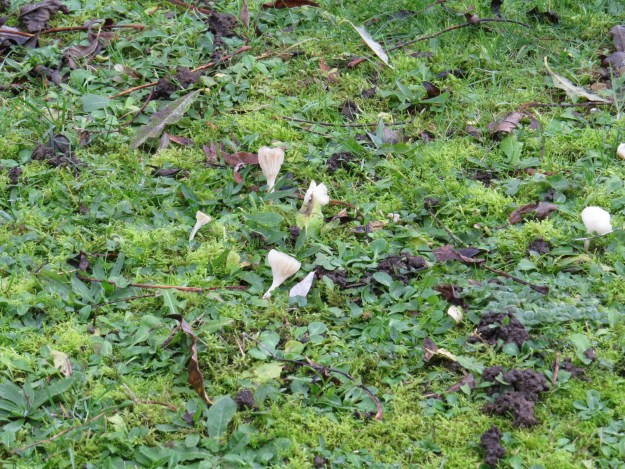
There are some new fungi on a grassy slope nearby too. They look as if they’ve been carved out of ivory and are tiny, only a couple of centimetres tall.

And then we head towards the noisy part of the cemetery, next to the North Circular Road, and who should fly into a small, isolated ash tree? Yes, it’s the kestrel. This is obviously a favourite spot for surveying the kingdom. Kestrels mainly hunt small rodents but the local birds obviously don’t know this (and I have seen sparrowhawks here too), as they are all of a twitter.


At one point the bird has a different twig in each foot and is rocking around trying to balance, his head perfectly still. The one thing I haven’t seen this bird do is hover – maybe s/he doesn’t need to if there are perching places. Hovering takes up a lot of energy, after all.

And with a swoop s/he’s off. It’s difficult to get an idea of how elegant this bird looks in flight, but the photo below shows how long and tapering the wings are.

I am starting to think of this ash as ‘the kestrel tree’. The bird obviously feels very safe here as it pays me little mind even as I fumble around with exposure on the camera. Someone told me that they’d seen a red kite over the cemetery last week too, so I shall be keeping a keen eye open. Buzzard, kestrel, sparrowhawk – there must be a whole lot of biodiversity in the cemetery. Let’s hope that it doesn’t become too regimented.

And I rather liked the way that this ‘winged creature’ was taking advantage of another one.


At this time of year, nearly all the leaves are gone, but I rather like the smoky effect of the bare, grey branches.

And those magnificent dark brooding trees against the skyline.

The snowberry is covered in ‘lardy balls’ this year – the tiny pink flowers are popular with bees in the spring, but nobody seems to like the berries, which is probably why they stay around for so long.

We turn into one of my favourite parts of the cemetery, along Kew Road and Withington Road. A Japanese gentleman is practicing his tai chi – we nearly always see him here, wearing a facemask and going through some moves. We wave and say hello, and he does the same. I often see the same people here every week, going for their constitutional. I do hope that at some point the cemetery will open up to ordinary folk during the week, it is such a source of solace for so many locals.

Anyhow, I suddenly notice a most unusual flag on one of the graves, and we head over for a look.

This is the one of the many designs of the early American flag, probably dating to about 1877. So what’s going on?

The grave belongs to George W. Denham, who fought in the Civil War (1861-1865) for the Unionists. The 111th Pennsylvania Volunteers were at the Battle of Antietam (one of the bloodiest battles of the war), and at Gettysburg.  He was on the USS Choctaw, a steamship that was converted into an ironclad ram and sent down to the Mississippi, where the ship was involved in the destruction of a number of confederate navy yards. Later, the Pennsylvania Volunteers were folded into the Army of the Potomac, which by 1865 had over 80,000 men either killed, wounded or missing in action. What a bloody war this was! What I don’t know is how Denton came to be living in North London, although it’s clear that he was involved with his fellow veterans, being a member of the London Branch of the Union Veterans of the Civil War. I managed to find a George W. Denham living in St Pancras parish with his wife Jane and six children, but whether this is ‘our’ George I’ve been unable to ascertain to my satisfaction.

Denham’s  great grandchildren laid a wreath on his grave, and they clearly got to know their great grandfather through the letters that he’d left. What a treasure trove for future generations something like this is, especially as this man had really lived through history, and furthermore had obviously recorded it.

What I found most poignant though was not so much the flag, and the wreath, and the letter, but the cap left on the corner of the grave, a memento of a soldier who was finally free to take it off.

And finally, to finish up our walk together, here are some more angels, because we need as many of them as we can find at the moment. Here’s an angel crowned with ivy.

And here are some cherub faces, on a family grave that included a child of one year and ten months old. There is something about the specificity of that which reminds me of how I often correct myself when I’m referring to Mum and Dad’s death – ‘Mum will have been gone for two years on 18th December this year’ for example. For those who grieve, the precise details are so important.