Yearly Archives: 2020

My Favourite Plants for Pollinators

White comfrey

Dear Readers, what follows is a very idiosyncratic list of my ‘favourite’ plants where pollinators are concerned. I expect a bit of controversy with some of them, but in all cases I have observed the comings and goings of various insects, and have noted that the flower in question is much appreciated. Onwards!

Dandelion

  1. Dandelion. I happen to love dandelions: they flower for most of the year, and are an invaluable source of early pollen, just when queen bumblebees and honeybees need the protein to rear their young ones. Plus, they always remind me of my husband’s father, Richard, who died on 11th May: the cemetery that he was buried in, Mount Pleasant in Toronto, was absolutely full to busting with dandelions in flower, and dandelion clocks, their seeds sailing away on the breeze. I thought it was one of the loveliest sights that I’d ever seen. Our local cemetery, St Pancras and Islington, can be just as pretty if the strimmers haven’t been too vigorous.

    St Pancras and Islington Cemetery in May 2015

  2. Ivy. I know that it can damage brick work and pull down trees, but its Sputnik-shaped flowers are a late-summer feast for all manner of pollinators, including the newly-arrived ivy bee shown below. I have lost count of the number of species that I’ve seen feeding in autumn, when there is little else in flower.

    Ivy bee (Colletes hederae)

    3. Mahonia. What a spikey and unruly plant this is! I have a very sad specimen in a pot, which is basically just a stem with a crown of prickles on top. And yet, when it puts forth its few sad yellow flowers as early as January, I can bet that it will be visited by queen bumblebees popping out of hibernation in a warm spell, and the blue tits can often be seen flying off with the berries. Earlier this week a young squirrel was half way up the stem trying to get to the fruit, as the whole plant swung back and forth like a pendulum. I believe that it’s worth having for that early nectar and pollen, if for nothing else. Maybe hide it at the back of a bed somewhere if you’re dubious. Incidentally, the flowers smell rather lovely.

    Mahonia

    4. Scabious (of all kinds). This is a lovely little flower, and seems to be particularly favoured by butterflies. I can never get it to grow properly in my north-facing garden, but I’ve seen it positively covered in six-spot burnet moths in Austria. The garden varieties seem to be equally popular, but do let me know your experience…

    Field scabious

    5. Buddleia. I know, I know. The RHS is telling us not to plant it, the wildlife books are increasingly advising against it, and yet, for the few brief months when it is in flower it attracts pollinators of all kinds in abundance. And it smells like honey. And it grows alongside railway lines, forming a thicket of flowers in lilac and white and purple. I have two huge self-planted buddleia bushes in my front garden, and in August I sit at my desk with my binoculars and watch the butterflies come and go.
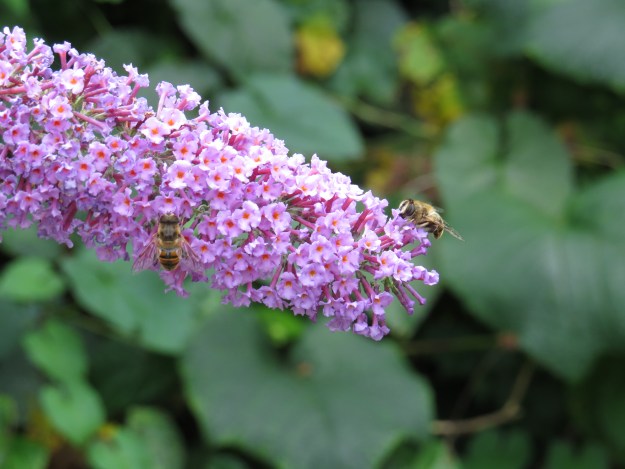
    Buddleia

    Red Admiral (Vanessa Atalanta) and Small Tortoiseshell (Aglais utricae) on buddleia

    6. Cardoon, and thistles in general. I watched entranced at all the bees feeding from these cardoons in Regents Park, but thistles are almost always great for insects. In Austria I look out for the beetles on the melancholy thistles, and for a while I had some very fine thistles in the garden. I have watched bees fall asleep in the flowers as if overcome with all the nectar.

    Cardoon (Cynar cardunculus)

    Melancholy thistle in Austria

    Bumblebees on thistle Cirsium atropurpureum

    7.Hemp agrimony. What a tatty flower this is: it becomes unkempt very quickly and the wild variety goes from a kind of vague pinkish colour to a whitish grey within about ten minutes. However, it loves the damp areas around my pond, and because it is so tall it makes watching the bees a delight, because I don’t even have to bend over or change my glasses. I love the way that the bigger bees seem to fumble through the flowers as if desperate to find the nectar. Much loved by hoverflies and smaller bees as well.

    Hemp agrimony

    8. Meadowsweet. I grew this for the first time last year because it was another waterside plant that was supposed to be good for pollinators, and I was delighted – again, hoverflies seemed to love it (I think all those small open flowers make life easy for them), but it also attracted my first ever gatekeeper butterfly. It looks as if it’s going to be even more impressive this year.

    Meadowsweet

    Gatekeeper (Pyronia tithonus)

    9. Foxglove. I’m not sure there’s anything more redolent of a drowsy summer day than the muffled sound of a bumblebee inside a foxglove flower. I sometimes wonder if they’re relieved when they finally escape!
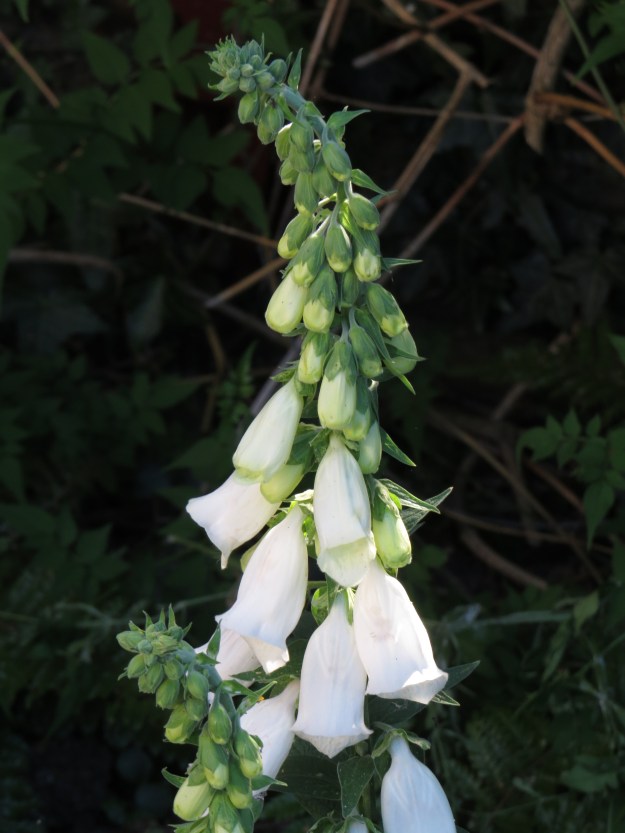
    White foxgloves in my garden

    10. Bittersweet. I love this plant, which has self-seeded in the middle of my honeysuckle, and which provides more year-round entertainment than anything that I’ve ever planted. In the autumn the birds seek out the berries, but in the summer the air is filled with the high-pitched sound of common carder bees buzz-pollinating the flowers. I have rarely seen anything as fascinating as the way that they vibrate the blooms in order to persuade them to drop the pollen out of the cones in the centre. This is the way that other members of the family, such as tomatoes and potatoes, are pollinated too.

    Common Carder Bumblebee buzz-pollinating Bittersweet

    And here’s a little film of them doing their work.

So there we go, with my top ten. But I am thinking that this is a most incomplete list. Where are the nettles (food for the caterpillars of many moth and butterfly species)? Where are the umbellifers, like wild carrot and queen anne’s lace? Where are the brambles, probably the most useful plants of all? And more to the point, having shown a picture of comfrey at the top of the page, why is it not included (oops). I can see that this list is just the start, and I’d love to hear from you. What are the most valuable plants in your garden, from a wildlife point of view? I’m sure that I’ve always got room to pop another one in…


Sunday Quiz – Wonderful ‘Weeds’

The long, bell-shaped flowers of the Yellow Corydalis

To those of you who are worried that someone has already had a bash at the answer to the quiz, can I reassure you that the first person to post isn’t necessarily the one with all the right answers? Also, if you have a better idea for how to provide the answers I’m happy to receive suggestions…

Dear Readers, many of you requested a plant quiz this week, so how could I refuse? All the plants in today’s quiz can be found within a mile of my house, and many of them can be found on several continents, so maybe it will give my non-UK readers a chance. Please include the Latin name if you know it (plants have so many different local names and I don’t want any fisticuffs). We’ll start with an ID quiz, and then I’ll be asking some random questions about the plants in the pictures. Let’s begin! I shall publish the answers on Tuesday to give you a chance to get properly stuck in. Put your answers in the comments by 5 p.m. on Monday (UK time) if you want me to give you a mark, but feel free to play along anyway.

1.

2. (The white flower)

3.

4.

5.

6.

7.

8.

9.

10. Not what you might think!

11.

12.

13.

14.

15.

And here are some additional questions for those of you with stamina! The answer to each question is one of the plants shown above, and you can find the answers in the Wednesday Weed for each species.

16. Which plant has proved efficacious in the treatment of migraine?

17. Which plant has smooth leaves at the top and prickly leaves at the bottom, and why?

18. Which plant was Wordsworth’s favourite flower?

19. Which plant is the foodplant for the orange-tip butterfly?

20. Which plant got its common name from the blessing ‘Benedictus’?

21. Which plant has leaves that taste of cucumber?

22. Which plant was described thus, in 1913:

In bushy places, common; and a most mischievous weed in gardens, not only exhausting the soil with its roots, but strangling with its twining stems the plants that grow nearby’.

23. Which plant is also known as ‘pissenlit’ because of its diuretic qualities?

24. Which plant generates its own heat, to entice insects to pollinate it?

25. The seedheads of which plant were believed to be used as hairbrushes by the Banshees in the folklore of Ireland?

26. Which plant is closely related to chamomile?

27. Which plant is described thus, and is the County Plant of Berkshire?

‘White flowers hanging in severe purity from long stems’.

28.Which plant is the larval foodplant of the holly blue butterfly, and has been described as ‘the most divisive wild plant in the UK’?

29. Which plant is also known as ‘purple archangel’?

30. Which plant is ‘always green’ although its flowers are blue?

Some Hopeful News, and Yet More Babies

Photo One by Satyrium w-album

White-letter hairstreak (Satyrium w-album) Photo One

Dear Readers, on Thursday I attended an online talk about London butterflies, given by Simon Saville, who has been studying the lepidoptera of London since 1992 on behalf of the Field Studies Council. You can watch it (and the other talks that have been given during lockdown) here. However, I wanted to summarise the key findings here because they are really quite exciting. Back in the 1980’s, only 22 of the most generalist butterfly species were found in Central London, and apart from a few large areas, such as Hampstead Heath and Richmond Park, no areas within Greater London had seen more than 25 species. Then, there was a big recording effort back in 2019, which revealed more than 30 species, with several butterflies making an impressive comeback.

One of these was the pretty white-letter hairstreak (shown above). This was a butterfly whose life cycle was inextricably linked with the elm tree: it lays its eggs on the leaves, the caterpillars pupate in crevices in the bark, and the adult butterfly can most frequently be seen dancing above the leaves of the tree. When Dutch elm disease struck, the numbers of the white-letter hairstreak fell precipitously, However, just recently it has been staging a comeback: it seems that it is perfectly happy with the disease-resistant varieties of elm that we are planting, such as New Horizon, and so it is now being spotted regularly wherever there are elms (Tooting Common is mentioned as a particular hotspot). I shall have to check out the elms planted on Queen Victoria Street in the City when/if I ever get back to my office.

Photo Two by By Charles J Sharp - Own work, from Sharp Photography, sharpphotography, CC BY-SA 4.0, https://commons.wikimedia.org/w/index.php?curid=42045358

Marbled white (Melanargia galathea) (Photo Two)

The second species making a comeback is the marbled white (Melanargia galathea) which, in spite of its appearance, is actually a member of the brown butterfly family (Satyrinae). Simon Saville described it as ‘a caterpillar with a short butterfly phase’ – it lives as a larva for over 11 months, from July right round to the following June, before pupating for about six weeks, emerging as an adult to mate and lay eggs and then dying after flying around until mid August. The larval stage is the most vulnerable, because who can resist a juicy caterpillar? Certainly not the birds in my back garden. But habitat reclamation seems to be working wonders for this creature – the caterpillar lives in unimproved grassland, feeding particularly on red fescue. It seems that all those unmown corners, the reduction in the use of biocides by local councils (who still use such chemicals on street weeds but are largely avoiding them in parks) and a greater awareness of the needs of wildlife by the general public are all having an impact. So, resist the urge to mow every bit of your lawn, and leave some not just for the marbled white caterpillars but for many other butterflies and moths as well.

Photo Three by By Charles J Sharp - Own work, from Sharp Photography, sharpphotography, CC BY-SA 4.0, https://commons.wikimedia.org/w/index.php?curid=42036614

Brown argus (male) (Aricia agestis) (Photo Three)

Photo Four by By Charles J Sharp - Own work, CC BY-SA 4.0, https://commons.wikimedia.org/w/index.php?curid=42060167

Brown argus – underwing (Photo Four)

And finally, the brown argus (Aricia agestis) is also making a comeback in London. This most unlikely species was formerly thought to be a specialist, with its caterpillars feeding only on rockrose (Helianthemum nummalarium) on chalk downland. But somehow this butterfly has switched its foodplant: the caterpillars have discovered a liking for the foliage of wild geranium species, in particular dove’s foot cranesbill (Geranium molle) which can be found pretty much everywhere in the south of England.

Photo Five by By No machine-readable author provided. Svdmolen assumed (based on copyright claims). - No machine-readable source provided. Own work assumed (based on copyright claims)., CC BY 2.5, https://commons.wikimedia.org/w/index.php?curid=746768

Dove’s foot cranesbill (Geranium molle) (Photo Five)

So, three success stories, to help to offset all the misery. It has never been more important to keep our eyes peeled, both in the garden (if we have one) and when we’re out and about on our exercise walks (if we’re able). There are discoveries to be made right under our noses.

And finally, I had to share the latest squirrel news with you. I had only just gotten over the fact that my resident squirrel babies were pretty much all grown up when I looked out of the window yesterday to find three new youngsters raiding the bird feeders, digging up goodness only knows what and generally wreaking havoc. What little rascals they are! My jasmine has become a jungle-gym, and they are showing a particular liking for the strawberry tops that my husband throws out, ostensibly for the birds.

Here are a couple of short films of their shenanigans. Enjoy!

Friday Books – My Favourite Plant Books

The Wild Flower Key by Frances Rose

Dear Readers, over the years I have used lots of books to help me with the creation of the Wednesday Weed, so today I thought I’d share four very different works. Some are useful for ID, some are full of information, and I use all of them practically every week. So, to start with, here is that old favourite ‘The Wild Flower Key’ by Frances Rose. This is the first book that most people use when they start to become seriously interested in identifying plants, because it is concise without being too simple, and because the illustrations are clear. You can use it as a proper ‘key’ once you know the basic plant terms, but I find it most useful in identifying plants when I already know roughly what they are.

A page from ‘Rose’ showing the fumitories.

Incidentally, with a surname like ‘Rose’, how could Frances Rose have become anything other than a botanist? In New Scientist they have called this ‘nominative determinism’ – so my plumber is called Mr Boyle, and I once had a dentist called Mr Fang. I’m sure you can find lots of others.

I love Rose, but I have to admit that there is a lot of writing. If I want photos, I always turn to this book.

Harrap’s Wild Flowers by Simon Harrap

I often use this in combination with Rose: I find the photos very useful, and it sets out the key ways of telling the difference between different plants by putting the diagnostic features in bold. For example, the position of the buds is a key way of telling the difference between oilseed rape and wild turnip, and I learned this from Harrap. Plus, the photos, though small, are rather lovely.

Another book that I’ve found to be full of useful information is in the New Naturalist series – Stace and Crawley’s Alien Plants. Stace is a master botanist, who produced the definitive guide to plants in the UK, and this work on ‘Aliens’ is fascinating. He explains the various paths by which alien plants have arrived in the UK, the reasons why they thrive, and how they impact on native flora.

Alien Plants by Clive A. Stace and Michael J.Crawley

He has a list of the most common alien plants found in different parts of the UK, and who would be surprised by the number one plant in London? Yes, it’s that old favourite the buddleia. Who’d have thought that petty spurge would come in at number four though? It hasn’t even made my Wednesday Weed list yet (though sun spurge has). I shall have to pay closer attention.

But finally, here is my favourite book on the folklore, uses and culture surrounding plants in the UK. Richard Mabey is probably my favourite author on plants, and his books will certainly crop up in future when I’m thinking about books on ‘weeds’. In Flora Britannica he gathered information from the four corners of the UK, and you cannot open a page without finding a useful factoid. He reminds us that our plants have a biography and a historical significance too, and, as it was originally published in 1996 it was before its time in its focus on what we were in danger of losing.

In addition to describing the various plant families, Mabey also has special sections on areas such as ‘spring flower festivals’ and ‘plants, places and names’. I cannot recommend this book highly enough for sheer breadth of knowledge. It single-handedly reclaims the history of plants in the UK and reminds us of how long we have been admiring, using and destroying them.

So, that’s a small selection of the plant books that I find most useful for the Wednesday Weed – I could easily add in another half dozen that I use more occasionally. What are your ‘go-to’ plant books? I think there might be room on my bookshelf for a couple more….

Spring into Summer

By Richard Crossley (The Crossley ID Guide Britain and Ireland) [CC-BY-SA-3.0 (http://creativecommons.org/licenses/by-sa/3.0)], via Wikimedia Commons

Dear Readers, I was sitting in the garden on Sunday when I heard what  I consider to be the first sign that spring is easing gently into summer. Way up above my head, circling in the clear blue sky, were swifts, scything through the air. Their shrill cries may be a way of keeping in contact with one another, but I sometimes wonder if they are just for sheer joy. Swifts fly high as they follow the clouds of insects, but on a hot, drowsy day I have seen them zipping through the garden just a couple of metres above the ground. By the end of July they will be done, these most ephemeral of visitors.

Spring starts for me with the frog chorus, and the sound of chiff chaffs in Coldfall Wood. But what marks the midpoint is the arrival of those papery-skinned nuggets of loveliness, Jersey Royal potatoes. I am a latecomer to asparagus (I think it was a very local, and probably very expensive, crop when I was growing up), but how my family loved a Jersey Royal. My earliest memory of them is my Nan sitting in her navy-blue quilted dressing gown with a yellow plastic bowl on her lap, scraping the skins off with meticulous care. We didn’t have proper cooks’ knives, but we did have a single bone-handled dinner knife with a blade that bent to the left. This knife had about an inch-worth of exquisite sharpness where the metal had thinned, and this was used for anything that required precision. Nan would work over each potato, no matter how small, until its creamy perfection was revealed. Sometimes, enough potatoes for the five of us would take her an hour and a half. Then it was into a pot of boiling water with them, with salt, and some mint thrown it at the end. With an essential knob of butter dropped on to them  and another sprinkling of salt, they were the high point of a Sunday dinner, and I could eat a bowl of them on their own, picking them up with my fingers and blowing on them until they were cool enough to eat.

Public Domain

Jersey Royals pre-scraping

Later, after Nan died in 1965, it was Mum who took up the mantle of the Jersey Royal scraping. Like Nan, she was a perfectionist, and a potato wasn’t done until there wasn’t a vestige of skin left. When I was in my teens we started on the New Potato wars: I would scrub the potatoes so that most, but not all, of the skin came off, because I rather liked the rustic appearance. Also, I had learned at school that most of the vitamins in a potato are just under the skin, and so why would you risk getting rid of it? Mostly, though, I think I was just expressing my independence in the way that teenagers so often do, by being contrary. Later, when I had Mum and Dad over for my legendary dinner parties, I would serve up the Jersey Royals scrubbed not scraped, and would watch Mum for the slightest hint of disapproval. I can still see her taking each potato in turn, perusing it with a slight frown, and then meticulously removing every scrap of skin before she started eating. As Mum was always a slow eater at the best of times (unlike the rest of us who could shovel it down for England) this could make for a very long meal.

I soon learned that Jersey Royals were either scraped or off the menu. I seem to remember that we came to a compromise and I served peeled King Edwards, roast or mashed, instead.

Now, I see it a little differently. For Nan and for Mum, spending all that time scraping the potatoes, doing something ‘properly’, was an act of love, something that was offered up to a largely unappreciative family. I once asked Mum why she was taking such care over something that she was knitting, when it was in a part of the garment that wouldn’t be seen.

‘They won’t even know, Mum’, I said, as she unravelled a sleeve.

‘Yes, but I’ll know’, she said.

Photo One from https://www.bbcgoodfood.com/recipes/buttered-jerseys

Jersey Royals post-scraping (Photo One)

When is something ‘good enough’? I have struggled with this my whole life, sometimes to the detriment of my mental and physical health. It’s as if I have a little voice in my head that judges whether I could have done more, worked harder. I gauge my mistakes against an impossible standard, while forgiving the mistakes of others with ease. And while it is good to be conscientious, it’s also true that some things matter more than others. People matter. Time spent creating matters. Doing things with love and care matters. But breaking yourself on the wheel of a scraped potato seemed a step too far for me earlier this week, as I scrubbed my Jersey Royals and threw them into a pot of boiling salted water, and delicious they were too, though I’m not sure they tasted quite as good as they did when I was a little girl.

Let me tell you a secret, though. I would scrape Jersey Royals with a bone-handled knife until my hands bled to share one more bowl of potatoes with Mum.

My mum. One of my favourite humans, then, now and for always

Photo Credits

Photo One from https://www.bbcgoodfood.com/recipes/buttered-jerseys

Wednesday Weed – Salsify

Salsify (Tragopogon porrifolius)

Dear Readers, as you know we have recently been allowed back into St Pancras and Islington cemetery at weekends, and so I am making the most of it with a nice long walk, usually going right up to the perimeter fence which is next to the North Circular Road. Once you realise that you can orientate yourself by the roar of traffic, you are much less likely to get lost, but I usually hurry along this bit, head down, until I can walk away into the quieter parts. However, on Saturday I was stopped in my tracks by this showy purple flower with bright yellow pollen. It was a rather odd plant, with a bulbous stem and very pointy petals. My husband took the pictures on his phone, as I had decided to leave my camera behind for once. I thought it looked a bit like an osteospurmum and thought no more about it. But then, I looked at the photos again and realised that something wasn’t quite right, so off I went to my Facebook Plant Identification UK group, and back they came with a most unexpected answer – salsify.

If you think this sounds rather familiar, it’s because salsify was a vegetable much loved by the Victorians, and which is now making a comeback. The roots and shoots can be eaten after they’re boiled, and are said to taste rather like seafood (hence the alternate name ‘oyster plant’). Cultivated varieties have a much better shaped and larger root than the wild plant, as you might expect (anyone who has ever dug up a wild carrot in the hope of a big juicy orange vegetable will know what a disappointment is in store in terms of size, though the taste of the wild plant is often much more intense than the cultivated variety). The Great British Chefs website has all manner of tasty suggestions, with Richard Corrigan’s Turbot with Mussels recipe aiming to capitalise on the shellfish flavour of the root. For the vegans among us, roasted salsify with toasted walnuts and a lemon tahini dressing sounds delicious.

Photo One from https://www.exceedinglyvegan.com/vegan-recipes/soups-starters/roasted-salsify-toasted-walnuts-and-lemony-tahini-dressing

Roasted salsify with toasted walnuts and a lemon tahini dressing (Photo One)

Salsify is a member of the daisy family, but its genus puts it amongst the goatsbeards. It was originally native to North Africa and southeastern Europe, but it has been introduced right across the rest of Europe (including the UK), and is present in North American and Australasia. Sometimes it was introduced as an edible plant, but it was also a garden plant that came in and out of favour. It was first recorded in the UK in 1597, and has been known to crossbreed with our native goatsbeard, Tragopogon pratensis or meadow salsify.

Photo Two by CC BY-SA 3.0, https://commons.wikimedia.org/w/index.php?curid=196810

Meadow salsify (Tragopogon pratensis) (Photo Two)

You might think that this plant looks nothing like ‘our’ plant, but have a look at the bud. It’s nearly identical. In both salsifies, the bud closes up once the sun has passed, which is probably why I’d never noticed it before – our native salsify is also known as ‘Jack-go-to-bed-at-noon’ for this very reason.

Photo Three by CC BY-SA 3.0, https://commons.wikimedia.org/w/index.php?curid=424886

Bud of Meadow salsify (Photo Three)

The hybrid of the two species is known as Tragopogon x mirabilis, and you can read about it here. The ‘child’ seems to have characteristics of both ‘parents’. In North America the situation is even more confused, as ‘our’ salsify and meadow salsify were both introduced, and crossed with the native salsify, Tragopogon dubius. Truly the sex-life of plants is a wonder.

Photo Four from https://www.ukwildflowers.com/Web_pages/tragopogon_x_mirabilis_hybrid_goatsbeard.htm

Hybrid salsify (Tragopogon x mirabilis) (Photo Four)

Medicinally, it seems that salsify has been used to ‘thin the bile’, and also (in East Anglia) as a treatment for jaundice. Like many members of the daisy family, salsify has a white latex-like sap, which was used as chewing gum by some Native Americans. And, according to this article from the Independent, one pronounces it as ‘sals-i-fee’ not ‘sals-i-fye’, so there. Don’t say I never save you from social embarrassment.

Yet another alternative name for salsify is ‘star of Bethlehem’. I can see why.

Photo Five by By Roger Culos - Own work, CC BY-SA 4.0, https://commons.wikimedia.org/w/index.php?curid=86154437

Salsify flower (Photo Five)

And finally, a poem. Mona Arshi was born to Punjab Sikh parents in West London, and is a poet and human rights lawyer. She won the Magma Poetry Competition in 2008 and the Forward Prize in 2015. I find this poem most intriguing, with its domestic detail and lurches into the surreal. What is actually going on here? One dramatic image follows another. See what you think.

Bad Day in the Office – Mona Arshi

Darling, I know you’ve had a bad day in the office
and you need some comfort
but I burned the breakfast again this morning
and the triplets need constant feeding –
they are like little fires.  And the rabbit ….
the rabbit topped himself but not before
eating the babies and the mother stared at me
as if I was the one who did it!
Everywhere there is the stink of babies and it’s a good job
I can’t smell my fingers as they’ve been wrapped
in those marigolds for weeks.
The mother-in-law has been.  She didn’t stay,
just placed a tulsi plant on the doorstop,
with a nose saying she had high hopes of it
warding off those poisonous insects.
That estate agent arrived for the purposes of the valuation.
He dandled the babies on his lap and placed his index finger
on my bottom lip.  There’s some paperwork somewhere.
As for dinner, well that’s ruined.  Those chillies you sent for
from Manipur? The juice from the curry bored a hole
in the kitchen tiles and I’ve had to move the pot to the stump
at the bottom of the garden, next to the dock-leaves;
it was a short trip but it was good to get some air.
We need to keep reminding ourselves that when it rains
it is not catastrophic it is just raining.
The lady radio anouncer has addressed me on several occasions,
– did you know orangutans are running out of habitat
and we don’t have much time?
I’ve become quite adept at handling the eccentric oranges,
those root vegetables need sweating out . . . but it’s difficult
to concentrate when that sodding bunny blames me
though how could I have done it when all morning
I’ve been next to the stove stirring the damn pot.
The salsify is eye-balling me, it’s lying on top
of that magazine  article – Bored with the same old winter veg?
Give salsify  a go.  We promise you’ll never look back. 

The poet’s website is here. Well worth a look.

Photo Credits

Photo One from https://www.exceedinglyvegan.com/vegan-recipes/soups-starters/roasted-salsify-toasted-walnuts-and-lemony-tahini-dressing

Photo Two by CC BY-SA 3.0, https://commons.wikimedia.org/w/index.php?curid=196810

Photo Three by CC BY-SA 3.0, https://commons.wikimedia.org/w/index.php?curid=424886

Photo Four from https://www.ukwildflowers.com/Web_pages/tragopogon_x_mirabilis_hybrid_goatsbeard.htm

Photo Five by By Roger Culos – Own work, CC BY-SA 4.0, https://commons.wikimedia.org/w/index.php?curid=86154437

Sunday Quiz – Know Your Crows! – Answers

Dear Readers,

What a corvid-aware bunch you are! In joint first place with 16 correct out of 16 were Sarah and Andrea Stephenson, you both deserve gold stars! In second place, only a single point behind, were Fran and Bobby Freelove with 15 out of 16. And in a very respectable third it’s Charlie Bowman, with 12 out of 16. I couldn’t be more choughed with the results :-).

Here are the answers….

1. Jackdaw (Corvus monedula)

2.Carrion Crow (Corvus corone)

3. Magpie (Pica pica)

4.Jay (Garrulus glandarius)

5. Rook (Corvus frugilegus)

Photo One by David Hofmann / CC BY (https://creativecommons.org/licenses/by/2.0)

6. (Photo One) Raven (Corvus corax)

Photo Two by gailhampshire from Cradley, Malvern, U.K / CC BY (https://creativecommons.org/licenses/by/2.0)

7. (Photo Two) Hooded crow (Corvus cornix)

Photo Three by By Andrew - originally posted to Flickr as chough, CC BY 2.0, https://commons.wikimedia.org/w/index.php?curid=7204919

8. (Photo Three) Red-billed chough (Pyrrhocorax phyrrhocorax)

Ok, so as if that wasn’t tricky enough, here are the calls. It can be so hard to pinpoint them when they’re out of context.

9. Magpie alarm call. I always think of this as a ‘machine gun’.

10. Jay. A bit of a wheezy sound

11. Raven. I only have to hear this to remember grey skies, the call echoing over a mountain tarn.

12. Rooks. This sounds so much like the West Country to me – there were rookeries both in Somerset where my Aunt Hilary lives, and in Dorchester where Mum and Dad lived.

13. Carrion crow

14. Hooded crow – until recently this bird was thought to be a subspecies of the carrion crow. It’s now out there on its own as a species, but I think the call is remarkably similar. Take a gold star if you were able to tell these two apart!

15. Jackdaws

16. Chough! Its call is described as a ‘richocheting bullet’. See what you think.


Babies!

Juvenile collared dove

Dear Readers, today I was mostly weeding in the garden – I have a high tolerance for wild plants, as you might imagine, but the cleavers (Galium aparine) was getting away from somewhat. Although it doesn’t actually climb, it does smother other plants, and so up it came. Meantime, my intrepid husband was wrestling with the bramble that lives behind the shed and is impossible to eradicate. I don’t mind brambles up to a point, what with the blackberries and the pollinators and all, but in some years it has actually grown through some of my pots and into the soil beneath, so I do need to keep some kind of control.

And once we sat down with a cup of tea to treat our various scratches and nettle stings, I noticed that one of the two collared doves who were working their way through the upturned soil was not like the others. For one thing, the bird was not as confident a flyer: s/he kept landing on things that were too flimsy to bear their weight. But for another thing, there are very subtle differences in the plumage. A juvenile collared dove has less variation in the colour of its plumage (though this is subtle at the best of times), and the neck ring in this one has not quite grown in yet. Plus, is it just me or is there something about the eyes that is different? Maybe it’s just that innocent, slightly gormless look that most young birds seem to have.

Juvenile

In other good news, the collared dove with the horrible chest injury seems to be almost completely healed, with just a tiny dent where the feathers are growing in. I shall try to get you a photograph later in the week.

Collared dove with chest injury – now almost completely healed!

The mother squirrel and the babies are still about: the youngsters are putting on weight at an amazing rate. The only way to tell them apart, unless they’re standing next to one another, is by the slightly less bushy tails of the youngsters, and their appalling behaviour – swinging from branches, chasing one another through the undergrowth, running at the starlings and almost falling in the pond.

But we do have another completely new youngster, and I couldn’t be more delighted.

Young robin (Erithacus rubecula)

Young robins have completely different plumage from the adults, and yet their behaviour is essentially identical. Although this one is not long out of the nest (to judge by the remnants of the gape flanges). And what is a gape flange, I hear you say? When baby birds are in the nest, the part of  beak where the upper and lower bill meet is often fleshy and sometimes brightly coloured, which probably helps the parent bird to know exactly where to stuff the caterpillar they’ve caught. Sometimes parts of the mouth are also visible in ultraviolet light, which birds can see, but we can’t. This ‘hinge’ is known as the gape flange.  In our robin there is still a tiny hint of yellow at the corner of the mouth, showing that s/he is still young.

The young robin’s parents were still about, seeing off any other robins and generally keeping an eye open, but the youngster was foraging for itself, especially in the area where I’ve pulled up weeds and there were worms and other invertebrates on show. When the parent bird sounded an alarm because a cat was wandering through, the youngster flew up and took up the call (a very distinctive ‘chink-chink’ sound that always reminds me of someone hitting a teeny-tiny anvil with a small but effective hammer). I was pleased to see that the collared dove flew up as well, though whether because it understood the alarm call or because it noticed the behaviour of the other birds I’m not sure. Many creatures listen to one another’s alarm calls, and also understand the variations that indicate if the predator is airborne or on the ground.

A young robin leaves the nest after about fourteen days, and all subsequent care is normally provided by the father, as the female settles down to produce a second batch of eggs. Robins normally breed twice a year, but can go through the whole performance another couple of times if conditions are good. I wonder what effect the lockdown will have? Less disturbance, more people providing bird food: maybe it could be a bumper year. Let’s keep our fingers crossed. After all, this is officially the UK’s  favourite bird.

Sunday Quiz – Know Your Crows!

Dear Readers,

The crow family is not universally popular, and yet for me it contains some of the most interesting and enigmatic birds of all. There is no doubting their intelligence and ingenuity, even if their omnivorous habits and look-at-me antics attract the disgust of those who want to protect their smaller, more vulnerable garden birds. But can we tell them apart? And, trickiest of all, can we identify them by call alone? Hah! Here’s a challenge for you all.

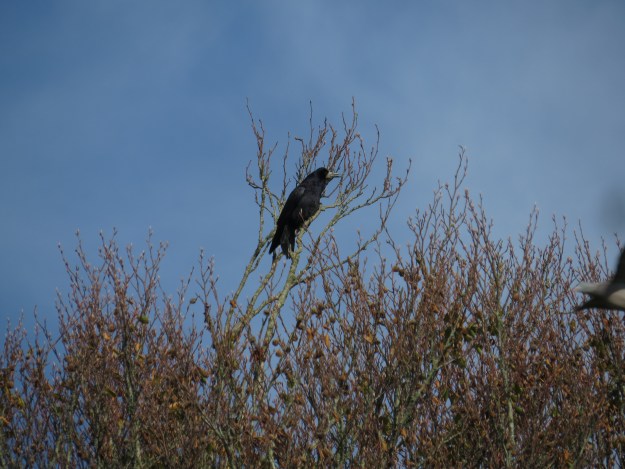
Firstly, what crows are these? Some of these are my personal photographs and, just to make it a bit trickier, they aren’t always the best of shots. I know you’re up to the task.

1.

2.

3.

4.

5.

Photo One by David Hofmann / CC BY (https://creativecommons.org/licenses/by/2.0)

6. (Photo One)

Photo Two by gailhampshire from Cradley, Malvern, U.K / CC BY (https://creativecommons.org/licenses/by/2.0)

7. (Photo Two)

Photo Three by By Andrew - originally posted to Flickr as chough, CC BY 2.0, https://commons.wikimedia.org/w/index.php?curid=7204919

8. (Photo Three)

Ok, so as if that wasn’t tricky enough, have a bash at identifying these crows by call alone. Good luck! NB All of the calls below were made by one of the birds in the photos above.

9. An ‘easy’ one to start 🙂

10. Often heard in autumn in oak woods…

11. Is this the most evocative call of all?

12. You country folk will be familiar with this sound…(not the woodpigeon in the background, that was last week 🙂 )

13. Sounds familiar?

14. If you think this sounds almost identical to (13) you’d be right…

15. What a cheerful bird!

16. This bird is said to say its own name, though I’m not sure I can hear it…

So there we go. As some of this is extremely difficult, I am going to give you until Tuesday to come up with your answers. Good luck!

And I would love to find out what other quizzes you would like, so for the first time ever I have added a poll. I have no idea if it’s going to work, but give it a go! You should be able to choose multiple subjects, or add some thoughts of your own. Let me know in the comments if you’re having any problems


Photo Credits

Photo One by David Hofmann / CC BY (https://creativecommons.org/licenses/by/2.0)

Photo Two by gailhampshire from Cradley, Malvern, U.K / CC BY (https://creativecommons.org/licenses/by/2.0)

Photo Three by By Andrew – originally posted to Flickr as chough, CC BY 2.0, https://commons.wikimedia.org/w/index.php?curid=7204919

Along the Playing Fields

View from Muswell Hill Playing Fields towards the cemetery

Dear Readers, I have always been interested in the edges of things, the places where one landscape bleeds into another, and so this morning I took a walk along the edge of Muswell Hill Playing Fields. Before the lockdown this would have been full of people playing football, walking their dogs, flying kites and picnicking, but today there was a handful of pooches illicitly chasing the crows, a couple of runners and us, puffing along on our daily exercise. The Fields are bordered on one side by the cemetery and on another by the woods, so there is a fair variety of things to look at.

Horse chestnut (Aexsculus hippocastanum)

Look at this sapling horse chestnut, for example. I love the way that the leaves unfurl and turn into loose shuttlecocks. When the tree is older there will be those ‘candle’ flowers that look so exotic close up, with their long stamen and carmine centres. According to my Collins Tree Guide, the middle of the flower starts off yellow and goes red after pollination. Sadly, by about July the tree’s leaves are likely to already be turning crisp and brown, having been mined by a tiny moth caterpillar. If the tree is particularly unlucky, it may also suffer from horse chestnut leaf blotch fungus. Such diseases weaken a tree, but don’t usually kill it. There was some evidence that blue tits were learning to eat the moth caterpillars, so let’s keep our fingers crossed that some ecological balance is soon reached.

Ash (Fraxinus excelsior)

There are lots of ash trees in the cemetery, many of them self-seeded, but this one has ‘escaped’ onto the edge of the fields. I love the way that the buds of ash look like the sooty-black hooves of tiny deer. I have learned so much about my local environment through writing this blog, and through the people that I’ve gotten to know through it: a friend mentioned the hoof comparison and it stuck, so that I can now instantly recognise an ash when I see one. We learn through metaphor, through making the connections between what we already know, and what we are trying to understand. I love that sense that we are able to constantly enlarge our mental territory, just by pushing on through the undergrowth.

Brassica

This plant has always puzzled me. It grows in swathes along the edge of the playing fields, in shades from butter-yellow to palest cream. It is definitely a brassica, but which one? My suspicion is either oilseed rape (Brassica napus) or wild turnip (Brassica rapa). Both have waxy green foliage, and the leaves ‘hug’ the stems, but in rape the buds are higher than the flowers on the flowerhead, producing a ‘domed’ effect. In wild turnip, the flowers overtop the buds, leaving a little dimple.  Goodness only knows what’s going on with these – I shall have to have a proper look next time I’m there. Whichever they are, they are going strong and seem to be increasing.

I remember as a child being enchanted by the fields of acid-yellow oilseed rape when we went for a drive in the country. How beautiful they looked against the green trees and the blue sky! However, when they moved to the country, Mum hated the stuff because she always said that it had a strong smell. I have to say that I never noticed, but then Mum always was sensitive to these things. Has anyone else noticed?

It certainly makes a pretty picture alongside the cow parsley.

Now, unless I’m mistaken this little tree is a crack willow (Salix fragilis) – the shiny green foliage and the very long fruits seem indicative to me. This tree grows elsewhere in the damp places in the wood, and so I’m not surprised to see it here. What an elegant plant it is! Left alone it can grow to about 20 metres tall, but its sideshoots often break (hence the name ‘crack’ willow). Fortunately, the broken twigs can take root easily and, as the plant often grows alongside water, this forms a handy way of colonising the whole river bank. The catkins are very popular with bees, who collect the pollen for their developing broods.

I think of elder as the quintessential ‘edge’ plant, growing in hedgerows and in the places where woods thin out to meet open ground. There is an elder right at the very entrance of Coldfall Wood, and I think it might be at the very limit of its tolerance for shade. I love those big, open clusters of white flowers, beloved by hoverflies and, more recently, by those with a taste for elderflower cordial, which has become Quite the Thing here in the UK. If the flowers are left along you will end up with heavy dangling bunches of elderberries, which are full of vitamin C. I suspect that elder kept our elders healthy for many millenia.

Elder (Sambucus nigra)

And finally, at the start of May, the May (or hawthorn) blossom is out in abundance, spreading its slightly sickly sweet vaguely fishy smell out on the warm air. Hawthorn is another plant which gives multiple gifts – it supports a whole range of invertebrates, the blue tits in my garden have been plundering my hawthorn for caterpillars, and in the autumn the blackbirds will be gobbling up the haws.

May (Hawthorn) blossom (Crataegus monogyna)

And finally, here among the Japanese knotweed is a dock that is in absolutely pristine condition. Later in the year it will look blotched and tatty – so many insects and fungi feed on it that it inevitably looks like something the cat dragged in. And yet, at the moment, I think it looks rather magnificent. My guess is that it’s broad-leaved dock (Rumex obtusifolius) because the leaves are only very slightly wavy at the edges (unlike the inventively-named curled dock (Rumex crispus) which has something of the Mobius strip about its foliage. However, I will have to wait for the summer to be sure. If it sends up great spikes of rusty-red branched flowers, I was right. Anything else, and it’s back to the drawing board (or to Harrap’s Wild Flowers in this case).

And so we head home as one of us has a nine a.m. team call (and one of us is free to write their blog). On the way, I notice the crows, who are socially distanced and are pecking for earthworms – it was very wet yesterday so their lives have been made a bit easier. i watch as an over-excited young dog tries to catch a crow, who only flies up at the very last minute, before settling down again just far enough away for the dog to keep a vestige of hope in its little canine heart. So many animals like to tease dogs that it seems a bit unfair – I’ve seen squirrels taunting them, crows chasing a greyhound and once, in India, some Hanuman langurs jumping down from a tree, slapping a poor sleeping hound and bouncing back into the branches before the dog could even look round. What is that about, I wonder? Dogs are so intelligent but they also have a kind of innocent naivete that other intelligent creatures seem to take as carte blanche to be hooligans.

Crows socially distancing

Incidentally, when I was growing up I was taught that crows were anti-social creatures, hanging out in pairs. If I saw a lot of black crows together, they were undoubtedly rooks. However, I think it’s different in the cities, where there is abundant food – I regularly see a dozen crows bathing in the stream in the woods for example, and I pass a park in Hackney where there are hundreds of crows. There is a scientific study going begging on urban corvids, I’m sure. What have you noticed? I wonder if this is just a London thing, or if, like many animals, crows in cities lose their territoriality. And I further wonder if, with food being scarcer during the lockdown, things will change.