
A hoverfly’s bum. You’re welcome!
Dear Readers, after missing last week’s walk in the cemetery because I was still feeling poorly, it was a great pleasure to have a stroll around today, enjoying the little things that have changed since I was here last. In truth, the end of July/beginning of August is a quiet time for nature, with the babies fledged, the caterpillars growing and all manner of creatures fattening up for the autumn, but there are still lots of interesting things going on if you look closely. The woodland graveyard site is full of blowsy thistles, wild carrot, ragwort and knapweed, and the hoverflies are taking full advantage.

Drone fly (Eristalis pertinax), a honeybee mimic
Hornet Mimic Hoverfly (Volucella zonaria)

Marmalade hoverfly (hopefully) (Episyrphus balteatus)
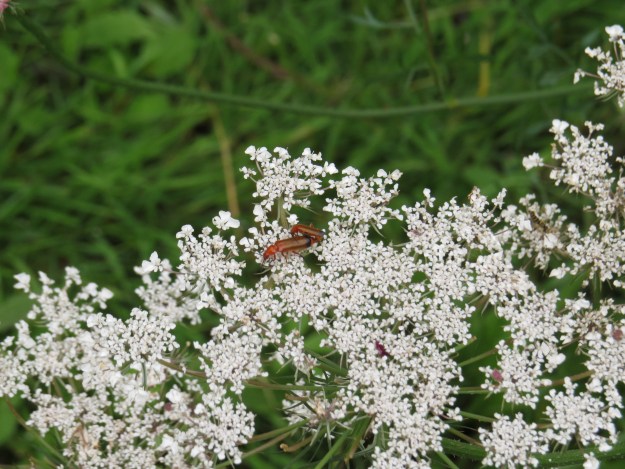
Hoverfly larvae are some of our most voracious aphid-eaters – we might be more familiar with ladybirds and their youngsters as they plough through a ‘herd’ of greenfly, but hoverfly maggots, though not the most appealing of creatures to look at, are basically aphid hoovers. The mimicry which means that these insects resemble bees or wasps is possibly also their downfall where humans are concerned – some people only have to see a flash of yellow and black stripes before they reach for a rolled-up newspaper. However, I’m sure that lots of predators leave them alone because of their colouration, so hopefully it all evens out. And look, here are some Common Red Soldier Beetles (Rhagonycha fulva), living up to their popular name of ‘bonking beetles’.
The conkers are continuing to fatten up.

Now, there’s a rose bush growing out of this conifer. So far, so unusual.

But here is something even more interesting…

This shaggy mass is the gall of a wasp, Diplolepsis rosae, which laid its eggs in the buds of the rose in the spring. Otherwise known as robin’s pincushions, each of these structures is woody inside and covered in long red or green hairs. The gall will contain many chambers, each of which contains a well-protected wasp larva. Male wasps are very rare, but the females can reproduce without needing sperm, so this is no problem. The new wasps appear in the spring, just in time to find new buds to parasitize. In Germany, these galls are known as ‘sleep apples’, and putting one under your pillow is supposed to be a cure for insomnia.

The inside of a robin’s pincushion, showing the chambers and larvae (Photo One)
I was having something of a gall-ing day though because I also found these galls on some crack willow. Someone has clearly been having a very good time! These are caused by a sawfly rather than a wasp: the female injects a chemical into the leaf that causes the plant to make the gall. She usually also lays an egg, which eats its way out of the gall over a few weeks, but occasionally a gall won’t have an egg, because for some reason the female didn’t lay one. This tree was positively peppered with galls but looked very healthy nonetheless. Healthy plants can put up with a great deal of nonsense from insect ‘pests’ without any detriment.


I spotted this lovely fresh female Gatekeeper butterfly (the males have a brown stripe across the forewings).

Rather less welcome is the positive plantation of Himalayan Balsam that I’m seeing next to the cemetery stream. This is such an attractive plant – it bears more than a passing resemblance to a huge moth orchid, and it comes in a whole range of pink, white and coral. However, it is going to be taking over this stream if folk don’t watch out, and as the cemetery already has a massive problem with Japanese Knotweed I hope that it will be kept under better control.


As we were walking through the trees, I heard the sound of young birds, probably raptors of some kind, hidden in the branches overhead. It was so frustrating not to be able to see them! But then I remembered a tip from Mike over at Alittlebitoutoffocus – he’d recently uploaded an app where you can ‘listen’ to birdsong with your phone, and it will then tell you, to a reasonable degree of accuracy, what you’re listening to. So, in the middle of the cemetery I downloaded the app, recorded the birds and lo and behold, it returned a result of ‘sparrowhawk’ with 95% certainty. Two minutes later, a sparrowhawk flew overhead. Result! I spent the rest of the walk recording various birds to see how good I was personally – I identified a song thrush, a green woodpecker and a blackcap, but would have missed a greenfinch (even though I know that they’re present in the cemetery because I’ve seen them). So, I can recommend this app if you want to improve your id skills, or even just want to find out what birds are about – there are definitely lots more than you ever see.
And finally, I had to stop to smell the lime blossom. I think it’s one of my favourite perfumes – not as heady as jasmine, not as floral as rose. What a delight it is to feel almost normal again.

Photo Credit
Photo One By Frank Vincentz – Own work, CC BY-SA 3.0, https://commons.wikimedia.org/w/index.php?curid=2623501
Like this:
Like Loading...


