Yearly Archives: 2021

Wednesday Weed – Sicilian Honey Garlic

Sicilian Honey Garlic (Allium siculum)

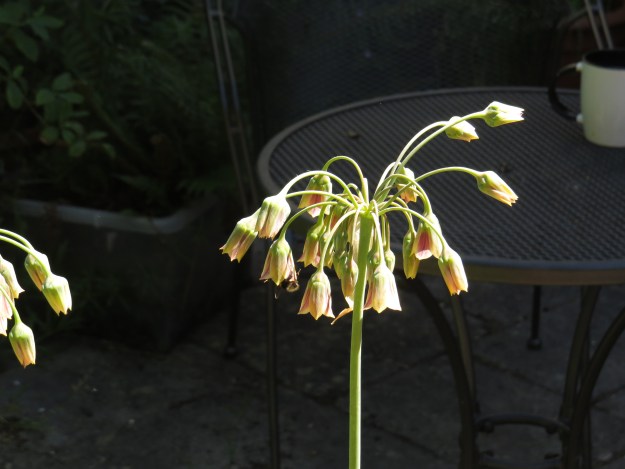
Dear Readers, I planted this bulb in a pot last autumn, and promptly forgot what it was. When all the other bulbs were finished it was still in bud, the flower wrapped in a fine tissue that gradually came to resemble cellophane. Who would have thought that all those blooms could be wrapped up in so small a package? Nature is great at compaction, for sure.

Sicilian honey garlic (or Mediterranean bells or Sicilian honey lily) is a member of the onion family, and comes originally from the area around the Black Sea, and from Italy. It grows there as a woodland plant, and indeed I have one lone Sicilian honey garlic popping up under my whitebeam, which indicates that I have been even more forgetful than I thought. Apparently when cut it has a ‘penetrating skunky odour’ so we won’t do that, but will leave it instead for the bumblebees, who seem to be the only bees with the intelligence to work out how to negotiate the flowers. How they love it, though! They fly in from all directions, and yesterday one actually flew into the back of my head in her haste to get to the nectar, which was quite a shock for both of us.

The flowers are extraordinary but it’s all a bit of a mess at the bottom of the plant, where the leaves are even more untidy than they usually are on bulbs (Wikipedia describes them as ‘unusual twisted foliage’, so maybe I just need to adjust my perceptions).  The flowers start by dangling downwards, but apparently turn to face upwards as they become seedheads. I shall make a point of taking photos daily from now on to see the whole process, otherwise I’ll only notice that things have changed when it’s too late.

As you might expect from an onion, Sicilian honey garlic has been used as an edible ingredient, particularly in Bulgaria, where the leaves of the wild plant (known there as samardala) turn up in spice mixes and salts. Indeed, you can buy some samardala salt for a very reasonable 1.41 GBP from the Bulgarian Spices website, and it’s recommended as a seasoning for egg sandwiches.

Photo One fromhttps://www.bulgarianspices.com/product/samardala/

Samardala spice (Photo One)

However, in a most splendid piece of research for the publication ‘Genetic Resources and Crop Evolution’, it appears that people in Bulgaria use samardala mostly with grilled, roasted or boiled meat. I never cease to be amazed at the sum of human knowledge.

Photo Two from https://www.researchgate.net/figure/Preferred-samardala-salt-food-pairings_fig2_323638847

Photo Two

Like all onions, Sicilian honey garlic contains ‘lachrymatory agents’ – in other words, chemicals that make you cry. I find that my response to cutting up alliums varies greatly according to the onion in question, and that, personally, it’s the little ones that are always the worst. I seem to have built up considerable tolerance over the years, but my husband only has to step into the kitchen when I’m frying up some shallots to start to weep (not as a direct consequence of my cooking skills, I should add). I’ve heard all of the supposed remedies – run your onion under water, wear a snorkel (really!) but my best advice is to use the sharpest knife you have and watch your fingers. Apparently damaging the onion cells causes them to release a chemical that converts to sulfenic acid on contact with the air, irritating the eyes. This chemical is protective for the plant, which might explain why many mammals and some invertebrates avoid garlic and onion-flavoured plants. Some gardeners recommend Sicilian honey garlic for woodland areas both because it is very shade tolerant, but also because (apparently) deer don’t eat it.
Now, I might be impressed by the bumblebees visiting my plant, but in North America you can sometimes see even more exciting visitors. Hummingbirds always know where the strongest, most plentiful nectar is.

Photo by Tony Spencer from https://www.inthehills.ca/2021/03/piet-oudolf-reimagined/

Ruby-throated hummingbird feeding from Sicilian honey garlic in Mono, Ontario, Canada (Photo Three by Tony Spencer)

Now, as you might expect nobody appears to have written a sonnet to this wonderful plant, but Denise Levertov, one of my favourite poets, did compose one on Alliums. I think she’s referring to the commoner purple one with its globe-shaped flowers, but this is also about the bees, and their relationship with all things oniony. I especially like the last two lines.

In Praise of Allium
by Denise Levertov
No one celebrates the allium.
The way each purposeful stem
ends in a globe, a domed umbel,
makes people think,
‘Drumsticks,’ and that’s that.
Besides, it’s related to the onion.
Is that any reason
for disregard? The flowers – look –
are bouquets of miniature florets,
each with six elfin pointed petals
and some narrower ones my eyes
aren’t sharp enough to count,
and three stamens about the size
of a long eyelash.
Every root
sends up a sheaf of sturdy
ridged stems, bounty
to fill your embrace. The bees
care for the allium, if you don’t ­–
hear them now, doing their research,
humming the arias
of a honey opera, Allium it’s called,
gold fur voluptuously
brushing that dreamy mauve.


Photo Credits

Photo One from https://www.bulgarianspices.com/product/samardala/

Photo Two from https://www.researchgate.net/figure/Preferred-samardala-salt-food-pairings_fig2_323638847

Photo by Tony Spencer from https://www.inthehills.ca/2021/03/piet-oudolf-reimagined/


Book Review – ‘Outlandish’ by Nick Hunt

Dear Readers, a while back I was waxing lyrical about Nick Hunt’s book ‘Where the Wild Winds Are‘ and so I couldn’t wait to read his latest book, ‘Outlandish’. In it, Hunt goes to four landscapes which are in places where you wouldn’t expect to find them – tundra in Scotland, desert in Spain, the steppe in Hungary and ancient forest in Poland and Belarus. He is a keen and curious observer, who takes delight in the quirky and who finds himself in a variety of ‘interesting’ situations during his travels.

In the section about the tundra, he meets some reindeer, descended from animals first brought to Scotland in the 1950s. He describes them in a passage which captures the otherworldliness of suddenly meeting an animal in its environment, where it is perfectly at home and you are the anomaly.

They approach on soft, splayed feet and cross the little bridge, expressing no more than mild interest in our presence….We stand quietly and watch as they bend their mouths to the montane grass, chewing rhythmically. Snowy ruffs sway at their necks. The silver-greyness of their hair is the colour of cooling metal. We count their antlers, furred like moss: two have two: one one: one none. Their sodden pelts are as matted as the land they eat’.

But underlying the sweetness of occasions like this is a sense of how the world is changing. The travelogue is book-ended by tales of The Sphinx, an ice patch in the Cairngorms that normally stays all year. When it first disappeared during the summer in 1933,

…’the Scottish Mountaineering Club declared the event to be so unusual that it was ‘unlikely to happen again’. But it did, in 1953, 1959, 1996,2003,2006, 2017 and 2019……. Snow patches such as these are not only scraps of winter but scraps of history, of deep time. Obvious symbols of endurance, of bloody-minded obstinacy, they are also thermometers that self-destruct as the planet warms. When their last smudges have dripped away, the national thaw will be complete. The British Isles will be entirely free of snow in summer’.

Will the Sphinx still be there when Hunt returns from his adventures, or will it have melted away completely? You’ll have to read the book to find out.

The theme of environmental change and the destruction of these fragile remnant habitats underlies the whole book. In Poland he stays with a group of ‘dirty-handed pseudo-ecologists’, there to defend the Bialowieza forest from government logging. In the desert of Tabernas in Spain, he walks in an unprecedented heatwave, headlined in the local paper as ‘Hell is Coming’. And in the Hungarian steppe country of Hortobágy, he meets a German man and, at the end of a long evening, the man shares what I fear a lot of us are feeling.

I do not have hope any more’, he says, this previously smiling man drinking palinka in a horse-drawn trap His voice is getting quieter, guttering with the candle. ‘These places……these places on earth….there are getting less of them. And no one seems to care. The birds are all leaving, and no one cares. What can we do?’

But I wouldn’t want you to think that this is a relentlessly depressing book. Hunt has a way of capturing a moment that I really enjoyed. Here he is, arriving at the guest house where he is staying in Belarus:

The village seems deserted apart from the place where I am staying, a ramshackle smallholding in which every resident creature stands out with the totemic clarity of a dream: the black puppy, the honey-coloured dog, the ginger cat, the ginger and white cat, the white geese with their orange beaks, the creamy brown clucking hens, the pair of white storks in their absurd, cartoonish nest. And Natalya, with her pale blue eyes, chapped red face and straw-coloured hair, in a green headscarf and red shoes, carrying eggs in a basket.’

And here he is, in the desert at Tabernas, trying to cope with the rising heat.

The heat of the afternoon flattens me, even in the shade. I cannot move or think, can only sit and breathe. The air is heavy, as warm as blood, windless, stultifying. I top up my internal reserves of sweat with sips of water. 

The itchy rhythm of the cicadas switches on and off, an electric circuit being interrupted and reconnected. Impossible to locate, seeming to have no origin point but to be present everywhere, even in the rocks and the air, the manic drill – produced by tymbals, rib-like structures in the abdomen – stops abruptly whenever any creature gets within close range, like a reverse intruder alarm. Never laying eyes on one, I find myself thinking of their noise as a manifestation of the heat itself, as if the temperature has been converted into waveform’. 

And in Hungary, he attends a gathering of the steppe-dwelling peoples from Central Asia and Siberia to China. Hunt describes it as ‘somewhere between a hippy folk festival, a medieval re-enactment fair and, as I will discover, a far-right nationalist rally.’

Later that night, during another performance of thundering guitars, I watch — with a hollow, dawning sickness- the unassuming man beside me raise his right arm at an angle of forty-five degrees, palm down, and hold it there. No one pays him any mind. His wife and teenage daughter giggle, a little embarrassed but not ashamed, and then a younger man joins in, smiling happily. The two of them keep it up for song after song until their arms grow tired; afterwards they embrace, as if a special moment has been shared between strangers‘.

Hunt has many gifts, but one is the way that he is able to pull all these disparate threads together. The book is both a celebration of Europe’s ‘outlandish’ places, a warning about the ways that they are changing, and a eulogy for what is already passing. I found it a fascinating and moving read. Highly recommended.

https://www.waterstones.com/book/outlandish/nick-hunt/9781529387391


Babies and Some Cheekiness

Dear Readers, blue tits always sound a bit flustered to me, but for maximum anxiety you need to be present on fledging day. Goodness, the poor parents! I couldn’t work out exactly how many babies there were, but I’d estimate at least six, and they were all over the place. For the adults it must have felt like herding cats, plus they were intent on feeding all the little ones.


Fortunately the fledglings soon get fed up with waiting around and start pecking at things at random, until eventually they learn what’s edible and what’s not. And as at today, none of the babies had managed to drown themselves in the pond, which is always a result.

I decided to put out some suet and live mealworms just in case the blue tits would find them. Sadly, everyone else found them first. Firstly the starlings, with their latest broods of youngsters….

And then an occasional visitor, who always scatters everyone else. The jackdaw spent a good five minutes meticulously searching out the mealworms before flying off. S/he must have a nest somewhere, I’m sure. Look at that face! No wonder no one messes with the jackdaw (except for the magpie).

And finally, I have planted some packets of seeds in some of my pots, and every day someone digs them up. I had my suspicions, but today they were confirmed.

And then another squirrel ran into the garden. Would there be war?

Well, these two obviously knew one another because they touched noses and then sat happily together, squashing my wildflower mix under their furry bottoms. If there was ever evidence that once you have a wildlife garden you have no control whatsoever about who turns up, this is it. And honestly? I don’t begrudge them. There’s plenty in my garden for everyone.

A Mid-June Walk in St Pancras and Islington Cemetery

‘My’ Swamp Cypress

Dear Readers, with the temperatures expected to be in the mid-eighties this week, it seemed that a walk in the shadier parts of the cemetery would be a good idea. However, first I wanted to say hello to ‘my’ swamp cypress, one of my (many) favourite trees. It’s looking very splendid at the moment, even though it’s a good few weeks later than I expected in greening up – the cold May certainly held it back.

It’s the changing of the guard again this week – as you can see from the photo above, the cow parsley is almost finished, but the hogweed is just getting going.

I always think that it looks as if it’s exploding from the stem like a firework.

This shieldbug seemed to be enjoying it as well – it’s the creature with the triangular patterns on it towards the centre of the photograph. Pretty sure it’s a hawthorn shieldbug (Acanthosoma haemorrhoidale) though they’re normally brighter coloured than this one.

The real star of the show this week, though, is the grass, which is waist-deep in some places. The chaps who do the strimming are having a real job keeping up. I quite like it wild, but for people visiting graves it can be a source of some distress. One lady that we spoke to had lost her mother to Covid a few months earlier, and not being able to keep her Mum’s resting place neat and tidy was a real source of distress.  Getting the balance right between the wild spots and the more neatly-groomed one is always going to be tricky, especially with council cutbacks, and such a large area to look after.

Grasses are definitely not my area of expertise, but these have piqued my interest. Let me know if you know what they are, readers! I shall do some research and get back to you. Just about the only grass I’m confident on is wall barley.

Perennial rye-grass (Lolium perenne)??

Cocksfoot (Dactylis glomerata)??

It’s interesting to see how this year’s conkers are already forming on the horse chestnuts…

And the haws are already coming on the hawthorns.

However, spring isn’t quite finished for the birds – I saw a few unusual goings-on in the garden today, which I shall report back on tomorrow, and there was a song thrush singing his head off, so I thought I’d share the moment with you all. You can’t actually see the bird, so you can just relax and listen.

Along by the North Circular Road was a tree that looked like bird cherry, but is evergreen, with very shiny leaves. I’m thinking that it’s a close relative of cherry laurel, Portugal laurel (Prunus lusitanica) – it’s flowering just as the cherry laurel is finishing.

The ox-eye daisies are in full swing, too.

And look at this path. Doesn’t it just make you want to walk along it?

The hogweed always seems to know exactly where the sunny patches are.

And the Scotsman has the sun on his back too.


And all this abundance rather made up for what has happened on our road at home in East Finchley’s County Roads, because the council has been round with the glyphosate and have sprayed not only all the ‘weeds’, but the tree bed where my next door neighbour was growing some California poppies, and the poppy that had self-seeded under my lavender. We shouldn’t blame the people who are doing the spraying, because they are just doing what they’ve been told to do and are probably earning minimum wage for walking the streets all day, but Barnet Council should be listening to the locals, who largely don’t want weed killer sprayed willy-nilly around the places where they live.

My neighbour’s tree pit.

The weeds along the road

My ex-California Poppy

My California poppy last week (Eschscholzia californica)

The only good thing is that most of these annuals have already set seed, and so they’ll be back within a couple of days. And also, the man from the council missed the most enormous sow thistle that is hiding amongst the lavender flowers, which gives me a certain degree of glee. I feel a campaign for no-spraying coming on…..


Things You Don’t Want to See in the Wood

Dear Readers, is there anything more pleasant than to walk amongst the oak and hornbeam trees on a sunny morning, minding your own business and enjoying the song of the birds? Well, if you went down to the woods in the past few weeks you might have gotten more than you bargained for, because here in Coldfall Wood we’ve had one chap exposing himself to women walking past, and another man bursting naked from a bush to confront a woman going for a wander by herself.  Personally, I think we do ourselves no favours by ignoring these events on the basis that the person is  just a mildly comic ‘flasher’. As someone who was, as a young woman, barged into a ditch in a wood in Winchester by a completely naked man and then chased through the undergrowth after I managed to get away, I can vouch for it being terrifying. I can still remember how he smelled, and how I got welts across my arms after running through nettles and brambles. I remember thinking that I would never see my parents again, and that they wouldn’t know what had happened to me. When I finally found some people and told them about the attack, they remarked that there were some very strange people about these days, as if I’d come across someone talking to themselves or wearing a funny hat. It still makes me furious to think about myself as a young woman,  shocked and bloodied, being told that what had happened to me was so was so insignficant.

Even if you are not touched, to be suddenly confronted by someone performing a sexual act that you have no wish to witness. let alone be part of, is a kind of violation, and I suspect that the shock and disgust that it engenders is part of the thrill for the perpetrator. I know of women who’ve responded wittily and disdainfully to such events, and well done them, but in my experience men who have these kinds of compulsions will choose the mildest, most inexperienced and often the youngest of women to torment. Ask your young friends, your daughters, your nieces what’s happened to them. You might be horrified.

But what is saddest, and what is sometimes difficult for people who haven’t had such an experience to understand, is that such events have long-lasting effects. After what happened to me, I could never again enjoy being on my own in an open space without being vigilant. Believe me, when I’m in the woods I know if there’s someone around, if they look suspicious and if I’ve seen them before. In a way it makes me feel closer to the animals for whom this is their everyday reality – no sparrow or wood mouse can afford to relax their guard, and it seems that the same is true for women. I’m not saying that I’m terrified of harm every time I walk out of the door, but the possibility of something happening is real and present to me.

Nor does it stop me doing what I want to do: I walk where I want to walk, when I want to, and if sometimes I have to steel myself to get out of the door, then so be it. I made a decision all those years ago that I would not let someone stop me from enjoying the thing that gives me the most solace, the natural world. And maybe these days I’d be one of those stern women telling the miscreant to ‘put it away’. We need to reclaim the woods, because I think some men take it for granted that they are the normal inhabitants and lords of these places, and that women are an anomaly. The woods actually belong to everyone, and we have as much right to walk unmolested as anyone else.

It’s important to report incidents of indecent exposure to the police – sometimes people need treatment for their compulsions, or you may stop someone from graduating to doing something worse. Believe me, if someone does this to you, the chances are that they”ve done it before and are going to do it again, and the next person might be even more vulnerable than you are.

And chaps, if you’re walking in the woods and you see a woman on her own that you don’t know, think twice before rushing up behind her unexpectedly, and be sensitive about engaging her in conversation, especially if there’s no one else about. You might only be being friendly, but she is probably already  considering you a potential threat, however lovely you are (and I know that the men reading this blog are kind and gentle human beings). Just be thankful that, generally, you can walk in the countryside without anyone waving their private parts at you, or trying to elbow you into a ditch. You don’t know how lucky you are.


So That’s What It Was….

Dear Readers, a couple of weeks ago I asked what on earth had popped up in a pot in my garden, because I’d completely forgotten what it was. Some kind soul suggested an allium, and I can see why, because this plant is an allium, but a rather unusual one. Known to its friends as Sicilian Honey Garlic (Allium siculum) it was recommended in my Gardening for Wildlife book as one of the very best for bumblebees, and whoever wrote it wasn’t kidding. After a slow and disappointing start I’m now entertained all through my lunch by the way the bumbles negotiate these rather tricky flowers, which necessitate them hanging upside down. It must be worth the effort, though, as you can see from the photo above. The bees can’t get enough of it.

Furthermore this is not the only insect action in my garden today, because I am tripping over the damselflies. The red ones have been about for a while….

Large red damselfly Pyrrhosoma nymphula)

And the females have been laying their eggs in the pond, whilst grasped around the neck by the males.

But today the azure damselflies have been getting in on the act too. This is all a bit inconvenient as I was going to clear out some of the hornwort, which has gone absolutely nuts as you can see. Now I think I’ll wait for the eggs to hatch and for the little damselflies to migrate to the bottom of the pond.

Azure damselflies Coenagrion puella

Meanwhile, we seem to have another rush of baby starlings after a disappointing May. I wonder how far the parent birds can control when they lay their eggs and raise their young? Do they take one look at the weather and decide to put it off for a bit, do you think? Anyhow, the garden is full of the sound of wheezing once again, and, between that and the bees, I couldn’t be happier.

Young starling

A Quick Walk Around the County Roads

Dear Readers, it’s been a long, long time since I’ve taken a leisurely walk around the County Roads in East Finchley, and I’m not sure why – it would have been a logical thing to do during lockdown, but somehow it seemed as if walking in the local woods or hanging out in the garden was safer, and once a habit has been put in place it’s very hard for me to break it! But on Monday I was happy to have a little walk around and see what was happening, and I was instantly rewarded by this gorgeous, well-loved front garden – it just goes to show how a few well-loved pots can cheer people up.

But the wild plants are very cheering too. I am trying to learn the difference between the two different kinds of bellflower that pop up around these parts. I am fairly sure that this one is Trailing Bellflower (Campanula poscharskyana) – my Harrap’s Wildflower Guide describes the petals as ‘widely spread into a star shape’ so I am feeling fairly confident. It is popular with the bees and seems to grow everywhere, but it came originally from the Dinaric Alps in Serbia.

Trailing Bellflower (Campanula porscharskyana)

And then there’s Adria Bellflower (Campanula portenschlagiana) – the flowers are described as ‘funnel-shaped’ (much longer than wide). This plant comes from the Dalmatian mountains of Croatia originally. I think the one below fits the bill, though the photo isn’t great for ID purposes. In botanical circles the plants are known as ‘posh and port’ which is a lot easier than getting your tongue around the Latin names. To add to the confusion there is also a Peach-leaved Bellflower (Campanula persicifolia) but I haven’t stumbled across that yet. All three are garden escapes which have happily set up home in the crevices and pavements of North London, and I for one am delighted to see them.

Adria Bellflower (Campanula portenschlagiana)

So, what else is going on? Well, in one front garden I see some scarlet pimpernel, the first time I’ve seen any in East Finchley although I was positively tripping over them when I used to go to Dorset. I wonder if a packet of wildflower seeds was involved, or if it got here under its own steam?

Scarlet pimpernel (Lysimachia arvensis)

There was a truly fabulous large-flowered clematis – I normally think of them as not as good for wildlife as the more discreet, small-flowered types, but there was a honeybee collecting the pollen on this one. And it’s difficult not to smile at those flowers.

Bees were hard at work on some hardy geraniums as well – these were a lovely veined pink. I am still campaigning for more species geraniums in gardens, as you can see – they flower for ages and you can cover most of the spring and summer-flowering periods if you pick the right ones.

I was happy to see that lots of people are growing red valerian(Centrathus ruber) too, though I’d like to put a word in for our native white valerian(Valeriana officinalis), which I shall be having a go at once I can find a spare square inch that isn’t already covered in plants. I have seen hummingbird hawkmoths feeding from red valerian, so if that isn’t a reason for growing it, I don’t know what is.

Red valerian (Centrathus ruber)

And how about this rock rose (Cistus) (I think)? Never was a plant so happy in full sun.

And here’s something else I want to grow – some Columbine, another plant that is popular with bees in spite of its complicated flowers. I really like the smaller-flowered dark blue and pink ones, though I have seen some truly spectacular varieties. Who knew that it was a member of the buttercup family? Not me for sure.

Columbine (Aquilegia vulgaris)

And finally, I lingered in the church yard of All Saint’s Church in Durham Road to watch the sparrows. At this time of year they eat not only the young chard leaves of my dear friend A, but also nectar (I watched them pecking at the flowers on an indigo bush) and, most especially, insects. I am fairly sure that this female sparrow was pecking the aphids off of the roses. If only she would come round and do the same on my buddleia I would welcome her with the proverbial open arms.

Which just goes to show how much there is to see in a walk around my local streets. I heartily recommend it if you’re feeling a bit uninspired or fed up.

Wednesday Weed – Sweet Woodruff

Sweet Woodruff (Gallium odoratum)

Dear Readers, I bought some sweet woodruff because I thought it would be perfect for the shady side of the garden. It was lovingly planted, watered and tended, and within about three days it had practically disappeared, with no sign of obvious nibbling. On the other hand, my good friend A has banks of the stuff in her garden, and so I know that the local conditions are not the problem. Still, that’s gardening for you, a succession of small disasters and happy accidents. If you have any illusions that you’re in control, I suggest you get a garden. It certainly put me right.

Anyhow, sweet woodruff is a really delightful plant. It’s a member of the bedstraw family (Rubiaceae), and is a plant of ancient woodland, with leaves that are said to be hay or vanilla-scented when bruised. It’s native to the UK but grows in a great swathe across Europe and Asia all the way to Japan, taking in Iran, Turkey and the Caucasus en route. In German it’s known as ‘waldmeister‘ or ‘Master of the Woods’ which seems a bit martial for this delicate beauty. It’s also known as ‘Wild Baby’s Breath’ – I assume that the ‘wild’ refers to the plant, not the baby (or indeed the breath).

As you might expect for something so sweet-smelling, sweet woodruff has been used for a variety of purposes. The sweet smell lingers on after the plant is dried, so it has often been used in pot pourri and cosmetics. It seems to have been particularly favoured as a flavouring in Germany, where it’s used in May Wine (Maitrank), an alcoholic beverage traditionally served on May Day. Maitrank involves steeping sweet woodruff in white wine, and very refreshing it looks too.

Photo One by By Dr. Bernd Gross - Own work, CC BY-SA 4.0, https://commons.wikimedia.org/w/index.php?curid=49057025

German May Wine (Photo One)

The plant was also used to flavour beer (Berliner Weisse), ice cream, brandy and a Georgian soft drink called Tarhun. It was used to flavour sherbet powder, though in the UK I’m sure we’re all much more familiar with the zesty lemon-flavoured substance that used to be eaten with a liquorice stick. Alas, the substance that gives woodruff its flavour is called coumarine, and in 1974 the Germans banned its use in products for children because it was found to cause liver damage (and children, being smaller, are more susceptible). Adults can still lay their hands on sweet woodruff-flavoured alcohol, but artificial substitutes are now used in sweets.

In Flora Britannica, Richard Mabey describes how dried woodruff was hung in wardrobes and laid amongst stored linen to deter moths. The leaf whorls were apparently used as bookmarks, and during Georgian times the leaves were placed in the cases of pocket-watches, so that the user could inhale their fragrance whenever they needed to tell the time. Mabey reports that woodruff no longer grows wild in London, but that it was once hung in churches on St Barnabas Day, the 11th June. And a turning close to the Tower of London, now called Cooper’s Row, was once called Woodruff Lane.

And finally, a poem. A few posts back, I wrote about friendship, and how it’s undervalued in our society compared with the love we feel for family and romantic partners. This feels like an intensely personal poem, and yet it made me think of so many of my female friends, past and present, and the things that we’d shared. See what you think.

Up, Over the Steep Hill
by Kathleen Ripley Leo

‘May we strive to touch and to know the great common woman’s heart of us all…’ Mary Stuart

Catch her by the waist, a woman friend,
whose laughter you hear in the night
ringing in your ears: over your elaborate strategy to lose weight;
over the grand joke you keep to yourselves;
over swearing her to secrecy for driving you
to the Secretary of State when you’re late renewing.

Catch her by the waist, a woman friend,
whose baby daughter crawls through your dining room
looking for all the world
like a pink shell on the carpet, she moves so sweetly;
whose son shares his bike lock with your son at school,
the son she cheers on to win the race, to make the grade,
to stay alive one more day in the isolette.

Catch her by the waist, a woman friend,
whose hostas and phlox bloom in your garden;
with whom you kneel and pray for peace;
with whom you silently walk in the woods
hoping the raccoon, sunning itself
on the branch overhead, does not wake up,
hoping the deer in the clearing does not bound away,
who watches with you, both apprehensive and in awe,
as two snakes curl and dance in the sun
on the cement pavement at Maybury;
who takes care of the cat, the mail, the paper,
the broken ground between your houses,
picking you up at the side of the road
when you’ve locked your keys in the car,
quelling the shaking wings of your heart.

Catch her by the waist, a woman friend,
who has lunch with you after the angel tour at the Art Institute;
who helps you overcome your panic attack at the mall,
or on that crowded street in Washington DC,
or at that Brighton home tour;
who asks you to write your poems and to read them outloud;
who helps you pick out glasses to fit your odd and funny face;
who carefully tends to the basil parmesan bread,
so you can take it to your progressive dinner party
and claim you made it;
who washes your clothes in her machine when yours gives out.

Catch her by the waist, a woman friend,
who tells you what happened to the bank of sweet woodruff you dug out
the spring your father died, because in the fall
you couldn’t remember doing that;
who tells you how to think about toxic criticism;
who helps you cope with aggressive jealousy;
who drives you to the hospital when your baby needs x-rays,
and then when your husband’s there;
who drives you to the doctor for the procedure,
and carefully holds you when you cry;
who sees your letters unanswered,
and your invitations refused, sees your hurt and stays quiet;
who catches your waist, too, and together, laughing and crying,
you pull each other up, over the steep hill.

Photo Credits

Photo One by By Dr. Bernd Gross – Own work, CC BY-SA 4.0, https://commons.wikimedia.org/w/index.php?curid=49057025

Tuesday Gardening Update

Dear Readers, I thought you might like to see my angelica aka ‘the triffid’ – the handrail is about three feet high, and the ground is about a foot below the stairs, so I think this plant is about ten feet tall. What a beauty! It’s still abuzz, mainly with honeybees but bumblebees and some tiny wasps/hoverflies have got in on the act too.

My plant guide suggests that in the wild it can grow to about eight feet tall, so this is clearly an outlier, but then I seem to have picked the perfect spot for it, largely by accident – it’s right by the pond, so it’s nice and damp at the root, but it gets sun for most of the day. Plus by the time it goes over the hemp agrimony will be coming into flower, so I’ve extended my flowering season. I just love it when there is a happy accident.

If you look very closely at the middle of the first photo you’ll see that there’s a little wasp/hoverfly, but I need him/her to stay still for a bit longer so I can get a better view. I do love the way that each individual flower on the angelica looks like a tiny acorn though.


Now, I wouldn’t want you to think that I’m so enamoured by the angelica that I’ve forgotten everything else. My blue water irises have buds on them now, which is very exciting, and one of the yellow flags has produced a flower too, the first of many I hope.

Blue water irises

And at the end of the garden, the mock orange is smothered in flowers and bumblebees, and the scent is extraordinary. In fact, there are so many bumblebees that I’m wondering if there’s a nest close by. That would really be a bonus.

I did see one ashy mining bee earlier on (typically when I didn’t have my camera handy), but I’m hoping that they’ll discover the climbing hydrangea flowers, which were a big favourite a few years ago. I’m seeing lots of ladybirds about too, but masses of aphids which are taking over the buddleia in the front garden again as they did last year. I think I’ll send my husband out with the hosepipe to give them a good dousing, that seems to slow them up a little bit.

And so, with the heady scent of the mock orange blossom indicating that summer is truly here, I shall bid you adieu until tomorrow.

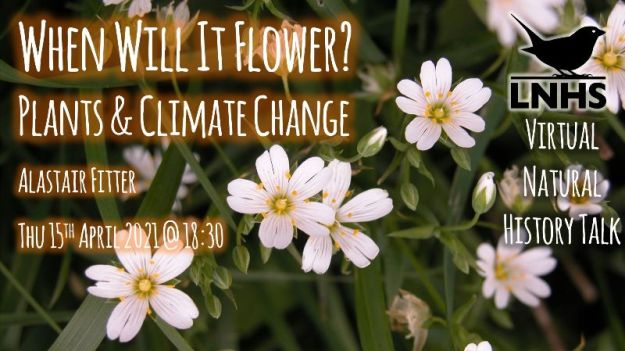
LNHS Virtual Talk – ‘When Will It Flower? Plants and Climate Change’, by Alastair Fitter

Dear Readers, every gardener or natural history enthusiast that I bump into has something to say about the way that plants are changing their habits. So often, though, the information is anecdotal, because we don’t tend to actually record things when they happen. So, it was wonderful to attend this talk by Alastair Fitter, son of Richard Fitter, who wrote the first book about London’s wildlife in the New Naturalist series back in the 1940s and who was, among many other things, president of the London Natural History Society. From 1954 to 2000, Richard Fitter recorded the first flowering dates of various wildflowers growing in his garden and this produced a data set that turned into the first major study of the impact of climate change on the flora of the UK. That document was published in 2002, a collaboration between Richard and Alastair Fitter, when Fitter Senior was nearly 90 years old. The Fitters were interviewed on Radio Four’s Today programme, and when Richard was asked why he’d done all that recording, he replied that as a boy he’d been told that it was always good to write things down. As Alastair Fitter remarked, thank goodness he did!

Another very useful resource is the Woodland Trust’s ‘Nature’s Calendar’, which recorded ‘First Flowering Days’ for a selection of different plants between 2001 and 2016.

What is very clear is that plants are coming into flower earlier, and that this process has speeded up over the past 25 years. From the Woodland Trust data, we see that:

Hazel (Corylus avellana) produced its catkins 31 days earlier in 2016 compared to 2000.

Hazel (Corylus avellana) (Photo One)

Lesser celandine (Ficaria verna) has advanced its flowering date by 27 days between 2001 – 2016, but Richard Fitter recorded the flowering had already come forward by 20 days between 1954 and 2000, making a total advance of an astonishing 47 days between 1954 and 2016.

Photo Two by By Michal Osmenda from Brussels, Belgium - https://www.flickr.com/photos/michalo/2425723494/, CC BY-SA 2.0, https://commons.wikimedia.org/w/index.php?curid=46945738

Lesser celandine (Ficaria verna) (Photo Two)

English bluebells have advanced their flowering date by three weeks since 2001.

Photo Three by MichaelMaggs, CC BY-SA 3.0 <https://creativecommons.org/licenses/by-sa/3.0>, via Wikimedia Commons

English bluebell (Hyacinthiodes non-scripta) (Photo Three)

From Fitter’s data, if you took all the different species in the sample, there had been a general movement towards earlier flowering of about 6 days by 2000, but this hid some major movements by individual plants. For example, white deadnettle (Lamium album) flowered 55 days earlier in the 1990s than it had in the 1950s (and indeed now flowers all year round).

Photo One by Rosser1954, CC BY-SA 4.0 <https://creativecommons.org/licenses/by-sa/4.0>, via Wikimedia Commons

White deadnettle (Photo Four)

There are some very strange anomalies, however: our old friend Buddleia flowered a whole 36 days later in the 1990s compared to the 1950s, and it’s still unclear why. All theories duly considered!

Photo Five by Agnieszka Kwiecień, Nova, CC BY-SA 4.0 <https://creativecommons.org/licenses/by-sa/4.0>, via Wikimedia Commons

Butterfly Bush (Buddleia davidii) (Photo Five)

And while we’re on the subject of garden plants, Fitter describes how Fred Last studied his garden and recorded first flowering dates from 1978 to 2007. Mahonia advanced its flowering time during this period by an extraordinary 3 months (which now makes it one of the handiest garden plants for early bumblebees).

Photo Six by Photo by David J. Stang, CC BY-SA 4.0 <https://creativecommons.org/licenses/by-sa/4.0>, via Wikimedia Commons

Mahonia japonica (Photo Six)

More recent data comparisons by Alastair Fitter show that over 50% of plants are coming into flower by the end of April, an advance of about 5 weeks. But the question is, why?

Fitter explained that flowering times are determined by a number of factors. Firstly, there’s the question of when the flower buds form. For spring bulbs, next year’s flowers are formed during the previous summer, but the actual flowering time is determined by the temperature in the spring.  Fitter used the example of the Tulip Society shows to illustrate this. The date of the Wakefield and North of England Tulip Society’s annual show is determined by when the ‘English florist tulips’ are thought to be coming into their best. The Society was founded in 1836, and Fitter showed a lovely slide, where the date of the show has been coming forward on a smooth curve that exactly matches the average mean temperature in March: for every degree increase, the show comes forward by three days. The show is now commonly held in the second week of May, compared with the very end of May in the mid 1800s.

Photo Seven from https://www.pontefractandcastlefordexpress.co.uk/news/tulips-be-displayed-wakefields-181st-show-778917

Tulips at the 181st Wakefield and North of England Tulip Society Show (Photo Seven)

Another factor that determines flowering time is day-length, with some plants coming into flower as the days lengthen, and others as the days get shorter. Fitter points out that for the majority of plants, we simply don’t know how day-length affects them but for a few, such as red campion (which responds to lengthening days) and hops (which react to shortening days) we can see a correlation.

Temperature is, however, critical. Fitter showed how the flowering time of Coltsfoot was dependent on the mean temperature in February but, more generally, an increase in temperature of 1 degree in the four months before flowering could advance the flowering date by about three days. However, a warm summer and autumn could act to delay flowering by about the same amount. Go figure!  I wondered if a warm summer and autumn might mean lower rainfall, which could delay bud formation. What is clear is that a lot more research is needed, and there is still a lot that we don’t know. The pattern is clear, however: most plants are flowering earlier, and flowering patterns are becoming a lot less predictable.

Photo Eight by Andreas Trepte, CC BY-SA 2.5 <https://creativecommons.org/licenses/by-sa/2.5>, via Wikimedia Commons

Coltsfoot (Tussilago farfara) (Photo Eight)

Fitter’s final point was, do these earlier flowering times matter? And of course, there are a number of problems not just with earlier flowering, but also with the increased unpredictability of flowering times. Some pollinators, for example, will take advantage of earlier flowering, but where there is a very specific relationship, such as that which occurs with orchids, the plant may come into flower but the pollinator will not yet have emerged. Sometimes, as in the case of the orange-tip butterfly, the insect is responding to earlier flowering times of cuckooflower, so that its caterpillars, which feed on the seedpods of the plant, are still ‘in sync’.

Photo Nine by Jessica Towne, CC0, via Wikimedia Commons

Female orange-tip butterfly (Anthocharis cardamines) (Photo Nine)

However, something that had never occurred to me was that, as flowering times change, some plants will be more or less likely to hybridise because their flowering times will move further apart, or begin to overlap. Sweet violets (Viola odorata) will be less likely to crossbreed with hairy violets (Viola hirsuta) because their flowering times are now 15 days further apart. Red campion (Silene dioica) and white campion (Silene latifolia) are, however, coming closer together, and so hybridisation is more likely. As Fitter points out, hybridisation is a major driver of evolutionary change, and so some groups may become less able to adapt over time as their flowering times grow further apart.

Photo Ten by The original uploader was Sannse at English Wikipedia., CC BY-SA 3.0 <http://creativecommons.org/licenses/by-sa/3.0/>, via Wikimedia Commons

Hybrid Campion ( red campion (Silene dioica) and white campion (Silene latifolia) (Photo Ten)

And so, Fitter ended by saying that earlier flowering times are a clear harbinger of climate change, and an indicator that things were changing rapidly in the natural world. We owe a debt of gratitude to Richard Fitter for ‘writing things down’, and it seems to me that this illustrates yet again the importance of citizen science, of recording these extraordinary times that we live in. And Fitter finished as he’d started, with a quote from Shakespeare, in which Titania blames Oberon for the strange changes in the climate. I think we need to look a little closer to home.

‘And thorough this distemperature we see
The seasons alter: hoary-headed frosts
Far in the fresh lap of the crimson rose,
And on old Hiems’ thin and icy crown
An odorous chaplet of sweet summer buds
Is, as in mockery, set: the spring, the summer,
The childing autumn, angry winter, change
Their wonted liveries, and the mazed world,
By their increase, now knows not which is which.’

I cannot recommend this talk highly enough, and you can watch the whole thing here.

Photo Credits

Photo One by Agnes Monkelbaan, CC BY-SA 4.0 <https://creativecommons.org/licenses/by-sa/4.0>, via Wikimedia Commons

Photo Two by By Michal Osmenda from Brussels, Belgium – https://www.flickr.com/photos/michalo/2425723494/, CC BY-SA 2.0, https://commons.wikimedia.org/w/index.php?curid=46945738

Photo Three by MichaelMaggs, CC BY-SA 3.0 <https://creativecommons.org/licenses/by-sa/3.0>, via Wikimedia Commons

Photo Four by Rosser1954, CC BY-SA 4.0 <https://creativecommons.org/licenses/by-sa/4.0>, via Wikimedia Commons

Photo Five by Agnieszka Kwiecień, Nova, CC BY-SA 4.0 <https://creativecommons.org/licenses/by-sa/4.0>, via Wikimedia Commons

Photo Six by Photo by David J. Stang, CC BY-SA 4.0 <https://creativecommons.org/licenses/by-sa/4.0>, via Wikimedia Commons

Photo Seven from https://www.pontefractandcastlefordexpress.co.uk/news/tulips-be-displayed-wakefields-181st-show-778917

Photo Eight by Andreas Trepte, CC BY-SA 2.5 <https://creativecommons.org/licenses/by-sa/2.5>, via Wikimedia Commons

Photo Nine by Jessica Towne, CC0, via Wikimedia Commons

Photo Ten by The original uploader was Sannse at English Wikipedia., CC BY-SA 3.0 <http://creativecommons.org/licenses/by-sa/3.0/>, via Wikimedia Commons