Monthly Archives: April 2022

Sunday Quiz – North London Plants

Dear Readers, you might think that North London would be a poor place for plants, but not a bit of it – there are a wide range of habitats, and a considerable number of ‘aliens’ who have made the pavements of East Finchley their home. Some might call them ‘weeds’, but for me they a valuable reminder of the extraordinary resilience and adaptability of life.

So, for this week’s quiz, see if you can identify the plants in the photographs below. I am going to make it a tad harder by not making it multiple choice this week, which is fiendish I know, but you’re all doing far too well. However, I will give you a little clue under each photo. So, ‘all’ you have to do is to name the plants.

You have until 5 p.m. UK time on Friday 15th April to pop your answers into the comments (as usual I will disappear them as soon as I see them) and the results will be published on Saturday  16th April.

Have fun!

1). Smelly but pretty?

2) The only native member of the cucumber family.

3. St Simeon’s Herb

4. Its leaves are so soft that some people call it the Andrex plant.

5) Also known as ‘moneywort’ and ‘herb twopence’.

6) The foodplant of the Wood White butterfly

7) Used to flavour beer and wine, and to sweeten the beds of our ancestors

8) Lemon-flavoured

9) Popular with birds, but beware of the cyanide….

10)This native might sound Scandinavian, but it’s the salt that it likes….. (we’re after the white plant, not the pink one :-))


Sunday Quiz – Baby Birds – The Answers!

Juvenile blackbird (Turdus merula) (Photo by Anne Burgess)

Dear Readers, everyone did extremely well this week, so you should all be very proud of yourselves! Andrea Stephenson had 9/12, Rosalind and Mark had 10/12, Mike from Alittlebitoutoffocus got 11/12 (you had two ‘k’s when I’m sure one of them was meant to be a ‘j’ Mike!) but the winners are Fran and Bobby Freelove with a perfect 12/12. Well done everyone, and let’s see what I can come up with tomorrow….

Photo One by Paco Gómez from Castellón, Spain, CC BY-SA 2.0 <https://creativecommons.org/licenses/by-sa/2.0>, via Wikimedia Commons

1) D) Ring Ouzel (Turdus torquatus)

Photo Two by Charles J. Sharp, CC BY-SA 3.0 <https://creativecommons.org/licenses/by-sa/3.0>, via Wikimedia Commons

2) G) Long-tailed Tit (Aegithalos caudatus)

Photo Three by Tristan Ferne, CC BY 2.0 <https://creativecommons.org/licenses/by/2.0>, via Wikimedia Commons

3) C) Great Tit (Parus major)

Photo Four by Christine Matthews 

4) K) Blue tit (Cyanistes caeruleus)

Photo Five by Tristan Martin at https://www.flickr.com/photos/mukumbura/7518935694

5) I) Dunnock (Prunella modularis)

Photo Six by Mike Prince from Bangalore, India, CC BY 2.0 <https://creativecommons.org/licenses/by/2.0>, via Wikimedia Commons

6) J) Robin (Erithacus rubecula)

Photo Seven by Ken Billington, CC BY-SA 3.0 <https://creativecommons.org/licenses/by-sa/3.0>, via Wikimedia Commons

7) H) Black Redstart (Phoenicurus ochruros)

Photo Eight by John Queen at https://www.flickr.com/photos/jdqueen/49988614782

8) L) Blackcap (Sylvia atricapella)

Photo Nine by Peter Trimming, CC BY 2.0 <https://creativecommons.org/licenses/by/2.0>, via Wikimedia Commons

9) B) Sparrowhawk (Accipiter nisus)

Photo Ten by Stevie Clarke at https://www.flickr.com/photos/steviec-photography/8497614479

10) A) Siskin (Carduelis spinus)

Photo 11 by Eero Kiuru at https://www.flickr.com/photos/eerokiuru/48421741136

11) F) Bullfinch (Pyrrhula pyrrhula)

Photo 12 by Marek Szczepanek, CC BY-SA 4.0 <https://creativecommons.org/licenses/by-sa/4.0>, via Wikimedia Commons

12) E) Goldfinch (Carduelis carduelis)

Photo Credits

Photo One by Paco Gómez from Castellón, Spain, CC BY-SA 2.0 <https://creativecommons.org/licenses/by-sa/2.0>, via Wikimedia Commons

Photo Two by Charles J. Sharp, CC BY-SA 3.0 <https://creativecommons.org/licenses/by-sa/3.0>, via Wikimedia Commons

Photo Three by Tristan Ferne, CC BY 2.0 <https://creativecommons.org/licenses/by/2.0>, via Wikimedia Commons

Photo Four by Christine Matthews 

Photo Five by Tristan Martin at https://www.flickr.com/photos/mukumbura/7518935694

Photo Six by Mike Prince from Bangalore, India, CC BY 2.0 <https://creativecommons.org/licenses/by/2.0>, via Wikimedia Commons

Photo Seven by Ken Billington, CC BY-SA 3.0 <https://creativecommons.org/licenses/by-sa/3.0>, via Wikimedia Commons

Photo Eight by John Queen at https://www.flickr.com/photos/jdqueen/49988614782

Photo Nine by Peter Trimming, CC BY 2.0 <https://creativecommons.org/licenses/by/2.0>, via Wikimedia Commons

Photo Ten by Stevie Clarke at https://www.flickr.com/photos/steviec-photography/8497614479

Photo Eleven by Eero Kiuru at https://www.flickr.com/photos/eerokiuru/48421741136

Photo Twelve by Marek Szczepanek, CC BY-SA 4.0 <https://creativecommons.org/licenses/by-sa/4.0>, via Wikimedia Commons

The Day the Asteroid Struck….

Images of fish, thought to be victims of the asteroid strike that wiped out the dinosaurs (Robert dePalma, University of Kansas, via New Scientist)

Dear Readers, as I was innocently sitting at my desk writing yesterday’s blogpost, there was an enormous flash in the street outside, followed by an ear-splitting boom. I thought for a moment that an electricity substation had blown up, or something more sinister had happened, but as it turned out, it was just a thunderstorm directly overhead. However, for the plants and animals going about their lives 66 million years ago, the end of the world really was nigh, and, remarkably, scientists have found a site which preserves the remains of animals in the very immediate aftermath of the disaster.

The Tanis site in North Dakota was the site of a massive flood in the immediate aftermath of  the asteroid impact, which took place at Chicxulub on the Yucatan peninsula in Mexico. It’s unusual to able to date a site so accurately, but the impact was so severe that it produced glass crystals called tektites, which rained down in the days and weeks following the event. The fish that are found at the Tanis site have these tektites in their gills, which indicates that they must have died very shortly after the asteroid hit. The chemical signature of the tektites matches that on the impact site in Mexico, and the rock formation that they are preserved in is also characteristic of the aftermath of the explosion.

The site has been somewhat controversial – the original results, in 2019, were published in New Yorker magazine rather than in a scientific journal. However, a continuous stream of interesting fossils has been discovered, including, in 2021, the remains of a turtle impaled on a branch. The animal was probably about five years old, and had already escaped being eaten by a crocodile, judging by the bite marks on its shell. The lead scientist, Robert dePalma, explained the fossil in New Scientist in 2021:

“First, it would have experienced an odd seismic jolt, some minutes after the impact,” DePalma told the conference. “And then it would have seen tiny, red-hot glass beads [in the sky] as the ejecta would have started to come in from the Chicxulub site. Then, the surge rushed up, about 10.5 metres in depth. At that point, he or she got impaled by a branch. So it was a very bad day for the turtle.”

Read more: https://www.newscientist.com/article/2294204-impaled-turtle-reveals-new-insight-on-the-day-the-dinosaurs-died/#ixzz7PmLnFIB1

And today, The Guardian reports that the thigh bone of a small dinosaur, a Thescelosaurus neglectus has been found, perfectly preserved (even the skin can be seen), with fragments of debris from the explosion embedded in the bone.

Skeleton of a Thescelosaurus neglectus, photographed by Jocelyn Augustino for The Guardian

It is astonishing to think that there is a site that preserves the remains of animals actually killed during the aftermath of the asteroid strike, and the BBC think so too, as they are in the process of making a documentary about the site (featuring David Attenborough no less), so UK viewers keep your eyes skinned – it will be called ‘Dinosaurs – The Final Day’. I suspect that the Tanis site will continue to produce fascinating details of this extraordinary day in the history of life on this planet. And although it was a bad day for the poor dinosaurs, it also cleared the way for the rise of mammals and for those other dinosaurs, the birds. It makes me think about how resilient life is, and how, pragmatically, nature seems to take lemons and make lemonade with them. Which, strangely enough, I find rather comforting.

At The Royal Academy – Man and Beast: Francis Bacon

Study for Chimpanzee (1957)

Dear Readers, as you might remember I am ploughing through a biography of Lucian Freud at the moment, and he was great pals with Francis Bacon. I find many similarities between their work – an obsession with the colour and texture of flesh, an insistence on what is actually there, a sense that ‘prettification’ is anathema. No one ever goes to see Francis Bacon to be cheered up, because although the word ‘visceral’ is overused, that’s what it is – these paintings go straight past the rational mind to something underneath.

As I stroll through the galleries of the Royal Academy (and to be out and about and doing something cultural is such a treat), I am struck by how many people look either bamboozled or disgusted, and I suspect that Bacon has been eliciting these emotions since he first started painting. Bacon was raised on a stud farm in Ireland, and was always fascinated by animals, though to my knowledge he never actually painted a horse. Still, he would have witnessed the raw emotions of ‘beasts’ at first hand, their lust and their violence, and also their deaths. He had well-thumbed copies of Muybridge’s books on animals and people in motion in his studio, and some of his paintings combine the human and the animal until they are the same.

In the Portrait of George Dyer (below), the human figure seems to be crouched in some kind of enclosure, like a zoo animal. Bacon’s subjects are often alone and confined. The reproduction doesn’t show it very clearly, but the ‘cloth’ to the right of the ‘enclosure’ was the same colour and texture as raw meat. The figure seems to be horned, or to have the mandibles of a beetle. He crouches as if uncertain what to do next.

Dyer was Bacon’s lover. They met in 1963, when Dyer was a handsome small-time gangster. Their relationship was sadomasochistic, alcohol-fuelled and deeply dysfunctional, particularly for Dyer, who discovered that being a muse, and a kept man, was not an easy life, regardless of how it appeared from the outside. He died of a deliberate overdose in 1971, two days before Bacon had a huge retrospective show in Paris.

Portrait of George Dyer Crouching, 1966

Bacon is, perhaps, the painter who most articulates sheer dread. His figures are always distorted, his mouths always screaming. The painting below predates Bacon’s ‘Screaming Popes’ series by several years, but already there’s the sense of existential horror – the figure encased and isolated in a glass cube. Is this about the loss of faith, the total loss of meaning? As usual with Bacon, it’s impossible to pin him down – the face is said to have been influenced by Eisenstein’s screaming woman from the film ‘Battleship Potemkin’, but the images are also based on Velasquez’s studies of Pope Innocent X.

Head VI (1949)

Towards the end of his life, Bacon was pushing the human figure about as far as it could go. He was working in the triptych form, and in 1988 he reworked his 1944 painting ‘Three Studies for Figures at the Base of a Crucifixion’, changing the background colour from orange to red, and making the figures smaller. The figures in both paintings are based on the Furies, who hunted down those who had committed matricide and patricide. One line from Aeschylus was said to have haunted Bacon throughout his life – “the reek of human blood smiles out at me”. When mouths are not screaming, they are looking to take a chunk out of someone.

Three Studies for Figures at the Base of a Crucifixion (1944)

Study for Three Figures at the Base of a Crucifixion (1988)

But strangely, after all that sound and fury, Bacon’s last painting is a subdued work. He had been fascinated by bullfights, with their combination of blood, cruelty, passion and death. But this image, with its muted tones and static subject, seems like a farewell to me: among the materials used in its creation is dust (and not for the first time – Bacon was notoriously slovenly in spite of his acute asthma, and would often use dust to create the colours and texture that his paintings needed).

“The world is just a dung heap,” Bacon told Joshua Gilder in 1980, when he was seventy-one. “It’s made up of compost of the millions and millions who have died and are blowing about. The dead are blowing in your nostrils every hour, every second you breathe in. It’s a macabre way of putting it, perhaps; but anything that’s at all accurate about life is always macabre. After all, you’re born, you die.” (Cabinet Magazine, Issue 35)

Bacon is undoubtedly one of the great painters of the twentieth century, with his unique vision. There is a truth to his work that it’s hard to deny. It’s not the only truth, however. There is no room in his work for beauty, and precious little for love. I can admire him without wanting to live in his world.

Francis Bacon: Man and Beast is at the Royal Academy until 17th April, so get your skates on if you want to visit!

Study of a Bull, 1991

April Garden Update

Dear Readers, spring has certainly sprung here in East Finchley, so I thought I’d give you a quick guided tour during my lunch break. The flowering currant is splendid as always, and much appreciated by the hairy-footed flower bees and this little blurred ginger blob, who, if I’m not mistaken, is a common carder bee. These small bumbles seem to emerge very early, and to stay around for longer than anybody else, and very sweet they are too.

I love the flowering currant; if it wasn’t for the fact that I need some later flowering plants, I would be collecting them! This one is the self-sown child of the one below, which has much redder flowers, but which is no longer so vigorous as it once was.

I planted lots of grape hyacinths last year, and while the ‘ordinary’ deep blue ones have been up for a while, the pure white ones are just getting going…

I also planted some which were blue at the bottom and white at the top, and they are just beginning to show. I suspect that like many varietals they won’t be as tough and floriferous as their less fancy cousins, but let’s see.


The wood anemones have come back, though I fear our sluggy friends might have been nibbling at the petals.

The Geranium macorrhizum turned out to be a very good buy, it’s been in flower for a couple of weeks now.

And the forget-me-nots are doing well…

As are the fritillaries. What you see beside them is a fancy new deadnettle, just in case you thought things were going completely to pot – I bought them last year and they didn’t flower, so fingers crossed for this year.

The marsh marigold is flowering…

And we are going to have a spectacular show of climbing hydrangea this year, just look at all the flowers…

I was just about to head back indoors when I heard the fluty song of a blackbird. Only it wasn’t, as a rapid-fire combination of whistles and clicks straight afterwards proved. No, it was this little chap. Enjoy your leisure time, starling, you’ll soon have lots of little beaks to feed….

Hot Ostriches!

Photo One by Bernard DUPONT from FRANCE, CC BY-SA 2.0 <https://creativecommons.org/licenses/by-sa/2.0>, via Wikimedia Commons

Male ostrich (Struthio camelus) (Photo One)

Dear Readers, I don’t know what it is about birds, but much as I like them, they don’t always like me. As you may remember, I was chased by a goose when I visited a City Farm, and when I went for my first ever visit to South Africa, our jeep was hotly pursued by a male ostrich, which was a bit like being hunted down by a velociraptor. Gosh, those creatures can run! And they know all the short cuts! I remember our jeep bumping over potholes and careering through bushes. We’d stop, thinking we’d finally outrun Mr Ostrich, only to hear the telltale thumping of his feet as he accelerated towards us. As he was more than eight feet tall on his tippy-toes and had already given someone a nasty peck on the head, we were all semi-traumatised by the experience. For the rest of the trip, the sight of an irate hippo or a prowling lion didn’t bother us, but we’d all shriek at the sight of an ostrich. It feels a bit like the chicken’s revenge.

Anyhow, I was fascinated by this article in New Scientist this week, which is all about the neck of the ostrich. Large animals tend to have more problems with rapid temperature changes because they can’t lose heat quickly (if you all remember your surface area to volume from school biology lessons). Different creatures evolve different methods to deal with this, like the enormous flappy ears of the African elephant. For the ostrich, the key seems to be that their necks act as a radiator.

Photo Two by Benh Liu Song from https://www.flickr.com/photos/blieusong/7234068808

Herd of ostriches (Photo Two)

Erik Svensson, from Lund University, Sweden, spent five years taking infrared photographs of ostriches at a research farm in Klein Karoo, South Africa, and discovered that the ostrich’s neck acts as a ‘thermal window’, emitting heat when it’s too hot, and retaining it when it’s too cold, thus keeping the temperature of the head and brain stable. Our guide on our ostrich-embellished South Africa trip told us that the birds only have a brain the size of a walnut, and was very disparaging about them. However, as the ostrich had reduced a whole jeepload of English tourists to jabbering wrecks I think he might have underestimated them.

The research farm has three different subspecies of ostrich, one from Kenya, one from Zimbabwe and one from South Africa. Interestingly, the ones from Zimbabwe and South Africa, where there is more climatic variation, seem to be better at shifting the temperature of their necks. Furthermore, female ostriches who had a greater temperature difference between their necks and their heads laid more eggs in the following period than ostriches with a smaller difference, implying that the neck is a buffer for heat stress. After all, keeping our brains from frying is important for any species, hence the need for sunhats and for none of that ‘mad dogs and Englishman going out in the midday sun’ stuff.

Photo Three byDonarreiskoffer, CC BY 3.0 <https://creativecommons.org/licenses/by/3.0>, via Wikimedia Commons

Ostrich panting (Photo Three)

Ostriches also pant, and Ben Smits at Rhodes University in South Africa wonders if the hot blood from the neck is actually shunted upwards and then cooled when the animal opens its mouth, as happens with dogs (and humans).

Scientists speculate that as the climate gets warmer, the neck of the ostrich could get even longer – this appears to be a genetic adaptation, and so it can be passed on through the generations. It’s clearly beneficial for the ostrich, both in terms of survival and of reproductive success. I’m not sure exactly how I feel about an even taller ostrich than the one that we met, but maybe next time I’m planning visiting somewhere which has ostriches, I’ll take a tin hat (though that might just lead to my brain overheating).

Photo Credits

Photo One by Bernard DUPONT from FRANCE, CC BY-SA 2.0 <https://creativecommons.org/licenses/by-sa/2.0>, via Wikimedia Commons

Photo Two by Benh Lieu Song from https://www.flickr.com/photos/blieusong/7234068808

Photo Three by Donarreiskoffer, CC BY 3.0 <https://creativecommons.org/licenses/by/3.0>, via Wikimedia Commons

Resilience…

Dear Readers, a few years ago this poor old crab apple  had a nasty encounter with a scaffolding lorry, which took off an entire branch. 

This was a bit of a peculiar looking tree to start with, and losing a great chunk has done nothing for its good looks. Furthermore, as far as I can see it has been left to its own devices, with the wound left open to the elements and to any passing fungal spores/burrowing insects/pollution that might be passing. And yet.

The wound today.

Look at the blossom! The tree is completely lopsided but it’s not going to let a little thing like that get in the way of its flowering.

I have no idea how long it will survive, but it is certainly not prepared to keel over just yet. Our street trees are so valuable and yet they often go under our radar until they are cut down.

I was also struck by the flowers on this cherry, also on Huntingdon Road, which are literally coming out of the bark. It doesn’t matter how often we prune our trees and shrubs, they sometimes seem to have an idea of what they want they do.

And here’s the blossom in a more usual spot…

And finally, here’s a view down Summerlee Avenue. This lovely road lost several silver birches during the recent storms, but it’s good to see that some survived. Spring is definitely on the way, even though we had snow flurries yesterday.

Sunday Quiz – Baby Birds

Juvenile blackbird (Turdus merula) (Photo by Anne Burgess)

Dear Readers, I’m being a little bit premature here, but very shortly the trees and shrubs will be full of juvenile birds, some of which look very unlike their parents. Your mission this week is to match the species of the birds to the photographs. I’ve published the photos at a smaller size in this week to reduce all the scrolling up and down, but let me know if this is an improvement (or not :-))

So, if you think that the bird in Photo 1 is a siskin, your answer is 1) A)

As usual, you will have until 5 p.m UK time on Friday (8th April) to post your answers in the comments, and I will disappear them as soon as I see them. The results will be posted on Saturday 9th April.

Onwards!

List of Species

A) Siskin (Carduelis spinus)
B) Sparrowhawk (Accipiter nisus)
C) Great Tit (Parus major)
D) Ring Ouzel (Turdus torquatus)
E) Goldfinch (Carduelis carduelis)
F) Bullfinch (Pyrrhula pyrrhula)
G) Long-tailed Tit (Aegithalos caudatus)
H) Black Redstart (Phoenicurus ochruros)
I) Dunnock (Prunella modularis)
J) Robin (Erithacus rubecula)
K) Blue tit (Cyanistes caeruleus)
L) Blackcap (Sylvia atricapella)

Photo One by Paco Gómez from Castellón, Spain, CC BY-SA 2.0 <https://creativecommons.org/licenses/by-sa/2.0>, via Wikimedia Commons

1)

Photo Two by Charles J. Sharp, CC BY-SA 3.0 <https://creativecommons.org/licenses/by-sa/3.0>, via Wikimedia Commons

2)

Photo Three by Tristan Ferne, CC BY 2.0 <https://creativecommons.org/licenses/by/2.0>, via Wikimedia Commons

3)

Photo Four by Christine Matthews 

4)

Photo Five by Tristan Martin at https://www.flickr.com/photos/mukumbura/7518935694

5)

Photo Six by Mike Prince from Bangalore, India, CC BY 2.0 <https://creativecommons.org/licenses/by/2.0>, via Wikimedia Commons

6)

Photo Seven by Ken Billington, CC BY-SA 3.0 <https://creativecommons.org/licenses/by-sa/3.0>, via Wikimedia Commons

7)

Photo Eight by John Queen at https://www.flickr.com/photos/jdqueen/49988614782

8)

Photo Nine by Peter Trimming, CC BY 2.0 <https://creativecommons.org/licenses/by/2.0>, via Wikimedia Commons

9)

Photo Ten by Stevie Clarke at https://www.flickr.com/photos/steviec-photography/8497614479

10)

Photo 11 by Eero Kiuru at https://www.flickr.com/photos/eerokiuru/48421741136

11)

Photo 12 by Marek Szczepanek, CC BY-SA 4.0 <https://creativecommons.org/licenses/by-sa/4.0>, via Wikimedia Commons

12)


Sunday Quiz – Don’t Bug Me! – The Answers

Red and Black Froghopper (Cercopsis vulnerata) Photo by gailhampshire from Cradley, Malvern, U.K, CC BY 2.0 <https://creativecommons.org/licenses/by/2.0&gt;, via Wikimedia Commons

Dear Readers, we only had a few players this week, but all of them did spectacularly well, so it’s congratulations to Fran and Bobby Freelove and to Claire who all got 12/12, well done! You certainly know your bugs, Bugwoman approves :-). And tomorrow I’m in the mood for something a bit birdy, so let’s see what happens….

Photo A by Martin Cooper from https://www.flickr.com/photos/m-a-r-t-i-n/14446738521

A) 4) Common Froghopper (Philaenus spumarius)

Photo B by AfroBrazilian, CC BY-SA 4.0 <https://creativecommons.org/licenses/by-sa/4.0>, via Wikimedia Commons

B) 10) Common Pondskater (Gerris lacustris)

Photo C by Bj.schoenmakers, CC0, via Wikimedia Commons

C) 2) Parent Shieldbug (Elasmucha grisea)

Photo D by By André Karwath aka Aka - Own work, CC BY-SA 2.5, https://commons.wikimedia.org/w/index.php?curid=3544799

D) 6) Rhododendron Leafhopper (Graphocephala fennahi)

Photo E by Bj.schoenmakers, CC0, via Wikimedia Commons

E) 12) Water Scorpion (Nepa cinerea)

Photo F by AfroBrazilian, CC BY-SA 4.0 <https://creativecommons.org/licenses/by-sa/4.0>, via Wikimedia Commons

F) 5) Rhombic Leatherbug (Syromastus rhombeus)

Photo G by Kjetil Fjellheim from Bergen, Norway, CC BY 2.0 <https://creativecommons.org/licenses/by/2.0>, via Wikimedia Commons

G) 7) Common Green Capsid Bug (Lygocoris pabulinus)

Photo H by Fritz Geller-Grimm, CC BY-SA 3.0 <https://creativecommons.org/licenses/by-sa/3.0>, via Wikimedia Commons

H) 3) New Forest Cicada (Cicadetta montana)

Photo I by By © entomartIn case of publication or commercial use, Entomart wishes then to be warned (http://www.entomart.be/contact.html), but this without obligation. Thank you., Attribution, https://commons.wikimedia.org/w/index.php?curid=823727

I) 9) Water Measurer (Hydrometra stagnorum)

Photo J by By Pjt56 --- If you use the picture outside Wikipedia I would appreciate a short e-mail to pjt56@gmx.net or a message on my discussion page - Own work, CC BY-SA 4.0, https://commons.wikimedia.org/w/index.php?curid=62624074

J) 1) Hawthorn Shieldbug (Acanthosoma haemoprrhoidale)

Photo K by By Content Providers(s): CDC/ Harvard University, Dr. Gary Alpert; Dr. Harold Harlan; Richard Pollack. Photo Credit: Piotr Naskrecki - http://phil.cdc.gov/phil/details.asp?pid=9822, Public Domain, https://commons.wikimedia.org/w/index.php?curid=2119254

K) 7) Bedbug (Cimex lectularius)

Photo L by AnemoneProjectors, CC BY-SA 2.0 <https://creativecommons.org/licenses/by-sa/2.0>, via Wikimedia Commons

L) 11) Common Water Boatman (Corixa Punctata)

Photo Credits

Photo A by Martin Cooper from https://www.flickr.com/photos/m-a-r-t-i-n/14446738521

Photo B by AfroBrazilian, CC BY-SA 4.0 <https://creativecommons.org/licenses/by-sa/4.0>, via Wikimedia Commons

Photo C by Bj.schoenmakers, CC0, via Wikimedia Commons

Photo D by By André Karwath aka Aka – Own work, CC BY-SA 2.5, https://commons.wikimedia.org/w/index.php?curid=3544799

Photo E by Bj.schoenmakers, CC0, via Wikimedia Commons

Photo F by AfroBrazilian, CC BY-SA 4.0 <https://creativecommons.org/licenses/by-sa/4.0>, via Wikimedia Commons

Photo G by Kjetil Fjellheim from Bergen, Norway, CC BY 2.0 <https://creativecommons.org/licenses/by/2.0>, via Wikimedia Commons

Photo H by Fritz Geller-Grimm, CC BY-SA 3.0 <https://creativecommons.org/licenses/by-sa/3.0>, via Wikimedia Commons

Photo I by By © entomartIn case of publication or commercial use, Entomart wishes then to be warned (http://www.entomart.be/contact.html), but this without obligation. Thank you., Attribution, https://commons.wikimedia.org/w/index.php?curid=823727

Photo J by By Pjt56 — If you use the picture outside Wikipedia I would appreciate a short e-mail to pjt56@gmx.net or a message on my discussion page – Own work, CC BY-SA 4.0, https://commons.wikimedia.org/w/index.php?curid=62624074

Photo K by By Content Providers(s): CDC/ Harvard University, Dr. Gary Alpert; Dr. Harold Harlan; Richard Pollack. Photo Credit: Piotr Naskrecki – http://phil.cdc.gov/phil/details.asp?pid=9822, Public Domain, https://commons.wikimedia.org/w/index.php?curid=2119254

Photo L by AnemoneProjectors, CC BY-SA 2.0 <https://creativecommons.org/licenses/by-sa/2.0>, via Wikimedia Commons

Two Years On…

Dear Readers, on 31st March it was two years since my lovely Dad died, and it’s already over three years since we lost Mum. When Dad died, I felt as if a whole chapter of my life had ended – it wasn’t just that I’d lost my parents, but that I was no longer going to the nursing home, or going to Milborne St Andrew where they’d lived. But gradually, I realised that if I lost Dorset and all the things it meant to me, it would be a choice, not something that was inevitable. I could either let all those memories, good and bad, fade until they became unreal, or I could continue travelling to the West Country to visit Mum and Dad’s grave, and to spend some time in the area that they loved so much. And so, I decided that although neither Mum or Dad were into grave visiting, I would make the trip to St Andrew’s Church, and would consciously take the time to remember them, and to keep Dorset in my life.

First there’s always the tidying away of the old items – there were some broken ornaments, and the artificial flowers had reached a point where they looked dusty and old. I had brought two scabious, both with lots of buds, and some lavender. I remembered later that Mum wasn’t a big lavender fan, but these are the ones with bunny ears that she always found amusing, so I hope she’ll forgive me.

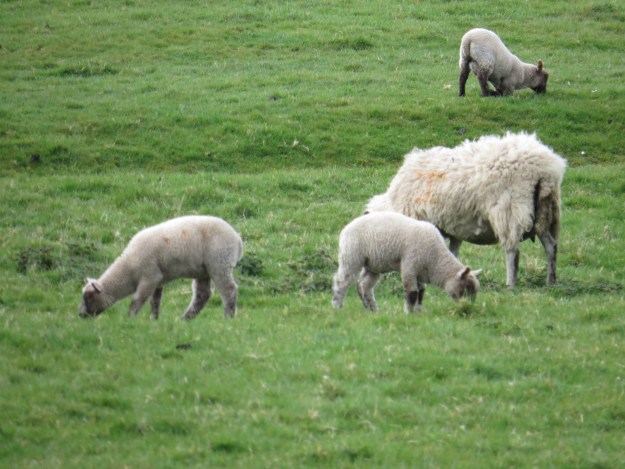
I was sitting by the grave, remembering, when there was a loud ‘baa-ing’ sound, and I noticed that I was being watched by a ewe and two lambs in the next field. As soon as I looked up they moved away, looking almost sheepish if you’ll forgive the pun. Then three small lambs bounced over to the corner of the field, where the grass is clearly greener.

The local agricultural college, Kingston Maurward, used to have ‘lambing days’, when you could visit and actually see the ewes giving birth to the lambs. I went with Mum and Dad once. I remember how Mum watched a ewe straining until she delivered twin lambs (Dad turned mildly green and had to go outside). When she saw the ewe licking the lambs, and then the lambs’ first wobbly steps, she turned to me and told me that she’d never eat lamb chops again. And so she didn’t. Mum was an inveterate city girl, born and bred in London, and it was as if it had suddenly dawned on her that meat had a cost. A visit to a piggery and a dairy farm and she’d probably have been a vegan.

And so, I felt a kind of joy that there were lambs so close to the grave, even though Mum isn’t here to see them.

And truly, this is a beautiful graveyard. The snowdrops have finished, and the lesser celandine were hiding their faces from the freezing wind, but the primroses are everywhere.

It’s painful coming back, and yet it’s also healing. I sat in the church where we held Dad’s memorial service last year, and had a good cry. There’s something about St Andrews that always makes me feel very held and supported; it was founded nearly a thousand years ago and I wonder if the accumulated weight of all the things that have happened on this spot makes for a deep, baked-in compassion that seeps from the very walls. When I left, I felt lifted up, and I heard the chuckle of jackdaws, which for me is the quintessential sound of the village. Two birds flew across the lane, each holding a twig for their nest, and it makes me think of how new life, death and everything in between is just a tiny part of a much bigger picture.

Every time I come back to Dorset, it reminds me that Mum and Dad really did exist, and that they really did die, and that everything is going on without them. I miss them every single day, and yet my life is happy and full of things that I love. I will never get over their loss, and yet my heart is full. Grief is a complicated animal, for sure.

St Andrew’s Church, Milborne St Andrew