Monthly Archives: September 2022

The Devil’s Coach Horse

Devil’s Coach Horse (Ocypus olens) (Public Domain)

Dear Readers, today I went to Walthamstow Wetlands which, as the skies opened, proved not to be the world’s best idea. However, my friend S noticed a large, elongated insect with huge jaws crossing the footpath, right into the path of a jogger. We moved over to protect the creature from being squished, and it raised its abdomen in a gesture of threat. It had just calmed down when the runner actually passed and it performed its threat display again, probably roused by the vibration of the footfalls. Once the runner had passed we shepherded the beetle to the other side of the path and into the undergrowth. Goodness, if it isn’t geese that we’re trying to herd to safety at Walthamstow Wetlands, it’s beetles. What’s next? Bitterns? Kingfishers? Weasels?

A Devil’s Coach-horse! It must be twenty years since I’ve seen one. I’ve always had a soft spot for these tetchy beetles with their multiple defenses. Not only do they raise their abdomen in a satisfyingly scorpion-like fashion, but they also emit fluid from their mouths, a foul-smelling fluid from glands at the end of their bodies, and faecal matter just to complete the whole look. Their species name, Olens, actually means ‘smelly’.  You mess with one of these critters at your peril.

Photo One by By H.-P. Widmer - Own work, CC BY-SA 4.0, https://commons.wikimedia.org/w/index.php?curid=79435306

A very impressive threat display by a Devil’s Coach Horse (Photo One)

Devil’s Coach-horses belong to the rove beetle family,Staphylinidae, which has over 46,000 members worldwide. Most rove beetles are elongated in shape, and feed on fly larvae, slugs, snails and the occasional earthworm, which they hunt down after dark. These insects are consummate predators – speedy, and equipped with huge jaws.

There are a lot of unfortunate superstitions about this beetle. It has long been associated with the devil, and there was a belief that if you squashed a Devil’s Coach-horse you would be forgiven seven sins. The beetles are said to have eaten the core of Eve’s apple, and are therefore guilty by association. There was a belief that the insect would raise its tail in the direction of a person that it wanted to curse, and in Ireland the only way to safely dispose of the poor creature was to pick it up on a shovel and throw it into a fire.

The only real danger from the creature (and the reason that I didn’t pick it up and move it) is that those powerful jaws are not just there for show – Devil’s Coach-horses are capable of giving a nasty nip, and shouldn’t be handled.

Photo Two by Quartl, CC BY-SA 3.0 <https://creativecommons.org/licenses/by-sa/3.0>, via Wikimedia Commons

A nice peaceful Devil’s Coach-horse (Photo Two)

The love life of a Devil’s Coach-horse is pleasingly straightforward. The females mate in the autumn (maybe our beetle was out and about during the day because s/he was looking for love). The eggs are laid in damp soil, and the adorable (ahem) larvae appear after about 30 days. They are every bit as irritable as the adults, with the same huge jaws and the same threat display, and they too eat the larvae of other insects, slugs, snails and earthworms. After about 5 months the larvae pupates for another month before emerging in the spring. The beetle can survive a second winter by hibernating as an adult in an old mouse burrow or other underground spot, before reappearing above ground as the days get longer.

Photo Three by Ben Sale from Stevenage, UK, CC BY 2.0 <https://creativecommons.org/licenses/by/2.0>, via Wikimedia Commons

Devil’s Coach-horse larva (Photo Three)

I was so pleased to see this insect again, a familiar friend from my childhood and a most welcome garden predator. It’s a shame that its sinister appearance has been the cause of so much prejudice. Maybe we should start a ‘Love Your Devil’s Coach-Horse’ campaign? The poor thing could certainly do with a bit of support.

Photo Four by Gail Hampshire from https://www.flickr.com/photos/gails_pictures/49599336556

Devil’s Coach-horse with shadow (Photo Four)

Photo Credits

Photo One by By H.-P. Widmer – Own work, CC BY-SA 4.0, https://commons.wikimedia.org/w/index.php?curid=79435306

Photo Two by Quartl, CC BY-SA 3.0 <https://creativecommons.org/licenses/by-sa/3.0>, via Wikimedia Commons

Photo Three by Ben Sale from Stevenage, UK, CC BY 2.0 <https://creativecommons.org/licenses/by/2.0>, via Wikimedia Commons

Photo Four by Gail Hampshire from https://www.flickr.com/photos/gails_pictures/49599336556


Cornelia Parker at Tate Britain

Cold Dark Matter – An Exploded View by Cornelia Parker (1991)

Dear Readers, I have a great fondness for an artist who would get the army to help her to blow up a garden shed with Semtex. I have an even greater admiration for the patience with which the artist combed the field afterwards, finding all the pieces, only to reconstruct them in her studio later. As she says, people seem to love to blow things up, and this work reminds me of one of those frozen moments just after something has happened. Is the garden shed flying apart, or, with a quick reversal, could it be put back together again, like Humpty Dumpty? There’s something playful here, but also something quite thought-provoking, and this is typical of Cornelia Parker’s work. Born in 1956, Parker has a deep interest in the transformation of objects, and in their potential even when damaged.

The idea of the shed was, according to Parker, because this is a place where we store things that we aren’t sure if we’ll ever need again. There are toys in the exploded shed, tools, all manner of bric-a-brac, all representing those things that we are reluctant to get rid of and don’t really want to bring into the light. Some of the objects were the artist’s own, but most were gathered from car boot sales over a three -month period. Parker discusses how the objects were charred and broken after the explosion, but how they were somehow reanimated once they were suspended, and I can see what she means.

Another work that I rather liked was ’30 Pieces of Silver’ from 1988-9. For this work, Parker again trawled through car boot sales and junk shops, collecting silver objects. These were then ceremonially flattened by a handy steam roller. I think Parker must have extraordinary social skills – she managed to persuade the Army to cooperate with the blowing up of her shed, and I imagine that a lot of steam roller drivers would have baulked at such a strange commission.

Once flattened, each object was suspended from a thread so that it hung a few inches above the ground. The objects are grouped into thirty ‘pools’, each containing between thirty three and forty six pieces, although each pool is roughly the same size. The overall effect is rather ethereal.

I was fascinated by the contents of the different pools. The one below has what looks like a brass platter, which is golden amongst all the silver.

And in the pool below, there’s what looks like a trumpet.

I love the shadows, too.

In War Room (2015), Parker has made a tent based on the one created for the Field of the Cloth of Gold by Henry VIII for his meeting with the King of France in 1520. The tent is completely lined with the material from which the Royal British Legion cuts out its poppies for poppy day. For Parker, the empty holes represent those who died in wars, although with only 300,000 holes it’s a massive underestimate.

Photo One from https://www.tate.org.uk/whats-on/tate-britain/cornelia-parker/exhibition-guide

War Room by Cornelia Parker (2015) (Photo One)

And finally, there’s Island, made in 2022. A little greenhouse, its windows whitewashed with chalk from the White Cliffs of Dover, stands alone in the middle of the room. The encaustic tiles on its floor come from the Houses of Parliament, and date back to 1847. What is disconcerting is the way that the single light in the middle of the greenhouse pulses on and off with the rhythm of an anxious breath. This is what Parker has to say:

“For Island I’ve painted the panes of glass of a greenhouse with white brushstrokes of cliff chalk, like chalking time. So the glasshouse becomes enclosed, inward looking, a vulnerable domain, a little England with a cliff-face veil. The Island in question is our own. In our time of Brexit, alienated from Europe, Britain is emptied out of Europeans just when we need them most. The spectre of the climate crisis is looming large: with crumbling coastlines and rising sea levels, things seem very precarious.

……The light inside the greenhouse slowly pulses, breathing in and out like a lighthouse. The white chalk strokes throw dark shadow moirés on the wall. What is white becomes black, and what was stable is now uneasily shifting.”

I loved this exhibition. Parker has a way of titivating the senses and the intellect which I find most satisfying. Well worth a look if you’re in London – the exhibition closes on 16th October, so there’s still time!

Photo Credit

Photo One from https://www.tate.org.uk/whats-on/tate-britain/cornelia-parker/exhibition-guide

At Tate Britain – The Procession

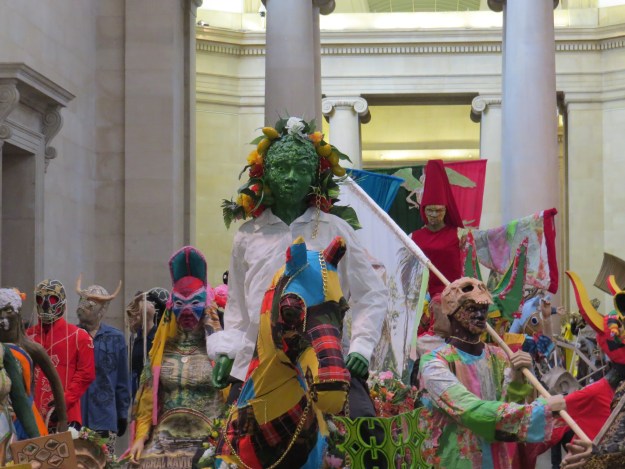
Dear Readers, today I took a little trip to Tate Britain in Pimlico, ostensibly to see the Cornelia Parker exhibition (of which more tomorrow). But when I got to the Duveen galleries, I was confronted by this lot, and very scary they are too.

This is the 2022 Tate Britain Commission, and it’s called The Procession. The artist is Huw Locke, who was born in Edinburgh but who moved to Guyana when he was five, just as the country was becoming independent.

It’s tricky to say what ‘The Procession’ is ‘about’, because it seems to be about many things – it’s about colonialism, conflict, history, nationhood, independence, and what these things mean. Locke says that he wanted the piece to be ‘human scale’, and so it is. He’s also used very workaday materials – cardboard features a lot, and while he’s used a lot of his own custom-printed fabric, a lot of it has also come from shops around London.

Locke says that the piece could be viewed as a puzzle, and that it rewards time spent with it – that was certainly my experience. I ended up spending about an hour wandering around and through it, wondering what things meant, trying to relate one character to another. I suspect I’d have needed to know a lot more about history, but I think it also gives you the opportunity to make your own connections and devise your own story.

Some of the characters seem quite frightening, but the children in the gallery seemed to love the piece, and their parents were having a great time trying to keep them from interacting rather more directly than the gallery wardens were happy with.

There is beauty here, and the macabre, and some characters who are both.

The Tate Gallery was, of course, built on money from sugar and the slave trade, and Locke says that this was a starting point for the piece. Then there is the sense of people on the move, people protesting and gaining a sense of their power, which feels very contemporary. But then there’s also a sense of Carnival.

And death is here too.

What is so striking about The Procession is the sheer amount of work that’s gone into it. If I’d designed one of the characters and brought them to fruition I would have been well chuffed, but here there are hundreds, all different, all with a story to tell. If you’re in London, it’s well worth a look. I’m sure everyone’s reactions will be different, and that is part of the interest of the piece.

To take just one facet of the piece: the banner here, showing the Black Star Line, is a reference to the shipping line incorporated by Marcus Garvey in the early 1920s. The idea was that the ships would transport goods and eventually African Americans throughout the African global economy. Garvey bought ships (funded by donations from the black community), but these were oversold and badly maintained, and the company itself was infiltrated by agents from what would become the FBI, who actively sabotaged the ships. So, the endeavour was a failure, through no fault of its own.

At the very end of the procession is this man. To me he looks rather like Atlas, carrying the weight of the world on his head. His shoelaces are undone, and he is lagging a little behind, but he looks pretty serious to me. Like the last runner in a marathon, he will get there too, I have no doubt.

Wednesday Weed – Agrimony

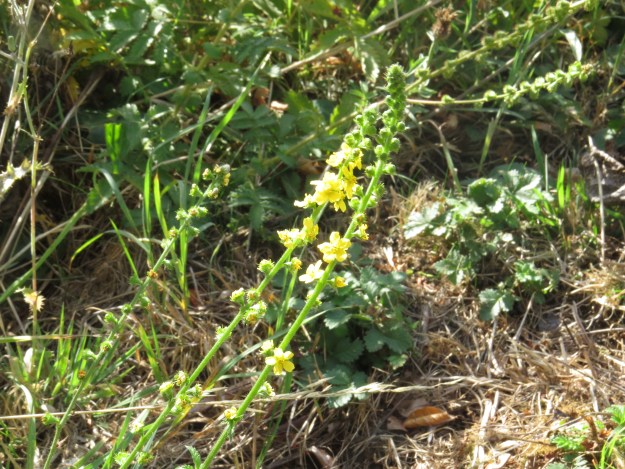
Agrimony (Agrimonia eupatoria)

Dear Readers, when I was visiting Mum and Dad’s grave last week I came across this lovely plant with its tiny yellow flowers. Meet Agrimony, a member of the rose family and a plant that favours chalky soils, which is probably why I never see it in East Finchley. It has long spikes of yellow flowers, and this plant was one of the last to still be in bloom, with most of the rest now just bearing splendid seedheads. One of the vernacular names for the plant is ‘Church Steeples’, because of the shape of the flower spikes, which also explains ‘Fairy Wand’ and ‘Aaron’s Rod’. I suspect that its golden colour has a lot to do with the name ‘Money In Both Pockets’.

The foliage is said to be mildly fragrant but that of the plant’s close relative Fragrant Agrimony(Agrimonia procera) is said to be very perfumed, as the name suggests. Fragrant Agrimony doesn’t like chalky soils, so it’s interesting to see how two very similar plants have divvied up the ecosystem. It reminds me of the way that Great Tits and Blue Tits, very similar small birds, can use the same tree because the former feed closer to the trunk, while the latter can take advantage of the smallest twigs because they’re marginally lighter.

The name ‘agrimony’ is said to come from the Greek word for poppy, which puzzled me for a bit – the plant doesn’t look like a poppy. However, it has had a folklore reputation as a sedative (and we all know about opium poppies) – it was said that if a sprig of Agrimony was placed under a person’s head, he or she would sleep until it was removed. The plant could also be brewed to make ‘arquebusade water’ which could cure musket wounds, and ward off witchcraft.

The seedheads are covered in hooks, rather like burrs, which cling to the fur of animals and are easily distributed around the countryside by passing foxes and golden retrievers. This gives rise to yet another local name, Sweethearts.

Photo One by CC BY-SA 3.0, https://commons.wikimedia.org/w/index.php?curid=255258CC BY-SA 3.0, https://commons.wikimedia.org/w/index.php?curid=255258

Agrimony seedheads (Photo One)

According to the indispensable Mrs Grieve’s Herbal, Agrimony produces a yellow dye, pale in September, darker later in the year. She also explains many of the medicinal uses of the plant. For internal haemorrhages, medieval medics recommended mixing the plant with pounded frogs and human blood. More recently, it was seen as being of great use in liver and gall-bladder complaints, skin conditions and gout. The plant also attracted the attention of Pliny the Elder, who believed that it could be useful for both preventing and treating snake bites. It is also said to be great for tired feet, so it’s just what I need after a trot around the Capital Ring. It was also used as an Anglo-Saxon sex aid: boiled in water, it would reduce lust, but if boiled in milk it would increase it. It just goes to show that a glass of warm milk before bedtime might not necessarily be relaxing.

Agrimony was a much commoner plant in the past, and one with such a variety of uses that many people will have known it. However, it is vulnerable to early mowing – its seed is set very late in the year, and so if an area is mown to early the seeds will not yet be ripe. This is a shame because Agrimony is favoured by many insects, including the Grizzled Skipper, whose caterpillars like agrimony and other small members of the rose family, such as wild strawberry and cinquefoil.

Photo Two by By James Lindsey at Ecology of Commanster, CC BY-SA 3.0, https://commons.wikimedia.org/w/index.php?curid=1680913

Grizzled skipper (Pyrgus malvae) (Photo Two)

And so, a poem. In the Language of Flowers, Agrimony stands for thankfulness, and I like this work by Christina M.Ward from 2019. I remember how, when I’ve been confronted with the great challenges of life, such as the death of a parent, I’ve felt myself slow down and soften, as if I’ve shed a skin. This poem captures some of that feelng.

Agrimonia (a free verse poem) by Christina M.Ward 

I have gathered church steeples,
racemes of yellow Agrimonia,
as many as I can carry

It is not enough, I think

The butterflies and sun
follow me. We leave a
tender trail,

thankfulness, our meditation

I slide the ends under
cool waters, nip the ends
stems clogging the drain

You stir in your sleep,
a gasp, a wheeze

I am filled with hope, for you
for these —may their radiance
inspire your lungs to lift
searching the air for oxygen
as your eyes search for yellow

thankful, one more day

Photo Credits
Photo Two By James Lindsey at Ecology of Commanster, CC BY-SA 3.0, https://commons.wikimedia.org/w/index.php?curid=1680913

The Capital Ring – Hackney Wick to Beckton Part Two

Abbey Mills Pumping Station

Dear Readers, those Victorians certainly liked to make industrial buildings look like temples, or cathedrals, and Abbey Mills Pumping Station is no exception. Built in 1868 it was known as ‘The Temple of Sewage’ during its working life, and was part of Joseph Bazalgette’s plan to rid London of sewage. The interior is apparently like a Byzantine church.

Even the smaller service buildings are ornate.

The pumping station has electric pumps which can be used to assist the new modern pumping station next door (not as pretty, for sure). Sewage is pumped into the Lee Tunnel and then onwards to Beckton Treatment works.

New Abbey Mills Pumping Station (Photo by By Gordon Joly – Own work, CC BY 3.0, https://commons.wikimedia.org/w/index.php?curid=41959)

On the other side of the Greenway is an attractive Victorian terrace, which surely used to house the workers for the pumping station. I loved the juxtaposition of those chimneys with the tower blocks beyond.

They seem to have something of a giant hogweed problem though, by the look of it. I saw my first ever giant hogweed over in the Olympic Park, and so it’s not a complete surprise.

Just past the pumping station, a piece of station machinery has been turned into an industrial sculpture. It reminds me of an ammonite.

We cross the Channelsea river, which is tidal. It splits into two creeks here, with Abbey Creek on the right and Channelsea Creek on the left. I wish I’d brought my binoculars to look for wading birds, but alas I am already heavily encumbered with water, camera, nibbles etc etc so something had to give.

From here on, it’s a bit of a slog, through West Ham and Plaistow. The sun beats down relentlessly etc etc and we realise that the benefit of walking on the grassy bit, which is softer our feet, is somewhat overshadowed by the sheer amount of dog poo. Clean up after your hounds, people! What is wrong with you?

On the left, I spy what I think is Ranelagh Primary School. I went to a similar Victorian primary school, and those huge windows and high ceilings let in an enormous amount of light. The windows were opened by a rather complicated metal pulley and lever system, and only the most well-behaved of children were allowed to manipulate it. I think in this school the windows might have been replaced with something more modern, though.

There are good views of Canary Wharf over the playing fields.

A cat pops out to see what s/he can find. Previously we’d seen a black cat look both ways before crossing the path, presumably after a close shave with a speeding cyclist. Cats are not daft, for sure.

A Community Orchard is being built by the side of the Greenway, which is a lovely idea.

The organisation ‘Good Gym’ helps out regularly – they combine a physical workout with actually doing some good in the community. In Coldfall Wood, Good Gym do everything from weeding to planting bulbs. It’s an excellent idea, and one that I hope really catches on.

And then we leave the Greenway, cross a truly terrifying road bridge over the A13, and enter Beckton District Park, which is a true oasis of greenery with the sound of the road rumbling in the background.

Beckton District Park

There is a tree trail with some interesting specimen trees too.

But our path takes us to Royal Albert DLR station, and home. The Docklands Light Railway has driverless trains (such a novelty when the line first opened) and is largely above ground, affording some spectacular views of Docklands.

At this station we are very close to London City Airport, so every so often a plane roars overhead.

And I cannot resist the joy of travelling home via the Elizabeth Line (Crossrail), which you can pick up from Excel West. Oh the comfort! The quietness! The efficiency!

Here comes the Elizabeth Line train!

Seats in regal purple

The Space Age curves at Tottenham Road Station

An empty tunnel…

And so, five-and-a-bit miles later we arrive at East Finchley, after another fine trot around the Capital. The variety of landscapes that the walk passes is so stimulating that it’s reminding me why I love London so much.

Next week, Beckton to Woolwich, and we finally cross the River Thames and go South of the River!

The Capital Ring – Hackney Wick to Beckton Part One

Graffiti at Hackney Wick

Dear Readers, what a long and varied walk this was (well, 5 miles in total but we are a little bit out of shape). We started in Hackney Wick which, as we mentioned last week, has turned into a trendy and desirable area, something my grandmother would have found astonishing – she and her family couldn’t wait to get out of the area, and I think she’d pass out at the housing prices now.

She’d also have been rather surprised, as was I, to find out that there’s a bar where you can practice your axe-throwing. Just the thing after a hard day in the office I imagine.

But look at this view across the Lee Navigation. It’s almost bucolic.

The south and east of London have always been the areas where the noxious, smelly industries were situated, and around here was no exception. Carpenters Road was home to maggot breeding, glue-making and fish preparation of all kinds. When I was a child, the air on a hot day was as thick as soup with the most awful smell, which seemed to linger on my clothes and in my hair. Not any more, clearly, although smells will be something of a theme on this walk, as we will see.

The stadium in the centre was the main Olympic Stadium for the 2012 games, but is now home to West Ham United (The Hammers!!), my local football team when I was growing up. It was called The Hammers because it was originally the Thames Ironworks team, back in the days when there was shipbuilding on the docks. It used to be housed in a little stadium in Upton Park (not far from where I went to school) but these days it plays at this splendid new place. I wonder if the atmosphere is the same? Let me know, Hammers supporters!

As usual we’ve only gone for about a quarter of a mile when we decide that we need a coffee, so back over the Lee Navigation we go. We pass this rather impressive converted warehouse…

And find a coffee in another converted warehouse. I rather like the image of Joanna Lumley as Patsy from Absolutely Fabulous.

There are lots and lots of new apartment blocks in Stratford these days. Who knew that it would become so desirable? When I visit it feels as if my memories have been built over and replaced. It’s hard to get my bearings.

And then, fortified with caffeine, we’re off again. We pass a converted lifeboat module…

and we pass H. Forman and Sons, apparently the world’s oldest producer of Scottish smoked salmon, and painted in salmon pink just to make the point. The building contains what looks to be a rather swanky restaurant.

Now we come to some locks, where the Lee Navigation joins the River Lea again.

The Roman Road from London to Colchester used to cross the River Lea hereabouts (the area is still known as ‘Old Ford’ but according to my Capital Ring guide, the wife of Henry I, Queen Maud, was accidentally and unceremoniously dumped into the river here, and so demanded that a new crossing be built at Stratford High Street.

There is a rather sad ‘waterbus’ sign – a waterbus ran during the Olympics to ferry visitors to the site, but this was discontinued a while back. What a shame, I do like a good waterbus (though it would be cheating today).

And then we leave the Lee/Lea and head onto the Greenway, which will be our companion for the next few miles.

The Greenway follows the route of the Northern Outfall Sewage Embankment, or NOSE – this is some engineer’s idea of a joke, I’m sure, as there is often a whiff of sewage as you pass some of the inspection hatches. The nine-inch pipes of the NOSE carry over 100 million gallons of sewage a day, the largest outflow in Britain. Let’s hope that it goes where it’s supposed to, rather than ending up in the rivers and on the beaches of the Thames Estuary and beyond. First, though, the Greenway gives us a fine look at the Stadium.

Then, there’s a fine photo opportunity next to the Arcelor Mittal Orbit, with its viewing platform and helter skelter. And no, I’m not tempted to go whizzing down it.

The Olympic Park itself was planted to a Piet Oudolf design – I’m adding a walk around the park itself to my list of places to revisit, just to see how it’s doing. As it stands, I’m seeing lots of traveller’s joy along the path.

And this elder cultivar seems to be pretty much everywhere – does anyone know what it is?

Then we trundle along the road for a bit, passing Pudding Mill DLR station. Why on earth is it called Pudding Mill? Well, it’s on Pudding Mill Lane, but that was apparently named after St Thomas’s Mill, which stood on the site and was shaped like a pudding.

The area was also known as Knob Hill, but it seems that this was passed over in favour of the pudding simile, for obvious reasons.

Then, we come to Stratford High Street. I remember when we were coming back to Stratford on the 25 bus from a trip ‘up town’ we’d pass the smaller of these buildings – it had a tilework picture of people gathering lavender, and was something of a local landmark. This was the Yardley HQ and box-making site, built in 1937 – note those lovely windows! The actual soap factory was built in 1905 on, you guessed it, Carpenter’s Road; it’s worth remembering that soap making produces some very unpleasant smells, and they no doubt added to the general miasma heading in the direction of chez Bugwoman. It’s nice to see that the lavender gatherers  are still there, though.

The Yardley building is the smaller one to the right of the photo.

The lavender gatherers mosaic

Then we cross Stratford High Street (as commanded by Queen Maud) and we’re back on the broad path of the Greenway (cyclists to the left, walkers to the right, in theory at least). The Greenway was widened to give something of a processional feel in the direction of the Olympic Park, and there are still some very surprising views en route. What, for example, is this thing?

Well, it’s a landmark to signify the regeneration of Stratford, apparently, and it looks pretty splendid at night if this photo can be believed. The Strand East development will include homes, restaurants, offices and a 350-bed hotel. My grandmother would be astonished. The area used to be known as ‘Sugar House Lane’ after a sugar refinery that stood here from 1843, before most refining moved to the Tate and Lyle refinery further east in Silvertown.

Strand East Tower December 2021 (Photo From https://www.ltpintegration.com/case-study/strand-east-tower/)

I am really surprised to find some clumps of  lucerne growing beside the path – this is a plant that seems to pop up in the most unusual places. A bee was thoroughly enjoying it.

And then, as we round a corner, we spot a most extraordinary building. What could it be? Let’s find out tomorrow.

So, Why is Bracken Important?

Photo One by Temple of Mara, CC BY-SA 3.0 <https://creativecommons.org/licenses/by-sa/3.0>, via Wikimedia Commons

Garden Tiger (Arctia caja) (Photo One)

Dear Readers, apologies for the preponderance of bracken this week, but reader Danny has reminded me about all the different moths whose larvae feed on the plant, and I think it’s always good to remember that even the most problematic of ‘weeds’ fulfils a role in its native ecosystem. First up is the Garden Tiger moth – the young caterpillars are often found on bracken before they move on to other herbaceous plants. These are the ‘woolly bears’ of my youth, and are still amongst my favourite caterpillars.

Photo Two by Dean Morley at https://www.flickr.com/photos/33465428@N02/5583264398

Garden Tiger caterpillar (Woolly bear) (Photo Two)

Then there’s the Brown Silver-line moth (Petrophora chlorosata), whose caterpillar only feeds on bracken. What an elegant and well-camouflaged moth this is, with its own subtle beauty. The caterpillar has both green and brown forms, with the green form shown below. It seems to be a very energetic little caterpillar, with something of the looper about it. And look at it pictured in situ on a bracken leaf! If I had some bracken nearby I would definitely be keeping an eye open for this chap.

Photo Three by Ben Sale from UK, CC BY 2.0 <https://creativecommons.org/licenses/by/2.0>, via Wikimedia Commons

Brown Silver-Line (Petrophora chlorosata) (Photo Three)

Photo Four by David G Green from https://www.hantsmoths.org.uk/species/1902.php

Brown Silver-Line caterpillar (Photo Four)

Then there is the Small Angle Shades (Euplexa lucipara). We’re probably all familiar with the Angle Shades moth, but the Small Angle Shades has a rather more out-of-focus/pixellated look about it. You can see them both below so you can make a comparison. The Angle Shades is often found sitting on a wall or fence, minding its own business, so if you’re in the UK you may well have seen one without even being aware of it.

Photo Five by By © entomartIn case of publication or commercial use, Entomart wishes then to be warned (http://www.entomart.be/contact.html), but this without obligation. Thank you., Attribution, https://commons.wikimedia.org/w/index.php?curid=1253796

Small Angle Shades (Euplexia lucipara) (Photo Five)

Photo Six by Rob Mitchell, CC0, via Wikimedia Commons

Angle Shades moth (Phlogophora meticulosa) (Photo Six)

The Small Angle Shades caterpillar is little, fat and green, but it feeds at night so you are unlikely to see it unless you’re rooting about in the bracken with your head torch on. It also feeds on other ferns and a wide variety of herbaceous plants.

Photo Seven by Line Sabroe from Denmark, CC BY 2.0 <https://creativecommons.org/licenses/by/2.0>, via Wikimedia Commons

Small Angle Shades caterpillar (Photo Seven)

And then there are the Swift moths. There is the Orange Swift…

Photo Eight by Ben Sale from UK, CC BY 2.0 <https://creativecommons.org/licenses/by/2.0>, via Wikimedia Commons

Orange Swift moth (Triodia sylvina) (Photo Eight)

the Common Swift moth…

Photo Nine by Ben Sale from UK, CC BY 2.0 <https://creativecommons.org/licenses/by/2.0>, via Wikimedia Commons

Common Swift Moth (Korscheltellus_lupulina) (Photo Nine)

Photo Ten by Chris Cant from Cumbria, UK, CC BY 2.0 <https://creativecommons.org/licenses/by/2.0>, via Wikimedia Commons

Map-winged swift moth(Korscheltellus fusconebulosa) (Photo Ten)

and the Gold Swift

Photo Eleven by Bernard Ruelle from https://butterfly-conservation.org/moths/gold-swift

Gold Swift moth (Phymatopus hecta) (Photo Eleven)

However, what you’re unlikely to see are the caterpillars of these moths, as they all live underground, munching on those eagle/oak-patterned roots for up to two years before appearing as a moth. Sadly they may also munch on other plants, including your prized paeonies or Michaelmas daisies, and so may be seen as a garden pest. I rather think that the adult moths are worth waiting for, though, especially if the caterpillars are only eating bracken. The adults have non-functioning moth parts, so they are only interested in reproduction rather than eating.

Photo Twelve from https://www.rhs.org.uk/biodiversity/swift-moth-caterpillars

Swift Moth caterpillars (Photo Twelve)

So, bracken may be a bit of a thug in the wrong place, but look at all the wildlife that it supports! I shall certainly be looking at it with more affection next time I fight my way through a thicket of it.

Photo Credits

Photo One by Temple of Mara, CC BY-SA 3.0 <https://creativecommons.org/licenses/by-sa/3.0>, via Wikimedia Commons

Photo Two by Dean Morley at https://www.flickr.com/photos/33465428@N02/5583264398

Photo Three by Ben Sale from UK, CC BY 2.0 <https://creativecommons.org/licenses/by/2.0>, via Wikimedia Commons

Photo Four by David G Green from https://www.hantsmoths.org.uk/species/1902.php

Photo Five by By © entomartIn case of publication or commercial use, Entomart wishes then to be warned (http://www.entomart.be/contact.html), but this without obligation. Thank you., Attribution, https://commons.wikimedia.org/w/index.php?curid=1253796

Photo Six by Rob Mitchell, CC0, via Wikimedia Commons

Photo Seven by Line Sabroe from Denmark, CC BY 2.0 <https://creativecommons.org/licenses/by/2.0>, via Wikimedia Commons

Photo Eight by Ben Sale from UK, CC BY 2.0 <https://creativecommons.org/licenses/by/2.0>, via Wikimedia Commons

Photo Nine by Ben Sale from UK, CC BY 2.0 <https://creativecommons.org/licenses/by/2.0>, via Wikimedia Commons

Photo Ten by Chris Cant from Cumbria, UK, CC BY 2.0 <https://creativecommons.org/licenses/by/2.0>, via Wikimedia Commons

Photo Eleven by Bernard Ruelle from https://butterfly-conservation.org/moths/gold-swift

Photo Twelve from https://www.rhs.org.uk/biodiversity/swift-moth-caterpillars

More on Bracken

Dear Readers, you might remember that, in our discussion on bracken, it was stated that it was known as ‘eagle fern’ because of the pattern in a transverse section of the root. Some people also thought that it looked like the oak tree that Charles II was said to have hidden in after the Battle of Worcester in 1651 (thanks to Sara for pointing out that I’d put down the wrong monarch (again)). Once I’d sorted out my Charles I’s and Charles II’s , I was delighted to be sent the botanical print above by long-time reader Anne Guy. It shows a cross-section of the root of the plant, and indeed it does look rather like a flying bird. However, as with all things it does rather depend on how you look at it. The root cross-section below (from a paper on hemorrhagic disease in Belgian cattle) is thought by the authors to resemble a double-headed eagle, but if you tilt your head and look at it upside down, it also looks very like a tree.

Cross-section of bracken root

And how about this one, from the book ‘Scandinavian Ferns’ by Benjamin Øllgaard and Kirsten Tind, Rhodos, 1993 (the root is in the bottom right-hand corner). Double-headed eagle or tree?

Root cross section in bottom right-hand corner

So, it seems as if the ‘eagle fern’ moniker for this plant is perfectly understandable. I wonder if it should also be known as ‘oak  fern’ as well, though? As with so many things, I suspect that it just depends on how you look at it.


The Dorset Flag and St Wite

Dear Readers, as I headed back to the bus stop after my visit with Mum and Dad yesterday, I noticed this rather splendid flag fluttering in a cottage garden.

I pass two chaps, one tending to a privet hedge while balanced on a rather precarious stepladder, the other out for his morning constitutional with his small scruffy dog, and ask them about it.

“That,” says the chap with the dog, “Is the County Flag of Dorset. I salute it every evening when I walk past”. And the chap on the stepladder guffaws so loudly that he nearly falls off.

The flag was designed by Stephen Coombs and David White, who pursued a long campaign to persuade the council that a flag for Dorset was a good idea. In the end, the flag was chosen by a public vote back in 2008, which was open to all residents of Dorset. Bournemouth and Poole declined to participate – maybe they thought they’d have a competition for their own flags, or maybe there was some internecine skulduggery at work – local councils everywhere are often hotbeds of rivalry and political machination, However, in a rather nifty manouevre Town Crier Chris Brown managed to convince the town of Wimborne Minster to adopt the ‘Dorset Flag’ regardless of the outcome of the county-wide vote. Four alternative designs were presented, and they’re shown below. The yellow and red flag which was eventually chosen got 2086 votes (54% of the total). I think there is definitely a book to be written about the whole affair.

Design A

Blue is for the sky and sea; yellow for sun and sand; and green for the fields and countryside.108 votes”

Design C

“The green background is synonymous with the county of Dorset and maintains our identity as a green and pleasant land. The yellow cross depicts the beautiful beaches we are fortunate to be blessed with. The oak leaf signifies the rural nature of this wonderful county, something most people living here are very proud of. The black border around the yellow cross signifies the black death that came to our shores and nearly wiped out the population but through our resilience as a people we overcame that threat and made us the proud people we are today. 856 votes.”

Design D

Design D

The colours on the flag should show all the good things we have in Dorset. Blue for the sea and beaches; green for the countryside; and gold for the sand and because Dorset is a sunny place to live. 818 votes.”

The red and white  in the winning entry is taken from the arms of Dorset County Council, but the gold is meant to represent the gold of the beaches and wheatfields of Dorset, and places such as Golden Cap on the Jurassic Coast. I guess the gold could also represent the fields of rape, maize and sunflowers that are being grown as biofuels these days too.  I find it interesting that the flag chosen is the most ‘traditional’ of the designs, not surprising in what is a very tradtional county.

Golden Cap on the Jurassic Coast

The white cross with a red border on the flag has also been linked to St Wite, an Anglo-Saxon holy woman who was (probably) martyred by the Vikings in the 9th Century, and whose relics are held at the church at Whitchurch Canonicorum in Dorset. Examination of her bones (which were found in a lead casket inside the tomb during renovation work in 1900) has revealed that she was about 40 when she died, and of small stature. St Wite is the unofficial patron saint of Dorset, and her feast day is on June 1st. Her shrine is a very rare survival, as many such sites were destroyed during the Reformation. It’s thought that perhaps the tomb was too modest to attract notice.

St Wite’s shrine at Whitchurch Canonicorum

The bones of the saint are housed in the tomb at the top, which is covered with a slab of local Purbeck marble. Underneath are holes into which the afflicted could place their limbs, their children or, if the ill person was unable to travel to the church, a handkerchief or some other receptacle to collect the saint’s blessings. Letters of request and thanks could also be posted into the holes. The custom continues to this day, with people making a pilgrimage to the church to ask for intercession.

And just a mile to the south is St Wite’s Well, which dates back to 1630. The waters, especially if lit by the rays of the sun, are said to be a cure for eye complaints. What a pretty and peaceful spot this seems to be! Saintly help or not, I’m sure that being here would be good for whatever ails you.

And so, having noticed the Dorset flag once, I’ve now seen it several times fluttering in people’s gardens as my train heads back east to London and home. When I see the cross of St George I always think of a kind of toxic nationalism, but somehow the Dorset flag just speaks to me of local pride and a sense of belonging. The man who spoke about saluting the flag was displaying the kind of knowing humour that I find so much here, but I am equally sure that if I’d been foolish enough to bad mouth his county I would have been chased back to London by a man wielding hedgetrimmers. Getting the balance right between feeling pride in where you came from, and allowing other people to rejoice in their home towns or countries, feels imperative in these times of division and strife.


Remembering Mum and Dad

Dear Readers, every few months I make a pilgrimage to the churchyard of St Andrew’s Church in Milborne St Andrew, to ‘visit’ Mum and Dad. I do a bit of tidying (there’s cherry seedling that’s determined to grow right above the memorial plaque), pop in some new plants, and settle down with my back to the cherry tree and wait for the tears to come, and then for them to ease. It’s been four years since Mum passed away, and two years since Dad died, and things have gotten easier, but I still miss them every single day, and I think I always will. But I wouldn’t have it any other way. Grief is the price we pay for love, and although I am sadder these days, I think I also have more perspective on what’s important, and am more aware of what other people might be feeling when they lose someone close to them.

But, there is a special magic about this place: the lambs in the field next door have gone, but an emperor dragonfly sweeps low across the grass, hunting for butterflies. And I notice a spotted flycatcher sitting in the bush opposite. Every so often it dashes from its perch and chases an insect, before returning. After a few minutes, I realise that there are two of them, each of them fluttering and twittering, disappearing for a few minutes and then reappearing. It is hard to stay sad when there is so much life going on all around.

As I watch a big, faded bumblebee pops into one of the penstemon flowers and then buzzes away. Mum always liked bumblebees; they were the acceptable face of insecthood to her, unlike wasps and ants and flies and  anything else with more than four legs. And yet, although she was afraid she would try to catch them and put them outside rather than kill them, and she never allowed her fear to contaminate us when we were children. That takes more bravery than we often appreciate. Courage is not the absence of fear, but the will to contain it.

A huge Scots Pine looms over the churchyard, and a raven flies out of it, sending some jackdaws into a frenzy. It’s only when I see these birds together that I realise how much bigger the raven is. The birds are gone before I can raise my camera but the tree is still there against a wind-blown sky.

The blackberries look so fat and juicy that I can’t resist them. In the distance, a combine harvester is raising a cloud of dust.

The church of St Andrew dates back to the 11th century, and I always pop inside when I’m here. There’s such deep peace in those old walls.

I feel so close to Mum and Dad in Dorset. They loved it here, and I feel their love in every bird and berry, in every flint and every lichen-covered headstone.

And then I gather my things and prepare to head back for the 12.01 bus back to Dorchester, but something makes me detour via the site of the lime tree that I loved, that was blown over in storm Eunice a few months ago – you can see a photo of it in its glory in this blogpost. I was expecting to see the bleak stump that was there a few months ago, but clearly you can’t keep a good tree down. I have rarely seen so much growth in such a short time. It will take it a long time to get back to its previous magnificence, but how it lifted my spirits to see that it wasn’t dead! It reminds me that  everything and everyone live on in some shape or form, and that is very comforting.