Monthly Archives: October 2022

Good Heavens!

Calceolaria uniflora, or Darwin’s Slipper

Dear Readers, I spotted this photo on Facebook earlier this week, and it stopped me in my tracks – it looks for all the world like a gang of happy Muppets running down to the sea for a paddle. But, in fact, it’s a plant, and furthermore one that you might have had as a houseplant – I remember Calceolaria being very popular when I was growing up.

Calceolaria pot plant (Photo by Bernard Spragg. NZ from Christchurch, New Zealand, CC0, via Wikimedia Commons)

Otherwise known as lady’s purse or slipperwort, in the wild Calceolaria species can be found from Mexico to Patagonia. I inadvertently described the plant as an orchid in my Facebook post, but actually this is a member of the Scrophulariaceae or Figwort family, most of whom are very unobtrusive and are pollinated by various bees and hoverflies.

Scrophularia nodosa (Figwort)

The Darwin’s Slipper is a Patagonia specialist, and is pollinated by a bird called the Least Seedsnipe (you couldn’t make this up, clearly).

Least Seedsnipe (Thinocorus rumicivorus)

The Least Seedsnipe pecks at the white ‘lower lip’ of the Darwin’s Slipper, and while that’s happening, the plant is depositing pollen on the back of his or her head. What a splendid example of co-evolution this is! The bird is rewarded with rich, energy-giving nectar, and the plant gets to scatter its pollen as widely as the bird flies. What fascinates me is that this bird is not normally a nectar-feeder, but eats seeds, as its name suggests. This plant seems to have seduced the seedsnipe into changing its behaviour, something that occasionally happens with other species – the crown imperial, for example, is now sometimes pollinated by blue tits, who are normally insectivores.

Darwin’s Slipper, showing the white ‘pecking spot’ (Photo by By Michael Lejeune – Self-photographed, CC BY-SA 3.0, https://commons.wikimedia.org/w/index.php?curid=3133546)

I have always been fascinated by Patagonia, though it is a very, very long way away for a visit. Maybe I’ll just have to be content with looking at photos of these extraordinary plants.

Photo by By Thomas Mathis – Own work, CC BY-SA 3.0, https://commons.wikimedia.org/w/index.php?curid=1026481


Sciencing…..

Dear Readers, what you see in the photo above is the result of two hours work, a lot of swearing, a Kenwood mixer driven to the edge of madness and various ethical dilemmas around what to feed my long-suffering birds. Yes, it’s my OU ‘prey discrimination test’, which works by offering birds food in two different colours, and then noticing which they prefer.

You might remember that last week, when I first mentioned this, I was concerned about the food colouring used. After doing some research (after all, what are university libraries for?) I discovered that the issue with the red food colouring used in hummingbird feeders in North America related to a particular artificial colouring called Red 40. But anyway, I shopped around for the most ‘natural’ colourings that I could find, and found one which is basically cochineal and glycerine, and another which uses turmeric. The ‘red’ version is therefore not pillar-box red, as you can see, but I’m sure it’s different enough for my purposes.

Then I wanted to tweak the recipe. In the original, it’s basically just flour, water, lard and food colouring, but I added some mealworm flour and some ‘flutter butter’ (peanut butter for birds with no salt).

How, I hear you ask, do you buy mealworm flour? Well, in my case I get a handful of dried mealworms and whizz them up in my spice mill. Don’t tell my husband. Actually, I’d always been a bit sceptical about people willingly eating insects, but as a powder I don’t think you’d know – it looked and smelled a bit like bran. I don’t really want us to be eating our six-legged friends, but as a way to produce protein that doesn’t destroy the planet it might be a winner.

Anyhow, then I threw half the mixture into the Kenwood Mixer (last used to make focaccia but it didn’t seem to mind) and used various hooks and mixing devices to try to get a dough, and an evenly-coloured one at that. Getting the texture right is always tricky – too wet and it’s difficult to handle, too dry and you can’t get the colour mixed in correctly. Speaking of colour, after I’d made the ‘red’ dough the kitchen looked as if they’d been a nasty knife attack, and I’ve thrown red colouring all over my favourite jumper, so now it looks like a crime scene. I guess that’s what aprons are for (doh).

The yellow colouring was much more biddable, and apart from what I suspect are some permanent stains on my work top, all has gone well.

So here we have two massive amounts of dough, and the next thing to do is to persuade the birds to have a nibble. I put some pea-shaped amounts outside, and a woodpigeon has inspected them and left in disgust. I hope that isn’t going to be the general reaction, but with birds you never know. The experiment itself doesn’t start for a few weeks, so hopefully by then it will be acceptable. Wish me (and the birds) luck….

One in a Million….

The Marylebone High Street Elm

Dear Readers, whenever I go to Marylebone High Street (almost always to visit Daunt Books, easily my favourite bookshop in the world), I always pause to check up on the Marylebone High Street Elm. This tree is designated as a ‘Great Tree of London’, and so it should be – the Dutch elm outbreak in the 1970s put paid to most of the elms not only in London, but in the UK, so this tree is a real survivor. It is a Huntingdon Elm (Ulmus x hollandica ‘Vegeta’), a natural hybrid between the wych elm and the field elm that was once common across the east of England, but is now extremely rare as a mature tree, especially in London and environs. ‘Nine Elms’ (now home of the US Embassy) was named for its trees, and Seven Sisters was also named after 9 elm trees that used to grow there, plus there are hundreds of street names with ‘Elm’ in them. That a plant that is so much part of our history could be wiped out in less than a decade is a stern warning to us about lapses in biosecurity, especially with the shadow of ash dieback about to destroy another iconic tree. The bonfire of regulations that is currently promised will no doubt make things even worse.

But still, the Marylebone Elm is doing extremely well, providing passersby with some much-needed shade, and growing a little every year. Long may it thrive, in spite of the cars and taxis swooshing past, climate change, drought and flood.

Sunjlight through the leaves of the Marylebone Elm

To see elms in all their glory it’s well worth a visit to Brighton, which has managed not only to hold onto many of its street elms, but also has the National Elm collection. Brighton’s location, between the South Downs and the sea, and the rigorous attention of its arborists, has managed to protect the trees when so many others were lost.

This was the tree often seen in Constable’s paintings. The loss of mature elms must have been heartbreaking for those who knew the countryside well. Carol Ann Duffy sums it up beautifully in her poem ‘The English Elms’.

Seven Sisters in Tottenham,
long gone, except for their names,
were English elms.

Others stood at the edge of farms,
twinned with the shapes of clouds
like green rhymes;
or cupped the beads of the rain
in their leaf palms;
or glowered, grim giants, warning of storms.

In the hedgerows in old films,
elegiacally, they loom,
the English elms;
or find posthumous fame
in the lines of poems-
the music making elm-
for ours is a world without them…

to whom the artists came,
time after time, scumbling, paint on their fingers and thumbs;
and the woodcutters, who knew the elm was a coffin’s deadly aim;
and the mavis, her new nest unharmed in the crook of a living, wooden arm;
and boys, with ball and stumps and bat for a game;
and nursing ewes and lambs, calm under the English elms…

great, masterpiece trees,
who were overwhelmed.

‘The Cornfield’ 1826 (John Constable)


Fat Bear Week

Otis, winner of the 2021 Fat Bear competition (Photo C Spencer/NPS/Reuters from https://www.theguardian.com/us-news/2022/oct/07/fat-bear-week-2022-alaska


Dear Readers, it’s been one helluva fortnight here at Schloss Bugwoman, what with bereavement, the government finally losing their collective mind, the environment in even more jeopardy than usual and the prospect of a cold, dark winter ahead. However, the grizzly bears of the Katmai National Park in Alaska are all prepared for the aforesaid cold, dark winter, because they have been stuffing their faces on salmon so that they’ll have enough fat reserves to last them through hibernation and into the spring. And so, in 2014 the Katmai Rangers started ‘Fat Bear Thursday’, so that people could vote for their favourite bear. By this year, the competition has expanded to a whole week, from 5th October to 11th October. Two candidates go head-to-head every day, and the bear with the most votes advances in the competition. YouWhat looks like a bit of fun has proven to actually be an excellent way to educate people about the challenges that these amazing animals face, and to encourage emotional involvement too. Otis, for example, who is in the photo at the top of the page, is an older male, whose teeth are beginning to give him problems. He is now frequently moved on from his favourite angling spots by younger, more aggressive males.  However, he is also an excellent fisherman, and once ate 42 salmon at a single sitting. Otis won ‘Fat Bear of the Year’ in 2014, 2016, 2017 and 2021, so it would be a brave person who discounted him now.

However, he has competition in the form of Chunk.

Chunk is a very big, dominant male, who displays some characteristics that show real confidence – he’s been seen playing with other bears, and will wait patiently to scavenge on salmon that’s been left by other bears. Could it be that he’s just a big softie?

The boys don’t have it all their own way, though.

Holly was champion Fat Bear in 2019, and with good reason – not only is she a very fat bear, but she not only managed to rear one cub who was born with a limp to successful adulthood, she also took in a yearling orphaned bear cub and raised him as her own. She is one of the most experienced bears on the Brooks River (which runs through Katmai National Park, and provides all that salmon). She is probably my favourite, so fingers crossed!

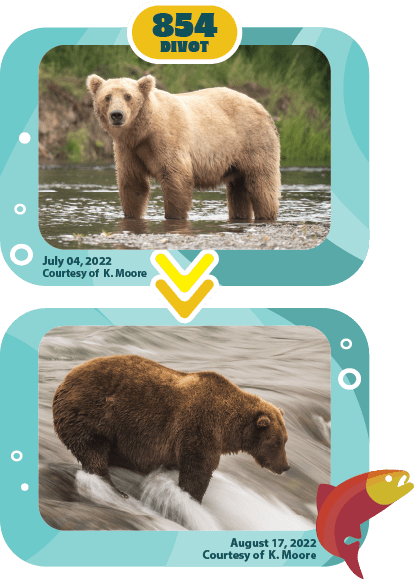
Divot is another large female bear with an interesting back story. In 2014 she left the park, and ended up trapping her head in a wire snare set for wolves (you can still see the circular scar around her neck). Fortunately she was tranquillised by park rangers and the snare was removed. The rescue was made all the trickier because she had a young cub with her, but the story has a happy ending, and Divot is now back in the park, and sometimes fishes alongside the larger adult males. Clearly, she is not a bear to be messed with. You can watch the whole rescue here. It is truly appalling what these snares do to animals.

And finally, here’s who I think might well win this year: 747.

Named after a jumbo jet, he is currently the river’s most dominant bear, and is so huge that other bears largely just move out of the way. He’s been estimated to weigh in at 1400 pounds (100 stone! 656 kg!). If the competition goes solely on size, he is likely to win again, just as he did in 2020. But the public are fickle, and are often swayed by the tales of these remarkable animals. Plus, there’s no prize for the bears, except for fame and the increased chance of being large enough to survive through the winter.

You can vote, find out all the details and watch webcams, learn the stories of the bears etc, here. Have a look! It certainly cheered me up.


Wednesday Weed on Friday – Yarrow Revisited

Yarrow (Achillea millefolium)

Dear Readers, I am seeing a lot of yarrow about at the moment, and I thought that this underappreciated little ‘weed’ deserved a moment in the spotlight. So, I have chosen it as ‘my’ plant in a team Bioblitz that we’re doing for my OU course at the moment. A Bioblitz is where a specific area is investigated in depth, to determine which plants and animals live there – I did a quick survey of Oxleas meadow (which we visited during our Capital Ring walk on Monday). It’s interesting to see the different plants that this grassland throws up, and I suspect that most areas of dry sward in England would quickly be populated by this plant if left to their own devices. Anyhow, yarrow was one of the very first plants that I treated as a Wednesday Weed, way back in 2014. See what you think!

Yarrow (Achillea millefolium)

Yarrow (Achillea millefolium)

As I squelched womanfully around the edge of the playing fields at Coldfall Wood on Monday, I was forcefully reminded that most of the soil of London is clay. The whole area was a slippery, claggy mass. I could have picked up a handful and thrown myself a pot. A Golden Retriever hurled himself into a large puddle, and a crow hopped down to check out the new water features that had appeared after the previous night’s heavy rainfall.

IMG_0718I was looking for something interesting to share with you all. Something with berries, or interesting foliage. Something that hadn’t either disappeared or turned into a twig. And then I spotted these, flowering amongst the brambles on the sunlit side of the fields.

IMG_0731Yarrow is a plant of the northern hemisphere, which grows in Europe, Asia and North America. It gets its Latin name, Achillea,  from the Iliad – Achilles was said to have been taught the use of yarrow by his centaur teacher, Chiron, and to have always carried some with him into battle to staunch bleeding. Everywhere that it grows it has a long history of use as a medicinal herb. Some of its other names, such as Woundwort and Sanguinary, reflect its traditional use as a bloodclotting agent, but the flowers and leaves have also been used for everything from phlegmatic conditions to menstrual cramps. Humble the plant may be, but it seems to be a veritable medicine chest, and is even said to increase the efficacy of other herbs when it is used in combination with them.

In Asia, the dried stalks of Yarrow are used as part of the I Ching divination process, and in North America the Navajo use it for toothache and earache.

IMG_0730 I associate Yarrow with areas of old grassland, where its delicate leaves form an important part of the sward, but quickly learned that it had an important role in the health of our agricultural land. Before we contracted our current mania for monoculture, Yarrow always formed part of the meadow’s plant community – it has extremely deep roots, which make it resistant to drought and helpful in cases of soil erosion, plus the leaves (which can also be eaten by humans) are rich in minerals and good for grazing animals. These days, it seems to be something of an outlier, growing at the edges of fields where the turf is allowed to grow a little longer.

IMG_0726The list of beneficial qualities goes on. Yarrow is excellent for companion planting because it attracts pollinators such as hoverflies who will eat many plant pests. Starlings use it to line their nests, and it has been shown to reduce the parasite load that the nestlings have to bear.

IMG_0728In the wild, Yarrow grows in three colour variations – white (as below), pale pink and dark pink. Many cultivated varieties exist, and are indeed ‘bee-friendly’, though not, I suspect, as ‘friendly’ as the original plant.

IMG_0724

Pale Pink Yarrow ( © Copyright Evelyn Simak and licensed for reuse under this Creative Commons Licence)

Pale Pink Wild Yarrow ( © Copyright Evelyn Simak and licensed for reuse under this Creative Commons Licence)

The name ‘Yarrow’ is said to come from the Anglo-Saxon word gearwe, which means ‘to prepare’ or ‘to be ready’. Many practices concerned its ability to ward off evil – it was burned on St John’s Eve (23rd June). This coincides with the Summer Solstice, so may be another case of a Christian holiday overlaying a much older tradition. Also at the Solstice, a bundle of Yarrow would be tied over a child’s cradle, or over the entrance to the house, to ensure good luck in the coming year.

As usual, I am gobsmacked. This unobtrusive little plant has had a millenium-long relationship with human beings all over the world. These days, most of us (including me) scarcely give it a second glance. Pushed to the edge of the field like so many plant species, it flowers on , even on an iron-hard December day. It makes me sad that so much of the plant lore that our grandparents would have known is being lost. It is so important that we recognise our place in a community that is made up of land, plants and animals, not just humans. In the meantime, the Yarrow waits on.

 © Copyright Ian Cunliffe and licensed for reuse under this Creative Commons Licence.

© Copyright Ian Cunliffe and licensed for reuse under this Creative Commons Licence.


Back to School with the Open University….

Dear Readers, as I might have mentioned a few weeks ago, I am now getting stuck in to not one but two courses with the Open University (both are 30 credits so in theory it shouldn’t be more work than a single 60 credit course but I have my doubts). One is on Cell Biology, and my mind is already blown with thinking about how the original cells formed. Not only did complex cells probably happen when one bacteria engulfed another, and both lived very happily together in a symbiotic relationship, but some of the building blocks for life could well have arrived on meteorites.

However, my second course, the Biology of Survival, is going to feature some cookery. Who knew? Our very first experiment is on ‘prey differentiation in birds’, and we are going to knock up a dough-and-lard based treat for the birds in the garden. One lot of dough will be coloured bright red, and the other bright yellow. I am thinking about adding in something to make it more nutritious – maybe flutter-butter (which is peanut butter without the preservatives or salt). I wonder if you can get mealworm powder? At any rate, the only difference between the two colours of dough should be the colour, so I need to make it all up at the same time. The flour and lard together come to a stonking 2 kg, so I shall have to use plenty of elbow grease (or, thinking about it, my Kenwood bread mixer). After all, what’s the point of an electrical device if you don’t use it? I shall also use the least artificial colouring that I can find. I don’t want to poison my feathery guests.

Then each batch of dough needs to be divided into equal pea-shaped pieces, and it can be frozen. I see me spending a few hours getting all this sorted out.

We then have to spend a few weeks acclimatising the birds to their new food (but at the same time I don’t want to use all the dough up before the experiment begins officially at the start of November).

I suppose what I expect to happen is for the birds to prefer the red doughballs to the yellow ones, but it will be very interesting to see if there’s any difference between species. I also full expect the wood pigeons to scoff the lot, but let’s see. If the jackdaws find it, they’ll probably beat off all comers.

I also wonder if these guys will take a liking to this novel new food. They clearly are not birds, so I wonder if they’ll invalidate my experiment? Fingers crossed they’re not bread lovers.

At the moment, I feel slightly overwhelmed but I know from experience that the trick is to just keep on top of each week’s work, and try not to worry about the mountain of work that lies ahead. At the very least it seems stimulating, and anything that cranks my poor old brain into action can only be a good thing. Onwards!

The Capital Ring – Falconwood to Grove Park

Eltham Park

Dear Readers, this section of the Capital Ring is only about 4 miles long, but it’s packed with interest – there were points during today’s walk when I found it hard to believe that I was still in London. We started from Falconwood Station, and soon found ourselves in Eltham Park. There is a splendid avenue of horse chestnuts, but some of them have clearly succumbed to honey fungus.

But what is this? Someone has left an adorable painted stone. It made my day, and I left it there so it could make somebody else’s day too.

The horse chestnut avenue

There are some very fine sweet chestnuts here as well, some of them full of parakeets. South London seems to be the epicentre of the ring-necked parakeet population, and I noticed that they seemed to like the chestnut trees very much. I also noticed how some of the sweet chestnuts had clearly rotated as young trees, with spiral patterns in the bark.

And there were some fine lone poplars too.

I popped into the ladies, only to find that one of the toilets was inhabited by a very shy workman. He’d gone in to fix a cistern but once women popped in to use the other cubicles he was too embarrassed to show himself, and was shouting instructions to his young apprentice to get him to try to direct other ladies in the direction of the disabled toilets. Bless. I made a discreet exit, and hopefully he was finally able to emerge and get his work done.

On we go, in the general direction of Eltham Palace. This was a very important London house, and the first indication that we pass is called Conduit Head – it used to house the sluice gates that controlled the water for the estate. Eltham Palace housed a fine array of Tudors, including Henry VIII and Elizabeth I, and was visited by Sir Thomas More and Cardinal Wolsey. It was ransacked by Cromwell during the Civil War, but then had a new lease of life when it was bought by the Courtaulds and transformed into an Art Deco masterpiece. Indeed, it deserves a visit and a blog post all to itself, but for now let’s continue with the walk.

Eltham Palace Sluice Gates

We pass Holy Trinity Church, which has a chapel dedicated to the dead of Gallipoli. It seems very busy today.

Then I notice that this shrub is full of harlequin ladybird larvae – I see at least four on one branch. These beetles are certainly making themselves at home.

The edge of Eltham Palace is approached via Tilt Yard Lane – a tilt yard was a place for jousting competitions. I love the way that the Tudor bricks have become mini-habitats for all kinds of plants.

We reach the entrance to Eltham Palace itself, but that’s as far as we’re getting without paying. Another day, perhaps. After all, it has a very impressive Great Hall, which was left intact after its 1920s restoration.

I always fancied a house with a moat, having read Roger Deakin, the nature writer, who used to go for a swim in his moat every morning. I can’t see it happening in the County Roads sadly, but a woman can dream.

And how about this very splendid Tudor mansion just opposite Eltham Palace? This dates back to the early 16th Century and was where the Lord Chancellor actually lived, so it housed Sir Thomas More and Cardinal Wolsey. It all makes me very nostalgic for Wolf Hall, and extremely sad to think that Hilary Mantel has died much too young. She was one of my favourite writers, and I mourn her passing very much.

The Lord Chancellor’s House

Next, we wander down a lane called King John’s Walk – it’s apparently named for King Jean II of France, who was held captive during the 14th Century and used to take his exercise along this lane. After a few hundred yards, I could be in the countryside. The Capital Ring is so full of contrasts and interest. Look at this little lot – I don’t recall ever seeing so many horses in London outside of the Royal International Horse Show that used to be held in Earl’s Court every year.

And yes, in the background is the Shard. There are fantastic views from the crest of the hill.

The Shard, the Post Office Tower and various other tall buildings….

Canary Wharf and a whole heap of new building…

The Gherkin, the Walkie-Talkie etc

And just to make my day complete, here are some donkeys.

We cross a railway line, and I am most impressed by the Virginia Creeper on one end….

..and the mile-a-minute vine (Russian Vine) on the other side. This seems to be the ‘weed of choice’ for this part of south London – I’m always intrigued by how common weeds in one part of London turn into completely different plants once you move a few miles.

Then we progress past the vast playing fields of Eltham College. No tarmac playgrounds here! Just acres and acres of rolling green sward. There’s a riding school opposite the entrance too (so that explains all the horses).

The lane beside Eltham College Playing Fields

And look at this tree! It has grown through the fence, absorbing the metal as it does. I love how resilient these organisms are.

And finally, we pass the culverted River Quaggy (which sounds a bit like something from Father Ted, but is actually a tributary of the Ravensbourne River). At the moment it is a trickle of a few inches, but the height of the concrete suggests that it might get a lot more ‘interesting’ after heavy rainfall.

And then it’s off to Grove Park station for a well-earned cuppa and a train back to Charing Cross. The next leg is from Grove Park to Crystal Palace, quite a long haul, so I suspect we’ll break it into two. But for now it’s home before the rain starts.

The Capital Ring – Shooters Hill to Falconwood

Castlewood

Dear Readers, this week we’re planning on getting in a few more walks around the Capital Ring, so we started where we left off last month, at Shooters Hill. The area around here is blessed with lots of green space – we started off by the Old Police Station on the corner of Shooters Hill Road and Academy Road. These days, it’s residential, as so many industrial and civic buildings seem to be. I do sometimes wonder about the sum of human misery that hospitals and police stations, prisons and asylums have seen, and whether some of that is baked into the walls somehow. I hope not, for the sake of the people now living in these places.

Then we cross Eltham Common and enter the first of the woods that we’ll be walking in today, Castlewood. This is one of several forests that form Shooters Hill Woods – the area was bought by London County Council during the 1920s and 1930s, and they have been designated an Area of Special Scientific Interest. The trees are certainly very interesting, being a mixture of hazel, silver birch, pedunculate and sessile oak and wild service tree, plus a large number of sweet chestnuts.

In the middle of the castle there is something that actually looks like a castle.

Severndroog Castle

This was built in 1784 as a memorial to Commodore Sir William James by his wife, Lady Anne James. Severndroog is a misspelling of Suvarnadurg, an island fortress in India captured by Commodore James in 1755. Apparently you can see several counties from the top but alas the ‘castle’ is only open on occasional Sundays and, to add insult to injury, the café was also closed. Harrumph! Still, this is the highest point on the Capital Ring (at a staggering 419 feet above sea level) so we could claim a small sense of pride.

On we go, and so we pass some people who are working on a rose garden, in what is clearly the remains of an old estate. Turns out that this was once the garden of Castlewood House, which stood here from the 1870s to the 1920s. I was very impressed by this magnificent redwood.

Further along the path there are great views south.

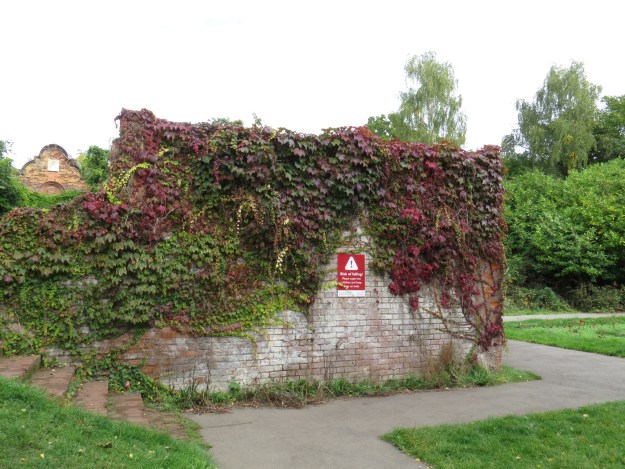
Then we pass the walls of another turn-of-last-century estate, this time Jackwood House. I love the walls, and the variety of vines that are clambering over them, especially as the Virginia Creeper starts to redden.

And here’s another sunny view through the trees.

By now, the absence of caffeine is starting to make itself felt, and so we are delighted to happen upon the Oxleas Wood Café, with its wonderful view and full range of sandwiches. Just the thing.

Oxleas Wood Cafe (Photo by David Fisher)

And just look at the view!

A falcon (probably a kestrel) flew over the scene and disappeared into a large tree just as I was raising my well-earned cuppa to my lips. This seemed very apt as our last stop was Falconwood Station.

Replete, we head off again for the last part of the journey. The last wood is Shepherdleas Wood, and it has some wonderful trees, like this four-trunked specimen, which looks like something out of Tolkien.

What has been missing from the walk, however, is water – this is the only pond that we see, and it seems to be a hotspot for frogs and newts in the spring.

Very sensibly, it has a sign to warn people not to take frogspawn or tadpoles from the pond.

I think people often don’t realise how difficult it is to rear the spawn of amphibians successfully, and also that they risk transferring disease from one area to another if they release any survivors somewhere else. I hope that people pay attention, and let the frogs and newts get on with reproducing without harassment. It’s not much to ask.

And so, we come to the end of a relatively short walk. Tomorrow, if the weather holds, we’re planning on marching on a bit further, from Falconwood to Grove Park. ‘See’ you tomorrow!

Home Again!

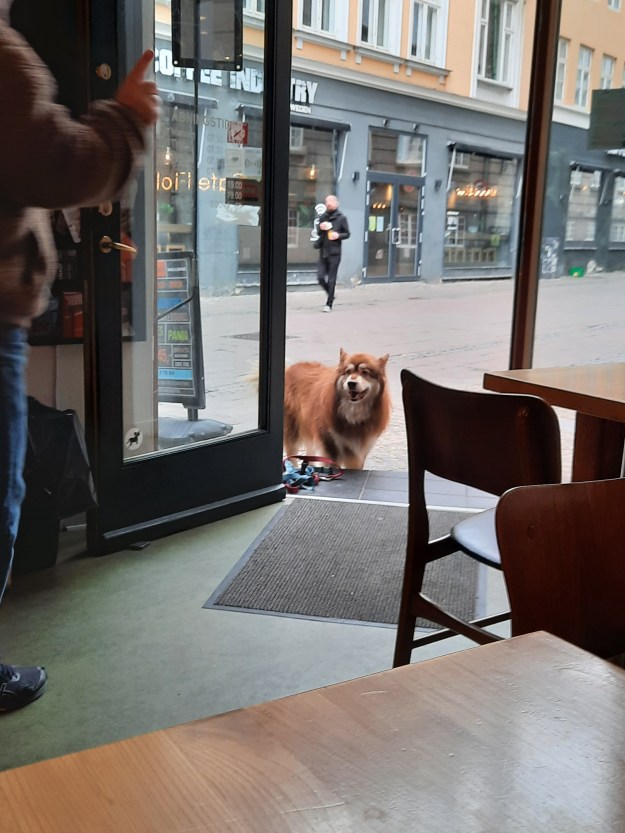
Dear Readers, well here we are again, back in East Finchley, but before we leave Copenhagen completely, I wanted to share a couple of recommendations from our trip, in case any of you decide to make a visit at some point. And also I wanted to share this very fine dog. His owner popped into the coffee shop where we were having a last cappuccino before heading to the airport, and asked the dog to stay outside. Well, he kind of did. Clearly having your chin on the step counts as not actually entering the coffee shop.

Incidentally, people kept speaking to us in Danish – I’m not sure if it’s because we’re both tall, or if I have Viking ancestry somewhere, or because we were dressed in the typical Danish garb of waterproof jacket and sensible trousers. Whatever the reason, I was very flattered.

Righteo, here are a few things that we’ve learned.

  1. Not only is this a great town for cycling, it’s also got excellent transport. There are numerous ways to get from the airport to the centre of town, but the Metro is probably the easiest. It’s only a fifteen-minute trip, costs about 36 Kroner (which is about £4.20) and drops you right in the centre of town. There are even lifts to get you and your pram/bags/bicycle tad the o ground level. We made the mistake of getting a taxi to the hotel on the way in, which is the easiest way but cost nearly £60 for a fifteen minute journey. Ouch.
  2. We stayed in an apartment block which was right in the middle of town, but was surprisingly quiet. It meant that we didn’t have to pay out for breakfast every day, and the kitchen was very well-equipped so you could easily cook if you wanted to save some money. We were also close to Copenhagen University so there were lots of cheaper places to eat for students. The apartments come in different sizes, and if there was a group of you it needn’t be eye-wateringly expensive, especially out of season. Be aware, though, that the autumn and winter can be very damp. No wonder the Danish are so keen on this hygge (cozy) idea – there were days when the thought of curling up in front of an open fire with a good book was very appealing (no open fires at the apartment, but you get the idea). There’s a link to the website here. And no, I’m not getting a commission :-). NB though that there is no lift, though there are ground floor apartments (and a stairlift up the few stairs to those apartments) but I’d make any mobility requirements clear on booking.

A typical Aperon Apartment room

3. Now, as you’ve probably gathered, eating out can be expensive in Copenhagen, so we were delighted to find this place – Paludan Bogcafé. It was full of students working, locals reading the paper, tourists, friends meeting up. We went for our first meal when we arrived in Copenhagen, tired and hungry, and liked it so much that we ate there most nights. The menu has burgers (veggie and meat), stirfry, chilli con carne, pasta, sandwiches (which are enormous) and about six kinds of cheesecake, including one made from Maltesers. It serves wine, beer, coffee and all kinds of soft drinks. You queue up, order your food, pick up your drinks and make yourself at home, surrounded by shelves of books. Honestly, what’s not to like? It’s open every day from 9.00 (10.00 at the weekend) till 22/23.00.

Paludan Bogcafe

4. We did have a couple of ‘nice’ meals out as well. The trend in Copenhagen seems to be towards tasting menus with no/little choice – both the places we visited had both ‘the full works’ tasting menus, with up to ten courses, wine pairings, mortgage application form etc (ok so I made that up), or a shorter, more affordable three-course menu, which was what we went for. Both places also had a vegetarian three-course menu. The food is light, local and seasonal, and berries feature in both savoury and sweet dishes. They also do lots of wine by the glass (just as well), and also Aamanns 1921, the first restaurant that we tried, makes its own soft drinks.

Aamanns 1921 is most famed for its open sandwiches (smørrebrød), but the food at dinnertime was delicious. The website is in Danish, but you can get a flavour of it here on the Michelin site.

Vækst is built around a greenhouse, and is full of plants and greenery. Again the dinner menu was short, but the blackcurrant sorbet was probably the most delicious thing that I ate during my whole visit. And there is a very nice apple-based dessert wine, Feminan, which the waitress had to Google to find out about – there are staff shortages in Copenhagen as there are everywhere else, but I found everyone extremely helpful and willing to go the extra mile, even though tips are not expected to be more than 10%.

So I would say that if you want a low-stress break, Copenhagen is a perfect spot – it’s easy to get around, there are ways to cut back on the bills, and even if it’s raining, there’s plenty to do indoors. We could easily have found enough to do for another week, and it’s also very child-friendly – every museum and art gallery has areas for children and things for them to do, and the pedestrianised centre of town means that you’re not dodging traffic as you have to in most capital cities. As always, I felt as if I was just getting to grips with the place when it was time to leave, so it was with some sadness that I waved goodbye to Paludan Bogcafé, the Botanical Gardens and the Food Market, and headed back to Heathrow. Still, at least the cat was pleased to see us.


In Christianshavn

Dear Readers, for our last day in Copenhagen we decided to explore the region of Christiansholm, just across the Inner Harbour from the hustle and bustle of the main sights. I love to just walk and ‘hang out’ in an area, and as today was more or less dry it seemed like a good opportunity to see what the city looks like from the other side of the tracks.

Well, looking back gives you a fine view of BLOX, which is where the Danish Architecture Centre is (we were there on Monday).

Blox and the Danish Archtitecture Centre

Then there’s the Black Diamond, which houses the National Library of Denmark.

I rather like that you can see people stomping across the bridge in the middle section of the library.

Then there is the bridge that was designed by Olafur Eliasson – you might remember the artist from his installation at the Tate Modern Turbine Hall a few years back, with its great gold sun. This is a little more subtle, and is known as The Circle Bridge.

I am delighted to see some hooded crows (Corvus cornix), a bird that I associate with Northern climes of all kinds. They instantly remind me of my time in Dundee . I thought that they were simply a subspecies of the ordinary carrion crow (Corvus corone) but it seems that I am out of date and that the hoodie (as we used to call it) is now granted species status in its own right.

Here in Copenhagen they are generally seen alongside jackdaws, another of my favourite corvids. There are plenty of magpies about too, but not as many pigeons as you might expect.

Jackdaw (Corvus monedula)

There is lots of new building…

but lots of old buildings too. I think of terracotta and mustard as being *the* colours of Copenhagen (along with grey, at least this week).

And this is the spire of the Vor Frelsers Kirke (Church of Our Saviour). In a city of spires, this is surely the most daunting. Not only does it have that spiral staircase around the outside (even looking at it from the ground gives me vertigo) but it has the largest carillion of bells in Northern Europe, consisting of 48 bronze bells that cover a range of four octaves. We heard it ring at midday and it was certainly very impressive.

But then it was lunchtime, and we found a lovely café close to the second, quieter canal. I had a smoked salmon smørrebrød and very delicious it was too, so delicious in fact that I almost forgot to take a photo. So here it is with a single bite taken out of it.

On we go, suitably refreshed, past some lovely social housing on the canal side where the marigolds have self-seeded along the path.

And then there is a small garden full of pollinator-friendly plants, and some more flats with gardens overlooking the canal which I think were the equivalent of sheltered housing.

In the distance is the power plant, which uses waste that can’t be recycled as an energy source. Denmark doesn’t have enough of this kind of waste so it imports some from Sweden. The site itself has a ski-slope, recreational hiking trail and the world’s highest climbing wall, at 85 metres. Very inspiring!

Now, around the corner from all this is the Free Town of Christiania, an area of small wooden structures that are enhanced with recycled materials, a huge warehouse/exhibition space with a motorbike and sidecar hanging out of the wall, various cafés and bars, and an all-pervasive scent of cannabis – whilst it’s illegal in Denmark it seems to be tolerated within Christiania itself and in the streets roundabout, where I swear I almost got high just from breathing in.

Because of the drug use there’s an air of edginess to some parts of the town that made me reluctant to get the camera out. If someone is doing something a wee bit dodgy they’re unlikely to relish getting caught on camera. And so I’m grateful to my husband/sidekick/lovely assistant for getting this photo.

And then it’s back to the Metro, to work out how the system works. By the time you read this we will hopefully be back in East Finchley with a huge bag of dirty laundry and a lot of memories. Tomorrow I’ll put together a note on some recommendations re accommodation and food in this very expensive town. Suffice it to say that I feel as if I’ve only just scratched the surface.