Monthly Archives: December 2022

Wednesday Weed – Clementine

Clementines (Citrus x clementina) (Photo by Carol)

Dear Readers, is there any fruit more redolent of Christmas than a clementine? Easy to peel, even for little sticky toddler hands, sweet, (usually) seedless and just the right size to stick in the toe of a Christmas stocking, my local greengrocer sells whole crates of them with the leaves still attached in December. I sometimes wish that they were around in October when it’s Halloween – surely one of these would be better for Trick or Treaters than the endless chocolate?

Clementines are a cross between a willowleaf mandarin orange (Citrus x deliciosa) and a sweet orange (Citrus x sinensis), and are named for Clément Rodier, a French missionary who first discovered and propagated the cultivar in Algeria. He ran an orphanage in Misserghin in Algeria and, while working in the institution’s citrus grove, found an interesting wild tree growing amongst some thorns. He made some grafts from this tree, and the result was the clementine, which proved to be very popular with the orphans and with the other Holy Brothers. Brother Clément died in 1904, and is buried in Misserghin.

Brother Clement’s grave in Misserghin, Algeria

Now, it’s very easy to get overloaded with clementines if your forward planning isn’t what it might be, and if your husband is very keen on them, so I have discovered the clementine cake, which is now a regular festive favourite. There cannot be an easier cake. Boil up four or five clementines until they are soft, and remove any hard stems or (heaven forfend) pips. Mix them with ground almonds, sugar, eggs and vanilla. Pop in the oven until done. If the urge comes upon you, you can make an icing of icing sugar and lemon or orange juice, but seriously, it’s delicious without it – it reminds me of one of those Middle-Eastern syrup cakes, though without the addition of syrup, and it will keep for a good week, though I doubt it will last that long. The recipe is a Nigella original, and you can find the whole thing here.

Nigella’s clementine cake

Clementines are apparently less troubled by cold conditions than many other citrus varieties, but today most of them come from hot regions such Spain and North Africa. However, China tops the chart for the production of all of the little citrus varieties (tangerines, mandarins, clementines and satsumas) with a whopping 17.2 million tonnes. Most of our clementines in the UK seem to come from Spain and Morocco these days.

A single clementine will provide 59% of your daily Vitamin C requirement, so tuck in!

And finally, I loved this poem by Wendy Cope so much (thank you again, sllgatsby, my poetry guru) that I wanted to share it with all of you. I think it captures those ordinary moments that somehow seem to burst with unexpected joy.

The Orange

At lunchtime I bought a huge orange–
The size of it made us all laugh.
I peeled it and shared it with Robert and
Dave-
They got quarters and I had a half.

And that orange, it made me so happy,
As ordinary things often do
Just lately. The shopping. A walk in the park.
This is peace and contentment. It’s new.

The rest of the day was quite easy.
I did all the jobs on my list
And enjoyed them and had some time over.
I love you. I’m glad I exist.

~Wendy Cope

The Mother of Sprouts

Common name: Brussels sprout

Dear Readers, the Christmas and New Year issue of New Scientist is such a delight that I thought I’d share a few highlights with you over the next few days, after yesterday’s rather more pensive post. First up is the brussels sprout. Scientist Chris Pires has made it his mission to discover the ancestor of the plant, and this has led him to some very interesting places.

Brussels sprouts have the scientific name Brassica oleracea, but sadly so do fourteen other varieties of cabbage, including cauliflower, Savoy cabbage, kohl rabi and kale. So how did this diminutive little chap get his start? It was thought that the brussels sprout might have been first domesticated in the UK, but another theory pointed to the Mediterranean. After doing some genetic analysis, it turned out that the closest relative to these green Christmas ‘favourites’ (I use the word advisedly) was a weedy plant called Brassica cretica, which languishes on the sunny shores of the Aegean.

This ties up with the first recorded mention of the Brussels sprout, in Greek literature from about 2500 years ago. The botanist Theophrastus suggested using the vegetable to offset the results of too much alcohol, something which is apparently still believed in Southern Italy to this day. I have no idea if you eat the sprouts before or after the intoxicating event, but either could, I fear, lead to disaster.

To my delight, it appears that Greek legend has it that cabbages sprang up where Zeus’s sweat fell to the ground.

Still, the theory about the Aegean weedy cabbage relative remains to be proven because apparently some of the Brassica cretica that the scientists found could themselves be feral – in a dry, hostile environment I’m sure people would eat every plant that poked its head up and that wasn’t actively toxic, so I imagine there have been endless crossbreeding between the species, both natural and encouraged by people. Will we ever get to the bottom of the heredity of the Brussels sprout? Who knows. I am just holding onto the vision of Zeus raising his arms to heaven as a whole shower of round green cabbages cascades out of his armpits.

You can read the whole article here.

Photo from New Scientist, by Maia Gatlin

And with apologies in advance for the scatological subject of the next brief item, it appears that artificial intelligence can detect diarrhoea with up to 98% accuracy if you place an AI listening device in a toilet. It’s thought that this might be able to track outbreaks of diseases like cholera. It appears that some poor human had to listen to hundreds of recordings in order to work out if there was a problem with someone’s defecation or not, so that the AI could ‘learn’. Whenever I’m fed up at work, I’m going to remember that things could be worse.

You can read the whole article here, if you have the stomach for it.

6.30 a.m. – 2022

Dad December 2017 (post nap, before G&T)

Dear Readers, I first published this in 2020 in the middle of the pandemic, but this has been a difficult year for many people that I know and love. I can think of at least four friends who have lost people close to them in 2022, and there will be many more for whom Christmas, Chanukah and other celebrations will bring feelings of sadness and loss. I am holding all of you in my heart, and wishing you peace, and grace. 

Dear Readers, it’s 6.30 a.m. on a Saturday morning and I’m sitting in the office, listening to the thin, sweet song of a robin. Outside it’s still dark as pitch, but a runner has trudged past, taking advantage of the quiet street to jog up the middle of the road. And I have been thinking about Christmas, and how different it will be this year, not just for me but for many of us. This is my first Christmas as an orphan, and the idea is taking some getting used to.

Until a few years ago, the weeks before Christmas were frantically busy for me as I tried to get everything in place for Mum and Dad’s visit. We already had the stairlift so that they could get upstairs, but there was the commode and the reclining chair to get, the temporary registration of the pair of them with my doctor, not to mention the food and the presents and the cleaning. The wheelchair had to be rented and popped into the hall, ready for action. The night before they arrived I would be nervously eyeing up everyone who parked outside our house – we don’t have a car, but it’s a long tradition that you can ‘save’ a parking space by popping a couple of wheelie bins into the road, and with Mum and Dad unable to walk very far it could save a lot of worry.

And then they’d arrive, usually driven down by my brother, and the work would really begin. Everything had to be perfect, of course, just as it had to be perfect when Mum used to be in charge. I wonder why I didn’t learn from the way that she often had a migraine on Christmas Day from sheer stress? I remember one day when Mum was in a particular tizzy about something. Dad was sitting in the armchair with a purple paper hat slightly askew on his head, a gin and tonic in one hand and the cat on his lap.

‘Syb’, he said, patting the chair next to him, ‘Just come and sit down for Gawd’s sake. The brussel sprouts can wait for half an hour’.

‘No they can’t!’ she said, and burst into tears.

And so by the time Christmas was over, Mum was worn to a bit of a frazzle. So maybe it’s no surprise that I remember the days after the big event with particular fondness – the days of eating cold turkey, hot potatoes and pickle, playing Trivial Pursuit and watching the obligatory James Bond film with Dad.

And, strangely enough, it’s not the big things that I remember about the Christmases that I hosted either.

It’s the afternoons when Mum and Dad both had a doze, Dad in his recliner, Mum on the sofa, both of them snoozing along peacefully.

It’s the morning that the great spotted woodpecker turned up on the feeder and I gave Mum my binoculars so that she could see him properly.

It’s the night that the International Space Station went by on Christmas Eve, and Mum and I watched it go sailing past.

This year will be the first Christmas in a long, long time where I don’t have anywhere to go, or anyone apart from my husband to cater for. I am lucky to have him, I know.

The losses pile up, and the difference between the Christmas gatherings on the television advertisements and my quiet, subdued bittersweet Christmas could not be starker.

But I know that I am not alone – for so many of the people reading this, there will be an empty space at the Christmas table that can never be filled. And so this is to say that I see you, and I’m holding you in my heart. Grief is the tax that we pay for loving people deeply, but  bereavement is a bitter path to walk, and attention must be paid to what we’re feeling at this time if we’re to bear it. There is a time for distraction, and a time for weeping, and only you will know which you need at any given time, but my advice would be to make room for both.

And unlike so many, many people, I don’t have agonising choices to make about who to see and how. I have not spent the year worrying myself sick about elderly relatives that I can’t see, children who haven’t been able to go to school, or who have gone and then been sent home because of a Covid outbreak. I’m still in work, and still housed. I see you too, trying to make this very different Christmas work because other people are depending on you. Please be kind to yourselves. The brussel sprouts will wait for thirty minutes while you have a cup of tea and watch something ridiculous on the television.

Outside there’s the slightest hint of a lightening sky, and the robin has stopped singing, duty done for another morning. In a few days time we’ll reach the winter solstice, the longest night for those of us in the Northern Hemisphere, and the light will gradually come back, until one day we wake up at our usual time and hear the dawn chorus, not a solitary robin. The world turns whether we want it to or not, the bulbs are already starting to stretch and yawn in their loamy beds and life will carry on. Let’s take things both lightly and with deep seriousness, with a sense of fun and with a sense that what we do matters, because it does, more now than ever.

‘Tree with a robin’ drawn by Dad December 2019


A Winter Parakeet, Some Redwings and Thoughts on Cold Feet

Dear Readers, there is always a bit of cognitive dissonance when I see a bright green ring-necked parakeet in the garden when the temperature is below zero, but that’s to forget that, in their native India, the mornings can be bitterly cold. And, of course, these birds are the ultimate adaptors, making the most of whatever is available, whatever the weather. I was hoping that this chap (for chap he was, with a bright pink ring around his neck) would move further up the tree into the sunshine, but he remained stubbornly in the dark bit. He had been polishing off the peanuts for at least fifteen minutes, and then flew up to try his hand with the whitebeam buds, which he was methodically plucking off and chewing, though from the way he was blinking and had turned his head quizzically to one side I suspect they weren’t altogether to his liking.

Anyhow, away he went, though I have no doubt he’ll be back tomorrow. You can almost set your watch by when they arrive, they are birds with a very strict routine.

Not so the redwings. They stop over in the whitebeam for a few minutes at a time, but all the hawthorn berries and rowan berries are already gone, so they move on. It always gives me a thrill to see these winter visitors, and today they, unlike the parakeet, obliged by sitting at the very top of the tree in the sunshine. They were all fluffed out, catching the air between their feathers so that they could warm it up. I did wonder about their poor cold feet, and the RSPB website tells me that this is why birds sometimes stand on one leg, so they can warm up their feet alternately. If you see a bird that is hunkered down with its tummy covering both feet, it’s probably trying to warm them up.

For some birds, such as ducks and gulls, a further adaptation is utilised – the blood entering the feet is in blood vessels that pass very close to those that bring the cold blood back from the feet. In this way, the blood leaving is slightly warmed up so that the body doesn’t get chilled quite as much as it would otherwise, which saves much-needed energy and evens things out a bit. One reason why humans get frostbite is that the blood is withdrawn from the extremities to protect our vital internal organs, and this can happen to birds too, but fortunately it’s rare. And I was rather moved by this story of a teacher in Wisconsin who, on hearing that a local Muscovy duck had lost both his feet to frostbite, used a 3-D printer to manufacture some new ones, which the duck appears to have taken to like, ahem, a duck to water.

Now, I have been thinking a bit about what to do for the Twelve Days of Christmas this year, and, being only too happy to give 2022 the boot, I thought it might be nice to look forward to what’s coming up next year – what should be blooming when, what the skies are doing, what natural events should be happening and if there’s anything special going on in each month. I often forget that there’s meant to be a lunar eclipse, or to look out for particular things that should be in flower (though climate change is making that a tad difficult to predict). It will make it a little bit  UK centric, but I shall give that some thought. Anyhow, any thoughts most welcome!

The Land of Counterpane

From ‘Journeys Through Bookland’ by Charles Herbert Sylvester (1922) From https://www.flickr.com/photos/internetarchivebookimages/14803107623

Dear Readers, after my post yesterday several readers got in touch to wish me a speedy recovery, and one, sllgatsby, reminded me of this poem by Robert Louis Stevenson, which I think sums up the imaginative world of childhood, and the mixed blessings of being sick.

The Land of Counterpane

Robert Louis Stevenson – 1850-1894

When I was sick and lay a-bed,
I had two pillows at my head,
And all my toys beside me lay
To keep me happy all the day.

And sometimes for an hour or so
I watched my leaden soldiers go,
With different uniforms and drills,
Among the bed-clothes, through the hills;

And sometimes sent my ships in fleets
All up and down among the sheets;
Or brought my trees and houses out,
And planted cities all about.

I was the giant great and still
That sits upon the pillow-hill,
And sees before him, dale and plain,
The pleasant land of counterpane.

This brought back so many memories of being a small child in bed, sick with something mildly unpleasant. At first it was all fever dreams, waking in the night to see Mum in the chair next to the bed, dozing herself and then jolting awake when some inner instinct told her that I had roused. Sometimes she would sing quietly – ‘Ghost Riders in the Sky’ was a favourite. But as I got better, my counterpane (actually a rose-coloured eiderdown’ would be covered in my toy animals, including the rubber snakes that I was very fond of. Then, it would be the books, or sometimes those paper dolls with different costumes that you could cut out. It was a kind of magical world, where all the usual rules about school and behaviour were forgotten. And I remember the cream of tomato soup with bread and butter, crusts cut off, and the skate with parsley sauce and mashed potatoes. Skate is now an endangered species, and no one can make mashed potatoes like my mother, I often actively avoid them on a menu because I know they won’t come up to scratch.

Being sick was a bubble, where I felt protected and loved. Everyday life felt much more exposing and raw. Strangely enough, being unwell felt safer than being out in the world, where much was uncertain and the adults in the house were in a constant state of unspoken conflict. No wonder I was more than happy to put up with the high temperature and the aches and pains, the nausea and the rashes, if it gave me a break from all that.

This poem/piece, by American poet Jennifer L. Knox, also hit a nerve. In my case, I wasn’t betrayed by my parents, but by the dentist. I was going in to have some teeth out (which in the 1960s seems to have been the answer to everything, especially for poor families) and the dentist told me that the vast chunk of rubber that he popped into my mouth as the anaesthetic took hold was ‘a big bit of chocolate’. I still haven’t forgiven him. For the child in the poem below, though, the betrayal was much worse.

A Fairy Tale

Jennifer L. Knox

When my father was nine years old, his mother said, “Tommy, I’m taking you to the circus for your birthday. Just you and me, and I’ll buy you anything you want.” The middle child of six, my father thought this was the most incredible, wonderful thing that had ever happened to him—like something out of a fairy tale.

They got in the car, but instead of driving him to the circus, his mother pulled up in front of the hospital and told him to go inside and ask for Dr. So-and-so. After that they’d go to the circus.

He went inside and asked for Dr. So-and-so. A nurse told him to follow her into a room where she closed the door and gave him a shot. My father fell asleep, and some hours later, woke up crying in agony with his tonsils gone. A different nurse got him dressed, and sent him outside where his mother was waiting in the car with the engine running. He couldn’t speak on the way home to ask her, “What about the circus?” Days later, when he could, he didn’t. They never mentioned it again.

Fifty-eight years later, he tells this story to his wife, his only explanation, when she asks him, “What are you doing home from church so early?”

He’d walked out in the middle of “A Mighty Fortress Is Our God,” never to return.

And although this is not quite to the theme, as we approach the fourth anniversary of my mother’s death, this poem reminds me of those times when I was older and we would work together on a meal, peeling potatoes, preparing the dreaded brussels sprouts, top and tailing some beans, usually in silence. We’d be lost in our own thoughts until something splashed, or was particularly gnarled, or reminded someone (usually Mum) of something slightly rude. Seamus Heaney, as usual, captures all this and more.

From ‘Clearances’ (In Memoriam M.K.H 1911- 1984) by Seamus Heaney

When all the others were away at Mass
I was all hers as we peeled potatoes.
They broke the silence, let fall one by one
Like solder weeping off the soldering iron:
Cold comforts set between us, things to share
Gleaming in a bucket of clean water.
And again let fall. Little pleasant splashes
From each other’s work would bring us to our senses.

So while the parish priest at her bedside
Went hammer and tongs at the prayers for the dying
And some were responding and some crying
I remembered her head bent towards my head,
Her breath in mine, our fluent dipping knives—
Never closer the whole rest of our lives.


Moan, Moan, Moan

The top of my whitebeam tree without any redwings in it.

Dear Readers, I am on the 28th Day of my cough from hell. You’ll be glad to know that I’m now on antibiotics (though I loathe the things) and even had a chest X-Ray at our local hospital yesterday, which was a fun experience. Somebody put me in a small room and told me to get into the traditionally attractive Hospital Gown. And there I sat, wondering why I’d worn socks with a hole in the toe, when I heard an ethereal voice calling my name from the main waiting room. I wrapped my gown around me, stomped out but there was no medical person there. This happened several times, and finally the X-Ray technician burst in with another lady.

“No one told me you were here!” she said. “I thought you’d disappeared!”

Literally five minutes later my X-Ray was done and I was on my way back to get dressed. What a shame for the delay, because otherwise I swear it would have been the fastest appointment ever. The NHS is a truly wonderful thing when it’s working.

Anyhow, I don’t think the 20 minute wait for a bus in both directions helped, and today my cough is tighter and meaner than before. I am cancelling Christmas as we speak. Bah humbug doesn’t really cover it.

Anyhow, I wanted to get to some photos of the splendid bird life in the garden but it refused to cooperate (as you can see from the photo above). We’ve had redwings and fieldfares, blackbirds and jackdaws, assorted finches and a full house of tits. Actually, I did get some photos of the great tit. Enjoy.

Tail to the left.

Head to the right

Entire bird but slightly out of focus.


You’re welcome.In other news, the hebe in the garden next door, which was already a bit wonky, looks like it’s going to precipitate itself into the pond. It’s the shrub leaning at a 45 degree angle to the left.

I am rather moved that it is still flowering though, bless it.

And so another day ends with me cancelling all my social activities for tomorrow because I think I just need to rest. My husband is making me various combinations of lemon, ginger and honey, I have bed socks and a hot water bottle, and so things could be a whole lot worse, so don’t worry. And at least I won’t have to brave the icy pavements for a few days, it’s like a skating rink around here. Stay safe and warm, UK peeps! There are buds on the whitebeam, so at least the spring is on the way.

Red List 2022 – Number Eight – Starling

Dear Readers, if you only paid attention to my garden you probably wouldn’t think that starlings were in trouble – they pop in every day, in spring they bring their fledglings and they provide entertainments for hours at a time. But sadly, I can remember when there were murmurations of starlings over the islands in St James’s Park in central London, and when the trees in Leicester Square were so full of roosting starlings that it was dangerous to the coiffure to stand underneath them. There has been a rapid breeding population decline, which, according to the British Trust for Ornithology, is largely due to intensive agricultural management, and in particular the lack of breeding sites – with old barns being knocked down and with new houses lacking the under roof tile cavities and other spaces where starlings used to nest. Starlings do take happily to nest boxes, however (particularly those with a 45mm diameter cavity if you fancy popping a few up), so both the RSPB and the BTO are keen for people to do so if they have the space.

In the breeding season, the male birds will attempt to guard some nest sites, and encourage several females to lay their eggs in them. Competition is fierce, and the males may end up with only female. The females, however, will cheerfully lay their eggs in the nests of other females if they can get away with it, so that another couple do all the work.The females that do this are usually unpaired females, or ones who haven’t found a nest site yet, but who have mated anyway. They may well settle down later in the season, but nestlings that hatch early in the year have a much better chance of success.

If you’ve listened to a starling at any point, you’ll know what a great range of sounds they can make. In Henry IV, Part One, Hotspur, enraged that the king has called his brother-in-law Mortimer a traitor, states that

I’ll have a starling shall be taught to speak

Nothing but Mortimer and give it to him

to keep his anger still in motion”.

In other words, the starling will say ‘Mortimer’ until the King goes mad.

Mozart had a starling too, and he taught it to sing part of one of his piano concertos. The bird died a week after his father’s funeral. He didn’t attend that, but he did give the bird a full memorial service, a tombstone, and a poem.

Have a listen to the starling singing in my whitebeam tree last summer. Apologies for the background rumble!

On the BTO website, they also mention how adaptable starlings are. In the spring they eat mainly insects, especially leatherjackets, but as the year wears on they take to berries and fruit, and their digestive tract lengthens as a result. I’ve seen them hawking for flies, trying to catch tadpoles (though with less success than our local blackbird) and anything on the bird table is up for grabs. Maybe their adaptability will be what saves these spiky birds in the end, as they leave the open fields and the centre of cities to live mostly on the outskirts. I do hope so.

Wednesday Weed – Poinsettia

Poinsettia – Photo by Tony Hisgett from Birmingham,

Dear Readers, I can scarcely believe that I haven’t done a post on poinsettia before, but here it is, in all its Christmassy glory. Who would have thought that this plant is actually a Euphorbia? In the wild, it lives in Mexico and Central America, and is named after Joel Poinsett, the first United States Minister to Mexico. Poinsettia grow to the size of a small tree if left unmolested, but most of them live their lives in a pot as a temporary house plant, being thrown in the bin at the end of the Christmas period as they lose their leaves and start to look extremely sad. It doesn’t have to be this way, though! Read on!

As you probably know, the red ‘flowers’ are actually leaves, or bracts, with the actual flowers being the little yellow and green blobs in the middle. They have been cultivated to appear in a variety of other colours, including cerise,  white and salmon. However, pretty as they are, cultivated poinsettias are diseased, according to Clare Wilson at New Scientist – to make short, bushy plants, growers infect poinsettias with a bacteria that causes them to grow lots more side shoots that terminate in those colourful bracts.

Poinsettia varieties (Photo By Andy Mabbett )

If you are lucky enough to receive a poinsettia at Christmas, the advice is not to overwater it – wait until the plant’s leaves are just starting to droop, and then put them in to a bowl of water for about an hour. The plant should also be kept at a fairly stable temperature (i.e. not next to a window where they’ll be cold overnight) – Wilson’s article mentions that the plants don’t need high light levels for the month or two that they’ll be on display, so they can be positioned well away from a window.

But are poinsettias poisonous? There was an urban legend in the 1920s that a child had died after ingesting a leaf, but this was later found to be untrue. Like all euphorbias, they can cause skin irritation, and I wouldn’t want to eat a poinsettia risotto or feed any to my dog or cat, but generally they are inoffensive plants. The Aztecs used the plant for traditional medicine, and one of the active chemicals in poinsettia is being investigated as a potential drug to treat Alzheimers disease.

Poinsettias in front of an altar in the Philippines (Photo By Ramon FVelasquez)

In Mexico, a 16th century legend tells of a poor girl who wanted to bring some flowers to the altar at Christmas, but couldn’t afford to buy any. An angel told her to pick some weeds and in the morning they had turned into poinsettias. The red colour is supposed to represent the blood of Christ, and the flower shape the Star of Bethlehem. And goodness, we have just missed National Poinsettia Day, which is on 12th December. Apparently the poinsettia is the most valuable potted plant in the world in terms of sales, with over 70 million plants sold in the US every year, to a value of about $250m.

How sad, then, that by January most of the plants are looking very sad, with their leaves dropping off and their glory much reduced. My Dad was a dab hand at bringing them back to life for the following Christmas, and though I’m pretty sure that he didn’t do anything as scientific as the advice below, it’s certainly possible.

Andrew Fuller from Bridge Farm Group in Spalding, UK, recommends that the poinsettia gets 12 to 14 hours of darkness per day for about two months once it’s lost its leaves. You can do this by putting the plant into a cupboard for that period, or sticking a bag over it. In a commercial greenhouse, the plants are actually ‘put to bed’ by pulling the curtains every night, which seems rather sweet to me. You will have to remember to do it every night, though. I have a suspicion that Dad just put the poinsettia into a room that wasn’t well lit for a few months and held off on the watering, to ‘give it a rest’.

And finally, a poem, by Jamaican poet Claude McKay (1889 – 1948). As I look out at the snow, it reminds me that for many people, December is a warm month. What a thought.


Flame-Heart

Claude McKay – 1889-1948

So much have I forgotten in ten years,
  So much in ten brief years; I have forgot
What time the purple apples come to juice
  And what month brings the shy forget-me-not;
Forgotten is the special, startling season
  Of some beloved tree’s flowering and fruiting,
What time of year the ground doves brown the fields
  And fill the noonday with their curious fluting:
I have forgotten much, but still remember
The poinsettia’s red, blood-red in warm December.

I still recall the honey-fever grass,
  But I cannot bring back to mind just when
We rooted them out of the ping-wing path
  To stop the mad bees in the rabbit pen.
I often try to think in what sweet month
  The languid painted ladies used to dapple
The yellow bye road mazing from the main,
  Sweet with the golden threads of the rose-apple:
I have forgotten, strange, but quite remember
The poinsettia’s red, blood-red in warm December.

What weeks, what months, what time o’ the mild year
  We cheated school to have our fling at tops?
What days our wine-thrilled bodies pulsed with joy
  Feasting upon blackberries in the copse?
Oh, some I know! I have embalmed the days,
  Even the sacred moments, when we played,
All innocent of passion uncorrupt.
  At noon and evening in the flame-heart’s shade:
We were so happy, happy,—I remember
Beneath the poinsettia’s red in warm December.

A Winter Wonderland

Dear Readers, there’s something about snow that takes me back to being a child – last night I stood on the front door step and watch with wonder as the streetlights lit up the falling flakes. I know that later this week I’ll be worried about the ice, but when the snow first arrives, like a whisper, I am always thrilled. And I must confess that being able to work from home, rather than having to fight onto a crowded tube train and go to the office, makes the situation much more comfortable.

It’s not very comfortable for the birds, though, so the first thing that I did was clear the snow from the bird table.

Then it’s a quick walk to the bird bath with a kettle of boiling water to break the ice. However, before I did I stopped to admire the fox tracks. The fox came in through the front garden and under the somewhat decrepit wooden door at the side of the house…

Then round and round the patio – I hope she could smell the handful of dried dog food that we’d thrown out…

and then back out to the front garden and over the garden wall.

And I am very glad that I took my spider web photos yesterday, as today the weight of snow and ice has destroyed them utterly. It reminds me of that old saying about ‘seizing the day’, and I imagine it especially applies if you’re a photographer of the natural world. A sunset, a bird, a cobweb can all be here and then gone in seconds.

Revelation

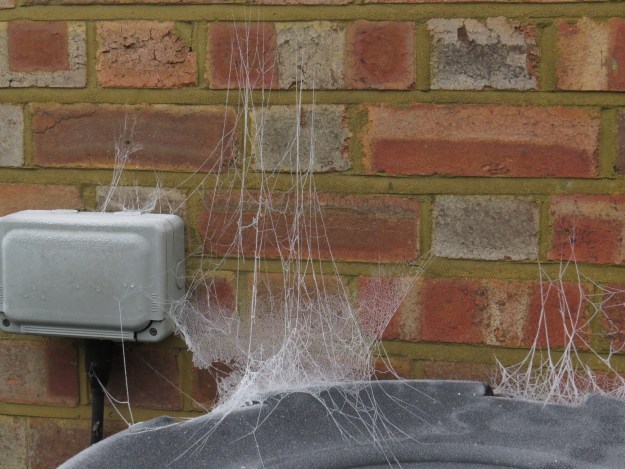
Dear Readers, the cold snap continues – the temperature as I write is a chilly 28 degrees (don’t laugh, Canadian readers). So far there’s no snow, but there’s a chance of some overnight and tomorrow, which, as I am working from home and don’t have to go out in it, makes me rather selfishly excited. But what was even more exciting this morning was the way that the overnight frost had exposed every single spider’s web in the garden. Who knew that they had been so busy?

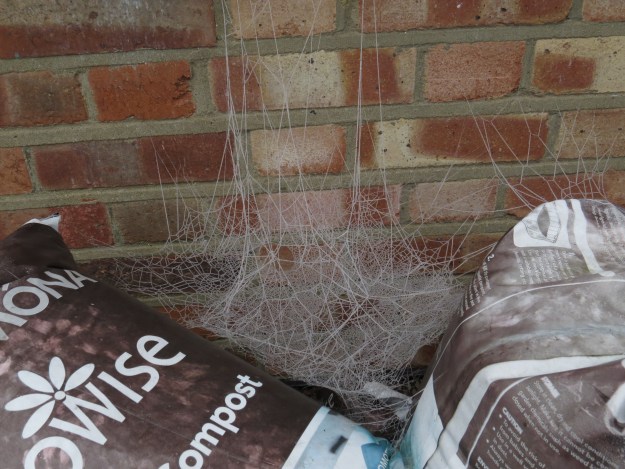
I suspect that these have been built by lace-web spiders (Amaurobius sp.), though they could also belong to the noble false widows which seem to be cropping up everywhere, and which also make a sheet web. The frost has revealed every strand, and shows the structure, with long, thick strands anchoring the web, and then a multitude of smaller ones forming the basis of the web.

In this web, the spider who made the lacy web at the top has been joined by a garden spider lower down.

The bags of compost that I left on the garden table have formed the basis for some very impressive webs.

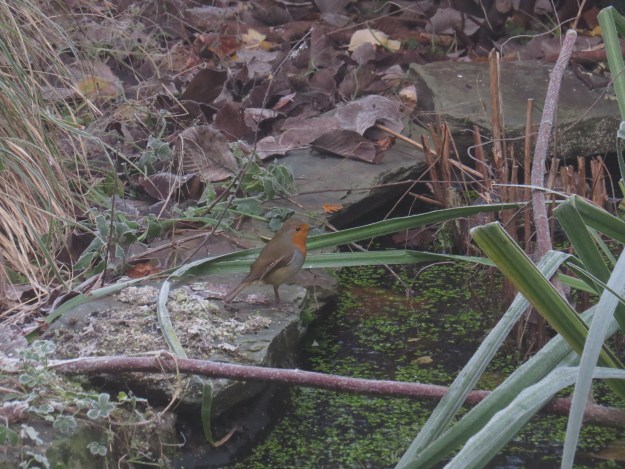
And a poor robin waits patiently above the frozen pond for someone to break the ice. Two minutes after my husband had broken it, the robin was back, having a bath. Clearly s/he got the memo about cold water being good for you.

And finally, a few more orb webs on the garden chairs.

It’s amazing what goes on in the garden that we can only see under very particular conditions. I love that the spiders were so busy during the summer, and that they left us these signs of their passing. These are the loveliest decorations that anyone could ever wish for.