Monthly Archives: February 2024

Holding Pattern…

Viburnum bodnantsis ‘Dawn’

Dear Readers, you might remember that I am hoping to have some work done on the trees in my garden – in particular, the whitebeam and the hawthorn need a bit of a trim. I’ve agreed the work with the tree surgeon, but since then there’s been torrential rain, high winds, problems getting the chipper for the bits that we’re going to cut off, and now the tree surgeon is off on holiday until 10th March. Woe is me! I am a little worried that the magpies will decide that it’s time to nest again, at which point we’ll be postponing everything until the autumn. For one thing it’s illegal to damage an active nest, and for another thing, much as magpies are rather divisive birds I’m not going to interfere if they’re just starting to breed.

But me  being me, that hasn’t stopped me from buying plants (and getting them as presents). My friend J bought me a Viburnum bodnantense ‘Dawn’ back in january, and it’s still sitting happily in its pot – it’s intended to go quite close to the whitebeam, so I’m taking no chances! And when I was at Myddelton Gardens with my pal L a few weeks ago I couldn’t resist the cheap plants at the Clockhouse Garden Centre, and so my Cyclamen coum and Dame’s Violet are waiting to get planted too. I’m visiting the Sunshine Garden Centre today (29th February) so who knows what I’ll have stacked up, just waiting to be planted, by the time the whitebeam is sorted?

Cyclamen just waiting to be planted.

In other news, you might remember that I was looking for a squirrel-proof feeder a while back, and the one below seems to be working nicely – the squirrels have had a go, but have given up, mainly because they can raid one of the other feeders.

Goldfinch taking advantage of the squirrel-proof feeder

But I have been fascinated by this rather handsome feral pigeon, who I have nicknamed ‘Rambo’ for reasons that will soon become apparent. He only visits once per day, and always comes alone, but once in situ he will see off any other bird, and sometimes even the squirrels. The parakeets get pecked as well, which is very impressive.

Here ‘he’ (I have no idea) is seeing off a woodpigeon.

And here the sparrows wait patiently for him to have his fill (though they have also taken to the suet feeder).

And everywhere, things are coming into bud, which is very gratifying after what has felt like a long, damp winter.

And today is ‘Leap Day’! Traditionally, a woman can propose marriage to a chap on 29th February, so if any of you have been thinking of doing such a thing, now’s your chance. In Scotland, any man who refused such a proposal could be fined (up to the price of a silk gown), and in Denmark any reluctant males had to buy twelve pairs of gloves for the woman in question, so that she could cover up the fact that she didn’t have an engagement ring.  On the other hand, in Ukraine and Greece it’s believed that getting married during a leap year can lead to divorce, so maybe leave the actual ceremony until 2025. And regardless, you could celebrate with a ‘Leap Year Cocktail’, devised by Harry Craddock, a bar tender at the Savoy. In 1928 he devised a drink that combined gin, vermouth, lemon juice and Grand Marnier, and after that lot I imagine that you might be far more amenable to proposals of many kinds. Cheers everybody!


A Visit to the Orchid Festival at Kew

Dear Readers, I have been wanting to visit the Orchid Festival at Kew Gardens for many years, but somehow something always happened (the pandemic, a crisis at work, a crisis with the parents). This year, however, I finally made it! This year’s theme was ‘The Orchids of Madagascar’, and fair enough – the country has over 1,000 species of orchid (one in ten plants in Madagascar is an orchid). Of these species, 90% are endemic (found nowhere else) and Kew has been very active in working with Malagasy scientists to document and conserve what’s there.

I was also lucky enough to visit Madagascar about twenty years ago – I found it one of the most interesting, difficult and heart-breaking places that I’ve ever encountered.

The Festival is held in the Princess of Wales Conservatory (which hosts a variety of different zones, from desert to tropical forest), and we all queued up in the chilly wind for about half an hour before we got in. At least it wasn’t raining! And then people had their bags checked so we trickled in a bit at a time, which meant that it never felt overwhelmingly busy.

Orchids in the desert zone

It’s fair to say that many of the orchids were not Madagascan, but there were some very unusual and attractive plants. Plus to entertain the young ‘uns (and the not-so-young ‘uns) there were various Madagascan animals dotted about, some obvious, some not.

Ring-tailed lemurs…

I loved the cactuses in the desert zone.

And there was an elephant bird! This bird was only rendered extinct well after humans arrived in Madagascar (probably as late as the 13th century) and you can still buy elephant bird eggs in the local markets.

An elephant bird.

I don’t know why my Christmas Cactus never looks exactly like this. 

Then it was off into the tropical zone, with its pond and explosion of orchids. Sadly my camera lens steamed up and I didn’t notice for quite a while. Still, hopefully you get the idea.

There was a wickerwork Zebu  (a kind of local humped cow) standing in the shallows. I remember driving past a herd of these cattle in our jeep, and seeing the farmer cut the throat of one of the animals – what a visceral and unexpected shock that was! But we also saw farmers tenderly washing and grooming their cattle and their water buffalo. There are a variety of cultures in Madagascar, and it would take a lifetime to even begin to appreciate them.

The next part of the conservatory was full of chameleons – not real ones, sadly. Madagascar is home to over half of the world’s species of chameleon, from giants to tiny leaf chameleons that would fit on a thumb nail.

There were also some tiny orchids dangling from the ceiling.

Oh look, an aye-aye! These are nocturnal lemurs who use their long middle-fingernail to extract beetle larvae from dead wood. When we visited, one of them wandered over to our guide and tappity-tapped at the foot of his wellington boot. I wonder if s/he thought that the movement of his toes was a grub?

One minor aggravation, for me at least, was that it was very difficult to find any information on the individual orchid species. I have lots of pretty photos, but I have no idea which of these plants are Madagascan, or anything about their lifecycles, except that they involve all kinds of complex interactions with other species. Still, these are exquisite organisms, and here are some photos to prove it.

And oh, look – a sifaka (one of those lemurs that leaps across the ground or between the trees).

The last ‘scene’ was a mock-up of a research camp, complete with jeep and tent and some herbarium specimens.

Interestingly, the Madagascar Periwinkle is the plant featured here – this was a folk-remedy for diabetes for decades, but its active ingredient was found to be able to stop the rapid dividing of cells. This ingredient, vincristine, is used as a treatment for childhood leukaemia – originally it could only be extracted from the plant, but can now be synthesised. It just goes to show that we could be losing plants which would be of great value to humanity – this is not the only reason for saving them, as every species has both an intrinsic value and a place in its ecosystem, but it does give the situation an added poignancy.

Madagascar periwinkle (Catharanthus roseus)

And then we were thoroughly hungry, and so we went for lunch at The Original Maids of Honour, just five minutes along Kew Bridge Road. They do what looks like a wonderful Afternoon Tea (the coffee eclairs looked scrumptious) and their pies, pasties and quiches are all home-made. It was absolutely delicious, but Readers, if you are going to go I would definitely book – we got the last available table on a rainy Monday, goodness only knows what it’s like at the weekend! I love Kew Gardens but have always been a bit underwhelmed by their food offering, so this is a great alternative.

Burtynsky – Extraction and Abstraction at the Saatchi Gallery

Dear Readers, when you look at the image above, what do you see? Is it an abstract painting? Is it a painting at all? In fact, it’s an image of a tailings pond from a diamond mine in Kimberley, South Africa, and is by Edward Burtynsky, a Canadian who has been photographing our impact on the natural world for 40 years. Here’s what he has to say:

Nature transformed through industry is a predominant theme in my work. I set course to intersect with a contemporary view of the great ages of man; from stone, to minerals, oil, transportation, silicon, and so on. To make these ideas visible I search for subjects that are rich in detail and scale yet open in their meaning. Recycling yards, mine tailings, quarries and refineries are all places that are outside of our normal experience, yet we partake of their output on a daily basis.

These images are meant as metaphors to the dilemma of our modern existence; they search for a dialogue between attraction and repulsion, seduction and fear. We are drawn by desire – a chance at good living, yet we are consciously or unconsciously aware that the world is suffering for our success. Our dependence on nature to provide the materials for our consumption and our concern for the health of our planet sets us into an uneasy contradiction. For me, these images function as reflecting pools of our times.”

What struck me was how beautiful some of these images were, in spite of what they depicted. I was particularly struck by these photographs of a Russian potash mine. The patterns in the tunnel walls are made by the drills, revealing these psychedelic patterns of colour (you can see the tunnel arcing off to left of the photograph).

This image, which looks to me like an eye, or maybe the centre of a flower, is of the tailings of an Australian coal mine, which has been leaking methane since its closure in 2014.

Not all the images show human damage – the spirals and wavy lines below are swales, channels ploughed into the earth to capture rainwater and and self-seeded plants in the Northern Cape, South Africa.

And the photos below show the polders in the Netherlands, where the Dutch have been dealing with the challenges of being a low-lying country for hundreds of years.

This photo, which looks rather like an illustration from a book, shows pivot irrigation in Arizona – the fields are circular because they’re irrigated from a central point with ground water from the Ogallala aquifer, which is running dry and will take thousands of years to replenish.

The photo below shows fields of rapeseed being grown for biofuels in China. We might compare this to the acres upon acres of rapeseed and maize being grown in the UK for a similar purpose.

These are the greenhouses of Almeria, in Spain…

And these are the oil sands of Alberta at Fort McMurray. Incidentally, for a challenging and exciting read I can recommend John Vaillant’s book on what happened in the fires of 2016 ‘Fire Weather – A True Story From a Hotter World’, which won the Baillie-Gifford Prize for Non-Fiction last year.

Here is what’s left of the landscape after a uranium mine in Northern Ontario was decommissioned twenty years ago….

And this is the image that probably made Burtynsky’s name back in 1996 – it shows the tailings from a nickel mine just outside Sudbury in Ontario. The red colour comes from oxidised waste from the mining process. Interestingly, this is a small stream rather than the mighty river that it appears – scale is everything in Burtynsky’s photos.

I love the sculptural quality of some of Burtynsky’s photographs – this one, of a partially-completed ship in a Chinese megadock really caught my eye.

But there are also human stories here. This is a Madagascan sapphire mine – it is totally unregulated, and people can dig here if they can afford the fees. You can see how dangerous the ‘mine’ looks, as if there might be a landslide at any second. The sapphires are sold for a fraction of their eventual price in wooden shacks in the main town, which feels more like the ‘wild west’ than anywhere I’ve ever been.

Here’s a close up of the top right hand corner, where the men have left their flip-flops so that they can dig barefoot. I find it very moving.

And finally, here are a few factory shots. Some of these took literally days to build. All these ladies in pink are preparing chicken in a Chinese factory.

And judging by the slogans on the banners, you might think this was another Chinese factory. Well, in effect it is, but it’s actually in Ethiopia, as you can see if you look at the workers. China is pouring money into some parts of Africa, and the outcomes will be interesting to see.

What can I say? This exhibition is well worth a look – the Saatchi is a great space, with enough room for you to actually stand back and take in the images. Plus, today it wasn’t at all crowded. It is £18 each though, which isn’t cheap, so if you’d like to see some Burtynsky for free, hang on until 28th February when his new work will be at the Flowers Gallery in Cork Street, London. You can also get a nice idea of the exhibition for free here, with images of each of the rooms at the Saatchi.

Overall, I’m conflicted. The images of such destructive practices as mining and intensive agriculture are often extraordinarily beautiful, and therein lies the rub. If we want to continue to have ‘things’ in the way that we’ve had them in the past, we need to be aware of what that wanting does. I feel a little as if Burtynsky’s photos present a gods’ eye view of the world, a certain detachment. I loved them as abstract images, but they didn’t move me. Let me know what you think.

Peach Fuzz!

An example of Peach Fuzz – Chrysanthemum Salmon Enbee Wedding (from https://www.hallsofheddon.com/product/chrysanthemum-salmon-enbee-wedding/)

Dear Readers, my Royal Horticultural Magazine is always a source of wonderment, and this month there was an article about Pantone’s ‘Colour of the Year’. Who knew that there was such a thing? But this year, the global colour-trend forecasters at the paint company have announced that it’s ‘Peach Fuzz’, and my poor old Mum would have been delighted – she was always one for a ‘Rosy Glow’ in the living room, and I’m sure this shade would have been right up her street.

I also didn’t know that the RHS have a Colour Chart, with 920 hues, each with a unique code and name that can be matched precisely to fruit, flowers and foliage. This must be very handy for the garden planner with a vision! It is apparently the standard reference used by horticulturalists worldwide, so that they know that when they refer to a particular colour, another gardener or plant enthusiast will know exactly what they’re on about. In order to see what ‘Peach Fuzz’ would look like, Yvette Harvey, the Keeper of the Herbarium at RHS, matched the paint sample to the Colour Chart, and discovered that the closest match was 26D, called, rather prosaically, ‘Light Yellowish Pink’. There are only fourteen plants out of the 90,000 listed that match the colour designation, and here are a few of them.

The chrysanthemum in the first photo is a half-hardy perennial, and looks as if it might be good for pollinators, though in my experience they aren’t particularly attracted to peach/apricot/orange flowers – do tell if you have a different experience!

Dahlia ‘Labyrinth’ is a stunner, but I have had no luck at all with dahlias so far. Maybe I’ll have another bash this year.

And how about this wonderful Red-Hot Poker (Kniphofia) – this definitely is good for pollinators, in spite of it being pollinated by sunbirds in its native South Africa.

And this is a plant that I’d never come across before – Lilium rosthornii, a Chinese lily that reminds me rather of a Martagon lily. As with all lilies, keep away from your feline friends!

And how about this rather strange narcissus – known as  ‘Waldorf Astoria’ it’s a pretty colour but has a most unlikely shape.

Now this is more like it! I rather like this Potentilla.

For anyone with no outside space who wants to get into the whole ‘Peach Fuzz’ thing, here’s a barrel cactus (Rebutia ‘Apricot Ice’)

Then there’s a peach-coloured Azalea (‘Hanger’s Flame)…

And this very pretty, delicate rose (‘Joie de Vivre ‘Korflociol’)…

Rosa ‘Joie de Vivre’ (Korflociol) from https://hayloft.co.uk/rosa-joie-de-vivre-g-k33574

And finally, and possibly my favourite, this Verbascum, ‘Tropic Sun’. Sadly this was the best photo that I could get, and the seeds are out of stock at this supplier, so no Tropic Sun for me!

So if this has all piqued your interest, there’s an article on the RHS website about how to incorporate peach-coloured plants into your garden here and should you wish to lay your hands on the RHS colour chart it’s here though at £295 you’d need to be very keen.

Furthermore, if you’re intrigued by the whole idea of ‘The Colour of the Year’, you can have a look at some previous winners (and the way that the colours are chosen) here. If nothing else, it’s a very astute marketing device, and no doubt companies from fashion houses to garden centres will be stocking up with pale orange, peach and apricot products. Let me know if you spot anything, I’m intrigued….

Last Call for Flowers for Fran

Dear Readers, I have had a wonderful response to the Flowers for Fran appeal – seeds have gone to Cornwall and Wales, various spots in London and Stratford Upon Avon. But as you can see, I still have quite a lot left, so if you’ve been hanging back coyly, now’s your chance to be bold! I have been sending out  the most recent seeds first, so some of the packets now have a date of 2023 or even earlier. However, in my experience, although you won’t get quite the same level of germination some seeds will still ‘do their stuff’ and it all makes for a bit less ‘pricking out’ when the time comes.

If you’d like some seeds (or already have some, but would like some more), see the list below. If you post a comment (with your email address rather than anonymously) I shall contact you to sort out where to send everything to. I’m paying for the postage as a little gift to Fran, and to all the bees and butterflies and other critters who will hopefully come calling.

I have the following seeds in my magic box. Don’t be shy! These flowers aren’t going to plant themselves you know :-).

Fran’s Flowers
Species Variety No of Packets
A
Ageratum Blue Mink 1
Amaranthus Pony Tails Mixed 2
Antirrhinum Royal Bride 1
Aquilegia William Guinness 2
B
Basil 1
Bellis Pomponette Mixed 1
C
Carrot St Valery 1
Catmint Catnip 2
Cephalophora Pineapples 1
Chamomile 1
Cleome Helen Campbell 2
Violet Queen 4
Coriander 1
Cosmos Brightness Mixed 2
Polidor Mixed 1
D
Dahlia Mignon Mixed 1
Daisy Goliath Mixed 1
Dianthus Loveliness Improved Mix 1
Russian Skies 2
Sooty 1
Diascia Apricot Queen 1
E
Echinacea Large-flowered 1
Echium Blue Bedder 1
F
Foxglove Alba 2
Apricot 1
Excelsior Mixed 1
H
Hesperis Lilac 1
Hollyhock Giant Single Mix 1
Honesty Purple and White Mix 2
L
Larkspur Giant Imperial 2
Laurentia Blue Stars 1
Bullet Bush 1
Lavatera Twins Hot Pink 1
Loveliness Mixed 1
Lemon Balm 1
Lettuce Salad Bowl Mixed 1
Arctic King 1
M
Malope Vulcan 1
Marigold (French) Red Cherry 1
Scarlet Sophie 1
Morning Glory Grandpa Otts 1
N
Nicotiana Sylvestris 1
Nigella Moody Blues 2
P
Pansy Early Mixed 1
Parsley Plain Leaved 2 1
Penstemon Scarlet Queen 1
Petunia Confetti Mixed 1
Physotegia Summer  Snow 1
Poppy Double Tangerine Gem 1
Fruit Punch 1
Iceland Mixed 1
Purple (Opium Poppy) 1
Shirley Single Mixed 1
Yellow Peony 2
Potentilla Monarch’s Velvet 1
R
Rudbeckia Cherokee Sunset 1
Daisies Mixed 1
Marmalade 1
Rustic Dwarfs 1
Solar Eclipse 1
Sputnik 1
S
Scabious Tall Double Mixed 1
Shasta Daisy Alaska 1
Schizanthus Angel Wings Mixed 1
Silene Starburst 1
Sunflower Earth Walker 1
Evening Sun 1
Red Sun 1
Teddy Bear 1
Valentine 1
Velvet Queen 1
Sweet Pea Heirloom Mixed 1
Fragrantissima 1
Singing the Blues 1
Tall Mixed 1
T
Tagetes Starfire Mix 1
Tomato Gardener’s Delight 1
Moneymaker 1
V
Verbena Bonariensis 2
Viola Comedy Mixed 1
Tricolor 2
Zinnia Early Wonder 1
Jazz 2
Miscellaneous Mixes
Mixed Annuals Quick and Easy 1
Samba Annuals nb 2017 1
Native Wildflower Mix 1
Wildlife Attracting Garden Mixed 1
Wildflower Cornfield Mix 1
105

2023 – The Kindness of Strangers

Dear Readers, sometimes it’s the little things that really make an impression, as with this incident. Writing a daily blog really helps me to notice things like this.

Dear Readers, why, you might ask, is the blog featuring a rather unassuming-looking sandwich bar today? Well, I am in Dorchester, and it’s always hard – Dorset has so many memories of when Mum and Dad were alive. When I travel through Moreton station, I can almost see the pair of them standing on the platform waiting for my train to arrive, Dad would be in his zip-up jacket, Mum in some combination of bright fuchsia and turquoise and both of  them would be wearing  those photochromatic spectacles that go dark at the first sign of sunshine. They always reminded me of a pair of mature and successful bank robbers taking a break from Marbella. And now, no one waits for me at the station, and yet I always find myself looking for them, or for some trace of them.

So, by the time I get to the next station along, Dorchester South, I am often a little downhearted. And then there’s the walk past the care home where Mum and Dad spent their last months. I always pause to look up at the window on the third floor which was Dad’s room, as if I expect him to be watching for me, or at least for my bright red coat. Towards the end, I think he recognised the coat more than he did me, but I take comfort that he always knew that I was someone who was special to him for some reason, and someone who cared about him.

Today, I jumped on the train before I had a chance to buy any lunch, and all this remembering had made me hungry, so I stopped at the Pic-Nick sandwich bar. It’s tiny, really just a counter and a space to wait, but the man working there made me a massive ham and mustard roll (for some reason my vegetarianism goes right out of the window here). And then, he asked me if I wanted any salad.

“No thank you”, I said. I always feel as if I need all the carbohydrates and fat that I can get.

And he hesitated, and then he said “Oh, go on, have some iceberg lettuce at least, it’s good for you, and we all need the vitamins. It’s not any extra”.

And I thought, you know what, I do need the vitamins. I never thought of myself as being a disordered eater, but just lately I do wonder. It’s as if I can make the effort to make healthy meals for other people, but when it’s just me I don’t bother.

He was waiting for me to make a decision.

“Yes, please”, I said, and he looked so delighted that I felt as I’d done him a favour, instead of the other way round.

Why should a complete stranger care about someone else’s health? And care enough to risk a rebuff? What a lovely man. And it was the most delicious roll that I’ve had in a long time (and a lot cheaper than the equivalent would have been in London).

And so, if you are ever in Dorchester and looking for a sandwich, I can recommend the Pic-Nick on Allington Street, just round the corner from the Tutankhamun exhibition and the art shop. And if I was you I would definitely include some salad, because we all need some more vitamins.


2022 – Wednesday Weed – Gooseberry

Dear Readers, I have no idea how I managed to get to 2022 without mentioning a Wednesday Weed – I’ve been writing them right from the very beginning, and it’s introduced me to many local plants that I had not previously made the acquaintance of. However, it’s easy to run out of plants, especially in the winter months, and so my attention has moved to anything that grows – ornamental plants, street trees, and favourite foods. The poem at the end  is a corker. Do have a look!

Dear Readers, it’s the short gooseberry season again, and yesterday I got  carried away and purchased not only some ordinary green  ones, but some of these rather fine red ones too. Personally I like the way that their lip-puckering sourness can be tempered with sugar and cream, and find it a perfect foil to something fatty like mackerel.  However, like liver, rhubarb and brussel sprouts it’s one of those foods that definitely splits the crowd.

Gooseberries are a member of the currant family, and have been in the UK since at least the 13th century, though they weren’t recorded in the wild until 1763. Their Latin name, Ribes uva-crispa, literally means ‘curved grape’, and they are very grape-like, apart from those prickly hairs. The name ‘goose berry’ is harder to fathom, though having seen geese munching on blackberries at Walthamstow Wetlands last week it wouldn’t surprise me if waterfowl sometimes found them a tasty snack. Some people believe that the ‘goose’ is a corruption of the word ‘groseille’ from the French word for currant, but the Oxford English Dictionary is firmly on the side of a goose being a goose. In some parts of the UK they’re known as ‘goosegogs’.

Now, how about the folkloric story that babies are found under a gooseberry bush? Charming as this is (and much easier than going through all that labour business as any mother will tell you), in the 19th century ‘gooseberry bush’ was apparently slang for pubic hair – I suspect that the hairiness of the berries probably contributed to the phrase.

I have looked in vain for the origin of the phrase ‘playing gooseberry’ (i.e accompanying a courting couple in the role of chaperone or general spoilsport). It’s first recorded in 1837, and the explanation given then is that the third party would have been ‘innocently’ involved in some other occupation (such as picking gooseberries) whilst the couple talked, while all the time taking note of everything that was said. Another interpretation is that the third party deliberately took themselves off so that the couple could be together. In all of this, the role of the poor gooseberry plant is rather obscure, but such is language – for some reason, phrases stick and their original meaning is lost in the fog. Suffice to say that when I was growing up, being a ‘gooseberry’ was considered to be being an unwanted hanger-on. Do let me know if you have or had an alternative meaning for the phrase! It all makes my head spin a little.

I also like the story from the Plant Lore website of a Dorset grandmother who used the phrase ‘may the skin of a gooseberry cover all of your enemies’. Indeed, and what a picture that conjures up! The same page describes how a cure for a stye (boil) on the eyelid was to prick it every day with the prickle from a gooseberry.  Apparently an alternative cure was to have a widow touch the stye with her gold wedding ring, which must have taken a bit of persuading.

The flowers of the gooseberry are rather unusual, purplish-brown in colour and, to my eye at least, rather alien-looking.

Photo One by By User:Ridinghag - photo made by myself, Public Domain, https://en.wikipedia.org/w/index.php?curid=26741565

Photo One

Originally, gooseberries come from the area to the east of France right the way through to the Himalayas and India. It’s unclear whether the Romans ever ate them, but they do seem to have had a reputation for medicinal value, with the juice being used to treat fever – one alternative English name is ‘Fea-berry’. In the wonderful ‘Modern Herbal’ by Mrs Grieves, she describes gooseberry juice as

sub-acid and is corrective of putrescent foods, such as mackerel or goose‘.

The leaves were thought to be a treatment for ‘gravel’ (presumably gallstones), and an infusion was thought to be useful to alleviate period pain.

The gooseberries found wild in the UK are probably the descendants of those grown for food or medicine, and are largely bird-sown, with thrushes not seeming to mind the sourness of the fruit. I wonder if birds, like cats, have no way of detecting sweetness? I shall have to investigate. Clearly they can distinguish colour, as they normally prefer ripe fruit, but I wonder if that’s because of its nutritional value rather than its taste?

Anyhow, birds are not the only creatures who like gooseberries: in North America, bears eat the berries (clearly they have a sweet tooth), and foxes, raccoons and coyotes browse the foliage. Amongst the smaller animals, in the UK the caterpillars of the magpie moth, comma butterfly and v-moth feed on the foliage.

Photo Two by Charles J. Sharp, CC BY-SA 4.0 <https://creativecommons.org/licenses/by-sa/4.0>, via Wikimedia Commons

Magpie moth (Abraxas grossuliata) (Photo Two)

Photo Three by Ben Sale from UK, CC BY 2.0 <https://creativecommons.org/licenses/by/2.0>, via Wikimedia Commons

The V-Moth (Macaria wauaria (Photo Three)

Photo Four by Charles J. Sharp, CC BY-SA 4.0 <https://creativecommons.org/licenses/by-sa/4.0>, via Wikimedia Commons

Comma butterfly (Polygonia c-album) showing the ‘comma’ on its underwing (Photo Four)

Gooseberries are also greatly loved by the larvae of the gooseberry sawfly (Nematus ribesii), who are voracious little devils, and who are reputed to be able to strip a gooseberry bush of its foliage in a matter of days. Sawflies are not actually flies, but a member of the wasp, ant and bee family (Hymenoptera), and many adult sawflies are useful either as pollinators or as predators on other caterpillars in the garden. Sadly, this might be small comfort to someone whose gooseberry bush (not a euphemism) has been stripped by eager little sawfly larvae.

Photo Five by By I, Karon ind, CC BY-SA 3.0, https://commons.wikimedia.org/w/index.php?curid=2287476

Gooseberry sawfly larvae (Nematus ribesii) (Photo Five)

Now, if your gooseberries have survived, what do you do with them? The traditional uses are of course crumbles, jam, or a chutney-ish preserve to eat with cheese or the aforementioned mackerel (in French, gooseberries are groseille à maquereau or mackerel berries). I am spoilt for choice on recipes, but here is one for gooseberry, turmeric and frangipane tart that uses fresh turmeric (should you stumble across some), and here is a rather more accessible recipe for gooseberry crumble cake. And how about gooseberry and elderflower trifle? Very tasty.

And whoa, how about this for a poem! Simon Armitage, Poet Laureate of the UK, tells quite the story here. How many strange directions this takes! The commentary for the poet mentions that he is widely seen as the inheritor of Philip Larkin’s ‘Dark Wit’ . See what you think.

Gooseberry Season
Simon Armitage – 1963-

Which reminds me. He appeared
at noon, asking for water. He’d walked from town
after losing his job, leaving me a note for his wife and his brother
and locking his dog in the coal bunker.
We made him a bed

and he slept till Monday.
A week went by and he hung up his coat.
Then a month, and not a stroke of work, a word of thanks,
a farthing of rent or a sign of him leaving.
One evening he mentioned a recipe

for smooth, seedless gooseberry sorbet
but by then I was tired of him: taking pocket money
from my boy at cards, sucking up to my wife and on his last night
sizing up my daughter. He was smoking my pipe
as we stirred his supper.

Where does the hand become the wrist?
Where does the neck become the shoulder? The watershed
and then the weight, whatever turns up and tips us over that
razor’s edge
between something and nothing, between
one and the other.

I could have told him this
but didn’t bother. We ran him a bath
and held him under, dried him off and dressed him
and loaded him into the back of the pick-up.
Then we drove without headlights

to the county boundary,
dropped the tailgate, and after my boy
had been through his pockets we dragged him like a mattress
across the meadow and on the count of four
threw him over the border.

This is not general knowledge, except
in gooseberry season, which reminds me, and at the table
I have been known to raise an eyebrow, or scoop the sorbet
into five equal portions, for the hell of it.
I mention this for a good reason.

Photo Credits

Photo One by By User:Ridinghag – photo made by myself, Public Domain, https://en.wikipedia.org/w/index.php?curid=26741565

Photo Two by Charles J. Sharp, CC BY-SA 4.0 <https://creativecommons.org/licenses/by-sa/4.0>, via Wikimedia Commons

Photo Three by Ben Sale from UK, CC BY 2.0 <https://creativecommons.org/licenses/by/2.0>, via Wikimedia Commons

Photo Four by Charles J. Sharp, CC BY-SA 4.0 <https://creativecommons.org/licenses/by-sa/4.0>, via Wikimedia Commons

Photo Five by By I, Karon ind, CC BY-SA 3.0, https://commons.wikimedia.org/w/index.php?curid=2287476

2021 – R.I.P Bailey, King of the Cats

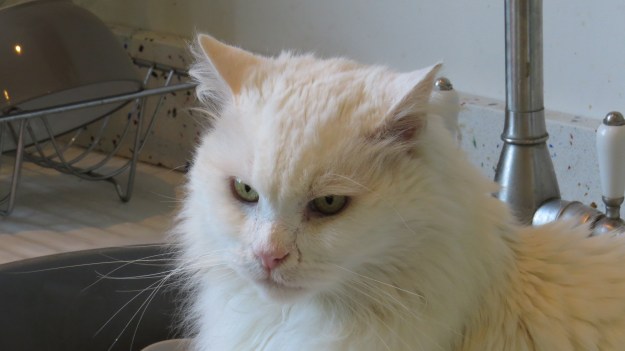
Bailey, the world’s most magnificent cat in 2017

Dear Readers, when I say that a community is about more than just people, I often think of Bailey, who visited our garden regularly from when we moved in in 2010 to when he passed away in 2021. What a magnificent creature he was! And he seemed to bring the community together in a whole range of creative ways. We miss him still….

Dear Readers, a few nights ago Bailey, the King of the Cats, went to sleep for the last time at the fine old age of nineteen years. He has been so much part of our life, and of the lives of many people who lived in the County Roads, that I wanted to pay tribute to him here.

I first met Bailey before we even moved to East Finchley. We were standing on the patio of what was to become our new home when we heard a loud and persistent miaowing issuing from the bushes. Up strode Bailey. He bobbed up for a head scritch, rolled on his back and then marched up to the back door, demanding to be let in. As it  wasn’t yet our house, we decided that this probably wasn’t the best idea, but once we were living there he became a regular visitor.

On one occasion I heard the voice of Bailey’s owner, followed by an all-too familiar wailing.

“Bailey! Come down from there. Don’t make a show of yourself”.

And there was Bailey standing on top of the ten-foot fence at the end of the side return. He had gotten up there, but seemed not to have worked out how he was going to get down. We humans stood and considered what to do. I tried standing on a chair but it wasn’t quite high enough. Fortunately at that point my six foot three inch tall husband arrived home from work, fetched a stepladder and rescued him. Carrying Bailey up the road to his actual house became part of our weekly routine. I think he regarded us as some kind of taxi service for when he was too tired to walk the last hundred yards home.

We soon made friends with Bailey’s actual family (or ‘subjects’ as I’m sure he thought of them). We were in regular contact, as Bailey developed a habit of wandering off. We never fed him, but other people did, and locating him became quite a problem. I am convinced that Bailey never thought of himself as a cat, but as a small furry human being. He would make himself at home on the armchair and watch benignly as I worked. He also loved sitting in the sink, normally (but not always) when there was nothing in it. We learned that what he loved was to drink from a running tap.

Bailey trying to get us to turn the tap on by telepathy.

Finally!

You would not believe that in these photos Bailey was already fifteen years old. He retained his elegant good looks for most of his life, and he was such a popular character on the street that everyone seemed to know his name. Well, you couldn’t really miss an extremely vocal pure-white cat who simply demanded to know who you were and what you could do for him. I had the sense that Bailey always knew what he wanted, and a bit more besides. We found we had a lot in common with Bailey’s owners, and we would probably never have found out how much if Bailey hadn’t ‘introduced’ us. He always seemed preternaturally wise to me.

As the years wore on, Bailey got a bit slower and a bit stiffer, like most of us, but he was still a regular visitor to the garden. The birds never bothered about him, and I never saw him try to catch anything. Other cats scattered at a glance. He would sometimes pay a visit to the garden ‘waterhole’ for all the world like a domestic lion.

Bailey drinking from the pond

He’d always march straight up to the back door and yowl to be let in. If he caught your eye from an upstairs window he would re-double his efforts.

Let me in!

In April this year he paid a visit to the garden. He was clearly a very elderly gentleman, and yet he still announced himself in the usual way,

He was very wobbly on his legs and so we called his ‘Dad’ who came to carry him home. It is so sad to see an animal towards the end of his days, and yet Bailey was a cat who defied pity; he was still the same regal cat that he’d been when we first met him eleven years ago. He loved people, was never happier than when he was plonked down in a patch of sunshine, and seemed to be of the opinion that everything had worked out for the best. He was, as Samuel Johnson said of his beloved cat Hodge, a very fine cat indeed.

R.I.P Bailey. The street is quieter, and much sadder, without you.


2020 – How Are We Doing?

Waterlily in frog pond, Tabin Wildlife Reserve, Borneo

And then there was that pandemic thing….it’s funny reading this now, with so much still to come on both a personal and a universal level. I started writing the blog daily at this point, and to my astonishment I haven’t missed a day since. 

Dear Readers, it has been a remarkable few weeks. On Friday 13th March I headed off for my big 60th birthday trip to Borneo, something that I’d been planning for over a year. At the time there were no travel advisories for Malaysia, and the main problems with Covid-19 seemed to be in China (where it was seemingly coming under control), Italy (in lockdown) and South Korea. Malaysia had a small number of cases, and Singapore, where we were heading to at the end of the trip, had the best results of any country in containing the disease. However, for the past ten days it has felt as if we are surfing just ahead of a huge wave. Singapore was closed, so that part of the trip was cancelled. Malaysia announced a lockdown, so no new tourists arrived. We were the last visitors at each place that we stayed, and the staff and guides at the lodges had no idea when they’d be able to work again after we left. Our plane home, on Sunday night, was packed with people who’d gotten stuck all over Asia. Out of 60 planes leaving from Kota Kinabalu, 56 were cancelled. I am so grateful and lucky to be home, and am also full of sadness, both for the beautiful but benighted country that I visited, and for the terrible effects of this virus. And don’t get me started on the inadequate responses of our own government.

So, I have lots of things to share with you, and I will start a daily blog from Thursday so that I can take you all with me on my Borneo adventure (minus the mosquito bites). But first, I wanted to check in with you and see how you are all doing. I know that different places are in different degrees of lockdown, but here in the UK all non-essential shops are closed along with schools, churches, and other meeting places. Physical distancing is supposed to be observed, with a 2 metre gap between people who don’t live together when in public spaces. You can go out to exercise once a day (and I’ve already had a brisk walk around Coldfall Wood, where most people seem to have got the message about keeping their distance). The police now have powers to enforce the closures and physical distancing but it will be interesting to see how that goes. The measures are supposed to be reviewed in three weeks, but realistically I expect this to last for a good few months at least. I am able to work from home, which is great, and for me I think that the key will be to get into a routine – it would be so easy to disappear into a black hole of online Covid-19 news and general nonsense. I recognise, again, how lucky I am in so many ways: I am in good health, my husband is also my best friend so we won’t be throwing things at one another as the weeks go on, and it’s easy to get to the local shops that are open for food. I am joining one of the local voluntary support groups so that I can help with shopping or picking up medications for people who are totally self-isolating, and that will help me feel connected. Plus, the garden is full of birds and the fritillaries are in bloom, so nature, as always, helps to make me feel grounded.

Bornean Daddy Long Legs spider

My biggest worry is Dad. His nursing home has been in lockdown for several weeks now, with no visitors allowed. On Sunday he developed a chest infection and was admitted to the local hospital. He is now improving, but has to await the results of a COVID-19 test, which is taking two days. This seems like a very long time to wait for test results – if Dad is getting better I suspect he doesn’t have the virus, and therefore is blocking a bed for someone who is much sicker than him. Plus, his dementia makes him extremely distressed in unfamiliar surroundings, and visitors are strictly limited. Fortunately his favourite carer from the home is going to see if there’s any way that she can get in to see him today, which will help, and hopefully he’ll test clear and be out on Wednesday. These situations always make me feel helpless, and it’s even worse when I can’t get down to see him myself.

Pig-tailed macaques in Sukau, Borneo

So, I would love to know how you’re holding up under the strain of the current situation. It’s an anxiety-provoking time for us all, and we will need one another more than ever. How are you spending your time? Are you, like me, looking at the clutter and deciding that this might be the time to make life a bit simpler? Are you able to get out into the garden or into nature? What hobbies or pastimes calm your nerves? And do you have any advice for the rest of us? We are living through a historic time, and there will be lessons to be learned that will resonate through the years to come. How we look after ourselves and one another may give us valuable information about the kind of world that we want to live in going forward.

Spiders Web, Sukau, Borneo


2019 – On Mother’s Day

Dear Readers, my mother died in December 2018, and I was visited by this heron on my first Mothers’ Day without her. At this point my Dad was still alive and was living in a nursing home in Dorset. I think my feelings about having a major predator in the garden were shared by lots of people. 

On the first Mothers’ Day since Mum died, I wander around the house like a ghost, unable to settle to anything. I would always ring Mum to see if she liked whatever pretty thing I had sent her, and to see if the Mother’s Day card had hit the spot. Everywhere I look  there are signs of happy families, complete with live mothers. We can’t get into our usual place for Sunday breakfast because it is completely full up from 8 a.m. Muswell Hill is full of young people carrying bunches of flowers.

I have joined yet another ‘club’, the ‘Problematic Mother’s Day’ club. For those who have lost their mothers, those who wanted to be mothers and weren’t able to, those who had abusive or alcoholic or troubled mothers, today, like Christmas, throws up the contrast between what things are ‘supposed’ to be like, and how they actually are. Real life is messier, infinitely more complicated. This year, Mother’s Day is about gritting my teeth and getting through, one hour at a time.

I do still have one parent alive though, and so I  ring the nursing home to see how Dad is  getting on.

‘I’m on a boat’, he says. ‘I’ll be gone for forty days’.

‘Where are you going, Dad?’ I ask. I’ve learnt that it’s easier for everyone if I join Dad in Dadland rather than attempting to drag him into the ‘real’ world, where he has dementia and his wife of 61 years is dead.

‘Northern China’, he says, emphatically.

‘You’ve not been there before, have you? It will be an adventure. I hope the food is good!’

I’m not sure if Dad is remembering the business trips that he used to take, or the cruises he went on with Mum, or if this is a metaphor for another journey that he’s taking. But I am sure that it could be all three explanations at once.

‘And I’ve done a picture of a rabbit with a bird on its head’.

‘That sounds fun Dad, I know you like painting and drawing’.

‘It’s with crayons’.

‘Well, they’re a bit less messy’.

Dad laughs. There’s a pause.

‘I haven’t been able to talk to Mum. I ring and ring, but she never answers’.

I wonder if he has actually been ringing the house and getting Mum’s voice on the answerphone. He is convinced that she is cross with him because one of the ‘young’ female carers at the home ( a very nice lady in her fifties) helped him to have a shower. He went to the funeral, and was in the room when Mum died, but he doesn’t remember.

‘She’s away at the moment Dad’, I say, ‘But she loves you and she knows that you love her’.

‘That’s all right then,’ he says. ‘But I have to go now’.

‘Love you Dad’.

‘Love you n’all’.

It’s as if, in his dementia, Dad is returned to some earlier version of himself – more placid, less anxious. His calls to my brother have gone from 43 in one day to once or twice a week. I am not sure if this peacefulness will last, or if it presages a movement to another stage in the progression of the disease, but I am grateful for his equanimity. Somewhere inside this frail, vulnerable man there is still my Dad, and I feel such tenderness for him.

I walk to the bedroom and look out of the window. There is something totally unexpected in the garden.

A grey heron is in the pond, and, as I watch, s/he spots the rounded head of a frog. Once the bird is locked on target, there is no escape. The heron darts forward, squashes the frog between the blades of its bill and waits, as if uncertain what to do. The frog wriggles, and the heron dunks it into the water, once, twice. And then the bird throws back its head and, in a series of gulps, swallows the frog alive.

I don’t know what to do. I feel protective towards the frogs, but the heron needs to eat too. The frogs have bred and there is spawn in the pond, so from a scientific point of view there is no need to be sentimental. But still. I have been away in Canada for two weeks, and I suspect that the heron got used to visiting when things when quiet. The pond must have had a hundred frogs in it when we left. Hopefully some of them quit the water once the breeding was over, because on today’s evidence the heron could happily have eaten the lot.

What a magnificent creature, though. It is such a privilege to have a visit from a top predator. Close up, I can see the way that those yellow eyes point slightly forward to look down the stiletto of the beak, and the way that the mouth extends back beyond the bill, enabling an enormous gape. The plume of black feathers at the back of the head show that this is an adult bird, perhaps already getting ready for breeding. S/he leans forward, having spotted yet another frog, and I decide that I’ll intervene. I unlock the back door and open it, but it isn’t until I’m outside on the patio that the bird reluctantly flaps those enormous wings and takes off, to survey me from the roof opposite.

I know that I won’t deter the bird for long – after all, I will leave the house, and the heron will be back. But there has been so much loss in my life in the past few months that I feel as if I have to do something. The delicate bodies of the frogs seem no match for that rapier-bill and there is something unfair about the contest in this little pond that riles me. We are all small, soft-bodied creatures, and death will come for us and for everyone that we love with its cold, implacable gaze, but that doesn’t mean we shouldn’t sometimes throw sand in its face. I am so lucky to have the graceful presence of the heron in my garden, but today, I want to tip the balance just a little in favour of the defenceless.