Monthly Archives: September 2025

Kitten Update (Probably the Last One….)

Dear Readers, it looks as if we might have a lovely home for the two foster kitties, McVitie and Jaffa (otherwise known as White Chin and Black Chin). They will be staying in North London, but in a much posher bit, and the people who are adopting them seem perfect. When they came to visit at the weekend, the kittens were on their very best behaviour (which makes a change, I must say). So here is a quick compendium of recent shots, just to show them in all their splendour…

And here, for your delectation, are a few  seconds of kitten purring. Sound up! I will miss these little guys, but I’m so glad to have helped to launch them into their new lives. They are adorable, and I’m sure their new owners will love them every bit as much as I do.


A Bird Walk in Coldfall Wood

Dear Readers, I don’t know what you were doing at 8 a.m. on Sunday morning, but I was out with local birder Gareth Richards and some other intrepid birdwatchers to see what was going on in Coldfall Wood. Last time we did a formal walk we spotted a Firecrest, which was a wonderful find. No such luck this time, but we did get a splendid view of a Treecreeper, which is not uncommon, but is fairly elusive.

Treecreeper (Certhis familiaris)

Birding in woodland at this time of year can be a little frustrating – there is still a lot of leaf cover, and you can hear about three times as many birds as you actually see. We were blessed with a good view of swallows and house martins flying over however – they were flying south-ish, but Gareth explained that the birds like to fly into the wind, which is the exact opposite of what you’d think. We all wished them the best – these fragile wisps of life heading off on a journey of so many miles, many for the first time, always move me.

We saw lots of smaller birds foraging in the trees – mixed flocks of tits and goldcrests were everywhere. Strangely enough, there weren’t any finches (I’ve seen flocks of dozens of chaffinches in the past) and although we heard long-tailed tits, they couldn’t be enticed any closer, even with Gareth making his famous ‘psshing’ sound which is usually irresistible. I imagine that as insects become (even) less common, the birds will concentrate on trying to find food.

And here’s some video of a Coldfall Wood treecreeper – not from this occasion, but fun nonetheless, especially if you can stomach the slight vertigo induced by my wobbly filming.

All in all we saw and heard over twenty species of bird during our 90 minute walk, including one of my favourites, the often-overlooked stock dove. You might take a quick look and think this is a wood pigeon, but note the lack of any white on the body, and those ‘kind’ dark eyes, as opposed to the rather manic stare of the wood pigeon. Worth keeping an eye open for, for sure!

Stock Dove (Calumba oenas)

And so, this was a walk of small pleasures, and a great chance to get out and about on a rather overcast day, when the inclination might be to just curl up in bed. Nothing wrong with curling up in bed, but you are most unlikely to see a treecreeper!

Many thanks to Gareth, and to everyone who came on the walk.

New Scientist – Sea Slug Excitement

The Hair Curler Sea Slug (Spurilla neapolitana) Photo by Carlos Fernandez-Cid at https://www.flickr.com/photos/78557484@N02/page5

Dear Readers, I am a long-term fan of sea slugs (known as nudibranchs by those of us with a scientific bent) – they are spectacularly coloured, and they eat sea anemones – as if being eaten wasn’t bad enough, the sea slugs actually harvest the stinging cells from their prey to grow their own ‘armoury’. The Hair Curler Sea Slug (Spurilla neapolitana) is in the news because it has been spotted in the waters off of Cornwall, whereas it usually lives in the Caribbean and Mediterranean. The fact that it can survive here probably relates to the warming of the oceans, sadly, but let’s at least acknowledge that this is a very fine mollusc indeed, though probably not quite as fine as some of its relatives:

Berghia coerulescens (Photo by By Géry PARENT – Own work, cropped, Public Domain, https://commons.wikimedia.org/w/index.php?curid=8647592)

Chromodoris lochi from Dungon Wall divesite, Puerto Galera, the Philippines. There is some colour variation among this species. Photo by By Alexander R. Jenner – Own work, CC BY-SA 3.0, https://commons.wikimedia.org/w/index.php?curid=8699877


Blue Dragon (Glaucus atlanticus) Photo  By Sylke Rohrlach from Sydney – Blue dragon-glaucus atlanticus, CC BY-SA 2.0, https://commons.wikimedia.org/w/index.php?curid=39934058

These very attractive animals are not very closely related to land slugs – for a start they are exclusively carnivorous (and while a few land slugs also eat other animals, mostly they just munch through leaves, mostly dead ones). Sea slugs eat sponges, corals, sea anemones, barnacles and even other sea slugs. However the Blue Dragon (pictured above) is a specialist predator of Portuguese Man O’War jellyfish, nibbling off the stinging tentacles and absorbing the nematocysts (the stingy bits) into their own skin, making them quite the proposition.

Unlikely as it seems, in 1884 a scientist observed that the sea slugs that he was keeping in a tank emitted a sound that is like:

the clink of a steel wire on the side of the jar, one stroke only been given at a time, and repeated at intervals of a minute or two; when placed in a large basin of water, the sound is much obscured and is like that of a watch, one stroke being repeated, as before, at intervals.’

The scientist, one Professor Grant, speculated that the sounds could indicate communication between the sea slugs: he maintained that the sounds could be heard at a distance of twelve feet from the tank. Goodness! I cannot find any evidence that anyone else has ever heard the song of the sea slug, but that doesn’t mean that Professor Grant was wrong.

Hermissenda crassicornis Photo By Brocken Inaglory – Own work, CC BY-SA 3.0, https://commons.wikimedia.org/w/index.php?curid=2202919

I would speculate that the bright colours of many sea slugs advertise to other creatures that although they are soft-bodied and slow-moving, they are not to be messed with. They have a few other tricks up their sleeves too: some of them can absorb the photosynthetic cells from algae and use them so that they can photosynthesise themselves, while others will sever chunks of their bodies if these become infested with parasites. Some sea slugs can grow an entire new body from just their head if decapitated, so the loss of a mere tentacle is as nothing. What amazing animals sea slugs are! It’s almost worth taking my diving qualification just to see some.

Goniobranchus kuniei (Photo by By Heavydpj – Own work, CC BY-SA 4.0, https://commons.wikimedia.org/w/index.php?curid=98478518)


Tree of the Year 2025 – The Argyle Street Ash, Glasgow

The Argyle Street Ash (Photo By Talesfromthecanopy – Own work, CC BY-SA 4.0, https://commons.wikimedia.org/w/index.php?curid=170150598)

Dear Readers, there have been some magnificent trees nominated for the Tree of the Year competition (links to previous competitions below), but the winner of this year’s award gladdens my heart. The Argyle Street Ash is the only tree on Argyle Street – legend has it that its seed arrived in the 1850s, when some people living in the lower tenement planted some primroses, not knowing that the ash seed was hiding among the flowers. By 1951,  the tree was already 75 feet tall, and was recorded in James Cowan’s book ‘From Glasgow’s Treasure Chest’ as being ‘as straight as a mast‘ and ‘quite the most graceful ash that I have ever seen‘.

The tree has survived the Clydeside Blitz, which killed 1000 people and injured 1200 in 1941, after the Luftwaffe dropped 272 tonnes of explosives and 1650 incendiary bombs on Glasgow. More recently, the tree is also  standing firm against a more recent threat –  ash dieback. The man who nominated the tree, David Treanor, is an arboriculturalist who has been looking after the winner.  Treanor notes that although the tree has been affected by ash dieback, it is still in good health and has 75 percent of its canopy intact. He suggests that this might be due to a variety of factors:

  • The dead leaves of the tree, which contain the ash dieback spores, are quickly blown away and don’t linger around the trunk
  • The tree is isolated
  • The higher heat and lower humidity in the city, especially with the tree butted right up against the warm walls of the tenement, means that it’s much harder for the ash dieback fruiting bodies to develop.

Treanor argues that just because a tree has been infected with ash dieback, it doesn’t mean it should automatically be felled – some trees can clearly shake off the infection, if only given a chance.

Whatever the reason for its survival, this is a fine, fine tree (and the first tree in Glasgow to gain a Tree Protection Order). I am delighted that the Tree of the Year is a street tree this year, and I think I’m right in saying that it’s the first street tree to win the award. Hooray! And may the Argyle Street Ash thrive for many more years to come.

Tree of the Year 2021, 2022, 2023, 2024

Emil the Problem Moose

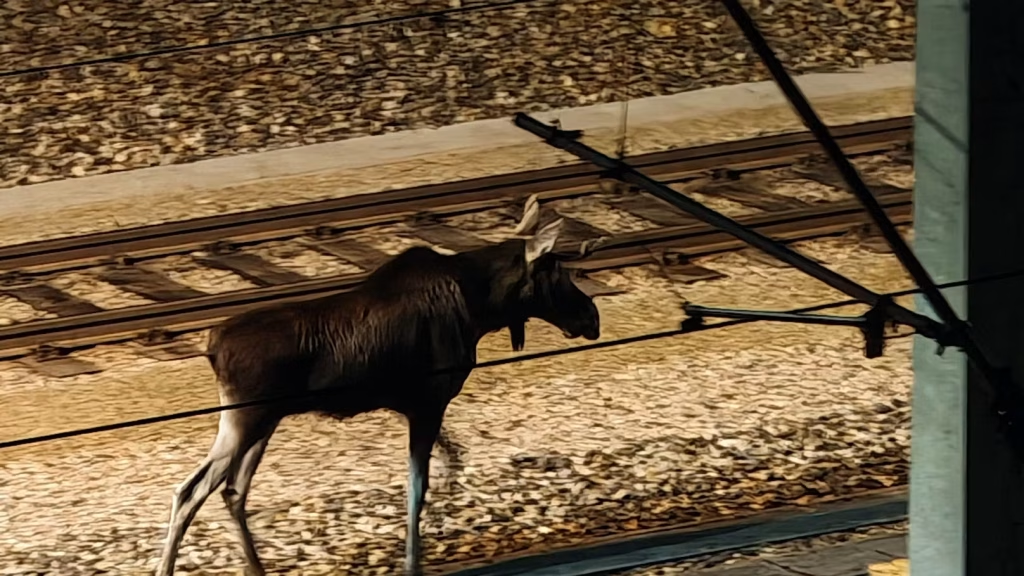
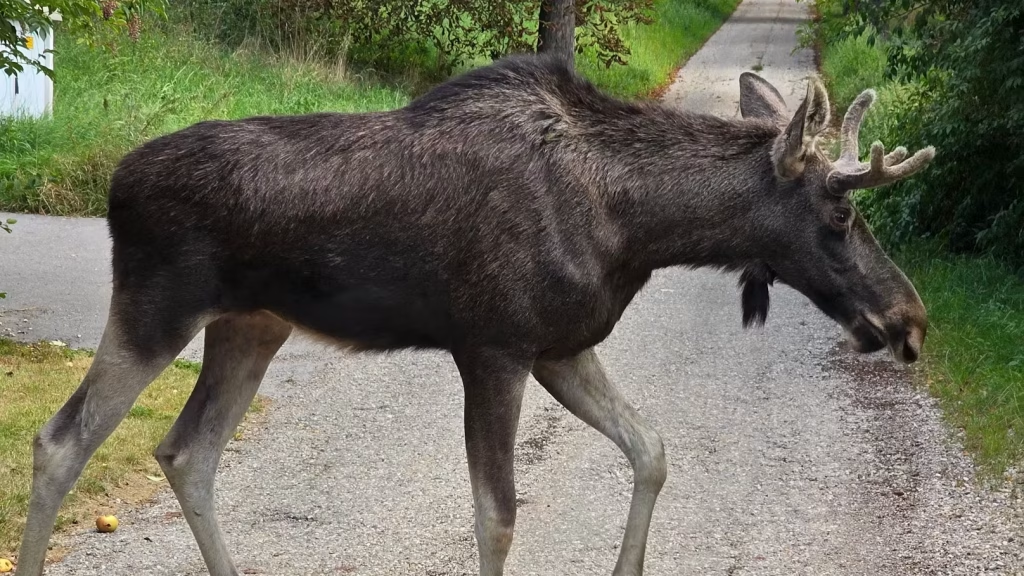
Dear Readers, I have always had a soft spot for moose, ever since I met Donald the Moose at Toronto Zoo 25 years ago. Such big animals, with such a considered and introspective approach to life! But a moose called Emil (after Czech Emil Zapotek, the long-distance runner) has been causing absolute havoc in Austria since August, when he wandered into various towns and cities, and even onto a railway (see the photo above) where he held up trains for four hours, and only moved when an express train started to move slowly towards him.

Emil probably came originally from Czechia or Poland, and made it almost as far as central Vienna. He became something of a social media  star as he wandered across golf courses, ate apples straight from the tree, and swam in the Danube. Alas, the reasons for his wanderings are, like so many things, climate-change related – scientists speculate that Emil was probably looking for somewhere cool and shady, which was hard to find in one of the hottest summers on record. Moose are cold-adapted animals, and overheat quickly, so this search is not just a matter of preference, but of life or death.

Emil’s search for a shady spot came to an end when he was spotted looking speculatively at a fence that stood between him and the A1 autobahn. An adult male moose can weigh up to 800kg, but they are surprisingly agile. Emil was tracked with drones and thermal-imaging cameras, and was finally brought down with a tranquilliser dart. It took eight firefighters to load him into a straw-lined truck. He was transported to the Šumava national park in Czechia, which has 30 moose already. On his release, Emil apparently started to lick some moss, and then wandered off, no doubt delighted by being back in a forest, though he was no doubt confused about how he got there. However, he now has a radio-enabled ear tag, so should he try to return to the bright lights of Vienna he’ll be easily spotted.

As things change, whether through climate change, urbanisation, intensive agriculture or for some other reason, we’re going to find ourselves closer and closer to wild animals. At least this encounter ended happily, without Emil being hurt (and fingers crossed he’ll be happy in his new home (it certainly looks lovely, and it’s big enough for the moose to get on with their lives without additional human interference). Let’s hope that we’re generous enough, and understanding enough, to avoid knee-jerk reactions to encounters with something that we haven’t seen before.

Thursday Poem – Home by Warshan Shire

HOME by Warshan Shire
I

No one leaves home unless home is the mouth of a shark. You only
run for the border when you see the whole city running as well. The
boy you went to school with, who kissed you dizzy behind the old tin
factory, is holding a gun bigger than his body. You only leave home
when home won’t let you stay.

No one would leave home unless home chased you. It’s not
something you ever thought about doing, so when you did, you
carried the anthem under your breath, waiting until the airport toilet
to tear up the passport and swallow, each mournful mouthful making
it clear you would not be going back.

No one puts their children in a boat, unless the water is safer than
the land. No one would choose days and nights in the stomach of a
truck, unless the miles travelled meant something more than journey.

No one would choose to crawl under fences, beaten until your
shadow leaves, raped, forced off the boat because you are darker,
drowned, sold, starved, shot at the border like a sick animal, pitied.
No one would choose to make a refugee camp home for a year
or two or ten, stripped and searched, finding prison everywhere. And
if you were to survive, greeted on the other side— Go home Blacks,
dirty refugees, sucking our country dry of milk, dark with their hands
out, smell strange, savage, look what they’ve done to their own
countries, what will they do to ours?

The insults are easier to swallow than finding your child’s body in
the rubble.

I want to go home, but home is the mouth of a shark. Home is the
barrel of a gun. No one would leave home unless home chased you
to the shore. No one would leave home until home is a voice in your ear
saying— leave, run, now. I don’t know what I’ve become.

II

I don’t know where I’m going. Where I came from is disappearing. I am
unwelcome. My beauty is not beauty here. My body is burning with the
shame of not belonging, my body is longing. I am the sin of memory and
the absence of memory. I watch the news and my mouth becomes a sink
full of blood. The lines, forms, people at the desks, calling cards,
immigration officers, the looks on the street, the cold settling deep into
my bones, the English classes at night, the distance I am from home.
Alhamdulillah, all of this is better than the scent of a woman completely
on fire, a truckload of men who look like my father— pulling out my
teeth and nails. All these men between my legs, a gun, a promise, a lie,
his name, his flag, his language, his manhood in my mouth.

Wednesday Weed – Loquat

Loquat (Eriobotrya japonica)

Dear Readers, the unadopted road around the corner from where I live in East Finchley is an endless source of ‘Wednesday Weeds’, but few are as spectacular as this one. This rather fine tropical shrub is a Loquat, a member of the endlessly generous rose family (Rosaceae). It comes originally from the hillier parts of China, but has been cultivated in Japan for more than a thousand years, largely for its orange fruit.

Loquat fruit (Photo By Aftabbanoori – Own work, CC BY-SA 3.0, https://commons.wikimedia.org/w/index.php?curid=32257868)

The name ‘loquat’ originally referred to the black-green, unripe fruit of the closely-related kumquat, but a Chinese poet referred to this plant as loquat, and the name stuck. When the plant arrived in Louisiana in the southern US, however, it was called ‘misbeliefs’ (after the Creole word for the plant ‘mísplís’ – this in turn was what the medlar, to which the loquat was thought to be related, was called.  I shall probably be calling it ‘misbelief’ going forward.

The plant in East Finchley still has a few flowers, but apparently  when in full blossom the scent is very sweet and pleasant.

Although the loquat is clearly grown as an ornamental shrub, for most of history it’s been all about the fruit. Though, as with kumquats, I find myself largely unmoved – there are lots of seeds for the volume of fruit, if the flesh is not perfectly ripe it can be mouth-puckeringly sour. Furthermore, those pesky seeds contain cyanide, which is not a great thing to ingest in quantity. Still, I can see how loquat  might make a delicious jam, where a bit of acidity is not a bad thing. The fruit is also turned into wine, and the seeds into a liqueur that is apparently reminiscent of amaretto, called nespolino.


In China, these fruit are commonly known as ‘pipa’, because they share their shape with this traditional musical instrument.

Pipa (This file was donated to Wikimedia Commons as part of a project by the Metropolitan Museum of Art. See the Image and Data Resources Open Access Policy, CC0, https://commons.wikimedia.org/w/index.php?curid=57858544)

And in China it is considered an auspicious fruit, its golden colour symbolising wealth and abundance. I can see why people thought that it was related to the medlar – the fruits have that squishy quality, which makes me think that they are probably only really sweet when they’re close to rotting. 

Photo by By Obaid Raza – Own work, CC BY-SA 4.0, https://commons.wikimedia.org/w/index.php?curid=40000357

If anyone has eaten loquats, do let me know what you think! And in the meantime here’s a poem by Jewish poet Esther Ettinger. See what you think.

THEN I BROUGHT YOU by Esther Ettinger

Then I brought you a persimmon
and we ate it at the café near the sea.
It was probably autumn or the end of summer
because the sun sank early into the water
round as a fruit and just as beloved.

Oh, beautiful autumn, season of poets

And at the beginning of spring, don’t mention the loquat,
and at the end, the blackberry, fruit of lovemaking
staining your lips one and then another
and a hidden curtain descends on what remains
crimson from memory.

Oh, fruit of my life, I split open from one season to the next

When was it, which season
in the back of the bus, in the dark
we sat on something warm and steaming
and ate sweet dried figs
depleted like a bag of bones

Translation: 2012, Rona May-Ron

Loquats and Mountain Bird (By Lin Chun – Old: http://depts.washington.edu/chinaciv/painting/4courbf.htm, Fu Sinian, ed., Zhongguo meishu quanji, huihua bian 4: Liang Song huihua, xia (Beijing: Wenwu chubanshe, 1988), pl. 96, p. 131. Collection of the National Palace Museum, Beijing.New: Zhihu (archived direct link) (archived direct link (“r” version)), Public Domain, https://commons.wikimedia.org/w/index.php?curid=3508092)


At Last….

Dear Readers, you might remember discussion about the foxes that visit my garden, and my hunch that there was more than one. Well, I’ve been checking the camera every day, but this is the first photo that actually shows two foxes in the garden at the same time. Hooray! The one on the right seems watchful, but not particularly fazed by the other one.

And here’s another photo…again the foxes seem very comfortable with one another. I’ve heard no sounds of fighting, so I’m assuming that all is peaceful, at least for the moment.

This is a relatively quiet time for mature foxes – the youngsters have largely dispersed, and it’s not the mating season yet, so there’s a little bit of time for just feeding and hanging out. These two could be a couple, or they could both just be passing through, but at any rate I feel a bit like David Attenborough finally spotting the Lesser Spotted Twistle Thrush after weeks of waiting around in a damp tent.

In other news, I am amused that we seem to have the same little visitor every morning at first light. It’s interesting to see the routines of the animals around us, they’re nearly as predictable as I am, though they seem to be able to do without coffee.

Have you noticed any routine behaviour in animals? My foster cats are now in a set routine, and get very irritated if their dedicated servants don’t dish up food or go to bed at the agreed times. I sometimes wonder who domesticated who…..

What Bird/Plant is That? Identification Apps That Work For Me

Pl@ntnet

Dear Readers, having been an  app sceptic for the longest time, I am gradually beginning to accept that they have their uses – the three I’m going to recommend here are all free, and all give at least a place to start when trying to identify a plant or bird. I use the apps when I’m out in the field (or park or walking along the street) – I don’t know about you, but if I see something interesting I’m most unlikely to have my field guides to hand. So, I use an app – sometimes the results agree with what I’m already thinking, sometimes  I go home and double-check with my books.

First up is Pl@ntnet, with the home screen pictured above. You can either take a photo with the app itself, or ask it to id a photo you’ve already taken. What I like about this app is that it gives  you a percentage certainty for the plant’s ID, and it is crowdsourced, so people can validate or argue with other people’s identification. In this it’s very similar to iNaturalist, but you get an instant idea of what  the plant is likely to be, rather than having to wait to see if your identification is accurate or not (though I greatly admire the whole citizen science aspect of the app).

For birds, I was a long-time fan of BirdNET, designed by the Cornell Bioacoustics Laboratory. You hear a particular call, record it, highlight the area that contains the call of interest, and the app will try to identify it. If someone is talking at the same time, it will tell you that it’s ‘human – probably’, which is amusing, at least in the short  term.

BirdNET recording

However, I recently downloaded Merlin, which works in a different way – you download it and it ‘listens’ for birds, before giving you a list of what it’s ‘heard’ – I shared an example of what it found during my walk in Golders Green Crematorium yesterday, and apart from being a little uncertain about the Kingfisher I’m very happy with the rest of the birds that it found. So maybe the Kingfisher was accurate! I shall have to go back and see if I can find one.

Merlin list for yesterday

So, with BirdNET you need to be listening yourself, hear something unusual and record it, whereas Merlin does all the listening for you. Personally, I’m keeping both.

You have to be careful with apps, though – I’m not a great fan of Google Lens. I find it is inaccurate more times than it’s accurate. I haven’t yet found an app that helps with insects and other invertebrates, or fungi, but in these cases I would go with iNaturalist – the final id might take longer, but it would have been checked by an actual human being with specialised knowledge. And I greatly value the expertise on some of the specialist Facebook pages, especially on plants and invertebrates. Plus, old-school as I am, you can’t beat a really good Field Guide, though the advantage of apps is that if you have absolutely no idea where to start to look in a book, they sometimes (not always) point you in the right direction. What we really need are more taxonomists, more people who have learned the nuances of identification, and are prepared to teach others. Correct identification matters more than ever in these times of rapid change – if we don’t know what’s in an area, how will we know what’s happening over time?


Roses and Herons….

Rosa persica – a climate-adapted rose

Dear Readers, we were back at Golders Green Crematorium today. It’s always so peaceful, and I love to see the way that the plants and colours change with every season. The roses are still in full bloom, but I was very interested in particular to see several cultivars of Rosa persica. This rose comes originally from desert areas of Iran and Afghanistan, though its range extends right through Central Asia and even into Siberia. In the wild, it’s a somewhat straggly yellow rose, but it has those distinctive darker marks at the base of its petals.

Wild Rosa persica (Photo By Yuriy75 – Own work, CC BY-SA 3.0, https://commons.wikimedia.org/w/index.php?curid=11395767)

Since the 1800s breeders have been trying to create a hybrid that retained that distinctive mark at the bottom of the petals, whilst improving disease resistance and flowering. However, it wasn’t until 2004 that rose breeders (particularly Chris Warner) were able to create something that was not only beautiful, but that repeat-flowered. It’s also rumoured that the dark patch acts to attract pollinators, and as this is a simple flowered rose I suspect that this might be true. The rose in the photo above is, I think, a variety called ‘For Your Eyes Only’, but I have no doubt you lovely people will put me right if not.

I really like this purple one (below) too, It reminds me of a hibiscus.

Rosa persica ‘Eyes for You’

Anyhow, we were trotting around the crematorium gardens, when, as we came to the ornamental pond. I noticed this statue of a heron.

Umm…..

Nope, not a statue but a real-life heron, and not a shy one either. S/he was happy provided I didn’t get closer than about ten feet away. We walked around the pond very quietly, trying not to disturb the bird, and once settled on a rock in the middle of the water s/he seemed to be content.

I have no idea what s/he might be eating – I’m sure there are frogs around, but I’ve never seen any fish. On the other hand, I am very curious about this.

This is from the Merlin app – it records the bird calls that it hears as you wander about, and presents you with its best guess. I’m very happy with most of the bird calls that it’s picked up, as I either saw the bird myself or know the call well enough to agree. But Kingfisher? It’s not too ridiculous, as there is a stream as well as the pond, plus we’re pretty close to the Mutton Brook (and the Dollis Brook). I didn’t realise that the bird had been picked up by the app until I was walking home. I am intrigued, though. Fingers crossed that the app is accurate!