
Michaelmas Daisies on Twyford Avenue
Dear Readers, what a splendid year it is for autumnal flowers here in East Finchley! The Michaelmas Daisies are particularly fine, and it’s easy to forget that this ubiquitous plant is not a UK native, but came here originally from North America, as mentioned in my original piece below. There are at least seven Michaelmas Daisy species that are naturalised in the UK, according to Stace and Crawley’s ‘Alien Plants’ – some are attractive (and you can see how they could have graced a garden), while others are not: of the ‘decidedly dull‘ Delicate Michaelmas Daisy (Aster concinnus) the authors remark that ‘the reasons for …. importation must remain a mystery’. I rather like it, but see what you think.

Delicate Michaelmas Daisy (Aster Concinnus) Photo by Emily Oglesby at https://fsus.ncbg.unc.edu/show-taxon-detail.php?taxonid=6481
Michaelmas Daisies are named for Michaelmas, the quarter day and feast of St Michael celebrated on 29th September, which is also peak flowering time for these flowers. An old rhyme records this:
“The Michaelmas daisies, among dead weeds, Bloom for St Michael’s valorous deeds …”.
Incidentally, this is also the day that Old Nick (the devil) was supposed to spit on/urinate on blackberries, so they shouldn’t be harvested after this date. However, I don’t know about where you live, but around here the blackberry harvest has been prolific, but the berries themselves a bit dry and disappointing (not enough rain at the right time, I guess).
And here is a rather sweet poem, by Victorian poet Letitia Elizabeth Landon (1802 – 1838). She published her first poem aged only 9 and wrote four novels and several poetry collections. Alas, much as today, her personal life was the subject of constant cruel speculation, and she died, aged only 36, after drinking prussic acid.
The Michaelmas Daisy by Letitia Elizabeth Landon
Last smile of the departing year,
Thy sister sweets are flown;
Thy pensive wreath is far more dear,
From blooming thus alone.
Thy tender blush, thy simple frame,
Unnoticed might have past;
But now thou contest with softer claim,
The loveliest and the last.
Sweet are the charms in thee we find,
Emblem of hope’s gay wing;
‘Tis thine to call past bloom to mind,
To promise future spring.
And now, let’s see what I had to say about Michaelmas Daisies back in (gulp) 2014….
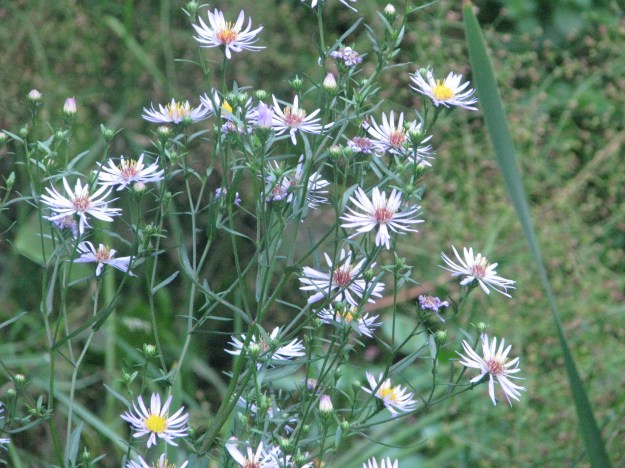 This small, lilac member of the daisy family seems to be popping up all over the place in my half-mile territory. These photos were taken in Coldfall Wood, where it makes the dried-up winter pond look like an Impressionist painting. But this delicate-looking plant has had a long journey. It comes originally from North America (it was introduced to England by John Tradescant in 1633), and it is a prairie plant rather than a woodland one. Nonetheless, it seems to made itself at home in all kinds of damp and neglected places, bringing a wash of pale lavender amongst the green
This is not an easy plant to identify at the species level. We have Common, Confused, Narrow-Leaved, Glaucous, Hairy and Changing Michaelmas Daisies, and every possible hybrid. As I squint at my photographs, I suspect that my daisies are Confused . On a bad day, I know exactly how they feel.
 The great thing about Michaelmas Daisies, as anyone who has planted them deliberately will know, is that they are full of energy and colour when most other plants are giving up. They seem to be particularly attractive to hoverflies, a creature that prefers flat, easily-accessible blossoms.
 Until 1752, this plant was known as Starwort. But when the Gregorian calendar was introduced, it was renamed the Michaelmas Daisy because its flowering coincided with St Michael’s Day on 29th September. However, I rather like the notion of a patch of Starworts, flowering under the harvest moon in a tiny ancient wood in North London, just as they have done for hundreds of years.
I’m pretty sure we have quite a few Michaelmas daisies in our garden. Indeed you’ve inspired me to go out and take a photo of all the flowers that are still left… (plus a few other things I spotted on the way round). 👍👍😀