Monthly Archives: December 2025

The Seventh Day of Christmas – The Antarctic Midge

The Antarctic Midge (Belgica antarctica)

Dear Readers, if I was to ask you to guess the largest purely terrestrial organism native to Antarctica you might, like me, scratch your head a bit. Seals aren’t purely terrestrial and neither are penguins. But I would never have guessed that the answer would be a 6mm long midge, named ‘Belgica’  after a Belgian expedition from 1899. The naturalist onboard collected a specimen of this midge, unknown to science previously. But how on earth does it survive in such a cold and barren place?

First up, this midge is flightless – the winds in Antarctica are legendary, and you wouldn’t want to be a tiny insect blown into the water or onto some even more hostile plain. In fact, the Antarctic Midge can only survive temperatures of -15 degrees Celsius, while the Antarctic regularly drops to -40 degrees. Rather the face the extremes of the weather, the midge burrows under the snow, where the temperature rarely drops below a ‘mere’ -7 degrees.

Even at these temperatures, though, the Antarctic Midge requires a bit of antifreeze – its tissues contain glucose, trehalose and erythritol, all forms of sugar that prevent ice crystals from forming, and help to stabilise the proteins and fats that the insect needs to metabolise.

In fact, the Antarctic Midge is so well adapted to freezing temperatures that exposing the larvae to temperatures as low as 10 degrees Celsius will kill them within a week. However, they can survive losing up to 70 percent of their bodily fluids – larvae born on the west coast of Antarctica live without water for the whole of their larval cycle. They reduce water loss by clustering together, and by doubling the concentration of sugars in their bodies, which helps to thicken their ‘blood’ and makes it more difficult to lose fluids.

Antarctic Midge on Moss (Photo By Igor Gvozdovskyy – Own work, CC BY 4.0, https://commons.wikimedia.org/w/index.php?curid=97127382)

For such a little creature, the Antarctic Midge has a long life cycle – it can take four years from egg to adult, with two long, cold Antarctic winters spent as a larva, dormant under the snow. During the larval stage, the young midges will eat moss, detritus, fungi and micro-organisms. The timing of the final emergence as adults is crucial – the adult midges will only live for ten days, so they have to find a mate and lay their eggs in this short time. The males emerge first and perform a mating ‘dance’ (similar to that of the Winter Gnats that we heard about a few days ago). The males can mate multiple times, but the females lay only one batch of eggs, after which their reproductive tracts are damaged and they are unable to produce any more. The females cover their eggs in a blanket of jelly which acts both to protect them from freezing and keeps them from dehydrating – this will also provide the first meal for the larvae when they hatch.

I wondered what on earth the female midges fed on, and the answer is ‘nothing at all’ – neither sex feeds after it emerges as an adult. What would they feed on, after all? The penguins are largely not around in the summer, and any animal that they fed on would only have to jump into the water to get rid of their irritating little friend.  The Antarctic Midge is  decidedly preferable (from a human point of view) to the fearsome Scottish Midge, where the females need a blood meal in order to provision their eggs, and they aren’t at all fussy about where they get it (although if I’m in the vicinity they show a distinct preference for me).

What an extraordinary animal the Antarctic Midge is! A survivor and a specialist. Let’s keep our fingers crossed that the Antarctic continues to be cold enough for it to survive, because if it’s too hot for the midge, the consequences for all of us could be pretty dire.

The Sixth Day of Christmas – The Christmas Tree Worm

Christmas Tree Worm (Spirobranchus giganteus) Photo By Nhobgood Nick Hobgood – Own work, CC BY-SA 3.0, https://commons.wikimedia.org/w/index.php?curid=6300216

Dear Readers, the Christmas Tree Worm is a feature of Caribbean and Indo-Pacific coral reefs, and quite the sight it is too. The worm burrows into large, live corals and makes itself a tube to live in. This might seem a bit harsh, but it’s thought that the Christmas Tree Worms might protect the coral from predators.  Once established, the worm sieves the water for plankton with its amazing feathery mouthparts (the ‘Christmas Trees’) – our humble limpet does much the same thing, though in a  much less spectacular fashion. Not only do the mouthparts absorb food and oxygen from the water, but they are also light-sensitive, so if the shadow of a predator passes over the worm can instantly withdraw into its tube. If something does take a bite out of the ‘Christmas tree’, the worm can regenerate it over time.

Each Christmas tree worm has two ‘Christmas trees’, so the photo above shows a single worm. There is a huge amount of variation between different worms, in terms of colour and size of appendage. A reef with lots of them is quite the sight to behold. And a single worm can live for up to forty years, a good age for an invertebrate.

Assorted Christmas Tree Worms (Photo By Nhobgood Nick Hobgood – Own work, CC BY-SA 3.0, https://commons.wikimedia.org/w/index.php?curid=6262056)

When it’s time to breed, the Christmas Tree Worms release their eggs and sperm in to the ocean at the same time. Fertilised eggs soon become larvae and, if these aren’t eaten by fish they too will settle down on a coral and the whole cycle will start up again. The thought of seeing some Christmas Tree worms  is almost enough to make me think about digging out the wet suit again. Almost.

Indo-Pacific Christmas Tree Worm (Photo By (c) portioid, some rights reserved (CC BY-SA) – https://www.inaturalist.org/photos/331402951, CC BY-SA 4.0, https://commons.wikimedia.org/w/index.php?curid=146094517)

Orange Christmas Tree Worm (Photo By Nhobgood Nick Hobgood – Own work, CC BY-SA 3.0, https://commons.wikimedia.org/w/index.php?curid=6262067)


The Fifth Day of Christmas – The Cricket on the Hearth

Frontispiece from the first edition of Dickens’s ‘The Cricket on the Hearth’

Dear Readers, I’ve seen three separate versions of Dickens’s ‘A Christmas Carol’ this year (including the highly-recommended ‘Muppet Christmas Carol’), but in fact the author wrote several pieces for the festive season, including ‘The Cricket on the Hearth’. Alas, this piece now languishes, unread and unappreciated. Could it be that this is because the eponymous Cricket is now rarely seen, and when it is it’s usually in boiler rooms or rubbish dumps, where the heat from the decaying midden keeps it warm?

House Cricket (Acheta domesticus) Photo By Geyersberg, Professor emeritus Hans Schneider – Own work, CC BY-SA 3.0, https://commons.wikimedia.org/w/index.php?curid=19915899

In the Dickens story, the cricket is described as ‘a little household god’, who watches over the family of ‘slow, lumbering, honest’ John Peerybingle and his pretty young wife Dot. Alas, John is jealous of his wife, and  has all sorts of ridiculous misgivings. In the end, the cricket transforms himself into a fairy to tell John that he is an idiot and his wife is not having an affair. I assume that Jiminy Cricket of Pinocchio fame is cut from the same cloth, what with his insanely happy personality and habit of dropping moral maxims whenever things get tough.

Crickets sang from the hearths of England for hundreds of years – as recently as 1890, W.H Hudson remarks on them shrilling from every cottage as he made his rounds above Selborne.  I suspect they were often brought in with the wood or coal or peat that was used to fuel an open fire, and once in they would ‘sing’ cheerfully away. In ‘Bugs Britannia’, by Peter Marren and Richard Mabey, it’s mentioned that you can tell the temperature by the number of chirrups that a cricket makes  – for Fahrenheit, you simply count the number of chirrups in fourteen seconds. To convert to Centrigrade, add 25, divide by 3 and add four. However, for accuracy it’s pointed out that you should have at least ten crickets and find the average number of chirrups. Good luck with that, people! And note that, wherever crickets were found singing by the hearth, it was considered very unlucky to harm them – the rumour was that the ghost of the dead cricket would inform all of their relatives, who would come and bite holes in the clothes of the cricket-murderer.

I feel a bit sad that crickets no longer pop in to keep us company on winter nights. Or do they? Is anyone still visited by crickets, or do they remember such a thing?

The Fourth Day of Christmas – Winter Gnats

Dear Readers, there are very slim pickings for the insect enthusiastic in December, but if you take a walk on a cold, sunny day you might see clouds of these tiny flies. Known as winter gnats, they are a member of the fly family, and they are amongst the few species which emerge as adults in winter. When you see them flying, you are looking at a group of males who are trying to attract a female – they fly up and down, being careful not to bump into one another. But, if you watch closely, you can see that each one is defending a small three-dimensional territory, which he hopes will impress any passing females.

Winter gnat (Trichocera annulata) Photo by By Luis Miguel Bugallo Sánchez (Lmbuga) – Own work, CC BY-SA 3.0, https://commons.wikimedia.org/w/index.php?curid=13136524

What always interests me is the way that if you walk through a cloud of winter gnats, they disperse but then form up again as you haven’t done anything at all. They like slightly warmer spaces, so sometimes they may form a cloud above your head. It always reminds me a little of ‘Pig Pen’ in the Peanuts cartoon, who simply can’t keep himself clean. The winter gnats are after your body heat, though, rather than your odour.

These tiny flies will only live for four or five days after hatching. The females will lay their eggs on vegetation, which the larvae will feed on, before disappearing underground to emerge next year. What a brief life, when the days are short and the nights are long. The winter gnats will also provide a welcome snack for insect-eating birds, who are mightily deprived of protein at this time of year. A gathering of winter gnats is known as a ‘ghost’ according to Buglife. What a welcome sign of life they are!

A ‘ghost’ of winter gnats

The Third Day of Christmas – Victorian Insect Christmas Cards

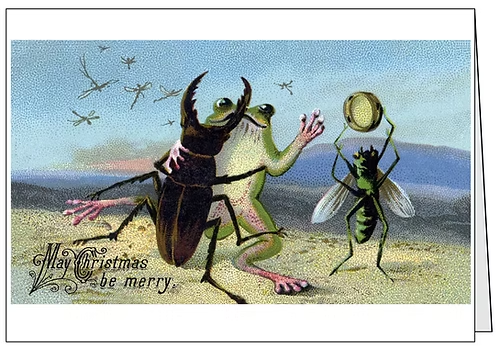
Image from https://www.meisterdrucke.ie/fine-art-prints/English-School/839025/A-Victorian-Christmas-Card-of-an-Insect,-Stag-Beetle-and-Scroll-on-Which-is-a-Christmas-Message.html

Dear Readers, when the Christmas card was first invented it was quite the novelty: the first ones were sent out in 1843 (commissioned by Sir Henry Cole, Director of the Victoria and Albert Museum) but they became really popular by the 1870s. These were the days when you could expect to receive 5 postal deliveries in a day: Dickens could write a letter in the morning, and get a reply by the afternoon. Almost as good as email! But the Victorians really embraced the Christmas card, and it’s nice to see that our insect friends got star billing in a way that seems rather macabre to us today. The happy stag beetle and cheery dragonfly in the card shown above date back to 1880.

Stag beetles dancing with a frog while a fly plays the tambourine? Why not? Plus there are hosts of mayflies in the background. Often frogs suffered a grisly end, but let’s hope this particular beach dance ended happily for all concerned.

Nothing says ‘Christmas’ more than a cicada about to be eaten by a praying mantis, with a quote from Othello in the top corner.

Dung Beetle carrying a sprig of holly

Here, a dung beetle gets into the festive mood by shouldering a huge sprig of holly through a snowstorm.

And here, a poor gnome is ambushed by a giant stag beetle. It seems that the Victorians were much more familiar with stag beetles than we are, because they seem to be something of a favourite Christmas insect.

And how about these infants terrorised by a giant hornet/bee hybrid? Tis the stuff of nightmares! Happy New Year to you too!

I know a lobster isn’t an insect, but it is an invertebrate, so here’s a mouse riding a lobster…

And this one, finally, is pretty rather than macabre, with a warning to all those ‘bah humbug’ types who look askance at merry-making. I do wonder whether this particular card was ever sent to some dyspeptic uncle, or miserable Scrooge-like cousin? Or maybe to a much-chastised, boisterous niece or nephew? I fear we will never know.

The Second Day of Christmas – The Christmas Beetle

Christmas Beetle (𝘈𝘯𝘰𝘱𝘭𝘰𝘨𝘯𝘢𝘵𝘩𝘶𝘴 sp) Photo by NSW Biodiversity Trust from https://www.facebook.com/photo.php?fbid=765714778917942&set=a.641488551340566&type=3&locale=en_GB

Dear Readers, invertebrates may be few and far between here in the UK, but in Australia it’s spring, and the Christmas beetles are emerging. And what spectacular beetles they are! They are members of the scarab beetle family, and there are about 36 species in total. They remind me a little of the rose chafer beetles that we get here in the UK.

Rose Chafer from the UK

The Christmas beetle grubs feed on grass roots, and hence need lawns in order to thrive. When they emerge, they feed on eucalyptus leaves. They can be found in Southern and Eastern Australia, and in Tasmania, and often emerge after heavy rain.

The commonest Christmas beetle – Anoplognathus pallidicollis Photo by By Cyron Ray Macey from Brisbane (-27.470963,153.026505), Australia – Flickr, CC BY 2.0, https://commons.wikimedia.org/w/index.php?curid=343947

Christmas beetles are not the most accurate of fliers, and can often be seen bumbling around and crashing into things, especially if there are outside lights. However, once they get orientated their main ambitions in life are to eat and mate, so after emergence their lives tend to be short (but hopefully happy).And look at this magnificent insect! This is the King Christmas Beetle, and can grow to over 3 centimetres long. The naturalist Edward Donovan described it thus:

 “Nature seems to have devoted abundant attention to the embellishment of this common insect: its glow of colouring is peculiar and inimitable. The prevailing hues do not strictly please us by their harmony as their contrast, which is indeed striking, or rather glaring, but upon the whole produce a rich effect”

Well, indeed, but all in all I’d say this is just a magnificent insect. He or she can fly into my outside lights anytime.

King Christmas Beetle () Photo by By (c) Nigel Main, some rights reserved (CC BY) – https://www.inaturalist.org/photos/344416193, CC BY 4.0, https://commons.wikimedia.org/w/index.php?curid=147986150

Then there’s the Washerwoman Christmas Beetle, probably named because there are little ridges on the wing covers that look a little like those on a washboard.

Sadly, Christmas beetles are in decline in Australia – droughts kill the grass that the beetle grubs feed on, and native eucalyptus is not planted as often as it once was. In Sydney, anecdotal evidence from the 1920s suggests that the eucalyptus branches used to bow down into the waters of Sydney Harbour under the weight of the Christmas beetle ‘baubles’, Alas, Sydney, like so many cities has grown in the past hundred years. Still, people are now aware of the problem and, like nature-minded folk everywhere, are doing what they can to stem the decline. Let’s hope they succeed!

Golden-brown Christmas Beetle (Anoplognathus chloropyrus) Photo By PotMart186 – Own work, CC BY-SA 4.0, https://commons.wikimedia.org/w/index.php?curid=113099944

The Twelve Days of Christmas Invertebrates – Jumping Spiders!

Dear Readers, merry Christmas/happy Chanukah! This year, it occurred to me that in spite of being called ‘Bug Woman’ my posts about invertebrates are actually quite few and far between. So this year, I’m going to be looking at the little creatures that perform such important roles in the world, with a focus on Christmas/winter. Let’s see what we find out! 

To start with, this is my favourite Christmas video. I think even the mildly arachnophobic might like it (after all, peacock spiders are about as far from those hairy-legged critters who live in the shed as I am from a marmoset).

https://www.youtube.com/watch?v=HYFQQB9vqPw

Peacock spiders are from the jumping spider family – remember this little chap? This is a fencepost jumping spider (Marpissa muscosa) who was living under the stairs on some deckchairs. He isn’t as colourful as the peacock spiders (who all live in Australia by the way, and are only the size of a grain of rice) but he is pretty cute all the same.

And if you are after some proper biological background on the peacock spiders, there’s a clip from a BBC documentary below. Beware, it features dancing, sex and violence, so it all depends what you enjoy at the festive season.

https://www.youtube.com/watch?v=5qkzwG2lLPc

And, my copy of the British Arachnological Society magazine this month had a very interesting story about Zebra Jumping Spiders – these are the little stripy critters that you often see on walls or doors. An arachnologist found a female and two males, a big one and a small one, and he made them all a microhabitat so he could observe them. The big male displayed to the female, but she was supremely uninterested and hid in the corner. Then, the small male tried to creep up on her, but the big male scared him away, and at this point she became fascinated with the big male, and eventually mated with him. Part of me can almost see her fluttering her eyelashes and saying ‘my hero’, but that would be very anthropomorphic. Nonetheless, it seems that the macho/protective behaviour of the big male spider was something of a turn on. Maybe he proved that he would provide the female with lots of big, fearless offspring? The lives of these creatures are much more nuanced than we might think at first.

Female Zebra Jumping Spider (Salticus scenicus)

Wednesday Weed – Mistletoe Revisited

Dear Readers, this year I have some mistletoe hanging from the back of my front door. It’s not that I want to ambush everyone who comes to the doorstep (though I do find myself full of Christmas cheer) but it’s there for anyone who is in need of a cuddle. And when I was in Namibia, I noticed that a lot of trees had what looked like mistletoe on them – the species that I saw lives on Acacia trees, and is known as ‘bird graft’, because the flowers send out a puff of pollen that attaches itself to the feet and feathers of the birds that pollinate them. The seeds are also eaten and spread by bulbuls and thrushes. As soon as a seed is excreted onto a branch, it germinates, and it also forms a strange structure called a ‘wood rose’. There’s clearly more to the mistletoe family than snogging, as we can see from my original mistletoe piece. And for everyone in the last throes of sorting themselves out for Christmas, breathe! And maybe hug someone. We need all the endorphins we can get at this time of year. 

Bird-graft (Tapinanthus oleifolius) Photo By Brian van der Spuy – Own work, CC BY-SA 3.0, https://commons.wikimedia.org/w/index.php?curid=48123349

Mistletoe (Viscum album) in Somerset

Dear Readers, as Christmas is just around the corner I thought I’d share a few thoughts about mistletoe. What a strange plant this is! It’s associated with Christmas because it stays fresh and green even after the trees lose their leaves, but it has a longer association with fertility: the branches, foliage and seeds are said to resemble various sexual organs, though I must admit that I am having to squint to see much of a likeness, innocent soul that I am.

Photo One by By Agnieszka Kwiecień, Nova - Own work, CC BY 2.5, https://commons.wikimedia.org/w/index.php?curid=752332

Mistletoe fruit (Photo One)

Nonetheless, mistletoe has been used as a ‘cure’ for infertility (though as it’s toxic one would have to be very careful), as a charm for young women seeking to find husbands, and, of course, as an excuse for kissing. My latest issue of the Royal Horticultural Society (RHS) magazine has an article on mistletoe, which mentions that the kissing business probably started in the southwest Midlands, which is where mistletoe is commonest, and spread out from there, probably as a commercial enterprise, with the plant being taken to other parts of the country by the rapidly-growing railway network.

What intrigued me most in this article, however, was the story of how the mistletoe is spread. Mistletoe is a hemiparasite, which means that it derives its water and nutrients from its hosts, although it can photosynthesise itself. The plant seems to prefer hawthorn, apple, poplar and linden trees, though it has been found on hundreds of other species. The name ‘mistle’ comes from the plant’s association with thrushes, in particular the mistle thrush, which loves the fruit. It was long believed that mistletoe was spread by the birds wiping their beaks on twigs to get rid of the sticky substance that coats the seeds. However, it seems that mistle thrushes don’t do this, but simply excrete the seeds, only some of which will fall onto the correct type of branch and stick.

Photo Two by By Fir0002 (talk) (Uploads) - Fir0002 (talk) (Uploads), CC BY-SA 3.0, https://commons.wikimedia.org/w/index.php?curid=32885953

Sticky mistletoe seed (Photo Two)

Photo Three by By Yuriy75 - Own work, CC BY-SA 3.0, https://commons.wikimedia.org/w/index.php?curid=8897596

Mistle thrush (Turdus viscivorus) (Photo Three)

However, over the past few decades there has been a large increase in the range of mistletoe in the UK, and the reason cited in the RHS article (by Graham Rice) is the blackcap. These little warblers used to migrate in winter, but an increasing number are staying in the UK all year round. Not only do they love mistletoe, but they do wipe their beaks after eating the fruit.

Although mistletoe feeds from its host trees, it’s not generally seen as dangerous to them. Indeed, there is advice in the RHS article on how to persuade mistletoe to colonise your trees. So this seems like quite a happy partnership between the mistletoe and the blackcap.

Photo Four by By Charles J. Sharp - Own work, from Sharp Photography, sharpphotography.co.uk, CC BY-SA 4.0, https://commons.wikimedia.org/w/index.php?curid=104326583

Male blackcap (Sylvia atricapilla) (Photo Four)

Photo Five by By Vogelartinfo - Own work, GFDL 1.2, https://commons.wikimedia.org/w/index.php?curid=13276336

Female blackcap (Photo Five)

Mistletoes belong to the sandalwood family (Santalaceae), and I’d never really given any thought to whether there were other species. And of course, there are. In Southern Spain there’s the red-berried Viscum cruciatum or red-berried mistletoe.

Photo Six by By Nbauers - Own work, CC BY-SA 4.0, https://commons.wikimedia.org/w/index.php?curid=77809079

Red-berried mistletoe (Viscum cruciatum) (Photo Six)

In central and southern Europe there’s the yellow-berried mistletoe (Loranthus europaeus) which favours oak trees. The plants in the Loranthanceae family are known as ‘showy mistletoes’. I can see why.

Photo Seven by Stefan.lefnaer, CC BY-SA 3.0 <https://creativecommons.org/licenses/by-sa/3.0>, via Wikimedia Commons

Yellow-berried mistletoe (Loranthus europaeus) (Photo Seven)

Another ‘showy mistletoe’ is the Western Australian Christmas Tree (Nuytsia floribunda). This is a hemiparastic tree, of all things – it draws nutrients from the roots of any nearby plants that it can reach. Almost all species are susceptible to attack, but normally the tree only takes a small amount from each individual plant. It will even infiltrate underground cables. This is an extraordinary tree, revered by some of the Aboriginal peoples of the country, who used the bark for shields and harvested small amounts of the sticky gum that it exuded. The flowers, which can grow to up to a metre long, are favourites with pollinators

Photo Eight by By enjosmith - Flickr: WA Christmas Trees, CC BY-SA 2.0, https://commons.wikimedia.org/w/index.php?curid=30325757

Western Australian Christmas Trees (Nuytsia floribunda) (Photo Eight)

Photo Nine by By Photographs by JarrahTree...commons.wikimedia.org, CC BY 2.5 au, https://commons.wikimedia.org/w/index.php?curid=29752289

Nuytsia floribunda flowers abuzz with bees (Photo Nine)

And finally, there are the dwarf mistletoes, which are more closely related to ‘our’ mistletoe than the showy mistletoes above. These can be more serious pests of trees because they are considered to be disease-vectors. They don’t rely on birds to spread their seeds, but can shoot them at up to fifty miles an hour after building up thermostatic pressure within the plant. The species below, Arceuthobium oxycedri, grows on juniper, and can cause problems where the shrubs are being grown commercially (for example, for their berries to flavour gin).

Photo Ten by By Elie plus - Own work, CC BY-SA 3.0, https://commons.wikimedia.org/w/index.php?curid=27859735

Dwarf mistletoe (Arceuthobium oxycedri) growing on juniper in Lebanon (Photo Ten)

So there is a lot more to mistletoes than just our species, but of course, the plain old white-berried one is closest to my heart. And of course, it needs a poem. So how about this one, which is actually a song – the words are by Barry Cornwall, and the poem itself comes from a book called ‘Christmas with the Poets’ by Henry Vizetelly, published in 1851. It’s rather a rambunctious way to finish this post, but as winter comes we need to ‘banish melancholy’ in any way that we can, I find. I hope you enjoy it!

The Mistletoe

Words: Barry Cornwall

Source: Henry Vizetelly, Christmas With The Poets (London: David Bogue, 1851).

When winter nights grow long,
And winds without blow cold,
We sit in a ring round the warm wood fire,
And listen to stories old!
And we try to look grave (as maids should be),
When the men bring in boughs of the laurel tree.
O, the laurel, the evergreen tree!
The poets have laurels, and why not we!

How pleasant, when night falls down,
And hides the wintry sun,
To see them come in to the blazing fire,
And know that their work is done;
Whilst many bring in, with a laugh or rhyme,
Green branches of holly for Christmas time.
O, the holly, the bright green holly!
It tells (like a tongue) that the times are jolly!

Sometimes — (in our grave house
Observe, this happeneth not;)
But at times the evergreen laurel boughs,
And the holly are all forgot;
And then — what then? why, the men laugh low,
And hang up a branch of —— the mistletoe!
Oh, brave is the laurel! and brave is the holly,
But the mistletoe banisheth melancholy!
Ah, nobody knows, nor ever shall know,
What is done under the mistletoe.

Photo Credits

Photo One By Agnieszka Kwiecień, Nova – Own work, CC BY 2.5, https://commons.wikimedia.org/w/index.php?curid=752332

Photo Two by By Fir0002 (talk) (Uploads) – Fir0002 (talk) (Uploads), CC BY-SA 3.0, https://commons.wikimedia.org/w/index.php?curid=32885953

Photo Three By Yuriy75 – Own work, CC BY-SA 3.0, https://commons.wikimedia.org/w/index.php?curid=8897596

Photo Four By Charles J. Sharp – Own work, from Sharp Photography, sharpphotography.co.uk, CC BY-SA 4.0, https://commons.wikimedia.org/w/index.php?curid=104326583

Photo Five By Vogelartinfo – Own work, GFDL 1.2, https://commons.wikimedia.org/w/index.php?curid=13276336

Photo Six By Nbauers – Own work, CC BY-SA 4.0, https://commons.wikimedia.org/w/index.php?curid=77809079

Photo Seven by Stefan.lefnaer, CC BY-SA 3.0 <https://creativecommons.org/licenses/by-sa/3.0>, via Wikimedia Commons

Photo Eight  By enjosmith – Flickr: WA Christmas Trees, CC BY-SA 2.0, https://commons.wikimedia.org/w/index.php?curid=30325757

Photo Nine  By Photographs by JarrahTree…commons.wikimedia.org, CC BY 2.5 au, https://commons.wikimedia.org/w/index.php?curid=29752289

Photo Ten by By Elie plus – Own work, CC BY-SA 3.0, https://commons.wikimedia.org/w/index.php?curid=27859735

Good News for Yellowhammers

Yellowhammer (Emberiza citrinella) Photo By Andreas Trepte – Own work, CC BY-SA 2.5, https://commons.wikimedia.org/w/index.php?curid=38974913

Dear Readers, the yellowhammer is the quintessential farmland bird, but over the past decades it’s been disappearing from the countryside – I outline some of the reasons in my post here. But here’s some good news! In my earlier post, I mention Hope Farm, which is owned by the RSPB, and which has been doing some excellent work to help to bring back this species.

It started off by creating more hedgerows and leaving insect-rich boundaries at the edge of fields – this resulted in a doubling of the yellowhammer population, but the main problem seemed to be poor winter survival, not just in the farm but in a much wider area. Changes in farming practices have meant that there’s much less food available for all sorts of farmland birds during the winter months, so Hope Farm, along with a number of other farms, have started supplementary seed feeding over the coldest time of year. This draws in farmland birds from a much wider area. When the programme started, it was unusual to see more than 9 or 10 yellowhammers, but in recent years numbers have climbed to an average of 200, with a peak count of 723, which is a tremendous success.

Yellowhammers have also benefitted from the statutory requirement to leave hedge-trimming until 1st September – this species breeds late, and can be actively rearing young as late as August.

Let’s hope that more of us will soon be able to hear the distinctive ‘little-bit-of-bread-and-no-cheese’ call of the yellowhammer. I’m not sure I can actually hear that sentence in the call – it sounds more like somebody very cross berating a waiter to me. But as the male bird can utter this phrase 3000 times per day during the breeding season, I imagine it soon gets a bit monotonous even to the yellowhammer. Here’s a recording of a French yellowhammer  by Martin Billard.

And is it too early to remind everybody in the UK about the RSPB Big Garden Birdwatch on 23-25th January 2026? Personally I can’t believe that it’s almost that time again, but here we are. This annual event has collected so much useful information on birds and their population trends over the past decades, and it’s well worth supporting.

Mothering….

Photo By AWeith – Own work, CC BY-SA 4.0, https://commons.wikimedia.org/w/index.php?curid=51548912

Dear Readers, a dear friend of mine has recently had a baby, and it feels like such a wonderful reminder of the circle of life. I wasn’t able to have children of my own, but that  doesn’t mean that I don’t need outlets for my maternal instincts, and it seems like I’m not the only one. You may have read that a polar bear mother in Northern Canada was originally spotted with one cub, but now seems to have acquired another one – it’s not clear whether the mother of the new cub has died, or if the little one has just somehow gotten lost. However, having a mum to teach it how to hunt will be an important factor in the cub’s survival. Sometimes the maternal instinct is so strong that it overrides all that pesky stuff about genetic inheritance that social Darwinists are so fond of. Polar bears normally have twin cubs, so this extra mouth to feed shouldn’t overtax the mother too much.

Interestingly, domestic cats will often rear their kittens alongside other mothers. When I was fostering for Cat Protection, one of the most extraordinary stories was of a ‘mother’ cat who had been caring for three young kittens. On closer examination, the ‘mother’ turned out to be a tom cat – he obviously couldn’t feed the kittens on milk but he cleaned them, protected them and found them food. He wasn’t the father of the kittens, but clearly he had a well-developed paternal instinct.

Primates will sometimes ‘adopt’ young members of their own species, and sometimes even other species: back in 2004, a capuchin monkey was found looking after a young marmoset, which she carried around. She cracked open nuts for her ‘baby’ and fed it the small pieces. Locals said that the marmoset had been with the capuchin for weeks, and that it the marmoset was not a pet or a tame animal, but a member of a troop of the small monkeys who shared the habitat with the capuchins.

So, there are many, many ways to put all that nurturing instinct to use. So many youngsters, of all species, need a good mother, and so many of us have a lot of love to give. For me, at least, it’s worth thinking about how to put those feelings to good use.