Author Archives: Bug Woman

With the Barnwood Silver Birches

Male Large Skipper (Ochlodes sylvanus)

Dear Readers, yesterday I was lucky enough to meet with the Silver Birches groups for the over-55s that are held in Barnwood Community Forest here in East Finchley. What a lovely day it was! We had sessions on pollinators and on the folklore of plants, and the afternoon group learned how to make moss hanging baskets with Ursula from The Flower Bank, an amazing enterprise that recycles and reuses the flowers that would otherwise go to waste at corporate events, supermarkets, weddings and fashion shoots.

Of course, being Bugwoman it was very important to get people up close and personal with the amazing variety of insects that live in Barnwood. Here are just a few…

Comma Butterfly

Tree Bumblebee

Marmalade Hoverfly

Side view of the Comma, showing the ‘comma’ mark on its underwings

Speckled Wood underside

What impressed me so much with the Silver Birches was how much fun they were, how welcoming, and how patient they were when chasing some very flittery insects from one place to another with their camera phones so that we could get a snapshot of what was around on this sunny Midsummer day. It has been a long, long time since I’ve had the chance to do something like this and I had a wonderful time. So thank you to Leo and Linda who organise the sessions and to everyone who attended, it was a day that I’ll remember for a long, long time.

Wednesday Weed – Candytuft

Candytuft (Iberis umbellata)

Dear Readers, candytuft has been a popular garden plant for as long as I can remember – it has a lot of garden variants, many of them pure white, but the ones I have in my windowboxes are palest pink when young. Candytuft is actually a member of the Brassicaceae, or cabbage family, and as with most of these plants there are four petals arranged in a cross-shape (hence the alternative name for the family of ‘crucifers’). The name ‘candytuft’ doesn’t relate to the plant’s sweetness, but to the old name for Heraklion the main city of Crete, Candia. The genus name ‘Iberis’ also emphasizes the Mediterranean connection, with Iberis coming from Iberia, the classicaal name for Spain.

Wild candytuft (Iberis amara) grows all over Europe but its heartland is around the Mediterranean. The wild plant can be found in the UK but is extremely rare, as it lives on the south-facing slopes of chalk downs, a habitat that is becoming increasingly rate. You can tell the plant from its garden cousin because the flowers grow up into little cones and the petals are asymmetric.

Photo One by By H. Zell - Own work, CC BY-SA 3.0, https://commons.wikimedia.org/w/index.php?curid=10426344

Wild Candytuft (Iberis amara) (Photo One)

All members of the cabbage family have chemicals called glucosinolates, which produce the pungent garlic/radish/mustard smell of many brassicas, and which defend against many insects. However, members of the candytuft family have an additional chemical defence, cucurbitacin, which is more commonly found in cucumbers. Interestingly, this defends against cabbage white butterflies, who are not deterred by the strong flavours of other kinds of brassicas.

Although a member of the cabbage family, Candytuft doesn’t seem to be particularly edible, what with its teeny tiny mustard-flavoured leaves which are hardly worth the gathering. Some people do admire the flowers though, and I’m sure that a few thrown into a salad would brighten things up no end.

Medicinally, the flowers have been used for gastro-intestinal complaints, such as bloating or acid reflux. I note that chemical company Bayer are growing their own candytuft flowers to produce ‘Iberogast’, a herbal treatment for these problems. In Mrs Grieve’s Modern Herbal (from the 1930s), the plant is said to have been used to treat gout, rheumatism and atrial fibrillation. Presumably the wild plant was much more  common then than now.

In the Victorian language of flowers, Candytuft is said to signify ‘indifference’, perhaps because it’s tolerant of a variety of growing conditions. I do wonder how the Victorian lady managed to decipher any bouquet sent to her, and whether spats developed with different posies winging their way backwards and forwards, becoming ever more insulting. For example, a bunch of flowers containing amaranth (pretension and foppery), aspen (lamentation), basil (hatred) and bilberry (treachery) would be a most irritating thing to receive. Maybe the only response would be to buy some very woody plants and throw the whole lot at the sender.

Photo Two by By Stefan Laarmann - Own work, CC BY 2.5, https://commons.wikimedia.org/w/index.php?curid=947261

Candytuft (Photo Two)

And finally, a poem. Christopher Morley’s ‘Our House’ features lots of things that I would like – the old-fashioned garden, the window seat, the summer house, the banister – but I think a moat is a step too far. See what you think. Morley was a journalist, poet and great fan of Sherlock Holmes, and I find this poem as cozy as an old armchair, and none the worse for it. We don’t need to be challenged all the time, eh.

Our House
by Christopher Morley (1890-1957)

IT should be yours, if I could build
The quaint old dwelling I desire,
With books and pictures bravely filled
And chairs beside an open fire,
White-panelled rooms with candles lit-
I lie awake to think of it!

A dial for the sunny hours,
A garden of old-fashioned flowers-
Say marigolds and lavender
And mignonette and fever-few,
And Judas-tree and maidenhair
And candytuft and thyme and rue-
All these for you to wander in.

A Chinese carp (called Mandarin)
Waving a sluggish silver fin
Deep in the moat: so tame he comes
To lip your fingers offering crumbs.
Tall chimneys, like long listening ears,
White shutters, ivy green and thick,
And walls of ruddy Tudor brick
Grown mellow with the passing years.

And windows with small leaded panes,
Broad window-seats for when it rains;
A big blue bowl of pot pourri
And-yes, a Spanish chestnut tree
To coin the autumn’s minted gold.
A summer house for drinking tea-
All these (just think!) for you and me.

A staircase of the old black wood
Cut in the days of Robin Hood,
And banisters worn smooth as glass
Down which your hand will lightly pass;
A piano with pale yellow keys
For wistful twilight melodies,
And dusty bottles in a bin-
All these for you to revel in!

But when? Ah well, until that time
We’ll habit in this house of rhyme.

Photo Credits

Photo One by By H. Zell – Own work, CC BY-SA 3.0, https://commons.wikimedia.org/w/index.php?curid=10426344

Photo Two by By Stefan Laarmann – Own work, CC BY 2.5, https://commons.wikimedia.org/w/index.php?curid=947261


Midsummer Goings On

Visiting Red Admiral

Dear Readers, by the time you read this it will be the summer solstice, the shortest night of the year, and a day much celebrated all over the world as the very height of summer. Here in East Finchley it’s forecast to be bright and sunny, and certainly this red admiral had got the message. It looks new-minted, and although many butterflies migrate north this one looks so fresh that I suspect it’s actually hatched out recently – females migrate north, lay their eggs and the caterpillars emerge as butterflies from late June/early July, so this one is a little early. It could also have hibernated over the winter. Male red admirals are territorial and fly ‘laps’ of their territories, fighting off other males and courting any passing females. Only a male holding a territory will have a chance to mate, so I shall keep an eye open to see if this butterfly is hanging around, or just passing through.

In other news, the wood pigeons are extremely crochety, and I had plenty of opportunity to observe their dominance behaviour when two of them landed on the same seed feeder, which I hadn’t yet topped up.

First we have the ‘peering round the tube’ behaviour as the birds attempt to size one another up.


Then we have the ‘how tall are you?’ phase when both birds stiffen and stand on their tippy toes to try to make themselves look bigger.

Then we have the ‘do I dare try and actually feed’ stage, when each bird gingerly lowers its head, anticipating a nasty peck to the cranium.


And then, sad to say, we have a nasty bout of wing snapping and general nonsense, until one of the birds gives up, only to be replaced by another who has been waiting in the wings (ahem) to try his or her luck.

Dear oh dear. Still, I have noticed that everyone seems to get fed in the end, and no one is seriously the worst for wear. After an hour or so of this nonsense the wood pigeons head off for a snooze, to be followed by the much more peaceable collared doves, and finally the goldfinches and house sparrows (who both use a feeder with no tray that the pigeons can’t perch on).

And at the front of the house the lavender has reached peak floral display…

The candytuft, Mexican fleabane and Delosperma is all in full flower (you might remember the latter as Mesembryanthemum back in the day)

And Some Animal has done a rather pungent poo on the windowsill, much to my surprise – it doesn’t look like any of the usual suspects, and although someone has been digging in the windowboxes, it doesn’t look like squirrel poo. Oh well. Any ideas, pop them in the comments (and apologies if you’re just having your breakfast). At least the greenbottles are happy.

The Monday Quiz – Marine Birds

Photo of the only albatross in the Northern Hemisphere (from The Yorkshireman https://the-yorkshireman.com/the-northern-hemispheres-only-albatross-has-returned-to-the-yorkshire-coast/)

Dear Readers, Sunday was World Albatross Day, and at Bempton Cliffs in Yorkshire there is the only albatross in the Northern Hemisphere. The black-browed albatross can normally be found on the Falkland Islands and South Georgia, but somehow this one has  been blown off course, and for the last few years he has been spotted flying around the Baltic. This year he’s ended up in the North of England, and everyone was very glad to see him, as the last time he was spotted he was off the coast of Denmark being hassled by a gang of sea eagles, and was presumed dead. With an eight-foot wingspan he really is something, and the crowds gather on the cliffs to see him – for many people, this will be their only chance to see one of these magnificent birds. It does feel like a shame that no one can give him a lift back to the southern hemisphere, though – he’ll never find a mate here, and the female gannets remain distinctly unimpressed by their giant companion.

Anyhow, this made me realise that I have never done a quiz on the UK’s marine birds – with all that coastline we have a fine variety. So, as usual, see if you can match the photo to the name. The deadline to get your answers in the comments is by 5 p.m. UK time on Saturday 25th June, and the answers will be published on Sunday 26th June. As soon as I see your comments I will ‘disappear’  them. One or two people were still having trouble posting, so you can also pop them on my Facebook page if that’s easier.

And if these photos don’t make you ache to see the sea I’ve obviously picked the wrong ones. I can almost hear the birds calling.

Onwards!

Birds

A. Mediterranean Gull

B. Kittiwake

C. Arctic Tern

D. Sandwich Tern

E. Razorbill

F. Common Guillemot

G. Little Auk

H. Northern Fulmar

I. Storm Petrel

J. Little Tern

Photos

Photo One by Hobbyfotowiki, CC0, via Wikimedia Commons

1)

Photo Two by © Copyright Anne Burgess and licensed for reuse under this Creative Commons Licence.

2)

Photo Three by AWeith, CC BY-SA 4.0 <https://creativecommons.org/licenses/by-sa/4.0>, via Wikimedia Commons

3)

Photo Four by Sir Iain, CC BY-SA 4.0 <https://creativecommons.org/licenses/by-sa/4.0CC BY-SA 4.0 Creative Commons Attribution-Share Alike 4.0>, via Wikimedia Commons

4)

Photo Five by https://www.flickr.com/photos/naturalengland/36310015891

5)

Photo Six by Charles J. Sharp, CC BY-SA 4.0 <https://creativecommons.org/licenses/by-sa/4.0>, via Wikimedia Commons

6)

Photo Seven by MPF, CC BY-SA 4.0 <https://creativecommons.org/licenses/by-sa/4.0CC BY-SA 4.0 Creative Commons Attribution-Share Alike 4.0>, via Wikimedia Commons

7)

Photo Eight by Richard Crossley, CC BY-SA 3.0 <https://creativecommons.org/licenses/by-sa/3.0>, via Wikimedia Commons

8)

Photo Nine by Avenue, CC BY-SA 3.0 <https://creativecommons.org/licenses/by-sa/3.0>, via Wikimedia Commons

9)

Photo Ten by JJ Harrison (https://www.jjharrison.com.au/), CC BY-SA 3.0 <https://creativecommons.org/licenses/by-sa/3.0>, via Wikimedia Commons

10)


Monday Quiz – Healthy Eating Week – The Answers!

Dear Readers, it’s very clear that you all know your onions (and your potatoes, cabbages, beans and beetroots) because Mal at FEARN, Fran and Bobby Freelove and Joanna all got 10 out of 10 on the vegetable quiz – well done all of you, and thank you for playing. Let’s see what I can come up with for tomorrow đŸ™‚

Photo One by By DC - Own work, CC BY-SA 3.0, https://commons.wikimedia.org/w/index.php?curid=29935246

1) F. January King (Cabbage)

2) J. Chantenay (Carrots)

3) I. Octavius (Celery)

4) G. Chioggia (Beetroot)

5) E. Guelph Millenium (Asparagus)

6) C. Polestar (Runner Bean)

7) A. Amethyst (French Bean)

8) B. Pink Fir Apple (Potato)

9) H. Purple Majesty (Purple potato, ugh!)

10) D. Green Globe (Globe artichoke)

Photo Credits

Photo One By DC – Own work, CC BY-SA 3.0, https://commons.wikimedia.org/w/index.php?curid=29935246

Photo Two from https://chantenay.co.uk/

Photo Three from https://www.dtbrownseeds.co.uk/Vegetable-Seeds-1/Celery_2/Celery-Octavius-F1-AGM-Seeds.html

Photo Four by © Jörgens.mi

Photo Five from https://www.rhsplants.co.uk/plants/_/asparagus-guelph-millennium/classid.2000016092/

Photo Six from https://www.wilko.com/en-uk/johnsons-runner-bean-polestar-stringless-seeds/p/0237793

Photo Seven from https://www.kingsseeds.com/Products/Vegetable-Seeds/Beans/Dwarf-French-Bean-Amethyst-PPP-APhaseolus-vulgaris-BGB40557-Clot-pkt-DGB

Photo Eight By Theroadislong – Own work, CC BY-SA 3.0, https://commons.wikimedia.org/w/index.php?curid=18316676

Photo Nine from https://www.suttons.co.uk/potatoes-onions-garlic/potatoes/maincrop-seed-potatoes/seed-potatoes-purple-majesty-1kg_MH-20084

Photo Ten from https://www.victoriananursery.co.uk/Artichoke-Plant-Green-Globe/

New Arrivals at Barnwood

Dear Readers, today I was in Barnwood, our local community orchard here in East Finchley. I am doing a couple of sessions on pollinators for Barnwood’s ‘Silver Birches’ group next week, so  I went to have a look round to see what was out and about. As we were walking around this magical place, with its combination of mature trees, fruit bushes, wildflowers and hidden shady spots we slowly became aware that all the small birds in the area were alarm-calling. The robins were ‘chinking’, which always sounds to me like a group of tiny elven miners hitting a silvery anvil with their hammers. The wrens were alarmed too. And then we saw this bird. Although it wasn’t a very clear view, it looked very much like a newly-emerged fledgling jay. And once it got together with its three siblings, the racket made the identification clear.

My friend L tells me that there was a magpie nest very close to where the young jays were, and wondered, quite sensibly in my view, if the jays had taken it over. There is such competition for nest spaces, and members of the crow family are notorious for stealing one another’s nests – I remember watching a gang of magpies chasing a well-established pair of crows away from their nest in a square in Islington. In a fight between a jay and a magpie I’d put my money on the magpie usually, but jays can be very feisty birds. At any rate, these little jays were mainly eating my friend L’s cherries, or at least the ones that the squirrels hadn’t already eaten.

An average jay clutch is apparently 3-6 eggs, so to have four healthy, living young is a testament to the efforts of the parents, who will continue to keep an eye out for their offspring for the next 6 to 8 weeks. Like most crows, jays are omnivorous, feeding on nuts and fruit (of which there is plenty in Barnwood), invertebrates (including many pest species), and young birds and eggs, hence the alarm of the robins. In years when oaks and beech produce lots of nuts the birds will cache them underground for later, a habit which means that oaks and beech seedlings often pop up some distance from their original homes when the jays forget where they buried them, or (more likely) are no longer around to dig them up. And so, although jays, like magpies and other crows, have a bad reputation, they are overall beneficial in a habitat, depositing acorns away from their mother trees so that they can grow in areas that are not already overshadowed by mature trees.

I always think of jays as the dandies of the bird world, with their pink plumage and iridescent turquoise and white wing feathers. I hope that these youngsters can complete this, the most dangerous period of their lives, without too much damage to the little birds that they share the habitat with.

Big Skies Over St Pancras and Islington Cemetery

Dear Readers, when my poor Mum became more or less housebound, she used to love to hobble to the front door, take a left turn, and look out over the hills at the back of the bungalow. She would never walk there again, but how she loved looking at the sky!

“It’s good to stretch me eyes”, she’d say. And so it is, especially when, like me, one spends so much time looking at a screen eighteen inches away. When I go to the cemetery sometimes I am amazed at how huge the sky is, how ever-changing, and how full of interest. Those clouds, that look so light and fluffy down here, turn out to be much more solid than you’d expect when you go through them in a plane – you can feel the drag and the buffeting. And then you soar above them, into a realm that’s always filled with sunshine. Mum didn’t go on a plane until she was into her fifties, but she always loved it.

And here, as a special treat, is the incomparable Kate Bush with her 1985 song ‘The Big Sky’. I was singing it in my head all the way around the cemetery. Kate is having something of a moment, with one of her songs (‘Running Up That Hill’) being used in the Netflix series ‘Stranger Things’. It’s great to see a new generation appreciating her music.

Last week’s walk was bittersweet. There is much to be happy about. The cottonwood tree that produced so many fluffy seeds last year has been brutally pollarded, but I’m happy to see that it’s coming back into leaf, regardless.

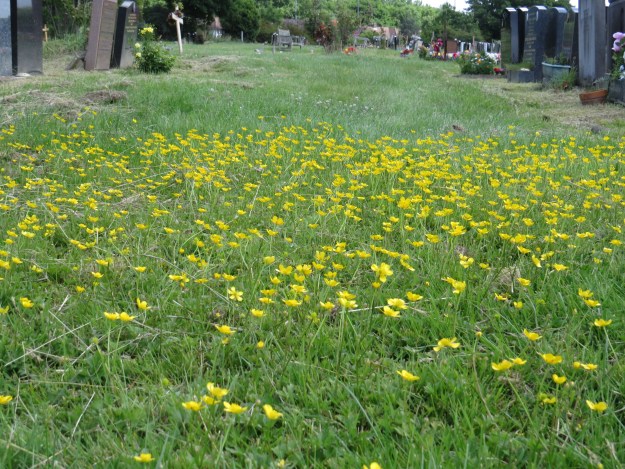
There are lovely patches of creeping buttercup in the damper areas.

The sycamore keys are plentiful this year, and so pretty.

But there is a set of rather brutal paths next to where the meadow used to be, and a couple of parking spaces, so I imagine that new graves will be going in here soon. Well, I suppose it is a graveyard so I can lament but not complain.

And although the comfrey has been dug out, it seems to be staging a fightback, along with a mass of other ‘weeds’.

And look at this cheeky squirrel. I’ve noticed that they eat the flowers from the memorial wreathes before, but this one seems particularly cheeky. I love the way that s/he is holding  the chrysanthemum as if s/he was a little dog.


Susanna Wesley’s Statue – An Update

Dear Readers, you might remember me being delighted with this statue when it first appeared outside East Finchley Methodist Church back in February. The hope then was that children would love it, and it seems that they do, because the pupils of Martin Primary School have named all the animals that appear on it, except for the poor rabbit. I am temporarily christening him ‘Radicchio’ because it’s my favourite lettuce, and because it’s great fun to say.


Sabina the Fox

Samir the Squirrel

Wendy the Hedgehog

Bob the mouse (with the temporarily-monikered Radicchio the Rabbit)

And Amira the Owl

While I was stomping around the garden with my camera, the very nice man who was clearing the church guttering while standing at the top of a rather precipitous ladder peered down.

“And to think”, he said, “that the bloke that did it did it with a chainsaw”.

Indeed. Well done to Simon O’Rourke, who has created a local landmark that I’m sure people will admire and love for many years to come.


Wednesday Weed – Phacelia

Phacelia tanacetifolia and some California poppies

Dear Readers, you might remember that a few weeks ago I had a walk in St Pancras and Islington cemetery, and noticed one grave that had been planted up with California poppies and Phacelia tanacetifolia , a plant in the borage family that is a great favourite not only with pollinators, but with allotment holders and gardeners, who use it as a green manure (a plant that is grown for a season and then ploughed back into the soil to help to enrich it). Well, I have had limited success in growing this plant in my shady garden, but it is so useful that I thought it deserved a blogpost. Do let me know if you’ve grown it yourself!

Phacelia is also known as blue or lacy tansy – its species name means ‘leaves resembling those of the tansy‘, although the plant is only very distantly related to that small yellow member of the daisy family. In my book ‘Gardening for Wildlife’ by Adrian Thomas, Phacelias are described as ‘scorpion weeds’, so I wonder if this is how they are known in their native south west USA and Mexico. It’s apparently also known as ‘fiddleneck’, presumably from the shape of the stem.

Photo One by By Walter Siegmund (talk) - Own work, CC BY-SA 4.0, https://commons.wikimedia.org/w/index.php?curid=70834984

Phacelia tanacetifolia (Photo One)

My book describes Phacelia as a top plant for flowering in June and July, and it is so popular with bees and hoverflies that it’s often planted in orchards to encourage pollinators, though I assume this is for later flowering trees than our spring cherries and plums. My book includes Phacelia along with many other ‘exotic’ annual cornfield plants, such as red flax and fairy toadflax, poached-egg plant and opium poppy. Certainly I’ve seen some very ‘exotic’ meadows in my time, such as the one from the Churchill Estate in Pimlico, shown below. I’m not sure that I don’t prefer the look of the native meadows with their mixture of ox-eye daisies, cornflowers, poppies and corn marigolds, but I can see the appeal.

‘Exotic’ meadow on the Churchill Estate in Pimlico

Like many of the borages, this plant is a bit on the furry side, and as you can see the stems are covered in short spikes. Some species of Phacelia are said to cause contact dermatitis, but apparently not this one.  The seeds are ‘negatively photoblastic’ (who knew?) which means that they will only germinate in the dark. The plant is also a bit droopy and straggly, but then so am I on a bad day, so it seems churlish to complain.

Although Phacelia doesn’t fix nitrogen in the same way as beans and some other plants do, ploughing it back into the soil at the end of the year does seem to enhance the amount of nitrogen that’s available for other plants in the soil.

Photo Two by By Meneerke bloem - Own work, CC BY-SA 4.0, https://commons.wikimedia.org/w/index.php?curid=82587604

Phacelia (Photo Two)

In North America, there is a species of mining bee that specialises in Phacelia, called, not surprisingly, the Phacelia Mining Bee (Andrena phacelia). And very nice it looks too.

Photo Three by Michael Veit, from https://www.discoverlife.org/mp/20p?see=I_VEIT201&res=640&flags=subgenus:

Phacelia bee on a species of Phacelia (Photo Three)

And finally, a poem. I was not hopeful of finding anything that mentions Phacelia but here it is, a poem by Natalie Diaz, a Mojave American poet. Her collection ‘Postcolonial Love Poem’ won the Pulitzer Prize for Poetry in 2021. I am running off to buy it shortly, on the strength of the poem below and of this review from The Guardian. Here’s the title poem. Tell me what you think!

Postcolonial Love Poem

I’ve been taught bloodstones can cure a snakebite,
can stop the bleeding—most people forgot this
when the war ended. The war ended
depending on which war you mean: those we started,
before those, millennia ago and onward,
those which started me, which I lost and won—
these ever-blooming wounds.
I was built by wage. So I wage love and worse—
always another campaign to march across
a desert night for the cannon flash of your pale skin
settling in a silver lagoon of smoke at your breast.
I dismount my dark horse, bend to you there, deliver you
the hard pull of all my thirsts—
I learned Drink in a country of drought.
We pleasure to hurt, leave marks
the size of stones—each a cabochon polished
by our mouths. I, your lapidary, your lapidary wheel
turning—green mottled red—
the jaspers of our desires.
There are wildflowers in my desert
which take up to twenty years to bloom.
The seeds sleep like geodes beneath hot feldspar sand
until a flash flood bolts the arroyo, lifting them
in its copper current, opens them with memory—
they remember what their god whispered
into their ribs: Wake up and ache for your life.
Where your hands have been are diamonds
on my shoulders, down my back, thighs—
I am your culebra.
I am in the dirt for you.
Your hips are quartz-light and dangerous,
two rose-horned rams ascending a soft desert wash
before the November sky untethers a hundred-year flood—
the desert returned suddenly to its ancient sea.
Arise the wild heliotrope, scorpion weed,
blue phacelia which hold purple the way a throat can hold
the shape of any great hand—
Great hands is what she called mine.
The rain will eventually come, or not.
Until then, we touch our bodies like wounds—
the war never ended and somehow begins again.

—Natalie Diaz

Photo Credits

Photo One by By Walter Siegmund (talk) – Own work, CC BY-SA 4.0, https://commons.wikimedia.org/w/index.php?curid=70834984

Photo Two by By Meneerke bloem – Own work, CC BY-SA 4.0, https://commons.wikimedia.org/w/index.php?curid=82587604

Photo Three by Michael Veit, from https://www.discoverlife.org/mp/20p?see=I_VEIT201&res=640&flags=subgenus: 

Mint Moths and Green-Eyed Bees

Dear Readers, for some reason this post was meant to appear on Thursday, but didn’t, so here it is today! Last week I had  one of those days today when I sat down at my desk and didn’t stir until I realised that my back had seized up. It’s clear that if I don’t set myself an alarm on my phone to remind me to move after 45 minutes, I will be practically petrified before I’m much older. And so I took myself down to the front garden to see what was going on on the lavender, and before long I spotted this rather pretty little moth. This is a mint moth (Pyrausta aurata), also known as a Small Purple and Gold. It’s true that the caterpillars eat mint and marjoram and thyme and quite possibly lavender too, but it cheered me up so much to see it fluttering around the flowers that I forgive it, as I do most of the creatures that have a quick nibble in the garden.

There were the usual honeybees, and some fine bumblebees…

But there was also a tiny bee buzzing around, moving at twice the speed of anything else. S/he looked a little bit familiar, but it was difficult to get a good view because she was so busy. But then, finally, s/he settled for a second, and I could see that she had green eyes.

Four-banded Flower Bee (Anthophora quadrimaculata)

How interesting that this species of bee visited last year as well – clearly the lavender is a favourite. My bee book mentions that it has a high-pitched buzz, and indeed it does – I’m sure that the size of the bee must have something to do with the pitch of the drone. Bumblebees always sound like Lancaster bombers, whereas these little guys are definitely more like Spitfires. Not that I saw any of them in the recent flypast however (harrumph). I wouldn’t want you to think that I’m bitter.

Anyhow, a good photo of the flower bee has eluded me so far this year, so here’s one from 19th June last year. It’s a reminder that it’s always worth spending time to really look at a patch of plants that the bees are visiting. You never know who is going to turn up.