Author Archives: Bug Woman

A Mid May Walk in St Pancras and Islington Cemetery


Dear Readers, this tumbled headstone, complete with its own pond and fine growth of algae, just about sums up this week. It is heading towards being the wettest May on record. What people generally don’t appreciate is that climate change creates weather chaos, not just a gradual rise in temperatures. For the birds who have started breeding the lack of insects will probably increase the rate of nest failure, and for insects trying to complete their reproductive cycles it will lessen the amount of time that they have available. At least we haven’t had snow in London, though it has fallen further north this month.

It’s also been very windy, so the dandelion clocks, so abundant last week, have more or less disappeared, to be replaced by a carpet of daisies and buttercups.

Creeping Buttercup (Ranunculus repens)

There are several species of buttercup in the cemetery: there’s the typical creeping buttercup (Ranunculus repens), with its three-lobed leaves, the poor old Goldilocks buttercup, (Ranunculus auricomus) where the flowers are always missing their petals and it looks as if it’s been nibbled even when it’s pristine, and the delicate meadow buttercup (Ranunculus acris), with its finely-cut leaves. Once you’ve got your eye in for identifying these plants, you notice that the flowers on the meadow buttercup seem to have more separated petals, and the whole plant is a bit taller than the creeping buttercup. My Dad taught me that where there are buttercups of any kind it’s an indicator that the soil is wet, so it’s best to avoid standing near them if you don’t have your Wellington boots on.

Meadow buttercup (Ranunculus acris)

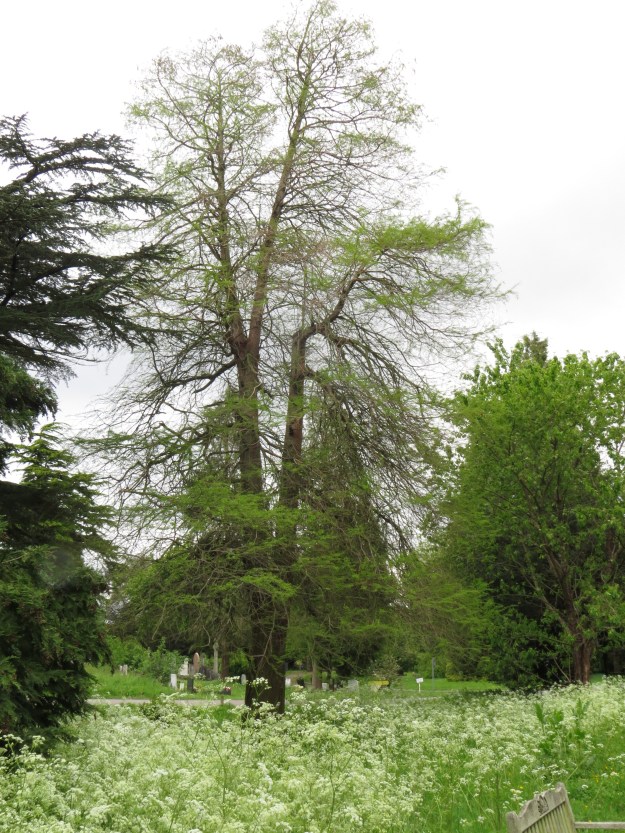
I am pleased to report that ‘my’ swamp cypress is finally getting a coat of green, rather later than I expected. Look at it standing ankle-deep in cow parsley!
I noticed how the flowers on the horse chestnut turn pink when they’re pollinated – you can see the mixture of yellow and pink blossom on this flowerhead. I have seen bumblebees about in the midst of the storms this week, determinedly heading for the dusky cranesbill which is in full flower in the garden. I am a recent convert to species geraniums – some varieties are shade-tolerant, and the bees love them. I imagine that a tree like a horse chestnut must be a powerful bee magnet. So many flowers! So much nectar and pollen!

There is some sorrel just starting to appear too – I horrified my husband by eating a leaf just to make sure. It looks rather like a grass, but it’s actually a member of the knotweed family. The leaves have a delicious lemony tang to them, and if you look at the stem you can see how similar it is to plants like bistort and redshank.

Common sorrel (Rumex acetosa)

When we reach the main path that leads to the North Circular Road entrance, what should we see but a blooming little egret flying past! I apologise for not getting a better photo for you, readers. I promise that the white blob just right of centre towards the top of the photo is actually an egret, not a stray handkerchief whooshing past in the high wind. I wonder where s/he was going?

On we go. I am delighted with the way that the sycamore flowers are already turning into the little ‘helicopters’ as we used to call them.

A rather magnificent crow surveyed the scene from the top of a tree. We’d just watched a crow pick up half a sandwich that someone had dropped, dunk it in a puddle to moisten it and then fly off, presumably back to a nestful of little dinosaurs waiting for their lunch.

And there’s an area completely covered in shining cranesbill (Geranium lucidum). Even allowing for the damp weather, just look how shiny the foliage is! And look at all those fallen horse-chestnut flowers, probably ripped untimely from the tree in this week’s wind, rain and hail.

Shining cranesbill (Geranium lucidum)

Storm damage


More branches down

My friend A told me that there were some whole trees down in other parts of the cemetery. It’s such a large area that they can lay around for quite some time if they haven’t fallen onto a recent grave, and if they aren’t blocking a well-used road.

And, as usual in the cemetery, I notice something that I’ve walked past a hundred times without really seeing it.

The broken column symbolises a life cut short, and was often used to signify the death of a child, as indeed is the case with this memorial. Little John Arthur Winter died at the age of 18 months, and is buried here with who I imagine are his grandparents, judging by the ages.

John Arthur was born in Shoreditch,  to Charles Richard and Amy Jane Winter, and was baptised in St John the Baptist church in Shoreditch. In 1881, 5 years after John Arthur had died, Charles Richard and Amy were living at 164 Southgate Road in Hackney. They had two children, Charles aged 12 and George aged 4, and their 4 year-old niece Alice was visiting them on the day of the census. Charles Richard lists his occupation as ‘clerk/surveyor’, but the section for Amy’s employment is blank. By 1891 the family have moved to Hever in Kent, and it seems as if Charles Richard has gone up in the world, with his occupation now listed as ‘Architect/Surveyor’. The older boy, Charles, is now 22 years old and a stonemason, and the younger, George, is a draughtsman and architect, so it looks as if both children followed in their father’s footsteps. Their niece, Alice, seems to be living with them, and they now have a general servant. In the 1901 census Charles Richard and Amy are still living in Hever, but all the young people have left and they no longer have a servant. The couple are only 55 years old  but by 11th November 1901, Charles Richard is dead, and is buried in St Pancras and Islington Cemetery, though not in the same grave as his infant son. Amy Jane follows him in 1920, and it seems from the burial records that she might have spent her last days in Brighton. Maybe one of her sons lived there?

It is extraordinary what you can find out on the internet these days, but the bare bones of a life give no idea of the really important things – was a person kind? Did they have a sense of humour? What infuriated them, and what got their pulses racing? Did they love their job, or hate it? Did the sons get on with their father? How come the niece was living with them? All these things vanish when the last person who remembers someone, or has heard about them, dies themselves. Nonetheless, I think we often don’t realise what a huge difference we can make to the people around us, for good and for ill, and how those things ripple out into the wider world. My grandmother remembered her two dead sons until her own dying day: one died at eighteen months of scarlet fever, and the other at two years old from diptheria. But the stories that she told me about them live on in me, and so in a way they still live on, though their lives were so short, and so long ago. Let’s never forget to pass on those stories.

Saturday Quiz – What’s the Bee?

Title Photo by Patrick Rock, CC BY 3.0 <https://creativecommons.org/licenses/by/3.0>, via Wikimedia Commons

Bumblebee….(Title Photo)

Dear Readers, we’ve had a lot of tricky quizzes just lately, so I wanted to make this one fun, in honour of World Bee Day (which was on 20th May). So, all you need to do is guess the type of bee from the clues. So, if you think Photo One shows a Mayor, your answer would be ‘Mayor bee’. Some of the clues have more than one photo, so you will have to combine them to make the name of the bee. Some are species and some are just types of bee, so hopefully it won’t be too UK-specific. But let’s see how we all get on!

The song for Question Three is very sad but I think you could guess the name of the bee just from the title, so you don’t have to listen if you’re feeling down-hearted already.

As usual, answers in the comments by 5 p.m. UK time on Thursday 27th May please. Answers will be posted on Friday 28th May. I will hide any answers as soon as I see them, but just in case you might want to write your answers down first if you are easily influenced (like me 🙂 ).

Onwards!

Photo One By Kyd (Joseph Clayton Clarke) - http://www.oldbookart.com/, Public Domain, https://commons.wikimedia.org/w/index.php?curid=18557519

1)

Photo Two By A&M Records - Billboard Magazine, page 2, Public Domain, https://commons.wikimedia.org/w/index.php?curid=75866990

2)

3)  Alone Again (Naturally) – YouTube

4)

Photo Four by Ben Rollman from https://www.flickr.com/photos/xadrian/7930303196/

4)a)

PLUS

Photo 4b I, MarcusObal, CC BY-SA 3.0 <http://creativecommons.org/licenses/by-sa/3.0/>, via Wikimedia Commons

4)b)

Photo Five Tony Hisgett from Birmingham, UK, CC BY 2.0 <https://creativecommons.org/licenses/by/2.0>, via Wikimedia Commons

5)

Photo Six By MesserWoland, CC BY-SA 3.0, https://commons.wikimedia.org/w/index.php?curid=985225

6)

7)

Photo 7a Faizan Rabbani, CC BY-SA 4.0 <https://creativecommons.org/licenses/by-sa/4.0>, via Wikimedia Commons

7a)

PLUS

Photo 7b Evan-Amos, Public domain, via Wikimedia Commons

7b)


8)

Photo 8a I, MarcusObal, CC BY-SA 3.0 <http://creativecommons.org/licenses/by-sa/3.0/>, via Wikimedia Commons

8)a)

PLUS

Photo 8b from https://picryl.com/media/war-production-drive-anthracite-rallies-coal-mining-is-serious-business-an

8)b)

9)

Photo 9a from https://www.flickr.com/photos/shallowend24401/2951338099 by Brian

9)a)

Photo 9b from https://barbrosthreads.com/2014/09/08/hand-carders/

9) b)

10)

Photo Ten by By Cuculus_canorus_vogelartinfo_chris_romeiks_CHR0791.jpg: Vogelartinfoderivative work: Bogbumper (talk) - Cuculus_canorus_vogelartinfo_chris_romeiks_CHR0791.jpg, GFDL 1.2, https://commons.wikimedia.org/w/index.php?curid=16077960

10)

And finally, what’s the bee-related link to these lyrics?

11)

Well, you can tell by the way I use my walk
I’m a woman’s man, no time to talk
Music loud and women warm, I’ve been kicked around
Since I was born
And now it’s alright, it’s okay
And you may look the other way
We can try to understand
The New York Times’ effect on man

Have fun!


Saturday Quiz – Endemic – The Answers!

Title Photo by By https://www.flickr.com/photos/francesco_veronesi/ - https://www.flickr.com/photos/francesco_veronesi/15101234309/, CC BY-SA 2.0, https://commons.wikimedia.org/w/index.php?curid=36447354

Helmet Vanga, endemic to Madagascar (Title Photo)

Dear Readers, just a few people had a bash at the quiz this week, and very well they did too – Claire got 19 out of 30, but the winners this week are Fran and Bobby Freelove with 26 out of 30! I should point out in all fairness that the lovely Mangrove Hummingbird in the third photo is actually endemic to Costa Rica, not Colombia, but I’ve given you full marks because Costa Rica wasn’t listed as an option, and Colombia makes perfect sense under the circumstances. 

Did you know that 20th May was National Bumblebee Day? That might be a clue to tomorrow’s quiz….

Photo One by By JJ Harrison (https://www.jjharrison.com.au/) - Own work, CC BY-SA 3.0, https://commons.wikimedia.org/w/index.php?curid=12262604

1) K) Australia Tasmanian Devil (Sarcophilus harrisii)

Photo Two by By Giovanni Mari - Flickr, CC BY-SA 2.0, https://commons.wikimedia.org/w/index.php?curid=24185462

2) G) China Golden snubnosed monkey (Rhinopithecus roxellana)

Photo Three by By Jorge Obando Nature Photo - Mangrove Hummingbird ♂, CC BY-SA 2.0, https://commons.wikimedia.org/w/index.php?curid=66096010

3)B) Colombia Mangrove hummingbird (Amazilia boucardi) (should actually have been Costa Rica!)

Photo Four by By The original uploader was Wragge at English Wikipedia. - Transferred from en.wikipedia to Commons., CC BY-SA 2.5, https://commons.wikimedia.org/w/index.php?curid=4338587

4) J) Ecuador Marine Iguana ((Amblyrhynchus cristatus))

Photo Five by By @rawjeev / Rajeev B / Rawlife - Own work, CC BY-SA 4.0, https://commons.wikimedia.org/w/index.php?curid=57143447

5)L) India Whitebellied treepie (Dendrocitta leucogastra)

Photo Six by By V31S70 - https://www.flickr.com/photos/veisto/8558671034/, CC BY 2.0, https://commons.wikimedia.org/w/index.php?curid=25261635

6)H) Japan  Japanese giant salamander (Andrias japonicus)

Photo Seven by By JialiangGao www.peace-on-earth.org - Own work, CC BY-SA 4.0, https://commons.wikimedia.org/w/index.php?curid=3152673

7) M) Madagascar  Parson’s chameleon (Calumma parsonii)

Photo Eight by By Paula Olson, NOAA - http://www.fisheries.noaa.gov/pr/species/mammals/porpoises/vaquita.html, Public Domain, https://commons.wikimedia.org/w/index.php?curid=30588208

8) C) Mexico Vaquita (Phocoena sinus)

Photo Nine by By Department of Conservation - https://www.flickr.com/photos/docnz/4015891720/, CC BY 2.0, https://commons.wikimedia.org/w/index.php?curid=48081940

9) F) New Zealand Kakapo ((Strigops habroptilus))

Photo Ten by By colin houston - originally posted to Flickr as Mauritian (echo) parakeet(Psittacula echo), CC BY 2.0, https://commons.wikimedia.org/w/index.php?curid=3816850

10) I) Mauritius Echo Parakeet (Psittacula eques)

Photo Eleven by By Gregg Yan - Low resolution derivative work from original photograph personally provided by photographer., CC BY-SA 3.0, https://commons.wikimedia.org/w/index.php?curid=19210444

11) N) Phillippines Giant golden-crowned flying fox (Acerodon jubatus)

Photo Twelve by By Maureen Leong-Kee from Boca Raton, FL, United States - file369 Seychelles Kestrel side vies, CC BY-SA 2.0, https://commons.wikimedia.org/w/index.php?curid=7419527

12) O) Seychelles Seychelles kestrel (Falco araeus)

Photo Thirteen by By Bl1zz4rd-editor - Own work, CC BY-SA 4.0, https://commons.wikimedia.org/w/index.php?curid=79060869

13) D) South Africa  African penguin (Spheniscus demersus)

Photo Fourteen by By Carlos Delgado - Own work, CC BY-SA 4.0, https://commons.wikimedia.org/w/index.php?curid=34667538

14) A) Sri Lanka Toque Macaque (Macaca sinica)

Photo Fifteen by By Jörg Hempel - Own work, CC BY-SA 3.0 de, https://commons.wikimedia.org/w/index.php?curid=45026917

15) E) USA Nene ((Branta sandvicensis))

Photo Credits

Title Photo  By https://www.flickr.com/photos/francesco_veronesi/https://www.flickr.com/photos/francesco_veronesi/15101234309/, CC BY-SA 2.0, https://commons.wikimedia.org/w/index.php?curid=36447354

Photo One By JJ Harrison (https://www.jjharrison.com.au/) – Own work, CC BY-SA 3.0, https://commons.wikimedia.org/w/index.php?curid=12262604

Photo Two By Giovanni Mari – Flickr, CC BY-SA 2.0, https://commons.wikimedia.org/w/index.php?curid=24185462

Photo Three by By Jorge Obando Nature Photo – Mangrove Hummingbird ♂, CC BY-SA 2.0, https://commons.wikimedia.org/w/index.php?curid=66096010

Photo Four  By The original uploader was Wragge at English Wikipedia. – Transferred from en.wikipedia to Commons., CC BY-SA 2.5, https://commons.wikimedia.org/w/index.php?curid=4338587

Photo Five  By @rawjeev / Rajeev B / Rawlife – Own work, CC BY-SA 4.0, https://commons.wikimedia.org/w/index.php?curid=57143447

Photo Six  By V31S70 – https://www.flickr.com/photos/veisto/8558671034/, CC BY 2.0, https://commons.wikimedia.org/w/index.php?curid=25261635

Photo Seven  By JialiangGao http://www.peace-on-earth.org – Own work, CC BY-SA 4.0, https://commons.wikimedia.org/w/index.php?curid=3152673

Photo Eight  By Paula Olson, NOAA – http://www.fisheries.noaa.gov/pr/species/mammals/porpoises/vaquita.html, Public Domain, https://commons.wikimedia.org/w/index.php?curid=30588208

Photo Nine by By Department of Conservation – https://www.flickr.com/photos/docnz/4015891720/, CC BY 2.0, https://commons.wikimedia.org/w/index.php?curid=48081940

Photo Ten By colin houston – originally posted to Flickr as Mauritian (echo) parakeet(Psittacula echo), CC BY 2.0, https://commons.wikimedia.org/w/index.php?curid=3816850

Photo Eleven by By Gregg Yan – Low resolution derivative work from original photograph personally provided by photographer., CC BY-SA 3.0, https://commons.wikimedia.org/w/index.php?curid=19210444

Photo Twelve by By Maureen Leong-Kee from Boca Raton, FL, United States – file369 Seychelles Kestrel side vies, CC BY-SA 2.0, https://commons.wikimedia.org/w/index.php?curid=7419527

Photo Thirteen by By Bl1zz4rd-editor – Own work, CC BY-SA 4.0, https://commons.wikimedia.org/w/index.php?curid=79060869

Photo Fourteen by By Carlos Delgado – Own work, CC BY-SA 4.0, https://commons.wikimedia.org/w/index.php?curid=34667538

Photo Fifteen  By Jörg Hempel – Own work, CC BY-SA 3.0 de, https://commons.wikimedia.org/w/index.php?curid=45026917

Emergence

Large red damselfly (Pyrrhosoma nymphula)

Dear Readers, earlier this week I saw my first large red damselfly. Or, to be more exact, I nearly squashed one when I reached for the handrail, and saw it whirling away like a miniature helicopter. I knew that they were the first of the dragonflies to emerge in this part of the world, but for some reason I never connected their appearance with the fact that they had actually hatched out in my pond: I assumed that they’d flown in from somewhere else.

When I went for a wander this evening though, there were not only half a dozen damselflies hiding in the marsh marigold and reclining on the figwort, there were signs of what had happened.

High up on the stem below is the exuvia of a damselfly – the skin that it has discarded as it emerges and turns into the adult insect. The nymphs of this species live on the bottom of the pond for two years before emerging, but they can fly around all summer, so at least they have a few months to enjoy their time in the sunshine. The time when a dragonfly nymph is transforming into an adult is the most dangerous time of the animal’s life, so it’s good to see so many adults about. Beneath the exuvia at the top, you can see a nymph that is probably waiting for its turn to emerge. I shall check in the morning and see what’s happened.

It will be interesting to see what happens next. Last year, males set up territories around the pond, and spent lots of time patrolling, checking out visitors and either trying to mate or indulging in ferocious dogfights. You might remember that there were several mating pairs, and apparently the sight of one pair mating can encourage others to do the same.

Ponds really are examples of ‘if you build it, they will come’ – I feel so lucky and so privileged to be visited by so many creatures, and to have had the opportunity to make a home for them.

Another large red damselfly keeping a low profile


But to complete my evening, I was looking at the figwort and thought that I could see a big fat bud. On closer inspection, it turned out to be a small rose chafer beetle, one of my very favourite insects (yes I know you aren’t supposed to have favourites, but look at it! Who could resist?). Apparently the grubs feed on rotting wood, of which I have an abundance in the form of some oak sleepers at the back of the garden that are gradually disappearing, so maybe that’s where this little one came from. It looked very snug curling up in the figwort leaves, and so I left it to rest and grow nice and big. Hopefully it will be very impressed when the angelica blooms…

Rose chafer (Cetonia aurata)

Angelica flowerhead unfurling (Angelica sylvestris)

Wednesday Weed – Angelica

Angelica (Angelica sylvestris)

Dear Readers, I was going to wait until my angelica plant flowered before writing about it, but I was so excited by the size of it that I could not defer gratification any longer. This giant member of the carrot family is native to the UK and my Harrap’s Guide to Wildflowers describes it as ‘very common’. Hah! I am sure I have never tripped over it before. It seems to have grown about a foot in the last week and is starting to be covered in great bulbous flowerheads. It looks strangely edible to me, as indeed parts of it are, though those in the know say that garden angelica (which has the delightful Latin name Angelica archangelica) is rather more delicate.

Angelica – emergent flowerhead!

I know angelica largely as the green candied ‘fruit’ that was plonked on top of a cake to provide a colour contrast to the glacé cherries or the candied orange peel, as in the picture below.

Photo One from https://www.bbcgoodfoodme.com/recipes/cassata-siciliana/

Sicilian cake with angelica topping (Photo One)

If you want to make your own, you can boil the stems, shoots or leaves in sugar syrup, and voila! You might be disappointed by the colour though, as the home-cooked examples that I’ve seen end up looking a kind of olive-yellow colour. The leaves can be eaten as a vegetable, or added to rhubarb. The seeds can also be used as a spice. However, be very careful not to confuse the plant with its close relatives hemlock and hemlock water-dropwort, or you could well end up deaded as my Dad used to say. The leaves of both these poisonous plants are very delicate and filmy compared to angelica, however, so that should help.

That doyen of the herb garden Jekka McVicar has a recipe for angelica jam, which you can find here. Don’t come asking me for any of mine, though, as my main reason for planting this whopper is, as usual, the pollinators that I’m hoping will wing a path to my door to feed on the mass of white flowers.

One in particular is the Norwegian wasp (Dolichovespula norwegica), a rather uncommon critter who can be distinguished from our usual wasps by a rusty band at the top of the abdomen. The adults apparently have a great fondness for the flowers of angelica and giant hogweed. How I would love to grow giant hogweed! But I fear I would be most unpopular with the neighbours, so angelica is a good substitute. The larvae of the wasp (who are fed on ground-up caterpillars, which is one reason why wasps of all kinds are the gardener’s friend) secrete a kind of honeydew to reward their hard-working aunties. The wasps generally make their nests in a tree, so let’s hope they’ve already settled somewhere else before coming to The County Roads to feed.

Photo Two by By S. Rae - https://www.flickr.com/photos/35142635@N05/9626119331/in/photolist-fECnUF-6QMCiR-6QRECw, CC BY 2.0, https://commons.wikimedia.org/w/index.php?curid=35577701

Norwegian wasp (Photo Two)

The plant is also the larval foodplant of the swallowtail butterfly, but I doubt that one will come all the way to North London just to oblige me. Lots of moths also feed on it, however, so fingers crossed.

Photo Three by By Entomolo - Own work, CC BY-SA 4.0, https://commons.wikimedia.org/w/index.php?curid=48664965

Swallowtail butterfly (Papilio machaon) (Photo Three)

Medicinally, chewing an angelica root before breakfast supposedly reduced heart palpitations and increased urination (though hopefully not at the same time). Irish folklore suggests that angelica could be used as a treatment for epilepsy, and that it could help with hydrophobia, the fear of water that usually accompanies rabies (from the Eatweeds website).

On the Plantlore website, it’s reported that if someone had a cut or graze, an angelica leaf was laid on the wound to heal it. It’s also said that in Devon, travelling people used to smoke angelica mixed with elm as a kind of tobacco.

It seems that angelica was also very much a London plant in days gone by: ‘A Modern Herbal’ by Mrs M.Grieve says of angelica:

In several London squares and parks, Angelica has continued to grow, self-sown, for several generations as a garden escape; in some cases it is appreciated as a useful foliage plant, in others, it is treated rather as an intruding weed. Before the building of the London Law Courts and the clearing of much slum property between Holywell Street and Seven Dials, the foreign population of that district fully appreciated its value, and were always anxious to get it from Lincoln’s Inn Fields, where it abounded and where it still grows. Until very recent years, it was exceedingly common on the slopes bordering the Tower of London on the north and west sides; there, also, the inhabitants held the plant in high repute, both for its culinary and medicinal use.”

When I can get back to Central London (in two week’s time, once my second vaccination kicks in) I shall have to see if the plant still grows in Lincoln’s Inn Fields. I imagine that things are rather more manicured these days.

Now, I was trying to find you a lovely poem, but while my search has pulled up lots of poets named Angelica, there is not a single poem that actually mentions the plant. And so, instead, here is a song called ‘Angelica’. It’s been recorded by both Gene Pitney and Scott Walker, and there are links to both below (don’t say I’m not good to you :-)). Gene Pitney was really part of my childhood – when we listened to the radio on Saturday mornings, someone always seemed to be requesting ‘ 24 Hours from Tulsa’. which has got to be one of the most overheated ballads ever committed to vinyl (and, in retrospect, a rather strange choice for ‘Family Favourites’).  My Mum used to get furious whenever she listened to it, and indeed it does paint a rather poor picture of the chap involved.

‘Your Dad would never do something like that’ , she said, and I am 100% sure she was right.

By the way, I like the way that the pronunciation has changed from the rather pedestrian ‘Anj-ell-ika’ to ‘Ang- ell- eeka’. Much more dramatic.

‘Angelica’ by Gene Pitney

‘Angelica’ by Scott Walker

’24 Hours from Tulsa’ by Gene Pitney

Photo Credits

Photo One from https://www.bbcgoodfoodme.com/recipes/cassata-siciliana/

Photo Two by By S. Rae – https://www.flickr.com/photos/35142635@N05/9626119331/in/photolist-fECnUF-6QMCiR-6QRECw, CC BY 2.0, https://commons.wikimedia.org/w/index.php?curid=35577701

Photo Three by By Entomolo – Own work, CC BY-SA 4.0, https://commons.wikimedia.org/w/index.php?curid=48664965

Tuesday Garden Update

Dear Readers, I needn’t have worried about the dearth of starlings, because on Friday last week the little devils arrived in droves. The parent birds seem to practice an avian form of ‘tough love’ – at first they feed the fledglings as soon as they start squawking, but after the first day the gaps between feeds get longer and longer. The youngsters still spend a lot of time watching the sky, but pretty soon they seem to get the hang of that pecking business and are starting to feed themselves. Managing the suet feeder takes a little longer, but by the end of the week this lot will all be pretty much offhand, and their parents can take a well-deserved break.

In other news, the hawthorn is in full flower, and very fine it looks too.

It’s a flowering-year for the whitebeam, too, though the rain has turned the flowers on the rowan a horrible brown colour. Did I mention the rain? It’s been showery rather than persistent, but there is some rain forecast for every day for the next fortnight. The garden will love it.

And now I have a mystery, but please don’t tell me! I planted these bulbs in a pot and have completely forgotten what they were. Fingers crossed it will be something interesting, and I’ll keep you posted.

Mystery bulb!

And I am extremely happy with the way that my angelica is doing. Goodness, what a beast! The flowerheads are just forming, and I’m hoping for lots of happy hoverflies. The RHS reckon that it’s a biennial or short-lived perennial, so it might be that after this year it just disappears, which would be a shame as it looks so spectacular.

Angelica poking through the handrail

Angelica – emergent flowerhead!

Nobody nested in my nestboxes this year, but the nestbox next door is occupied by blue tits, who seem to spend half the day swearing at the cats and the magpies in the garden. I have to brace myself for the emergence of the fledglings, they’re so small and vulnerable.

Elsewhere my perennial wallflowers are doing very nicely, and so are the forget-me-nots, though the woodruff that I planted has keeled over and died in less than a week. What’s up with that, I wonder? Still, as a gardener you win some, you lose some…

And my ‘yellow border’ in the side return is a mass of greater celandine and yellow corydalis and some green alkanet. I could pull them all up and plant something that won’t grow, but what would be the point of that?

The hemp agrimony has grown about six inches in a week (or so it seems). Next to them, the lily of the valley is coming up, and if it wants to take over that entire corner, it’s more than welcome.

The climbing hydrangea is having a very good year, and will be in flower soon, just in time for the ashy mining bees to turn up.

And the lady’s mantle is popping up yet again. I love those hydrophobic leaves!

And finally, I also love a happy accident. I’d completely forgotten about this creamy-white wallflower, and now it’s in flower, next to a herb Robert, and what looks like a red valerian. It’s amazing the way that nature puts things together sometimes.


Professional Whistler

Dad at the Marina close to Minnesota

Dear Readers, whatever happened to whistling? When I was growing up, everyone seemed to do it. Paperboys whistled on their rounds. Van drivers wolf whistled out of their windows at any female between 11 and 65 (these days they yell obscenities which is hardly an improvement). To attract a friend’s attention, you put two fingers in your mouth and emitted a startlingly loud blast (which I could never do, but was impressed by those who could). Nowadays the paper boys (those who are left now that we all read the news online) listen to music on their phones rather than making it, and I suspect most people never learn to whistle in the first place. The only living things whistling on my street are the starlings.

Dad was a long-established whistler. He would put a Nana Mouskouri or Demis Roussos record on the player, and would tap along for the first thirty seconds. My brother and I would wait for the inevitable. Dad would pucker up and join in, invariably half a bar late and with a tune that only roughly approximated what was actually happening. Sometimes he would stop and give it another bash, and on other occasions he would rush to try to catch up. We were often in silent stitches by the end of the performance, but Dad would always look quietly content, as if the race had been difficult but he’d got there in the end.

I don’t remember the last time I heard Dad whistle. It might have been around the time that he was diagnosed with COPD, but for years he’d barely had the breath to sit in his reclining chair comfortably. As his health, and Mum’s, declined, there was precious little to whistle about. But when I had lunch with him in the home in March last year, they were playing Spanish music and serving Spanish food, and I saw him tapping along with Julio Iglesias. He puckered up at one point, as if about to start, but then the Spanish chicken turned up and he set to with enthusiasm. It was the last time that I ever ate with Dad, or had a proper conversation with him, because he died on 31st March. The tuneless whistler was finally silenced, and there will never be a performance like it again.

How amused Dad would have been to hear that there is such a thing as a professional whistler! I thought of him when I read this piece in The Guardian yesterday. Here’s an excerpt:

‘Sitting by the deathbed of the Hollywood veteran Harry Dean Stanton, professional whistler Molly Lewis delivered her most poignant performance to date. The Australian-born musician whistled otherworldly versions of Danny Boy and Just a Closer Walk from Thee, the gospel ballad Stanton croons in 1967’s Cool Hand Luke. “He kissed my hand – it was such a beautiful moment”, remembers Lewis of her intimate 2017 performance”.

So, naturally I had to have a listen myself. For your delectation, here is the video for Lewis’s 2021 single ‘Oceanic Feeling’. I think the sound is utterly beautiful, but it might be better listened to rather than watched – it’s difficult not to be distracted by the comic appearance of someone whistling.  See what you think!

https://www.youtube.com/watch?v=YZ6vuWFxvGM


A Damp Walk in St Pancras and Islington Cemetery

Dear Readers, we didn’t walk in the cemetery last week because there the rain was blowing horizontally across the garden, but I couldn’t wait to get there this week. A fortnight is a long time when it’s spring, and already most of the dandelions are shedding their seeds. Those ‘dandelion clocks’ really are entrancing, especially if you look closely. I love the way that the seeds detach one at a time and head off to find somewhere to put down their roots…

When all the seeds are gone, I love the spirals of little holes where they were once attached. And I’d never noticed how the ‘parachutes’ of the seeds are angled backwards, maybe so that the plant can produce more seeds per seedhead?

But it was to be a day of floral and avian wonders. A magpie decided to have a bath in a muddy puddle, as one does.

There were germander speedwells….

An ocean of cow parsley…..

Lots of red campion….

Cowslips…..

English bluebells…

And the buttercups have taken over from the lesser celandine in the yellow flower competition.

The flowers on the horse chestnut are pretty much full grown now and how enticing they look!

Even the grasses have gone berserk. That combination of lots of rain and longer day length has really kicked everything off.

We walk along the narrow path that connects two parts of the cemetery, and the cow parsley has sprung up to waist high.

But then there’s one of those moments that make the cemetery so special. I hear a familiar yaffling call, and there, posing on a headstone, is a green woodpecker.

These birds always remind me a bit of tiny dragons. There is a close-mown area nearby where they often search for ants, pounding away into the earth with their beaks. Unlike the great-spotted woodpecker, they don’t drum on dead trees to establish territory. This one was exceptionally obliging. This one is a female – the ‘moustache’ at the side of the face is all black in females, but has a red stripe in males. I found this description a bit confusing as I associate a moustache as being in the middle of the face, but for ornithologists it’s more of the ‘muttonchop’ variety.


Anyhow, this was a real delight, and well worth getting damp for. I normally hear the green woodpeckers, but they rarely stand still long enough for a photo. The wet weather has kept most of the visitors away, which makes the birds bolder.

Next, it was a wander along the road which is right next to the North Circular. The traffic noise is so loud here that it’s hard to make yourself heard, but the flowers are worth it. The ragwort is in full flower…

Last year’s salsify is in flower again….

And how about this lovely tangle of vetch? Some of my favourite plants are in the pea family.

One of the pleasures of a walk like this is seeing familiar plants, but noticing something new about them. Last year I was crunching through acorns as I passed these trees, but today I saw that they were in flower. I’d never even thought about oak trees having flowers (doh). The catkins are the male flowers, and there are tiny female flowers that look like buds amongst the leaves.

The comfrey is in flower, and the bumblebees are delighted. Along by the stream there is creeping comfrey and the larger common comfrey.

Common comfrey


And for some reason, in the middle of all this wildness there is a Japanese acer, just about holding its own.

There is bugle and great stitchwort….

Bugle

Greater stitchwort

Cuckoo flower and shining cranesbill…

Cuckoo flower

And a great big patch of three-cornered garlic, with its triangular stem. I can’t resist having a little nibble as we march on through the woody bits of the cemetery. Overhead a buzzard is mewing and suddenly appears above us, pursued by a huge flock of crows – I count at least thirty, and more are joining from all directions. A sparrowhawk flies over, fast and low, and goes unmolested. The crows take such glee in the mobbing that you’d almost think they enjoyed it. I wonder if it’s one of those visceral reactions to anything that looks like a bird of prey? I always wonder this, and I still have no answers. And neither does the lovely Scotsman statue, standing in the spring woods with the bluebells dying back and the greenery rising all around him.


Saturday Quiz – Endemic

Title Photo by By https://www.flickr.com/photos/francesco_veronesi/ - https://www.flickr.com/photos/francesco_veronesi/15101234309/, CC BY-SA 2.0, https://commons.wikimedia.org/w/index.php?curid=36447354

Helmet Vanga, endemic to Madagascar (Title Photo)

Dear Readers, an endemic species is one that is found in only one country or geographic region, and nowhere else in the world. So, for this quiz, can you match the photo of the animal to the country? I will give an extra point if you can name the species, so there’s a total of 30 points to be won. I think this is mega-difficult though, so if anyone gets all the countries right that will be deserve a huge round of applause.  So, if you think photo 1 is from Sri Lanka and that the animal is a flugel hound your answer is 1) A) flugel hound. You might want to check the species though :-).

All answers in the comments by 5 p.m. UK time next Thursday (20th May) please. I’ll post the answers on Friday 21st May. As soon as I see your reply in the comments I shall hide it away so it can’t influence the easily-swayed (like me) but write your answers down first if you don’t want to be affected by the brilliance of others.

Onwards!

Countries

A) Sri Lanka

B) Colombia

C) Mexico

D) South Africa

E) USA

F) New Zealand

G) China

H) Japan

I) Mauritius

J) Ecuador

K) Australia

L) India

M) Madagascar

N) Phillippines

O) Seychelles


Photo One by By JJ Harrison (https://www.jjharrison.com.au/) - Own work, CC BY-SA 3.0, https://commons.wikimedia.org/w/index.php?curid=12262604

1)

Photo Two by By Giovanni Mari - Flickr, CC BY-SA 2.0, https://commons.wikimedia.org/w/index.php?curid=24185462

2)

Photo Three by By Jorge Obando Nature Photo - Mangrove Hummingbird ♂, CC BY-SA 2.0, https://commons.wikimedia.org/w/index.php?curid=66096010

3)

Photo Four by By The original uploader was Wragge at English Wikipedia. - Transferred from en.wikipedia to Commons., CC BY-SA 2.5, https://commons.wikimedia.org/w/index.php?curid=4338587

4)

Photo Five by By @rawjeev / Rajeev B / Rawlife - Own work, CC BY-SA 4.0, https://commons.wikimedia.org/w/index.php?curid=57143447

5)

Photo Six by By V31S70 - https://www.flickr.com/photos/veisto/8558671034/, CC BY 2.0, https://commons.wikimedia.org/w/index.php?curid=25261635

6)

Photo Seven by By JialiangGao www.peace-on-earth.org - Own work, CC BY-SA 4.0, https://commons.wikimedia.org/w/index.php?curid=3152673

7)

Photo Eight by By Paula Olson, NOAA - http://www.fisheries.noaa.gov/pr/species/mammals/porpoises/vaquita.html, Public Domain, https://commons.wikimedia.org/w/index.php?curid=30588208

8)

Photo Nine by By Department of Conservation - https://www.flickr.com/photos/docnz/4015891720/, CC BY 2.0, https://commons.wikimedia.org/w/index.php?curid=48081940

9)

Photo Ten by By colin houston - originally posted to Flickr as Mauritian (echo) parakeet(Psittacula echo), CC BY 2.0, https://commons.wikimedia.org/w/index.php?curid=3816850

10)

Photo Eleven by By Gregg Yan - Low resolution derivative work from original photograph personally provided by photographer., CC BY-SA 3.0, https://commons.wikimedia.org/w/index.php?curid=19210444

11)

Photo Twelve by By Maureen Leong-Kee from Boca Raton, FL, United States - file369 Seychelles Kestrel side vies, CC BY-SA 2.0, https://commons.wikimedia.org/w/index.php?curid=7419527

12)

Photo Thirteen by By Bl1zz4rd-editor - Own work, CC BY-SA 4.0, https://commons.wikimedia.org/w/index.php?curid=79060869

13)

Photo Fourteen by By Carlos Delgado - Own work, CC BY-SA 4.0, https://commons.wikimedia.org/w/index.php?curid=34667538

14)

Photo Fifteen by By Jörg Hempel - Own work, CC BY-SA 3.0 de, https://commons.wikimedia.org/w/index.php?curid=45026917

15)

Saturday Quiz – Of Cabbages and Kings – The Answers!

Title Photo by Terren, CC BY 2.0 <https://creativecommons.org/licenses/by/2.0>, via Wikimedia Commons

Ornamental Cabbages (Title Photo)

Dear Readers, we have a three-way split for First Prize this week, with Mal from FEARN, Anne and Fran and Bobby Freelove all identifying all 15 of the plants correctly. Well done all of you! I shall have to think of something fiendish for tomorrow 🙂 you’re all too good at this stuff…..

Photo One by Bob Jones 

1) F) Sea Kale (Crambe maritima)

Photo Two by H. Zell, CC BY-SA 3.0 <https://creativecommons.org/licenses/by-sa/3.0>, via Wikimedia Commons

2) I) Wallflower (Erysimum cheiri)

Photo Three by Enrico Blasutto, CC BY-SA 4.0 <https://creativecommons.org/licenses/by-sa/4.0>, via Wikimedia Commons

3) J) Charlock (Sinapsis arvensis)

Photo Four by H. Zell, CC BY-SA 3.0 <https://creativecommons.org/licenses/by-sa/3.0>, via Wikimedia Commons

4) A) Oilseed Rape (Brassica napus)

Photo Five by Tony Atkin / Garlic Mustard - Alliaria petiolata

5) O) Garlic Mustard (Alliaria petiolata)

Photo Six by Niccolò Caranti, CC BY-SA 4.0 <https://creativecommons.org/licenses/by-sa/4.0>, via Wikimedia Commons

6) M) Horseradish (Amoracia rusticana)

Photo Seven by Sten, CC BY-SA 3.0 <https://creativecommons.org/licenses/by-sa/3.0>, via Wikimedia Commons

7) N) Hoary Cress (Lepidium draba)

Photo Eight by Nick Moyes at https://www.flickr.com/photos/21874898@N05/2120901133

8) B) Danish Scurvygrass (Cochlearia danica)

Photo Nine by Σ64, CC BY 4.0 <https://creativecommons.org/licenses/by/4.0>, via Wikimedia Commons

9) H) Shepherd’s Purse (Capsella bursa-pastoris)

Photo Ten by CC BY-SA 3.0, https://commons.wikimedia.org/w/index.php?curid=133378

10) C) Thale Cress (Arabidopsis thaliana)

Photo Eleven by Sten Porse, CC BY-SA 3.0 <http://creativecommons.org/licenses/by-sa/3.0/>, via Wikimedia Commons

11) D) Cuckooflower/Lady’s Smock (Cardamine pratensis)

Photo Twelve by CC BY-SA 3.0, https://commons.wikimedia.org/w/index.php?curid=107188

12) G) Honesty (Lunaria annua)

Photo Thirteen by Stefan.lefnaer, CC BY-SA 4.0 <https://creativecommons.org/licenses/by-sa/4.0>, via Wikimedia Commons

13) E) Watercress (Nasturtium officinale)

Photo Fourteen by Anneli Salo, CC BY-SA 3.0 <https://creativecommons.org/licenses/by-sa/3.0>, via Wikimedia Commons

14) L) Dame’s Violet (Hesperis matronalis)

Photo Fifteen by Aiwok, CC BY-SA 3.0 <https://creativecommons.org/licenses/by-sa/3.0>, via Wikimedia Commons

15) K) Hairy Bittercress (Cardamine hirsuta)

Photo Credits

Title Photo by Terren, CC BY 2.0 <https://creativecommons.org/licenses/by/2.0>, via Wikimedia Commons

Photo One by Bob Jones 

Photo Two by H. Zell, CC BY-SA 3.0 <https://creativecommons.org/licenses/by-sa/3.0>, via Wikimedia Commons

Photo Three by Enrico Blasutto, CC BY-SA 4.0 <https://creativecommons.org/licenses/by-sa/4.0>, via Wikimedia Commons

Photo Four by H. Zell, CC BY-SA 3.0 <https://creativecommons.org/licenses/by-sa/3.0>, via Wikimedia Commons

Photo Five by Tony Atkin / Garlic Mustard – Alliaria petiolata

Photo Six by Niccolò Caranti, CC BY-SA 4.0 <https://creativecommons.org/licenses/by-sa/4.0>, via Wikimedia Commons

Photo Seven by Sten, CC BY-SA 3.0 <https://creativecommons.org/licenses/by-sa/3.0>, via Wikimedia Commons

Photo Eight by Nick Moyes at https://www.flickr.com/photos/21874898@N05/2120901133

Photo Nine by Σ64, CC BY 4.0 <https://creativecommons.org/licenses/by/4.0>, via Wikimedia Commons

Photo Ten by CC BY-SA 3.0, https://commons.wikimedia.org/w/index.php?curid=133378

Photo Eleven by Sten Porse, CC BY-SA 3.0 <http://creativecommons.org/licenses/by-sa/3.0/>, via Wikimedia Commons

Photo Twelve by CC BY-SA 3.0, https://commons.wikimedia.org/w/index.php?curid=107188

Photo Thirteen by Stefan.lefnaer, CC BY-SA 4.0 <https://creativecommons.org/licenses/by-sa/4.0>, via Wikimedia Commons

Photo Fourteen by Anneli Salo, CC BY-SA 3.0 <https://creativecommons.org/licenses/by-sa/3.0>, via Wikimedia Commons

Photo Fifteen by Aiwok, CC BY-SA 3.0 <https://creativecommons.org/licenses/by-sa/3.0>, via Wikimedia Commons