Author Archives: Bug Woman

A Quick March around the Playing Fields and Daily Starlings

Wood millet (Millium effusum)

Dear Readers, on Mondays, Wednesdays and Fridays our early morning walk through Coldfall Wood and Muswell Hill Playing Fields is at quite a pace, because my husband has to get back for a 9 a.m. call. Hence today, as I galloped along, I was able to snatch a few photos but couldn’t linger, for fear of being tardy. And so, I am throwing myself upon your mercy. I have always been interested in grasses, and in particular the way that they are so well adapted to the habitats that they find themselves in, but my identification skills are approximately zero. So, if you think I am wrong about any of the species I’m writing about, do not hesitate to put me right.

First up is what I think is wood millet (Millium effusum), growing amongst the hornbeams in the shadier parts of the wood. I love the way that each individual seed is lit up in the sunshine – it is a most ethereal plant. It’s said to favour winter-wet clay soils, and there’s certainly plenty of that lurking in Coldfall Wood.

Couch grass (Elymus repens)

We head out into the sunshine at a spanking pace but I manage to get a quick photo as we move along the side of the playing fields. This looks rather like couch grass of some variety: if so it is something of a pain for gardeners, what with its creeping rhizomes. However, finches and buntings like the seeds, and it is the one of the food plants for the Essex skipper butterfly.

Photo One byBy Charles J Sharp - Own work, from Sharp Photography, sharpphotography, CC BY-SA 3.0, https://commons.wikimedia.org/w/index.php?curid=33951282

Essex Skipper (Thymelicus lineloa) (Photo One)

At least social distancing on the Fields is relatively easy (even at speed) – one can always cut a corner to avoid a runner, and at least you can see people coming. As the temperatures are going into the ’80’s today, though, I do wonder if there are enough 2 metre squares of grass in the whole of England for everyone to sit on, now that we’ve been told that we can sunbathe. Of course, we must simultaneously ‘stay alert’, which rather ruins the whole idea of relaxation. In spite of this I have yet to see a virus, although I know some people in the prime of their lives who have caught it, and are finding that it’s a disease with a very long ‘tail’ that brings with it total exhaustion for weeks and weeks. I for one shall be walking briskly and sitting in the garden (and yes, I really do know how very lucky I am to have one).

Onwards! Another (probably inaccurately identified) grass is this rather dangly chap. It’s growing on the very edge of the fields, and I didn’t manage to capture the way that it sways in the breeze. I think that it might be hairy brome (and even if not, it’s a wonderful name). Hairy brome apparently likes shade, and this was a relatively sheltered spot. I believe that it could also be false brome, or even a fescue. Help! I’m sure there are some gramnophiles out there who could assist. I looked up the phrase ‘grass lover’ on Google to see if there was a special word for such a person, and I guess you can imagine which kind of sites I found.

Hairy-brome (Bromopsis ramosa) or possibly false brome (Brachypodium sylvaticum)

We stomp around the edge of the stream that brings all the run-off from the surrounding area into the woods, and there is my old friend, pendulous sedge. If you have a pond and leave it for more than ten minutes, one of these plants will soon arrive, and within the hour it will have had thousands of babies and distributed them into every nook and cranny. It is, nonetheless, a rather handsome plant (though, as the name suggests, a sedge rather than a ‘true’ grass) and it served the valuable purpose of hiding all my froglets from predators. However, it also has other uses, one of which is that the seeds from all those dangling seedheads can be made into flour. Who knew? Furthermore, unlike other grasses and sedges, pendulous sedge is not prone to the poisonous fungi ergot, which causes hallucinations, limb cramps and convulsions (more commonly known as St Anthony’s Fire).

Incidentally, you can tell a sedge from a grass because a sedge cross-section is triangular. So now we all know.

Pendulous sedge (Carex pendula)

And finally, as we head out past the electricity sub-station, I spot an old friend.

Wall Barley (Hordium mureum)

How we used to love playing with the seedheads of wall barley when we were children! You could pull the seeds apart, you could throw them at one another, and at one point I had them in my ‘zoo’ as ‘sheep’. The ‘zoo’ was polystyrene tiles left over from doing some work on the ceiling (yes, this was the 1960’s and polystyrene-tiled ceilings were all the rage in the East End), and the fence around the ‘field’ was made from spent matches and used drinking straws. The ‘house’ for the ‘sheep’ was made out of Lego. Now, if only I could have persuaded my brother not to run them all down with his toy tractor we would have been in business.

And finally, we are just reaching peak starling, I hope. The fledglings started squealing for food at 5 a.m. this morning, and are still going twelve hours later. Isn’t anybody else feeding them? At one point there were fifteen lined up on what was my pristine new handrail, and which will now require a very thorough scrub. I am pleased to see that the branch that I put into the pond so that the little birds could access a drink is being put to good use though. I just hope that all the fledglings learn to feed themselves soon and will pipe down,  before I am driven out of East Finchley by neighbours bearing pitchforks and lighted torches.

And yes, the water level in the pond is down again, though hopefully just because we’ve had no rain rather than because a heron has stabbed the lining again. We have had maybe 2 substantial days of rain since lockdown started in mid-March. It is the sunniest, most beautiful spring that I can remember which helps a bit, at least for me. I hope that you are managing too, wherever you are.

Wednesday Weed – Hoary Cress

Hoary cress (Lepidium draba)

Dear Readers, Muswell Hill Playing Fields has been a most unexpected source of interesting Wednesday Weeds over the past few weeks, but I was stumped when I first saw this plant. It reminded me somewhat of a white sedum, with its mass of snowy-white flowers and rather waxy green-grey stem, but a quick glance at my Harrap’s Wildflower Guide showed me that I had found another brassica; Hoary Cress. Apparently it is also known as ‘whitetop’, for obvious reasons.

This is a plant that is a long way from home, though: native to south-west Asia and southeastern Europe, it is treated as an invasive weed in both the USA and Australia, where it probably arrived in contaminated seed. In the UK it arrived in the early nineteenth century: in Alien Plants, Clive Stace and Michael Crawley suspect that it probably arrived in ship’s ballast. And therein hangs an interesting tale.

Ship’s ballast was comprised of gravel, sand, stones etc that were placed into the hold of a ship to give it stability and stop it capsizing. It’s easy to see how collecting this material in one port, and then emptying it out when the ship was at the end of its journey, could easily transport plant matter from one place to another. The first recorded case of it, according to Stace, was in 1627, when Francis Bacon reported that:

‘Earth that was brought out of the Indies and other remote countries for ballast for ships, cast upon some grounds in Italy, did put forth foreign herbs, to us in Europe not known’.

Ballast was sometimes dumped at sea, but this ran foul of harbour regulations and incurred a high cost when dredging was required to re-establish safe passage. As a result, it was increasingly left on the land, forming ‘ballast hills’ which must have been a botanist’s delight as alien species germinated. Some ports were more important for this than others: Newcastle, a port where ships went out carrying coal, and came back empty except for ballast, was a prime site for ballast-dumping, whereas London, which was largely an importing port, wasn’t the recipient of a lot of ballast (though alien plants often arrived with the cargoes themselves). The initial entrance site for the plant is established to be Swansea (another coal exporting port) in 1802, but this hasn’t stopped a whole array of stories about the plant’s supposed initial arrival (see later).

Ballast more or less disappeared as a source of alien plants as soon as iron hulls replaced wooden ones, but a number of plants were established by then. The most famous is probably pineappleweed, but in Cornwall prostrate toadflax (Linaria supina) probably arrived in this way.

There is little doubt that hoary cress was also imported with straw brought in for fodder, so it had at least two ways of arriving in the UK. Which ever route was the most important, it has earned the epithet ‘curse of Kent’ and is also associated with the area in yet another name, ‘Thanet Cress’, though it is now found in most parts of the UK. Stace describes it as an ‘aggressive rhizomatous species’. I find it interesting that it has turned up alongside the Playing Fields, much as I was puzzled about the oil-seed rape that is all over the place. I find myself wondering if these have emerged from an agricultural seedbank, dating from when the area was ‘proper’ fields rather than playing fields. I shall have to dig out some maps of the area and have a look.

Stace notes that hoary cress is also often a component of the cheap ‘cornfield seed mixes’ that are sold in order to generate an ‘instant meadow’. I think that this is quite an attractive plant, but that, if the playing fields are anything to go by, it’s also something of a thug – I suspect that the poor old cornflowers and poppies would soon be inundated by a sea of white. There is much to be said for buying such seeds from reputable sources if you want to end up with native species: there are many ‘lookalikes’ which are not the same as the ones that actually evolved here. Still, there is no way that the flora around East Finchley is ever going to be made up of exclusively native plants, and the species from other places make for a most interesting mix.

Stace also points out that in some ways, hoary cress is the ‘ideal’ alien: it doesn’t need any fungal support to spread, it can self-pollinate and spread via its rhizomes, and the seeds are wind-pollinated. In short, given a head start it could take over the world! And it might do this via motorway verges, where it is often found growing alongside oilseed rape. I can imagine those wind-dispersed seeds being blown along the road with each passing car, gradually travelling to every part of the UK.

The plant is also sometimes found in coastal areas, and seems to be highly salt-tolerant, which makes me wonder if the salting of motorways during icy periods has helped it to spread, much as Danish scurvy-grass has.

Now, during the lockdown I have found my thoughts often turning to food, and so naturally I wondered if this member of the cabbage family was edible. Results seem to be mixed: Wild Food Girl in the US uses the young plant in the same way that I would use tenderstem broccoli, and reports that tasting the flowers raw ‘nearly blew my head off’. The Hunger and Thirst website describes it as ‘delicious’. Nearly everyone is very specific that the plant should be eaten ‘young’, and some suggest that you could use the leaves raw, though they also mention that the plant contains hydrogen cyanide so you maybe shouldn’t be too overenthusiastic. As a great lover of broccoli I am almost tempted to have a bash myself. If the blogs suddenly stop arriving, you’ll know what’s happened.

Photo One from https://wildfoodgirl.com/2013/whitetop-a-wild-invasive-substitute-for-broccoli/

Hoary cress and oyster mushroom quiche by Wild Food Girl (Photo One)

Medicinally, the plant has been used to counteract scurvy (like all brassicas it is a good source of Vitamin C) and is said to also be good if you have contracted food poisoning by eating contaminated fish. This seems very specific: I almost wonder if its link with docks and the sea is coming into play here. However, in Plant Lives, Sue Eland mentions that rather than treating food poisoning, the seeds were used as a way of poisoning fish, so that they would float to the surface for easy harvesting – I’m guessing that the hydrogen cyanide was involved.

I went looking for folklore about the plant: often when a plant is a relatively new arrival, there isn’t much to say about it, at least in the UK. I found one ‘creation myth’, from an elderly lady who lived in Whitstable in Kent: she said that the hoary cress had arrived during the 1914-18 war, in the straw brought to feed the horses that were being shipped to the front. Sadly, we know that the plant actually arrived in Swansea a hundred years earlier, but of course plants do arrive in different areas at different times. The war link will not go away, either: in Vickery’s Folk Flora there is a story from the Westminster Gazette of 6th May 1915.

When our troops disembarked at Ramsgate after the disastrous Walcheren expedition of 1809. the straw and other litter on which they had slept aboard ship was thrown into a chalkpit, and afterwards carted into the fields for manure by a farmer called Thompson. A huge crop of the plant (Lepidium draba), thence named ‘Thompson’s Curse’, sprang up, spread right across England, and is now attacking the North Country. The roots of this terrible pest are many feet in length’.

And now a poem. This is actually about a different weed, spotted knapweed, but it could in essence be about any invasive plant, introduced accidentally or for a different purpose, but suddenly out of control. And, like all good poems, it is actually about much more than just a weed. See what you think.

Weeds by Dennis Held (from ‘Betting on the Night‘)

Blessed fiend, sultan of the sagebrush,

spotted knapweed of thee I sing,

bowed before thy spiked tenacity.


Cousin to other floral marauders

unholy cadre we honour with sacred

pagan names;dalmatian toad flax


dyer’s woad, purple loosestrife, leafy

spurge, hawkweed, cinquefoil,

hoary cress. Knapweed, you’re


a hired gun gone amok, imported

by beekeepers greedy for late

summer blooms, but soon


you outgrew the pasture

and blasted free, root-fed

toxins offing all around:


pedestrian bunch grass,

hyperbolic balsam root,

range-hardened sage,


croaked by your democratic

methods-all must die-

just doing what you have to,


doing what you can

and you have done it all:

invaded, took over,


wiped out the locals,

poisoned the ground,

wasted the water


moved west, ever west

and hell, that’s why we fight

so hard to purge you in futile


“War on Weeds” campaigns,

knowing we’ll fail, miraculous

centaurea maculosa, impure beast


half human, we love

and hate you best,

the honeyed weed within.

Photo Two By Matt Lavin from Bozeman, Montana, USA - Centaurea maculosa, CC BY-SA 2.0, https://commons.wikimedia.org/w/index.php?curid=14711862

Spotted knapweed (Centaurea maculosa) (Photo Two)

Photo Credits

Photo One from https://wildfoodgirl.com/2013/whitetop-a-wild-invasive-substitute-for-broccoli/

Photo Two By Matt Lavin from Bozeman, Montana, USA – Centaurea maculosa, CC BY-SA 2.0, https://commons.wikimedia.org/w/index.php?curid=14711862

The Sunday Quiz – Butterflies – The Answers

Dear Readers,

Congratulations this week to our joint winners Fran and Bobby Freelove, and Alittlebitoutof focus, who got every single question right! Gold stars to all of you. And congrats also to Sarah, who got every one of the questions that she answered right. Well done you.

Let’s see how we got on with the quiz! The answers are below.

1) (f) – Comma (Polygonia c-album)

2) (b) – Speckled Wood (Pararge aegeria)

3) a) Small Tortoiseshell (Aglais urticae)

4)(e) – Orange tip (Anthocharis cardamines)

5)(c) Holly blue (Celastrina argiolus)

6) (d) Gatekeeper (Pyronia tithonus)

Now to the caterpillars. I thought maybe 2 were straightforward, but the others were really tricky…

gailhampshire from Cradley, Malvern, U.K / CC BY (https://creativecommons.org/licenses/by/2.0)

7)2) – This is a speckled wood caterpillar. Apparently the two little ‘horns’ at the back differentiate this caterpillar from the millions of other green stripey ones. Well done if you got this right!

AnemoneProjectors (talk) (Flickr) / CC BY-SA (https://creativecommons.org/licenses/by-sa/2.0)

8) (1) – Comma caterpillar. The larvae are said to resemble bird droppings!

By Dean Morley at https://www.flickr.com/photos/33465428@N02/5781530985

9)5) – Holly blue caterpillar. Rather a scrunched-up little chap, I thought.

By Peter Eeles from https://www.ukbutterflies.co.uk/species.php?species=tithonus

10) 6) Gatekeeper caterpillar

https://commons.wikimedia.org/wiki/File:Small_Tortoiseshell_Caterpillars_on_Nettle_-_Flickr_-_gailhampshire.jpg

11)(3) Small tortoiseshell caterpillars

Ilia Ustyantsev from Russia / CC BY-SA (https://creativecommons.org/licenses/by-sa/2.0)

12) 4) Orange tip caterpillar. It is said to be especially well-comouflaged when laying flat along the seed-pods of its foodplant.

And here are the foodplants. Even trickier!

13)4) – Garlic mustard (Alliaria petiolata) is one of the main foodplants of the orange tip butterfly, along with lady’s smock (Cardamine pratensis)

14) 1and 3- Stinging nettle (Urtica dioica) is the main food of both comma and small tortoiseshell caterpillars.

By No machine-readable author provided. Pere prlpz assumed (based on copyright claims). - No machine-readable source provided. Own work assumed (based on copyright claims)., CC BY-SA 2.5, https://commons.wikimedia.org/w/index.php?curid=1638974

15) 2) Speckled wood caterpillars feed on woodland grasses such as false brome ((Brachypodium sylvaticum) shown here: they also feed on Cock’s-foot (Dactylis glomerata); Yorkshire-fog (Holcus lanatus); Common Couch (Elytrigia repens).

By Rasbak - Own work, CC BY-SA 3.0, https://commons.wikimedia.org/w/index.php?curid=168670

16)6) Gatekeeper caterpillars feed on fine grasses such as the common bent (Agrostis capillaris) shown here. They also like fescues and meadow grasses.

17)5) Holly blue caterpillars feed on the flowers and buds of holly when the first brood emerges in spring, while the second brood feeds on ivy.

So, how was that? I think it was our toughest so far, but maybe you are all lepidopteran luminaries.

Next week I shall be trying to think up a quiz that everyone, not just the folk in the UK, can play. If you have any ideas, let me know in the comments!


Starling Shenanigans and a Bold Blue Tit

Young starling

Dear Readers, after the first few fledgling starlings arrived in my East Finchley garden on Friday, there was a brief lull before it seemed as if hundreds arrived on Sunday morning. What a racket! As I sat having my coffee, I began to be able to distinguish between the different calls. There’s the ‘feed me’ call of the young starling, which is uttered whenever a likely-looking adult flies over head or arrives nearby.

Feed me!

Then there’s the call that an adult makes when it’s trying to find its offspring in the mass of infants. It’s very clear that while the youngsters will beg from anyone with a yellow beak and iridescent plumage, the adults are only going to feed their own offspring, thank you very much.

There’s the general all purpose squawking and arguing from the adults as they mob the bird table.

And, saddest of all, there’s the continuous, plaintive wheezing cry of a bird in the jaws or talons of a predator. I haven’t seen this in my garden so far this fledgling-season, but I did hear it in a garden a few doors down. Although the adults are ultra-aware of cats or sparrowhawks, their alarm calls don’t always cause their youngsters to fly into the trees as instructed. I suspect that the slow learners don’t get many chances. This one, for example, sat there after the alarm call sent all the other birds into the hawthorn.

Luckily it was only a jackdaw, who was more interested in the newly-filled bird table.

Young starlings do learn, though: if they have to wait too long to be fed they start to peck at anything that looks unusual, and a few are already learning to feed from the bird table, though the suet feeders will require more dexterity. They seem to already know how to drink, and there was an adult on the bird bath, teaching the children how to bathe. I love how one of them seems to be taking it all in.


The racket, though! Holy moly. At least it’s only for a few days.

And then there was this blue tit. Blue tits are nesting in a box high up on my neighbours’ wall, and when my elderly cat popped out for a walk one of them lost no time in telling her off. How brave they are! This one was positively puffed up with rage, and kept getting lower and lower down the jasmine in order to make sure that the message that the cat was Not Welcome was heard. I think Willow must have got the message, because she turned tail and strolled nonchalantly back indoors.

Angry blue tit takes no nonsense from cat

And so the next highlight/cause for anxiety will be when the baby blue tits leave the nest, which will probably be in the next couple of days. Is there anything more adorable or vulnerable than the ball of fluff that is a fledgling blue tit? Fingers crossed that the predators don’t notice…

Urban Tree Festival

Dear Readers,

This online festival started yesterday, and it looks so exciting that I thought I’d share it straight away. The events are free, though they do suggest making a donation. I’ve signed up for rather more things than I actually have time for, they all sound so interesting! Let me know if you manage to attend anything, and have fun!

https://urbantreefestival.org/

The Sunday Quiz – Butterflies

Dear Readers,

This week we’re looking at butterflies. The quiz is in three sections.

1) Match the butterflies to their names.

2) Match the caterpillars to the butterflies

3) Match the foodplants to the butterflies!

So hopefully the first part will be easy-ish, but the next two will be rather trickier. Feel free to give up at any point! Answers in the comments please, but if you don’t want to be influenced by those who have gone before, I would suggest not looking at the comments until after you’ve written your answers down.

Section One

So, without further ado, match these butterflies to their names. So, if you think butterfly 1 is a Small tortoiseshell, your answer will be 1) a).

1)

2)

3)

4)

5)

6)

a) Small Tortoiseshell (Aglais urticae)

b) Speckled Wood (Pararge aegeria)

c) Holly blue (Celastrina argiolus)

d) Gatekeeper (Pyronia tithonus)

e) Orange tip (Anthocharis cardamines)

f) Comma (Polygonia c-album)

Section Two

Ok so far? Now, see if you can match the caterpillars to the photos of the butterflies. So, if you think the caterpillar of butterfly number 1 is caterpillar number 7, your answer will be 1) 7).

gailhampshire from Cradley, Malvern, U.K / CC BY (https://creativecommons.org/licenses/by/2.0)

7)

AnemoneProjectors (talk) (Flickr) / CC BY-SA (https://creativecommons.org/licenses/by-sa/2.0)

8)

By Dean Morley at https://www.flickr.com/photos/33465428@N02/5781530985

9)

By Peter Eeles from https://www.ukbutterflies.co.uk/species.php?species=tithonus

10)

https://commons.wikimedia.org/wiki/File:Small_Tortoiseshell_Caterpillars_on_Nettle_-_Flickr_-_gailhampshire.jpg

11)

Ilia Ustyantsev from Russia / CC BY-SA (https://creativecommons.org/licenses/by-sa/2.0)

12)

Section Three

I think that was really tough. Maybe this last bit will be a little bit easier? Or maybe not? So, the caterpillar of which butterfly eats which plant? If you think the caterpillar of butterfly 1) eats plant 13), your answer will be 1)13). That way, even if you haven’t got the caterpillar right you can still have a bash at the foodplant.  Please note that one of the plants is eaten by two of the caterpillars 🙂

If that doesn’t make sense, just shout (in the comments).

The answers will be posted on Tuesday, so if you want to be ‘marked’ please comment before 5 p.m. UK time.on Monday.  Please feel free also just to have a go in private if you prefer. And have fun!

13.

14)

By No machine-readable author provided. Pere prlpz assumed (based on copyright claims). - No machine-readable source provided. Own work assumed (based on copyright claims)., CC BY-SA 2.5, https://commons.wikimedia.org/w/index.php?curid=1638974

15)

By Rasbak - Own work, CC BY-SA 3.0, https://commons.wikimedia.org/w/index.php?curid=168670

16)

17)

Good luck!


Little Things…

Herb Robert (Geranium robertianum)

Dear Readers, it’s funny how ‘weeds’ seem to appear in the garden in waves. Earlier this year, I was inundated with cleavers, or goose-grass. But as I sat in the garden this evening, sipping a cup of tea at the end of the work week, I thought that I had never seen so much herb robert, or noticed how delicate and pretty it is. True, it smells of mice, or burning tyres, depending on your sense of smell. True, it’s a bit of a thug. But how pretty it is, with those soft pink flowers, furry stems and lacy leaves!

As the plant grows, the foliage and stems turn fiery red – you can just see the colour changing in the photo above. It’s been used medicinally for nose bleeds and headaches, to ease tummy upsets and even as a mosquito repellent. Deer and rabbits can also be deterred from their nibbling by the smell of the plant. It’s also known as bloodwort, though I’m not sure if this is because of its late-summer colour, or because of the nosebleed connection.

Not all the flowers are pink, either: I found one plant that was lily-white, blooming away in a dark corner. Herb robert is a great plant for a shady area, and rather underappreciated, I think.

White herb robert

While I was admiring the herb robert, though, a very familiar noise drifted into my consciousness. There was a strange wheezing sound, and looking into the cherry tree next door, I saw my first fledgling starling of the year.

Young starling waiting to be fed.

No doubt the next few days will follow the usual pattern. To start with, the youngsters are completely hopeless, expecting their parents to pick up the suet pellets and feed them. But the patience of mum and dad wears thin very quickly: first of all they start flying away from their youngsters with a harried expression. Then they leave them parked in various trees for longer and longer periods of time. The hungry fledglings soon start to peck at everything that looks remotely edible, and eventually the garden is filled with gangs of marauding adolescent starlings, who squabble and get into all sorts of trouble. I fear that the cats and corvids who visit the garden may soon be having a lot of fun. Infant mortality is high, especially as young starlings have no sense of danger – every year I fish one out of the pond, and spend time on high alert for predators, though I can’t save them all. But nonetheless, many survive to join the growing flock of starlings. I love the idea that some of the birds visiting the feeders now might be the great great great grandchildren of the starlings who first found that there was food available in the garden. Will there soon be an East Finchley murmuration, I wonder, to replace the great clouds of birds that used to mass over St James’s Park and Leicester Square? I can but dream.

Where’s my dinner?


Friday Books – London Flora and Fauna

The Great Trees of London from Time Out

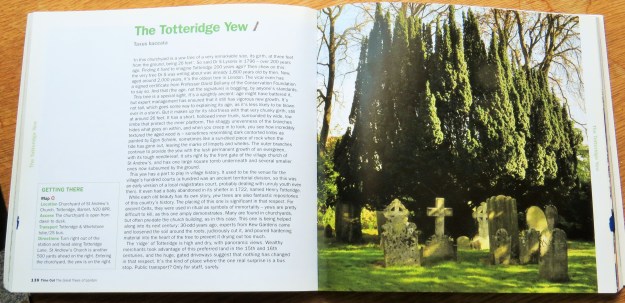
Dear Readers, as the whole purpose of this blog is (ostensibly) to look at wildlife in London, it will come as no surprise that I have amassed a collection of books on urban flora and fauna. Let’s start with The Great Trees of London, which is a small but beautifully-formed guide to the an award which was born out of the terrible storm of 1987. In 1997, the public were asked to nominate London’s ‘Great Trees’. To qualify, they had to be publicly accessible, and have either historical significance or imposing physical stature. If it was in some way a landmark this was also taken into consideration. 41 trees made the cut, followed by another 20 in 2008. One of the many things that I plan to do in retirement is to visit all of them, and I have already featured one or two: the Totteridge Yew was an early subject, as was the Marylebone elm. This is a snappily -written book, and it has the added advantage of fitting into a largish handbag for when one goes exploring (whenever that becomes a possibility). I’m sure that there are champion trees all over the world,  and they are always well worth getting to know.

Next, another little guide that has found me several sites for birdwatching: David Darrell Lambert’s Birdwatching London. I have had this book for ages, but only just noticed what fun the front cover was. That is surely the photo of a lifetime.

I am indebted to this book for not only indicating where things like heronries are, but also for alerting me to the smaller nature reserves such as the Greenwich Peninsula Ecology Park and East India Dock Basin, which I would probably otherwise not have known existed. I can see my retirement becoming even busier with all these sites to visit.

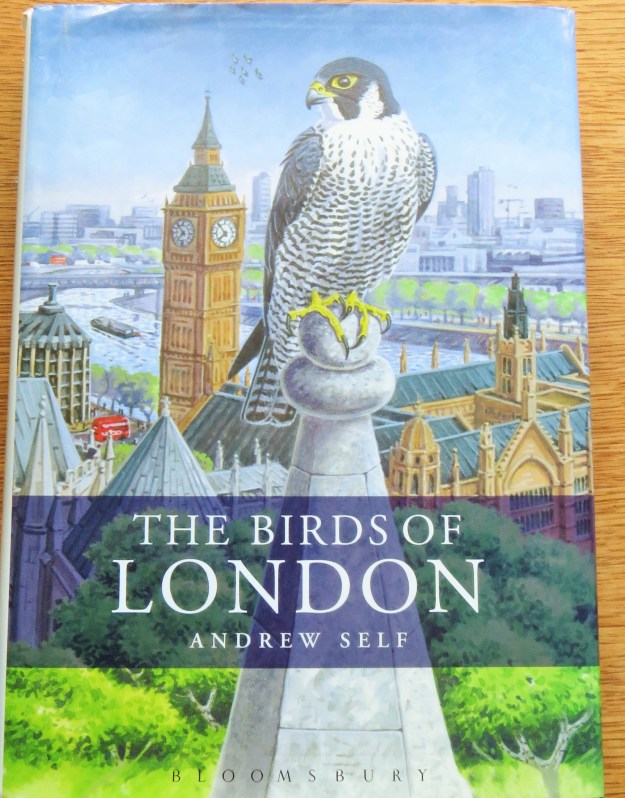
One of my ambitions is to see some little owls (i.e. the species, not some diminutive individuals) and according to my next book, ‘The Birds of London’ by Andrew Self, there are at least 30 pairs in Richmond Park (and several in Regent’s Park and Kensington Gardens). Although this book is definitely for information rather than fun, it can be a fascinating read: it follows each species’ decline and fall over the past few hundred years, and gives an indication of where they can be found today.

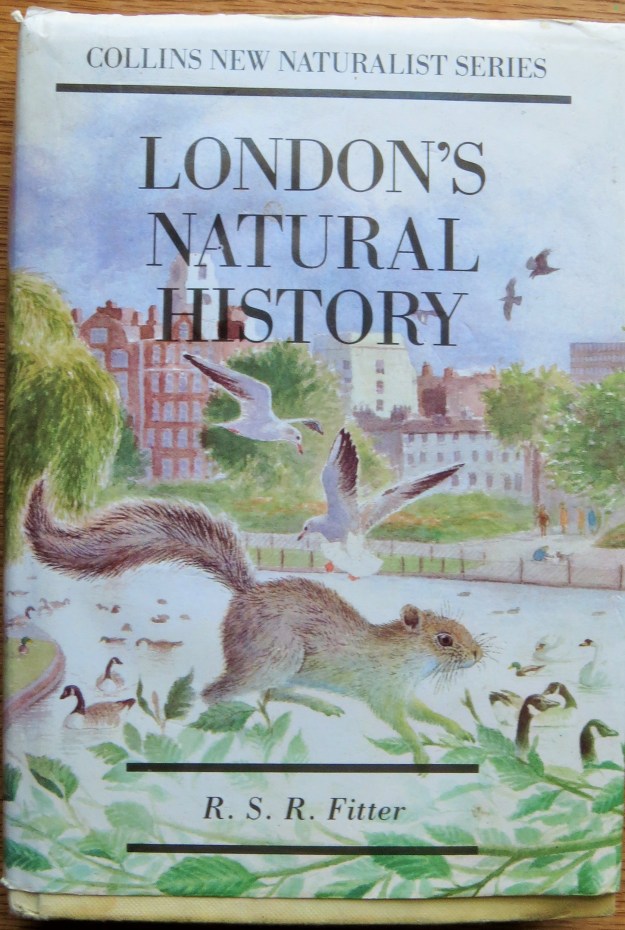
But I have left my favourite till last. ‘London’s Natural History’ by Richard Fitter was first published in 1945, and every page has a fascinating titbit. I learned, for example, that Epping Forest was the last redoubt of the red squirrel in London at the time the book was written, but all was not as it seemed: in 1910 a local landowner bought some live continental red squirrels in Leadenhall Market and released them on his estate. The ‘native’ red squirrels in the forest were found to be from this original stock. Incidentally, Fitter maintains that the grey squirrels moved into a niche vacated by red squirrels following a catastrophic plague of squirrel pox: he suggests that red squirrels always preferred coniferous forest, and that they were forced into deciduous forest by sheer force of numbers.

As you might expect, there is also a lot about London’s bombsites. I found this photo interesting because it is just around the corner from where I now work. Who can imagine prime London real estate laying vacant these days?

Fitter even has a list of the flowering plants and ferns recorded from bombsites: I note that 88% of them had rosebay willowherb as a feature. What a sight it must have been with all those cerise flowers painting the debris! And there are also the absences: not a single mention of rose-ringed parakeets, for example, nor of collared doves, but much talk of the house sparrows in St James’s Park. I also remember the clouds of little birds that would settle on the head and arms of one particular man who used to feed them. How much things change, and how fast! And how precious are the creatures and the plants that remain.

Coltsfoot on a bombsite


A Tale of Two Birds

Sycamore flowers turning into samaras

Dear Readers, every morning since the lockdown began, my husband and I have gone out for a walk before work. Our usual destination is Coldfall Wood, followed by a brisk trot around the Playing Fields. I have written the fields off as a nature destination in previous visits, but goodness there is a lot to see if I pay attention! Having remarked on the beauty of the sycamore flowers, I am now impressed with the way that each blossom is turning into a samara, one of nature’s helicopters. How I used to love playing with them when I was a child, but I had never noticed the way that they emerged from the flowers before.

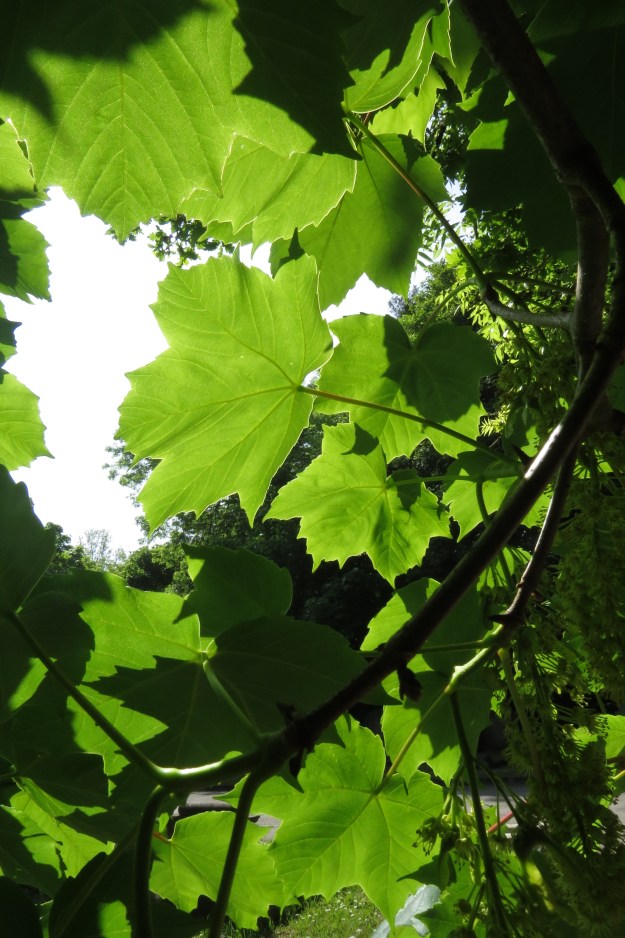
And then there is the sunlight through the leaves. What a delight!

The cow parsley is in full flower and the hogweed is just getting started. I love how the flowers burst through those closed-fists of buds.

Hogweed opening

I love how the umbellifers follow one another, with the cow parsley, then the hogweed, then the wild carrot – there’s something for hoverflies to feed on for months on end.

But one big delight has been the single male blackcap that I’ve heard singing from an ash tree every single morning, except this one when I had my camera. I love these slate-grey birds with their black Beatles-style ‘haircuts’. I’ve had one visit my garden in winter very occasionally, but I’ve never heard one in full song before. Here’s a recording (sadly not by me):

Photo One by Tony Hisgett from Birmingham, UK / CC BY (https://creativecommons.org/licenses/by/2.0)

Male blackcap (Sylvia atripicilla) (Photo One)

As I passed the ash tree I looked up and listened hard, but no luck. And then, twenty metres away, I heard him singing from the depths of a sycamore. Hopefully he’ll be a bit less bashful tomorrow.

The Japanese knotweed has grown into an impassable thicket, and my favourite dock is now almost up to my shoulder.

There has been some excitement on the Playing Fields this week because, after many, many months of waiting, the council are coming to try do something about the quagmire that appears at the entrance every year. The wood and the fields have had drainage problems for as long as I’ve been visiting: there are a number of streams and rivulets that water the woods, the fields and the cemetery, sometimes with rather too much enthusiasm. However, today there is a van, and an earth-mover, and the start of what could be a very fine hole, so fingers crossed that it all works.

And then I’m at home, and sitting at my desk, listening to a conference call, when something catches my eye. Look at this little beauty sitting on the buddleia outside.

Goldfinch

A pair of them have been sitting just outside my window for most of the day, flitting in and out and apparently munching up all the aphids. They have been singing and preening one another, and have been most excellent companions, even when I had four hours of User Acceptance Testing for a new system and thought that I would lose the will to live. It’s always a treat when nature comes to you, rather than you having to go out and find it.

Wednesday Weed – Ragged Robin

Ragged robin (Silene flos-cuculi)

Dear Readers, the overgrown patch at the side of Muswell Hill Playing Fields continues to be an unexpected source of interesting ‘weeds’ – in amongst the red campion and the comfrey, I spotted some ragged robin, a plant that I have been wanting to write about for about five years. What a strange, exotic flower it has! Looked at closely, each petal  is divided into four lobes: which gives the flower the appearance of a group of small pink men with very long legs joining hands for ‘Ring-a-ring-of-roses’.

Photo One from CC BY-SA 3.0, https://commons.wikimedia.org/w/index.php?curid=557700

Ragged Robin (Photo One)

Ragged robin is often described as a bog plant, and I suspect that this one is doing so well because under all the plant life there is a drainage ditch. It is a member of the Caryophyllaceae family, otherwise known as the campions and chickweeds. The family also includes carnations and the Antarctic pearlwort, which is one of only two flowering plants that survive in Antarctica. This latter plant hunkers close to the ground to avoid the freezing winds, and produces these tiny yellow flowers – it reminds me of the moss campion that I often see in the Alps, where the climate can be almost as inhospitable.

Photo Two by By Liam Quinn - Flickr: Antarctic Pearlwort, CC BY-SA 2.0, https://commons.wikimedia.org/w/index.php?curid=15525940

Antarctic Pearlwort (Colobanthus_quitensis)(Photo Two)

But, as usual, I digress.

The plant is dedicated to St Barnabas, whose feast day is 11th June. The pink flowers would have been seen amongst the hay which would have had its first cut at around this time (the Latin name ‘flos-cuculi’ means ‘cuckoo call’, which is also a reference to the time of flowering. . St Barnabas is the saint who is said to protect against hailstorms, which would have been devastating during haymaking season. Regular readers will know that practically every wild plant that I write about has some kind of dire warning concerning what will happen if the flower is brought indoors attached to it. Ragged robin is said to cause thunderstorms if picked, which connects rather nicely with the St Barnabas/hailstorms link. How anxiously our ancestors, without the benefit of fairly accurate short-term weather forecasts, must have watched for signs of incoming tempests that would ruin their hay harvest!

The name ‘robin’ was often associated with evil and mischievous goblins, which would have been another reason to leave the plant alone. On the other hand, all bets are off when it comes to romance, as if a gentleman placed a ragged robin in his pocket and it survived, it indicated that he would be lucky in love. What ‘survived’ looks like is anybody’s guess, as this looks like a rather delicate plant to me.

In the Victorian language of flowers, the plant is said to signify ‘ardour, aversion and wit’, which sounds like quite a tricky combination to pull off, even if you have a couple of wilted ragged robins stashed about your person.

In Shakespeare’s time ragged robin (which sounds like a very Shakespearian name) was actually known as crowflower, and as such it appears in Gertrude’s speech describing Ophelia’s suicide:

There is a willow grows aslant a brook
That shows his hoar leaves in the glassy stream.
There with fantastic garlands did she come
Of crowflowers, nettles, daisies, and long purples,
That liberal shepherds give a grosser name,
But our cold maids do “dead men’s fingers” call them.


Medicinally, ragged robin has been used to treat snakebite and in infusion as a treatment for wounds. It has also been used to alleviate migraine in some countries in the Mediterranean. Like all campions, ragged robin contains chemicals called saponins in its roots, which have been used to make soap in the past – one closely-related species (Saponaria officinalis) is known as ‘soapwort’. As a result of all those soapy chemicals, it has no culinary uses that I’ve been able to find, although one site did enigmatically refer to the root as ‘tasting like wasabi’.

Ragged robin is a good plant for pollinators, in particular long-tongued bees such as the garden bumblebee (Bombus hortorum) which can reach right into the depths of the flower. In the photo below, I was initially stumped – is that a hoverfly with a bumblebee’s backside? I think there might actually be two insects – a hoverfly at the front, and a bumblebee feeding behind. Either way, it proves that this is a great plant for insects.

Photo Three by Clint Bud from https://www.flickr.com/photos/58827557@N06/42034065484

Insects on ragged robin (Photo Three)

Now, here’s something that I found very interesting, and it harks back to my earlier mention of the Victorian language of flowers. In her book ‘Women Poets in the Victorian Era‘, Dr Fabienne Moine refers to a poem called ‘The Flower Girl’ by one Mrs Cobbold. In it, the flower girl of the title offers flowers to the passing gents, summing them up with a quick glance in much the same way that merchants in street markets from Kiev to Marrakesh are able to tell what language to use when approaching their potential customers simply by looking at their clothes and body language.

I have always thought of the language of flowers as being a rather languid and prissy way to think about plants, but this poem has some real bite to it – there is ‘ardour, aversion and wit’ in it. And I love that it has been written from the point of view of a feisty young woman, who obviously brooks no nonsense. The poem has been seen as a possible inspiration for Christina Rossetti’s ‘Goblin Market’, but I think it stands very nicely on its own.

The Flower Girl by Mrs Cobbold (circa 1813)

Come buy, come buy my mystic flowers

All ranged with due consideration

And cull’d in Fancy’s fairy bowers

To suit each age and every station.


For those who late in life would tarry 

I’ve snowdrops, Winter’s children cold;

And those who seek for wealth to marry

May buy the flaunting marigold.


I’ve ragwort, ragged-robins too,

Cheap flowers for those of low condition;

For bachelors I’ve buttons blue 

And crown imperials for ambition. 


For sportsmen keen who range the lea

I’ve pheasant’s eye and sprigs of heather;

For courtiers with the supple knee 

I’ve climbing plants and prince’s feather. 


For tall thin fobs I keep the rush;

For pedants still am nightshade weeding;

For rakes I’ve devil in the bush;

For sighing Stephens, love-lies-bleeding. 


But fairest blooms affection’s hand

For constancy and worth disposes

And gladly weaves at your command

A wreath of amaranth and roses. 

The Flower Girl (1913) Eugene de Blaas (Public Domain)

Photo Credits

Photo One from CC BY-SA 3.0, https://commons.wikimedia.org/w/index.php?curid=557700

Photo Two by By Liam Quinn – Flickr: Antarctic Pearlwort, CC BY-SA 2.0, https://commons.wikimedia.org/w/index.php?curid=15525940

Photo Three by Clint Bud from https://www.flickr.com/photos/58827557@N06/42034065484