Category Archives: London Birds

A Damp Walk in St Pancras and Islington Cemetery

Dear Readers, we didn’t walk in the cemetery last week because there the rain was blowing horizontally across the garden, but I couldn’t wait to get there this week. A fortnight is a long time when it’s spring, and already most of the dandelions are shedding their seeds. Those ‘dandelion clocks’ really are entrancing, especially if you look closely. I love the way that the seeds detach one at a time and head off to find somewhere to put down their roots…

When all the seeds are gone, I love the spirals of little holes where they were once attached. And I’d never noticed how the ‘parachutes’ of the seeds are angled backwards, maybe so that the plant can produce more seeds per seedhead?

But it was to be a day of floral and avian wonders. A magpie decided to have a bath in a muddy puddle, as one does.

There were germander speedwells….

An ocean of cow parsley…..

Lots of red campion….

Cowslips…..

English bluebells…

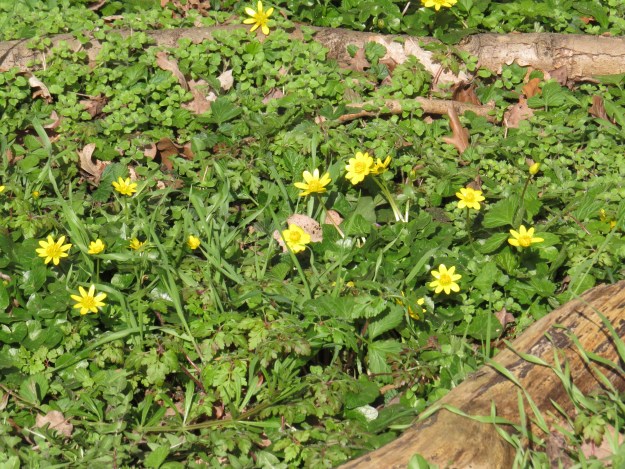
And the buttercups have taken over from the lesser celandine in the yellow flower competition.

The flowers on the horse chestnut are pretty much full grown now and how enticing they look!

Even the grasses have gone berserk. That combination of lots of rain and longer day length has really kicked everything off.

We walk along the narrow path that connects two parts of the cemetery, and the cow parsley has sprung up to waist high.

But then there’s one of those moments that make the cemetery so special. I hear a familiar yaffling call, and there, posing on a headstone, is a green woodpecker.

These birds always remind me a bit of tiny dragons. There is a close-mown area nearby where they often search for ants, pounding away into the earth with their beaks. Unlike the great-spotted woodpecker, they don’t drum on dead trees to establish territory. This one was exceptionally obliging. This one is a female – the ‘moustache’ at the side of the face is all black in females, but has a red stripe in males. I found this description a bit confusing as I associate a moustache as being in the middle of the face, but for ornithologists it’s more of the ‘muttonchop’ variety.


Anyhow, this was a real delight, and well worth getting damp for. I normally hear the green woodpeckers, but they rarely stand still long enough for a photo. The wet weather has kept most of the visitors away, which makes the birds bolder.

Next, it was a wander along the road which is right next to the North Circular. The traffic noise is so loud here that it’s hard to make yourself heard, but the flowers are worth it. The ragwort is in full flower…

Last year’s salsify is in flower again….

And how about this lovely tangle of vetch? Some of my favourite plants are in the pea family.

One of the pleasures of a walk like this is seeing familiar plants, but noticing something new about them. Last year I was crunching through acorns as I passed these trees, but today I saw that they were in flower. I’d never even thought about oak trees having flowers (doh). The catkins are the male flowers, and there are tiny female flowers that look like buds amongst the leaves.

The comfrey is in flower, and the bumblebees are delighted. Along by the stream there is creeping comfrey and the larger common comfrey.

Common comfrey


And for some reason, in the middle of all this wildness there is a Japanese acer, just about holding its own.

There is bugle and great stitchwort….

Bugle

Greater stitchwort

Cuckoo flower and shining cranesbill…

Cuckoo flower

And a great big patch of three-cornered garlic, with its triangular stem. I can’t resist having a little nibble as we march on through the woody bits of the cemetery. Overhead a buzzard is mewing and suddenly appears above us, pursued by a huge flock of crows – I count at least thirty, and more are joining from all directions. A sparrowhawk flies over, fast and low, and goes unmolested. The crows take such glee in the mobbing that you’d almost think they enjoyed it. I wonder if it’s one of those visceral reactions to anything that looks like a bird of prey? I always wonder this, and I still have no answers. And neither does the lovely Scotsman statue, standing in the spring woods with the bluebells dying back and the greenery rising all around him.


First Fledglings…

Dear Readers, I had my second vaccination yesterday (Astra Zeneca, bit of a sore arm but so far none of the flu symptoms that sent me to bed last time). As I walked back to the house, I heard a familiar wheezing sound and there, on the handrail, was the first of this year’s starlings. What a fluffy little dude s/he is! And how completely lacking in any sense of danger. As I’ve noted before, the starlings that survive are the ones that pretty quickly pick up on the alarm calls and the behaviour of the birds around them (and not just their own species either – I’m pretty sure that the alarm calls of robins and blue tits put them on high alert too).

The adult starlings seem to be able to identify whose chick is whose, but the chicks will beg from any passing adult. Who could resist them? They couldn’t be any more plaintive. Anyone would think that they hadn’t eaten for weeks. Just as well I’m well stocked up with live mealworms and suet pellets.

By the time they’ve finished I’ll have to take the wire wool to the hand rails again – the fledglings love to perch here, and to run along it like some toddler on a low wall, and to basically crap everywhere. It won’t take them long to begin pecking at things themselves – last year I was astonished at how quickly they learned to get the pellets out of the suet feeder, which requires a fair measure of dexterity.


This will be the tenth generation of starlings that I’ve fed in the garden. The Breeding Bird Survey shows a decline of 63% in London from 1995-2018, and places where they used to gather in their thousands (such as Leicester Square and St James’s Park) seem to be bereft of them these days. I remember watching a murmuration in St James’s Park with Mum back in the ’80s, when great flocks of the birds reeled and turned over the islands in the middle of the lake, before settling down to roost. You can still see birds in the low thousands at places like Rainham Marshes, Walthamstow Wetlands and Beddington Farmlands, but ‘proper’ murmurations seem to be rarer and rarer. And so, every noisy, messy youngster is precious, especially as they are taken in huge numbers by cats and corvids, and as they are forever getting tangled in things and drowning themselves.

This spring has been cold compared to last year, so I suspect the amount of insect prey is lower – no self-respecting caterpillar is going to hatch while there is still frost on the ground. What will happen to our bird life as the seasons, so delicately tuned, start to become more unpredictable? In towns and cities, feeding softens the blow, and because these places are warmer than the surrounding countryside the effect might not be felt quite so severely. And soon there will be hawthorn berries, and it looks like a good year for the fruit on the rowan and the whitebeam. There are things that we can do to help our besieged wildlife, and the sight of the fledglings always gives me hope.


A May Walk in Highgate Wood and Queen’s Wood

Sunlight through hornbeam leaves

Dear Readers, sometimes when I walk through one of North London’s ancient woodlands, I am reminded of how much I have learned through writing the blog over this last 7 years. Although there is still so much to find out, it makes me happy that I can look at the muscular trunk of a hornbeam and identify it, and that I can imagine it as a younger sapling, a mass of twigs that were probably cut back once or twice when the tree was a baby, before coppicing was abandoned and the tree was left to grow.

The tree above has five distinct trunks growing from the same ‘stool’ – they interweave with one another in a kind of slow-motion dance as they reach towards the light. I love the silvery bark of hornbeam, and the way that it is covered in a web of ‘veins’ and ‘sinews’ like a weight-lifter’s arms.

There is so much to notice, and yet so often we don’t, absorbed in our thoughts or in our phones.

And here’s a horse-chestnut seedling, optimistically growing in a patch of sunlight.

Last time we walked in these woods it was Boxing Day, we were ankle-deep in mud, and there were hundreds if not thousands of people on the paths. But today it’s a weekday, the children are back at school, most folk are at work and it feels as if the woods are breathing again.

There is a new dead-hedge around the little pond, though whether this will keep an enthusiastic golden retriever out of the water remains to be seen.

A pair of great tits have made their nest in this dead tree stump, a great advert for leaving dead wood where it is.

The coppiced areas in the middle of the wood really show off the oaks as they reach for the sky.

But hang on, who is that on the path? My keen-eyed husband spots a creature just past the ‘cross walk’ in the picture.

There are rats in all of the woodlands that I’ve visited this year. There are always a few around, but with more people also in the woods they’ve been noticed a bit more. In Cherry Tree the council have put down poison, so there are now dead rats. Let’s hope that they don’t become food for foxes, dogs, cats, crows, buzzards, magpies, owls etc etc.

Rat populations (like pigeon populations) are almost entirely governed by availability of food. There has been a huge increase in littering in wild places and parks all over the country, with people seeming incapable of taking their rubbish home. Lots of creatures have taken advantage. Plus there is a kind of hysteria about rats. We have become so detached from wildlife that some people seem to feel that if their toddler sees a rat they will keel over with Weil’s disease. I understand that you wouldn’t necessarily want to share your house with wild rats, but in a woodland?

Someone recently posted a short film on our local community Facebook page of an elderly rat being harassed by crows, so let’s not forget that in the natural world these rodents are way down the food chain. However, this crow was rather more interested in something in the stream.

I wonder if the crow is looking for invertebrates in the mud at the bottom of the rivulet? They are such intelligent animals generally, but all members of the crow family seem to be super-attuned to possible food. You can almost see them working out what’s what.

There is a little drift of wood anemones here too, an indicator of ancient woodland because they don’t travel very far over the generations. They are partially protected by the fence, which is probably why they’ve survived the huge growth in footfall in the woods during the lockdown.

And then, there is a patch of hybrid bluebells in the sun, close to where the boundary of the wood meets the local housing. Sometimes people throw their garden rubbish over the fence in these situations, which is why there is often such diverse non-native flora in these places. The evidence seems to show that in a ‘real’ bluebell wood, hybrids can’t outcompete the native bluebells, though they may still make incursions at the edge where there is normally more light. At any rate, these are pretty and have some value to pollinators clearly. In an urban wood such as this I suspect any increase in biodiversity isn’t to be sniffed at.

Nest Box Blues

My sparrow nest box from the RSPB

Dear Readers, when we had the external decorations done last year, I persuaded one of the chaps to climb up a ladder and put up the sparrow nest box that I’d been lovingly hoarding for several years. At this point, several sparrows were visiting every day, and I hoped to persuade them to linger – after all, they are a red list species and so any help that I can give them is a pleasure. I had noted, however, that the local sparrows (and the ones in Mum and Dad’s old garden) seemed to prefer thick beech hedges and holly trees to anywhere else. Communal breeders that they are, I suspect that they also need to have a big enough flock to feel safe. Nevertheless I persisted. We put the nest box in among the branches of the climbing hydrangea – by spring there should be cover. We positioned it pointing west so the babies wouldn’t overheat.

And then nothing happened for a whole year. Furthermore, I haven’t seem a house sparrow in the whole of lockdown.

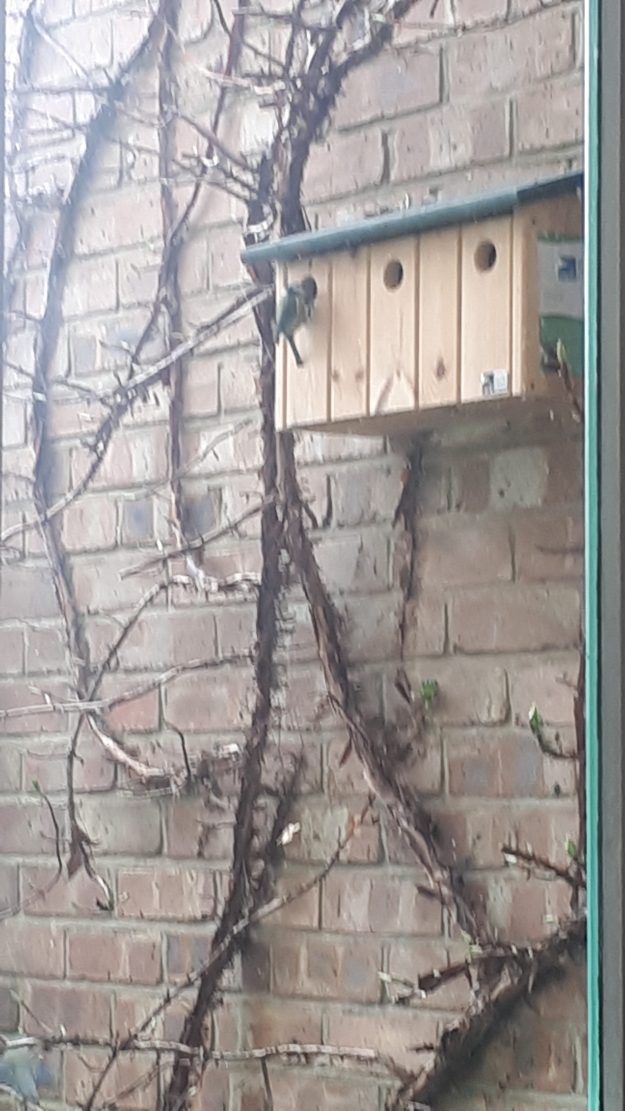
However, several other birds have been to visit. A pair of coal tits popped in and found this des res unappealing. Some blue tits did the same, and then returned to their old nest box, under the eaves of the house next door. Apologies for the photo, it was taken after two cups of coffee and via a dusty pane of glass.

Now, I believe that birds prefer nest boxes where the holes are a snug fit, so this was never going to be a good choice for the smaller tits. However, in the past few days a pair of great tits have been showing much more interest, popping in and out and calling to one another. I have no idea if they will stay, but they’ve made me drop my croissant on several occasions.

So, readers, what are your experiences with nest boxes? I suspect that birds will always prefer a cozy nook in a tree or in a dense tangle of brambles, but if you’ve had any success with birds nesting in your garden, do let me know. I need all the encouragement I can get.

Celandine Time in St Pancras and Islington Cemetery

Lesser celandine (Ficaria verna)

Dear Readers, I think we’ve reached the height of Lesser Celandine season here in the cemetery – every path is ankle-deep in those shiny yellow flowers with their heart-shaped leaves. I love the polished look of the petals, so different from the waxy petals of the daffodils.

It seems difficult to imagine that in a few weeks they’ll be gone, the leaves dying back until next year. I note from my Harrap’s Wild Flowers that there are two sub-species of Lesser Celandine, one which is fertile (Ficaria verna ssp fertilis) and has petals that are 10-20mm long, and one which reproduces from bulbils (Ficaria verna ssp verna) which has flowers 6-11mm long. I shall have to take my ruler next time I visit, but my hunch would be that these are the latter – plants that reproduce by bulbils are often seen as indicators of ancient woodland because they can’t travel quickly from one place to another. The cemetery has only been around since 1854, but previously the land belonged to Finchley Common, so the area has a long history. At any rate, it’s difficult not to feel the spirits lift at the sight of all these little golden flowers.

Lesser celandine is not the only plant that’s in flower at the moment, though – the violets are just starting to emerge. I found this lovely patch of sweet violet close to a fence – the flowers are very pale and I didn’t get any scent, but the rounded sepals (the ‘covers’ for the bud) give the game away.

Sweet violet (Viola odorata)

I was very struck by the red flowers on the Lawson cypress as well – I had never noticed them before, but this year they are very bright, almost like drops of blood, or like some stripy beetle.

The ground ivy is in flower, too – a member of the deadnettle family, the flowers always remind me of little dolls.

The blossom is going over, particularly on my favourite cherry plum where the coppery leaves are just coming through.

Lots of daffodils are still out, and although as you know I have mixed feelings about them, they are very striking when backlit by the sun.

And here are the sticky buds of the horse chestnut getting ready to burst. Soon there will be the candelabras of creamy, sweet-scented flowers, but for now it’s the first intimation of spring.

As we walk through the cemetery I hear the mewing of a buzzard, and for once it isn’t being mobbed by crows. We watch it catching a thermal (no mean feat on this blustery, chilly day), and it continues to call until another buzzard appears. They can travel a long, long way at speed just by riding the wind. Are they nesting somewhere in the cemetery? It wouldn’t surprise me, but I haven’t found the site yet. If they are, I’m sure it will be hidden away in one of the most difficult-to-access parts of the forest, but how exciting it would be!

And finally, here is another little patch of violets. These are a ‘proper’ violet colour, but it’s difficult to make out the sepals. However, those perfect heart-shaped leaves make me think it’s dog violet (Viola riviniana), so-called because it doesn’t have any scent, and ‘dog’ is often used as an epithet for something commonplace and uninteresting. Try telling that to any dog (or dog owner) though.


An Early Spring Walk in St Pancras and Islington Cemetery

Dear Readers, it really feels as if spring is gathering apace this week. From a few tentative flowers opening gently on the crab apples and cherry trees, there is now an abundance of fluffy blossom.

The chapel looks spick and span after its long renovation, although these days it only houses the (much-appreciated) toilets rather than holding any services.

The tree on the corner of the woodland burial area is looking very fine as well.

The primroses are emerging under the cedars of Lebanon.

And the daffodils are everywhere. I feel a bit of a Scrooge for saying it, but I am generally not a great fan of those big butter-coloured daffodils, though they are cheerful enough, I suppose. I like the paler, creamier ones that look more like the vanishingly-rare wild daffodils of Wales, and I have a fondness for the little miniature ones as well. And I’m fond of what I think of as ‘proper’ narcissi, like the pheasant’s eye ones with a small, red-rimmed trumpet. Paperwhites have their place, though Mum used to find their scent overpowering in a small space, and I must admit that they can make me feel slightly nauseous too. I’m becoming so fussy! Or is it just that I’m noticing my preferences more?

Little daffodils (Tete-a-tete I think?)

On a few of the sunnier graves there is a cheery outburst of red deadnettle.

And of course there are always daisies. I think you could find some in flower in the cemetery on every single day of the year. They always seem so modest and so hard-working to me.

There are some unexpected visitors resting next to the stream. I love the way that ducks appear to be asleep but always have one eye open to make sure that you aren’t up to any mischief.

A lady stopped her car to say she’d been seeing the ‘birds’ for a few days, but wasn’t sure what they were. Unfortunately she asked my husband, who, momentarily flustered,  could only say that they were ‘ducks’. I have more work to do, clearly, though if she’d asked me she’d probably still be sitting in her car listening to me pronouncing forth on the wildfowl of London, so she had a lucky escape.

More spring flowers are emerging: there are the first grape hyacinths

and some Loddon lilies, which seem to be a cemetery speciality. I’m sure all of them are planted rather than wild, but they are naturalising in some areas. At first glance you might think that they are just giant snowdrops, but the shape of the flowers is quite distinct.

A rose-ringed parakeet posed very nicely for the camera, unlike the two that were briefly on the suet feeder in the garden this morning. Whenever I see them I think of the one that visited the garden the day after Dad died. It’s funny how superstitious death can make a person: I almost believed that Dad had popped back to cheer me up, and with the two this morning I automatically thought of Mum and Dad together again. Of course, I don’t really believe that they have somehow been reincarnated as parakeets, but part of me wishes it were true. What complicated beings we are as we wrestle with the big, unsolvable questions of life. Or maybe it’s just me.

And as we head into my very favourite part of the cemetery, the overgrown, unpeopled area around Kew Road and Withington Road, I am struck yet again by the beauty of a blossom tree.

The early crocuses are almost over now, how glad I am that I caught them in their full glory! They rather look as if an elephant has trodden on them now.

On the other hand, the Dutch crocuses are just coming out.

And while the snowdrops in the sunny areas emerged first and are now dying back…

…the ones in the shady areas are still in full flower.

And, let me share a little story with you that made me gasp. One of the Facebook groups that I belong to is about plant identification. A person posted that they had been reading about sorrel (the lemony-leaved member of the dock family), and so when they saw the plant below they decided to forage some and eat it.

And of course, it’s cuckoo-pint/lords and ladies, and is poisonous. How you could mistake one for the other astounds me, but then it’s often difficult to judge scale and size from a photo, and I suppose that the leaves are a similar shape if you squint. Fortunately, the poison in cuckoo-pint expresses itself by making the lips tingle and the tongue swell up, plus it tastes extremely unpleasant, so you aren’t likely to eat a lot of it. But even so, this was a close escape. I guess it’s exactly how our ancestors learned, and the ones who didn’t learn ended up deaded, as my Dad would have said.

Cuckoopint (Arum maculatum)

I heard the buzzard but didn’t see it. It’s very frustrating – I have a feeling that there’s a nest in the cemetery somewhere, and it must be pretty big, but I can’t find it. Anyhow, instead I saw a pair of crows harassing the kestrel, poor thing. It’s very difficult to make out from my most excellent photo (ahem) but it’s the bird in the middle. Kestrels don’t take nestlings or eggs, but I guess the crows aren’t taking any chances.

I saw one of the feral cats looking very sleek and well-fed – the lady who used to travel all the way from Camden to feed them and the foxes and the birds every day manages to get in at the weekend now when she can get a lift, but I suspect that other people are doing their bit to make sure that the animals don’t go hungry. I caught a quick glimpse of a fox too, but not for long enough to see if it was the poor vixen who’d had an accident that I saw last time.

And in other news,  I had my first Covid vaccination on Wednesday (the Astra Zeneca one), and although I felt pretty rubbish for about 24 hours it really does feel now as if there is a glimmer of  hope for some return to a new ‘normal’. I am so grateful to the NHS and all the people who are volunteering to help with the programme, and to the scientists who have managed to perform this miracle. I just hope now that we find a way to distribute the vaccine more equitably than we currently are, because in this situation it really is true that none of us are safe until we’re all safe. As I have done right through lockdown I am counting my blessings fervently and hoping for a decent pay rise for NHS staff (rather than the derisory 1% currently on offer), for more recognition for our care home staff, for a complete review of the care system, for support and recognition for our teachers and for all the workers who continued to staff our essential shops and transport systems, who collected our waste and delivered our post. If nothing else, this last year should have taught us who really is essential, and who really does deserve to be rewarded.


Tense Times for Coldfall Wood

Sunrise in Coldfall Wood December 2020

Dear Readers, you might think that the trees that form part of an ancient woodland nature reserve would be safe from being cut down,  except when it’s essential for the management of the area. Sadly, as I have learned, you would be wrong. Trees are often felled in urban areas because they are blamed for damage to nearby housing, even when the houses are built  after the trees are fully grown, and even when such housing is extended right up to the treeline.

Those of you who have been following this blog for a while will know how passionately I care about the few small areas of ancient woodland that remain in North London, in particular Coldfall Wood. At only 14 hectares it provides a home for 26 species of breeding birds (including the lesser spotted woodpecker and song thrush, both Red List species),  2 species of bat, 106 species of beetle (including three Nationally Notable species), 56 species of spiders and 3 species of pseudoscorpion.

Song Thrush (Turdus philomelos) singing in Coldfall Wood

Black and Yellow Longhorn Beetle (Rutpela maculata) in Coldfall Wood

Two nuthatches – Coldfall Wood

Stock Dove (Coldfall Wood)

Treecreeper (Coldfall Wood)

One of the species recorded is the very rare Lesser Glow Worm (Phosphaenus hemipterus).

Photo One By Urs Rindlisbacher - Majka GC, MacIvor JS (2009) The European lesser glow worm, Phosphaenus hemipterus (Goeze), in North America (Coleoptera, Lampyridae). ZooKeys 29: 35–47. doi:10.3897/zookeys.29.279, CC BY 3.0, https://commons.wikimedia.org/w/index.php?curid=8770508

Lesser glow worm (Phosphaenus hemipterus) (Photo One)

However, being a rare ecosystem brings limited protection when insurance companies become involved. A local householder has been having subsidence problems with an extension that was built ten years ago. A number of two-hundred year-old oaks have already been destroyed without the knowledge of the local Friends group, whose role is to liaise with the council and to protect the wood. The plan was to fell a further seven trees on 1st March, even though the loss of the other trees hasn’t improved the situation. Fortunately we were able to get the felling postponed, but the trees still aren’t safe.

Coldfall Wood August 2020

Speckled Wood butterfly

Our local Council, Haringey, is under pressure from the insurance company (AXA) to fell the trees – the council can be found to be negligent if it doesn’t act, and can be forced to pay for any works deemed necessary. However, there are lots of reasons other than trees that can cause subsidence to occur, including the soil composition, the geography of the area and the adequacy of the foundations of the building,  and none of them have been explored. Our question is this: if cutting down a number of mature oak and hornbeam trees didn’t solve the subsidence problem, how will removing further trees help? Where does it end?

Water mint (Mentha aquatica) next to the seasonal pond, Coldfall Wood August 2020

There is a meeting on 5th March at the council to discuss a strategic approach to the problem, and we hope that this will at least allow for further research into the causes of the subsidence. However, we also have a petition asking for the felling to be stopped,  which has over 50,000 signatures already (link below). We are angry that trees and the habitat that they represent are considered so expendable at a time when councils, corporations and our national government all claim to be working to alleviate climate change. There is so much talk about protecting the environment, and yet greenspaces have never been under so much pressure. While we want to work constructively with the council and with the insurers, we have no intention of allowing the destruction of these trees.

The by-line for this blog has always been ‘ Because a community is more than just people’. That community includes the trees that provide much of the oxygen that we breathe, that shade us in the summer and that provide a home for hundreds of other species. If we don’t act now to give them the protection that they deserve, then when? 

The link to the petition is here. Please feel free to sign and share. I shall let you know how we get on.

Coldfall Wood 7.30 p.m. August 4th 2020

Photo Credits

Photo One By Urs Rindlisbacher – Majka GC, MacIvor JS (2009) The European lesser glow worm, Phosphaenus hemipterus (Goeze), in North America (Coleoptera, Lampyridae). ZooKeys 29: 35–47. doi:10.3897/zookeys.29.279, CC BY 3.0, https://commons.wikimedia.org/w/index.php?curid=8770508

All other photos by the author

Goings on in the Garden

Dear Readers, every day this week I have been woken up by the sound of cackling. Magpies rarely land in the garden – it’s a little bit too small for them to comfortably take-off, big inflexible lummoxes that they are – and so they usually settle for a quick smash and grab on the bird table.  However, I have been throwing out some live mealworms on the ground for the robins, and they often hide under the mulch (I like to give the poor things a sporting chance).

These two are adults, but quite young I think, and I suspect that they’re nesting somewhere close by. I’m not absolutely delighted by this, as I know they can take nestlings and eggs, but nature is it what it is. And they are superb birds to look at, with their iridescent tails and wings. And they are so intelligent. I’m not surprised that they’ve realised that there are easy pickings at Casa Bugwoman.

The photos were all taken through my kitchen window which hasn’t had a proper clean for a while because there are False Widow Spiders living in the window frame. Apologies for the slight fuzziness, but our eight-legged friends must come first, you know.

I also noticed the magpie giving the pond what my mother would have called ‘an old-fashioned look’ – the frogs are just getting going, and if they stray too close to the edge I suspect they’ll get exploratory stab. On the subject of which…..

Lovely Readers, I have a question for you. What could I plant around the edge of the pond that would provide some cover for frogs who are coming and going from the pond at this time of year? In a month or so it will be packed with greenery (and it’s fine for when the little frogs leave) but any amphibians arriving or leaving at this time of year have to run a pretty bare gauntlet. Ideally I’d like something that is wildlife friendly in other ways too, and which has lots of greenery by February. All suggestions eagerly considered!

Anyhow, it isn’t just the magpies who are enjoying the garden. There was a robin belting out his challenge as the sun slowly faded yesterday. I love the long shadows and the golden light at this time of year.

And here’s a great tit…

And how about the blue tits?  A pair of them checked out my sparrow nesting boxes again yesterday, but I’m sure the entrance is too large for them.

So the pace of life is really hotting up. I’m glad I’ve got suet pellets under the stairs and worms in the shed, because everything is just about to kick off. Looks like maybe, just maybe, we got through winter.

A Sunday Walk in Coldfall Wood

Dear Readers, as if by a miracle the temperature has gone up a tad, the mud has (probably temporarily) abated in Coldfall Wood and on Muswell Hill Playing Fields, and so it was a good day to get some air. The woods have been more heavily used this year because of lockdown, and I don’t think I’ve ever seen the understorey quite so bare. The leaf cover makes it difficult for smaller plants to survive in the uncoppiced areas, but because of the need to socially distance, many new paths have been carved through the trees. Still, some plants are still popping up, like this Italian Cuckoo Pint (Arum italicum), poking out from below the holly.

We head out to the fields for the first time in ages – it was such a mud bath for a few months that we decided to give it a miss. But today it’s full of people walking their dogs and playing with their children. It’s been such a hard time for everyone, in so many different ways.

On the way round, I spot the crossbar from at least three football goals. I wonder if people swing on them and they collapse?

The pyracantha berries on the big hedge look to be well-nibbled, and I wonder if it’s the redwings.

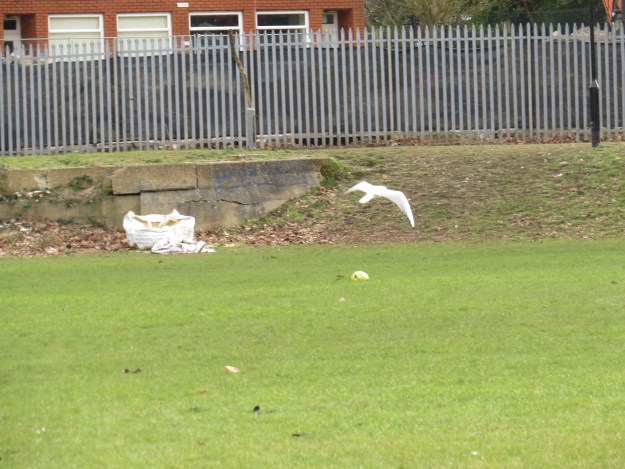
There is a small group of black-headed gulls – the ‘black’ mark behind the ear of this one is gradually getting bigger. Soon it will have a fine chocolate-brown hood, and summer will be here, and this gull will probably be much further north. Over two million black-headed gulls overwinter in the south of the UK, so they aren’t rare, but they are elegant, and noisy!

I have a look at ‘my’ wildflower border. Not much to tell at this time of year, except for some impressive burrs and the new leaves of the lambs-ear.

Oh, and the fennel seedheads.

I almost walk past the Japanese knotweed, though I do like the mixture of browns and tans that the dead stalks make at this time of year.

But then I spot this.

I thought that it was some kind of man-made object, but when I waded through the stems to get a closer look, I was fairly convinced that it is in fact a bird’s nest. It’s attached to the stalks by a filigree of plant stems. What bird made it I’m unsure, let me know if you have any thoughts. I did wonder about long-tailed tits, but then they tend to be mossy rather than grassy. At any rate, it proves that Japanese knotweed is at least good for something – I doubt that anything could have reached the nestlings while the plant was in full leaf. And what fun to find a nest! Considering how many birds nest every year, they do a fine job of keeping the locations pretty secret.


Storm Darcy Arrives in East Finchley

Dear Readers, well I’m not having to shovel my way out of the front door, but we do have snow this morning, and so it’s on with the walking boots and woolly hat, and out into the garden to make sure there’s food and water for the birds. A blackbird was pecking over the bird table before it was even light, so the critters are definitely hungry. Sure enough, the robin was down pecking at the mealworms before I’d even left the garden. And then the starlings arrived.


And the chaffinches.

I’ve noticed before how more tolerant birds are of one another in the winter, but even I was surprised when this little gathering on the bird table didn’t end up with ‘pistols at dawn’.

It doesn’t take much to spook them though.

And it turns out that one of the starlings has ‘cracked’ the nut butter feeder. I’ve seen coal tits feeding on the other one (which is hidden away next to the bittersweet) so at least somebody likes them.

But the height of the excitement was spotting a female blackcap working over the bittersweet. At least I’m thinking that it’s a female – juveniles look similar. Some folk have found that these birds are aggressive at the bird table, but this one couldn’t be more reclusive. I love that she’s eating the berries – at one point she hung upside down on a twig to get one. I hung a roosting pouch in the hedge so I wonder if she’s using it?

And it’s still snowing, though just wispy little flakes. The temperature isn’t expected to get above 30 degrees Fahrenheit for the rest of the week, so I’m glad that I stocked up on birdfood. And who knows, maybe we’ll get lucky and see a fox like we did last time.