Category Archives: London Invertebrates

A Bit More on the Thick-Legged Flower Beetle

Dear Readers, I was so entranced by these beetles yesterday that I thought I’d seek out a little more information to share with you all. I have seen the common name vary between Thick-thighed beetle, Swollen-thighed beetle and Thick-legged beetle, so hooray for scientific nomenclature, because all of these titles relate to Oedemera nobilis, a false blister beetle in the family Oedemeridae. According to the charity Buglife, they are a fair-weather beetle, usually seen nibbling pollen from open-faced flowers such as ox-eye daisies or yarrow or hogweed. Only the males have those impressive thighs and they remain a bit of an enigma – the males beetles don’t jump, or burrow, or even perform some Coleopteran variation on a Cossack dance. I did notice the sun positively glinting off of these appendages, though, so maybe they are just there to impress the ladies. There is also a theory that the thighs are used to grip on to the female beetles during mating, but then most male beetles get on very well without such enhancements. Maybe it’s one of those things that’s not harmful and so persists.

Incidentally I didn’t see a single female, so maybe the thighs aren’t all that attractive after all. Here is a photo just so that you can compare.

Photo One by By Luis Miguel Bugallo Sánchez (http://commons.wikimedia.org/wiki/User:Lmbuga) - Commons., CC BY-SA 3.0, https://commons.wikimedia.org/w/index.php?curid=935030

Female thick-legged flower beetle (Photo One)

It’s easy to forget that beetles can fly, and when I was watching these beetles I was mildly surprised when one of them flipped open his wing-cases and bumbled over to the next hogweed flower. It’s certainly a lot easier than going down to the ground, running over the soil and then climbing up the next stem. A thick-legged flower beetle seems to have a rather idyllic life, feeding on pollen and nectar and then drifting over to the next plant. The young live in the hollow plant stems of flowers such as thistles, another reason not to be in too much of a hurry to cut back your ‘weeds’ when they’ve finished flowering.

Thick-legged beetle to the right, long-horned beetle to the left….

And if you’ll forgive me another brief digression, I was surprised when I really looked at the flowers of the hogweed to see that they aren’t a mass of symmetrical daisy-like flowers at all – each individual flower looks very wonky, rather like someone in a white-flared body suit. I’m guessing that this is one way of fitting the maximum number of small flowers onto one flowerhead, but who knows?

All members of the Oedemeridae contain cantharidin, otherwise known as Spanish fly – this is a defensive substance which deters predators from eating them, and may be why they can display such fine metallic colours without having to worry about being detected. If handled, the beetles can exude a fluid which irritates and blisters the skin, one reason for the family name being ‘False Blister Beetle’. I’m not sure what the ‘false’ bit refers to though, as it appears that the blisters are very real. However, some naturalists are trying to rename the family as ‘pollen beetles’, which is an adept piece of public relations for sure ( and descriptive, because as adults they eat nothing but pollen and the odd sip of nectar).

Doing my cemetery walk every week has proved to be a fascinating calendar of what appears when – last week I didn’t see a single one of these beetles, but this week they’re everywhere. Or maybe I just didn’t look closely enough? The world certainly becomes a richer place when we spare a few minutes to really look at things.


A Foxy Walk in St Pancras and Islington Cemetery

Fox and Cubs (Pilosella aurantica)

Dear Readers, our walk in the cemetery today had a distinctly foxy overtone. Firstly, we bumped into my friend A, who told us that she’d seen the fox with the terrible eye injury that we’d both spotted a few months ago – all the fox has now is a pronounced sickle-shaped scar. What a testament to the resilience of wild animals! I honestly thought that the animal was probably doomed, but then the people in the cemetery, both staff and visitors, are very kind folk.  Apparently the fox was very interested in A and tried to steal her carrier bag, but wasn’t at all impressed by the handful of dog biscuits that she threw down – clearly this is a fox with more refined tastes! Anyway, we were both delighted to hear that he’d survived. Here’s a photo that I took when I saw him.

So it seemed very appropriate that the flowers known as fox and cubs (Pilosella auratiacia) were in full flower in many places in the cemetery today too. Otherwise known as orange hawkbit, these are stunning members of the daisy family, and quite made my day. The colour is always stunning, but today it seemed even brighter than usual.

So, what else is happening? Well, the bindweed is opening, and if it wasn’t such a thug I’m sure we’d all love it. A lot of pollinators, such as this hoverfly, are very fond of it too.

This cabbage palm had a spectacular show of flowers, and you could smell its honeyed sweetness from the other side of the path.

The hedge woundwort is in flower. I always think of this as being a most underrated ‘weed’. especially the way that it stands up in such a martial fashion, as if on parade.

There is a tangle of yellow vetchling (Lathyrus pratensis)…

a blooming of self-heal (Prunella vulgaris)….

an outburst of nipplewort (Lapsana communalis)

and on some of the graves, where the conditions are just right, there’s a carpet of white stonecrop (Sedum album) with its tiny white flowers.

But it’s funny the things that catch the eye. No one would consider sowthistle as the most delicate of flowers, but I was very taken with the tracery on the leaves of this one. Leaf-mining insects get between the layers of the leaf and leave these lacy pathways, without any obvious detriment to the plant. I thought that they were rather beautiful.

But the real excitement came when I dragged my husband along a mowed path beside the stream, while I looked for hoverflies. I had a strong feeling of being watched.

And so I edged my way along in slow motion….

And this curious cub just sat and watched my peculiar slow progress…

..almost as if s/he couldn’t believe all the shenanigans…

..until s/he decided enough was enough, and disappeared into the undergrowth. What a treat, though! And how adorable s/he looks, as if s/he hasn’t quite grown into her ears yet. I always feel such gratitude when I’ve had a close encounter like this with a wild animal. I will be cheered up for the whole week.


To Bee or Not to Bee

Dear Readers, it’s pouring down with rain today, but yesterday I spent half an hour sitting in the front garden and watching the bees coming and going on my lavender. Every year I love the way that it becomes such a beacon for bumblebees of all shapes and sizes, but this time I noticed this little white-faced bee zipping about between the stems of the plants. It was very difficult to get  a photograph because, unlike the bumbles, he never stayed anywhere for long.

In the photo above, you can hopefully see that not only is this an extremely stripy bee with a ginger thorax, but that it has pale-green eyes! It looked to me like a miniature hairy-footed flower bee (the males also have those distinctive white faces) but it was only half the size. A quick chat with the experts on the Bees, Ants and Wasps Facebook page and I was able to identify my visitor as a four-banded flower bee (Anthophora quadrimaculata). This one is a male (only the males have the white faces), and it is a real Londoner – my Field Guide to the Bees of Great Britain and Ireland describes it as a ‘scarce away from Greater London’. Apparently the bees sometimes gather in large aggregations around flowers such as catmint and lavender, ’emitting a high-pitched buzz as they hover and dart rapidly between flowers’. Today it was just this one bee, but who knows if I’ll end up a whole gang of them?

Incidentally, I love that some of the neighbourhood children are stopping on their way to school to watch the bumblebees. They seem to be a great way of introducing young people to flying insects, and helping to allay some of their fears – the bees are generally stoical about being observed, and they look so benign, like flying teddy-bears. If only that general tolerance could be extended to wasps and hoverflies we’d all get on much better. And here, to put you in the mood for the weekend, is a little film I made of the bees on the lavender yesterday. I hope you enjoy it!

Well, It’s Not All Bad….

Teasel

Dear Readers, I have never grown teasel before and so I was delighted to see that it looks for all the world like a group of happily cheering people, rather like the ones below. The meme is 100% me 🙂

But what I wanted to say was that although a stem of my angelica plant has tumbled over, it has been instantly colonised. First of all the aphids came – I think this really backs up the argument of many organic gardeners, who say that plants that are weakened are much more likely to support masses of pests. The main, living part of my plant appears to be completely aphid-free.

And then these spiny predators turned up.

This is a harlequin ladybird larva. It’s true that harlequins are rather less picky about what they eat than other ladybirds, and that they are outcompeting our native species, but it’s much too late to worry about that now. This one was positively shovelling his way through the greenfly, leaving nothing behind but their poor, parched corpses. See, I told you this was a cheerful post.

And the head of the plant was alive with bugs – I am hoping that this chap was, joy of joys, a Trivial Plant Bug (Closterotomus trivialis), just for the sheer happiness of having a trivial insect in the garden. However, bugs are extraordinarily difficult to identify, so I’m prepared a) to be wrong and b) to be told that these two insects were different species. Hopefully one of them also likes aphids.

And then I spotted this fly. It seems to be a tachinid fly – this is a group of parasitic flies who lay their eggs on the larvae of other insects. My insect book mentions that some species can be ‘abundant on hogweed and angelica’. Who knew? I just thought that they were houseflies, and had no idea that they had such interesting lives. Apparently they find their host caterpillars, lay their eggs in the vicinity or actually on the larvae, and when the eggs hatch the flylets (a new word that I just made up) burrow their way in and eat away. One species, Phasia hemiptera, eats shieldbugs, so I am just wondering if this is what was going on.

In other news, the magpie fledglings have hatched, and very demanding they are too. My neighbours are a bit unhappy about the noise, and it’s true that these birds don’t have the sweetest of singing voices, and also that they get up very very early (the birds, not the neighbours). Here is one of the adults and a youngster on the television aerial opposite. I rather like that late evening light.

And finally, here is a rare find. My lavender is just coming into flower, and I noticed a most unusual bee feeding from it. Look how furry it is!

This is a wool carder bee (Anthidium manicatum) – if you have lambs-ears (Stachys) in your garden, you might see these bees gathering the hairs in order to form a nest ball – only the females do this, while the males (unusually for insects these are larger than the females) may establish a territory above a patch of flowers, and will do battle with any other bees, hoverflies or other flying invertebrates that appear. Fighting might involve head-butting, wrestling or using their abdominal spines to crush an intruder into submission. This individual hasn’t reappeared (yet) – they have a great liking for woundworts of various kinds and black horehound, along with other dead nettles, so maybe they are hanging out somewhere else. I actually gave away several lots of stachys earlier in the year, so maybe my neighbours will be reaping the benefits. Do watch out for these bees, they are a real treat, and with those hairy legs they’re (relatively) easy to tell from your average bumblebee.

Ups and Downs

Sicilian honey garlic or sheath of arrows?

Dear Readers, in yesterday’s post I mentioned that when Sicilian honey garlic flowers are pollinated, they reverse direction and stand up like little arrows. And so they do! One of the great things about writing the blog is that I read things, and then go back to investigate. Apparently this plant will also self-seed all over the place, which is no bad thing in my book.

But other news is not so great.

Tumbled angelica

Either my angelica simply outgrew its strength, or one of the neighbourhood cats or foxes rushed through the undergrowth a little too enthusiastically, but one of the stems on my angelica has keeled over. Such a shame! I have leaned it against the handrail while I decide what to do. It is pretty much broken off at the base, but the tallest stem is still fortunately doing very well.

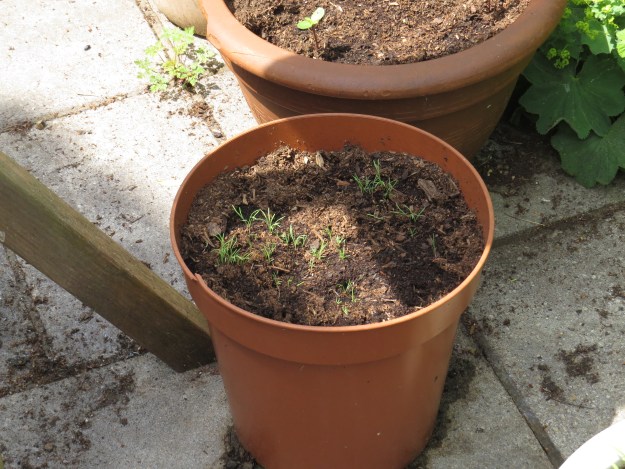
On one side of the garden, someone (I suspect a mollusc) is systematically eating all the new leaves off of my seeds as they germinate.

But on the other side of the garden, there is not a nibble to be seen. It’s a tiny bit sunnier, so maybe that’s enough to deter the slugs and snails.

And my blue water iris is in flower!

But what has kept me most amused today is the mating behaviour of the azure damselflies. The females are a pale green, the males brilliant blue, and once a male has mated, he grasps the female around the neck so that no other chap can ruin his genetic legacy. It’s quite a performance, and the males have to perform all kinds of gymnastics to stay attached. You can see their wings are just a blur as they try to keep their balance. The female probes about in the hornwort to find the perfect place to lay her eggs, and then she flies off, male in tow, to find another spot. What extraordinary animals they are! Meanwhile, unpaired males sit around on the reeds, waiting for their chance.

And finally, how’s this for some mimicry?

Bumblebee mimic hoverfly (probably Criorhina berberina)

This hoverfly not only looks like a bumblebee but sounded and behaved like one too: I heard a loud disgruntled buzzing, and when I looked I thought it was a bumblebee looking for a nesting site. I wonder how many hoverflies go completely under the radar because they look so much like another insect? How handy it must be to disguise yourself as a much more dangerous insect, especially as not many creatures in the UK eat bees, and lots eat flies. There is so much to learn about, even in an average back garden, that if I lived to be 500 years old I’d never get to the bottom of it.

A Mid-June Walk in St Pancras and Islington Cemetery

‘My’ Swamp Cypress

Dear Readers, with the temperatures expected to be in the mid-eighties this week, it seemed that a walk in the shadier parts of the cemetery would be a good idea. However, first I wanted to say hello to ‘my’ swamp cypress, one of my (many) favourite trees. It’s looking very splendid at the moment, even though it’s a good few weeks later than I expected in greening up – the cold May certainly held it back.

It’s the changing of the guard again this week – as you can see from the photo above, the cow parsley is almost finished, but the hogweed is just getting going.

I always think that it looks as if it’s exploding from the stem like a firework.

This shieldbug seemed to be enjoying it as well – it’s the creature with the triangular patterns on it towards the centre of the photograph. Pretty sure it’s a hawthorn shieldbug (Acanthosoma haemorrhoidale) though they’re normally brighter coloured than this one.

The real star of the show this week, though, is the grass, which is waist-deep in some places. The chaps who do the strimming are having a real job keeping up. I quite like it wild, but for people visiting graves it can be a source of some distress. One lady that we spoke to had lost her mother to Covid a few months earlier, and not being able to keep her Mum’s resting place neat and tidy was a real source of distress.  Getting the balance right between the wild spots and the more neatly-groomed one is always going to be tricky, especially with council cutbacks, and such a large area to look after.

Grasses are definitely not my area of expertise, but these have piqued my interest. Let me know if you know what they are, readers! I shall do some research and get back to you. Just about the only grass I’m confident on is wall barley.

Perennial rye-grass (Lolium perenne)??

Cocksfoot (Dactylis glomerata)??

It’s interesting to see how this year’s conkers are already forming on the horse chestnuts…

And the haws are already coming on the hawthorns.

However, spring isn’t quite finished for the birds – I saw a few unusual goings-on in the garden today, which I shall report back on tomorrow, and there was a song thrush singing his head off, so I thought I’d share the moment with you all. You can’t actually see the bird, so you can just relax and listen.

Along by the North Circular Road was a tree that looked like bird cherry, but is evergreen, with very shiny leaves. I’m thinking that it’s a close relative of cherry laurel, Portugal laurel (Prunus lusitanica) – it’s flowering just as the cherry laurel is finishing.

The ox-eye daisies are in full swing, too.

And look at this path. Doesn’t it just make you want to walk along it?

The hogweed always seems to know exactly where the sunny patches are.

And the Scotsman has the sun on his back too.


And all this abundance rather made up for what has happened on our road at home in East Finchley’s County Roads, because the council has been round with the glyphosate and have sprayed not only all the ‘weeds’, but the tree bed where my next door neighbour was growing some California poppies, and the poppy that had self-seeded under my lavender. We shouldn’t blame the people who are doing the spraying, because they are just doing what they’ve been told to do and are probably earning minimum wage for walking the streets all day, but Barnet Council should be listening to the locals, who largely don’t want weed killer sprayed willy-nilly around the places where they live.

My neighbour’s tree pit.

The weeds along the road

My ex-California Poppy

My California poppy last week (Eschscholzia californica)

The only good thing is that most of these annuals have already set seed, and so they’ll be back within a couple of days. And also, the man from the council missed the most enormous sow thistle that is hiding amongst the lavender flowers, which gives me a certain degree of glee. I feel a campaign for no-spraying coming on…..


Tuesday Gardening Update

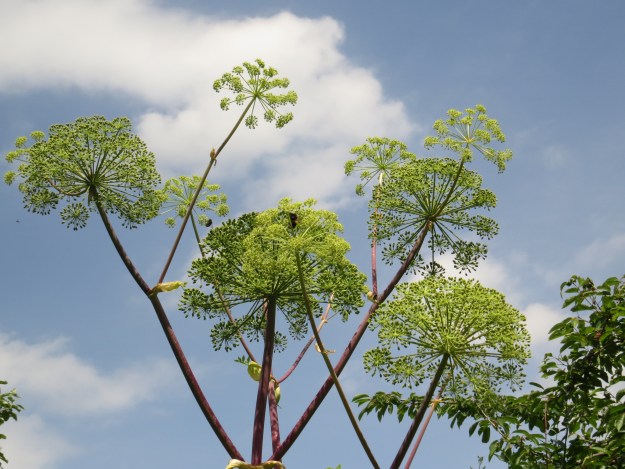
Dear Readers, I thought you might like to see my angelica aka ‘the triffid’ – the handrail is about three feet high, and the ground is about a foot below the stairs, so I think this plant is about ten feet tall. What a beauty! It’s still abuzz, mainly with honeybees but bumblebees and some tiny wasps/hoverflies have got in on the act too.

My plant guide suggests that in the wild it can grow to about eight feet tall, so this is clearly an outlier, but then I seem to have picked the perfect spot for it, largely by accident – it’s right by the pond, so it’s nice and damp at the root, but it gets sun for most of the day. Plus by the time it goes over the hemp agrimony will be coming into flower, so I’ve extended my flowering season. I just love it when there is a happy accident.

If you look very closely at the middle of the first photo you’ll see that there’s a little wasp/hoverfly, but I need him/her to stay still for a bit longer so I can get a better view. I do love the way that each individual flower on the angelica looks like a tiny acorn though.


Now, I wouldn’t want you to think that I’m so enamoured by the angelica that I’ve forgotten everything else. My blue water irises have buds on them now, which is very exciting, and one of the yellow flags has produced a flower too, the first of many I hope.

Blue water irises

And at the end of the garden, the mock orange is smothered in flowers and bumblebees, and the scent is extraordinary. In fact, there are so many bumblebees that I’m wondering if there’s a nest close by. That would really be a bonus.

I did see one ashy mining bee earlier on (typically when I didn’t have my camera handy), but I’m hoping that they’ll discover the climbing hydrangea flowers, which were a big favourite a few years ago. I’m seeing lots of ladybirds about too, but masses of aphids which are taking over the buddleia in the front garden again as they did last year. I think I’ll send my husband out with the hosepipe to give them a good dousing, that seems to slow them up a little bit.

And so, with the heady scent of the mock orange blossom indicating that summer is truly here, I shall bid you adieu until tomorrow.

An Early June Walk in St Pancras and Islington Cemetery

Dear Readers, this might not look like much but it gives me hope for the future. Traditionally, cemetery lawns have always been close cut and relatively lifeless, but I noticed that, in the sweeping sward of the green closest to the entrance, some little patches of grass have been left unmown, and the daisies, buttercups, speedwell and cut-leaved geranium were all the happier for it. Well done, L.B. of Islington!

Cut-leaved geranium in the sward.

It’s definitely dog rose time too, with bushes bursting into flower all over the cemetery.

However, I have officially designated this week as buttercup week. Just look at them! And they are popular with bees too, something that I’d never noticed before.

And look at this handsome little chap, sunning himself in the woodland grave area – it’s a small copper (Lycaena phlaeas), and at this time of year the males establish territories close to areas where females might want to lay their eggs (usually on sorrel, of which there is a plentiful supply). The male flies up in the hope of intercepting any passing females, but will also see off other males, and butterflies of other species. This one was particularly brightly coloured, and for a moment I imagined myself amongst the alpine meadows of Austria, which is where I usually see these creatures.

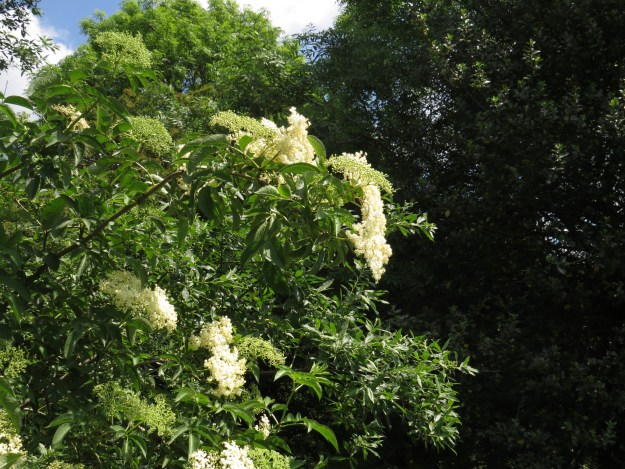
The elder is in flower too, and in the sun there was that faint smell of gooseberry. There seems to be salsify everywhere as well – last year it was just along the path next to the North Circular, but this year it’s busting up all over.

Two other great pollinator favourites are the flowers on the pyracantha (firethorn) which are now studded with bumblebees, and the various forms of comfrey in the damp areas close to the stream.

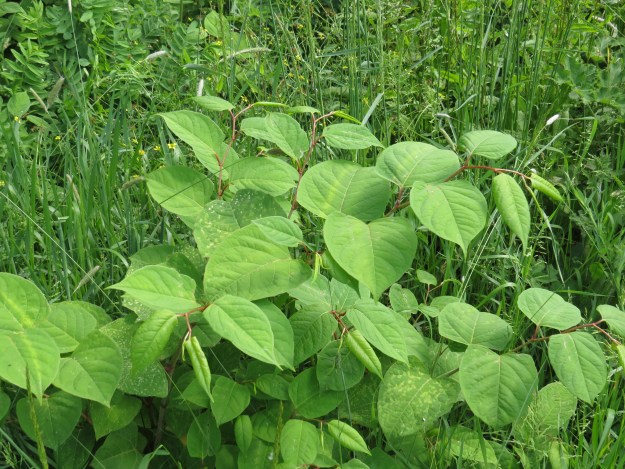
Sadly the Japanese Knotweed continues to gather pace right along the stream and the edge of the playing field. It really is such a thug – there are thickets twenty or thirty feet deep in some places now. I am a little intrigued by the leaf damage on this plant though. Could it be leaf miner damage? I shall do some research and let you know. It would be great if some creature decided that it was dinner and started to bring it into check.

There was a rather tired-looking speckled wood butterfly along one of the walks. I hope that it has done its duty by the next generation and can have a bit of a rest now. It flew up at another butterfly but seemed a bit half-hearted, I thought. Spring is tough on all kinds of animals, and this spring has been colder and harder than many.

As we left a woodland path and started walking in the sunshine, something enormous shot past. At first I wasn’t sure what it was, but then I spotted it perching in the long grass. It wasn’t until it flew up and started quartering the grass again that I realised it was a male broad-bodied chaser, using this spot to survey its kingdom with those enormous eyes before setting off on patrol again. I always get a frisson when in the company of large dragonflies – this one circled us with what I’d describe as curiosity before returning to exactly the same place on a sturdy stem. I like this shot because you can see the way that the wings are stacked on the body.

Now, have you ever noticed the way that teasels develop little ponds at the base of their leaves after it’s rained? I hadn’t this week, but I was very curious about it. I had no idea that an alternative name for the plant is ‘Venus’s Basin’, and that the water was said to have healing properties. In one experiment, where some plants were allowed to ‘keep’ their water and others had it emptied out, the plants where the water was allowed to stay set more seed and were taller.  There is one theory that teasels are on the evolutionary path towards becoming insectivorous although this is usually an attribute of plants that live in extremely inpoverished soils such as bogs. More likely is a second theory that the water acts as a way of stopping insects climbing up the stem, though as aphids in particular can fly I wouldn’t have thought that this was so much of an advantage. What do you think, readers? All theories gratefully considered. If only there was a little frog that could live in the pools, like the tree frogs in the tropics who live in the middle of bromeliads.

Water at the base of teasel leaves.

I am going to make a point of taking a photo of the Scotsman so that I can see how the wood changes during the year, so here is this week’s shot. Lots of tree cover but no lesser celandine or crocuses. The next plant to put in an appearance will be hogweed I suspect.

And so we meander home, past the daisies, pausing only to look at the sculptural form of some ivy working its way up a tree. The cemetery is about the only place round about here where you can walk for a couple of hours and see just a handful of people. Unlike so many of our green places, which have been trampled relentlessly for the past eighteen months, the cemetery retains a kind of serenity that is very pleasing in these fraught times. Long may it remain so.

A Tiny Visitor

Celery Fly (Euleia heraclei)


Dear Readers, I was absolutely fascinated by this tiny fly on my angelica yesterday. I know that it’s a celery fly, and that its larvae will happily mine the leaves on what is currently my favourite pondside plant, but what a performer it is! My photo is far from perfect, but hopefully you can see that it has a shiny black body, wings rippled with chocolate, a bright yellow head and green eyes. All this in a critter smaller than my little fingernail.

It seemed to be displaying, though I couldn’t see anyone apart from me who was enjoying the show. The fly twisted its wings from side to side, hopped from one leaf to another, investigated the fallen pollen from the angelica flowers, disappeared briefly and then hopped back again.

And to my delight, a bit of research showed me that this male fly is actually displaying, and furthermore you can watch it too:

https://en.wikipedia.org/wiki/File:Euleia_heraclei_-_2015-06-17.webm#file

Celery flies lay their eggs on the leaves of the host plant, and the larvae burrow in and mine the inside, leaving a brown or yellow blotch. After four weeks, the larvae drop to the ground and pupate in the soil, with a second generation emerging later in the summer. I found it very interesting that the first generation of larvae burrow to a measly four or five centimetres down into the ground, but the second generation, who have to survive through the winter, will dig down to about 10 centimetres. Nature really is quite remarkable.

I would never have seen this fly if I hadn’t grown my angelica, and so it seems that whenever yo you plant something, you don’t just get the flora, you get the fauna that it attracts too. The angelica is now taller than me, and is attracting not just bees, but an early blue butterfly too – this one is a holly blue, and I hope that it’s found the ivy that’s overtaking my shed for its eggs. I am so delighted with this plant, and if you have a damp patch in the garden and don’t mind something huge, I’d definitely plant this beauty.

Laying in Wait….

Honeybees on angelica

Dear Readers, for about twenty minutes today the sun shone, and so I wandered outside to take a few photos. My angelica flowers are just opening, and are already a hit with the local honeybees, much to my delight. There is such a feeling of accomplishment when you plant something to attract pollinators and it actually does.

I imagine that the recent wet weather has kept all the pollinators at home, so they will all be playing catch-up. The tadpoles have been very happy though – it’s rained so much that it’s raised the level of the pond, and they are able to forage for algae on the parts of the pond that are usually just a beach. They look very fat and happy to me, but I’ll have to make sure that none of them get stuck as the water level goes down (it’s supposed to be much warmer and drier for the next week or so). The water snails are happy too.

But who is this lurking on one of the other angelica flowers?

This is a young male running crab spider (Philodromus sp.) (many thanks to the British Spider Identification Group on Facebook for the ID). This is a group of fast-moving arachnids who hunt flies and other insects, and who also guard their eggs, which are enclosed in what looks like the tip of a medium-sized cotton bud. I shall have to keep my eyes open to see if any females turn up, and also if the male reappears, because when I popped down to see if I could get another photo he had, true to his name, done a runner. If I was a honeybee or a hoverfly, I would be very careful. Incidentally, these spiders spend the winter hibernating beneath loose bark, yet another reason to not be too tidy in the garden.

In other news, I have about 150 honesty seedlings pinging up from the seeds that my friend J gave me last year. I suspect that the good people of the County Roads in East Finchley where I live are going to have an opportunity to put them all over their gardens if the urge takes them. Now all I have to do is prick them out. I know what the bank holiday is going to hold in store for me!