Category Archives: London Invertebrates

A Damp Walk in St Pancras and Islington Cemetery

Dear Readers, we didn’t walk in the cemetery last week because there the rain was blowing horizontally across the garden, but I couldn’t wait to get there this week. A fortnight is a long time when it’s spring, and already most of the dandelions are shedding their seeds. Those ‘dandelion clocks’ really are entrancing, especially if you look closely. I love the way that the seeds detach one at a time and head off to find somewhere to put down their roots…

When all the seeds are gone, I love the spirals of little holes where they were once attached. And I’d never noticed how the ‘parachutes’ of the seeds are angled backwards, maybe so that the plant can produce more seeds per seedhead?

But it was to be a day of floral and avian wonders. A magpie decided to have a bath in a muddy puddle, as one does.

There were germander speedwells….

An ocean of cow parsley…..

Lots of red campion….

Cowslips…..

English bluebells…

And the buttercups have taken over from the lesser celandine in the yellow flower competition.

The flowers on the horse chestnut are pretty much full grown now and how enticing they look!

Even the grasses have gone berserk. That combination of lots of rain and longer day length has really kicked everything off.

We walk along the narrow path that connects two parts of the cemetery, and the cow parsley has sprung up to waist high.

But then there’s one of those moments that make the cemetery so special. I hear a familiar yaffling call, and there, posing on a headstone, is a green woodpecker.

These birds always remind me a bit of tiny dragons. There is a close-mown area nearby where they often search for ants, pounding away into the earth with their beaks. Unlike the great-spotted woodpecker, they don’t drum on dead trees to establish territory. This one was exceptionally obliging. This one is a female – the ‘moustache’ at the side of the face is all black in females, but has a red stripe in males. I found this description a bit confusing as I associate a moustache as being in the middle of the face, but for ornithologists it’s more of the ‘muttonchop’ variety.


Anyhow, this was a real delight, and well worth getting damp for. I normally hear the green woodpeckers, but they rarely stand still long enough for a photo. The wet weather has kept most of the visitors away, which makes the birds bolder.

Next, it was a wander along the road which is right next to the North Circular. The traffic noise is so loud here that it’s hard to make yourself heard, but the flowers are worth it. The ragwort is in full flower…

Last year’s salsify is in flower again….

And how about this lovely tangle of vetch? Some of my favourite plants are in the pea family.

One of the pleasures of a walk like this is seeing familiar plants, but noticing something new about them. Last year I was crunching through acorns as I passed these trees, but today I saw that they were in flower. I’d never even thought about oak trees having flowers (doh). The catkins are the male flowers, and there are tiny female flowers that look like buds amongst the leaves.

The comfrey is in flower, and the bumblebees are delighted. Along by the stream there is creeping comfrey and the larger common comfrey.

Common comfrey


And for some reason, in the middle of all this wildness there is a Japanese acer, just about holding its own.

There is bugle and great stitchwort….

Bugle

Greater stitchwort

Cuckoo flower and shining cranesbill…

Cuckoo flower

And a great big patch of three-cornered garlic, with its triangular stem. I can’t resist having a little nibble as we march on through the woody bits of the cemetery. Overhead a buzzard is mewing and suddenly appears above us, pursued by a huge flock of crows – I count at least thirty, and more are joining from all directions. A sparrowhawk flies over, fast and low, and goes unmolested. The crows take such glee in the mobbing that you’d almost think they enjoyed it. I wonder if it’s one of those visceral reactions to anything that looks like a bird of prey? I always wonder this, and I still have no answers. And neither does the lovely Scotsman statue, standing in the spring woods with the bluebells dying back and the greenery rising all around him.


A May Walk in Coldfall Wood and Muswell Hill Playing Fields

Coldfall Wood

Dear Readers, after many months of trudging through the mud during the winter, it’s astonishing how the wood has now dried out. It’s true that we haven’t had any serious rain for several months (though some is forecast overnight), but even so the clay soil has turned into a miniature relief-map of ruts and runnels. Still, the place is alive with bird song – robins, song thrushes, blue tits and nuthatches to name but a few.

Someone has moved some branches to protect this multi-coloured group of hybrid bluebells from trampling, and very pretty they are too. There’s not a sign of the wood anemones that I remember from back in 2011 when I first arrived in East Finchley, though – maybe they’re hiding out in some of the less-trodden corners.

The hornbeam is flowering – it’s monoecious, which means that it has male and female flowers on the same tree. In the photo below, the prominent catkin right in the middle is the male one, but on the lower right-hand side you can see a collection of green slender outward-pointing ‘seeds’ which are the female flowers. As in many trees which have both male and female flowers, all the trees in the area are likely to set seed at the same time, so that there will be at least some cross-pollination. There might also be a slight time-lapse between the different sexes on the same tree, to prevent self-pollination. The sex-lives of plants are extremely confusing, and don’t even get me started on fungi.


Male and Female hornbeam catkins/flowers

In fact, there are flowers and catkins everywhere today. The crack willow has ridiculously long catkins (these are the female ones)

And here are some completely different catkins – this is black poplar (Populus nigra), though I’m not sure whether it’s the vanishingly rare native subspecies (ssp betulifolia) or the more commonly seen hybrid black poplar. It would be great if it was the first, as this is our rarest native tree, but let’s see – I’ll keep you all posted.

And what a fabulous year it’s been for the blackthorn. I have never seen so many flowers.

Blackthorn

And I rather like the catkins on the sycamore too.

I had to have a quick look at what I’m beginning to think of as ‘my’ wildflower bed in the far corner of the fields, although I am a bit nervous about the encroachment of the Japanese Knotweed, which seems to increase year on year. It looks to me as if children have been thrashing their way through it, which will only help to spread the stuff. Still, there are plenty of plants in flower already:

White Deadnettle

Green alkanet

Forget-me-not

Red campion

More green alkanet

However, it was on the walk home that I noticed that the whole path was full of flies. What a twit I am! I’ve been hoping to see St Mark’s Flies (Bibio marcii) – these jet-black, slightly hairy flies are so-called because they normally emerge around about St Mark’s day, which is 25th April. The males have enormous eyes, largely because they fly around at head height looking for females to mate with. The females have much smaller eyes because presumably all they have to do is avoid predators. Look at the beautiful iridescence on the wings of this chap – like pastel-coloured stained glass.

St Mark’s Fly (Bibio marci)

I soon realised that the flies were all over the path, which led to some very delicate ‘tiptoe through the tulips’ type manoeuvres.

I think the fly on the grass is just sorting out his wings preparatory to his maiden flight….

And here is some wobbly film of one of the St Mark’s Flies having a little wash and brush-up. You’re welcome 🙂

And now I realise that the ‘little hoverfly’ that I mentioned in my Saturday post was actually a St Mark’s Fly, and furthermore, the reason that the starlings have been behaving in a most peculiar manner (hawking and diving around very energetically) is because they’re catching these little chaps by the beakful. Doh.

A blooming St Mark’s Fly.

A Blossom-Filled Walk in East Finchley Cemetery

Goodness Readers, although East Finchley Cemetery is a much posher, more manicured cemetery than my favourite, St Pancras and Islington Cemetery, it certainly has some very trees. Today, the rose-garden was looking a bit bare, but the trees more than made up for it.

One of the disadvantages of roses is that, although they look and smell wonderful when they’re in flower, they are very uninteresting for the rest of the year (and many varieties need a fair bit of looking after as well, what with the pruning and the feeding and the keeping an eye open for black spot). Furthermore, this part of the cemetery, which has an ornamental pond and then a small stream running down the middle, has been a bit of a problem for the landscape gardeners – the bit at the bottom was a quagmire earlier this year, though the weeping willows loved it.

However, there are some very pretty trees here. There is the usual Kanzan cherry tree, not my favourite but very ebullient.

Kanzan cherry. Look at all those petals!

There are some magenta-coloured crab apples too – I think this is purple crab (Malus x purpurea) but am happy to be corrected, as always.

But I think my favourite is this tree, which I think could be Siberian crab (Malus baccata), possibly the Lady Northcliffe variety? I think that it might be the prettiest blossom tree I’ve ever seen, what with those cherry-pink buds. Let me know what you think, you clever people!

Elsewhere, I find an Indian horse chestnut (Aesculus indica) – it has much narrower, more dainty leaves than ‘our’ horse chestnut, and is smaller and more delicate. I love the way that this cemetery makes a feature of its specimen trees – some of those in St Pancras and Islington are rather swallowed up with undergrowth, though this is much better for wildlife. I’m lucky to have both types of cemetery within a twenty-minute walk.

Indian horse chestnut (Aesculus indica)

And the pollen from this fir tree is absolutely everywhere. No wonder my husband’s nose is twitching. I’m thinking it looks most like a Nordmann Fir (i.e. the one that’s used as a Christmas tree), and if so these are the male flowers.

The ‘willow garden’ is coming on nicely, with lots of spring flowers, including this rather nice white Dicentra.

And the tree below rather caught me out – it’s a bay tree. I’d never seen one in flower before. What a twit.

I always stop to pay homage to the Cedar of Lebanons as well. What magnificent trees they are, planted when the cemetery first opened in 1854. I love the barrel-shaped cones, which gradually disintegrate, allowing the seeds to fall.

And the monkey-puzzle tree is putting on lots of new growth too – look at those cones! Apparently they will break up on the tree, rather than falling on someone’s head.

While I was admiring the monkey puzzle, my husband spotted that I had a hitchhiker – this bee. I’m thinking that it’s an orange-tailed mining bee (Andrena haemorrhoa) but these are tricky critters to ID to species level. As it likes south-facing grassy slopes to nest in, there will be plenty of opportunities for it in the cemetery – in some places the turf is kept very short, but there are also areas that are more overgrown.

The cemetery is a hot-spot for bats, too. What a shame that it closes at 4.30 p.m! But then there are signs outside prohibiting alcohol and barbecues, so I imagine that it has been the site of what I loosely describe as ‘urban vibrance’. Maybe it’s just as well that the bats, birds and bees have the whole place to themselves as dusk falls.

A fine array of bat boxes


An Insect-Filled Walk in St Pancras and Islington Cemetery

Dear Readers, it was the most beautiful spring today, and while the cherry plums in the cemetery have mostly lost their blossom, the heavy candy-floss pink flowers of the cherry trees are just starting to emerge. It’s a shame that many of the prettiest are behind fencing at the moment, while the cemetery tries to turn yet another area of rough scrub into a site for graves, but nonetheless the tree is still exuberant. The blossom on these trees can sometimes seem almost too much: I suspect that these trees are of the Kanzan variety, with each blossom having up to 28 petals. There is a road close to where I used to live in Islington which was lined with these trees on each side: when the blossom started to fall, it could be like scuffling through a thin layer of pink snow.

The cherry plums have lost every last flower now, and are instead glorying in their copper foliage.

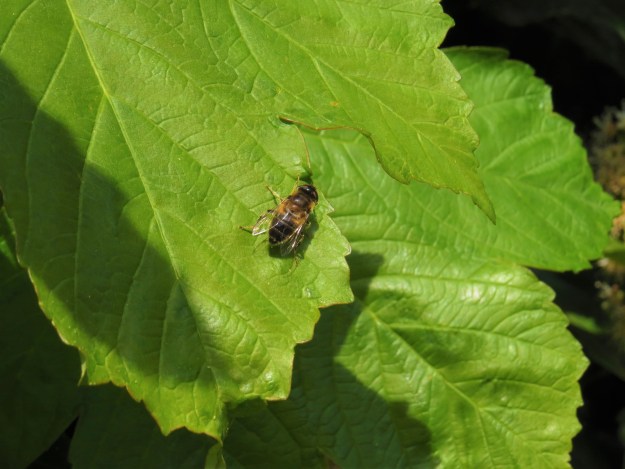
The cow parsley is just starting to flower in the woodland grave area, and is already attracting pollinators, like this little hoverfly. The photo is not good enough to identify the species, but it does give an indication of how varied this group of insects can be – at first glance you’d think this was a flying ant.

I had to pause for a quick look at the swamp cypress, which appears to have been in suspended animation for weeks. Not for much longer, though! I can’t wait until it’s decked out in fluorescent green.

I had to pause for a quick look at the cherry laurel by the main path – it is covered in strange, spidery flowers, and has a most nose-tingling smell, somehow dusty and honey-ish at the same time.

Another hoverfly was sunning itself on the leaves. I’m going to hazard a guess and say that this is probably a female Eristalsis pertinax. The males of this fly defend territories around flowering plants, and I imagine that the cherry laurel must be a very appealing site. The young go by the appealing name of ‘rat-tailed maggots’, and live in drainage ditches and other stagnant water: the ‘tail’ is actually a breathing tube.

And here’s an insect that I haven’t come across before. Superficially it looks rather like a shield bug, but it is narrower in the body and has much thicker, more pronounced antennae. This is a box bug (Gonocerus acuteangulatus) and it isn’t named after the plant directly but after Box Hill in Surrey (which was, admittedly, named after the box hedges that grew there).  The bug was considered endangered, and in 1990 it was known only in the area around the eponymous Box Hill, but since then it has expanded its range to most of south-east England. It seems to have expanded the variety of foodplants that it eats to include hawthorn, bramble and rose, and I predict a sunny future for it as it munches its way northwards.

The dandelions are still out in force.

The leaves on the horse chestnut are getting bigger every week.

And the first flowers are opening on the hawthorn.

But what I’ve really noticed this week are the bluebells. The vast majority of the ones in the cemetery are hybrids, and they come in the most astonishing array of colours. I doubt that the cemetery was ever a pristine environment for bluebells, and in fact I suspect that if there weren’t hybrids here, there wouldn’t be any bluebells at all.

  The primroses are doing their hybridizing thang as well. In the beds at the entrance to the cemetery there is the most extraordinary range of primulas and polyanthus, and I suspect that they are all cross-breeding and coming up with multiple varieties across the rest of the area. Genetic exuberance is certainly in evidence here.

In one of the sunnier parts of the cemetery I saw, in quick succession, a brimstone butterfly, a peacock butterfly, and a male orange-tip. I managed to get photos of two out of the three, which wasn’t bad considering how quickly the brimstone was flying. They apparently emerge from hibernation from March onwards, and will only be on the wing till May, so I cherished this glimpse of a butterfly in a tearing hurry!

Brimstone butterfly(Gonepteryx rhamni)

And then we almost trod on two peacock butterflies in quick succession, both of them sunning themselves on the path. These adults will have been hibernating over winter, and are now looking for someone to mate with, and somewhere to lay their eggs. They looked very ragged and tired, poor things.

The orange-tip will have been very happy to see the abundance of garlic-mustard which has popped up everywhere, and is now coming into flower. It’s good that there is so much of the stuff, as the caterpillars are cannibalistic and so the female normally lays each egg on a different plant – when an egg is laid, the female also deposits a pheromone which will prevent other females from laying there. Furthermore, the females will only lay their eggs on plants which are already in flower, but will also refuse to lay if the flower is starting to age. This is an insect which wants to give their young the very best start in life, for sure.

Photo One by By Charles J. Sharp - Own work, from Sharp Photography, sharpphotography, CC BY-SA 4.0, https://commons.wikimedia.org/w/index.php?curid=48875414

Male orange-tip (Anthrocharis cardamines) (Photo One)

Garlic mustard and lesser celandine

I couldn’t resist getting a photo of this watchful crow, and I rather liked the backlit dandelions too.

And for my final butterfly of the day, here’s a newly-minted speckled wood (Parage aegeria). These are woodland butterflies, flitting through the dappled shade. The males are fiercely territorial, and spend a lot of time flying into the air to investigate every insect that goes past. If it’s another male, an aerial battle will take place that could last up to 90 minutes. The battles are fiercest if the incumbent male has already been visited by a female – presumably this proves that his territory is a good spot. What a lot of hard work this reproduction business is.

Speckled wood (Parage aegeria)

And so, it seems that, with the arrival of flies and bugs and butterflies, and with bluebells and garlic mustard springing up all over the cemetery, we are now into what I think of as ‘mid-spring’, the period when the battle to mate and rear young and get pollinated is at its height. All I need now is the arrival of the house martins to know that spring is fading, and summer is beginning.


Sunday in the Pond

Dear Readers, after a chilly couple of weeks I was delighted to see that the tadpoles are finally emerging from their spawn. What extraordinary little question marks they are! In the photo above you can see some tadpoles that are quite well grown and others, like the one with the straight tail that seems to be ‘crossing swords’ with the one above, who have just struggled out of the egg. Most of them are currently hanging around the plants, but one or two brave souls have crossed the pond to feed on the abundance of algae growing on the liner.

In the photo below I love the way that the shadows of snail and pond skater can be seen on the bottom right, while a lone tadpole keeps a very low profile. The pond skater went over to investigate the snail, but these insects are largely scavengers, who will take advantage of any invertebrate unfortunate enough to fall into the water. You might sometimes notice ‘rafts’ of pond skaters all feeding on a dead bee or clumsy fly. They have the piercing mouthparts of all bugs, and will make short work of any little corpses.

Pond skaters are superbly adapted to living on the surface of the water – their bodies and limbs are covered in tiny hairs which increase the insect’s surface area and make it easier for it to stay on the surface. If the creature is submerged by a wave (not likely on my pond where all is currently tranquil) the air bubbles trapped in the hairs will help the insect to right itself. The long middle legs are used for ‘rowing’, the back ones for steering, but to the naked eye they seem to move across the water by magic.

For pond skaters it’s all about the vibrations that they can feel through their limbs – they take a while to settle down if I walk past, even if I tiptoe. Once they’re relaxed again, you can see all sorts of shenanigans going on. Pond skaters signal to one another using different frequencies: one to repel, one as a threat, and one to signal amorous intentions. When two pond skaters notice one another, one will send out a ‘repel’ signal. If it isn’t responded to by another repel signal, or even a threat signal, the pond skater knows that it’s happened upon a female, and will send out a courtship signal. A receptive female will respond with a courtship signal, and the male will then mate and stay with her until her eggs are laid. This means that the female (who is larger than the male) will have to ferry her lover about, possibly for weeks.

Photo One by By Markus Gayda, CC BY-SA 3.0, https://commons.wikimedia.org/w/index.php?curid=198901

Pond skaters in flagrante (Photo One)

When the young hatch, sometimes they will have short wings, sometimes long wings,  and sometimes no wings at all. Wingless forms obviously can’t leave the water body where they were born, but this isn’t a problem if there is plenty of food – I suspect that ‘my’ pond skaters hibernated in the pond over the winter to get a head start this spring. However, if a pond gets too crowded, or dries up, it’s useful to have wings so that the young can disperse – short wings enable a local flight, long wings can carry the new pond skaters to exciting new ponds and lakes. However, this has to be balanced against the disadvantages of wings for a surface-living insect like a pond skater – wings are extra weight, and can get tangled. It’s likely that because my pond is stable and the water level is lovingly tended by a mammal (me) most of ‘my’ pond skaters will be wingless. I shall pay attention over the next few months and see what happens.

Although pond skaters in the UK are modest little chaps, the Giant Pond Skater of Vietnam (Gigantometra gigas) has a ‘legspan’ of twelve inches, and you can read all about them here.

While I was sitting on a stone with my camera trained on the pond skaters, who should pop by but Bailey King of the Cats. He is now twenty years old, and so a little bit stiff, but he is still every bit the monarch that he was previously, so much so that his minions (aka his owners) popped by to pick him up and take him home.

Bailey asking where his taxi is.

And finally, here is a little film of the goings on in the pond. Do not be alarmed (overly) by the appearance of two leeches from under the edge of the plant pot – this species lives by funnelling up tiny invertebrates and so the tadpoles will go unmolested.

Small Beauties

Fritillary

Dear Readers, we’re into my ‘busy week’ at work, which means lots of reports have to be written and lots of project managers need to be talked to. Some days I plonk down at 7.30 a.m. and suddenly realise it’s 5.30 p.m. and I’ve only broken for a twenty-minute lunch. So it feels even more important to schedule in a quick walk around the garden, even if it’s only for ten minutes. It’s astonishing what you can find!

For example, I had never really noticed the snakeskin pattern on the fritillary before (even though one of its names is ‘snakeshead fritillary). This was a very fine example, especially against the bright leaves of the mock orange. Let me tell you now that half an hour spent popping in the bulbs in October provides an excess of joy in spring. You can never have too many bulbs!

I’ve grown some very pale blue grape hyacinths this year, but as usual the ‘ordinary’ blue ones seem to be doing best.

Grape hyacinth

The marsh marigolds are just coming into bud, and when did the flag irises start to get so tall?

I pop into the shed to dig out some bird seed (mainly for the squirrel it has to be said, if he gets any chubbier he won’t be able to walk) and I noticed this stunning cobweb behind the door. We have so many spiders that I honestly think the shed will be listed as a Site of Special Scientific Interest soon. This web was probably made by a cellar spider (one of those very skinny chaps who vibrate up and down when disturbed). Strangely enough, these etiolated-looking spiders, who wouldn’t appear to be strong enough to say boo to the proverbial waterfowl, are themselves spider-killers, finishing off all manner of other species.

And finally, the flowering currant is still going strong, and is now attracting female hairy-footed flower bees. These are tricky to photograph, being fast and flighty, but I did manage to one satisfactory photo. If you look closely you can see the ‘hairy’ ginger legs, used as a pollen basket by the female.

And finally, I was sitting back at my desk, just about to tackle my most imposing project, when there was a fluttering outside and this butterfly landed on the windowsill. This is a female small white (Pieris rapae), described in my Garden Wildlife book as being often the first butterfly of the year to emerge from its chrysalis. No doubt she will be off to find a) a male and b) a cabbage to lay her eggs on as we speak.

And so, it’s back to work. Roll on Friday!


Poking Your Tongue Out….

Dear Readers, few things make me happier than the first hairy-footed flower bees. They often arrive before the end of March, and they have a great fondness for my flowering currant bush. The males are unmistakable – they have white faces, as if they’ve run head-first into some putty. And look at the length of that tongue! I love the way that they fly around with their tongues out, like little knights about to head into a joust.

The hairy-footed flower bee (or Anthophora plumipes to give the correct name) is generally an early riser – my Field Guide to the Bees of Great Britain and Ireland by Stephen Falk suggests that the males can be on the wing as early as mid February, though they’d have been blown about rather roughly if they’d put in an appearance in February this year. The males are said to appear two to three weeks before the females, who are jet black but have russet hairs on their legs and collect pollen, unlike the chaps who are just after the nectar and some lurve. I did spot a female this morning, but as usual she was too speedy for me – the males seem to hover and hang around a lot more, while the females are very purposeful. There is a suggestion that the males hold territories around desirable flowers, so now that I have a few days off I can spend some time watching them.

The nests are usually made in crumbling brickwork and sometimes in chimneys, which is one reason why the females will sometimes appear indoors.

In the photo below you can just make out the white hairs on the last pair of legs, which indicates to me that they should be ‘hairy-legged’ rather than ‘hairy-footed’. Maybe that’s a bit too Morecombe and Wise for the apiphiles out there.

And they were not the only bees either; there were a couple of honeybees on the plant-whose-name-I’ve-forgotten. Remind me, readers! It’s evergreen with white or green flowers, and I have a couple strewn about the garden.

The ratio of leaf to flower on the potted grape hyacinths is gradually improving, plus I suddenly realised that they were fragrant, something I’d never noticed before. I think once they’ve gone over I’m going to liberate them from their pots and plant them around the pond to provide some cover.

And look, the fritillaries are coming into bloom!

And the wood anemones. Please turn a blind eye to the guano if you can. I think I’m going to get nappies for the visiting birds, they have no manners at all.

The marsh marigold is doing very well, and if the water in the pond gets much lower I am going to have to tip out the frogspawn. A lot of it looks as if it will be hatching soon, though.

And here is my one and only self-sown lesser celandine. I’ve got some way to go before the garden is as full of golden flowers as the cemetery is, but there you go, it’s a start. I might regret ever bewailing their rarity, I know.

And finally, here are a few more shots of the hairy-footed flower bees. I am very pleased with this flowering currant, but the one next to the pond is looking very sad this year, I’m not sure what’s wrong with it. I think I’ll let it flower, cut it back a bit and then give it some TLC. I’m not sure how long they live, but I know I’ve had it for ten years, so it deserves a bit of a rest. Any way, let’s see. A garden is a perpetual work in progress, and none the worse for it.

Tense Times for Coldfall Wood

Sunrise in Coldfall Wood December 2020

Dear Readers, you might think that the trees that form part of an ancient woodland nature reserve would be safe from being cut down,  except when it’s essential for the management of the area. Sadly, as I have learned, you would be wrong. Trees are often felled in urban areas because they are blamed for damage to nearby housing, even when the houses are built  after the trees are fully grown, and even when such housing is extended right up to the treeline.

Those of you who have been following this blog for a while will know how passionately I care about the few small areas of ancient woodland that remain in North London, in particular Coldfall Wood. At only 14 hectares it provides a home for 26 species of breeding birds (including the lesser spotted woodpecker and song thrush, both Red List species),  2 species of bat, 106 species of beetle (including three Nationally Notable species), 56 species of spiders and 3 species of pseudoscorpion.

Song Thrush (Turdus philomelos) singing in Coldfall Wood

Black and Yellow Longhorn Beetle (Rutpela maculata) in Coldfall Wood

Two nuthatches – Coldfall Wood

Stock Dove (Coldfall Wood)

Treecreeper (Coldfall Wood)

One of the species recorded is the very rare Lesser Glow Worm (Phosphaenus hemipterus).

Photo One By Urs Rindlisbacher - Majka GC, MacIvor JS (2009) The European lesser glow worm, Phosphaenus hemipterus (Goeze), in North America (Coleoptera, Lampyridae). ZooKeys 29: 35–47. doi:10.3897/zookeys.29.279, CC BY 3.0, https://commons.wikimedia.org/w/index.php?curid=8770508

Lesser glow worm (Phosphaenus hemipterus) (Photo One)

However, being a rare ecosystem brings limited protection when insurance companies become involved. A local householder has been having subsidence problems with an extension that was built ten years ago. A number of two-hundred year-old oaks have already been destroyed without the knowledge of the local Friends group, whose role is to liaise with the council and to protect the wood. The plan was to fell a further seven trees on 1st March, even though the loss of the other trees hasn’t improved the situation. Fortunately we were able to get the felling postponed, but the trees still aren’t safe.

Coldfall Wood August 2020

Speckled Wood butterfly

Our local Council, Haringey, is under pressure from the insurance company (AXA) to fell the trees – the council can be found to be negligent if it doesn’t act, and can be forced to pay for any works deemed necessary. However, there are lots of reasons other than trees that can cause subsidence to occur, including the soil composition, the geography of the area and the adequacy of the foundations of the building,  and none of them have been explored. Our question is this: if cutting down a number of mature oak and hornbeam trees didn’t solve the subsidence problem, how will removing further trees help? Where does it end?

Water mint (Mentha aquatica) next to the seasonal pond, Coldfall Wood August 2020

There is a meeting on 5th March at the council to discuss a strategic approach to the problem, and we hope that this will at least allow for further research into the causes of the subsidence. However, we also have a petition asking for the felling to be stopped,  which has over 50,000 signatures already (link below). We are angry that trees and the habitat that they represent are considered so expendable at a time when councils, corporations and our national government all claim to be working to alleviate climate change. There is so much talk about protecting the environment, and yet greenspaces have never been under so much pressure. While we want to work constructively with the council and with the insurers, we have no intention of allowing the destruction of these trees.

The by-line for this blog has always been ‘ Because a community is more than just people’. That community includes the trees that provide much of the oxygen that we breathe, that shade us in the summer and that provide a home for hundreds of other species. If we don’t act now to give them the protection that they deserve, then when? 

The link to the petition is here. Please feel free to sign and share. I shall let you know how we get on.

Coldfall Wood 7.30 p.m. August 4th 2020

Photo Credits

Photo One By Urs Rindlisbacher – Majka GC, MacIvor JS (2009) The European lesser glow worm, Phosphaenus hemipterus (Goeze), in North America (Coleoptera, Lampyridae). ZooKeys 29: 35–47. doi:10.3897/zookeys.29.279, CC BY 3.0, https://commons.wikimedia.org/w/index.php?curid=8770508

All other photos by the author

A Winter Walk in East Finchley Cemetery

The view along Cypress Avenue

Dear Readers, Christmas was pretty much cancelled for lots of people yesterday at 4 p.m. in the UK, just as most people had stocked up on food for the people who were allowed to travel to see their relatives for five days over the holidays. Instead, in areas with Tier 4 (pretty much all of the south-east including London) no household mixing is allowed (unless you have formed a support bubble) and everything except essential retail is closed. In other parts of the country, 2 households can mix on Christmas Day only. If you’re in Tier 4 you shouldn’t travel to lower tiers, but of course everyone jumped onto a train or into a car and headed off to escape the lockdown which started at midnight last night. My heart goes out to everyone who had made plans and wanted to finally be with the ones they loved after this terrible year. The numbers of cases are frightening, though. My main ire is with the powers that be, who have ignored calls from scientists for London to be completely locked down since October. Only a few days ago, Boris Johnson was mocking Kier Starmer when he called for household mixing restrictions to be cancelled.

Anyhow, here we are. For me personally it makes very little difference, what with having no parents left. We were planning a quiet Christmas, and that’s exactly what we’ll have. I am planning to get out for a walk whenever the weather cooperates even a tiny bit, however, and so today we found ourselves back in East Finchley Cemetery (which confusingly is largely owned by Westminster City Council). Maybe it’s this Westminster connection rather than the Barnet one which makes it such a posh place – everywhere is well manicured and there are a plethora of graves with extravagant headstones. Angels and Celtic crosses abound.

I found this headstone particularly interesting – I’ve not seen anything like it before. The wheel at the bottom looks like a Buddhist symbol for the wheel of reincarnation, but I’m not sure about the boss in the middle – could it be a lotus? Let me know if you have any thoughts, I haven’t included the details of the person buried because there weren’t any clues, and also I try not to be too personal out of respect.

There is some very fine carving, particularly of plants, as in the headstones below. What patience must have been required to create them!

But what I like most are the ones that are intensely personal. Have a look at this cricket-themed gravestone, for example.

And who was ‘Harry’? And why is this all that is on his gravestone? Did his family run out of money to put more details, or was his name all that you needed to know about him? So many mysteries….

And then there is that magnificent Italianate crematorium which is still largely fenced off, and probably will be until the pandemic is over.

But look at the trees! This is the home of some fine Cedars of Lebanon, some of which are covered in pine cones this year.

A gnarled and ancient-looking tree  has what looks to me very much like home for a woodpecker – I will have to check it later in the year to see if anyone has taken up residence.

Small flocks of redwings go twinkling away as soon as I get within a hundred metres. Was there ever a shyer thrush? I am even prouder of my devastatingly good portrait captured in the other cemetery yesterday.

I am very fond of this fine angel who is one of a row of very fine tombs beside the entrance. I think that the ivy rather enhances the overall effect.

But before I forget, here is a rather surprising sight. It’s 46 degrees and the middle of December, and yet, on Bedford Road in East Finchley, two bumblebees are collecting pollen from Mahonia- these are not queens, but workers. The nests of buff-tailed bumblebees sometimes survive throughout the winter these days – normally all the adults except the queens, who hibernate, die. But you can clearly see the pollen in the leg baskets in the second photo – a queen at this time of year would just be gathering nectar to keep herself fed until she started laying eggs in the spring. These workers still have a nest to go back to, and if we don’t have severe weather, who knows but that they might survive right through? The impacts of climate change are unpredictable, for sure.


Arachnophobes Look Away Now

Noble False Widow (Steatoda nobilis)

Dear Readers, was there ever a creature more maligned than the poor old False Widow spider? If the newspapers were to be believed, they are ravaging folk all over the country, taking chunks out of small children and wrestling dachshunds to the ground. Well, I must be as brave as that woman in Game of Thrones with the dragons, as I have three visible in my kitchen at the moment, one on the ceiling and two in the corners of the sash windows outside. A single bite can be enough to make you lose a limb, apparently, and back in 2013 four schools in East London were closed while they dealt with an ‘infestation’ of False Widows. To be frank, I suspect the children were in much more danger from the pesticides used than the spiders themselves. If you hear the sound of distant harrumphing, that’s probably me.

So, to get to the nitty-gritty – do these spiders bite? If cornered, yes, and the female bite is said to be worse than the males. Is it painful? Yes, and there might be local swelling. A few very unlucky people might go on to have that bite become infected, and some people might also have an allergic reaction. Is that a reason for killing every spider that you see? Absolutely not. Make sure that children know not to pick up small creatures that are just going about their business, and chances are everyone will be fine.

If you can bring yourself to look closely at the spider above, you’ll see that the eyes are lit up like little headlights – spiders have a ‘tapetum lucidum’, a membrane behind the eyeball that reflects the light. I have to say that I find that rather cute, but I can see why others might struggle.

This spider is a chap – you can see by those two things that look like jaws but are actually what are known as pedipalps, and are used to transfer sperm to the female. Also, the males tend to be a bit more slim-line than the females, who look like Maltesers with legs attached.He should have no shortage of possible mates, because the ones outside look pretty much like ladies to me.

Exhibit A

Exhibit B

Now, I was just about to have my windows cleaned, but I fear I might have to wait for a bit. I have been known to block up the spider’s lair with a piece of polystyrene in an attempt to preserve them during the process, but as most window cleaners use power jets these days I wouldn’t want to risk it with these lovelies. The Noble False Widow builds a little tubular retreat, which is why old-fashioned sash windows are so popular: they also build a pretty unimpressive web (at least when compared to the lovely ones in my garden) but the silk used is extremely strong. In spite of those shining eyes, False Widows are very short-sighted (a condition with which I can sympathise) and they mainly respond to vibration. I should say that the poor little soul on the ceiling did flinch when I took a flash photograph of him though, so they definitely don’t like sudden bright light.

That short-sightedness might also account for all the stories of spider bites as well, though I do wonder how come people are coming into contact with a creature that mostly lives in cracks and holes. It’s not likely to be lurking in your washing or snuggling up in the duvet. But like all creatures, it should be respected just in case.

Photo One By Alvesgaspar - Own work, CC BY-SA 3.0, https://commons.wikimedia.org/w/index.php?curid=2888258

A much clearer photo of a Noble False Widow (Photo One)

False Widows are not native to the UK – they come originally from the Canary Islands and Madeira, of all places, and they will no doubt be delighted that our climate is warming up. It’s believed that they arrived in 1879, and one was noticed by the Reverend Hamlet Clark of Torquay (and what a fine name that is). Presumably the spider arrived in a shipment of something or other (window frames possibly) and from there it has gone on to become one of our commoner spiders.

We do have our own native species of False Widow (Steadota grossa), but as you can only tell the difference between this and the spider in my kitchen by harpooning one and dissecting its genitalia, I’m going to pass.

Photo Two By Ryan Kaldari - Own work, CC0, https://commons.wikimedia.org/w/index.php?curid=30397907

Uk False Widow spider (Steatoda grossa) (Photo Two)

So, I shall watch my little community of spiders with some interest over the weeks and months to come. The males, sadly, only live for a year, but the females are good for three years if no one sits on them or sprays them with pesticide. During that time they will cheerfully munch their way through any errant flies, clothes moths, gnats or midges that venture indoors: indeed, my chap with his ramshackle web on the ceiling has already caught half a dozen small invertebrates. And things will get very exciting if the male actually gets on the same side of the window as one of the females, as the ladies can be very grumpy (though not normally murderous). I shall keep you all posted.

Photo Credits

Photo One By Alvesgaspar – Own work, CC BY-SA 3.0, https://commons.wikimedia.org/w/index.php?curid=2888258

Photo Two By Ryan Kaldari – Own work, CC0, https://commons.wikimedia.org/w/index.php?curid=30397907