Category Archives: London People

Wednesday Weed – Brussels Sprout Revisited

Brussels sprouts (Brassica oleracea)

Dear Readers, I didn’t want to write a blog after Mum died, but Mum somehow insisted….

Now, some of you may have read Joan Didion’s book ‘The Year of Magical Thinking’, in which she describes her emotional journey following the sudden death of her husband. She recounts how she keeps his shoes because ‘he’ll need them when he comes back’. The rational  part of her knows that he’s never coming back, but she still can’t throw the shoes away. I had my own version of this when I found Mum’s hairbrush with some of her long, silver hair still in it. I found myself thinking ‘maybe someone could clone Mum from the DNA in her hair’. I know that this is completely ridiculous, but the thought was there. And I have the hairbrush, just in case.

More helpful is what happened to me earlier this morning. I was getting ready to go out for breakfast, and I was telling my husband that I probably wouldn’t do a blog this week because, after all, my mother had just died, and everyone would understand. And then I heard Mum’s voice in my head, as clearly as if she was standing next to me.

‘Don’t you dare not do the blog! Tell them about the Brussels sprouts’.

And so, Dear Readers, here is my take on that most divisive of vegetables the Brussels sprout, courtesy of my mother.

Every Christmas we would have Brussels sprouts with our turkey. I quite liked those sulphurous, squidgy little crucifers, and Dad positively loved them. They were usually a little watery and yellow, and I maintained that this was because Mum insisted on making a cross in the bottom of each one which allowed the cooking water to penetrate right into the heart of the vegetable. I, with my new-fangled modern ways, declared that this wasn’t necessary but somehow, even when I hosted Christmas in my own house, Mum managed to get hold of the Brussels and a sharp knife and the rest was history.

In fact last year, when we had Christmas in Dorset because Mum and Dad were getting over a chest infection and were too sick to travel, the only thing that Mum had the energy to do was to sabotage the Brussels sprouts. By this point I was only too happy to let Mum have her way.

When we eat sprouts, we’re actually eating the buds of the plant. I was too late to get a picture of the Brussels sprouts on the stem that were being sold at Tony’s Continental in East Finchley (the best greengrocer in London in my humble opinion), but here are some so that you get the idea. The plant is, of course, a member of the cabbage family (Brassicaceae) which accounts for those hints of sulphur if the plant is overcooked. It probably originally came from the Mediterranean area, and forerunners of our sprouts may well have been  grown in ancient Rome. The plant was known in northern Europe from about the 5th century onwards, and was said to have been grown in Belgium from about the 13th century, hence the name.

Photo One by By Emmanuel.revah - Own work, CC BY-SA 4.0, https://commons.wikimedia.org/w/index.php?curid=47586931

Brussels sprouts ready for harvest (Photo One)

Each stalk can bear a harvest of up to 3lbs of sprouts, which can be picked all at the same time, or over a period of weeks. The sprouts are normally ready for harvesting between 90 and 180 days after planting, and are considered sweetest after a frost. They are a traditional winter vegetable in the UK, though I would be willing to bet that a lot of people have them with their Christmas dinner and at no other time. Personally, my winter crucifer of choice would be a fine green cabbage, but that is an absolute no-no in my household.

There are some new varieties of Brussels sprout about, including a rather neat looking red and green flouncy variety that cropped up in Waitrose last year, and red Brussel sprouts have been around for a while . The red ones are a hybrid between red cabbage and the traditional Brussels sprout. Just as I find it hard to keep up with the ever-burgeoning selection of citrus varieties that appear in the greengrocers, so I am overwhelmed with Brassicas. I just get my head around kale when cavalo nero appears, and now there is micro-kale. I am not always sure that too much choice is a good thing.

Photo Two from https://www.telegraph.co.uk/foodanddrink/foodanddrinknews/8065212/Red-Brussels-sprouts-to-be-sold-at-supermarkets.html

Red Brussel sprouts (Photo Two)

Most of the Brussels sprouts eaten in the UK will be home grown, with the ones in Tonys coming from Lincolnshire. Sprouts need temperatures no higher than 75 degrees and are also fairly thirsty plants, so the climate in East Anglia is ideal.  In the US, the area around Monterey Bay, with its year-round coolish climate and coastal fog,  is a big area for growing sprouts, although up to 85% of them will be for the frozen food market. I’ve never eaten frozen sprouts, my great fear being that upon defrosting they would turn into mush, but surely all those American consumers can’t be wrong.

Like all members of the cabbage family, Brussels sprouts are very good for you, packed full of vitamins and minerals and that all important fibre. But if you are on Warfarin or some other blood-thinning drug, beware: sprouts are high in Vitamin K, and a Scottish man was hospitalised following excessive consumption of the vegetable at Christmas. Apparently eating Brussels sprouts means that the Warfarin is cleared through the body more quickly, and therefore does not create the desired anticoagulation effect. And here’s me thinking that the main danger from a Brussels sprout was stepping on a raw one and being catapulted into the Christmas tree.

Of course, the Brussels sprout lends itself to all sorts of other shenanigans not related to its health-giving  properties. In August 2014 adventurer Stuart Kettell pushed a Brussels sprout all the way to the top of Mount Snowdon with his nose to raise money for MacMillan Cancer Support. He needed 22 sprouts, it took him four days, and he lost all the skin on his knees. He managed to raise £5000. He had previously practiced by pushing a Brussels sprout around his garden, and purposely chose large sprouts so that they wouldn’t get stuck in any crevices. Well done that man! He had previously raised money by walking every street in Coventry on stilts, and by running in a giant hamster wheel.

Then there is Linus Urbanec from Sweden who holds the world Brussels sprout consumption record, eating 31 sprouts in a minute in November 2008. I assume that they were cooked.

And on the subject of cooking, there are so many recipes for Brussels sprouts that it is difficult to choose just a few. The rumour is that roasting sprouts avoids the sulphur flavour that results from boiling or steaming, and you can also shred them and stir-fry them. One of my favourite dishes is bubble and squeak, which uses left over mashed potato and left over sprouts. But I don’t think they should ever be turned into desserts, or smoothies for that matter. I am reminded of the time that I used swede in a cake recipe, and the whole thing was so revolting that even I couldn’t eat it. For those who are keen on such things, however, there are some Brussels sprout smoothie recipes here. And good luck.

I note that the ever-innovative Heston Blumenthal made a ‘Brussels sprout’ dessert for Waitrose last year, but, quel suprise, it contained no actual sprouts, only green profiteroles filled with lime creme patissiere. Hah.

Photo Three from https://www.mirror.co.uk/news/uk-news/heston-blumenthal-launches-next-big-11654201

Heston Blumentha’s ‘Brussels sprout’ dessert (Photo Three)

In ancient folklore, Brussels sprouts were said to have sprung from bitter tears, although it is also said that eating sprouts before a riotous evening will help to ward off drunkenness. It seems to me that a combination of sprouts and beer would be apt to produce both bitter tears and all manner of personal explosions, but there you go. If you can’t let rip at Christmas, then when can you?

And finally, in my journey through the world of sprouts I have found the delightful ‘Sprouts are Cool‘ website. And for your delectation, here is a poem by Suzie S, which sums the whole sprouts dichotomy in a few sentences.

Brussel Sprouts Poetry

O, Brussels sprout sae green and round,

Ye sit upon ma plate,
So innocently mystifying,
The cause o’ much debate.

Some say ye taste like camel droppings,
While others think you great,
I’m sure your sitting there a wonderin’,
Whit’s goin’ tae be your fate.

So let me tell you o’ so quick,
As nervously you wait,
That I find you e’er so loathsome,
So you definitely won’t be ate.

-Suzie S.

Mum was always so supportive of my writing. For years I would write 1000 words and send it to her, and she would read it, and then read it out loud to my Dad (who often fell asleep but there you go). She would foist my magazine articles onto anyone  who stood still long enough, whether they wanted to read them or not. She always believed that I was meant to be a writer, and would chide me if I stopped producing for any reason. And here she is, still doing it although she’s no longer here. She wanted me to be the best version of myself that I could possibly be, and so I guess I’d better get back to my notebooks and laptop and get composing. I wouldn’t want to disappoint her, even now.

Photo Credits

Photo One by By Emmanuel.revah – Own work, CC BY-SA 4.0, https://commons.wikimedia.org/w/index.php?curid=47586931

Photo Two from https://www.telegraph.co.uk/foodanddrink/foodanddrinknews/8065212/Red-Brussels-sprouts-to-be-sold-at-supermarkets.html

Photo Three from https://www.mirror.co.uk/news/uk-news/heston-blumenthal-launches-next-big-11654201

Flâneuse-ing on the County Roads – Revisit

IMG_7356

Dear Readers, I can’t tell you how often I’ve been desperate for something to write about, and, after a quick turn around my local streets in East Finchley, have found enough for several blogs. It’s always good to see what’s under your nose with fresh eyes….

Dear Readers, for many years I have been intrigued by the idea of the Flâneur. This was a 19th century French character, invariably male, who would wander around a city wearing a top-hat and carrying a cane, and was described as a ‘connoisseur of the street’. He would get into all kinds of adventures and encounters, and would have a thoroughly interesting time. However for women, it was somewhat different.  In her new book ‘Flâneuse – the (Feminine) Art of Walking in Cities’, Lauren Elkin records how women doing exactly the same thing as the Flâneur could be subject to harassment and suspicion, and were sometimes accosted or even arrested. Nonetheless, I strolled forth intrepidly (though without top-hat and cane) to explore the County Roads here in East Finchley.

The County Roads are a set of six roads, built at the turn of the twentieth century, and they are all named after old English counties: Lincoln, Leicester, Huntingdon, Bedford, Hertford and Durham. They are a jumble of different Victorian/Edwardian styles, and vary from the ornate to the simple, from the grand to the (relatively) humble. What they all have, however, are front gardens, and for a naturalist like myself, that’s good enough. Who knows what I might see? I was especially intrigued to see how the pollinators were getting on, and what was attracting their interest.

My first step was right outside my front door, to admire my giant buddleia. It is true that it needs yet another prune, but I’m reluctant to get rid of those enormous racemes of flowers just yet. Plus, the more I hack at it, the larger it grows. Yesterday afternoon, it largely attracted honeybees.

IMG_7353Onwards! I head down to the High Road and, as if for the first time, notice what a strange shape the London Plane trees are after their pollarding. Each one appears to be trying to accommodate the buildings around it. Apart from the peculiar topiary effect, however, they are looking very healthy at the moment, though we could do with some rain – my water butt has run dry for the first time since we installed it five years ago. Every night the clouds gather and then dissipate away over Muswell Hill. Who knows what we have done to anger the gods.IMG_7362IMG_7385If bumblebees could vote with their many little hooked feet, I’m sure they would put their crosses down for lavender. The County Roads are very obliging in this respect, and there is a fine patch at All Saint’s Church on Durham Road, while many individual houses have handsome stands of the plant.

IMG_7373IMG_7374Although modern roses are not a favourite, the ones that are closer to the wild type attact some attention.

IMG_7371On another note, the bollard on the corner of Leicester Road is still not fixed (or maybe was fixed and got walloped again). Is there a gremlin here that attracts collisions?

IMG_7379

Lesser-spotted bollard

Alongside some very splendid cultivated sweet peas, there are some stands of a wild cousin, Broad-leaved Everlasting Peas (Lathyrus latifolius), and very pretty it is too.

IMG_7382

Broad-leaved everlasting pea (Lathyrus latifolius)

I stop to congratulate a man who is two-thirds of the way up a ladder, re-painting some of his plasterwork cornice. He nearly falls off with shock, but recovers himself to say how much he loves these old buildings and the little details that make them different from one another. I couldn’t agree more.

Someone is having much more luck with Nepeta (Cat Mint) than I did. I planted mine in a pot, and came downstairs to find that I had apparently grown a cat, though it just turned out to be some stoned feline who had crushed it in his frenzy, and who gazed at me with a demented expression.

IMG_7386

Honeybee on catmint (Nepeta).

It's no good trying to look innocent.

Evil cat-mint destroyer in pot.

Evil cat-mint destroyer

It’s no good trying to look innocent, though you are a very fine cat indeed.

I stopped to view a particularly wildlife-friendly garden that met with full Bugwoman approval. It had verbena and nicotiana (for the moths), some sedum just ready to come into flower, an interesting yellow vetch and all manner of other delights. I stopped to photograph it when, dear reader, I was finally accosted, by a lovely lady with a bunch of lavender from her allotment in her hand. She asked me if I was Bugwoman, and so of course I could not demur. Then another lovely lady approached, and I was introduced to her too. My cover was blown! Maybe I should create a Bugwoman costume, perhaps with dangly antennae and wings, though it might be difficult to handle the camera with extra legs.

IMG_7391

Sedum – a great plant for autumn pollinators

IMG_7390

Verbena bonariensis and nicotiana, amongst other pollinator-friendly delights

IMG_7389

Honeybee on Verbena boniarensis, a great bee and butterfly plant

Now, East Finchley readers, have you noticed our magnificent pigeons? We have our fair share of the normal blue-grey birds, and very fine they are too. But we have more than our share of birds which are partially white, and also ones that have a pinky-grey colouration, which is known as ‘red’ in the trade, I think. Huntingdon Road has its own resident pair of red birds, which I fear is due to the Kentucky Fried Chicken on the corner, and concomitant rubbish which is strewn at that end of the street (in spite of the litter bin). (Don’t get me started).

IMG_7426

A red pigeon about to indulge in KFC chips

IMG_7393

One of many pied pigeons in East Finchley

As I loop up towards the corner of Bedford and Durham Road, I stop to look at the fennel growing in one of the gardens. All of the umbellifers (plants with flat, multi-flowered blooms like Cow Parsley and Hog Weed) are pollinated by insects smaller than bumblebees: all kinds of flies, wasps, honeybees and beetles. It is thought that flies, in particular, are not so skilled at pollination, and don’t have the ability to cope with the complicated flowers that bumblebees do, so they tend to prefer single flowers, and lots of them.

IMG_7405

Little and Large….

IMG_7413

Ichneumon wasp on fennel

And some surprisingly complicated flowers can be ‘cracked’ by bumblebees, who really are the brains of the pollinator world. It’s been shown that, given sufficient incentive, they can tell the difference between human faces, so a passion flower is easy-peasy.

IMG_7417

Bumblebee on passionflower

As I make my last turn around the County Roads, the sound of cawing alerts me to the fact that the crow family have reproduced successfully again. Earlier, one of the parent birds was trying to persuade a fledgling to come down and eat a suspiciously new-looking slice of bread that they had filched. By the time I returned, the adult was watching as the youngster pecked about in the gutter of a nearby house, looking for food.

Parent crow

Parent crow

Fledgling

Fledgling

Dear Readers, I had a very fine walk around the County Roads, and I wasn’t arrested once. Even in a built-up area there is lots to see and enjoy. I would like to leave you with a brief clip of the bees feeding on a particularly lovely patch of lavender, where the heat of the sun was bringing up the scent, and the lazy droning of the insects (only partially obliterated by a plane heading home to Heathrow) made me wish that I had brought a deckchair with me. I hope that you enjoy it as much as I did. There is so much more ‘nature’ in a city than people often think.


Real Life – Revisited

IMG_5116Dear Readers, this piece, from 2016, was the first time that I ever shared anything really personal on the blog. It turned out to be one of my most popular posts, and I continued to share about Mum and Dad’s last years. So many readers were going through similar things, and it felt as if we were part of a club that no one volunteered for….

My mother and father came to stay with me in London this Christmas. All three of us knew it was a risk. Both my parents have the full range of late-onset ailments ( COPD, diabetes, dicky hearts) but this is the only holiday that they get, and, besides, prizing safety above all else means that we gradually retreat into our shells, like hermit crabs, afraid that every shadow is a shore-side bird waiting to gobble us up.

On Christmas morning. Mum was trying to pin one of the brooches I’d bought her onto her jumper, fumbling with the clasp. She sat back and smiled, the filigree butterfly a little skew whiff. Then, I remembered.

‘One last present,’ I said.

I’d almost forgotten the orchid that I’d hidden away in the bedroom. As I walked back downstairs, I looked at the flowers. I am not a great fan of orchids – they have an alien quality that looks sinister to me. And yet, my mother has a gift for coaxing them into flower time and again. This one was pale pink with mauve bruise-like blotches. The mouth of each bloom opened like a man-trap with long, backward-pointing teeth.

‘It’s beautiful!’ said Mum, as I passed it to her.

As I removed the wrapping, one of the flowers detached itself and floated to the ground. I picked it up, feeling the waxiness of the petals. I showed it to Mum.

‘Oh, put it in some water’, she said, ‘I can’t bear to think of it just getting thrown away’.

‘Really?’ I said. ‘Won’t it just die anyway?’

But she looked so upset that I found a dish and floated the flower in it. It’s still there now.

———————————————————————————————————————————-

Early on Sunday morning, I heard a rasping whisper from Mum and Dad’s bedroom.

‘I think you need to call someone’, Mum said. ‘I can breathe in, but I can’t breathe out’. I could hear her chest wheezing and crackling from across the room.

An hour later, she was in an ambulance, being given oxygen, heading for the nearest London hospital.

The doctors confirmed that she was 80 years old. They heard the recitation of her health problems, shook their heads over her oxygen levels and the sounds coming through their stethoscopes. They ascertained that at her best she could walk only ten paces without having to stop to gather her breath. They admitted her to the hospital. She was put in a huge room on her own. There were no windows, but there were lots of empty navy-blue storage cupboards, as if this had once been a kitchen but all the appliances had been removed. The fluorescent light gave off a constant background hum. It was like being in the belly of a great machine.

‘I’m not afraid of dying’, said Mum. ‘But it makes me so sad to think that I’ll never walk around Marks and Spencer again, or walk in a park. And I know I’m lucky and there are lots of things that I can still do, but somehow, just now, that doesn’t help’.

Normally I try to protect myself by avoiding what is really being said in these conversations, by trying, like Pollyanna, to look on the bright side. But today, I just sat, and held her hand, and cried with her.

IMG_5085As I walk to the hospital, I notice how bright all the colours seem, as if I’m hallucinating. The thoughts are chasing one another round and round inside my skull, as scratchy as rats. There is a wall alongside me and beyond a wildflower garden, at head height. The low winter sun lights up a patch of trailing bellflower. I see the way that the stamen are casting a hooked shadow on the lilac petals, the way a single raindrop trembles on the edge of a leaf before falling, in what seems like slow motion, onto the soil. And for a moment, I don’t think about Mum at all, and I feel my shoulders relax. I take a deep breath, then another. And then I walk on.

————————————————————————————————————————————-

It used to be that hospital wards were full of flowers, the stink of lilies and gently decomposing chrysanthemums rising above the smell of antiseptic and hospital cooking. But now, all plants are banned ‘for hygiene reasons’. Probably the nurses are so overworked that they don’t have time to cope with browning foliage and wilting poinsettias. But I can’t help thinking that something alive and beautiful is as important for healing as drips and antibiotics. Mum’s bunker looked completely sterile. But I had underestimated her.

At Christmas dinner, I had handed out some crackers that I’d bought from a wildlife charity. Each one contained a card that, when opened, released a snippet of bird song. The game was to guess which bird was singing – nightingale, blue tit, wren? Mum had put the cards in her bag. When the very important Consultant and his two trainees came along to see how she was doing, she produced one of the cards and pushed it into the Big Man’s hand.

‘Open that’, she said.

He looked at her askance, and opened the card. The sound of a song thrush in full-throat filled the bare room, flooding the place with the sound of woodland wildness.

The consultant’s face changed. He closed the card and opened it again. He turned to the two trainees.

‘I know you want to go home’, he said to them, ‘But listen to this!’

And he ‘played’ the  song again, before closing the card and handing it back to Mum with a bow.

After a few days, Mum is moved to a different ward. As usual, she hates it at first – relationship is what Mum thrives on, and in each new location she has to charm everyone all over again. But she does have a window now.

‘At night, I can see all the planes flying over’, she says.

I notice that there’s a spider outside the window. At first I think it’s dead, but then I see that it is on a web, blowing backwards and forwards as the wind buffets the building. I decide not to tell Mum. She isn’t the world’s biggest spider fan. But it makes me happy to see this little note of anarchy in this antiseptic place.

‘At least I can get a breeze here’, says Mum. ‘Though when I was standing up next to the window yesterday they made me get back into bed in case I caught a chill’.

Her temperature is still too high, she is coughing most of the time and she’s pulled her canula out.

‘ I thought I’d be feeling a bit better by now’, she says. ‘But they’ve still got me on that bloody antibiotic that doesn’t work’.

I know that doctors don’t like to be told their jobs, but still.

‘Did you know that Mum’s been hospitalised for Proteus infections several times?’ I ask the doctor when he’s next on his rounds.

‘No’, he says. ‘Maybe we should talk to the people in Metabiotics’.

———————————————————————————————————

Proteus is a super-bug, and Mum probably acquired it in a hospital. Along with MRSA and C.Difficile, it is infecting our clinics and operating theatres. Proteus is so-called because it hides in the body, changing location. There are several variants, many of them immune to one antibiotic, some to several. The use of several antibiotics simultaneously is called Metabiotics.

This is the age of the antibiotic-resistant bacteria. On a bad day, I feel that we are standing on the threshold of apocalypse. I remember a display I saw about the Jamestown settlers in America. Several of them died from a simple tooth abscess that could not be treated, became infected, and spread through the body.

As we seek to sterilise our homes and hospitals and schools, life is creeping back through the keyhole, pouring under the door, finding the draughty spaces around our windows.

The doctors change the drugs. My mother’s body becomes a battleground. At 3.30 a.m. she rings me.

‘I’m in The Game’, she says. ‘I’m trapped in a room, and they’re murdering people next door, and slaughtering them like animals, and they won’t let me out’.

‘Mum,’ I say, heart racing, ‘You know that none of this is real?’

‘I know’, she says, ‘but I want to get out and they won’t let me go’.

The phone goes dead. I call the ward. After what seems like a year, the nurse answers. I explain the situation.

‘I’ll talk to her’, he says. ‘It’s the drugs’.

The next morning, Mum can’t remember any of it, but her breathing seems better. Then her blood sugar climbs to 32, a dangerously high level. It seems that, somehow, the bacteria are fighting back. This is not going to end any time soon.

On my visit, Mum hands back the cards with the bird songs in them.

‘Take them home’, she says. ‘Keep them safe. They don’t belong here’. And she closes her eyes, a look of concentration turning her face to marble. She is not beaten yet.

IMG_5117

Today, there is finally good news. The blood sugars are under control. Mum’s breathing is improving. Her poor body has fought back again, and if all goes well, she will be out of the hospital in a couple of days.

I am making my peace with the orchid. The buds are clenched fists, but the newly opened flowers are poppy-shaped, like cupped hands, around the soft inner petals. I see that the long, tongue-like leaves have a fine layer of dust.

‘I’d better clean you up’, I say to the plant. ‘Before Mum comes home’.

Update

Mum finally left the hospital on Thursday, and is travelling back home to Dorset with Dad and I on Sunday. She isn’t fully well yet, as might be expected, but she is getting better.I am deeply grateful to all the staff at the Whittington Hospital in north London for their unfailing care of my mum, and for their patience and dedication. The NHS truly is a pearl beyond price.


The Cup of Gold – Revisit

The Cup of Gold 002

Bug Woman is away, but I love this celebration of Coldfall Wood, and the unlikely people that you meet there…..

During the past week, my husband John and I have been going for a walk around Coldfall Wood after dinner every night. We can both sense that the darkness comes a little earlier with every passing day, and soon, it will be night time before he gets home.

When I open the gate to the wood, it’s as if I’ve entered another world. The branches of the oak and hornbeam meet overhead, so the area underneath is still and dark, the only sounds the chippy calls of robins sorting out their territories. These are ancient, twisted trees that look as if they’ve been caught out in the middle of a dance, and will start to gyrate again once we’ve moved on.

The wood is only a few hundred metres deep at this point. As we follow the path, we can see the sun setting, the space between the trees glowing copper-red, an abstract painting of molten light and matt black. As the path turns right, we are right up against the fence that separates the wood from the allotments. And there, in the fork of a small tree, I see something that makes me catch my breath.

The Cup of Gold 005

It looks as if someone has woven a delicate cup out of strands of caramel. In fact, it’s a spider’s web, layer on layer of threads twisted around and around the twigs. Beautiful in itself, it’s now backlit by the sunset. And to complete the illusion of something supernatural, every individual silken hair is moving gently in the whispering breeze.

Such moments, when we see something as if we’ve never seen it before, feel sacred to me, as if for a few moments we’ve been granted a view of the innate beauty and perfection of everything on this earth. It makes me wonder what I miss every day as I go about my business, oblivious.

In a few minutes, the sun has disappeared and the web returns to invisibility. We walk on, loop up onto the playing fields. There are dozens of crows here, digging at the turf, chatting away, walking around with their feet turned inwards and what looks like their hands behind their backs. They always remind me a little of Prince Charles – it must be that slightly self-conscious gait. Crows have such a variety of cackles and coughs and giggles and caws, and as they fly backwards and forwards from the trees to the football field, they use them all. This is a big crow community, and I wonder what they talk about.

Hitchcockian Crow

We turn back into the darkness of the wood, turn right over a tiny muddy brook, one of several that criss-cross between the trees. Towards the road, a big bed of reeds is growing, planted deliberately to try to reduce the polluted water that comes from the road above. There is a small scuffling noise in the brambles, and a rat appears. I’ve seen one here everytime I’ve taken this walk, but I have no way of knowing if it’s the same one, or if there’s a family. They seem to be especially common this year – maybe the warm weather has meant more picnics, and hence more food-waste, although the wood is normally very unlittered. The rat sits up on his haunches, gnawing at something that he holds between his little pink hands. He is surprisingly tame, and lets us approach to within ten feet before he scuttles off into the undergrowth.

The Cup of Gold 012We turn the final corner to head home. A young man wearing a beret and glasses is there with a small hairy dog. We say good evening, pass him by, go on a little further, and stop. There, amongst the dead leaves, is one of the biggest cats I’ve ever seen.

‘Hello!’ I say.  The cat looks a little unnerved, but comes forward all the same. It has a mass of long hair, in cream and tabby and swirls of grey. Its ears have little tufts on them, as if were a lynx.

‘He looks like a Norwegian Forest Cat’, I say to John. ‘What a beautiful cat’.

The young man turns.

‘Yes’, he says, “He is a Norwegian Forest Cat. He sometimes comes for a walk with us when I bring the dog out’.

The little dog rushes up to us, jumps up for a sniff and a lick and a scratch on the head

‘Careful’, says the young man, ‘He’ll cover you in mud’.

But it’s a dry evening, and so the damage is minimal.

‘It’s a bit of a pain when the cat comes out, actually’, says the young man. ‘I have to watch out for all the other dogs in case they chase him. He might be big, but he’s really soft’.

The dog runs up to the cat, who head butts him. They are obviously good friends.

And so, that finishes off a fairy-tale evening. We’ve had cups of gold, talking crows, tame rats and cats that go out for a walk with their dog and human friends. Coldfall Wood really is a magical place.

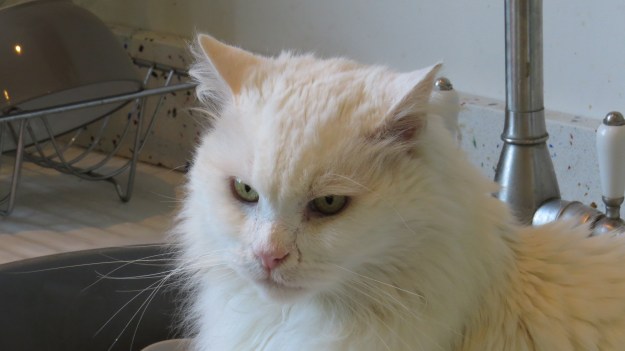
2021 – R.I.P Bailey, King of the Cats

Bailey, the world’s most magnificent cat in 2017

Dear Readers, when I say that a community is about more than just people, I often think of Bailey, who visited our garden regularly from when we moved in in 2010 to when he passed away in 2021. What a magnificent creature he was! And he seemed to bring the community together in a whole range of creative ways. We miss him still….

Dear Readers, a few nights ago Bailey, the King of the Cats, went to sleep for the last time at the fine old age of nineteen years. He has been so much part of our life, and of the lives of many people who lived in the County Roads, that I wanted to pay tribute to him here.

I first met Bailey before we even moved to East Finchley. We were standing on the patio of what was to become our new home when we heard a loud and persistent miaowing issuing from the bushes. Up strode Bailey. He bobbed up for a head scritch, rolled on his back and then marched up to the back door, demanding to be let in. As it  wasn’t yet our house, we decided that this probably wasn’t the best idea, but once we were living there he became a regular visitor.

On one occasion I heard the voice of Bailey’s owner, followed by an all-too familiar wailing.

“Bailey! Come down from there. Don’t make a show of yourself”.

And there was Bailey standing on top of the ten-foot fence at the end of the side return. He had gotten up there, but seemed not to have worked out how he was going to get down. We humans stood and considered what to do. I tried standing on a chair but it wasn’t quite high enough. Fortunately at that point my six foot three inch tall husband arrived home from work, fetched a stepladder and rescued him. Carrying Bailey up the road to his actual house became part of our weekly routine. I think he regarded us as some kind of taxi service for when he was too tired to walk the last hundred yards home.

We soon made friends with Bailey’s actual family (or ‘subjects’ as I’m sure he thought of them). We were in regular contact, as Bailey developed a habit of wandering off. We never fed him, but other people did, and locating him became quite a problem. I am convinced that Bailey never thought of himself as a cat, but as a small furry human being. He would make himself at home on the armchair and watch benignly as I worked. He also loved sitting in the sink, normally (but not always) when there was nothing in it. We learned that what he loved was to drink from a running tap.

Bailey trying to get us to turn the tap on by telepathy.

Finally!

You would not believe that in these photos Bailey was already fifteen years old. He retained his elegant good looks for most of his life, and he was such a popular character on the street that everyone seemed to know his name. Well, you couldn’t really miss an extremely vocal pure-white cat who simply demanded to know who you were and what you could do for him. I had the sense that Bailey always knew what he wanted, and a bit more besides. We found we had a lot in common with Bailey’s owners, and we would probably never have found out how much if Bailey hadn’t ‘introduced’ us. He always seemed preternaturally wise to me.

As the years wore on, Bailey got a bit slower and a bit stiffer, like most of us, but he was still a regular visitor to the garden. The birds never bothered about him, and I never saw him try to catch anything. Other cats scattered at a glance. He would sometimes pay a visit to the garden ‘waterhole’ for all the world like a domestic lion.

Bailey drinking from the pond

He’d always march straight up to the back door and yowl to be let in. If he caught your eye from an upstairs window he would re-double his efforts.

Let me in!

In April this year he paid a visit to the garden. He was clearly a very elderly gentleman, and yet he still announced himself in the usual way,

He was very wobbly on his legs and so we called his ‘Dad’ who came to carry him home. It is so sad to see an animal towards the end of his days, and yet Bailey was a cat who defied pity; he was still the same regal cat that he’d been when we first met him eleven years ago. He loved people, was never happier than when he was plonked down in a patch of sunshine, and seemed to be of the opinion that everything had worked out for the best. He was, as Samuel Johnson said of his beloved cat Hodge, a very fine cat indeed.

R.I.P Bailey. The street is quieter, and much sadder, without you.


2016 – Flâneuse-ing on the County Roads

IMG_7356

Dear Readers, after two years of finding things to write about for the blog I had discovered that all I had to do was take myself off for a walk around the County Roads here in East Finchley and there would always be something to see. I would invariably come back with a spring in my step and a conversation to report. I think this was the first of many such adventures. 

Dear Readers, for many years I have been intrigued by the idea of the Flâneur. This was a 19th century French character, invariably male, who would wander around a city wearing a top-hat and carrying a cane, and was described as a ‘connoisseur of the street’. He would get into all kinds of adventures and encounters, and would have a thoroughly interesting time. However for women, it was somewhat different.  In her new book ‘Flâneuse – the (Feminine) Art of Walking in Cities’, Lauren Elkin records how women doing exactly the same thing as the Flâneur could be subject to harassment and suspicion, and were sometimes accosted or even arrested. Nonetheless, I strolled forth intrepidly (though without top-hat and cane) to explore the County Roads here in East Finchley.

The County Roads are a set of six roads, built at the turn of the twentieth century, and they are all named after old English counties: Lincoln, Leicester, Huntingdon, Bedford, Hertford and Durham. They are a jumble of different Victorian/Edwardian styles, and vary from the ornate to the simple, from the grand to the (relatively) humble. What they all have, however, are front gardens, and for a naturalist like myself, that’s good enough. Who knows what I might see? I was especially intrigued to see how the pollinators were getting on, and what was attracting their interest.

My first step was right outside my front door, to admire my giant buddleia. It is true that it needs yet another prune, but I’m reluctant to get rid of those enormous racemes of flowers just yet. Plus, the more I hack at it, the larger it grows. Yesterday afternoon, it largely attracted honeybees.

IMG_7353Onwards! I head down to the High Road and, as if for the first time, notice what a strange shape the London Plane trees are after their pollarding. Each one appears to be trying to accommodate the buildings around it. Apart from the peculiar topiary effect, however, they are looking very healthy at the moment, though we could do with some rain – my water butt has run dry for the first time since we installed it five years ago. Every night the clouds gather and then dissipate away over Muswell Hill. Who knows what we have done to anger the gods.IMG_7362IMG_7385If bumblebees could vote with their many little hooked feet, I’m sure they would put their crosses down for lavender. The County Roads are very obliging in this respect, and there is a fine patch at All Saint’s Church on Durham Road, while many individual houses have handsome stands of the plant.

IMG_7373IMG_7374Although modern roses are not a favourite, the ones that are closer to the wild type attact some attention.

IMG_7371On another note, the bollard on the corner of Leicester Road is still not fixed (or maybe was fixed and got walloped again). Is there a gremlin here that attracts collisions?

IMG_7379

Lesser-spotted bollard

Alongside some very splendid cultivated sweet peas, there are some stands of a wild cousin, Broad-leaved Everlasting Peas (Lathyrus latifolius), and very pretty it is too.

IMG_7382

Broad-leaved everlasting pea (Lathyrus latifolius)

I stop to congratulate a man who is two-thirds of the way up a ladder, re-painting some of his plasterwork cornice. He nearly falls off with shock, but recovers himself to say how much he loves these old buildings and the little details that make them different from one another. I couldn’t agree more.

Someone is having much more luck with Nepeta (Cat Mint) than I did. I planted mine in a pot, and came downstairs to find that I had apparently grown a cat, though it just turned out to be some stoned feline who had crushed it in his frenzy, and who gazed at me with a demented expression.

IMG_7386

Honeybee on catmint (Nepeta).

It's no good trying to look innocent.

Evil cat-mint destroyer in pot.

Evil cat-mint destroyer

It’s no good trying to look innocent, though you are a very fine cat indeed.

I stopped to view a particularly wildlife-friendly garden that met with full Bugwoman approval. It had verbena and nicotiana (for the moths), some sedum just ready to come into flower, an interesting yellow vetch and all manner of other delights. I stopped to photograph it when, dear reader, I was finally accosted, by a lovely lady with a bunch of lavender from her allotment in her hand. She asked me if I was Bugwoman, and so of course I could not demur. Then another lovely lady approached, and I was introduced to her too. My cover was blown! Maybe I should create a Bugwoman costume, perhaps with dangly antennae and wings, though it might be difficult to handle the camera with extra legs.

IMG_7391

Sedum – a great plant for autumn pollinators

IMG_7390

Verbena bonariensis and nicotiana, amongst other pollinator-friendly delights

IMG_7389

Honeybee on Verbena boniarensis, a great bee and butterfly plant

Now, East Finchley readers, have you noticed our magnificent pigeons? We have our fair share of the normal blue-grey birds, and very fine they are too. But we have more than our share of birds which are partially white, and also ones that have a pinky-grey colouration, which is known as ‘red’ in the trade, I think. Huntingdon Road has its own resident pair of red birds, which I fear is due to the Kentucky Fried Chicken on the corner, and concomitant rubbish which is strewn at that end of the street (in spite of the litter bin). (Don’t get me started).

IMG_7426

A red pigeon about to indulge in KFC chips

IMG_7393

One of many pied pigeons in East Finchley

As I loop up towards the corner of Bedford and Durham Road, I stop to look at the fennel growing in one of the gardens. All of the umbellifers (plants with flat, multi-flowered blooms like Cow Parsley and Hog Weed) are pollinated by insects smaller than bumblebees: all kinds of flies, wasps, honeybees and beetles. It is thought that flies, in particular, are not so skilled at pollination, and don’t have the ability to cope with the complicated flowers that bumblebees do, so they tend to prefer single flowers, and lots of them.

IMG_7405

Little and Large….

IMG_7413

Ichneumon wasp on fennel

And some surprisingly complicated flowers can be ‘cracked’ by bumblebees, who really are the brains of the pollinator world. It’s been shown that, given sufficient incentive, they can tell the difference between human faces, so a passion flower is easy-peasy.

IMG_7417

Bumblebee on passionflower

As I make my last turn around the County Roads, the sound of cawing alerts me to the fact that the crow family have reproduced successfully again. Earlier, one of the parent birds was trying to persuade a fledgling to come down and eat a suspiciously new-looking slice of bread that they had filched. By the time I returned, the adult was watching as the youngster pecked about in the gutter of a nearby house, looking for food.

Parent crow

Parent crow

Fledgling

Fledgling

Dear Readers, I had a very fine walk around the County Roads, and I wasn’t arrested once. Even in a built-up area there is lots to see and enjoy. I would like to leave you with a brief clip of the bees feeding on a particularly lovely patch of lavender, where the heat of the sun was bringing up the scent, and the lazy droning of the insects (only partially obliterated by a plane heading home to Heathrow) made me wish that I had brought a deckchair with me. I hope that you enjoy it as much as I did. There is so much more ‘nature’ in a city than people often think.


The Twelve Plants of Christmas – Day Two (26th December) – Brussels Sprouts

Dear Readers, I am impressed by brussels sprouts in their native state – just look at those little baby cabbages sprouting from the stem, plus the leaves at the top! Two vegetables in one! But they are still not my favourite vegetables, and indeed we got until December 23rd before caving in and deciding that Christmas wouldn’t be Christmas without them. If you read the piece below, you’ll see that I have quite the history with the vegetable. They are more than just a cabbage to me! For background, the original piece was written in December 2018, just a few days after Mum died. And clearly, five years on, she’s still having an impact.

I still have the hairbrush, and use it every day.

Brussels sprouts (Brassica oleracea)

Now, some of you may have read Joan Didion’s book ‘The Year of Magical Thinking’, in which she describes her emotional journey following the sudden death of her husband. She recounts how she keeps his shoes because ‘he’ll need them when he comes back’. The rational  part of her knows that he’s never coming back, but she still can’t throw the shoes away. I had my own version of this when I found Mum’s hairbrush with some of her long, silver hair still in it. I found myself thinking ‘maybe someone could clone Mum from the DNA in her hair’. I know that this is completely ridiculous, but the thought was there. And I have the hairbrush, just in case.

More helpful is what happened to me earlier this morning. I was getting ready to go out for breakfast, and I was telling my husband that I probably wouldn’t do a blog this week because, after all, my mother had just died, and everyone would understand. And then I heard Mum’s voice in my head, as clearly as if she was standing next to me.

‘Don’t you dare not do the blog! Tell them about the Brussels sprouts’.

And so, Dear Readers, here is my take on that most divisive of vegetables the Brussels sprout, courtesy of my mother.

Every Christmas we would have Brussels sprouts with our turkey. I quite liked those sulphurous, squidgy little crucifers, and Dad positively loved them. They were usually a little watery and yellow, and I maintained that this was because Mum insisted on making a cross in the bottom of each one which allowed the cooking water to penetrate right into the heart of the vegetable. I, with my new-fangled modern ways, declared that this wasn’t necessary but somehow, even when I hosted Christmas in my own house, Mum managed to get hold of the Brussels and a sharp knife and the rest was history.

In fact last year, when we had Christmas in Dorset because Mum and Dad were getting over a chest infection and were too sick to travel, the only thing that Mum had the energy to do was to sabotage the Brussels sprouts. By this point I was only too happy to let Mum have her way.

When we eat sprouts, we’re actually eating the buds of the plant. I was too late to get a picture of the Brussels sprouts on the stem that were being sold at Tony’s Continental in East Finchley (the best greengrocer in London in my humble opinion), but here are some so that you get the idea. The plant is, of course, a member of the cabbage family (Brassicaceae) which accounts for those hints of sulphur if the plant is overcooked. It probably originally came from the Mediterranean area, and forerunners of our sprouts may well have been  grown in ancient Rome. The plant was known in northern Europe from about the 5th century onwards, and was said to have been grown in Belgium from about the 13th century, hence the name.

Photo One by By Emmanuel.revah - Own work, CC BY-SA 4.0, https://commons.wikimedia.org/w/index.php?curid=47586931

Brussels sprouts ready for harvest (Photo One)

Each stalk can bear a harvest of up to 3lbs of sprouts, which can be picked all at the same time, or over a period of weeks. The sprouts are normally ready for harvesting between 90 and 180 days after planting, and are considered sweetest after a frost. They are a traditional winter vegetable in the UK, though I would be willing to bet that a lot of people have them with their Christmas dinner and at no other time. Personally, my winter crucifer of choice would be a fine green cabbage, but that is an absolute no-no in my household.

There are some new varieties of Brussels sprout about, including a rather neat looking red and green flouncy variety that cropped up in Waitrose last year, and red Brussel sprouts have been around for a while . The red ones are a hybrid between red cabbage and the traditional Brussels sprout. Just as I find it hard to keep up with the ever-burgeoning selection of citrus varieties that appear in the greengrocers, so I am overwhelmed with Brassicas. I just get my head around kale when cavalo nero appears, and now there is micro-kale. I am not always sure that too much choice is a good thing.

Photo Two from https://www.telegraph.co.uk/foodanddrink/foodanddrinknews/8065212/Red-Brussels-sprouts-to-be-sold-at-supermarkets.html

Red Brussel sprouts (Photo Two)

Most of the Brussels sprouts eaten in the UK will be home grown, with the ones in Tonys coming from Lincolnshire. Sprouts need temperatures no higher than 75 degrees and are also fairly thirsty plants, so the climate in East Anglia is ideal.  In the US, the area around Monterey Bay, with its year-round coolish climate and coastal fog,  is a big area for growing sprouts, although up to 85% of them will be for the frozen food market. I’ve never eaten frozen sprouts, my great fear being that upon defrosting they would turn into mush, but surely all those American consumers can’t be wrong.

Like all members of the cabbage family, Brussels sprouts are very good for you, packed full of vitamins and minerals and that all important fibre. But if you are on Warfarin or some other blood-thinning drug, beware: sprouts are high in Vitamin K, and a Scottish man was hospitalised following excessive consumption of the vegetable at Christmas. Apparently eating Brussels sprouts means that the Warfarin is cleared through the body more quickly, and therefore does not create the desired anticoagulation effect. And here’s me thinking that the main danger from a Brussels sprout was stepping on a raw one and being catapulted into the Christmas tree.

Of course, the Brussels sprout lends itself to all sorts of other shenanigans not related to its health-giving  properties. In August 2014 adventurer Stuart Kettell pushed a Brussels sprout all the way to the top of Mount Snowdon with his nose to raise money for MacMillan Cancer Support. He needed 22 sprouts, it took him four days, and he lost all the skin on his knees. He managed to raise £5000. He had previously practiced by pushing a Brussels sprout around his garden, and purposely chose large sprouts so that they wouldn’t get stuck in any crevices. Well done that man! He had previously raised money by walking every street in Coventry on stilts, and by running in a giant hamster wheel.

Then there is Linus Urbanec from Sweden who holds the world Brussels sprout consumption record, eating 31 sprouts in a minute in November 2008. I assume that they were cooked.

And on the subject of cooking, there are so many recipes for Brussels sprouts that it is difficult to choose just a few. The rumour is that roasting sprouts avoids the sulphur flavour that results from boiling or steaming, and you can also shred them and stir-fry them. One of my favourite dishes is bubble and squeak, which uses left over mashed potato and left over sprouts. But I don’t think they should ever be turned into desserts, or smoothies for that matter. I am reminded of the time that I used swede in a cake recipe, and the whole thing was so revolting that even I couldn’t eat it. For those who are keen on such things, however, there are some Brussels sprout smoothie recipes here. And good luck.

I note that the ever-innovative Heston Blumenthal made a ‘Brussels sprout’ dessert for Waitrose last year, but, quel suprise, it contained no actual sprouts, only green profiteroles filled with lime creme patissiere. Hah.

Photo Three from https://www.mirror.co.uk/news/uk-news/heston-blumenthal-launches-next-big-11654201

Heston Blumentha’s ‘Brussels sprout’ dessert (Photo Three)

In ancient folklore, Brussels sprouts were said to have sprung from bitter tears, although it is also said that eating sprouts before a riotous evening will help to ward off drunkenness. It seems to me that a combination of sprouts and beer would be apt to produce both bitter tears and all manner of personal explosions, but there you go. If you can’t let rip at Christmas, then when can you?

And finally, in my journey through the world of sprouts I have found the delightful ‘Sprouts are Cool‘ website. And for your delectation, here is a poem by Suzie S, which sums the whole sprouts dichotomy in a few sentences.

Brussel Sprouts Poetry

O, Brussels sprout sae green and round,

Ye sit upon ma plate,
So innocently mystifying,
The cause o’ much debate.

Some say ye taste like camel droppings,
While others think you great,
I’m sure your sitting there a wonderin’,
Whit’s goin’ tae be your fate.

So let me tell you o’ so quick,
As nervously you wait,
That I find you e’er so loathsome,
So you definitely won’t be ate.

-Suzie S.

Mum was always so supportive of my writing. For years I would write 1000 words and send it to her, and she would read it, and then read it out loud to my Dad (who often fell asleep but there you go). She would foist my magazine articles onto anyone  who stood still long enough, whether they wanted to read them or not. She always believed that I was meant to be a writer, and would chide me if I stopped producing for any reason. And here she is, still doing it although she’s no longer here. She wanted me to be the best version of myself that I could possibly be, and so I guess I’d better get back to my notebooks and laptop and get composing. I wouldn’t want to disappoint her, even now.

Photo Credits

Photo One by By Emmanuel.revah – Own work, CC BY-SA 4.0, https://commons.wikimedia.org/w/index.php?curid=47586931

Photo Two from https://www.telegraph.co.uk/foodanddrink/foodanddrinknews/8065212/Red-Brussels-sprouts-to-be-sold-at-supermarkets.html

Photo Three from https://www.mirror.co.uk/news/uk-news/heston-blumenthal-launches-next-big-11654201

Nature’s Calendar – Cacophonies of Conkers (23-27 September)

img_7954

Dear Readers, I will have more to say about horse chestnuts in general, and conkers in particular, later this week. But today, in memory of my Auntie Mary, I wanted to share this piece from 2016. See what you think. 

As I walked through St Pancras and Islington Cemetery earlier this week, I came across the shed leaves of a horse chestnut tree, and a windfall of conkers. Some were new and mahogany-coated. Others had been crushed by cars, revealing their white, mealy interior. Some were still partly wrapped in their spiky green coats, and looked like half-open eyes. And as I photographed them, I suddenly remembered Auntie Mary.

Auntie Mary wasn’t a ‘real’ auntie at all: she was my maternal grandmother’s sister, whatever title that bestows. And yet we knew her better than we knew some of our official aunties. I can easily bring to mind her toothless grin, her thin dark hair held back by a hairgrip, her National Health glasses, the way she shambled around, shoulders hunched.

It was said that when she was a child, a boy had picked Mary up and swung her around while she screamed with delight, until suddenly his grip slipped and everything fell silent. Mary struck her head on the kerb, and was never the same again. These days, we would say that she had Learning Disabilities. When she was growing up, it was whispered that she was Simple.

img_7961And simple she was, in many ways. Mary never learned to count or to read or write. Her chief role was as wheelchair-pusher for my great-grandmother, who was crippled with polio. And yet, it would be a mistake to say that Mary didn’t understand what was going on.  When she was sent out to the corner shop to buy cigarettes, she remembered exactly what coins she had handed over, and what she got back. There was many an occasion when Mary was cheated, and my nan marched her back to the shop to say exactly what had happened. Faced with such evidence, most shopkeepers confessed to a mistake and returned the money. It was a trick that they didn’t try twice.

Mary was a generous soul with the little that she had. She loved the tiny chocolate-covered toffees that you could buy at the newsagents. Unfortunately, so did our mongrel dog, Sally. Sally would sit beside Mary and gaze up at her. Mary would resist for a few minutes, but then relent.

‘Alright!’ she would say, ‘But just one’.

And she would take out the paper bag that she had folded and folded until it was tight shut, and unfold it, and take out a single toffee the size of a bean, and give it to Sally, who would chomp it down in a tenth of a second. Mary would screw up the bag again and put it back in her pocket, but the dog was unrelenting. Mary would heave a huge sigh and take out the bag again.

‘This is the Last One’ she would say. But it never was.

Mum maintains that the dog had more of the sweets than Mary ever did.

img_7958Mary lived with Great Gran and Nan and Mum for years, but there came a point where it was all too much. Nan couldn’t look after a huge woman in a wheelchair and her own disabled sister any more. Great Gran went into one home, and Mary into another.

As was Mary’s way, she just got on with it. The home was in a mansion in Chigwell with rolling lawns and huge horse chestnut trees. We would go to visit, and play Banker with Mary. This easiest of card games involves breaking the pack into piles and betting on which pile will have the highest card. It’s pure luck, and Mary loved it, as did my brother and I – I was eight, and my brother was six, and so we were all pretty much at the same level. Mary’s glee when she won was infectious, and somehow she always won, probably because she wouldn’t let us stop until she had.

img_7964Mary was never loud or badly behaved, but the same could not be said of the other inhabitants, who were sometimes in the last stages of dementia. The screaming and the erratic behaviour of some of the ladies frightened my brother and I, and when it all got too much Dad would take us outside. In my memory it was always a damp autumn afternoon, and we would rustle about under the horse chestnut looking for conkers. The glint of the polished nuts shining amongst the fallen leaves, the faint smell of bonfires, our shrieks of excitement as we found yet another conker – these are the things that I associate with those last days, with the white mansion behind us and the lawn falling away. We would collect a whole shopping  bag full of conkers and bear them away. Strangely, I can’t recall playing conkers more than once or twice – it always seemed like a violent and dangerous game, in spite of Dad’s enthusiasm. I do remember sticking pins into the chestnuts and turning them into little temporary animals, before they were all tidied away in time for Christmas.

img_7967Mary went into hospital for a cataract operation one day. Something went wrong, and she died, never coming round from the anaesthetic. Apparently there was something wrong with Mary’s heart that had never been diagnosed. The staff at the hospital, and at the care home, were griefstricken.

What is a life worth, I wonder? It seems to me that the hole that is left in the web when someone dies is a bigger indicator of someone’s value than any money accrued or status acquired. Mary’s simple soul had drawn people and animals towards her like a magnet. She never created a great work of art or became a person of power and prestige, but she lived her life with joy, and never knowingly did harm to a living soul. The world would be a better place if we all lived so gently.

img_7965

At Whittington Hospital

Whittington Hospital Main Entrance (Photo by Tony Peacock)

Dear Readers, whenever I enter Whittington Hospital I am flooded with emotion. This is where they looked after my mother when she became ill with sepsis on Boxing Day 2015. It’s here that they saved her life, so that she could go on to enjoy her sixtieth wedding anniversary party, and to relish some of the small sweetnesses of existence as she became increasingly ill. I remember so well sitting in the canteen before the ward opened to visitors and walking back down the stairs in tears after a tricky visit.

Today, I was there for a whole raft of blood tests. I have some strange numbness and tingling in my feet, and as Mum, Dad and my brother all have type two diabetes, I thought I should get it checked out. Never one for half measures, my doctor has also requested lipids, liver function, bone density, a blood count and anything else she could think of. I expect that my left arm is now a few ounces lighter than my right.

The phlebotomy clinic is very well-organised – you’re checked off, given a number, and ten minutes later you’re leaving. The receptionist was apologetic that things were running a little late, but in the end I was actually seen five minutes before my scheduled time, so I’m definitely not complaining. I used to sometimes faint when my blood was taken, but fortunately I seem to have grown out of it – provided I don’t watch, it’s fine. And I should know the results by the end of the week. I never forget how lucky I am not to have to worry about the costs of medical procedures like this.

Anyway, today I wanted to share this original piece with you, written while Mum was still in hospital. It was the first time that I’d shared anything personal on the blog, and it changed everything for me. So, let’s go back to December 2015.

IMG_5116My mother and father came to stay with me in London this Christmas. All three of us knew it was a risk. Both my parents have the full range of late-onset ailments ( COPD, diabetes, dicky hearts) but this is the only holiday that they get, and, besides, prizing safety above all else means that we gradually retreat into our shells, like hermit crabs, afraid that every shadow is a shore-side bird waiting to gobble us up.

On Christmas morning. Mum was trying to pin one of the brooches I’d bought her onto her jumper, fumbling with the clasp. She sat back and smiled, the filigree butterfly a little skew whiff. Then, I remembered.

‘One last present,’ I said.

I’d almost forgotten the orchid that I’d hidden away in the bedroom. As I walked back downstairs, I looked at the flowers. I am not a great fan of orchids – they have an alien quality that looks sinister to me. And yet, my mother has a gift for coaxing them into flower time and again. This one was pale pink with mauve bruise-like blotches. The mouth of each bloom opened like a man-trap with long, backward-pointing teeth.

‘It’s beautiful!’ said Mum, as I passed it to her.

As I removed the wrapping, one of the flowers detached itself and floated to the ground. I picked it up, feeling the waxiness of the petals. I showed it to Mum.

‘Oh, put it in some water’, she said, ‘I can’t bear to think of it just getting thrown away’.

‘Really?’ I said. ‘Won’t it just die anyway?’

But she looked so upset that I found a dish and floated the flower in it. It’s still there now.

———————————————————————————————————————————-

Early on Sunday morning, I heard a rasping whisper from Mum and Dad’s bedroom.

‘I think you need to call someone’, Mum said. ‘I can breathe in, but I can’t breathe out’. I could hear her chest wheezing and crackling from across the room.

An hour later, she was in an ambulance, being given oxygen, heading for the nearest London hospital.

The doctors confirmed that she was 80 years old. They heard the recitation of her health problems, shook their heads over her oxygen levels and the sounds coming through their stethoscopes. They ascertained that at her best she could walk only ten paces without having to stop to gather her breath. They admitted her to the hospital. She was put in a huge room on her own. There were no windows, but there were lots of empty navy-blue storage cupboards, as if this had once been a kitchen but all the appliances had been removed. The fluorescent light gave off a constant background hum. It was like being in the belly of a great machine.

‘I’m not afraid of dying’, said Mum. ‘But it makes me so sad to think that I’ll never walk around Marks and Spencer again, or walk in a park. And I know I’m lucky and there are lots of things that I can still do, but somehow, just now, that doesn’t help’.

Normally I try to protect myself by avoiding what is really being said in these conversations, by trying, like Pollyanna, to look on the bright side. But today, I just sat, and held her hand, and cried with her.

IMG_5085As I walk to the hospital, I notice how bright all the colours seem, as if I’m hallucinating. The thoughts are chasing one another round and round inside my skull, as scratchy as rats. There is a wall alongside me and beyond a wildflower garden, at head height. The low winter sun lights up a patch of trailing bellflower. I see the way that the stamen are casting a hooked shadow on the lilac petals, the way a single raindrop trembles on the edge of a leaf before falling, in what seems like slow motion, onto the soil. And for a moment, I don’t think about Mum at all, and I feel my shoulders relax. I take a deep breath, then another. And then I walk on.

————————————————————————————————————————————-

It used to be that hospital wards were full of flowers, the stink of lilies and gently decomposing chrysanthemums rising above the smell of antiseptic and hospital cooking. But now, all plants are banned ‘for hygiene reasons’. Probably the nurses are so overworked that they don’t have time to cope with browning foliage and wilting poinsettias. But I can’t help thinking that something alive and beautiful is as important for healing as drips and antibiotics. Mum’s bunker looked completely sterile. But I had underestimated her.

At Christmas dinner, I had handed out some crackers that I’d bought from a wildlife charity. Each one contained a card that, when opened, released a snippet of bird song. The game was to guess which bird was singing – nightingale, blue tit, wren? Mum had put the cards in her bag. When the very important Consultant and his two trainees came along to see how she was doing, she produced one of the cards and pushed it into the Big Man’s hand.

‘Open that’, she said.

He looked at her askance, and opened the card. The sound of a song thrush in full-throat filled the bare room, flooding the place with the sound of woodland wildness.

The consultant’s face changed. He closed the card and opened it again. He turned to the two trainees.

‘I know you want to go home’, he said to them, ‘But listen to this!’

And he ‘played’ the song again, before closing the card and handing it back to Mum with a bow.

After a few days, Mum is moved to a different ward. As usual, she hates it at first – relationship is what Mum thrives on, and in each new location she has to charm everyone all over again. But she does have a window now.

‘At night, I can see all the planes flying over’, she says.

I notice that there’s a spider outside the window. At first I think it’s dead, but then I see that it is on a web, blowing backwards and forwards as the wind buffets the building. I decide not to tell Mum. She isn’t the world’s biggest spider fan. But it makes me happy to see this little note of anarchy in this antiseptic place.

‘At least I can get a breeze here’, says Mum. ‘Though when I was standing up next to the window yesterday they made me get back into bed in case I caught a chill’.

Her temperature is still too high, she is coughing most of the time and she’s pulled her canula out.

‘ I thought I’d be feeling a bit better by now’, she says. ‘But they’ve still got me on that bloody antibiotic that doesn’t work’.

I know that doctors don’t like to be told their jobs, but still.

‘Did you know that Mum’s been hospitalised for Proteus infections several times?’ I ask the doctor when he’s next on his rounds.

‘No’, he says. ‘Maybe we should talk to the people in Metabiotics’.

———————————————————————————————————

Proteus is a super-bug, and Mum probably acquired it in a hospital. Along with MRSA and C.Difficile, it is infecting our clinics and operating theatres. Proteus is so-called because it hides in the body, changing location. There are several variants, many of them immune to one antibiotic, some to several. The use of several antibiotics simultaneously is called Metabiotics.

This is the age of the antibiotic-resistant bacteria. On a bad day, I feel that we are standing on the threshold of apocalypse. I remember a display I saw about the Jamestown settlers in America. Several of them died from a simple tooth abscess that could not be treated, became infected, and spread through the body.

As we seek to sterilise our homes and hospitals and schools, life is creeping back through the keyhole, pouring under the door, finding the draughty spaces around our windows.

The doctors change the drugs. My mother’s body becomes a battleground. At 3.30 a.m. she rings me.

‘I’m in The Game’, she says. ‘I’m trapped in a room, and they’re murdering people next door, and slaughtering them like animals, and they won’t let me out’.

‘Mum,’ I say, heart racing, ‘You know that none of this is real?’

‘I know’, she says, ‘but I want to get out and they won’t let me go’.

The phone goes dead. I call the ward. After what seems like a year, the nurse answers. I explain the situation.

‘I’ll talk to her’, he says. ‘It’s the drugs’.

The next morning, Mum can’t remember any of it, but her breathing seems better. Then her blood sugar climbs to 32, a dangerously high level. It seems that, somehow, the bacteria are fighting back. This is not going to end any time soon.

On my visit, Mum hands back the cards with the bird songs in them.

‘Take them home’, she says. ‘Keep them safe. They don’t belong here’. And she closes her eyes, a look of concentration turning her face to marble. She is not beaten yet.

IMG_5117

Today, there is finally good news. The blood sugars are under control. Mum’s breathing is improving. Her poor body has fought back again, and if all goes well, she will be out of the hospital in a couple of days.

I am making my peace with the orchid. The buds are clenched fists, but the newly opened flowers are poppy-shaped, like cupped hands, around the soft inner petals. I see that the long, tongue-like leaves have a fine layer of dust.

‘I’d better clean you up’, I say to the plant. ‘Before Mum comes home’.

Update

Mum finally left the hospital on Thursday, and is travelling back home to Dorset with Dad and I on Sunday. She isn’t fully well yet, as might be expected, but she is getting better.I am deeply grateful to all the staff at the Whittington Hospital in north London for their unfailing care of my mum, and for their patience and dedication. The NHS truly is a pearl beyond price.


With the Barnwood Silver Birches

Male Large Skipper (Ochlodes sylvanus)

Dear Readers, yesterday I was lucky enough to meet with the Silver Birches groups for the over-55s that are held in Barnwood Community Forest here in East Finchley. What a lovely day it was! We had sessions on pollinators and on the folklore of plants, and the afternoon group learned how to make moss hanging baskets with Ursula from The Flower Bank, an amazing enterprise that recycles and reuses the flowers that would otherwise go to waste at corporate events, supermarkets, weddings and fashion shoots.

Of course, being Bugwoman it was very important to get people up close and personal with the amazing variety of insects that live in Barnwood. Here are just a few…

Comma Butterfly

Tree Bumblebee

Marmalade Hoverfly

Side view of the Comma, showing the ‘comma’ mark on its underwings

Speckled Wood underside

What impressed me so much with the Silver Birches was how much fun they were, how welcoming, and how patient they were when chasing some very flittery insects from one place to another with their camera phones so that we could get a snapshot of what was around on this sunny Midsummer day. It has been a long, long time since I’ve had the chance to do something like this and I had a wonderful time. So thank you to Leo and Linda who organise the sessions and to everyone who attended, it was a day that I’ll remember for a long, long time.