Category Archives: London Plants

Small Pleasures in St Pancras and Islington Cemetery

A hoverfly’s bum. You’re welcome!

Dear Readers, after missing last week’s walk in the cemetery because I was still feeling poorly, it was a great pleasure to have a stroll around today, enjoying the little things that have changed since I was here last. In truth, the end of July/beginning of August is a quiet time for nature, with the babies fledged, the caterpillars growing and all manner of creatures fattening up for the autumn, but there are still lots of interesting things going on if you look closely. The woodland graveyard site is full of blowsy thistles, wild carrot, ragwort and knapweed, and the hoverflies are taking full advantage.

Drone fly (Eristalis pertinax), a honeybee mimic

Hornet Mimic Hoverfly (Volucella zonaria)

Marmalade hoverfly (hopefully) (Episyrphus balteatus)

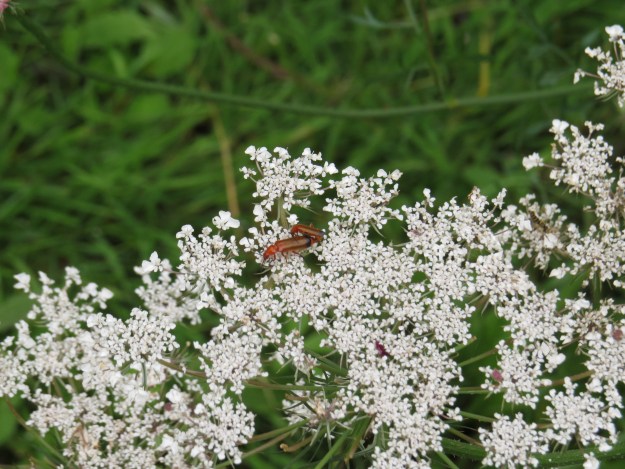
Hoverfly larvae are some of our most voracious aphid-eaters – we might be more familiar with ladybirds and their youngsters as they plough through a ‘herd’ of greenfly, but hoverfly maggots, though not the most appealing of creatures to look at, are basically aphid hoovers. The mimicry which means that these insects resemble bees or wasps is possibly also their downfall where humans are concerned – some people only have to see a flash of yellow and black stripes before they reach for a rolled-up newspaper. However, I’m sure that lots of predators leave them alone because of their colouration, so hopefully it all evens out. And look, here are some Common Red Soldier Beetles (Rhagonycha fulva), living up to their popular name of ‘bonking beetles’.
The conkers are continuing to fatten up.

Now, there’s a rose bush growing out of this conifer. So far, so unusual.

But here is something even more interesting…

This shaggy mass is the gall of a wasp, Diplolepsis rosae, which laid its eggs in the buds of the rose in the spring. Otherwise known as robin’s pincushions, each of these structures is woody inside and covered in long red or green hairs. The gall will contain many chambers, each of which contains a well-protected wasp larva. Male wasps are very rare, but the females can reproduce without needing sperm, so this is no problem. The new wasps appear in the spring, just in time to find new buds to parasitize. In Germany, these galls are known as ‘sleep apples’, and putting one under your pillow is supposed to be a cure for insomnia.

Photo One by By Frank Vincentz - Own work, CC BY-SA 3.0, https://commons.wikimedia.org/w/index.php?curid=2623501

The inside of a robin’s pincushion, showing the chambers and larvae (Photo One)

I was having something of a gall-ing day though because I also found these galls on some crack willow. Someone has clearly been having a very good time! These are caused by a sawfly rather than a wasp: the female injects a chemical into the leaf that causes the plant to make the gall. She usually also lays an egg, which eats its way out of the gall over a few weeks, but occasionally a gall won’t have an egg, because for some reason the female didn’t lay one. This tree was positively peppered with galls but looked very healthy nonetheless. Healthy plants can put up with a great deal of nonsense from insect ‘pests’ without any detriment.

I spotted this lovely fresh female Gatekeeper butterfly (the males have a brown stripe across the forewings).

Rather less welcome is the positive plantation of Himalayan Balsam that I’m seeing next to the cemetery stream. This is such an attractive plant – it bears more than a passing resemblance to a huge moth orchid, and it comes in a whole range of pink, white and coral. However, it is going to be taking over this stream if folk don’t watch out, and as the cemetery already has a massive problem with Japanese Knotweed I hope that it will be kept under better control.

As we were walking through the trees, I heard the sound of young birds, probably raptors of some kind, hidden in the branches overhead. It was so frustrating not to be able to see them! But then I remembered a tip from Mike over at Alittlebitoutoffocus – he’d recently uploaded an app where you can ‘listen’ to birdsong with your phone, and it will then tell you, to a reasonable degree of accuracy, what you’re listening to. So, in the middle of the cemetery I downloaded the app, recorded the birds and lo and behold, it returned a result of ‘sparrowhawk’ with 95% certainty. Two minutes later, a sparrowhawk flew overhead. Result! I spent the rest of the walk recording various birds to see how good I was personally – I identified a song thrush, a green woodpecker and a blackcap, but would have missed a greenfinch (even though I know that they’re present in the cemetery because I’ve seen them). So, I can recommend this app if you want to improve your id skills, or even just want to find out what birds are about – there are definitely lots more than you ever see.

And finally, I had to stop to smell the lime blossom. I think it’s one of my favourite perfumes – not as heady as jasmine, not as floral as rose. What a delight it is to feel almost normal again.

Photo Credit

Photo One By Frank Vincentz – Own work, CC BY-SA 3.0, https://commons.wikimedia.org/w/index.php?curid=2623501

A Late July Walk on Hampstead Heath

Dear Readers, there has been all sorts of shenanigans at the Bathing Ponds on Hampstead Heath during the past few years. Charges were introduced for swimmers at the Women’s Pond for in 2004 (though I note that over sixties can still swim for free before 9.30 a.m.), and were increased recently. Works have taken place to dam some areas around the men’s pond due to flood risk – there are a lot of flood mitigation works in the pipeline in several of the green spaces in North London, and with the recent flooding following storms during the past month it looks as if something will need to be done. Balancing the future needs of the area against present amenities is always tricky, especially as, with climate change, things look so uncertain. One thing is certain – Hampstead Heath will always provoke strong, passionate feelings from those who use the area regularly, and who want to protect it. Long may this continue.

It was very quiet in the woods today: on a summer weekend during lockdown the crowds were everywhere, but today seemed like a welcome return to some kind of normal. The ivy roots dangling from this horse chestnut put me in mind of those great trees of the Southern USA with the Spanish Moss dangling from their branches.

There are little patches of Small Balsam (Impatiens parviflora) – I haven’t noticed this elsewhere in North London. At least it isn’t as bold and invasive as the Himalayan Balsam (Impatiens glandulifera) that’s popped up in other places, such as the Cemetery.

This very fine hoverfly was on the creeping thistle – I can’t pass a patch of thistle without stopping for a look, there’s always someone interesting popping in for a feed. This very handsome chap is the Great Pied Hoverfly (Volucella pellucens), a close relative of the Hornet Hoverfly(Volucella zonaria) that I mentioned in my post about Cherry Tree Wood earlier this week. The Great Pied Hoverfly has a most interesting lifecycle. The adult female walks into the nest of a common wasp, and somehow gets away without being stung to death. She lays her eggs, and when they develop into larvae they feed on detritus in the nest, and dead and dying wasps and their larvae. When they are ready to pupate, they leave the nest and burrow underground, reappearing the following spring in time for the whole cycle to begin again. Never underestimate a fly, that’s all I can say.

And here is some Great Mullein (Verbascum thapsus),  a plant that I hadn’t noticed on the Heath before. I feel a Wednesday Weed coming on.

Great Mullein (Verbascum thapsus)

And here is some Musk Mallow (Malva moschata), a much more delicate plant than the Common Mallow that I’m usually finding all over the cemetery. Another Wednesday Weed, maybe?

Musk Mallow (Malva moschata)

I always love my first glimpse of Kenwood House through the trees. That way lies coffee and a brownie!

Now, have a look at this absolutely magnificent sweet chestnut (Castanea sativa). I am clearly getting better at identifying things, because one factor in identification of mature sweet chestnuts (over 60 years old) is that the bark starts to spiral around the tree, usually in a clockwise direction, though I’m not convinced that this isn’t anti-clockwise (says she, scratching her head). I do love being able to put a name to things, it seems more respectful somehow. Also, I must remember to take a big sniff towards high summer, as the male catkins are said to smell of frying mushrooms.

When we finally get our coffee and brownie, we’re joined by this very fine pigeon. He is not at all deterred by the fact that my husband’s flapjack is vegan, and I swear he’d be sitting on our knees waiting for crumbs if he was allowed. He breaks off only briefly to huff and dance around a female he lands nearby before he’s back on flapjack watch.

A crow flies up onto the roof of the building opposite with what appears to be an entire scone – possibly someone wasn’t paying full attention in the tearoom gardens next door. The crow is soon joined by a fledgling. I can’t see for certain, but I suspect that the adult is dunking the cake into some water in the gutter to soften it up a bit for the youngster – I’ve seen them do this before. You are always being watched by some sort of avian beady eye when you sit here with a sandwich. Be warned.

The flowers outside the gift shop are all supersized, be they the white hydrangeas, the dahlias or the ten-foot-tall sunflowers.

And there was a brief moment on the path back to the ponds when there was no one around at all – not a jogger, not someone having a conversation on their mobile, not a gaggle of small children or a dog walker with various hounds. There was just us, and the sunshine, and the trees for about 90 seconds.

Long enough to notice how the Enchanter’s Nightshade, normally such a weedy little plant, can actually also be magical in the right light.

Back to the boating pond. Oh dear.

And just in case it isn’t clear….

No one told the ducks and the black-headed gulls though, and the swifts were skimming the surface for insects. I haven’t seen a single swallow or house martin yet this year though, I hope things are better where you are.

Tufted duck and black-headed gull having a rest

And how about this female/juvenile Mandarin duck (Aix galericulata)? I’ve never seen a male here, but I know that many of them have escaped from wildfowl collections. There are a lot more protected, reedy areas around the boating pond now, and the duck nests in tree holes, so it would be nice to think that they might have made a home here.

We head back, stepping carefully around a painted lady butterfly that’s picking up salts from the path.

I’m delighted to see the ragwort doing so well – this must be one of the UK’s most maligned plants, but it’s the foodplant of the cinnabar moth, and is much beloved by all sorts of pollinators.

We stop for a few minutes to watch the dogs swimming in the doggy part of the pond. Some dogs are clearly into it, and others can’t understand what all the fuss is about. Guess which heading this hound falls under.

And then it’s back to the 214 bus stop, with a brief pause to admire this sign on the side of what is now an Italian restaurant. How I’d love to stop for a Bean Feast!

A Summer Walk in East Finchley Cemetery

Bhutan Pine (Pinus wallichiana)

Dear Readers, today I pulled out all the stops and headed to East Finchley Cemetery for a quick look at what was going on. I feel a bit as if I’m in Wonderland at the moment – all the colours seem brighter and the sounds of the birds are enchanting.

There are some spectacular specimen trees in the cemetery, such as this Bhutan pine (Pinus wallichiana). Its original home is the foothills of the Himalayas, Karakorum and Hindu Kush, but it seems strangely at home here in North London, amidst the monkey puzzle trees and the cedars of Lebanon.

On a smaller scale, I love the community of tiny plants living on this wooden roof. What look like bird droppings are, in fact, lichens.

And then a streak of greenish-yellow catches my eye, and a young green woodpecker poses very nicely for a few minutes.

We hear a young bird of prey calling from one of the big cedars, but no amount of patience will persuade it to emerge from the foliage, and its parents are clearly not in the mood to indulge it, so I might never know what it was. Very frustrating, but then that seems to be how nature works – some days everything falls into your lap, and some days you have to sigh and walk on.

There are some lovely unused buildings in the grounds of the Cemetery, which seems to mostly use the Italianate crematorium or the big Anglican chapel at the main entrance. The Glenesk Mausoleum is a lovely building, now completely fenced off and in danger of being engulfed by the nearby trees.

The Glenesk Mausoleum

There is a hopeful kneeling saint on the right hand pediment, but the one on the left has disappeared under a tangle of ivy.

The non-conformist chapel is in better shape, though the two small heads on the doorway have seen better days.

I’m not sure how much this chapel is used, but according to the cemetery’s management plan to 2012 it was thought to be a feeding roost for brown long-eared bats, so maybe a little seclusion is not a bad thing. There are lots of bat boxes mounted in the trees around the cemetery, but as it closes at 4 p.m. I guess I will never take a twilight walk to see what’s going on. Let’s keep our fingers crossed that the summer air is criss-crossed with bat flight.

And, as I am midway through my Leith’s Online Cookery Course (it’s pasta week!) my eye was drawn to this grave. Jean Baptiste Virlogeux was chef at the Savoy during the 1930s, and was then Head Chef at the Dorchester for ten years, where he catered for the Queen and Prince Phillip. Whilst at the Savoy he invented the ‘Omelette Arnold Bennett’, a mixture of smoked haddock, eggs and gruyere in honour of the famous author. At the Dorchester, Virlogeux came up with the idea of the ‘Chef’s Table’, a private table for very special guests who could watch the chef work and no doubt ply him with confusing and impertinent questions while he wrestled with their dinner.

On our way back to the entrance we encounter this cheeky squirrel, who is clearly of the view that if he stays still enough we won’t notice him.

But then, how about this? Most of the beds in the cemetery are rather formal, but this is so bright that it seers the eyeballs, and none the worse for that. There is a sweet smell, I think from the salvia. How it cheers me up, especially on a dull day like today.

And just when you think the colours couldn’t get any brighter, look who drops in.

Peacock butterfly (Aglais io)

And now it’s time to head home for a cuppa and a few hours with my feet up (once I’ve done my blog of course). As usual the cemetery has provided all sorts of delights. What fine spots they are for reflection and for nature!

First Walk for a Week

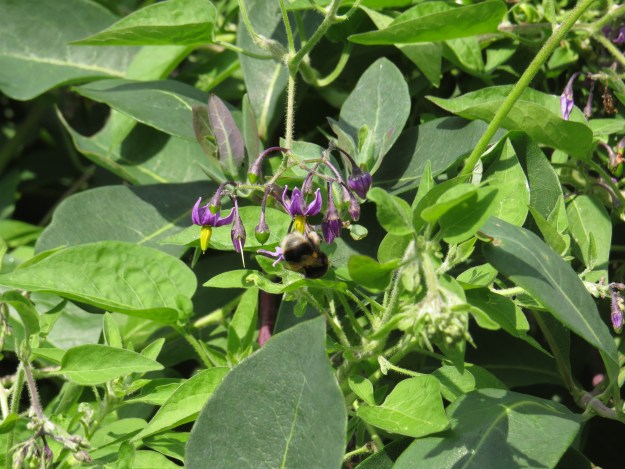
Dear Readers, how different the world outside looks after even a few days! I positively skipped around East Finchley today, there seemed to be so many things to see. First up was this bumblebee, who couldn’t have gotten herself anymore covered in pollen if she’d tried. I wondered if she’d been caught in a shower and then visited something very pollinaceous. At any rate, she was going to be popular with any larvae left in the nest for sure.

I stopped for a look at the tree which had a branch knocked off in an unfortunate event last year. It appears that nothing much has been done, and I suspect (though I’m no expert) that damp will penetrate the wound, along with fungi and all manner of other organisms. At the moment it suddenly seems to be abloom with lichen. I note from my previous piece, though, that this is nothing new. Let’s hope the tree is resilient enough to withstand even this.

I stop to note the pretty orange berries on a rowan cultivar just down the street…

…and that the infamous bollard at the bottom of Leicester Road appears to be upright at present.

Leicester Road bollard in 2018

We turn into Summerlee Avenue, which has some of my favourite plants. There is one front garden with a mauve and white buddleia that are both abuzz.

White buddleia

Further down the road, one of my two favourite Japanese maples has tiny ‘keys’ appearing, reminding me that it’s a relative of the sycamore, even if it’s rather more refined.

But what on earth is this plant, heavy with scent and so full of insect activity that I could hear it one house away? It looks and smells a little privet-y, but the flowers don’t look right. Someone has suggested Pittosporum but I think they flower a lot earlier. Help me out here, people!

But wait, what’s that on the first photo? It’s my find of the day, a perfect hornet hoverfly (Volucella zonaria). It’s a big beasty, and the colours are a perfect match for a hornet, though the shape and those massive eyes are a bit of a giveaway. Hornet hoverflies are the largest hoverflies to be found in the UK, and it’s always a thrill to see this impressive, harmless beast. I do hope that its mimicry doesn’t result in more pointless swatting than usual.

A real hornet

Off we go into Cherry Tree Wood. It’s very green at this time of year, and the slow-motion dance of the hornbeam trunks seems even more marked than usual.

Lots of the hornbeams are setting seed….

And someone is working on the cafe, where I think a pop-up is planned for later in the summer. There’s been some nice planting around by the tennis courts too, and some areas are unmown, which is great for the butterflies.

On the way home we take a walk along the unadopted road, which is always great for ‘weeds’ and insects. There is a splendid red admiral who poses very nicely. I had never noticed those blue marks on the lower wings before! I must get back to doing some nature-drawing, it really helps to focus attention on the detail.

People have clearly planted wildflower seeds outside their back doors, and there are some very nice combinations. This one has some phacelia and what I think might be ‘proper’ valerian.

This house has corncockle and corn marigold and poppies. It always feels so generous to plant where you can’t even see the results.

And finally, when I get home (in dire need of a cuppa) I see that someone has been committing murder in the hemp agrimony. There are the bodies of several tiny hoverflies already trussed up amongst the flowers.

This is confusingly known as a candy-striped spider (Enoplognatha sp.) Some of them have a very attractive pink stripe or two on their abdomen, but mine only has some tiny dots. Nonetheless, what an efficient little hunter this is! She seems to spend some time under the flowers, waiting for prey of a suitable size to land – at the moment there are some tiny black hoverflies about, which seem to be a particular favourite. Then she seems to grab them from below, truss them up and give them the killer bite before retreating for a well-earned rest. I love having plants that grow to just below eye level in the garden, it makes the invertebrate-spotting so much easier.


Feeling Hot, Hot, Hot (But Not in a Good Way)

Well Dear Readers, here is sickbed update number seven, and if only my fever would behave itself I feel as if I might actually be on the verge of getting better. I am cautiously hopeful at the moment so keep your fingers crossed! Goodness knows what this is, but I will be very glad to wave goodbye to it.

Anyhow, I was sitting in the garden and something jet- black flew in – I honestly thought it was a smut from someone’s bonfire, or a scrap of black dustbin bag. But then it landed on the hemp agrimony, and I could see that it was a peacock butterfly, as fresh as you like. I didn’t manage to get a photograph of its spectacular eyespots, but in a way that satanic black was so surprising that I wasn’t sorry.

When the light changed, I could see that the ends of the antennae have tiny gold spots on them, and you can see the butterfly’s long tongue probing into the flower.

Lots of other insects are enjoying it as well. Such a raggedy plant and yet every year it’s popular. The purple loosestrife is just coming into flower too, so there will be plenty to keep this lot going until September at least.

And then there’s this plant, which will hopefully provide some autumn sustenance – once upon a time it was called sedum but it’s now a Hylotelephium, though what variety it is I can’t remember – chip in if you know! It’s a most delightful chocolate colour.

Anyhow, to round this off, I thought I’d leave you with a few ‘fever’ songs for your delectation. Firstly, the wonderful ‘Hot, Hot, Hot’ by Arrow – if this doesn’t get a party started, I don’t know what will.

https://www.youtube.com/watch?v=-L9jBi7sGsc

And now, two versions of ‘Fever’. What a great song this is! See whether you prefer Peggy Lee or Elvis. I think Elvis has the edge for me, but how I love that you can hear every single word, and the weight of erotic meaning that both artists give to it. Summer is officially here, though if my personal summer could get back to normal body temperature I’d be ecstatic.

‘Fever’ – Peggy Lee Version

‘Fever’ – Elvis Version

Oh The Irony….

Dear Readers, there is something a little ironic about having gotten through 18 months of a pandemic without even being pinged by the NHS app, only to catch something and end up self-isolating when ‘Freedom Day’ is today, 19th July. On the other hand, ‘Freedom Day’ won’t be freedom for vulnerable people, people who have compromised immune systems because of chemotherapy, elderly people or anyone else who has reason to fear the devastating potential effects of this virus. With only 50% of the country double-vaccinated, would it really have hurt to keep things on an even keel for another month or so? I don’t doubt that most people will continue to be sensible, but there has been a leadership vacuum of colossal proportions in this country. My heart goes out to people working in the NHS who are seeing the numbers of the hospitalized rising inexorably. We have been abandoned. No wonder so many people are filled not with joy at the unlocking, but with trepidation.

Anyhow, I have done my Covid test and posted it, and now I wait to see if what I have is something known or something unknown. I feel a bit tired, but basically much better, so I will just have to be a patient patient. Thank you for all the good wishes, and in particular to the person who reminded me that even if  it’s not Covid it doesn’t mean that  I should rush headlong back into my usual frantic round of activity – I think the phrase was ‘other viruses are available’, which made me hoot.  That is excellent advice. I feel tired to my bones somehow: it’s sometimes a struggle just putting one foot in front of another. But then, there’s always the garden, and it’s too blooming hot to do any actual work so I just sat in the shade and tried to pay attention, as that is the cure for most ills.

If you look very carefully at the picture below, you can just see a tiny plane about to enter the clouds. Who remembers that feeling when you’re on a flight and the plane starts to judder as you enter the clouds, as if it’s flying through something viscous? Or that extraordinary sensation when you get above the clouds and there’s the sun and that perfect blue? It always reminds me of that Buddhist sense that behind all our nonsense there is that clear, vast ‘mind’ that is available to all of us if only we could put other things aside.

I wouldn’t want you all to think that I was being too lazy, so I actually got up and wandered over to the pot of ‘wild flowers’ that we planted about a month ago. It’s fair to say that they haven’t been a stunning success, but what’s with the brassica? It looks like oilseed rape to me.

But all is not lost, because I did notice a small white butterfly hanging around earlier this morning, and when I bent down for a closer look, she has laid a single egg. Now, if you’re a gardener I can imagine you not being that impressed, but at least Small Whites only lay one egg, as opposed to 50 like a Large White. I shall have to see if this one survives, and shall have to remind my poor long-suffering husband not to water too enthusiastically this evening when he gets the hosepipe out.

In other news, the Great Willowherb is just opening. Every year the buds are parasitized by some little moth, and every year it seems to make not a jot of difference to the flowering.

And the collared doves are huddled in the whitebeam for shade. I think these birds are underestimated on the looks front, with their subtle shades of cinnamon and fawn and dusty grey.

And so, there you have it. I expect a few more garden posts in the next few days, but the weather looks gorgeous. Stay safe out there, UK people, and avoid any idiots….

A Mid July Walk in St Pancras and Islington Cemetery

Dear Readers, after a most peculiar day yesterday, when I seemed to run completely out of energy, I felt a bit better this morning, so decided to go for a somewhat truncated walk in the cemetery. I can avoid getting close to people, and felt quite a lot better, so it felt like a reasonable thing to do. Alas, halfway round it seemed like I am still not myself, so I went home to isolate and have ordered a test. I still think it will be negative, but you can’t be too sure.

Anyhow, the first thing I noticed was that the cherry plums, who seem to have been in bloom only about twenty minutes ago, are now dropping their fruit. How quickly the year goes!

And just look at the swamp cypress. After a slow start, it’s now truly magnificent.

The wild carrot is in flower. The young flowerheads are a dusty pink, the older ones bright white.

The white flowerhead has the characteristic single red flower in the middle, and botanists think that this has evolved to convince pollinators to come visit – it looks just like a small beetle already feeding. The pink flowers have one too, but they aren’t as obvious (yet).

it’s certainly persuaded this long-horned beetle to drop by.

The conkers are doing very nicely, though the leaves of the horse chestnut are looking worse every week.

The yellow and white stonecrops are being overtaken by this pretty pink-flowered plant, which I think is Caucasion stonecrop (Phedimus spurius). I am fascinated by the way that some graves form a good habitat for these plants, and others don’t – I’m guessing it’s all down to a mix of soil, sun and exposure.

It really does have a mid-summer feeling to it today – temperature in the ’80’s, sun beating down….

We stop for a most uncharacteristic rest, and a jumping spider pops onto my leg…

The evening primrose is coming into flower.

And what a pleasure it is, on these long, hot days, to walk along a shady lane.


Five Minutes in the Garden

Dear Readers, it’s been one of those days when what I’ve mostly done is compare and contrast two spreadsheets and try to bring them together as one coherent whole, so what a pleasure it was to get up, stretch my legs and see what was going on in the garden. There are still a few damselflies about, I rather like that this one has a bar-code on her tail. This one is a Large Red Damselfly (Pyrrhosoma nymphula) and I know that it’s female because you can just about see a yellow band between some of the segments on the abdomen. She’s probably thinking about laying her eggs somewhere in the pond if she hasn’t done so already.

This plant has just popped up (as they do), and it’s a willowherb, probably Hoary Willowherb (Epibilium parviflorum),  a common willowherb of damp places. It’s so delicate that it’s hard to imagine how it held its own amidst the more vigorous plants, but here it is.

And over in the bittersweet there’s a bumblebee with bright orange pollen baskets on her legs. She looks as if she’s wearing a pair of tangerine-coloured bloomers.

This bee is carrying grey pollen, and interestingly you can tell what plant a bee has been foraging on by the pollen colour. Grey pollen can come from hazel or elder (probably elder at this time of year), and orange can come from lime – there are masses of lime trees in flower at the moment.

And having mentioned that I hadn’t seen any chaffinches for a while, a young one popped up on the seed feeder.

And finally, look who turned up on the guttering this morning while I was half-way through (yet another) Zoom call! The garden has been full of sparrows all week, and some were even belatedly examining my sparrow nesting boxes. Let’s hope they remember them next year.

How the Mighty Have Fallen….

Dear Readers, those who’ve been following this page for a few weeks might recognise this plant as the nine-foot tall angelica that popped up this spring. Well, the flowerheads have gone over and the plant has been looking a bit precipitous for a few days, but the rain and wind on Sunday night finally blew it over altogether. What a shame! But it’s clearly become handy for some of my local visitors, who find it very convenient.

The garden is still full of fledgling starlings – by this time in a normal year they’d be much more independent, and the garden would be falling silent. This year, the little devils are still everywhere. Each time I walk out to the shed they positively explode out of the surrounding trees and shrubs, followed by the woodpigeons, collared doves, goldfinches etc etc.

I’ve taken to saying “Calm down guys, it’s only me” every time I go out, but I’m not convinced it’s working.

And then, I had a very nice surprise this morning.

Fledgling sparrow marching along the hand rail.

Look at this fledgling house sparrow! I haven’t really seen sparrows in the garden for months, apart from the odd fleeting visit, but this morning the place was full of them. Here’s a Dad feeding his youngster…

For an enchanting ten minutes they seemed to be everywhere. Perching on the hemp agrimony….

..hanging out on the greater willow herb…

or just chilling on the hand rail waiting for some food….

…and every so often getting lucky…

Mum used to love sparrows.

“They’re so friendly!” she’d say. “You never see them fighting”.

Well, all I can say is she must have been watching a different species from the one that I observe, because I see sparrows squabbling all the time though, to give Mum her due, it does normally seem short-lived and non-serious. And today it was all about the difficult business of rearing these hard-earned balls of fluff to maturity. I always feel so privileged to host the local birds, especially when, like sparrows and starlings, they’ve become so much rarer than they were when I was a girl. The garden might look a bit wild and woolly, but goodness a lot of wildlife pops by, and that makes me much happier than a manicured plot would ever do.

Wednesday Weed – Creeping Jenny

Creeping Jenny (Lysmachia nummularia)

Dear Readers, I was rather taken with this pretty little plant when I spotted it at the cemetery last week. I have been thinking about getting some for the edges of the pond: it likes damp conditions and shade, which is just about perfect. It’s a member of the primrose family, though it superficially resembles a buttercup, and is a native plant, found mostly in the south of England. It’s also known as ‘moneywort’, probably because of its golden flowers and round leaves: its Latin name ‘nummularia’ also means ‘like a coin’.

Creeping Jenny (Lysimachia nummularia)

Creeping Jenny is also known as ‘herb twopence’, probably because of the leaves laying two by two along the stem. It was felt to be a most beneficial plant, one of the very best for treating wounds, and useful also for scurvy and haemorrhage. Boiled with wine and honey, it was believed to be a useful treatment for whooping cough. In Chinese traditional medicine it’s used to treat kidney and urinary stones, and it’s also said to be useful in the alleviation of gout.

Snakes were said to seek out the plant when they were in need of medicine, and yet another alternative name for it is ‘serpentaria’. I wonder if grass snakes, with their love of water and damp places, were often seen in association with the plant? This is often how these connections are made.

When burned, creeping Jenny was thought to deter insects and vermin in the house. Nobody will admit to actually eating the plant, but you can make a tea from its flowers and leaves.

A garland of creeping Jenny laid across the shoulders of yoked oxen is said to have made them work more peacefully together. As part of the loosestrife family (along with spotted loosestrife), it is said to generally increase serenity and lessen conflict, something that could come in very handy.

You may also have seen this golden version of creeping Jenny, which seems to be particularly popular for container displays.

Photo One by Photo by David J. Stang, CC BY-SA 4.0 <https://creativecommons.org/licenses/by-sa/4.0>, via Wikimedia Commons

Golden version of creeping Jenny (Photo One)

And finally, a poem. I rather liked this recent work by American poet Jack Ridl, published in Reformed Journal. I hope he has better luck with the sweet woodruff than I did, though.

Let Us Break Bread Together on Our Knees 

by Jack Ridl

And the angel said unto thee, Go thou
into your garden and plant Creeping Jenny,

alyssum, Sweet Woodruff to crawl across
the earth, and herbs to bring culinary alchemy

into each and every meal: oregano, rosemary,
lemon balm, chives, sage, and thyme. Then

set deep into the soil two wisteria vines, three
redbud trees, a butterfly bush, lupines, salvia,

zinnias, a hundred zinnias. Wait for the bees.
Wait for the 20,000 kinds of bees, from bumble

to honey to mason. Watch how they live in
harmony, all humming as if they can trust

one another and the petals, stamens, the ways
the flowers make their indifferent offerings

of pollen. Genuflect to the bees that ye may
eat of the fruit of the land. Be ever humble

in your unknowing. Learn the intelligence
of worm, vole, sparrow, spider, how none

needs even a holy word to linger and
work, becoming nothing more than what

they are under the benign disregard of sky,
the unpredictable nonchalance of weather.

Photo Credit

Photo One by David J. Stang, CC BY-SA 4.0 <https://creativecommons.org/licenses/by-sa/4.0>, via Wikimedia Commons