Category Archives: London Plants

A Mid May Walk in St Pancras and Islington Cemetery


Dear Readers, this tumbled headstone, complete with its own pond and fine growth of algae, just about sums up this week. It is heading towards being the wettest May on record. What people generally don’t appreciate is that climate change creates weather chaos, not just a gradual rise in temperatures. For the birds who have started breeding the lack of insects will probably increase the rate of nest failure, and for insects trying to complete their reproductive cycles it will lessen the amount of time that they have available. At least we haven’t had snow in London, though it has fallen further north this month.

It’s also been very windy, so the dandelion clocks, so abundant last week, have more or less disappeared, to be replaced by a carpet of daisies and buttercups.

Creeping Buttercup (Ranunculus repens)

There are several species of buttercup in the cemetery: there’s the typical creeping buttercup (Ranunculus repens), with its three-lobed leaves, the poor old Goldilocks buttercup, (Ranunculus auricomus) where the flowers are always missing their petals and it looks as if it’s been nibbled even when it’s pristine, and the delicate meadow buttercup (Ranunculus acris), with its finely-cut leaves. Once you’ve got your eye in for identifying these plants, you notice that the flowers on the meadow buttercup seem to have more separated petals, and the whole plant is a bit taller than the creeping buttercup. My Dad taught me that where there are buttercups of any kind it’s an indicator that the soil is wet, so it’s best to avoid standing near them if you don’t have your Wellington boots on.

Meadow buttercup (Ranunculus acris)

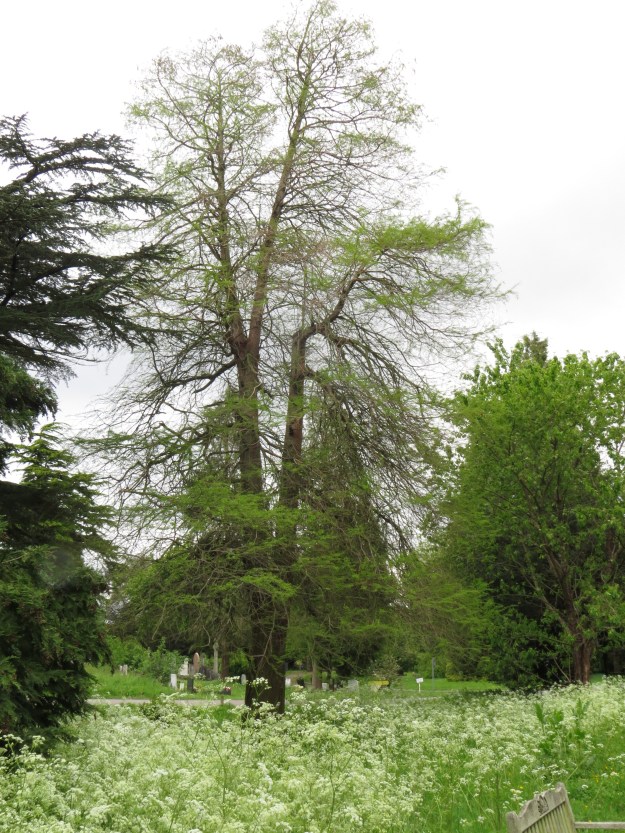
I am pleased to report that ‘my’ swamp cypress is finally getting a coat of green, rather later than I expected. Look at it standing ankle-deep in cow parsley!
I noticed how the flowers on the horse chestnut turn pink when they’re pollinated – you can see the mixture of yellow and pink blossom on this flowerhead. I have seen bumblebees about in the midst of the storms this week, determinedly heading for the dusky cranesbill which is in full flower in the garden. I am a recent convert to species geraniums – some varieties are shade-tolerant, and the bees love them. I imagine that a tree like a horse chestnut must be a powerful bee magnet. So many flowers! So much nectar and pollen!

There is some sorrel just starting to appear too – I horrified my husband by eating a leaf just to make sure. It looks rather like a grass, but it’s actually a member of the knotweed family. The leaves have a delicious lemony tang to them, and if you look at the stem you can see how similar it is to plants like bistort and redshank.

Common sorrel (Rumex acetosa)

When we reach the main path that leads to the North Circular Road entrance, what should we see but a blooming little egret flying past! I apologise for not getting a better photo for you, readers. I promise that the white blob just right of centre towards the top of the photo is actually an egret, not a stray handkerchief whooshing past in the high wind. I wonder where s/he was going?

On we go. I am delighted with the way that the sycamore flowers are already turning into the little ‘helicopters’ as we used to call them.

A rather magnificent crow surveyed the scene from the top of a tree. We’d just watched a crow pick up half a sandwich that someone had dropped, dunk it in a puddle to moisten it and then fly off, presumably back to a nestful of little dinosaurs waiting for their lunch.

And there’s an area completely covered in shining cranesbill (Geranium lucidum). Even allowing for the damp weather, just look how shiny the foliage is! And look at all those fallen horse-chestnut flowers, probably ripped untimely from the tree in this week’s wind, rain and hail.

Shining cranesbill (Geranium lucidum)

Storm damage


More branches down

My friend A told me that there were some whole trees down in other parts of the cemetery. It’s such a large area that they can lay around for quite some time if they haven’t fallen onto a recent grave, and if they aren’t blocking a well-used road.

And, as usual in the cemetery, I notice something that I’ve walked past a hundred times without really seeing it.

The broken column symbolises a life cut short, and was often used to signify the death of a child, as indeed is the case with this memorial. Little John Arthur Winter died at the age of 18 months, and is buried here with who I imagine are his grandparents, judging by the ages.

John Arthur was born in Shoreditch,  to Charles Richard and Amy Jane Winter, and was baptised in St John the Baptist church in Shoreditch. In 1881, 5 years after John Arthur had died, Charles Richard and Amy were living at 164 Southgate Road in Hackney. They had two children, Charles aged 12 and George aged 4, and their 4 year-old niece Alice was visiting them on the day of the census. Charles Richard lists his occupation as ‘clerk/surveyor’, but the section for Amy’s employment is blank. By 1891 the family have moved to Hever in Kent, and it seems as if Charles Richard has gone up in the world, with his occupation now listed as ‘Architect/Surveyor’. The older boy, Charles, is now 22 years old and a stonemason, and the younger, George, is a draughtsman and architect, so it looks as if both children followed in their father’s footsteps. Their niece, Alice, seems to be living with them, and they now have a general servant. In the 1901 census Charles Richard and Amy are still living in Hever, but all the young people have left and they no longer have a servant. The couple are only 55 years old  but by 11th November 1901, Charles Richard is dead, and is buried in St Pancras and Islington Cemetery, though not in the same grave as his infant son. Amy Jane follows him in 1920, and it seems from the burial records that she might have spent her last days in Brighton. Maybe one of her sons lived there?

It is extraordinary what you can find out on the internet these days, but the bare bones of a life give no idea of the really important things – was a person kind? Did they have a sense of humour? What infuriated them, and what got their pulses racing? Did they love their job, or hate it? Did the sons get on with their father? How come the niece was living with them? All these things vanish when the last person who remembers someone, or has heard about them, dies themselves. Nonetheless, I think we often don’t realise what a huge difference we can make to the people around us, for good and for ill, and how those things ripple out into the wider world. My grandmother remembered her two dead sons until her own dying day: one died at eighteen months of scarlet fever, and the other at two years old from diptheria. But the stories that she told me about them live on in me, and so in a way they still live on, though their lives were so short, and so long ago. Let’s never forget to pass on those stories.

A Damp Walk in St Pancras and Islington Cemetery

Dear Readers, we didn’t walk in the cemetery last week because there the rain was blowing horizontally across the garden, but I couldn’t wait to get there this week. A fortnight is a long time when it’s spring, and already most of the dandelions are shedding their seeds. Those ‘dandelion clocks’ really are entrancing, especially if you look closely. I love the way that the seeds detach one at a time and head off to find somewhere to put down their roots…

When all the seeds are gone, I love the spirals of little holes where they were once attached. And I’d never noticed how the ‘parachutes’ of the seeds are angled backwards, maybe so that the plant can produce more seeds per seedhead?

But it was to be a day of floral and avian wonders. A magpie decided to have a bath in a muddy puddle, as one does.

There were germander speedwells….

An ocean of cow parsley…..

Lots of red campion….

Cowslips…..

English bluebells…

And the buttercups have taken over from the lesser celandine in the yellow flower competition.

The flowers on the horse chestnut are pretty much full grown now and how enticing they look!

Even the grasses have gone berserk. That combination of lots of rain and longer day length has really kicked everything off.

We walk along the narrow path that connects two parts of the cemetery, and the cow parsley has sprung up to waist high.

But then there’s one of those moments that make the cemetery so special. I hear a familiar yaffling call, and there, posing on a headstone, is a green woodpecker.

These birds always remind me a bit of tiny dragons. There is a close-mown area nearby where they often search for ants, pounding away into the earth with their beaks. Unlike the great-spotted woodpecker, they don’t drum on dead trees to establish territory. This one was exceptionally obliging. This one is a female – the ‘moustache’ at the side of the face is all black in females, but has a red stripe in males. I found this description a bit confusing as I associate a moustache as being in the middle of the face, but for ornithologists it’s more of the ‘muttonchop’ variety.


Anyhow, this was a real delight, and well worth getting damp for. I normally hear the green woodpeckers, but they rarely stand still long enough for a photo. The wet weather has kept most of the visitors away, which makes the birds bolder.

Next, it was a wander along the road which is right next to the North Circular. The traffic noise is so loud here that it’s hard to make yourself heard, but the flowers are worth it. The ragwort is in full flower…

Last year’s salsify is in flower again….

And how about this lovely tangle of vetch? Some of my favourite plants are in the pea family.

One of the pleasures of a walk like this is seeing familiar plants, but noticing something new about them. Last year I was crunching through acorns as I passed these trees, but today I saw that they were in flower. I’d never even thought about oak trees having flowers (doh). The catkins are the male flowers, and there are tiny female flowers that look like buds amongst the leaves.

The comfrey is in flower, and the bumblebees are delighted. Along by the stream there is creeping comfrey and the larger common comfrey.

Common comfrey


And for some reason, in the middle of all this wildness there is a Japanese acer, just about holding its own.

There is bugle and great stitchwort….

Bugle

Greater stitchwort

Cuckoo flower and shining cranesbill…

Cuckoo flower

And a great big patch of three-cornered garlic, with its triangular stem. I can’t resist having a little nibble as we march on through the woody bits of the cemetery. Overhead a buzzard is mewing and suddenly appears above us, pursued by a huge flock of crows – I count at least thirty, and more are joining from all directions. A sparrowhawk flies over, fast and low, and goes unmolested. The crows take such glee in the mobbing that you’d almost think they enjoyed it. I wonder if it’s one of those visceral reactions to anything that looks like a bird of prey? I always wonder this, and I still have no answers. And neither does the lovely Scotsman statue, standing in the spring woods with the bluebells dying back and the greenery rising all around him.


Wednesday Weed – Bird Cherry

Bird Cherry (Prunus padus)

Dear Readers, those of you who read my earlier post about Cherry Tree Wood might have guessed which way my Wednesday Weed was tending this week! I have often walked past these trees without paying them much attention, and yet they are glorious at this time of year, with their spikes of white flowers going off in all directions like little fireworks. The plant likes damp conditions, and there are plenty of streams and rivulets arising in the wood, so I think it feels very at home.

In other parts of the world the tree is known as Hackberry, Hagberry or the Mayday tree. It’s native to Eurasia but has been naturalised all over the world. It was apparently planted by home owners in great quantities in Anchorage, Alaska, which goes to show how hardy it is.

The tree was probably planted for its beauty, but it is popular with bees and other pollinating insects, and although the fruit is generally too tannic for human tastes, birds don’t care (as the name of the plant might suggest).

Photo One by By Anneli Salo - Own work, CC BY-SA 3.0, https://commons.wikimedia.org/w/index.php?curid=5084318

Fruits of the bird cherry (Photo One)

However, it wouldn’t be true to say that no one has ever eaten the fruit. Herodotus, writing 2500 years ago, describes a race of people known as the Agrippeans, who were all bald from birth and appear to have lived in the foothills of the Ural Mountains. They used the fruit of what appears to be the bird cherry as a staple food, pressing the cherries for their juice and then making a kind of cake from the residue. They sound like rather lovely people – in the winter they made their yurts around the bird cherries, using the trunk as a kind of living tentpole. According to Herodotus:

They dwell each man under a tree, covering it in winter with a white felt cloth, but using no felt in summer. These people are wronged by no man, for they are said to be sacred; nor have they any weapon of war. These are they who judge in the quarrels between their neighbours; moreover, whatever banished man has taken refuge with them is wronged by none.

– Herodotus, Ἱστορίαι (The Histories) Book IV, Chapter 23

In Siberia the berries are milled for flour, which is again baked into a kind of cake, and jam is also made from the fruit. For further details of this, I was fascinated by Professor Gordon Hillman’s website ‘Wild Food Plants of Britain’, which explains how the pits of bird cherry contain various toxins (including cyanide), but their preparation by native peoples living in the Amur valley of Far Eastern Russia eliminates the poison – the fruits are pounded in a pestle and mortar and then laid out in the sunshine to dry. Cyanide is a rather unstable compound, and so exposure to the sunlight and air makes it safe to eat. The berries are then turned into a kind of fruit ‘leather’ for consumption right through the winter.

In Scotland, the fruit is sometimes made into brandy.

Photo Two by By Oleg Bor - Own work, CC BY-SA 4.0, https://commons.wikimedia.org/w/index.php?curid=80467614

Bird Cherry Pie from Siberia (Photo Two)

According to my Harrap’s Wild Flower guide, Bird Cherry is largely found in the north of the UK, and it’s here that we find most of the folklore about the plant. In the north-east of the country it was considered to be a witches tree (which is presumably where the common name ‘hagberry’ came from), and this meant that the branches should never be used for staves or walking sticks, and the flowers should never be taken into the house. However, confusingly, in Wester Ross in Scotland, a walking stick made from bird cherry was supposed to mean that you would never get lost in the mist, so I suppose it was a choice between upsetting a witch and falling into a bog. I think falling into the bog was probably the wiser choice, but as I’m getting into my own ‘crone years’, maybe that’s just me.

In Wales, Bird Cherry is said to be considered unlucky, as it’s ‘the tree that the devil hung his mother from‘. Has anybody ever heard the details of this legend? Goodness, even the Kray Twins were good to their mother.

In the north of England, the tree was sometimes known as ‘Yorkshire lilac’, and indeed it does bear a passing resemblance to my white lilac bush, which is in full bloom at the moment.

The bark of bird cherry has an acrid smell, and it used to be believed that nailing it to your front door would keep the plague away. The bark was also used as a pesticide to deter insects and rodents from eating crops, and a dye derived from the bark was used to colour fishing nets brown.

Medicinally, Bird Cherry was used to treat many ailments, including conjunctivitis, fevers, kidney stones, anaemia and bronchitis.

And finally, a poem. Am I the only one who sees a similarity to the ecstatic poetry of Gerard Manley Hopkins here? Let me know, readers.

And I Was Alive

by Osip Mandelstam

And I was alive in the blizzard of the blossoming pear,
Myself I stood in the storm of the bird-cherry tree.
It was all leaflike and starshower, unerring, self-shattering power,
And it was all aimed at me.

What is this dire delight flowering fleeing always earth?
What is being? What is truth?

Blossoms rupture and rapture the air,
All hover and hammer,
Time intensified and time intolerable, sweetness raveling rot.
It is now. It is not.

(4 May 1937)
Translated from the Russian by Christian Wiman.

Photo Credits

Photo One by By Anneli Salo – Own work, CC BY-SA 3.0, https://commons.wikimedia.org/w/index.php?curid=5084318

Photo Two by By Oleg Bor – Own work, CC BY-SA 4.0, https://commons.wikimedia.org/w/index.php?curid=80467614

A May Walk in Highgate Wood and Queen’s Wood

Sunlight through hornbeam leaves

Dear Readers, sometimes when I walk through one of North London’s ancient woodlands, I am reminded of how much I have learned through writing the blog over this last 7 years. Although there is still so much to find out, it makes me happy that I can look at the muscular trunk of a hornbeam and identify it, and that I can imagine it as a younger sapling, a mass of twigs that were probably cut back once or twice when the tree was a baby, before coppicing was abandoned and the tree was left to grow.

The tree above has five distinct trunks growing from the same ‘stool’ – they interweave with one another in a kind of slow-motion dance as they reach towards the light. I love the silvery bark of hornbeam, and the way that it is covered in a web of ‘veins’ and ‘sinews’ like a weight-lifter’s arms.

There is so much to notice, and yet so often we don’t, absorbed in our thoughts or in our phones.

And here’s a horse-chestnut seedling, optimistically growing in a patch of sunlight.

Last time we walked in these woods it was Boxing Day, we were ankle-deep in mud, and there were hundreds if not thousands of people on the paths. But today it’s a weekday, the children are back at school, most folk are at work and it feels as if the woods are breathing again.

There is a new dead-hedge around the little pond, though whether this will keep an enthusiastic golden retriever out of the water remains to be seen.

A pair of great tits have made their nest in this dead tree stump, a great advert for leaving dead wood where it is.

The coppiced areas in the middle of the wood really show off the oaks as they reach for the sky.

But hang on, who is that on the path? My keen-eyed husband spots a creature just past the ‘cross walk’ in the picture.

There are rats in all of the woodlands that I’ve visited this year. There are always a few around, but with more people also in the woods they’ve been noticed a bit more. In Cherry Tree the council have put down poison, so there are now dead rats. Let’s hope that they don’t become food for foxes, dogs, cats, crows, buzzards, magpies, owls etc etc.

Rat populations (like pigeon populations) are almost entirely governed by availability of food. There has been a huge increase in littering in wild places and parks all over the country, with people seeming incapable of taking their rubbish home. Lots of creatures have taken advantage. Plus there is a kind of hysteria about rats. We have become so detached from wildlife that some people seem to feel that if their toddler sees a rat they will keel over with Weil’s disease. I understand that you wouldn’t necessarily want to share your house with wild rats, but in a woodland?

Someone recently posted a short film on our local community Facebook page of an elderly rat being harassed by crows, so let’s not forget that in the natural world these rodents are way down the food chain. However, this crow was rather more interested in something in the stream.

I wonder if the crow is looking for invertebrates in the mud at the bottom of the rivulet? They are such intelligent animals generally, but all members of the crow family seem to be super-attuned to possible food. You can almost see them working out what’s what.

There is a little drift of wood anemones here too, an indicator of ancient woodland because they don’t travel very far over the generations. They are partially protected by the fence, which is probably why they’ve survived the huge growth in footfall in the woods during the lockdown.

And then, there is a patch of hybrid bluebells in the sun, close to where the boundary of the wood meets the local housing. Sometimes people throw their garden rubbish over the fence in these situations, which is why there is often such diverse non-native flora in these places. The evidence seems to show that in a ‘real’ bluebell wood, hybrids can’t outcompete the native bluebells, though they may still make incursions at the edge where there is normally more light. At any rate, these are pretty and have some value to pollinators clearly. In an urban wood such as this I suspect any increase in biodiversity isn’t to be sniffed at.

Wednesday Weed – Sticky Mouse-Ear

Sticky Mouse-ear (Cerastium glomeratum)

Dear Readers, some plants are so small, so unobtrusive and so ubiquitous as to go completely unnoticed. Sticky Mouse-ear, also known as ‘Clammy Chickweed’, is a member of the Carophyllaceae, which includes stitchworts, campions and pinks. It is extremely hairy, which gives it that ‘sticky’ feel, and has a starburst of tiny white flowers. The Latin genus name ‘Cerastium’  comes from the Greek word for ‘a horn’, and refers to the seed capsules. ‘Glomeratum‘ means ‘collected together’ (think of agglomerate). And so, the whole name means ‘horns collected together’. Not a bad description of the flowers, either. And as far as the ‘mouse-ear’ bit goes, the leaves are certainly small and furry.

Photo One by CC BY-SA 3.0, https://commons.wikimedia.org/w/index.php?curid=98387

Sticky Mouse-ear flowers (Photo One)

The plant was probably initially native to Eurasia, but has since spread to pretty much the whole world. It’s an annual that would have been harvested with grain or entangled in sheepskin, but it rarely occurs in such quantities as to be a pest. It is also a plant that likes it damp and shady (a typical woodland plant in other words), and it looks as if those delicate leaves could be shrivelled up very easily. No doubt one of my gardening/allotment friends will tell us that it has the tenacity of a hungry anaconda :-).

You might think that the plant would be way too small to be a valuable food, and you’d be (largely ) right, although it was eaten as a famine food in China (B.E. Reid’s Famine Foods of the Chiu-Huang Pen-ts’ao via Sticky Mouse-ear Chickweed, CERASTIUM GLOMERATUM (backyardnature.net)). Ordinary chickweed has been eaten as a salad vegetable in many cultures, but I imagine that the hairs probably put most people off. However, several caterpillars like the plant: the larvae of the small yellow underwing (Panemeria tenebrae) eats the ripening seeds of sticky mouse-ear, firstly by hiding inside the seed capsule, and then later by laying along the stem, where it is very well camouflaged.

Photo Two by Ilya Usyantsev from https://www.flickr.com/photos/155939562@N05/27206255498

Small yellow underwing moth (Panemeria tenebrata) (Photo Two)

It’s also one of the foodplants of the Coast Dart moth (Euxoa cursoria), a most unusual moth that is believed to spend all day hiding underground (usually in sandy coastal soils), emerging at night to feed. Several species of mouse-ear are coastal specialists, so I imagine that the caterpillars usually eat these, but ‘our’ plant may well be taken if these aren’t available. The moth is also thought to be an immigrant, landing on our coasts every year. It’s an easily overlooked species, but is currently classified as ‘nationally scarce’.

Photo Three by Garry Barlow, from https://www.norfolkmoths.co.uk/index.php?bf=20830

Coast Dart (Photo Three)

Medicinally, the whole of the plant has been used as a diuretic, to encourage milk flow in nursing mothers, and as a general tonic. N. P Mandanhar’s book on Plants and People of Nepal describes how the juice from sticky mouse-ear was dropped onto the forehead as a treatment for a headache, and into the nostrils to staunch a nosebleed.

And now, here’s something interesting. The folk singer Bella Hardy was Musician in Residence in Yunnan, China, and combined several of the classic poems of the Shijing (written from 11 to 7BCE) with Chinese and Western instruments, to create something that is still distinctively Chinese but is cross-pollinated with traditional Western folk styles. Also, Bella has the most beautiful voice. This song is called ‘Gathering the Mouse-Ear’. Well worth a listen.

Photo Credits

Photo One by CC BY-SA 3.0, https://commons.wikimedia.org/w/index.php?curid=98387

Photo Two by Ilya Usyantsev from https://www.flickr.com/photos/155939562@N05/27206255498

Photo Three by Garry Barlow, from https://www.norfolkmoths.co.uk/index.php?bf=20830

A May Walk in Coldfall Wood and Muswell Hill Playing Fields

Coldfall Wood

Dear Readers, after many months of trudging through the mud during the winter, it’s astonishing how the wood has now dried out. It’s true that we haven’t had any serious rain for several months (though some is forecast overnight), but even so the clay soil has turned into a miniature relief-map of ruts and runnels. Still, the place is alive with bird song – robins, song thrushes, blue tits and nuthatches to name but a few.

Someone has moved some branches to protect this multi-coloured group of hybrid bluebells from trampling, and very pretty they are too. There’s not a sign of the wood anemones that I remember from back in 2011 when I first arrived in East Finchley, though – maybe they’re hiding out in some of the less-trodden corners.

The hornbeam is flowering – it’s monoecious, which means that it has male and female flowers on the same tree. In the photo below, the prominent catkin right in the middle is the male one, but on the lower right-hand side you can see a collection of green slender outward-pointing ‘seeds’ which are the female flowers. As in many trees which have both male and female flowers, all the trees in the area are likely to set seed at the same time, so that there will be at least some cross-pollination. There might also be a slight time-lapse between the different sexes on the same tree, to prevent self-pollination. The sex-lives of plants are extremely confusing, and don’t even get me started on fungi.


Male and Female hornbeam catkins/flowers

In fact, there are flowers and catkins everywhere today. The crack willow has ridiculously long catkins (these are the female ones)

And here are some completely different catkins – this is black poplar (Populus nigra), though I’m not sure whether it’s the vanishingly rare native subspecies (ssp betulifolia) or the more commonly seen hybrid black poplar. It would be great if it was the first, as this is our rarest native tree, but let’s see – I’ll keep you all posted.

And what a fabulous year it’s been for the blackthorn. I have never seen so many flowers.

Blackthorn

And I rather like the catkins on the sycamore too.

I had to have a quick look at what I’m beginning to think of as ‘my’ wildflower bed in the far corner of the fields, although I am a bit nervous about the encroachment of the Japanese Knotweed, which seems to increase year on year. It looks to me as if children have been thrashing their way through it, which will only help to spread the stuff. Still, there are plenty of plants in flower already:

White Deadnettle

Green alkanet

Forget-me-not

Red campion

More green alkanet

However, it was on the walk home that I noticed that the whole path was full of flies. What a twit I am! I’ve been hoping to see St Mark’s Flies (Bibio marcii) – these jet-black, slightly hairy flies are so-called because they normally emerge around about St Mark’s day, which is 25th April. The males have enormous eyes, largely because they fly around at head height looking for females to mate with. The females have much smaller eyes because presumably all they have to do is avoid predators. Look at the beautiful iridescence on the wings of this chap – like pastel-coloured stained glass.

St Mark’s Fly (Bibio marci)

I soon realised that the flies were all over the path, which led to some very delicate ‘tiptoe through the tulips’ type manoeuvres.

I think the fly on the grass is just sorting out his wings preparatory to his maiden flight….

And here is some wobbly film of one of the St Mark’s Flies having a little wash and brush-up. You’re welcome 🙂

And now I realise that the ‘little hoverfly’ that I mentioned in my Saturday post was actually a St Mark’s Fly, and furthermore, the reason that the starlings have been behaving in a most peculiar manner (hawking and diving around very energetically) is because they’re catching these little chaps by the beakful. Doh.

A blooming St Mark’s Fly.

Wednesday Weed – Bay

Bay (Laurus nobilis)

Dear Readers, I feel a bit of an idiot concerning this plant. When I spotted it in East Finchley Cemetery yesterday, I suspected that it was Mediterranean because of those grey-green, waxy leaves, but as I had never seen a bay tree in flower before, I thought I’d found something much rarer and more exotic. However, seeing that fluffy yellow blossom has given me a whole new perspective on a plant that I’d previously thought of as small, clipped and well-behaved. This beautiful tree was at least thirty feet tall, elegant and abundant. It just goes to show what a plant that is normally seen in a terracotta pot can do when it’s liberated.

Photo One by By Petar43 - Own work, CC BY-SA 3.0, https://commons.wikimedia.org/w/index.php?curid=33242606

Bay in a pot (Photo One)

I was right about the plant’s Mediterranean origins though – there used to be Laurel forests which covered most of the area. Before the drying out of the area during the Pliocene era (between 5 and 2.5 million years ago), evergreen forests flourished in the high humidity and constant temperatures. Today, there are only a few relict areas of laurel forest in places such as Madeira, the Canary Islands and the wetter areas of Spain. However, the inheritance of these damp, rainy places can be seen in the shape of the leaf of the bay tree – it has a sharp, pointed tip, and a waxy surface, enabling the rain to trickle down and drip off rather than accumulating on the leaf. The wax acts to prevent the leaves from drying out in the much hotter, drier climate of the Mediterranean basin today, too.
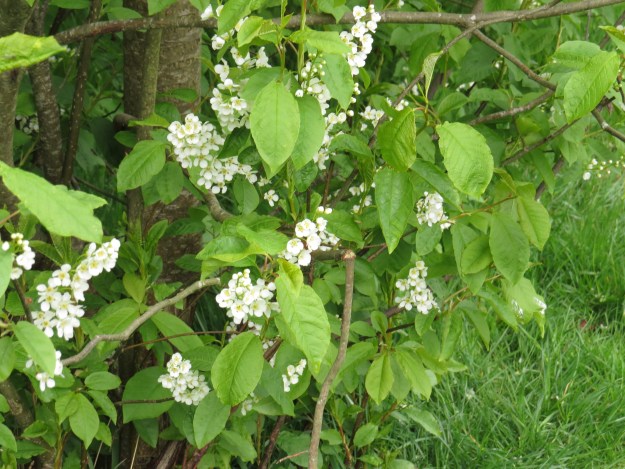
Photo Two by By Inkaroad - Own work, CC BY-SA 3.0, https://commons.wikimedia.org/w/index.php?curid=16991162

Laurel Forest in Tenerife (Photo Two)

Photo Three by By PicsART05 - Own work, CC BY-SA 4.0, https://commons.wikimedia.org/w/index.php?curid=48893760

Laurel Forest in La Gomera (One of the Canary Islands) (Photo Three)

When anyone mentions bay, though, thoughts turn to stews (or mine do, anyway). My Mum always tucked a random dried bay leaf into a beef stew, though not a chicken casserole. The leaves that we had seemed to serve no purpose at all other than being something of a surprise when they were accidentally eaten at dinner time, but I have been experimenting with using more bay, in different dishes, and I’ve finally come to the conclusion that the dried leaves can add a subtle but delicious background flavour in conjunction with ingredients such as garlic, thyme and rosemary. It appears that the fresh leaves have rather too much of the menthol and eucalyptus flavour that comes from the essential oils, so bay is one of the few herbs that most chefs prefer to use dried. I have also used it in rice pudding, and rather liked it, plus it’s one of those herbs that is regularly thrown into pickling mixtures. Let me know how you use it, readers! I am always keen to learn.

Photo Four from https://www.pinterest.co.uk/pin/377950593703120990/

Beef casserole with bay leaf(Photo Four)

The essential oils in bay leaves probably developed to dissuade insects from nibbling them (as is the case with other herbs such as rosemary, thyme and lavender). Interestingly, some entomologists used crushed bay leaves in their killing jars; the insects subjected to the fumes die slowly and peacefully, making them easier to mount. Not that Bugwoman approves, obviously. The leaves can also be used to repel clothes moths, silverfish, mice and many other small unwelcome visitors (though not children 🙂 )

Bay has a very long cultural history too. In Ancient Greece, bay leaves were used to make the laurel wreath that adorned the foreheads of competition winners and poets, and in Rome it became the symbol of emperors. Originally it represented the god Apollo, and his priestess was said to chew laurel leaves before giving her prophecies. The laurel is deeply embedded in our language even today – we have a poet laureate (i.e. a poet who wears the laurel wreath), and we speak of someone ‘resting on their laurels’ or suggest that they should ‘look to their laurels’ in the face of new competition. The name of the French examination the Baccalaureate comes from the same root.

Photo Five by By Auréola - Own work, Public Domain, https://commons.wikimedia.org/w/index.php?curid=7654436

Ovid wearing a laurel wreath (Photo Five)

The Romans also believed that bay trees were immune to lightning, and so the Emperor Tiberius always wore a laurel wreath when there was stormy weather. As with so many things, there is an element of truth here – bay is very resistant to fire, but when it does burn it does so with a loud crackling noise, leading the Romans to believe that the tree was inhabited by a fire demon who protected it. Pliny the Elder advised against burning bay on altars, for example, because the noise that it emitted sounded as if it was angrily protesting. Apparently the devil is rendered helpless by bay, so wearing a laurel wreath might be a useful precaution during most every day activities, if you don’t mind the funny looks.

Medicinally, bay has been used as a preventative during epidemics, and for rheumatism. The berries of the bay tree were believed by Culpeper to be efficacious against all kinds of bites from venomous creatures. A tincture of bay was used for ear drops, and bay oil was used for sprains (something very useful for those of us who are inclined to trip over stray microbes or infinitesimally small imperfections in a paving slab).

Photo Six by By Itineranttrader - Own work, Public Domain, https://commons.wikimedia.org/w/index.php?curid=5781348

Lauris nobilis essential oil (Photo Six)

Incidentally, the bay tree is not closely related to the similar-looking cherry laurel, which seems to have taken over half the country. This is an important distinction because while you can obviously eat the leaves of the bay tree, those of the cherry laurel are packed full of cyanide. You have been warned.

Photo Seven by By Karduelis - Original image, Public Domain, https://commons.wikimedia.org/w/index.php?curid=470021

Leaves of the cherry laurel (Prunus laurocerasus) (Photo Seven)

And finally, a poem. I rather love this, because it’s about a pigeon, and a bay tree, and lots else besides.

by Lachlan Mackinnon
Any time I happen to open my front door

a pigeon batters out the bay-tree opposite and stumbles

into flight as implausibly as a jumbo.

At night, more

ominously, when the garden gate goes, it shambles

loudly off through the same shaken, protesting tree,

having slept, as it must, on its nerves. The bay-leaves

subside, and my own jumpy heart, before my key

goes home.

The pigeon’s world is no better than it believes

but I have sometimes known acts of kindness make me weep

for shame.

Most nights, most people are not afraid to sleep.


Photo Credits

Photo One By Petar43 – Own work, CC BY-SA 3.0, https://commons.wikimedia.org/w/index.php?curid=33242606

Photo Two  By Inkaroad – Own work, CC BY-SA 3.0, https://commons.wikimedia.org/w/index.php?curid=16991162

Photo Three  By PicsART05 – Own work, CC BY-SA 4.0, https://commons.wikimedia.org/w/index.php?curid=48893760

Photo Four from https://www.pinterest.co.uk/pin/377950593703120990/

Photo Five By Auréola – Own work, Public Domain, https://commons.wikimedia.org/w/index.php?curid=7654436

Photo Six by By Itineranttrader – Own work, Public Domain, https://commons.wikimedia.org/w/index.php?curid=5781348

Photo Seven by Karduelis – Original image, Public Domain, https://commons.wikimedia.org/w/index.php?curid=470021

A Blossom-Filled Walk in East Finchley Cemetery

Goodness Readers, although East Finchley Cemetery is a much posher, more manicured cemetery than my favourite, St Pancras and Islington Cemetery, it certainly has some very trees. Today, the rose-garden was looking a bit bare, but the trees more than made up for it.

One of the disadvantages of roses is that, although they look and smell wonderful when they’re in flower, they are very uninteresting for the rest of the year (and many varieties need a fair bit of looking after as well, what with the pruning and the feeding and the keeping an eye open for black spot). Furthermore, this part of the cemetery, which has an ornamental pond and then a small stream running down the middle, has been a bit of a problem for the landscape gardeners – the bit at the bottom was a quagmire earlier this year, though the weeping willows loved it.

However, there are some very pretty trees here. There is the usual Kanzan cherry tree, not my favourite but very ebullient.

Kanzan cherry. Look at all those petals!

There are some magenta-coloured crab apples too – I think this is purple crab (Malus x purpurea) but am happy to be corrected, as always.

But I think my favourite is this tree, which I think could be Siberian crab (Malus baccata), possibly the Lady Northcliffe variety? I think that it might be the prettiest blossom tree I’ve ever seen, what with those cherry-pink buds. Let me know what you think, you clever people!

Elsewhere, I find an Indian horse chestnut (Aesculus indica) – it has much narrower, more dainty leaves than ‘our’ horse chestnut, and is smaller and more delicate. I love the way that this cemetery makes a feature of its specimen trees – some of those in St Pancras and Islington are rather swallowed up with undergrowth, though this is much better for wildlife. I’m lucky to have both types of cemetery within a twenty-minute walk.

Indian horse chestnut (Aesculus indica)

And the pollen from this fir tree is absolutely everywhere. No wonder my husband’s nose is twitching. I’m thinking it looks most like a Nordmann Fir (i.e. the one that’s used as a Christmas tree), and if so these are the male flowers.

The ‘willow garden’ is coming on nicely, with lots of spring flowers, including this rather nice white Dicentra.

And the tree below rather caught me out – it’s a bay tree. I’d never seen one in flower before. What a twit.

I always stop to pay homage to the Cedar of Lebanons as well. What magnificent trees they are, planted when the cemetery first opened in 1854. I love the barrel-shaped cones, which gradually disintegrate, allowing the seeds to fall.

And the monkey-puzzle tree is putting on lots of new growth too – look at those cones! Apparently they will break up on the tree, rather than falling on someone’s head.

While I was admiring the monkey puzzle, my husband spotted that I had a hitchhiker – this bee. I’m thinking that it’s an orange-tailed mining bee (Andrena haemorrhoa) but these are tricky critters to ID to species level. As it likes south-facing grassy slopes to nest in, there will be plenty of opportunities for it in the cemetery – in some places the turf is kept very short, but there are also areas that are more overgrown.

The cemetery is a hot-spot for bats, too. What a shame that it closes at 4.30 p.m! But then there are signs outside prohibiting alcohol and barbecues, so I imagine that it has been the site of what I loosely describe as ‘urban vibrance’. Maybe it’s just as well that the bats, birds and bees have the whole place to themselves as dusk falls.

A fine array of bat boxes


An Insect-Filled Walk in St Pancras and Islington Cemetery

Dear Readers, it was the most beautiful spring today, and while the cherry plums in the cemetery have mostly lost their blossom, the heavy candy-floss pink flowers of the cherry trees are just starting to emerge. It’s a shame that many of the prettiest are behind fencing at the moment, while the cemetery tries to turn yet another area of rough scrub into a site for graves, but nonetheless the tree is still exuberant. The blossom on these trees can sometimes seem almost too much: I suspect that these trees are of the Kanzan variety, with each blossom having up to 28 petals. There is a road close to where I used to live in Islington which was lined with these trees on each side: when the blossom started to fall, it could be like scuffling through a thin layer of pink snow.

The cherry plums have lost every last flower now, and are instead glorying in their copper foliage.

The cow parsley is just starting to flower in the woodland grave area, and is already attracting pollinators, like this little hoverfly. The photo is not good enough to identify the species, but it does give an indication of how varied this group of insects can be – at first glance you’d think this was a flying ant.

I had to pause for a quick look at the swamp cypress, which appears to have been in suspended animation for weeks. Not for much longer, though! I can’t wait until it’s decked out in fluorescent green.

I had to pause for a quick look at the cherry laurel by the main path – it is covered in strange, spidery flowers, and has a most nose-tingling smell, somehow dusty and honey-ish at the same time.

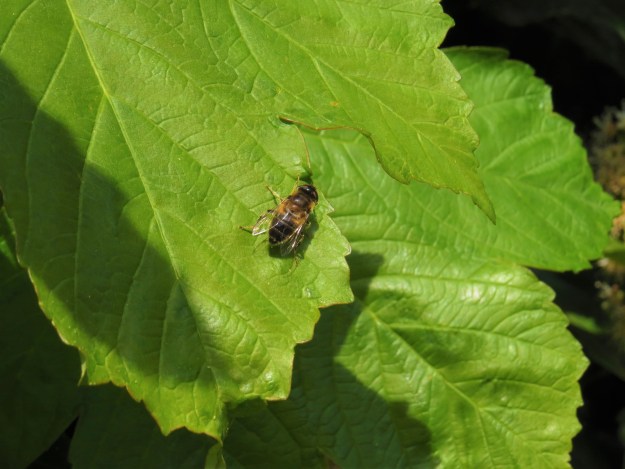
Another hoverfly was sunning itself on the leaves. I’m going to hazard a guess and say that this is probably a female Eristalsis pertinax. The males of this fly defend territories around flowering plants, and I imagine that the cherry laurel must be a very appealing site. The young go by the appealing name of ‘rat-tailed maggots’, and live in drainage ditches and other stagnant water: the ‘tail’ is actually a breathing tube.

And here’s an insect that I haven’t come across before. Superficially it looks rather like a shield bug, but it is narrower in the body and has much thicker, more pronounced antennae. This is a box bug (Gonocerus acuteangulatus) and it isn’t named after the plant directly but after Box Hill in Surrey (which was, admittedly, named after the box hedges that grew there).  The bug was considered endangered, and in 1990 it was known only in the area around the eponymous Box Hill, but since then it has expanded its range to most of south-east England. It seems to have expanded the variety of foodplants that it eats to include hawthorn, bramble and rose, and I predict a sunny future for it as it munches its way northwards.

The dandelions are still out in force.

The leaves on the horse chestnut are getting bigger every week.

And the first flowers are opening on the hawthorn.

But what I’ve really noticed this week are the bluebells. The vast majority of the ones in the cemetery are hybrids, and they come in the most astonishing array of colours. I doubt that the cemetery was ever a pristine environment for bluebells, and in fact I suspect that if there weren’t hybrids here, there wouldn’t be any bluebells at all.

  The primroses are doing their hybridizing thang as well. In the beds at the entrance to the cemetery there is the most extraordinary range of primulas and polyanthus, and I suspect that they are all cross-breeding and coming up with multiple varieties across the rest of the area. Genetic exuberance is certainly in evidence here.

In one of the sunnier parts of the cemetery I saw, in quick succession, a brimstone butterfly, a peacock butterfly, and a male orange-tip. I managed to get photos of two out of the three, which wasn’t bad considering how quickly the brimstone was flying. They apparently emerge from hibernation from March onwards, and will only be on the wing till May, so I cherished this glimpse of a butterfly in a tearing hurry!

Brimstone butterfly(Gonepteryx rhamni)

And then we almost trod on two peacock butterflies in quick succession, both of them sunning themselves on the path. These adults will have been hibernating over winter, and are now looking for someone to mate with, and somewhere to lay their eggs. They looked very ragged and tired, poor things.

The orange-tip will have been very happy to see the abundance of garlic-mustard which has popped up everywhere, and is now coming into flower. It’s good that there is so much of the stuff, as the caterpillars are cannibalistic and so the female normally lays each egg on a different plant – when an egg is laid, the female also deposits a pheromone which will prevent other females from laying there. Furthermore, the females will only lay their eggs on plants which are already in flower, but will also refuse to lay if the flower is starting to age. This is an insect which wants to give their young the very best start in life, for sure.

Photo One by By Charles J. Sharp - Own work, from Sharp Photography, sharpphotography, CC BY-SA 4.0, https://commons.wikimedia.org/w/index.php?curid=48875414

Male orange-tip (Anthrocharis cardamines) (Photo One)

Garlic mustard and lesser celandine

I couldn’t resist getting a photo of this watchful crow, and I rather liked the backlit dandelions too.

And for my final butterfly of the day, here’s a newly-minted speckled wood (Parage aegeria). These are woodland butterflies, flitting through the dappled shade. The males are fiercely territorial, and spend a lot of time flying into the air to investigate every insect that goes past. If it’s another male, an aerial battle will take place that could last up to 90 minutes. The battles are fiercest if the incumbent male has already been visited by a female – presumably this proves that his territory is a good spot. What a lot of hard work this reproduction business is.

Speckled wood (Parage aegeria)

And so, it seems that, with the arrival of flies and bugs and butterflies, and with bluebells and garlic mustard springing up all over the cemetery, we are now into what I think of as ‘mid-spring’, the period when the battle to mate and rear young and get pollinated is at its height. All I need now is the arrival of the house martins to know that spring is fading, and summer is beginning.


A Quick Trot Around the Garden

Marsh Marigold

Dear Readers, by the time you read this I will be on holiday (in the sense of ‘not working’ rather than ‘ going off somewhere exciting’) so there is the usual palaver around making sure nothing will blow up in my absence. Being a recovering perfectionist is a hard road to travel – I have to accept that a) I’m not irreplaceable and b) the organisation can get along very well without my presence. However, I do love to leave things in a tidy condition, and so for my blog post today I have spent a whole fifteen minutes in the garden before getting back to the grind.

I wouldn’t even have done this if a huge cardboard box containing 3 water irises hadn’t turned up – they were already potted up and ready to be dropped into the pond, so it seemed like the least I could do for the poor things. Can I just put in a plug here for Puddleplants if you are in the UK and want some pond or bog garden plants? I have been so impressed by the standard of the plants that they provide, and if they aren’t happy with the quality of anything they will let you know and ask if you want a refund or a different plant. Their customer service really is second to none.

Anyway, today’s delivery was of three Iris x robusta ‘Gerald Darby’, and if they thrive they should look like this:

Photo One from https://www.bethchatto.co.uk/conditions/plants-for-damp-conditions/iris-x-robusta-gerald-derby.htm

Iris x robusta Gerald Darby (Photo One)

…though at the moment they look like this:

And yes, the water level in the pond is down yet again. We’ve had no rain for weeks. I am growing creeping/dangling plants along the pond edge and may gradually remove some of the stones to get a more natural look, but in the meantime I’m looking to the skies.

Everything seems to be taking off. The water mint is extending its little invasive fingers and will no doubt be planning to take over the pond shortly.

Water mint (Mentha aquatica)

The water figwort plants look extremely happy.

Water figwort (Scrophularia auriculata)

The yellow flag iris are shooting upwards. I love its butter-yellow flowers though it can be a bit of a thug. This one will need dividing for next year.

Yellow flag (Iris pseudacorus)

The leaves of the first water lily have broken the surface, though whether that’s because the leaves have grown up or the water level has gone down I shall leave for you to judge….

The yellow loosestrife (Lysimachia vulgaris) has just broken the surface of the water. One of the pots slid off the ‘shelf’ around the edge of the pond and has upturned and disappeared into the depths. I shall try to retrieve it soon – my planting guide suggests that it should be under no more than 10 cm of water, and it must be in about 70 cm so that isn’t going to work. The other three are wedged in, so should be safe!

And finally the purple loosestrife is springing forth. Every year it gets so big that it ends up toppling over, and every year I think to myself that I should try to prevent this from happening. Sadly, ‘think’ is all I seem to do, being a bit short of inspiration. Maybe another case of dividing and putting into a heavier pot?

Away from the pond, there has been some cat-on-bird action – I ‘discouraged’ one slinky black and white marauder who was hiding under the bushes but he or she might have been back. Fortunately there are usually so many birds in the garden that someone sounds the alarm. Plus, fortunately, the feathers of woodpigeons are very loosely attached, so all a predator often gets is a mouthful of fluff.

I rather liked these grape hyacinths, but the bees don’t, much preferring the dark blue ones. Still, you live and learn.

The forget-me-nots that my friend J gave me are out…

And so are these wallflowers. I bought them thinking they would be cream and mauve, and instead I have one yellow one and two red ones, which rather mucks up my colour scheme. Never mind. Also, what’s with the leaves going brown around the edges? All advice gratefully received. I’ve been watering them religiously (or rather my husband has).

The ferns are looking good too! I have a couple more that have been in a pot for ages so I’m planning to liberate them this year.

And look, here is my one English bluebell (it’s a darker blue than it looks here, and the flowers do flop endearingly to one side so I’m fairly confident that it is Hyacinthoides non-scripta, as purchased). And yes, there are some stinging nettles next to it which will most likely be coming out when I have something to plant in its place.

And finally, I have planted up some honesty seeds (also given to me by my friend J) and have taken delivery of three woodruff plants (Gallium odorata), all of which will be popped into the shady side of the garden.

Woodruff and honesty seeds….

And finally, how about this red valerian that’s planted itself next to. the water butt? Whenever I see this plant it makes me think of Dorset and my time with Mum and Dad – the Red valerian there used to self-seed in every crook and cranny, and there were white and pink forms too. I don’t have the heart to pull it up.

Red valerian

And so, it’s back to work to tidy up a few more things. I hope to be having a few more exciting trips over the next few weeks – there are wetlands to visit locally, (Walthamstow and Woodberry), parks to walk in, and all sorts of places to explore. But I hope to be spending lots of time sitting in the garden too. After all, the lilac is almost in flower.

Lilac buds….

Photo Credits

Photo One from https://www.bethchatto.co.uk/conditions/plants-for-damp-conditions/iris-x-robusta-gerald-derby.htm