Category Archives: London Plants

Garden Plans for 2021

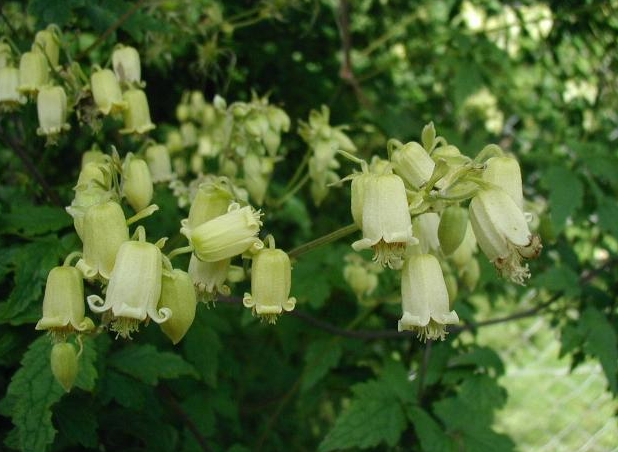
Photo One by https://upload.wikimedia.org/wikipedia/commons/f/ff/Clematis-rehderiana.JPG

Clematis rehderiana (Photo One)

Dear Readers, as I no longer spend money on eating out (except for the odd pizza delivery) or on holidays or on cinema or theatre, I have two main sources of outlay left, once food and domestic ‘stuff’ is covered – one is books, and the other is the garden. This year I am determined to have a rethink, and to try out some new plants – who knows how we’ll get on, but there’s only one way to find out!

My first purchase is a Clematis rehderiana (otherwise known as ‘Nodding Virgin’s Bower’, but we’ll skip over that thank you very much). It was quite a puzzle finding one, and I only persevered because my Gardening For Wildlife book by Adrian Thomas mentions it as being the very best clematis for wildlife. Unlike some of the other types, it has primrose yellow bells and smells of cowslips. The Guardian describes it as a ‘romper’, which is just what the garden needs. I’ve planted it next to my lilac, which is pretty early in the year and boring for the rest of it, so I’m hoping the clematis can be persuaded to scramble over it and then onto the fence behind. At the moment it is a twig with exactly one set of leaves, so let’s hope it perks up now it’s  in the ground.

Secondly, I was very aware that my north-facing garden is a bit of a desert for pollinators during the winter, and so I have chanced my arm on a Clematis cirrhosa var balearica – this one is ‘Wisley Cream’. It’s said to flower from November to March, and I am going to pop it in against my West-facing fence, and make sure that the roots are protected as I know it’s not necessarily fully frost hardy. The bittersweet and honeysuckle also grow on this fence, so I’ll have to make sure that they all share. And as it’s close to where we sit, it might even encourage us to brave the garden during the warmer days of winter.

Photo Two by sunoochi, CC BY 2.0 <https://creativecommons.org/licenses/by/2.0>, via Wikimedia Commons

Clematis cirrhosa var balearica ‘Wisley Cream’ (Photo Two)

In other news, I want to extend the range of geraniums in the garden, as they can be so good for pollinators – my Dusky Cranesbill (Geranium phaeum) are  covered in bees early in the year, but they die back way too soon, and I want something else that will take up the mantle. I’ve planted some Geranium macrorrhizum in a slightly sunnier (but not too sunny) position – these do amazingly well in some places around here. The plants are nicely well-grown, so I hope they’ll soon be flowering away. Any advice on geranium varieties for shady places would be gratefully received. Even the geranium ‘Rosanne’ that everybody swears by gave up the ghost when I planted it.

Photo Three by I, KENPEI, CC BY-SA 3.0 <http://creativecommons.org/licenses/by-sa/3.0/>, via Wikimedia Commons

Geranium macrorrhizum (Photo Three)

And I almost forgot that a lovely friend of mine gave me an envelope full of honesty seeds, so they’ll be going in pronto. I know they can be invasive but it’s such a struggle to get anything to thrive that invasive sounds like a feature rather than a bug, as us elderly IT folk sometimes say.

Photo Four from CC BY-SA 3.0, https://commons.wikimedia.org/w/index.php?curid=107188

Honesty (Lunaria annua) (Photo Four)

In other news, I’ve planted winter aconite, snowdrops and lily of the valley (another plant that can get out of control, yay!) in the green. I’m hoping that the lily of the valley will give some leafy cover to my poor frogs, although they’ve gone really quiet for the past week or so  – the temperature dropped to below freezing last night, so I’m sure that’s got something to do with it.

Photo Five by liz west from Boxborough, MA, CC BY 2.0 <https://creativecommons.org/licenses/by/2.0>, via Wikimedia Commons

Lily of the Valley (Convallaria majalis) (Photo Five)

So let’s see how this lot get on. In other projects, we have just got a new tiny table and chairs for the back of the garden – it’s something of a sun trap and will be a nice place to sit in the spring and autumn, and so I’ll need to tidy that area up a bit as well. And I really, really want to sort out some enormous planters/raised beds for the south-facing front garden, so that I can extend the season for pollinators – they are spoiled for choice when the buddleia and lavender are out, but it’s boring during the rest of the year (though I do have some Lambs Ears (Stachys byzantina) in my window boxes and I’m hoping that some wool carder bees might turn up).

Whoever said that a garden is always a work in progress had it absolutely right.

Photo Credits

Photo One by https://upload.wikimedia.org/wikipedia/commons/f/ff/Clematis-rehderiana.JPG

Photo Two by sunoochi, CC BY 2.0 <https://creativecommons.org/licenses/by/2.0>, via Wikimedia Commons

Photo Three by I, KENPEI, CC BY-SA 3.0 <http://creativecommons.org/licenses/by-sa/3.0/>, via Wikimedia Commons

Photo Four from CC BY-SA 3.0, https://commons.wikimedia.org/w/index.php?curid=107188

Photo Five by liz west from Boxborough, MA, CC BY 2.0 <https://creativecommons.org/licenses/by/2.0>, via Wikimedia Commons

An Early Spring Walk in St Pancras and Islington Cemetery

Dear Readers, it really feels as if spring is gathering apace this week. From a few tentative flowers opening gently on the crab apples and cherry trees, there is now an abundance of fluffy blossom.

The chapel looks spick and span after its long renovation, although these days it only houses the (much-appreciated) toilets rather than holding any services.

The tree on the corner of the woodland burial area is looking very fine as well.

The primroses are emerging under the cedars of Lebanon.

And the daffodils are everywhere. I feel a bit of a Scrooge for saying it, but I am generally not a great fan of those big butter-coloured daffodils, though they are cheerful enough, I suppose. I like the paler, creamier ones that look more like the vanishingly-rare wild daffodils of Wales, and I have a fondness for the little miniature ones as well. And I’m fond of what I think of as ‘proper’ narcissi, like the pheasant’s eye ones with a small, red-rimmed trumpet. Paperwhites have their place, though Mum used to find their scent overpowering in a small space, and I must admit that they can make me feel slightly nauseous too. I’m becoming so fussy! Or is it just that I’m noticing my preferences more?

Little daffodils (Tete-a-tete I think?)

On a few of the sunnier graves there is a cheery outburst of red deadnettle.

And of course there are always daisies. I think you could find some in flower in the cemetery on every single day of the year. They always seem so modest and so hard-working to me.

There are some unexpected visitors resting next to the stream. I love the way that ducks appear to be asleep but always have one eye open to make sure that you aren’t up to any mischief.

A lady stopped her car to say she’d been seeing the ‘birds’ for a few days, but wasn’t sure what they were. Unfortunately she asked my husband, who, momentarily flustered,  could only say that they were ‘ducks’. I have more work to do, clearly, though if she’d asked me she’d probably still be sitting in her car listening to me pronouncing forth on the wildfowl of London, so she had a lucky escape.

More spring flowers are emerging: there are the first grape hyacinths

and some Loddon lilies, which seem to be a cemetery speciality. I’m sure all of them are planted rather than wild, but they are naturalising in some areas. At first glance you might think that they are just giant snowdrops, but the shape of the flowers is quite distinct.

A rose-ringed parakeet posed very nicely for the camera, unlike the two that were briefly on the suet feeder in the garden this morning. Whenever I see them I think of the one that visited the garden the day after Dad died. It’s funny how superstitious death can make a person: I almost believed that Dad had popped back to cheer me up, and with the two this morning I automatically thought of Mum and Dad together again. Of course, I don’t really believe that they have somehow been reincarnated as parakeets, but part of me wishes it were true. What complicated beings we are as we wrestle with the big, unsolvable questions of life. Or maybe it’s just me.

And as we head into my very favourite part of the cemetery, the overgrown, unpeopled area around Kew Road and Withington Road, I am struck yet again by the beauty of a blossom tree.

The early crocuses are almost over now, how glad I am that I caught them in their full glory! They rather look as if an elephant has trodden on them now.

On the other hand, the Dutch crocuses are just coming out.

And while the snowdrops in the sunny areas emerged first and are now dying back…

…the ones in the shady areas are still in full flower.

And, let me share a little story with you that made me gasp. One of the Facebook groups that I belong to is about plant identification. A person posted that they had been reading about sorrel (the lemony-leaved member of the dock family), and so when they saw the plant below they decided to forage some and eat it.

And of course, it’s cuckoo-pint/lords and ladies, and is poisonous. How you could mistake one for the other astounds me, but then it’s often difficult to judge scale and size from a photo, and I suppose that the leaves are a similar shape if you squint. Fortunately, the poison in cuckoo-pint expresses itself by making the lips tingle and the tongue swell up, plus it tastes extremely unpleasant, so you aren’t likely to eat a lot of it. But even so, this was a close escape. I guess it’s exactly how our ancestors learned, and the ones who didn’t learn ended up deaded, as my Dad would have said.

Cuckoopint (Arum maculatum)

I heard the buzzard but didn’t see it. It’s very frustrating – I have a feeling that there’s a nest in the cemetery somewhere, and it must be pretty big, but I can’t find it. Anyhow, instead I saw a pair of crows harassing the kestrel, poor thing. It’s very difficult to make out from my most excellent photo (ahem) but it’s the bird in the middle. Kestrels don’t take nestlings or eggs, but I guess the crows aren’t taking any chances.

I saw one of the feral cats looking very sleek and well-fed – the lady who used to travel all the way from Camden to feed them and the foxes and the birds every day manages to get in at the weekend now when she can get a lift, but I suspect that other people are doing their bit to make sure that the animals don’t go hungry. I caught a quick glimpse of a fox too, but not for long enough to see if it was the poor vixen who’d had an accident that I saw last time.

And in other news,  I had my first Covid vaccination on Wednesday (the Astra Zeneca one), and although I felt pretty rubbish for about 24 hours it really does feel now as if there is a glimmer of  hope for some return to a new ‘normal’. I am so grateful to the NHS and all the people who are volunteering to help with the programme, and to the scientists who have managed to perform this miracle. I just hope now that we find a way to distribute the vaccine more equitably than we currently are, because in this situation it really is true that none of us are safe until we’re all safe. As I have done right through lockdown I am counting my blessings fervently and hoping for a decent pay rise for NHS staff (rather than the derisory 1% currently on offer), for more recognition for our care home staff, for a complete review of the care system, for support and recognition for our teachers and for all the workers who continued to staff our essential shops and transport systems, who collected our waste and delivered our post. If nothing else, this last year should have taught us who really is essential, and who really does deserve to be rewarded.


Wednesday Weed – Early Crocus Revisited

Dear Readers, if you saw my Sunday post you will know that I am once again completely in love with the early crocuses that are in bloom in St Pancras and Islington Cemetery. I am revisiting this post from 2016, if only because I love all three of the poems at the end of the piece, in particular the curmudgeonly offering from Edna St Vincent Millay.

However, I also wanted to look at a question raised by a good friend of mine, who planted a variety of crocus bulbs in her lawn, but over the years has been left with just the lavender ones (though whether Early Crocus or Dutch Crocus I do not know). However, the folks at New Scientist had noticed a similar thing, and had waded in with a variety of explanations. One is that birds, particularly sparrows, will peck at and eat the yellow flowers but ignore the other ones. It’s also said that the grey squirrel and some other rodents also have a preference for the yellow crocuses, though the furry chaps in my garden seem much less pernickety. However, a third explanation is that apparently the yellow ones flower before the others, and so are much more likely to be caught out by a sudden spell of wintry weather that ruins their reproductive ambitions for the year. Thoughts, people?

You can read the whole discussion here.

Early Crocus (Crocus tommasinianus)

Early Crocus (Crocus tommasinianus)

Dear Readers, close to the entrance of Coldfall Wood there is a tiny patch of Early Crocus (Crocus tommasinianus). How fragile this plant is, and yet how strong! It has burst through the hard-packed clay soil, sometimes lifting whole twigs and stones in its urge to reach the sunlight.

IMG_5282There are two very similar species of crocus that you are likely to see naturalised in the UK. The Dutch or Spring Crocus (Crocus vernus) looks similar to the Early Crocus, but it has a mauve or purple ‘throat’ which is never lighter in colour than the flowers themselves.

By Franz Xaver (Own work) [CC BY-SA 3.0 (http://creativecommons.org/licenses/by-sa/3.0) or GFDL (http://www.gnu.org/copyleft/fdl.html)], via Wikimedia Commons

Spring/Dutch Crocus (Crocus vernus) – notice the mauve ‘throat’ to the flowers. (Photo One – see credits below)

‘Tommies’ are native to Bulgaria, Albania, Hungary and the former Yugoslavia, and were named for the botanist Muzio G. Spirito de Tommasini (1794-1879), who was Mayor of the city of Trieste. They are relatively late arrivals, first cultivated in 1847, and not recorded in the wild until 1963, although this may have been due to confusion  with the Spring Crocus. The plant naturalises easily in lawns and churchyards, and there is a fine patch in St Pancras and Islington Cemetery, which has no doubt grown from a handful of bulbs planted on a grave.

IMG_5288You might not think it to look at them, but crocuses (or, indeed croci) are part of the Iris family. The name is thought to derive from the Sanskrit word for ‘saffron’ (kunkuman) although it is the autumn crocus (Crocus sativus) that produces this spice, not these spring-flowering species. They do have the most intense yellow pollen, however, and you can see how the name has arisen.

IMG_5276In Greek mythology, Crocus was a human youth in love with a nymph called Smilax. Apparently irritated by his audacity, the gods turned Crocus into, well, a crocus. Smilax was turned into either a yew tree or bindweed, depending on your source. The Greek gods were certainly a touchy bunch.

IMG_5269In the financial world, a ‘crocus’ is a company or sector which recovers quickly after an economic downturn. The waxy cuticle helps it to survive even when there is late frost or snow on the ground, so you can see how the comparison has developed.

https://www.flickr.com/photos/vasile23/8606299884 Vasile Cotovanu

‘Tommies’ under snow (Photo Two – See credits below)

As I researched this piece, it became apparent that the poor old crocus had been the focus of some truly execrable poetry. Certainly, its bravery in sticking its petally head above the soil into the teeth of a snowstorm has been extensively celebrated, to the extent that Sherman Alexie, the editor of New American Poetry 2015, has this to say:

None of us ever needs to write another poem about crocuses, or croci, or however you prefer to pluralize it. Trust me, we poets have exhausted the poetic potential of the crocus. If any of you can surprise me with a new kind of crocus poem then I will mail you one hundred dollars.’

But, wait! I wonder if Mr Alexie has ever read Edna St. Vincent Millay’s poem ‘Spring’. I have to confess to loving this. It made me laugh out loud at the unexpectedness of the last few lines, for all their curmudgeonliness.  And if Ms Millay were still alive, I think she would deserve her prize.

Spring

To what purpose, April, do you return again?
Beauty is not enough.
You can no longer quiet me with the redness
Of little leaves opening stickily.
I know what I know.
The sun is hot on my neck as I observe
The spikes of the crocus.
The smell of the earth is good.
It is apparent that there is no death.
But what does that signify?
Not only under ground are the brains of men
Eaten by maggots.
Life in itself
Is nothing,
An empty cup, a flight of uncarpeted stairs.
It is not enough that yearly, down this hill,
April
Comes like an idiot, babbling and strewing flowers.

IMG_5272

Ruth Fainlight’s powerful, disturbing piece on crocuses would surely also be a contender for a new way to look at the plant. I hadn’t come across the poet before, but I shall certainly be reading more of her work.

Crocuses
These crocuses are appalling:
pale, bare, tender stems rising
through the muddy winter-faded turf,

shivering petals the almost luminous mauve
of lurid bruises on the frightened faces
and naked bodies of men, women, children

herded into a forest clearing or
towards a siding where a train has halted
and the trucks are waiting.

But perhaps there is much to be said for ending with a poem that was chalked on a blackboard at Des Moines High School for all the children to learn. The sight of crocuses, for me, means that the world is still turning, in spite of all the things we are doing to it. The clock of the seasons ticks on, however erratically.

Daffodils and tulips
impatient underground
in March sent up a crocus
to have a look around.

She yelled, “It still is winter,
there is frost on everything.”
But a passerby who saw her said,
“A crocus!  It is spring!”

Photo Credits

Photo One – By Franz Xaver (Own work) [CC BY-SA 3.0 (http://creativecommons.org/licenses/by-sa/3.0) or GFDL (http://www.gnu.org/copyleft/fdl.html)], via Wikimedia Commons

Photo Two –  By Vasile Cotovanu https://www.flickr.com/photos/vasile23/8606299884

All other photos copyright Vivienne Palmer

Spring Comes to St Pancras and Islington Cemetery

Dear Readers, after the fog, the snow, the icy winds, the rain and the general gloom it was a delight to be in St Pancras and Islington Cemetery today. The crocuses seem to have all burst into life within the past few days: the temperature was in the low thirties Fahrenheit last week, but today it was nearly sixty degrees, and everything seems to be in flower. What a joy it is! I spotted this queen buff-tailed bumblebee in the grass about ten metres from a patch of snowdrops, and I was quite concerned.

I thought she was dead at first, but as I crouched down she reached out with her middle leg in a very clear ‘don’t mess with me gesture’. As I hunkered back and considered what to do she picked herself up and flew in the opposite direction to the snowdrops, only to do a big loop and head back to them. How do they know, I wonder? Are they smelling the flowers, or had she visited before and remembered them? Anyhow, she had a good feed and then headed away at speed, so it was a most welcome false alarm.

There are two kinds of crocuses in the cemetery: Crocus vernus, which is the more typical garden crocus in its shades of purple, yellow, white/maroon and lilac, and Crocus tommasinianus, which is always a delicate lavender colour, and which seems more inclined to naturalise.

Crocus vernus (Spring crocus/Dutch crocus)

Crocus tommasinianus, or Woodland Crocus

Although the Woodland Crocus gets a bit floppy and falls over more easily than the Spring Crocus, I must say that I prefer it to its blousier relative. Some graves are absolutely covered in Woodland crocus, and the bees and hoverflies are already enjoying it. What a joy it is to see some colour after such a long, dark winter. And I am reminded that Woodland Crocus is known as elfenkrokus in German, which is just about perfect.

The native flowers are coming out too. I saw my first Lesser Celandine, but soon the paths will be carpeted with it.

First Lesser Celandine

There’s some red deadnettle, another favourite with the bees….

Some germander speedwell, with its sweet sky-blue and white flowers…

and of course some daisies, with their faces turned towards the sun.

But really it’s the crocuses and the snowdrops that are the stars of the show this week. They lifted my spirits and reminded me that the bulbs that I planted last year won’t be too far behind, though they are always later in my north-facing garden. Here are a few more photos, to cheer you up too…

And finally, it wouldn’t be me if I hadn’t found a grave to puzzle over. I had never noticed this one before, although it is literally the first grave that I pass if I walk my usual route.

There was a big Welsh community in the Kings Cross area of London, and I love how this headstone bears the daffodil, the National Flower of Wales. I used to live very close to Amwell Street, and just half a mile away on Pentonville Road there was a building that used to be the Welsh chapel, with the London Welsh Centre about the same distance away on Grays Inn Road. The story seems to have been a sad one: Lloyd Lloyd was listed as being an ‘invalid for the last seven years’ in 1939, while Margaret was ‘a helper in business’. Their son, David, was a ‘master dairyman and provision merchant’. However, they at least had the money to have not only a servant living with them, but also a male nurse. Margaret passed away in 1946, Lloyd in 1948, and according to the probate records, David received what would have been a very decent inheritance of almost £8,000. A little more digging reveals why – their home at 42 Amwell Street seems to have actually been a dairy, so David had taken over the family business. Something about the name ‘Lloyd’s Dairy’ rang a bell, and so I turned to Google for some help. And here is the site of the dairy. Apparently it opened in 1905 and finally closed about a century later.

What I can’t work out is if there were actually cows on the premises. Many Welshmen, especially from Cardiganshire, set up dairy businesses from about the 1860’s in London, selling milk and cream by the bottle, and also running a milk round. This continued until about 1954, so it’s not ancient history. The dairies tended to pop up along the line of the Euston Road (like this one) so even if cows weren’t kept on the premises, milk could be easily picked up via Paddington Station, which had direct links to the Welsh farms. And (light bulb moment) this is probably why the first trains in the early hours of the morning were known as ‘milk trains’.

It never ceases to amaze me how a simple headstone can reveal so much and yet so little about the people that it commemorates. I now know  a lot about Lloyd and Margaret Lloyd, and yet I know nothing about them as people. Still, I think I shall take some daffodils for their grave next time I visit, to say thank you for the insights they’ve provided into a whole area of London life that I knew nothing about.

Photo One from https://collage.cityoflondon.gov.uk/view-item?key=SXsiUCI6eyJ2YWx1ZSI6ImFtd2VsbCBzdHJlZXQgcml2ZXIgc3RyZWV0Iiwib3BlcmF0b3IiOjEsImZ1enp5UHJlZml4TGVuZ3RoIjozLCJmdXp6eU1pblNpbWlsYXJpdHkiOjAuNzUsIm1heFN1Z2dlc3Rpb25zIjozLCJhbHdheXNTdWdnZXN0IjpudWxsfX0&pg=3&WINID=1533845224776#daMHWlkAf9EAAAFlIEy1ag/62626 via https://alondoninheritance.com/london-streets/lloyds-dairy-lloyd-baker-estate/

Lloyds Dairy as it was (Photo One)I found this photo on A London Inheritance, a very interesting site run by one of my classmates from The Gentle Author’s blogging class back in 2014. If you are at all interested in London and how it has changed, I recommend you dash over to A London Inheritance right this minute.

Photo Credit

Photo One from https://collage.cityoflondon.gov.uk/view-item?key=SXsiUCI6eyJ2YWx1ZSI6ImFtd2VsbCBzdHJlZXQgcml2ZXIgc3RyZWV0Iiwib3BlcmF0b3IiOjEsImZ1enp5UHJlZml4TGVuZ3RoIjozLCJmdXp6eU1pblNpbWlsYXJpdHkiOjAuNzUsIm1heFN1Z2dlc3Rpb25zIjozLCJhbHdheXNTdWdnZXN0IjpudWxsfX0&pg=3&WINID=1533845224776#daMHWlkAf9EAAAFlIEy1ag/62626 via https://alondoninheritance.com/london-streets/lloyds-dairy-lloyd-baker-estate

A Sunday Walk in Coldfall Wood

Dear Readers, as if by a miracle the temperature has gone up a tad, the mud has (probably temporarily) abated in Coldfall Wood and on Muswell Hill Playing Fields, and so it was a good day to get some air. The woods have been more heavily used this year because of lockdown, and I don’t think I’ve ever seen the understorey quite so bare. The leaf cover makes it difficult for smaller plants to survive in the uncoppiced areas, but because of the need to socially distance, many new paths have been carved through the trees. Still, some plants are still popping up, like this Italian Cuckoo Pint (Arum italicum), poking out from below the holly.

We head out to the fields for the first time in ages – it was such a mud bath for a few months that we decided to give it a miss. But today it’s full of people walking their dogs and playing with their children. It’s been such a hard time for everyone, in so many different ways.

On the way round, I spot the crossbar from at least three football goals. I wonder if people swing on them and they collapse?

The pyracantha berries on the big hedge look to be well-nibbled, and I wonder if it’s the redwings.

There is a small group of black-headed gulls – the ‘black’ mark behind the ear of this one is gradually getting bigger. Soon it will have a fine chocolate-brown hood, and summer will be here, and this gull will probably be much further north. Over two million black-headed gulls overwinter in the south of the UK, so they aren’t rare, but they are elegant, and noisy!

I have a look at ‘my’ wildflower border. Not much to tell at this time of year, except for some impressive burrs and the new leaves of the lambs-ear.

Oh, and the fennel seedheads.

I almost walk past the Japanese knotweed, though I do like the mixture of browns and tans that the dead stalks make at this time of year.

But then I spot this.

I thought that it was some kind of man-made object, but when I waded through the stems to get a closer look, I was fairly convinced that it is in fact a bird’s nest. It’s attached to the stalks by a filigree of plant stems. What bird made it I’m unsure, let me know if you have any thoughts. I did wonder about long-tailed tits, but then they tend to be mossy rather than grassy. At any rate, it proves that Japanese knotweed is at least good for something – I doubt that anything could have reached the nestlings while the plant was in full leaf. And what fun to find a nest! Considering how many birds nest every year, they do a fine job of keeping the locations pretty secret.


Wednesday Weed – Paperbark Maple

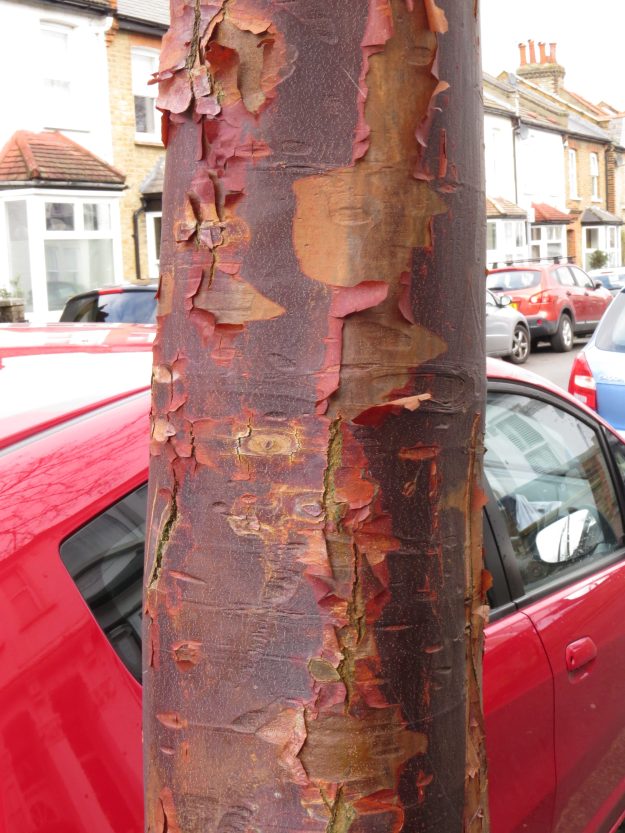
Paperbark Maple (Acer griseum)

Dear Readers, I was so taken with this Paperbark Maple,  spotted in East Finchley earlier this week, that I had to find out a bit more about it. As you can see, it has bark that peels away in tissue-thin layers of of coral and blush pink. The effect was even more impressive when I looked up at the branches. This peeling bark first appears when the tree is 6 or 7 years old, and continues for the rest of the plant’s life.

While the bark reminds me slightly of when I got sunburn as a child, it’s also a quite extraordinary effect. In his book ‘London’s Street Trees’, Paul Wood describes Paperbark Maple as ‘occasionally planted’, but it seems like a good choice to me – the trunk is the one thing that everybody sees, and so you don’t even have to look up to be impressed. It’s also a tree that’s happy on clay soil (which is basically what London sits on).

Paperbark maple is a long way from home, though – a native of China, it’s usually found at altitudes of 1,500 to 2,000 metres. It was introduced to Europe in 1901, and to North America shortly afterwards: apparently only two trees reached the US, and all paperbark maples in the country are descended from this pair of trees. It is a difficult plant to cultivate – a lot of the fruits that develop are seedless ( a phenomenon known as parthenocarpy, another new word!), and  a joint American/Chinese expedition met up in China in 2015 to try to collect seeds to improve the genetic diversity of the plants in cultivation. This is not purely to enhance North American trees, either – the plant is considered endangered by the IUCN, with the populations in China increasingly fragmented and threatened. It’s quite something to find an endangered plant growing in a suburban street.

The bark isn’t the end of the story with Paperbark Maple, however: in autumn, the leaves flush orange/red. The leaflets are arranged in threes, as are the flowers (which turn into the typical maple ‘keys’). In spring, the leaves are dark green above, but decidedly furry underneath.

I wonder if it’s the difficulty in propagation that results in this amazing tree not being planted more often?

Photo One from https://treeheritage.co.uk/planting-trees-for-autumn-colour/acer-griseum-autumn-colour/

Paperbark Maple autumn colour (Photo One)

Why, though, would a tree lose its bark in this way? Many trees do this, the most familiar to us Londoners being the London Plane tree (Platanus x hispanica). In this species, the loss of bark is thought to be a way of getting rid of accumulated toxins from pollution, although in the very hot summer a few years ago I noticed that the plane trees were losing much more bark than usual, possibly from stress. However, it seems unlikely that a tree that evolved in China’s mountains would be doing the same thing.

Another possible explanation is that the exfoliation helps the tree to rid itself of unwanted parasites and fungi. Yet another is that trees at high altitudes actually have their bark damaged by the UV light from intense sunshine, and also that they might suffer frost damage, so getting rid of damaged bark makes sense. It can also deter climbers and epiphytes. So, who knows? One explanation that I have rejected for ‘my’ tree, as I’ve come to think of it, is that the bark cracks and peels as the tree grows, a bit like an insect growing out of its exoskeleton. In that case, why doesn’t it happen to all trees? And why doesn’t it stop when the tree reaches its full height? Let me know what you think, readers. I know that you’ll all have some native trees where the bark peels, but why? I know we won’t get to the bottom of it here, but it’s always good to ponder.

Photo Two By Bruce Marlin - Own work http://www.cirrusimage.com/tree_paperbark_maple.htm, CC BY-SA 2.5, https://commons.wikimedia.org/w/index.php?curid=2988653

A Paperbark Maple in summer (Photo Two)

And finally, a somewhat tangential poem. It actually made me tear up, this poem: partly because I remember the sheer excitement of a library, and partly because of the destruction of the library system in the UK which means that so many children will never experience that excitement.

Maple Valley Branch Library, 1967
For a fifteen-year-old there was plenty
to do: browse the magazines,
slip into the Adult section to see
what vast tristesse was born of rush-hour traffic,
decolletes, and the plague of too much money.
There was so much to discover-how to
lay out a road, the language of flowers,
and the place of women in the tribe of Moost.
There were equations elegant as a French twist,
fractal geometry’s unwinding maple leaf;
I could follow, step-by-step, the slow disclosure
of a pineapple Jell-O mold-or take
the path of Harold’s purple crayon through
the bedroom window and onto a lavender
spill of stars. Oh, I could walk any aisle
and smell wisdom, put a hand out to touch
the rough curve of bound leather,
the harsh parchment of dreams.
As for the improbable librarian
with her salt and paprika upsweep,
her British accent and sweater clip
(mom of a kid I knew from school)-
I’d go up to her desk and ask for help
on bareback rodeo or binary codes,
phonics, Gestalt theory,
lead poisoning in the Late Roman Empire;
the play of light in Dutch Renaissance painting;
I would claim to be researching
pre-Columbian pottery or Chinese foot-binding,
but all I wanted to know was:
Tell me what you’ve read that keeps
that half smile afloat
above the collar of your impeccable blouse.
So I read Gone with the Wind because
it was big, and haiku because they were small.
I studied history for its rhapsody of dates,
lingered over Cubist art for the way
it showed all sides of a guitar at once.
All the time in the world was there, and sometimes
all the world on a single page.
As much as I could hold
on my plastic cards imprint I took,
greedily: six books, six volumes of bliss,
the stuff we humans are made of:
words and sighs and silence,
ink and whips, Brahma and cosine,
corsets and poetry and blood sugar levels-
I carried it home, five blocks of aluminum siding
and past the old garage where, on its boarded-up doors,
someone had scrawled:
I CAN EAT AN ELEPHANT
IF I TAKE SMALL BITES.
Yes, I said to no one in particular: That’s
what I’m gonna do!

– Rita Dove

Photo Credits

Photo One from https://treeheritage.co.uk/planting-trees-for-autumn-colour/acer-griseum-autumn-colour/

Photo Two By Bruce Marlin – Own work http://www.cirrusimage.com/tree_paperbark_maple.htm, CC BY-SA 2.5, https://commons.wikimedia.org/w/index.php?curid=2988653


Wednesday Weed – Blood Orange

Dear Readers. there is something almost shocking about cutting into an orange and discovering flesh the colour of liver rather than the expected citrus hue. In fact, the marketing of the fruit has included changing the name to ‘Sicilian red orange’ and ‘ruby orange’, among other synonyms. It’s interesting that some websites refer to the orange having a ‘raspberry flavour’ – I wonder how much this is the influence of the colour, rather than the taste itself? I realise now that I should have done a blindfold taste test to see if there was actually any difference.

Blood oranges are red because they contain anthocyanins, the same pigments that we see in blueberries and black rice. They are protective against low temperatures, and blood oranges tend to be grown in areas where it’s cold at night. The flesh of blood oranges actually gets redder as the pigments accumulate during cold storage.

Blood oranges are thought to be the result of a natural mutation, and there are three main varieties. The Sicilian ‘Moro’ variety is thought to have originated originated in Syracuse at the beginning of the nineteenth century, and is said to be the reddest of all the red oranges, with flesh that is nearly black and pink rind. The variety has been given Protected Geographical Status, which means if you’re calling an orange a Sicilian Red Orange it had better come from Sicily or else. My oranges are the Sicilian variety, and very nice they were too, though my delight in them was tainted by the realisation that most Sicilian Red Oranges are harvested largely by immigrants from West Africa, who live in tin shacks on low wages and who are subject to constant harassment and ill treatment by their bosses and the local population. I shall be writing to the people who provide my fruit and vegetable box to ask about the provenance of the fruit.

Then there’s the Tarocco, also Italian but without such deep red flesh. The name is said to have come from an exclamation of wonder by the farmer who first discovered it. It’s said to the sweetest of the varieties, but I rather like the hint of sourness in the flesh of citrus. There is evidence that most fruit and vegetables have been bred to be sweeter during the past thirty years – who can remember the mouth-puckering sourness of old-school grapefruit? These days we barely need the brown sugar.

But I digress, as usual.

And finally we have the Spanish Sanguinello, which has flesh which is orange with red streaks. It can be harvested from February, but  can stay on the tree right through to May.

As you might expect, you can use blood oranges for all the things that you’d use a normal orange for, with the added bonus of that pretty pink tinge. You can make marmalade with them, although if you’re like me, you’ll add some Seville oranges to big-up the orange flavour. You can make orange and almond cake with them, or pop them into a salad. You can do what I just did and whoosh them up in a smoothie. I think they’re good with oily fish such as mackerel, although again they can tend a bit too much to sweetness. And I once had a blood orange icecream in Venice that was possibly in the top ten most delicious things I’d ever eaten. This website has some fabulous recipes if you find yourself juggling with some blood oranges in a hesitant way. I love the way that the author has added a lemon to the ice cream recipe to add sourness.

Photo One from https://theviewfromgreatisland.com/blood-orange-ice-cream/

Blood orange icecream (Photo One)

And finally, a poem. This is only tangential to a blood orange, though one is mentioned. It’s one of those poems that has an obligatory moment of silence at the end. See what you think.

The Park Drunk by Robin Robertson

He opens his eyes to a hard frost,
the morning’s soft amnesia of snow.

The thorned stems of gorse
are starred crystal; each bud
like a candied fruit, its yellow
picked out and lit
by the low pulse
of blood-orange
riding in the eastern trees.

What the snow has furred
to silence, uniformity,
frost amplifies, makes singular:
giving every form a sound,
an edge, as if
frost wants to know what
snow tries to forget.

And so he drinks for winter,
for the coming year,
to open all the beautiful tiny doors
in their craquelure of frost;
and he drinks
like the snow falling, trying
to close the biggest door of all.

·Photo Credits

Photo One from https://theviewfromgreatisland.com/blood-orange-ice-cream/


The Final January Walk in St Pancras and Islington Cemetery

Dear Readers, what a cold and windy day it was today, made rather worse by my not getting to sleep until 3 a.m. Usually I haven’t been sleeping badly during the lockdown, but on some nights my brain starts racing and won’t stop, and this was one of those nights. Plus in the rush to get out of the door I forgot my trusty hat, so the icy wind seemed to get into the deepest interstices of my ears. Harrumph! It’s fair to say that I wasn’t in the best of moods.

However, there’s always something to see in the cemetery, even though on some days you have to dig deeper than others.

I noticed this angel, with fist raised and trumpet. I would love to see the cemetery through the eyes of someone who didn’t share our iconography. What on earth would they think of all these winged figures, I wonder?

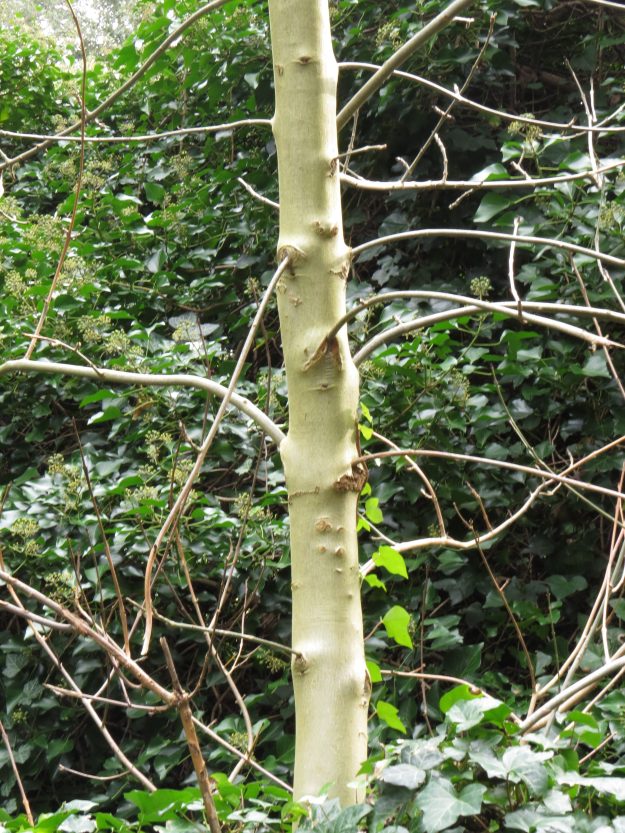
And I found myself completely fascinated by, of all things, the bark on the ash trees. As I’ve mentioned before, there are ash springing up all over the cemetery, and they are by far the most numerous tree, although it’s the stately Victorian plantings that get most of the attention.

On the younger saplings, the bark is smooth and pretty much without blemish.

However, according to The Science Photo Library, the smooth bark of the ash tree is also less acidic than that of many other common forest trees, which encourages the growth of lichens. The pH of the bark also offsets some of the effects of sulphur dioxide and nitrogen oxides, making them more amenable to the lichens and to fungi.  In fact, 536 different species of lichen have been found on ash trees, and ash dieback will put them in danger too.

My guess is that the lichen is black apothecia (Arthonia) though I am no expert. Some trees also have a marked rusty tone (as this one does), which could be another lichen called pale orange apothecia (Leconora). I shall have to come back with a hand lens and have a proper look. ‘Apothecia’ relates to the cup-shaped fruiting bodies of the lichen.

Marked orange staining on this ash tree.

Ash trees often develop huge scars on their trunks as they get older. My Collins Tree Guide refers to these as ‘erupting black cankers’ that ‘disfigure many trees’. That might be so, but the trees largely seem unperturbed by these scabs. 

And having referred to the stately Victorian planting, I rather liked this fine tree, which could not be more conical if it tried. It could be a Western Red Cedar or it could be a Leylandii (which I just discovered is a hybrid between a Western Red Cedar and a Monterey Pine). It just goes to show that even the much maligned Leylandii (if that’s what it is) is fine in the right place. It’s just not a good idea to create a suburban hedge out of it without being prepared to do a lot of trimming.

And here is a fine Scots Pine, which must have looked even more magnificent without the current backdrop of other trees. Now I look at the photo though, do I see the outline of what was once a holly hedge to the left of the tree? In my cemetery guide, it says that it seems that the custodians of the cemetery were overwhelmed by the sheer size of the place (at 185 acres it’s the second largest cemetery in London), and seem to have decided largely to keep the more recent areas neat and tidy, letting the rest of it grow wild. Long may it continue!

And here is some more forest statuary – the lady seems to be clasping a palm branch, but I’m not quite sure what the object is to the left. An urn, possibly?

And finally,  as we leave, my husband decides to go into the War Graves Cemetery for a quick look. I, however, am distracted (as always), this time by this stump.

Just look at the fine array of bracket fungi that are breaking down what remains of the tree!


I am thinking that the fungus is a variety of forms of the ubiquitous turkeytail (Trametes versicolor) but I’m no expert. I was just very taken by the way that the stump was providing sustenance even as it disappeared. Some red deadnettle was just coming into flower in the shelter of its roots.

I’m guessing that the tree was cut down because of some kind of fungal disease – even the main branches have been cross-hatched with an axe, and even they are providing a home for moss.

And so, feeling slightly less tired and with my head full of questions about lichens and fungi, I head for home. And by the time you read this it will be February! The cemetery is full of singing robins and squabbling blackbirds. Spring is on the way, readers.

Wednesday Weed – Kumquat

Kumquats

Dear Readers, those of you who saw my birthday post last week will know that I got some unusual ingredients in my vegetable box: salsify (which I roasted and which was delicious) and some kumquats. The name comes from the Cantonese kamkwat ( 金橘) which literally means ‘golden mandarin orange’) and they are native to China, where they have been cultivated since the 12th century. In 1846 the plant hunter Robert Fortune brought them to Europe, and from there they soon arrived in North America.

The ones that I have are unbelievably sour – having had a little taste, I suspect that they will shortly be languishing in a bit of sugar syrup just to take the edge off. But the round kumquat (Citrus japonica) is said to have sweet skin and sour flesh, which must make for a most intriguing flavour. Some species have fruit which is eaten whole, probably by people that have a taste for bitter fruit. I’m sure that in the West at least, our taste buds have been corrupted by the lust for sugar (which would have been a very rare thing in the natural environment, probably limited to berries and honey). When I was in Pakistan for work, I sampled bitter gourd, which is a delicacy throughout the region, and the face that I inadvertently pulled was a source of great amusement to my colleagues.

One variety of kumquat, the Hong Kong kumquat (Citrus hindsii) has pea-sized fruits and enormous seeds, so unsurprisingly it’s grown mostly as an ornamental plant. However, as the kumquats are thought to be the earliest forms of citrus fruit, this species might be the closest we have to the ‘ur-orange’, the ancestral citrus from which all other kinds have evolved.

Photo One By Bernhard Voß - Self-photographed, Public Domain, https://commons.wikimedia.org/w/index.php?curid=10555646

Hong Kong kumquat (Citrus hindsii) (Photo One)

Kumquats can bear thousands of fruits and, unlike most other citrus, are frost-hardy, which means that they are popular in spite of their sourness. Turned into marmalade they are a useful source of vitamin C, and their fresh taste can be used to offset sweeter ingredients such as chocolate or vanilla. They can also be used in fruit sauces to cut through the fat of meat such as duck or lamb. Very helpfully, 14 chefs give their ideas here. I rather like Nick Leahy’s idea of making a compote to eat with rice pudding: maybe I could dollop some onto my morning porridge? If I don’t get the sweetening right it will certainly wake me up. Or here’s a healthy salad instead.

Photo Two by Traci Des Jardins from https://www.foodandwine.com/chefs/how-to-cook-kumquats-chefs

Winter Chicory Salad with Kumquats and Date Dressing / Traci Des Jardins (Photo Two)

On a visit to Corfu back when I was a young ‘un, I remember that there was a bright orange  liquor called Koum Quat, which was incredibly sweet and sticky. When I dug a bit further though, it appears that the fruit is also made into a clear spirit to be drunk after dinner. Kumquats were apparently introduced to the island in 1860 and have been grown ever since.

Photo Three by Edal, CC BY-SA 3.0 <https://creativecommons.org/licenses/by-sa/3.0>, via Wikimedia Commons

Kuom Quat liquer on sale in Corfu (Photo Three)

In China and some other countries in Asia the kumquat symbolises good luck, and is often given as a gift at Lunar New Year. It’s also a plant that seems to lend itself to being made into a bonsai, and, as people become more urbanised but still crave a bit of ‘nature’. they are becoming very popular. In Vietnam, many garden centres are turning away from selling the traditional trees and are turning to bonsai instead, although it’s an art that cannot be rushed. In the article here, I was amused to learn of the many things that unscrupulous gardeners try to sell their ‘bonsais’, from sticking on false fruit to inconspicuously attaching false branches. It reminds me a bit of the dyed heathers and ‘fake’ flowering cacti that were popping up all over the place a few years ago.

I must say that these bonsais look a bit bigger than I expected though. More like smallish shrubs.

Photo Four from https://vietnamnews.vn/society/266434/clever-growers-switch-to-bonsai-kumquat-trees.html

Garden Centre with ‘bonsai’ kumquat trees (Photo Four)

It might also surprise you to know that there is a Kumquat Festival, not in Asia but in Dade County, Florida. Apparently St Joseph, Florida, a nearby town, is the Kumquat Capital of the World. Tens of thousands of people come to the festival, which, in addition to everything kumquat-related, includes an arts and crafts fair, a 5km race in aid of a cancer charity, wagon rides and antique fire engines. In Dade County, everything hangs on the weather – from November to April the blossom appears roughly every fortnight, so there can be almost continual picking. However, in some years a freeze in December or January can destroy the crop and damage the trees, which won’t fruit again for three years. Farming has always been a precipitous business, and with climate change things are more unpredictable than they ever were.

Photo Five from http://www.kumquatgrowers.com/festival.html

A seller at the 2004 Dade County Kumquat Festival (Photo Five)

Now, I thought that finding a poem about kumquats was going to be a challenge, but here are the first few verses of Tony Harrison’s poem ‘A Kumquat for John Keats’. I have taken the liberty of editing it down a bit, because for me it says everything it needs to say in the first few stanzas. However, if you want to see if I’m right, you can read the whole thing here. See what you think!

from A Kumquat for John Keats

Today I found the right fruit for my prime,
not orange, not tangelo, and not lime,
nor moon-like globes of grapefruit that now hang
outside our bedroom, nor tart lemon’s tang
(though last year full of bile and self-defeat
I wanted to believe no life was sweet)
nor the tangible sunshine of the tangerine,
and no incongruous citrus ever seen
at greengrocers’ in Newcastle or Leeds
mis-spelt by the spuds and mud-caked swedes,
a fruit an older poet might substitute
for the grape John Keats thought to be Joy’s fruit,
when, two years before he died, he tried to write
how Melancholy dwelled inside Delight.* / /
and if John keats had only lived to be,
because of extra years, in need like me,
at 42 he’d help me celebrate
that Micancopy kumquat that I ate
whole, straight off the tree, sweet pulp and sour skin–
or was it sweet outside, and sour within?
For however many kumquats that I eat
I’m not sure if it’s flesh or rind that’s sweet,
and being a man of doubt at life’s mid-way
I’d offer Keats some kumquats and I’d say:
You’ll find that one part’s sweet and one part’s tart:
say where the sweetness or the sourness start.

I find I can’t as if one couldn’t say
exactly where the night became the day,
which makes for me the kumquat taken whole
best fruit, and metaphor, to fit the soul
of one in Florida at 42 with Keats
crunching kumquats, thinking, as he eats
the flesh, the juice, the pith, the pips, the peel,
that this is how a full life ought to feel,
its perishable relish prick the tongue,
when the man who savours life’s no longer young,
the fruits that were his futures far behind.
Then its the kumquat fruit expresses best
how days have darkness behind them like a rind,
life has a skin of death that keeps its zest.

*Cf. John Keats, “Ode on Melancholy,” lines 25-26

Tony Harrison 1981

Photo Credits

Photo One By Bernhard Voß – Self-photographed, Public Domain, https://commons.wikimedia.org/w/index.php?curid=10555646

Photo Two by Traci Des Jardins from https://www.foodandwine.com/chefs/how-to-cook-kumquats-chefs

Photo Three by Edal, CC BY-SA 3.0 <https://creativecommons.org/licenses/by-sa/3.0>, via Wikimedia Commons

Photo Four from https://vietnamnews.vn/society/266434/clever-growers-switch-to-bonsai-kumquat-trees.html

Photo Five from http://www.kumquatgrowers.com/festival.html

A Chilly Walk in St Pancras and Islington Cemetery

Redwing about to fly off

Dear Readers, the cemetery is full to busting with redwings at the moment – these small thrushes are extremely shy, so getting any kind of photo has proven to be a challenge. The one in the photo above headed off as soon as it saw my camera. I wonder if they are hyperalert to people raising metal objects in their direction? I know that the woodpigeons in Dorset were always much more worried when I tried to take a photograph than the ones in London, and I put this down to the fact that the country ones are much more likely to be shot. Anyhow, even seeing a redwing was a nice start to the walk.

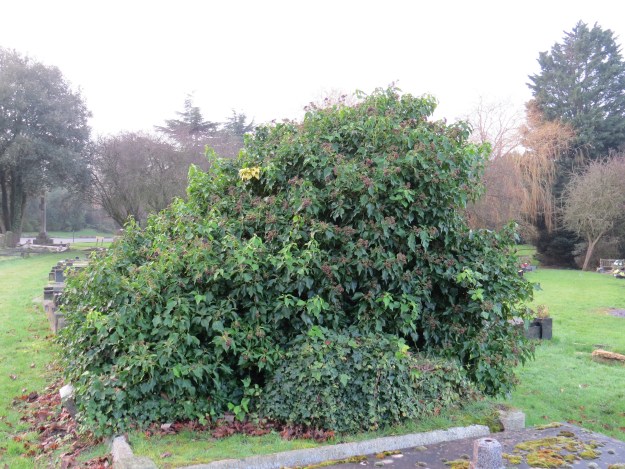
As usual, I suddenly notice things that I’ve been passing every week. This grave, in quite a well-manicured part of the cemetery, is completely covered in ivy. I wonder what’s under there? Quite the conundrum.

We loop through the woodland cemetery site, and I stop to say hello to the swamp cypress, now completely denuded of its leaves. But look, it has buds! Spring will soon be here.

And as we walk along our normal path, I suddenly notice an outbreak of snowdrops. What a particular joy they are this year! They must have been pushing up for ages, but I’ve only paid attention to them now that they’re in flower. Years ago, I imagine someone planted a few bulbs, and now they’re colonising the whole area. I love their delicacy and their strength.

Once I’ve noticed them in this spot, I see them all over the cemetery.

And by the stream, in the usual stand of ash trees, a robin is announcing his territory to the world.

These little puffed-up balls of feistiness are in full song: if you listen above the rumble of the traffic from the North Circular you can hear them challenging one another right through the cemetery.

We head towards the woody part of the cemetery. I hear a buzzard mewing, and crows cawing, but don’t see anyone overhead this week. However, there is a fine gathering of crows and magpies, and they are happily picking up chunks of bread that someone has left them under one of the trees. They are joined by at least two foxes, who are too fast for me to catch properly on camera, though there is the faintest suggestion of one in the photo immediately below.

Fox just to the right of the road sign.

We came into the cemetery at about 10.15 (it opens at 10 o’clock) and a car shot past us on the way out – maybe this was the person who feeds the birds. I’m sure they need it in this cold snap. Anyhow, now we know where to head for. Maybe next time I’ll have more luck getting a photo of the foxes.

I was rather moved by this Victorian cherub, on the grave of a child who died at six years old. It’s easy to forget how far we’ve come in terms of health: my grandmother lost three of her four children, one to scarlet fever, one to diptheria and one to a late miscarriage, before she gave birth to my Mum. This wasn’t unusual in the East End. But just because early death was so common it didn’t make it any easier; my Nan remembered the poems on the remembrance cards for her dead children for her whole life. I suppose that being in a pandemic is, for many of us, our first experience of a disease that curtails our activities and fills us with fear, one where medical science doesn’t immediately have all  the answers. As recently as the 1950’s people lived in dread of their children contracting polio and ending up in an iron lung. We have been very lucky, and you don’t have to walk far in this cemetery before you start to realise how unusual we’ve been. It makes me very humble when I see what previous generations have gone through, and what I’ve taken for granted, at least until now.

The great spotted woodpeckers don’t care about our troubles  though, they’re much too busy drumming and staking their claims to the best trees. I watch two woodpeckers chasing one another past the chestnut trees, and then get this most excellent photo of one. Yet another candidate for Wildlife Photographer of the Year, I feel.

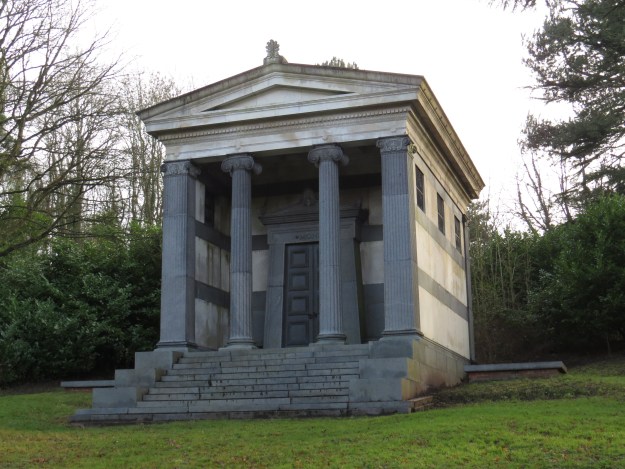
And then I wander down for a quick look at the Mond mauseleum. I’ve mentioned it before, but it really is an extraordinary thing: my book ‘London Cemeteries – An Illustrated Guide and Gazetteer’ by Hugh Meller and Brian Parsons describes it as ‘the finest classical building in any of the London cemeteries (along with the Ralli mortuary chapel at Norwood’). It was designed by Darcy Braddell, later a vice-president of the R.I.B.A, and was built in 1909. I’ve mentioned before that Ludwig Mond was a major industrialist and philanthropist. I must confess that I don’t love this building: it seems a bit overbearing and austere to me.

But I am very fond of this little tree that stands at the road junction opposite. I am thinking that it’s a weeping cultivar of silver birch, maybe ‘Tristis’? No doubt you lovely people will put me right. There was no angle from which I could avoid the sign pointing to the crematorium and pick up the purple of the shoots and the snaky twisting of the branches, so this will have to do. But what a pretty little tree this is! I shall have to pay it more regular visits to see how it’s coming along.