Category Archives: Personal

Real Life – Revisited

IMG_5116Dear Readers, this piece, from 2016, was the first time that I ever shared anything really personal on the blog. It turned out to be one of my most popular posts, and I continued to share about Mum and Dad’s last years. So many readers were going through similar things, and it felt as if we were part of a club that no one volunteered for….

My mother and father came to stay with me in London this Christmas. All three of us knew it was a risk. Both my parents have the full range of late-onset ailments ( COPD, diabetes, dicky hearts) but this is the only holiday that they get, and, besides, prizing safety above all else means that we gradually retreat into our shells, like hermit crabs, afraid that every shadow is a shore-side bird waiting to gobble us up.

On Christmas morning. Mum was trying to pin one of the brooches I’d bought her onto her jumper, fumbling with the clasp. She sat back and smiled, the filigree butterfly a little skew whiff. Then, I remembered.

‘One last present,’ I said.

I’d almost forgotten the orchid that I’d hidden away in the bedroom. As I walked back downstairs, I looked at the flowers. I am not a great fan of orchids – they have an alien quality that looks sinister to me. And yet, my mother has a gift for coaxing them into flower time and again. This one was pale pink with mauve bruise-like blotches. The mouth of each bloom opened like a man-trap with long, backward-pointing teeth.

‘It’s beautiful!’ said Mum, as I passed it to her.

As I removed the wrapping, one of the flowers detached itself and floated to the ground. I picked it up, feeling the waxiness of the petals. I showed it to Mum.

‘Oh, put it in some water’, she said, ‘I can’t bear to think of it just getting thrown away’.

‘Really?’ I said. ‘Won’t it just die anyway?’

But she looked so upset that I found a dish and floated the flower in it. It’s still there now.

———————————————————————————————————————————-

Early on Sunday morning, I heard a rasping whisper from Mum and Dad’s bedroom.

‘I think you need to call someone’, Mum said. ‘I can breathe in, but I can’t breathe out’. I could hear her chest wheezing and crackling from across the room.

An hour later, she was in an ambulance, being given oxygen, heading for the nearest London hospital.

The doctors confirmed that she was 80 years old. They heard the recitation of her health problems, shook their heads over her oxygen levels and the sounds coming through their stethoscopes. They ascertained that at her best she could walk only ten paces without having to stop to gather her breath. They admitted her to the hospital. She was put in a huge room on her own. There were no windows, but there were lots of empty navy-blue storage cupboards, as if this had once been a kitchen but all the appliances had been removed. The fluorescent light gave off a constant background hum. It was like being in the belly of a great machine.

‘I’m not afraid of dying’, said Mum. ‘But it makes me so sad to think that I’ll never walk around Marks and Spencer again, or walk in a park. And I know I’m lucky and there are lots of things that I can still do, but somehow, just now, that doesn’t help’.

Normally I try to protect myself by avoiding what is really being said in these conversations, by trying, like Pollyanna, to look on the bright side. But today, I just sat, and held her hand, and cried with her.

IMG_5085As I walk to the hospital, I notice how bright all the colours seem, as if I’m hallucinating. The thoughts are chasing one another round and round inside my skull, as scratchy as rats. There is a wall alongside me and beyond a wildflower garden, at head height. The low winter sun lights up a patch of trailing bellflower. I see the way that the stamen are casting a hooked shadow on the lilac petals, the way a single raindrop trembles on the edge of a leaf before falling, in what seems like slow motion, onto the soil. And for a moment, I don’t think about Mum at all, and I feel my shoulders relax. I take a deep breath, then another. And then I walk on.

————————————————————————————————————————————-

It used to be that hospital wards were full of flowers, the stink of lilies and gently decomposing chrysanthemums rising above the smell of antiseptic and hospital cooking. But now, all plants are banned ‘for hygiene reasons’. Probably the nurses are so overworked that they don’t have time to cope with browning foliage and wilting poinsettias. But I can’t help thinking that something alive and beautiful is as important for healing as drips and antibiotics. Mum’s bunker looked completely sterile. But I had underestimated her.

At Christmas dinner, I had handed out some crackers that I’d bought from a wildlife charity. Each one contained a card that, when opened, released a snippet of bird song. The game was to guess which bird was singing – nightingale, blue tit, wren? Mum had put the cards in her bag. When the very important Consultant and his two trainees came along to see how she was doing, she produced one of the cards and pushed it into the Big Man’s hand.

‘Open that’, she said.

He looked at her askance, and opened the card. The sound of a song thrush in full-throat filled the bare room, flooding the place with the sound of woodland wildness.

The consultant’s face changed. He closed the card and opened it again. He turned to the two trainees.

‘I know you want to go home’, he said to them, ‘But listen to this!’

And he ‘played’ the  song again, before closing the card and handing it back to Mum with a bow.

After a few days, Mum is moved to a different ward. As usual, she hates it at first – relationship is what Mum thrives on, and in each new location she has to charm everyone all over again. But she does have a window now.

‘At night, I can see all the planes flying over’, she says.

I notice that there’s a spider outside the window. At first I think it’s dead, but then I see that it is on a web, blowing backwards and forwards as the wind buffets the building. I decide not to tell Mum. She isn’t the world’s biggest spider fan. But it makes me happy to see this little note of anarchy in this antiseptic place.

‘At least I can get a breeze here’, says Mum. ‘Though when I was standing up next to the window yesterday they made me get back into bed in case I caught a chill’.

Her temperature is still too high, she is coughing most of the time and she’s pulled her canula out.

‘ I thought I’d be feeling a bit better by now’, she says. ‘But they’ve still got me on that bloody antibiotic that doesn’t work’.

I know that doctors don’t like to be told their jobs, but still.

‘Did you know that Mum’s been hospitalised for Proteus infections several times?’ I ask the doctor when he’s next on his rounds.

‘No’, he says. ‘Maybe we should talk to the people in Metabiotics’.

———————————————————————————————————

Proteus is a super-bug, and Mum probably acquired it in a hospital. Along with MRSA and C.Difficile, it is infecting our clinics and operating theatres. Proteus is so-called because it hides in the body, changing location. There are several variants, many of them immune to one antibiotic, some to several. The use of several antibiotics simultaneously is called Metabiotics.

This is the age of the antibiotic-resistant bacteria. On a bad day, I feel that we are standing on the threshold of apocalypse. I remember a display I saw about the Jamestown settlers in America. Several of them died from a simple tooth abscess that could not be treated, became infected, and spread through the body.

As we seek to sterilise our homes and hospitals and schools, life is creeping back through the keyhole, pouring under the door, finding the draughty spaces around our windows.

The doctors change the drugs. My mother’s body becomes a battleground. At 3.30 a.m. she rings me.

‘I’m in The Game’, she says. ‘I’m trapped in a room, and they’re murdering people next door, and slaughtering them like animals, and they won’t let me out’.

‘Mum,’ I say, heart racing, ‘You know that none of this is real?’

‘I know’, she says, ‘but I want to get out and they won’t let me go’.

The phone goes dead. I call the ward. After what seems like a year, the nurse answers. I explain the situation.

‘I’ll talk to her’, he says. ‘It’s the drugs’.

The next morning, Mum can’t remember any of it, but her breathing seems better. Then her blood sugar climbs to 32, a dangerously high level. It seems that, somehow, the bacteria are fighting back. This is not going to end any time soon.

On my visit, Mum hands back the cards with the bird songs in them.

‘Take them home’, she says. ‘Keep them safe. They don’t belong here’. And she closes her eyes, a look of concentration turning her face to marble. She is not beaten yet.

IMG_5117

Today, there is finally good news. The blood sugars are under control. Mum’s breathing is improving. Her poor body has fought back again, and if all goes well, she will be out of the hospital in a couple of days.

I am making my peace with the orchid. The buds are clenched fists, but the newly opened flowers are poppy-shaped, like cupped hands, around the soft inner petals. I see that the long, tongue-like leaves have a fine layer of dust.

‘I’d better clean you up’, I say to the plant. ‘Before Mum comes home’.

Update

Mum finally left the hospital on Thursday, and is travelling back home to Dorset with Dad and I on Sunday. She isn’t fully well yet, as might be expected, but she is getting better.I am deeply grateful to all the staff at the Whittington Hospital in north London for their unfailing care of my mum, and for their patience and dedication. The NHS truly is a pearl beyond price.


One Year On….


Dear Readers, one year ago today I was carrying a suitcase downstairs at East Finchley Station when I slipped, and ended up with a spiral fracture of the tibia. And what a year it’s been! I have made lots of new friends, have gained a much better understanding of what it is to live with mobility issues, and have an even greater appreciation of the NHS and the ambulance service.

It wasn’t the year I was planning on having – we were on our way for our annual walking trip to Obergurgl in Austria, but Easyjet had cancelled the flight and we were heading home, planning to fly with Lufthansa the next day. Instead, I spent months hobbling around. I watched way more of the Olympics than I’d ever done before, and gradually, gradually my strength and confidence started to come back.

The fall that broke my leg was the fourth that I’d had in six months, so once I was relatively mobile again, I started trying to find out what was going on. I was diagnosed with hypermobility, which explained why my ankles always seemed to bend way too far when I stumbled – I went to see a podiatrist and am now the proud owner of some very nifty orthotics, which seem to keep everything much more where it should be.

I had also been noticing that my feet were numb, and so this made me go to the doctor to find out why. We’ve ruled out B12 deficiency, diabetes and all the normal causes of peripheral neuropathy but, as my poor Mum had severe neuropathy from thirty years of age, we did some genetic testing. It shows that I do have a number of gene variants that are associated with neuropathy, but none that indicate any of the syndromes that have been identified as having neuropathy as a component. In other words, here I am, and I’ll just have to be careful and adapt to the fact that I increasingly can’t feel my feet.

I am doing pilates, and have been working with my particular teacher for nearly twenty years, so we do a lot of work on balance and on strengthening those pesky ankles. Fingers crossed that it helps me maintain and even improve my mobility.

As it is, I have my very fancy walking stick – I don’t need it for weight-bearing, but it is a very useful ‘third leg’ for balance purposes if I’m out and about. And if it hadn’t been for my broken leg, I would probably still not have dug into the causes of my falls. At least now I have a better idea of what’s going on.

And, shortly, we will be heading off to Austria again – same early morning plane, same overnight stay at Gatwick. Let’s hope that we actually get there this time.

Migraine – What’s That About?

Impression of Visual Migraine (Photo by By S. Jähnichen – File:Brandenburger_Tor_Blaue_Stunde.jpg, CC BY-SA 3.0, https://commons.wikimedia.org/w/index.php?curid=6668898)

Dear Readers, very occasionally I get a brief case of retinal migraine – the photo above doesn’t quite do it justice, but it’s the closest I can find! Basically I get what looks like a bright, shimmering ‘hair’ in my right eye, that seems to just float about irritatingly. It usually crops up when I’m tired, hungry or stressed, and lasts for about half an hour. The only other effect I get is a slight light-headedness. I’m very lucky, I know.

There is thought to be some kind of genetic component to migraine, and my poor mother suffered horribly from full-blown migraine. One of my earliest memories is going into a darkened room where she was laying, and seeing her hitting her head against the wall. She was completely knocked sideways by the migraines, sometimes for days. She couldn’t bear the light, was often nauseous, and all she could really do was lay as still as possible until they passed. Luckily my grandmother lived with us, and so she was able to take care of my brother and I,  but we knew to be quiet and well-behaved when ‘Mummy wasn’t well’.

Things improved a little when the drug Solpadeine came to the market – Mum found that it helped if she took it as soon as she started to get the ‘aura’ that preceded an attack. But other than that, she just had to get on with it. She was most likely to fall ill around the time of her period, and she found that she could eat chocolate or cheese, but if for some reason she had them in the same meal, it was likely to trigger a migraine.

Approximately 10 million people in the UK alone suffer from migraine, with an estimated 3 million lost workdays per year, at a cost of £4 billion. More women than men are susceptible to migraine, and there are increasing numbers of children and young people who suffer from the disorder. And yet, I wonder if things have improved from my Mum’s day, when she was basically expected to take a few painkillers and muddle through? Like so many people, Mum worked out some of her triggers and avoided them, but I’m sure a lot of people never manage to work out exactly what strange combination of things brings on a migraine. The NHS are trying to establish a new regime for migraine and headache care, helping people to keep a ‘headache diary’ to see what causes their problems, developing support lines for patients and providing better information for GPs, which is a step in the right direction. Still, it reminds me of how many people are living under the shadow of a migraine attack every day.

Mum had a hysterectomy in her late fifties, and her migraines disappeared almost overnight – clearly for many women there’s a strong hormonal link. I’ve heard many women say that their migraines eased after the menopause. But it seems to me that we still don’t have an effective treatment for migraine, and that people are losing great chunks of their lives to a condition that knocks them sideways for days at a time.

However, there is some hope – a new treatment that is specifically for migraine, called Calcitonin gene-related peptide antibodies (CGRP) monoclonal antibodies (mAbs) (quite the mouthful) are used to target the chemicals that are produced prior to the onset of a migraine, and they seem be both safe and effective. They have to be given by injection, or infusion, and last for a few months. Currently, they are only available if three other preventative medications have been tried, and have failed, but they are definitely worth knowing about – there’s a factsheet here. I think my Mum would have tried anything to get her life back.

So, Readers, do any of you suffer from migraine, or know someone who does? Have things improved since my Mum’s day? What works for you, and what are your triggers?

The Migraine Trust has a lot of very useful information, and is currently planning a campaign to ask for better services for people with migraine. Long overdue, I’d say.

Remembering the Professional Whistler on Father’s Day

Dad at the Marina close to Minnesota

Dear Readers, I was sitting on the top deck of a bus en route to the Museum of Barnet on Saturday when I heard a sound that I thought had been consigned to the past. The man sitting at the front of the top deck was looking pensively out of the window at the driving rain (well, it is June after all) and occasionally whistling what sounded like an excerpt from ‘You Are My Sunshine’. Ah, how the memories flooded back, as you’ll see from my piece below, written in 2021. 

I am trying to forget about Father’s Day, but of course I don’t want to forget my father. Father’s Day could often be a bit fraught, as Dad was impossible to buy for because he didn’t want anything. His only vice, latterly, was creme caramel (a bit difficult to send in the post) . Plus, on one occasion when I phoned to wish him Happy Father’s Day, he announced that he was too young to have any children and put the phone down. When questioned by the nurse it transpired that rather than being in his eighties, he was a young lad of 21. 

As the years go on, the sharpness of grief largely eases, but the ache remains, ready to be nudged into consciousness by a complete stranger and his tuneless whistling. If I close my eyes, I can nearly hear Dad’s all time most terrible rendition – a version of ‘She’ by Charles Aznavour, not an easy tune to start with but made all the more surprising by Dad attempting to whistle in a French accent . If you are finding that difficult to imagine, then count yourself lucky. But how I miss him! And for more on the subject of whistling, read on…

Dear Readers, whatever happened to whistling? When I was growing up, everyone seemed to do it. Paperboys whistled on their rounds. Van drivers wolf whistled out of their windows at any female between 11 and 65 (these days they yell obscenities which is hardly an improvement). To attract a friend’s attention, you put two fingers in your mouth and emitted a startlingly loud blast (which I could never do, but was impressed by those who could). Nowadays the paper boys (those who are left now that we all read the news online) listen to music on their phones rather than making it, and I suspect most people never learn to whistle in the first place. The only living things whistling on my street are the starlings.

Dad was a long-established whistler. He would put a Nana Mouskouri or Demis Roussos record on the player, and would tap along for the first thirty seconds. My brother and I would wait for the inevitable. Dad would pucker up and join in, invariably half a bar late and with a tune that only roughly approximated what was actually happening. Sometimes he would stop and give it another bash, and on other occasions he would rush to try to catch up. We were often in silent stitches by the end of the performance, but Dad would always look quietly content, as if the race had been difficult but he’d got there in the end.

I don’t remember the last time I heard Dad whistle. It might have been around the time that he was diagnosed with COPD, but for years he’d barely had the breath to sit in his reclining chair comfortably. As his health, and Mum’s, declined, there was precious little to whistle about. But when I had lunch with him in the home in March last year, they were playing Spanish music and serving Spanish food, and I saw him tapping along with Julio Iglesias. He puckered up at one point, as if about to start, but then the Spanish chicken turned up and he set to with enthusiasm. It was the last time that I ever ate with Dad, or had a proper conversation with him, because he died on 31st March. The tuneless whistler was finally silenced, and there will never be a performance like it again.

How amused Dad would have been to hear that there is such a thing as a professional whistler! I thought of him when I read this piece in The Guardian yesterday. Here’s an excerpt:

‘Sitting by the deathbed of the Hollywood veteran Harry Dean Stanton, professional whistler Molly Lewis delivered her most poignant performance to date. The Australian-born musician whistled otherworldly versions of Danny Boy and Just a Closer Walk from Thee, the gospel ballad Stanton croons in 1967’s Cool Hand Luke. “He kissed my hand – it was such a beautiful moment”, remembers Lewis of her intimate 2017 performance”.

So, naturally I had to have a listen myself. For your delectation, here is the video for Lewis’s 2021 single ‘Oceanic Feeling’. I think the sound is utterly beautiful, but it might be better listened to rather than watched – it’s difficult not to be distracted by the comic appearance of someone whistling.  See what you think!

https://www.youtube.com/watch?v=YZ6vuWFxvGM


2021 – R.I.P Bailey, King of the Cats

Bailey, the world’s most magnificent cat in 2017

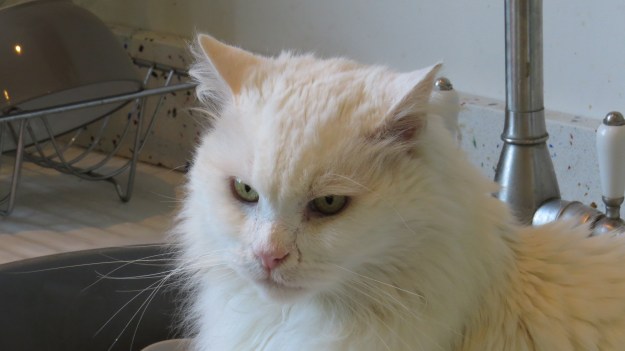
Dear Readers, when I say that a community is about more than just people, I often think of Bailey, who visited our garden regularly from when we moved in in 2010 to when he passed away in 2021. What a magnificent creature he was! And he seemed to bring the community together in a whole range of creative ways. We miss him still….

Dear Readers, a few nights ago Bailey, the King of the Cats, went to sleep for the last time at the fine old age of nineteen years. He has been so much part of our life, and of the lives of many people who lived in the County Roads, that I wanted to pay tribute to him here.

I first met Bailey before we even moved to East Finchley. We were standing on the patio of what was to become our new home when we heard a loud and persistent miaowing issuing from the bushes. Up strode Bailey. He bobbed up for a head scritch, rolled on his back and then marched up to the back door, demanding to be let in. As it  wasn’t yet our house, we decided that this probably wasn’t the best idea, but once we were living there he became a regular visitor.

On one occasion I heard the voice of Bailey’s owner, followed by an all-too familiar wailing.

“Bailey! Come down from there. Don’t make a show of yourself”.

And there was Bailey standing on top of the ten-foot fence at the end of the side return. He had gotten up there, but seemed not to have worked out how he was going to get down. We humans stood and considered what to do. I tried standing on a chair but it wasn’t quite high enough. Fortunately at that point my six foot three inch tall husband arrived home from work, fetched a stepladder and rescued him. Carrying Bailey up the road to his actual house became part of our weekly routine. I think he regarded us as some kind of taxi service for when he was too tired to walk the last hundred yards home.

We soon made friends with Bailey’s actual family (or ‘subjects’ as I’m sure he thought of them). We were in regular contact, as Bailey developed a habit of wandering off. We never fed him, but other people did, and locating him became quite a problem. I am convinced that Bailey never thought of himself as a cat, but as a small furry human being. He would make himself at home on the armchair and watch benignly as I worked. He also loved sitting in the sink, normally (but not always) when there was nothing in it. We learned that what he loved was to drink from a running tap.

Bailey trying to get us to turn the tap on by telepathy.

Finally!

You would not believe that in these photos Bailey was already fifteen years old. He retained his elegant good looks for most of his life, and he was such a popular character on the street that everyone seemed to know his name. Well, you couldn’t really miss an extremely vocal pure-white cat who simply demanded to know who you were and what you could do for him. I had the sense that Bailey always knew what he wanted, and a bit more besides. We found we had a lot in common with Bailey’s owners, and we would probably never have found out how much if Bailey hadn’t ‘introduced’ us. He always seemed preternaturally wise to me.

As the years wore on, Bailey got a bit slower and a bit stiffer, like most of us, but he was still a regular visitor to the garden. The birds never bothered about him, and I never saw him try to catch anything. Other cats scattered at a glance. He would sometimes pay a visit to the garden ‘waterhole’ for all the world like a domestic lion.

Bailey drinking from the pond

He’d always march straight up to the back door and yowl to be let in. If he caught your eye from an upstairs window he would re-double his efforts.

Let me in!

In April this year he paid a visit to the garden. He was clearly a very elderly gentleman, and yet he still announced himself in the usual way,

He was very wobbly on his legs and so we called his ‘Dad’ who came to carry him home. It is so sad to see an animal towards the end of his days, and yet Bailey was a cat who defied pity; he was still the same regal cat that he’d been when we first met him eleven years ago. He loved people, was never happier than when he was plonked down in a patch of sunshine, and seemed to be of the opinion that everything had worked out for the best. He was, as Samuel Johnson said of his beloved cat Hodge, a very fine cat indeed.

R.I.P Bailey. The street is quieter, and much sadder, without you.


Flowers for Fran

Fran Freelove with her cat Toby

Dear Readers, back in 2022 a most beloved reader, Fran Freelove, passed away from ovarian cancer. Those of you who have been following the blog for a while will remember how Fran and her sister Bobby were always the ones to beat when I used to set a quiz, often polishing it off while the rest of us were still in bed and blearily considering what to have for breakfast.  I have reproduced the blog that I wrote at the time below, so that you can see what a very special person she was.

Well, I have been in touch with her son Antony since Fran died, and he mentioned that he had a large box of the seeds that she’d bought to plant in the garden. And this ‘germinated’ a thought. How about if those of us lucky enough to have gardens, or window boxes, or a container, tried to grow some of these seeds, so that Fran’s love of nature could be spread far and wide?

I should mention that these seeds have been sitting around since Fran died, so they won’t have quite the germination success that more recent  packets might have, but I am pretty sure that at least some should come up. They are pretty much all pollinator-friendly (though there are a few packets of herb and veg seeds too). To start with I’m going to limit us to 5 packets each, but I might do a second round if there are any left.

You can find the list of available seeds here. Fran’s Flowers

All you need to do is leave a comment on the blog, or on my Facebook page, and I’ll contact you to find out your address. I’m happy to send overseas, though I’m relying on you to find out if there are any restrictions on seeds through the post to your particular location (I know that Australia, for example, has very strict rules).

Please note that you don’t have to have read about Fran before – if you love nature, you can have some seeds, and I’m sure that Fran would be only too pleased to share some with you if she were here. 

All I’d ask is that you send me a photo if your plants are successful, so that I can share them here. It’s fine to keep a low profile if they don’t work 🙂

I really love the thought of gardens everywhere being all the better for Fran’s love of bees and birds and butterflies.

And here’s my original blog about Fran, from 2022. Do have a read. She was a remarkable person.

Dear Readers, I wanted to share with you the sad news of the death of one of the blog’s most regular contributors, Fran Freelove. For anyone who did my weekly quizzes, Fran and Bobby Freelove were the ones to beat, and very rarely was this accomplished, even though for the past six years Fran has been undergoing treatment for ovarian cancer.

Fran and Bobby were sisters, but her son Antony told me that it was actually Fran who normally did the quizzes. Her range of knowledge was astonishing – everything from plants and insects to songs and birdcalls were all taken in her stride. She was always generous to anyone who did manage to beat her, although this was a rare occurrence indeed.

But there was so much more to Fran than her knowledge of the natural world. Although we never met, I always thought of Fran as a kindred spirit. We agreed on so much. Here is Fran writing about the foxes in her garden, for example:

We’re extremely lucky to have three, Betty, Bass and BonBon, we haven’t seen our fourth one, Stump ( he only had half of his brush) for quite some time. They do get fed and they’re very good at time keeping! We have cameras so we can watch them, it’s quite amusing the antics they get up to. With their mortality rate being so high we must do all we can to look after these beautiful creatures.

Like me, she was often horrified at the way that people treated the natural world, and enjoyed trying to make things better. And how I loved her sense of humour too!

You are so right Bugwoman. We too have collected rubbish for the nearly four years on our daily walks, we hate to see our beautiful countryside spoilt by other peoples thoughtlessness. If everyone just did a little bit wouldn’t it be a nicer place.
We’re always surprised about the number of Red Bull cans, it obviously doesn’t ‘give them wings’ enough to put them in a bin. Litter picking can be quite therapeutic we find.

And here is Fran, feeding her extremely lucky tadpoles…

We feed ours with the tadpole foods you can get, early and late stage, quite expensive but they seem to like it. When they come up to feed don’t you just love their little faces. 😀

And she and Bobby had different opinions about frogs:

You have touched on one of my most favourite subjects, frogs. Whilst i read your post avidly it has to be said Bobby was the total opposite, they give her the heebie jeebies. During the season i often get a phone call with her panicking at the end of the phone because she’s found one in her garden. While she actually locks herself in her house i have to go and rescue the little treasure and take it back to my pond, good job we only live four doors apart. I think they are the most amazing little creatures so i never mind adopting yet another one. My pond is right under my bedroom window and the sound some nights of the frogs singing is wonderful.

We had the same attitude to pesticides too.

We totally agree with Anne on the use of pesticides, we would not dream of using them, and we’re lucky enough to have foxes and hedgehogs as well as a vast array of birds. Our gardens are healthy and full to brimming. As we’ve said before, everything is here for a reason.

Fran had been commenting on the blog since 2017, but the first time that she even mentioned that she was undergoing treatment for cancer was in 2020.

We too very much enjoy your posts. It’s so important to be involved with nature, i’ve (Fran), been battling cancer and am now, after two major ops, masses of radiotherapy now in fortnightly chemotherapy. To be outside is so important surrounded by all the lovely things, we so love our walks and it definitely helps take your mind off things.

And I mustn’t forget to mention Fran’s faithful cat Toby. Here is Fran talking about her cat.

They truly are one of the best companions, throughout my illness there are days when i have to spend days in bed, he will not leave my side and lies on the bed with me even on lovely sunny days when i know he’d much rather be outside.

Between 2018 and 2020, I had seen the decline and death of both my parents, and Fran was such a comfort to me, even though she was going through surgery, radiotherapy and chemotherapy herself. She was such a kind and generous woman, and I will always be grateful for her insight and empathy. Here is Fran after I posted about Mum and Dad going into a nursing home:

You have done this purely for the right reason and that is the welfare of your parents. You have always done everything possible for them so you have absolutely nothing to reproach yourself about. We remember when our father went for respite care for a while what a huge weight it was off our shoulders to know someone was there 24-7 for his needs. I’m sure your mum will soon adapt to her new surroundings and it sounds like your dad will be fine. We wish you and your parents all the very best and we’re sure we’re safe in saying so does everyone who reads your post and feels like they have been on this journey with you.

And here is Fran after my Mum’s death in 2018.

We were so very sad to hear of your mother’s passing. A difficult time for you and your dad but a gentle release for her. Your mum will still be with you, just in different ways, you have some wonderful memories to look back on which we know will help you through the coming times. take care xx

A blog is a strange thing. I never met Fran, and yet my world was always a happier place knowing that she was in it. My dream when I started Bugwoman was that it would create an online community of people who cared about the natural world wherever they lived, and Fran was so much part of that. I’d like the finish with the first comment that she ever made on the blog, back in 2017. I would have loved to have Fran and Bobby as my actual neighbours too, but I will always think of Fran whenever I see a fox in the garden, or a frog in the pond. Farewell, my friend, and heartfelt condolences to Bobby, Fran’s sister, Antony, her son, and to her other family and friends. I am holding all of you in my heart.

Hello Bugwoman, my sister and i thought we must comment on your blogs, we found you quite by accident some while ago after i had major surgery. We adore everything to do with nature and wildlife and we can’t wait to read your brilliant blogs every week, so informative and you have such a lovely way with words. We walk every single day through our local woods whatever the weather and there is always something different to see. You sound so much like us we’d love you as a neighbour, Fran and Bobby.

The Years Roll Past, But Love Never Dies

Dear Readers, Sunday was Mum’s birthday and this year she would have been 88 years old.  My brother sent me a photo of the family gathered for Mum’s birthday dinner at a local pub in 2016. We had booked a table at the restaurant  but sadly, though they took our reservation, when we rolled up the place was in darkness. Much hammering on the door resulted on it being opened, and the beleaguered woman who answered it was horrified that we were in our glad rags and expecting dinner. Nonetheless, she made us welcome, and the few staff who were there went into the kitchen and knocked us up something with chips, which we ate in solitary splendour. They even turned on the Christmas tree lights. Looking at the photo now, I’m struck by how pale Mum and Dad both look – by this point, life was a constant stream of hospital stays and antibiotics and steroids for chest infections. But if I could see which way the compass was pointing, I chose to ignore it. After all, Mum and Dad had both survived so many illnesses that would have killed lesser mortals that I fully expected that that would continue to be the case.

This was just a month before Mum and Dad came to stay with me in East Finchley for  Christmas, and Mum ended up nearly dying of a chest infection in Whittington Hospital. In 2017, Mum and Dad celebrated 60 years of marriage, but in 2018 Mum died, followed by Dad in 2020.

I have the scarf that Mum is wearing in the photo in my wardrobe, along with so many other things that she made. Every so often, I pull something out and wear it. It feels as if she’s giving me a hug. She taught me so many things – how creativity is sometimes easier if you share what you make with other people, be it a scarf or a piece of writing. How everybody is interesting in their own way. And most importantly of all, how to be kind, and how to put aside judgement and work on the basis that everyone is doing their best. I don’t always manage it, but she makes me want to try, even now.

And here is the piece that I wrote last year, and here is the piece that I wrote in 2019, the year after her death. It’s interesting to see how grief morphs and changes as the years go by. We are never truly ‘over it’, but somehow joy returns, and the memories of the last awful years no longer overshadow all the good times.

And, as I said last year, I am sending love out to everyone who finds this season painful. There will be people reading this who have lost someone close to them this year, and for whom this will be the first Christmas without their loved one. Be gentle with yourself. Do what you need to do. Don’t strive for perfection, there’s no such thing under the sun. Follow the old family traditions where they bring comfort, but be prepared to ditch them if they no longer make sense, or are too painful. Grief is a process that never truly ends, and there is no right way to feel or not to feel: don’t let anybody tell you something different.

Mum at the Royal Oak pub in Milborne St Andrew 2012


Farewell, Margaret Lovett

Margaret in C’a D’Oro in Venice

Dear Readers, back in 2016 I visited Venice with my friend Margaret Lovett. She was 89 and a bit years’ old then, and had mentioned, rather wistfully I thought, that she’d love to see Venice one more time. I had been visiting Venice regularly, and usually stayed in an apartment right on the Cannaregio main canal, so I said I’d be glad to go with her. And so, off we went.

Margaret had had an interesting life. She was the daughter of the Vicar of Sherbourne in Dorset, and lived in the town throughout her life, when she wasn’t off on some adventure or another. She trained as a nurse, and for a while she was living and working in Samoa.  In her forties she had had a spinal fusion operation, which she said had made all the difference to her mobility, helped by the fact that she had assisted the surgeon who operated on her during many similar procedures, and therefore was confident that he ‘knew his stuff’.

When she retired, Margaret took up travelling with a vengeance. We met in China, on a gruelling expedition along the old Silk Road to Kashgar, the centre of the Uigher community at that point. Margaret was in her 80s then but bore with the extreme heat, the dust, the dodgy toilets, the tight timetable, and even the being manhandled on and off of a Bactrian camel in the Gobi desert. We became fast friends, but catching up with Margaret was always tricky – she returned to the Silk Road twice more, and also spent months in Australia, visiting with her nieces and nephews.

Margaret never married, but she has a whole raft of people to buy presents for, and so visiting a gift shop was always high on the agenda. In Venice, we’d accidentally left it until a day when the Aqua Alta (the occasional minor flooding of the streets) happened, but, undeterred, Margaret paddled through the water in her sandals to buy the necessary trinkets. Her suitcase, which was light as a feather when she arrived in a country, was always perilously close to over-weight by the time she left.

Margaret had a tricky relationship with Venice – on her previous visit, she had tripped getting into a Vaporetto, and got a nasty gash on her leg. She told me with some glee that she’d been blue-lighted in a water ambulance to the hospital, and that she’d watched with interest as her leg was sewn up, much to the surprise of the surgeon, who’d expected her to look away squeamishly.  On our trip, she tumbled over once but bounced, and was quickly relieved by a sit down and a prosecco. In fact, Margaret loved a prosecco on every possible occasion – lunch, with dinner, after dinner, and on one memorable occasion, at breakfast.

I thought I knew Venice, but Margaret persuaded me into many churches with Veronese and Titian altarpieces. I’d never visited C’a D’Oro ( a palazzo come art gallery) either, in spite of it being so close to where we always stayed. And when we went to Murano, so that I could buy a genuine Venetian chandelier (a very small one I should add), Margaret galloped through the streets so that we could visit a church with a famous altarpiece before it closed at noon.

It’s rare to find such delightful and congenial company, but Margaret was the perfect travel companion. She never complained, she was clear about what she wanted to see but was always interested in what you wanted to do too. Every morning we’d work out what we were doing, and there was never a cross word. She saw the positive in everything, even when we had to get up at 4.30 a.m. on our last day to beat yet another Aqua Alta. She was learned, but she wore her learning lightly, and her smile lit up the room.

Earlier this week, I discovered that Margaret died back in May, aged 97. I had been meaning to get in touch, but hadn’t done so, and now it’s too late, so let that be a lesson to us all. I am sure that she will be missed in Sherbourne, on the other side of the world in Australia, and by everyone that she came into contact with, and there can be no better memorial than that.  Farewell, Margaret Lovett, and safe travels.

The Results Are In….

Dear Readers, as you were all so long-suffering while I was studying for my Open University science degree this year, I thought the least I could do was share with you my results for my 2022/23 courses. This is the first year of study that actually counts towards my degree, so I’m very happy that I’ve got a good foundation, and I’ve absolutely loved everything that I’ve studied this year. I’m grateful that I have the time and resources to do this, and I can definitely feel it expanding my brain.

But what does the next year hold? I’m going back to Environmental Science next year, having done a year of biology, and will be studying module DST206 – Environment – Sharing a Dynamic Planet. The blurb says:

Environmental issues pose challenges. What are the biophysical and social causes of environmental change? What exactly is an environmental issue and why are they often controversial and difficult to resolve? How can we make a difference? You’ll address all of these questions as you explore four key global environmental concerns – life, water, carbon, and food – through a rich and interactive set of study materials. As you do so, you’ll develop a distinctive way of thinking about environments and environmental issues that draws on the insights of both natural and social sciences to be at once intellectually innovative and practically relevant.’

So, having been extremely ‘sciencey’ for three years, this module brings in some of the social aspects of environment issues: I don’t think that you can think about the science without considering the impact that the changes we’re seeing will have on people. I expect it to be very challenging and intellectually stimulating, and of course I’ll keep you posted on the key things that come up for me. As I’ll be retired by the time we start (and indeed have timed my last day to be the opening day of the new module) I’ll be able to devote a bit more time to it. And it will be easier to manage one course rather than juggling two this year, fascinating though it was. It’s funny how much more time two courses take, even though the marks are the same in the end.

And because I can’t get enough of this stuff,  I’ve also just signed up for the Life Sciences Online Summer School, which is free and doesn’t contribute to your overall degree, but just sounds like a lot of fun. Just look at the topics! And here’s me with a pond!

  • Survey of aquatic life: Using invertebrates as an indication of water quality.
  • Microbiology of water: Culturing bacteria from water samples
  • Investigating the effects of varying nutrient levels on different cell lines
  • Finding better sunscreens from molecules found in nature

It starts next Monday, so again I’ll keep you posted. Who knows what I’ll find out? I’m just very excited to be getting stuck into sciencing again.

Heart-felt

Dear Readers, as you might remember I have been having tests over the past few months, following a persistent cough – I’ve had a CT scan and various ultrasounds, with an echocardiogram last Sunday. Everything has come back negative except one. The CT scan picked up that there was something ‘dodgy’ about my heart – there seemed to be fluid around the heart, and the aorta seemed to be dilated. None of these things exactly filled me with cheer, and the echocardiogram doctor seemed to think that there was definitely something amiss.

Although this hasn’t been confirmed yet, she thinks that what I have is a congenital heart defect – where in the diagram above it says ‘tricuspid valve’ (meaning ‘three leaves’), I only have a bicuspid valve. For the early part of life this usually causes no problems, but as you get older it can become less and less efficient, so the blood may leak, and the aorta grows to compensate. The only symptoms that I have are breathlessness, which I was putting down to two years of sedentary lockdown, and rather too many cakes (ahem). However, it might seem that the cakes are not to blame at all.

I am waiting for the echocardiogram report to make its leisurely way to my GP (hopefully next week) and then I am assuming that I’ll be sent off to a cardiologist, probably for yet more tests. There are no drugs for this condition, so depending on my overall health the most likely outcome is probably a valve replacement. The bad news is that this is a major operation, but the good (in fact great) news is that it’s been discovered, and that once I’ve recovered from the operation I’ll be as good as new.

It’s all been a bit of a shock, and of course there is lots of uncertainty at the moment, but if the past few years has taught me anything it’s that nothing is ever actually certain, and that we have to take each precious moment as it comes. So, I am letting you know just in case you have any experience of something like this (Mum and Dad had all sorts of heart problems but this was never picked up, although if it does turn out to be congenital one of them would have had it too), and also because I think it helps to share these things (and because you have been such a wonderful support through all sorts of shenanigans over the years).

I must say that my science studies are actually helping – I am so curious about what will happen next! I have spent more time in hospital on my own behalf in the past few months than in the whole of my previous 63 years, so it’s been quite an education, and it makes me realise how incredibly lucky I’ve been on the health front. I am 100% up for whatever happens next, so let’s see.