Category Archives: Personal

My Favourite Things….

Dear Readers, over the years I’ve built up a collection of objects that remind me that insects and other invertebrates have been essential to my love of the natural world. When I was a little girl, our tiny back garden was a haven for all kinds of creeping and crawling things, and I was taking notice of their lives from as soon as I could walk. And so, I suppose it’s not surprising that if I’m going to wear clothing or a piece of jewellery, it’s likely to have an entomological theme.

Take the brooch above, for example. It’s made by Canadian designer Danny Pollak, and is a combination of vintage stones and new materials.  My Aunt Rosemary bought it for me in Creemore, Ontario, on a visit to Canada many years ago.  It was on this very same visit that I made the close acquaintance of a young turkey vulture, who was perching on the roof of someone’s car, oblivious to the stir that he was creating. And I also bought a vegan cookbook in the  local bookstore by a Canadian author, Angela Liddon – it has the most fabulous recipe for a sweet potato, peanut and red pepper soup. Highly recommended.

This brooch was made by Annie Sherburne, who uses salvaged stones to make one-off pieces. I fell in love with this beetle, and dropped enough hints to get it as a Christmas present from my lovely friend J. I think of her whenever I wear it, and there is something very special about owning something that brings together a warm feeling of friendship and the joy of a very quirky object.

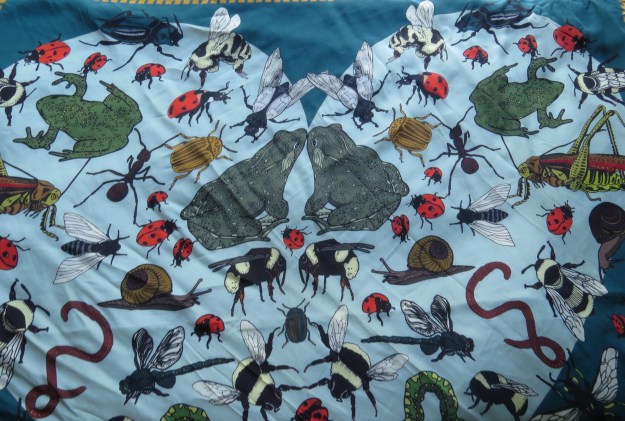
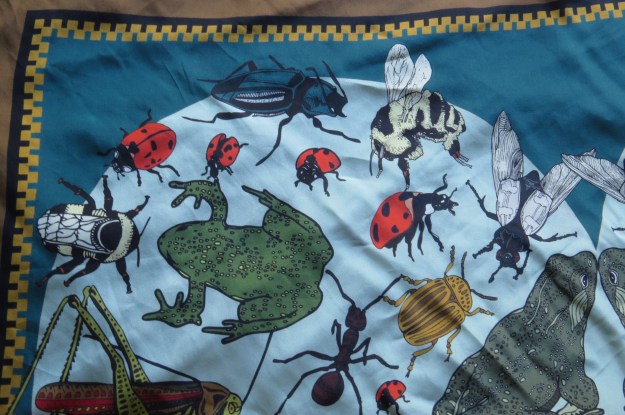
J also bought me this scarf for my birthday a few years ago. It has images of pretty much all my favourite creatures – frogs and toads, bees and beetles, earthworms and ants. I’m just sorry I didn’t iron it before I took the photograph. I love that it looks like one of those elegant lady scarves, but turns out to be covered in creepy crawlies. Many a person has done a double-take when they’ve looked at it closely.

And this is the brooch that got me into trouble with my boss, who I was meeting ‘in real life’ for the first time in Dublin. We’d gone out for a team dinner, and it turned out that she was arachnophobic. I ended up popping the poor spider into my pocket for the duration.

And of course I could never resist a bee. I had a lovely holiday with my dear friend S, who was working in Washington D.C, so I got a chance to go to the Smithsonian Museum of Natural History. A visit to the museum shop is obviously essential, and they had the best selection of insect jewellery that I’d ever seen in one place. Sadly most of the pieces aren’t online, and my friend works from London now.

Smithsonian bees!

I fell in love with this quirky chap when I saw him at a craft market in London. Sadly, the pink gemstones have been falling out all over the place – I used to wear him a lot when I was travelling for work in Europe, and I know for a fact that one stone is in Prague, one is in Helsinki and another one is most likely in Copenhagen. Never mind. Whenever I look at him, I’m reminded of the days when such lunatic levels of travel were not only condoned but expected, and I’m happy to be more settled, and less of a carbon liability.

And finally, how about this Bugwoman-themed cardigan? If I ever do personal appearances, I shall have to wear this.

It’s funny how I am so drawn to images of ‘bugs’, even after all these years. For me, they are still a source of fascination, and nothing cheers me up more quickly than the discovery of a new insect, or a new piece of information about their lives. I can quite see myself as an elderly lady in a care home with a secret pet spider in the corner of the room. This last few years have really made me consider what is important, and what isn’t, and I know that being connected to the natural world is so fundamental to me that without it, life wouldn’t be worth living. It’s always worth thinking about and stating these things while you still can.

One Year On

Dad and Bugwoman on her wedding day in 2001.

Dear Readers, on Wednesday it will be a year since my father died ,and as those of you who have been through a bereavement know, the ‘firsts’ are hard. The first Father’s Day, the first birthday, the first Christmas are all filled with memories of the person who isn’t there any more. Sometimes I sit in my living room and look at the space in the bay window where Dad used to lay in his reclining chair, and I can almost hear him snoring away gently. Or I remember him tapping along to the radio, or noticing some bird on the cherry tree, just visible through the French doors. At these times I feel that he is there, just  outside my peripheral vision, and if I turn around fast enough I’ll catch a glimpse of him. But at other times it’s clear to me that he is absolutely gone in any meaningful way, and so is Mum.

I had a dream where the two of them were tottering along the garden path towards the car, and I was watching them from the house. They were bickering as usual – Dad wanted to hold Mum’s hand because she was unsteady on her feet, but she thought that Dad would fall over too if she tripped and he was holding her. But then Dad snatched her hand anyway, and they headed remorselessly away from me. I so wanted them to turn and wave but they were very focused on where they were going. The dream flavoured the whole of my day. At the age of 60 I felt as abandoned as a small child lost in a supermarket.

All around me people are wiping the dust off their garden tables and sorting out their wineglasses in preparation for the first step out of lockdown tomorrow. It’s going to be glorious weather, and I expect my neighbours will be having a whole gaggle of garden-based events, meeting up with family that they haven’t been able to see properly for months. I’m pleased for them, but at the same time it just reminds me that most of my close family are dead. Lockdown has been a kind of protection because everything has been so strange. When Mum died I couldn’t somehow believe that people were going about their lives, laughing and joking and worrying about trivialities. I am reminded of the famous Auden poem about stopping the clocks because someone has died. But then, I too have been that person, laughing and joking and worrying about trivialities, and indeed a lot of the time I still am. Perhaps part of the wonderful thing about life is that it drags you on, even when you don’t want to go.

Someone compared grief to a bookshelf. In the beginning, the only book is the one about sorrow. That book is always there, but gradually other books appear, about different subjects, until life fills out again, and we can go moments, then hours, then maybe even days without thinking about the person who is gone. But this I have learned: losing someone that you love, however old they were, however predictable the event was, is like having a door slam shut behind you. You can never be the person that you were before, because now you know, in your bones, that nothing is forever. Death is no longer some abstract notion, but a bitter fact that you are going to have to learn to live with and incorporate into your daily life.

The nature of grief changes though, and that is a blessing.  I find myself thinking about how mischievous Dad was, how determined to get his own way. I remember that he loved to make people laugh, how kind and gentlemanly he was towards women, how he hated a direct fight but was a master of the sneaky move.  I find myself remembering all the times that we’d sit in the living room watching Countdown, pretending not to be competitive. Even after his dementia, Dad was always the one who could win at a quiz. In short, he is coming back to me, and he’s coming back whole, all of him, with a big grin on his face.

When Dad’s dementia took hold, it was clear that he had become a master of paradox. He could believe that his parents were coming to visit him at Christmas, even though they had been dead for years. He could believe simultaneously that Mum was dead, that she was living somewhere else and wasn’t speaking to him because he’d upset her, and that he wasn’t old enough to be married. And it isn’t so different for me. I know that Dad is utterly, absolutely, completely gone, never to return, and that I’ll never hold his hand again. And yet, I also sense him moving through me every time I make a decision about the garden, or put a slice of lime into a gin and tonic, or get a question right on Mastermind. He is here but not here, present but absent. I miss him more than I can express, but I am  having trouble remembering his face.

I will never ‘get over it’, and yet I am moving on, regardless.

Thomas Reginald Palmer (5.12.35 to 31.3.20)

Garden Plans for 2021

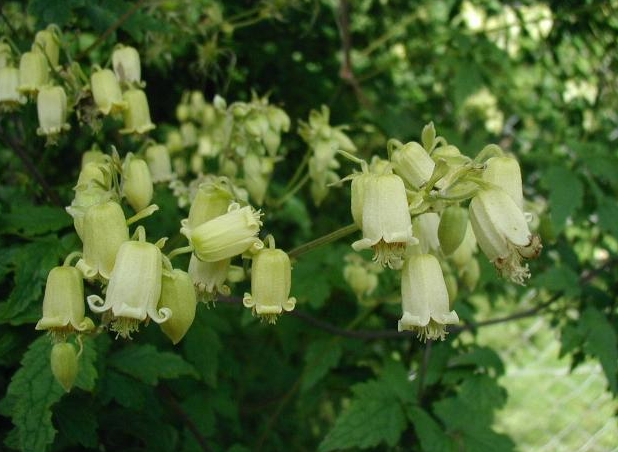
Photo One by https://upload.wikimedia.org/wikipedia/commons/f/ff/Clematis-rehderiana.JPG

Clematis rehderiana (Photo One)

Dear Readers, as I no longer spend money on eating out (except for the odd pizza delivery) or on holidays or on cinema or theatre, I have two main sources of outlay left, once food and domestic ‘stuff’ is covered – one is books, and the other is the garden. This year I am determined to have a rethink, and to try out some new plants – who knows how we’ll get on, but there’s only one way to find out!

My first purchase is a Clematis rehderiana (otherwise known as ‘Nodding Virgin’s Bower’, but we’ll skip over that thank you very much). It was quite a puzzle finding one, and I only persevered because my Gardening For Wildlife book by Adrian Thomas mentions it as being the very best clematis for wildlife. Unlike some of the other types, it has primrose yellow bells and smells of cowslips. The Guardian describes it as a ‘romper’, which is just what the garden needs. I’ve planted it next to my lilac, which is pretty early in the year and boring for the rest of it, so I’m hoping the clematis can be persuaded to scramble over it and then onto the fence behind. At the moment it is a twig with exactly one set of leaves, so let’s hope it perks up now it’s  in the ground.

Secondly, I was very aware that my north-facing garden is a bit of a desert for pollinators during the winter, and so I have chanced my arm on a Clematis cirrhosa var balearica – this one is ‘Wisley Cream’. It’s said to flower from November to March, and I am going to pop it in against my West-facing fence, and make sure that the roots are protected as I know it’s not necessarily fully frost hardy. The bittersweet and honeysuckle also grow on this fence, so I’ll have to make sure that they all share. And as it’s close to where we sit, it might even encourage us to brave the garden during the warmer days of winter.

Photo Two by sunoochi, CC BY 2.0 <https://creativecommons.org/licenses/by/2.0>, via Wikimedia Commons

Clematis cirrhosa var balearica ‘Wisley Cream’ (Photo Two)

In other news, I want to extend the range of geraniums in the garden, as they can be so good for pollinators – my Dusky Cranesbill (Geranium phaeum) are  covered in bees early in the year, but they die back way too soon, and I want something else that will take up the mantle. I’ve planted some Geranium macrorrhizum in a slightly sunnier (but not too sunny) position – these do amazingly well in some places around here. The plants are nicely well-grown, so I hope they’ll soon be flowering away. Any advice on geranium varieties for shady places would be gratefully received. Even the geranium ‘Rosanne’ that everybody swears by gave up the ghost when I planted it.

Photo Three by I, KENPEI, CC BY-SA 3.0 <http://creativecommons.org/licenses/by-sa/3.0/>, via Wikimedia Commons

Geranium macrorrhizum (Photo Three)

And I almost forgot that a lovely friend of mine gave me an envelope full of honesty seeds, so they’ll be going in pronto. I know they can be invasive but it’s such a struggle to get anything to thrive that invasive sounds like a feature rather than a bug, as us elderly IT folk sometimes say.

Photo Four from CC BY-SA 3.0, https://commons.wikimedia.org/w/index.php?curid=107188

Honesty (Lunaria annua) (Photo Four)

In other news, I’ve planted winter aconite, snowdrops and lily of the valley (another plant that can get out of control, yay!) in the green. I’m hoping that the lily of the valley will give some leafy cover to my poor frogs, although they’ve gone really quiet for the past week or so  – the temperature dropped to below freezing last night, so I’m sure that’s got something to do with it.

Photo Five by liz west from Boxborough, MA, CC BY 2.0 <https://creativecommons.org/licenses/by/2.0>, via Wikimedia Commons

Lily of the Valley (Convallaria majalis) (Photo Five)

So let’s see how this lot get on. In other projects, we have just got a new tiny table and chairs for the back of the garden – it’s something of a sun trap and will be a nice place to sit in the spring and autumn, and so I’ll need to tidy that area up a bit as well. And I really, really want to sort out some enormous planters/raised beds for the south-facing front garden, so that I can extend the season for pollinators – they are spoiled for choice when the buddleia and lavender are out, but it’s boring during the rest of the year (though I do have some Lambs Ears (Stachys byzantina) in my window boxes and I’m hoping that some wool carder bees might turn up).

Whoever said that a garden is always a work in progress had it absolutely right.

Photo Credits

Photo One by https://upload.wikimedia.org/wikipedia/commons/f/ff/Clematis-rehderiana.JPG

Photo Two by sunoochi, CC BY 2.0 <https://creativecommons.org/licenses/by/2.0>, via Wikimedia Commons

Photo Three by I, KENPEI, CC BY-SA 3.0 <http://creativecommons.org/licenses/by-sa/3.0/>, via Wikimedia Commons

Photo Four from CC BY-SA 3.0, https://commons.wikimedia.org/w/index.php?curid=107188

Photo Five by liz west from Boxborough, MA, CC BY 2.0 <https://creativecommons.org/licenses/by/2.0>, via Wikimedia Commons

Birthday in Lockdown

Dear Readers, last year on my birthday I had a pizza lunch in a real restaurant with my work colleagues, dinner in our local French restaurant in the evening with my husband and a birthday trip to the cinema. I also had my 60th birthday very-special-holiday to Borneo, in the teeth of the pandemic.

This year, by contrast, I am very excited by my vegetable box delivery. I have treated myself to the ‘cooks special’ box, which includes weird and wonderful things that you wouldn’t normally see, such as these strange roots in the picture above. Does anybody know what they are?

Well, maybe this will be a clue….

Yep, it’s salsify. Beneath that uninspiring grubby interior lies the queen of root vegetables (apparently). Let me know if you’ve ever cooked it, I am on the hunt for recipes! Also in the box was this…

And here we have some chervil, which I shall need to use up at great speed because it looks very fragile. Maybe in an omelette? Again, all suggestions welcome.

And finally, these little chaps. Kumquats are tiny members of the citrus family, apparently favoured in the colder areas of East Asia because the trees are frost-hardy. Who knew? I have a Gary Rhodes recipe for chocolate pudding with kumquats which I shall find hard to resist.

Anyhoo, in case you thought all I got for my birthday was a bunch of fruit and veg (though that would have been very fine), it will be no surprise to regular readers that I also got some books.

My reading pile is getting higher and higher – I no sooner  read one than I add another two to the pile it seems. I am still struggling with ‘Wilding’ by Isabella Tree – it’s inspirational for sure, with lots of really valuable information, but maybe it’s not ideally suited for night time after a hard day sorting out management overheads and trying to nail currency conversions. Let’s see how I get on. I have certainly learned a lot from ‘Wilding’ but to me it reads more like a text book.

And my lovely husband got me a few more books in the British Wildlife series. How I love them! And how I’d like to head off to a salt marsh or a rocky shore. One day soon, I hope.

And finally, a lovely friend bought me the tea towel below. The giraffe is my totemic animal ( I was a tall skinny child and I identified with these lanky beasts from a very young age) so this is perfect. Much too nice to dry up with though I think.

And so, on a rainy day in North London in the middle of a pandemic, I feel extremely lucky. I have made my own birthday cake (oats, pecan nuts, chocolate, bananas) which is baking as I write this. And to top it all, I have new slippers. After ten years in the house in which I swear I didn’t end a single winter’s day without frozen appendages, here, I hope, is the answer.  There’s nothing like toasty toes to celebrate being another year older. Onwards!


What Works – A Personal View

Dear Readers,  I’m finding the present UK lockdown much more difficult than the first two, and I’m sure I’m not alone. In the Northern Hemisphere it’s winter, and so the days are shorter, and the possibilities for going for a local walk are squeezed into a few hours. Plus I find myself ‘doomscrolling’ on the phone, going from news of the frightening events in the US to the seemingly unstoppable march of the virus, to tales of climate change, extinction and disaster. Some days I am so anxious that my skin crawls. Other days, I feel close to despair.  If I am feeling like this when I am in such a privileged position – no real money worries, no children or family to worry about, a job, a roof over my head and a garden – I can only imagine what it’s like if you have terrible neighbours, children to home school, a job that forces you to go out and expose yourself, no outside space where you can decompress. And those of us who have lost some one dear to them during the course of this pandemic, whether directly through Covid-19 or indirectly, I can only bow my head in sympathetic sorrow – as regular readers will know, I lost my poor old Dad in March last year. He didn’t die from Covid, but the circumstances around it caused a chain of events that led to his death.   So I offer this in all humbleness, and I hope that some of it will resonate and help.

  1. Stop, or at least limit, doomscrolling!

Tempting as it can be to just spend your life on the phone, worrying, I’ve learned that setting limits has helped my mental health enormously. I put my phone on to recharge when we have dinner, and don’t look at it again (usually) till the morning. I had to start doing this when Dad’s dementia meant that he could ring at any hour of the day or night – once he was in the Home, and I knew he was being looked after, I knew that I could phone him back in the morning. But these days, it’s because if I read something particularly troubling it spoils my sleep.

The worst thing about having the whole world come at you through your phone is that it can make you feel helpless. Which brings me to the next thing that’s helped.

2. If you can, do something about it!

As I’m lucky enough to still be working, I donate to organisations like my local foodbank. I sign petitions for things that are happening, especially locally where the numbers really count – we recently got a stay of execution on some ancient oaks in Queen’s Wood in Highgate for example. I am on the Whatsapp group for our street, and have been able to help out with people who are unwell or shielding – without the group, I wouldn’t have know what was needed. You can be an activist without even stepping out of  your front door. There’s nothing to stop us from joining a campaign, writing to our MPs or making a donation if we have any spare cash, and the benefits are endless, not least in making us feel useful and engaged.

3. You are not alone

Well, except in an existential sense of course. But this is one way in which the internet has helped – you can make  connections with people that you can’t currently see in real life, but who can share ideas or a joke or news. I think one positive thing that might come out of all this is that people who used to shun the internet have learned to use things like Zoom and Facetime, and although it’s no substitute for getting together for a chat over coffee and cake, it’s so much better than nothing. Also, I have recently rediscovered the joys of talking on the phone.

Do reach out. It’s very easy for the world to contract, and that’s something that should be pushed against at all costs. Phone a friend! It always makes me feel better.

4. Get outside, but choose your time and place carefully

I love going for walks in Coldfall and Cherry Tree Wood, and especially in the Cemetery. But these places can sometimes be extremely busy, and there’s not much fun in dodging people every five seconds. I tend to avoid the woods at weekends, even now, and was also avoiding the times when children were being taken to school and coming home, as those times were busy too.

However, I have become an even bigger fan of walking in cemeteries, as regular readers might have gathered. If you have a cemetery locally and haven’t visited it yet, do give it a go if it’s open – they are full of interest, both in terms of history and of wildlife and plants, and I find them surprisingly uplifting. Many of them have restrictions due to Covid so do check. I also prefer them at the weekend because there aren’t usually funerals going on, and so I don’t feel as if I’m intruding, though our cemeteries are big enough to avoid gatherings.

5. Get creative

I have spent the past months knitting like a maniac. For me, it’s always something that I’m making for someone else, just because otherwise I don’t have the impetus, but I also love it: there’s something about the rhythm of crafts such as knitting or embroidery or crochet that seems very soothing. Also, it adds steps onto my Fitbit so I usually hit my exercise target :-).

A jumper I made for my Boss’s little boy. I wouldn’t mind one meself.

6. Exercise your brain!

There has been a lot of advice around physical exercise, which I largely get from my walks, but how about our brains? I’ve gone the whole hog and embarked on a degree with the Open University (never one to do things by halves) but there are literally thousands of courses online, many of them free. People speak highly of Coursera but the Open University also do a range of free courses. Plus, if you have some money to spare there are courses in everything from embroidery to cookery to languages (this one is free, and I also recommend Rosetta Stone).

Plus, if you don’t want to study intensively, there are a raft of free talks and lectures out there. I have been reporting on the LNHS (London Natural History Society) talks (which are all free and are also recorded so you can catch up with them even if you can’t watch them live).  In fact I hope they carry on with them after the lockdown is over. New Scientist also has talks, so does The Guardian, and practically every cultural institution has been running at least a few, so there should be something for everyone.

The great advantage of a course or a lecture is that it helps me to look outside my very small world and feeds my curiosity.

7. Read, but carefully

I thought that 2020 would be the year when I really got stuck into reading, and so I did, but I soon learned that I had to be particular about what I read. Normally I read the whole Booker Prize shortlist, but I soon found that the mood and atmosphere of a book could colour my whole day. So, at a time of high anxiety, I would put aside writing that made things worse, or which filled me with dread. Unfortunately that was most of the Booker Prize out of the window for a bit, regardless of the excellent writing! I am a bit delicate on this front, and some people don’t seem to be affected in the same way, so go for it if tales of dystopian apocalypse cheer you up.

I thought I might get into comfort reading (which for me means Dickens or Trollope or Jane Austen) but I haven’t so far. I also normally re-read the Gormenghast Trilogy by Mervyn Peake every few years, but that’s also not cropped up. What I’ve really enjoyed are books by Madeleine Miller based on the tales from the Odyssey and the Iliad, Pat Barker’s book ‘The Silence of the Girls’ about Penelope and Briseis, the women in the Odyssey, and also Emily Watson’s translation of The Iliad. There’s something about Homer that resonates, whatever the age.

Mostly, I’ve read non-fiction, which can also contain some horrors, but which somehow seem more manageable. I read the whole of the Wainwright Prize for Nature Writing shortlist, and wrote about most of them on the blog – my personal favourite was Brigit Strawbridge’s ‘Dancing With Bees’ but I enjoyed all of them. I’m currently reading ‘Wilding’ by Isabella Tree, so expect a review soon!

8. Watch TV for comfort and inspiration

I love watching things like The Great British Bake-Off, The Great British Sewing-Bee and, starting this week, The Great British Pottery Throwdown. I love to see ordinary people showing their skills, and while I’m not the slightest bit interested in things like Big Brother or Love Island, I cannot get enough of reality shows where there’s actually a purpose. I love all the varieties of Masterchef except for (usually) the celebrity one – what’s the fun in watching someone who can’t cook make a hash of a shepherd’s pie?

After Mum died in 2018 I spent hours watching all the series of RuPaul’s Drag Race that were on Netflix (yep, all eleven of them). I found myself not only amazed at the extraordinary transformations, but also moved and inspired by the stories of the drag queens themselves. It was a kind of balm to my soul when I couldn’t move off of the sofa. I had no idea how exhausting grief was. This past few years have been an education.

I also love documentaries, particularly the wildlife ones, though they can be a bit too ‘when animals attack’ for if I’m feeling particularly vulnerable. I somehow don’t need David Attenborough, lovely as he is, to tell me how bad things are at the moment. After all, I work for a Climate Change organisation and am studying environmental science, so I think I have enough to contend with :-).

9. Make Unexpected Connections

And finally, dear readers, I can’t overstate how helpful writing the blog has been for me. When I decided, almost instinctively, to blog every day during lockdown, I could never have anticipated what the repercussions would be. Every day I have to get out of my little bubble of doom to think about what has interested or inspired me. Every day I get to interact with people all over the world, to share your thoughts and observations and to get a feeling for how you are doing. I’ve discovered some wonderful blogs, and some wonderful people. I have learned so much, and am constantly learning. Other blogs might have more followers and might make more of a splash, but I feel that we have built a real community here, and it makes me very happy. So thank you for reading, and do let me know what’s worked and hasn’t worked for you – I might create a page with links to resources on it so we can all share websites that could be useful.

Together, we’ll get through this.


Real Life

IMG_5116Dear Readers, today I would like to share a piece with you that I wrote during my mother’s recent stay in hospital. I know that many of us have loved ones who are unwell for one reason or another, and I was interested in the way that the NHS regards non-human nature. I’ll be back to the normal birds, insects and plants next week.

My mother and father came to stay with me in London this Christmas. All three of us knew it was a risk. Both my parents have the full range of late-onset ailments ( COPD, diabetes, dicky hearts) but this is the only holiday that they get, and, besides, prizing safety above all else means that we gradually retreat into our shells, like hermit crabs, afraid that every shadow is a shore-side bird waiting to gobble us up.

On Christmas morning. Mum was trying to pin one of the brooches I’d bought her onto her jumper, fumbling with the clasp. She sat back and smiled, the filigree butterfly a little skew whiff. Then, I remembered.

‘One last present,’ I said.

I’d almost forgotten the orchid that I’d hidden away in the bedroom. As I walked back downstairs, I looked at the flowers. I am not a great fan of orchids – they have an alien quality that looks sinister to me. And yet, my mother has a gift for coaxing them into flower time and again. This one was pale pink with mauve bruise-like blotches. The mouth of each bloom opened like a man-trap with long, backward-pointing teeth.

‘It’s beautiful!’ said Mum, as I passed it to her.

As I removed the wrapping, one of the flowers detached itself and floated to the ground. I picked it up, feeling the waxiness of the petals. I showed it to Mum.

‘Oh, put it in some water’, she said, ‘I can’t bear to think of it just getting thrown away’.

‘Really?’ I said. ‘Won’t it just die anyway?’

But she looked so upset that I found a dish and floated the flower in it. It’s still there now.

———————————————————————————————————————————-

Early on Sunday morning, I heard a rasping whisper from Mum and Dad’s bedroom.

‘I think you need to call someone’, Mum said. ‘I can breathe in, but I can’t breathe out’. I could hear her chest wheezing and crackling from across the room.

An hour later, she was in an ambulance, being given oxygen, heading for the nearest London hospital.

The doctors confirmed that she was 80 years old. They heard the recitation of her health problems, shook their heads over her oxygen levels and the sounds coming through their stethoscopes. They ascertained that at her best she could walk only ten paces without having to stop to gather her breath. They admitted her to the hospital. She was put in a huge room on her own. There were no windows, but there were lots of empty navy-blue storage cupboards, as if this had once been a kitchen but all the appliances had been removed. The fluorescent light gave off a constant background hum. It was like being in the belly of a great machine.

‘I’m not afraid of dying’, said Mum. ‘But it makes me so sad to think that I’ll never walk around Marks and Spencer again, or walk in a park. And I know I’m lucky and there are lots of things that I can still do, but somehow, just now, that doesn’t help’.

Normally I try to protect myself by avoiding what is really being said in these conversations, by trying, like Pollyanna, to look on the bright side. But today, I just sat, and held her hand, and cried with her.

IMG_5085As I walk to the hospital, I notice how bright all the colours seem, as if I’m hallucinating. The thoughts are chasing one another round and round inside my skull, as scratchy as rats. There is a wall alongside me and beyond a wildflower garden, at head height. The low winter sun lights up a patch of trailing bellflower. I see the way that the stamen are casting a hooked shadow on the lilac petals, the way a single raindrop trembles on the edge of a leaf before falling, in what seems like slow motion, onto the soil. And for a moment, I don’t think about Mum at all, and I feel my shoulders relax. I take a deep breath, then another. And then I walk on.

————————————————————————————————————————————-

It used to be that hospital wards were full of flowers, the stink of lilies and gently decomposing chrysanthemums rising above the smell of antiseptic and hospital cooking. But now, all plants are banned ‘for hygiene reasons’. Probably the nurses are so overworked that they don’t have time to cope with browning foliage and wilting poinsettias. But I can’t help thinking that something alive and beautiful is as important for healing as drips and antibiotics. Mum’s bunker looked completely sterile. But I had underestimated her.

At Christmas dinner, I had handed out some crackers that I’d bought from a wildlife charity. Each one contained a card that, when opened, released a snippet of bird song. The game was to guess which bird was singing – nightingale, blue tit, wren? Mum had put the cards in her bag. When the very important Consultant and his two trainees came along to see how she was doing, she produced one of the cards and pushed it into the Big Man’s hand.

‘Open that’, she said.

He looked at her askance, and opened the card. The sound of a song thrush in full-throat filled the bare room, flooding the place with the sound of woodland wildness.

The consultant’s face changed. He closed the card and opened it again. He turned to the two trainees.

‘I know you want to go home’, he said to them, ‘But listen to this!’

And he ‘played’ the  song again, before closing the card and handing it back to Mum with a bow.

After a few days, Mum is moved to a different ward. As usual, she hates it at first – relationship is what Mum thrives on, and in each new location she has to charm everyone all over again. But she does have a window now.

‘At night, I can see all the planes flying over’, she says.

I notice that there’s a spider outside the window. At first I think it’s dead, but then I see that it is on a web, blowing backwards and forwards as the wind buffets the building. I decide not to tell Mum. She isn’t the world’s biggest spider fan. But it makes me happy to see this little note of anarchy in this antiseptic place.

‘At least I can get a breeze here’, says Mum. ‘Though when I was standing up next to the window yesterday they made me get back into bed in case I caught a chill’.

Her temperature is still too high, she is coughing most of the time and she’s pulled her canula out.

‘ I thought I’d be feeling a bit better by now’, she says. ‘But they’ve still got me on that bloody antibiotic that doesn’t work’.

I know that doctors don’t like to be told their jobs, but still.

‘Did you know that Mum’s been hospitalised for Proteus infections several times?’ I ask the doctor when he’s next on his rounds.

‘No’, he says. ‘Maybe we should talk to the people in Metabiotics’.

———————————————————————————————————

Proteus is a super-bug, and Mum probably acquired it in a hospital. Along with MRSA and C.Difficile, it is infecting our clinics and operating theatres. Proteus is so-called because it hides in the body, changing location. There are several variants, many of them immune to one antibiotic, some to several. The use of several antibiotics simultaneously is called Metabiotics.

This is the age of the antibiotic-resistant bacteria. On a bad day, I feel that we are standing on the threshold of apocalypse. I remember a display I saw about the Jamestown settlers in America. Several of them died from a simple tooth abscess that could not be treated, became infected, and spread through the body.

As we seek to sterilise our homes and hospitals and schools, life is creeping back through the keyhole, pouring under the door, finding the draughty spaces around our windows.

The doctors change the drugs. My mother’s body becomes a battleground. At 3.30 a.m. she rings me.

‘I’m in The Game’, she says. ‘I’m trapped in a room, and they’re murdering people next door, and slaughtering them like animals, and they won’t let me out’.

‘Mum,’ I say, heart racing, ‘You know that none of this is real?’

‘I know’, she says, ‘but I want to get out and they won’t let me go’.

The phone goes dead. I call the ward. After what seems like a year, the nurse answers. I explain the situation.

‘I’ll talk to her’, he says. ‘It’s the drugs’.

The next morning, Mum can’t remember any of it, but her breathing seems better. Then her blood sugar climbs to 32, a dangerously high level. It seems that, somehow, the bacteria are fighting back. This is not going to end any time soon.

On my visit, Mum hands back the cards with the bird songs in them.

‘Take them home’, she says. ‘Keep them safe. They don’t belong here’. And she closes her eyes, a look of concentration turning her face to marble. She is not beaten yet.

IMG_5117

Today, there is finally good news. The blood sugars are under control. Mum’s breathing is improving. Her poor body has fought back again, and if all goes well, she will be out of the hospital in a couple of days.

I am making my peace with the orchid. The buds are clenched fists, but the newly opened flowers are poppy-shaped, like cupped hands, around the soft inner petals. I see that the long, tongue-like leaves have a fine layer of dust.

‘I’d better clean you up’, I say to the plant. ‘Before Mum comes home’.

Update

Mum finally left the hospital on Thursday, and is travelling back home to Dorset with Dad and I on Sunday. She isn’t fully well yet, as might be expected, but she is getting better.I am deeply grateful to all the staff at the Whittington Hospital in north London for their unfailing care of my mum, and for their patience and dedication. The NHS truly is a pearl beyond price.