Category Archives: Uncategorized

Well, That Was An Interesting Experience!

Well Readers, it’s been an interesting couple of days. When I left you last, I was in the Whittington Hospital waiting for an operation on my leg. I’ve never been in a hospital overnight, I’ve never had a general anaesthetic and I’ve certainly never had a titanium rod inserted into tibia, so there’s been a lot to process.

First up, I cannot praise the hospital staff, from the handsome orthopaedic consultant to the cheery porters, highly enough. The Whittington is like the United Nations, there’s someone from everywhere, and many people have been there for years – the staff nurse had been working at the hospital for nearly two decades. They worked together so well – in the X-Ray section there was an A team of young women in hijabs who were expert at placing limbs and manipulating an x-ray machine that hung from the ceiling and looked like something from Star Wars. My ward had two patients suffering from dementia, and the nurses and orderlies couldn’t have been kinder or more patient and tactful. I honestly think we should all pay a chunk more tax to fund this astonishing institution. How lucky we all are.

The orthopaedic team were clearly very into bones – one of the more junior staff showed me my fracture when I asked, and very dramatic it was too. And when they had to use a bit of traction to get the bones to line up (probably the most painful 30 seconds I’ve had in my life) they were efficient and matter-of-fact, which is just what you need when you think your leg is going to come off.

And then there was the operation. I can’t tell you much about it, except that one minute I was mentally trying to calculate my height in centimetres to save the anaesthetist from having to look up Dr Google, and then next someone was shouting my name and telling me that it was all over. What a strange experience it is! I wonder if my body remembers all the drilling and pulling about, even if my brain hasn’t registered it. Anyhow, the result is the aforementioned titanium rod and a few bolts in the ankle to keep it in place, like a kind of reverse Frankenstein.

The immediate effect of the general anaesthetic though was to make me nauseous for about eight hours. A pair of jolly physiotherapists bounced in to see if they could get me used to my crutches and all I could say is ‘sorry, I’m going to chuck up now’ so they bounced out again. The photo at the top is the result of me trying to choose my lunch while in this state. I have ordered a salad with a side salad, a yoghurt, and a plate of custard with nothing in it. Go figure.

Actually, the food and the selection was pretty good, though I’m glad I was around too long to enjoy it.

And after a painful night I was discharged this morning (now I’m ‘crutch-trained’, which means I can use crutches to make sure that I only put fifty percent of my bodyweight on my right leg). I have to inject myself with an anti-coagulant daily for the next fortnight and I have a fine array of pain-killers. More importantly, I have lots of knitting to do, and a fine pile of books to read, plus my poor husband is at my beck and call for the next two weeks till he goes back to work. it’s not quite the holiday I was intending, but I plan to make the most of it.

However, I will probably also take a bit of time to be sad, and to let all that shock and disappointment catch up with me. I’ve just been putting one foot in front of the other (see what I did there :-)) but I am sorry about my Austria holiday, and I am still a bit rattled. It reminds me (as if I needed to be reminded) that things can change in a split second, and not always for the better. Still, I have been so moved by people’s kindness over the past few days, from Chantelle, the Station Master at East Finchley who looked after me until the ambulance men came, to the lovely Eritrean taxi driver who just brought us back from the hospital. It reminds me that however independent we think we are, we are all ultimately reliant on the kindness of strangers, even if it’s just to bring us a bedpan in the middle of the night.

The Best Laid Plans..

Well Readers, today I was meant to be in Obergurgl, but our Easyjet flight to Innsbruck was cancelled. Then I managed to fall down the stairs at East Finchley Station and fractuted my leg in 2 places.

Well.it just goes to show that you never know.

I’m writing this on Saturday, and am expecting to be in surgery on Sunday, so by the time you read this I should be on the mend. I’ll keep you posted, but don’t worry if I miss a day now and again! I’m in good spirits and feeling pretty good all things considered.

Mountain Books…

The Alps in Obergurgl

Dear Readers, it will soon be time for me to head off into the Alps for our annual Austrian trip to Obergurgl, and so I am getting into the mood by remembering some of my favourite mountain-themed books.

First up is Robert Seethaler’s ‘A Whole Life‘, set in the Austrian Tyrol. It tells the story of Andreas, who only leaves the valley once, to fight in the Second World War, and who returns to find his isolated village being transformed by tourism  and the burgeoning ski industry. It reminds me of how much even Obergurgl has changed in the thirty years since I first visited, but it also shows how impoverished people were, for all that they were living in such a beautiful place. Highly recommended.

Then there’s Nan Shepherd’s ‘The Living Mountain‘, about the Cairngorms in Scotland. This is a meditation on the nature of the mountain and its rocks, rivers and creatures. It was written during the Second World War, but wasn’t published for 30 years. It’s a book that helps you to both feel and see the landscape, and I always want to jump onto a train north when I’ve read it.

Robert Macfarlane’s ‘Mountains of the Mind‘ is a history of mountains and mountaineering – I didn’t find it as compelling as his more recent work, Underland, where he explores various underground sites (and helped to induce secondary claustrophobia in this reader at least) but it’s still an interesting book, well worth a look.

Somebody recently reminded me about Peter Mathiesson’s ‘The Snow Leopard‘ – whilst this isn’t primarily about the Himalayas they are present in every sentence, a kind of main character in all but  name. This is a brilliant book about what we search for, and what we find, and how these things might not be the same.

And for an absolute page-turner, there’s ‘Touching the Void‘ by Joe Simpson and Simon Yates. Two friends go on an expedition to the Andes, and after an accident, one of them is given up for lost. But is he? A true-life story that will keep you up late into the night.

Now, I know that I’ve missed a shedload of excellent books, so what are your favourites? Let me know, Readers! I’m in the mood for a bit of mountain literature.

Synchronicity, and Eating Orchids

Dear Readers, I am currently reading ‘Cold Kitchen’ by Caroline Eden. In it, she recounts her culinary journeys to places as distant as Uzbekistan (where she buys winter melons from a farmer at the roadside), Georgia and Istanbul. And in Istanbul, what should she try but Salep, which, as you might remember, is made from the roots of orchids.

Here’s what she has to say.

“Taking my seat at the back of the café, I spotted salep on the menu, a warm winter drink made from the powdered dry tubers of wild orchids, specifically Ophrys speculum, which has weird furry bumblebee-like flowers. I ordered a glass. Two steel shakers, one of ginger and one of cinnamon, were set down with the cup and I sprinkled both powders onto the drink, hot and dairy-tasting. It instantly reminded me of childhood, its subtle favour not easy to nail down: vanilla-like, reminiscent of mastic, earthy, woody, smooth as velvet. The sort of thing you’d take to sip under the covers while reading a bedtime story. Later, I read about what should have been obvious – that excessive collecting of such orchids, which kills the plant, has led to serious conservation issues for wild orchid populations. One website claims that ‘a single cup of salep needs about 13 orchid tubers’. Feeling guilty, I vowed never to have it again'”.

Pyramidal orchid in East Finchley car park

I am thoroughly enjoying this book, though reading it last thing at night does have a tendency to make me get up in search of something sustaining from the fridge, so be warned….

My Favourite Story of the Week

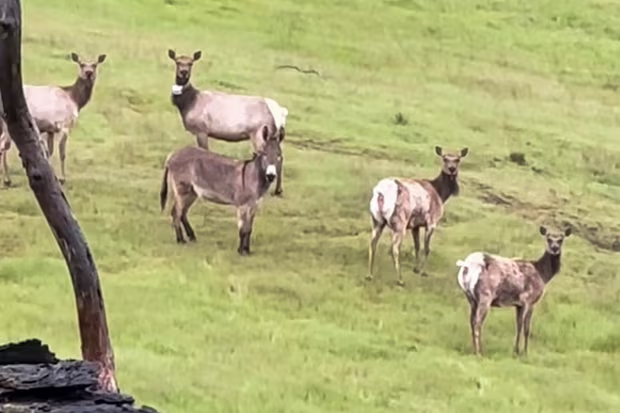
Diesel the donkey living wild with a herd of elk (Photo @maxfennell via Instagram)

Dear Readers, five years ago a family were hiking with their donkey, Diesel, in Northern California (like you do) when something spooked him, and he ran away. The family, the Drewrys, searched for Diesel in vain – he was spotted on a trail camera, and there were some hoofprints, but he was never found, in spite of weeks of searching on foot, on horseback and even by drone.

And then, earlier this year a hunter, Max Fennell, spotted something unusual in a herd of elk – one of them appeared to be not an elk, but a donkey. Fennell has some short video of the herd (which he observed but didn’t harm) on his Instagram feed here.

According to an interview with CBS, Diesel has even  been earning his keep with his adopted family by killing  coyotes who menace the young deer, and he might even have protected the elk from a mountain lion.

What is probably most heart-warming about this story is not only how healthy and strong Diesel looks, but also that the Drewry family are content to let him continue in the wild, without attempting to recapture him.

Terrie Drewry had this to say when she saw the video:

It was amazing. It was like, oh my gosh. Finally, we saw him. Finally, we know he’s good. He’s living his best life. He’s happy. He’s healthy, and it was just a relief.” 

Letting go seems to me to be something that is rarely appreciated for the skill that it is, in this world of striving and owning. How powerful it is when someone can truly relinquish control and allow something to just be as it should be. Here’s hoping that Diesel and his new family continue to thrive.

The Pigeon De-stringers of London

Pigeon at Waterloo Station, 2015

Dear Readers, my friend A sent me this article today, and it was timely in a number of ways. Firstly, regular readers will know that I have a great deal of sympathy for the poor old beleaguered city pigeon, something that I think I’ve inherited from my Mum. She was always a champion of the underdog, and (with apologies to those of you who’ve heard this story before) that included the humble pigeon.

About thirty years ago, my mother was sitting in Finsbury Square in London having her lunch. As usual, she was sharing it with the pigeons. One had thread tangled around one of its feet. As my mother watched it hobbling about, she felt that she had to do something. She had a pair of nail scissors in her bag, but being on the verge of retirement she was not quick enough to catch the bird. Plucking up her courage, she approached a besuited chap sitting on a nearby bench.

“Excuse me,” she said, “but that poor pigeon is all tangled up. If you could just hold it for a minute, I could cut the thread off very easily. Will you help me?”

He looked at her for a long minute, as if trying to work out if she was serious.

“Touch that?” he said. “You must be mad”.

And so, in a single exchange, we see that the world is divided into those who think of pigeons as living creatures, and those who think of them as ‘feathered rats’.

So it was with great interest that I read that there is now an informal organisation in London called The London Pigeon String Foot and Rescue. It teaches people how to catch pigeons and ‘de-string’ their feet – pigeons often become entangled with human hair and other kinds of twine, which cuts off the blood supply to their feet. It is clearly painful, but it can also lead to necrosis and the pigeon can even lose its feet. If the injury is not too severe, the bird can go on its way once ‘de-stringed’, but if it’s more serious, the organisation takes the birds in for rehabilitation.

It takes a bit of courage to be a pigeon de-stringer, though – as Mum found out, people believe that the birds are ‘flying rats’, or ‘full of disease’. Clearly they aren’t rats, and as the article above points out, between 1941 and 2004 there were 13 recorded cases of global deaths from pigeon-related disease, most of them involving pigeon-keepers. On the other hand, there are 59,000 cases of fatal rabies every single year, most transmitted by dogs.

I sometimes think that pigeons don’t actually ‘count’ as animals. Some parents allow children to harass pigeons by chasing them and stamping at them, something I’m pretty sure they wouldn’t let them do if the animals were puppies or kittens. They really are close to the bottom of the pack, probably only just above rats and mice. And maybe it’s not surprising that the people in the article who sympathise most with the pigeons are homeless people, and the lonely. Pigeons are intelligent birds and they will certainly learn to appreciate people who feed them and are kind to them.

I remember this scene as if it were yesterday.

I was once on a bus travelling along Euston Road, when it came to a sudden halt. There in the middle of the road was an elderly lady. She wore plastic bags over her sandals, and was shouting to herself, occasionally stopping dead to harangue some invisible enemy. But circling over her head was a flock of pigeons, accompanying her as she walked like an aerial guard of honour. When she finally slumped on to a bench, they descended around her as she pulled bread from her pockets and began to feed them, gesturing at particular birds and admonishing others. As the bus pulled away, I looked back to see her finally settling back, her face calm, as the birds pecked around her feet. I had no doubt that the pigeons knew her, just as she knew them, and that there was a kind of fellowship between them. We are all just struggling animals, trying to survive the vicissitudes of life, but it takes a hard-earned wisdom to recognise the fact.

Wednesday Weed – A Plethora of Weeds

Trailing Bellflower, Herb Robert, Yellow Corydalis and Green Alkanet

Dear Readers, there is a house nearby which has been having extensive work done inside. As a result, the front garden has been left to itself, and I’ve been watching with some interest as the local ‘weeds’ move in, forming a miniature and no doubt temporary garden. The selection above is basically a top four of East Finchley’s ‘weeds’ – they all seem to love disturbed, clay soil, and not picky about whether they’re in the sun or not.

There’s a fine crop of what I suspect is American willowherb, which is literally bursting through the concrete. Never underestimate the combination of a determined little plant and lots of time. There are a lot of different small willowherbs, all less showy than the Great Willowherb in my garden, or the magnificent Rosebay Willowherb, but still attractive in a small, pink way.

And it’s not just ‘weeds’. There is the most magnificent antirrhinum, which is frequently visited by bumblebees.

And a single rose has burst through too, along with some canna lilies. I’m not sure how long they’ve been here, but they haven’t given up just yet.

The single rose

Canna lilies

And just in case you think that these plants aren’t good for wildlife, there’s a leaf-cutter bee feeding on one of the trailing bellflowers.

So, why am I banging on about this one small, neglected front garden? In a way, it’s a miniature ‘brownfield site’. These are ex-industrial, recreational or residential spaces which are thought to be of less value than, say, a field doused in fertiliser and biocides, with depleted, compacted soil. ‘Brownfield sites’  are often cited as places to build upon, without any recognition that these scrappy areas can often be more  biodiverse than the ‘countryside’, and that they often have a lot of value to the people who walk, birdwatch and explore there.

Plus, when you really look at our most disregarded weeds, they often have a whole raft of interesting uses and folklore. They have been intertwined with us for centuries. I remember playing with the flowers of the antirrhinums (or ‘snapdragons’ as we called them) as a child, ‘biting’ one another’s noses with them. I remember wrinkling up my nose at the smell of herb Robert, with its odour of warm rubber tyres. but more than anything, I am amazed at how, having probably only known the names of a dozen ‘weeds’ before I started this blog, I can now recite a positive poem of plant names as I walk down the road. They seem to me like friends now, as much part of the community as the cat across the road, or indeed her owners.

I have also, over the ten years of the blog, seen some ‘weeds’ come and go. Welsh poppies are now pretty common, and a few weeks ago I noticed my first gallant soldier. Weeds can be ubiquitous, but they can also be extremely local. I look forward to seeing what will do well as climate change brings more unpredictability.

And finally, a poem, by Gerard Manley Hopkins. ‘Long live the weeds and the wilderness yet’, indeed.

Inversnaid

This darksome burn, horseback brown,
His rollrock highroad roaring down,
In coop and in comb the fleece of his foam
Flutes and low to the lake falls home.

A windpuff-bonnet of fáwn-fróth
Turns and twindles over the broth
Of a pool so pitchblack, féll-frówning,
It rounds and rounds Despair to drowning.

Degged with dew, dappled with dew
Are the groins of the braes that the brook treads through,
Wiry heathpacks, flitches of fern,
And the beadbonny ash that sits over the burn.

What would the world be, once bereft
Of wet and of wildness? Let them be left,
O let them be left, wildness and wet;
Long live the weeds and the wilderness yet.


A Quiet Day

Dear Readers, after all the excitement of Sunday’s East Finchley Festival, it was as much as I could do to  trundle out of the front door to my dental hygienist’s appointment. What a way to start the week! There’s nothing like having your gums probed with a sharp metal instrument to put you in a good mood. I do, however, remember Mum making me promise to look after my teeth – she ended up with dentures, and they were a nightmare, what with all the falling out and stuff getting stuck underneath them and general nuisance. Then when she was in hospital one of the nurses managed to drop and break them, and it was yoghurt, porridge and custard for the rest of Mum’s life. I have her make up bag, and yesterday I was looking for my lipstick when I found a tiny screwed-up advert from a newspaper, for ‘denture repairs’. You think you’ve shut the door on grief and then it climbs back in through the bathroom window.

Anyway.

I noticed the enormous fly in the photo above landing on the  buddleia – it sounded like a bomber as it flew in. What is it, though? I suspect that it’s the hoverfly Eristalis tenax, though these insects can be difficult for the amateur to identify to species level. Otherwise known as a drone fly, the males, like this one (in male hoverflies the eyes generally meet in the middle of the head, while in females they are more widely spaced) defend territories, usually based around a particular shrub or flowerbed. I shall have to keep an eye open for this chap, as they apparently try to ‘see off’ everything from bumblebees to butterflies. However, as I haven’t seen him before he might just be dispersing – the larvae are known as ‘rat-tailed maggots’ and live in water, preferably heavily polluted water.

In a piece of information that I count as ‘too much information’, rat-tailed maggots can exist inside humans that are forced to drink contaminated water. Whilst unpleasant for the humans, I am impressed that the larvae can survive in the extremely acidic environment of a mammal stomach – they must be extremely tough little critters. Fortunately, normally they just live on the bacteria in sewage tanks and ditches, and the flies that emerge skip around on the flowers and are significant pollinators. They have a passing resemblance to bees, which may give them protection except from particularly swat-enabled human beings.

Anyway, my thoughts were then distracted by a rabble of swifts flying up and down the road. Every so often they would fly up towards the eaves of the houses, though as far as I know no house on our road has a swift’s nest. Just imagine if we all put up swift-nesting boxes! It’s too late for this year, but maybe I’ll send someone up a ladder to pop up a swift box next year, though I need to find out about the orientation – although the birds were interested in our eaves, they are south-facing, so surely too hot? Let me know if you have any ideas, Readers…

At East Finchley Festival

Linda behind the stall!

Dear Readers, I have popped home in the middle of the East Finchley Festival for a few hours to report back on how it’s all going. What a great event it is! There are lots of community groups, including our lovely colleagues at Friends of Cherry Tree Wood, Muswell Hill Sustainability Group, Finchley Foodbank and lots and lots of others, there’s music coming from one stage and children dancing on another stage, the smell of doughnuts and sausages in the air, and the sun is (mostly) shining.

We have information boards about Coldfall Wood and their history.

We have photographs of activities in the wood, and a board with the QR codes for our walks – one of them got messed up and so I had to run home and sort it out. We use Ticketsource for our events and it’s generally great, but if you alter one date you end up accidentally altering lots of others, so there’s the occasional glitch.

And then, of course, there are the window boxes…

Everybody who enters the raffle seems to want one, but there are only two. There are lots of books on offer as well though, so hopefully everyone will be happy. I am so impressed with how the windowbox meadows have gone that I think that I might knock up a few for myself.

And it was so lovely to meet people, including a few folk that I know from this blog (Hi Esther and Mary!) and folk from all around East Finchley. This really is a wonderful place to live, I’m so very lucky.

And now I’m off to get a bite to eat before heading back into the fray!

East Finchley Festival Ready!

Well, Readers, here is my mini-meadow window box, already to go to the East Finchley Festival tomorrow as part of the Friends of Coldfall Wood and Muswell Hill Playing Fields stall. We’ll be raffling two of the mini-meadows, but in the meantime we have a plant quiz, to see how many of the plants people can identify (there are clues too, so it should be pretty easy for even the most unbotanical to get a good result). I must confess that I’ve gotten very fond of my window box, and am thinking that I might knock some up for myself next year. The self-heal in particular has grown very well.

and look how cheery the rough hawkbit looks!

Plus the sorrel is full of seeds…

and, having blasted off the black aphids from earlier on this week with the hosepipe, the goatsbeard might actually flower with a bit of luck.

Anyhow, we have water testing and seed bomb making and the chance to sign up for some of our walks in Coldfall Wood. It promises to be quite a full-on day, but I’ll report back either tomorrow or on Tuesday, depending on how it all goes. It looks like a lovely sunny day, so fingers crossed that the Festival is a great success, especially after all the extraordinary hard work that people have put in to make sure that people enjoy themselves. See you on the other side!