Going Out In Style

Horse drawn hearse at Nunhead Cemetery Open Day (Photo by © Peter Trimming and licenced for reuse under cc-by-sa/2.0)

Dear Readers, as I sat on the 263 bus crawling back up towards East Finchley earlier today, I noticed that the reason for our slow process was an absolutely magnificent horse-drawn hearse, heading up towards St Pancras and Islington Cemetery. There were four black horses with plumes and a hearse not dissimilar to the one above – glass sided, and festooned with Arsenal Football Club memorabilia.  I would say that I see one of these hearses on average about once a month heading up towards one of the cemeteries, and I’m always intrigued. There is a certain irony about the fact that the horses and the hearse actually have to be brought close to the site of the funeral by motor vehicle – those horses have a hard enough job getting the heavy hearse from the top of Highgate Hill, and I think this particular funeral actually started from the Church of St Josephs which is just before Waterlow Park.

I am slightly amused by some of the funeral companies advertising their horse-drawn hearses as being more environmentally friendly. Mate, I just saw two enormous vehicles with ‘carriage horses’ and ‘hearse’ on the side speeding up the Great North Road.

Horse drawn hearse from just outside Cambridge © enchantingmiaow and licenced for reuse under cc-by-sa/2.0

Once upon a time, nobody needed to travel to be buried, because the coffin could easily be carried from the church to the graveyard by some strong chaps. However, gradually there was the separation between church and burial site, and so horses were often needed – historically the coffin was carried on a bier, which was basically an open cart. However, horses fell out of favour after the First World War – so many horses had gone to the killing fields of France and Belgium, along with the men who looked after them, and so there was a shift towards motorised transport.

However, people who could afford the expense of a horse-drawn hearse, and a ‘carriage master’ continued to see it as a way of giving someone a stylish send-off (our local funeral directors, Levertons, will do you a hearse and four horses for a mere £1900). (Which is actually a bit less than I imagined).  Four black horses became something of a tradition amongst the East End criminal fraternity, for one thing. And there is something about the clopping of hooves and the black plumes that makes passersby stop and stare. Nobody falls silent, or takes their hat off these days, though – I remember my parents and my grandmother, East Enders all, doing this when a funeral passed as late as the early 1970s. I must admit that I often just stand quietly when I see a cortege.

Very occasionally I see a white hearse drawn by white horses, often with pink plumes. This is nearly always because the deceased is a little girl. I find these occasions particularly poignant.

I cannot leave this subject without a few words on the Victorian tradition of the mute. A mute was a paid mourner, often a day-labourer, whose job was to stand outside the house of the deceased and then lead the funeral procession. As this could be a cold, lonely vigil, it was traditional to provide the mute with gin, with the predictable results.

This is exemplified in a quote from the secretary of an English burial society, printed in the illustrated magazine, Leisure Hour, in 1862:

‘The men who stand as mutes at the door are supposed to require most drink. I have seen these men reel about the road, and after the burial, we have been obliged to put these mutes into the interior of the hearse and drive them home, as they were incapable of walking.’ From the website of Austins Funeral Directors here.

Even more in demand was the child mute: you might remember this, from Oliver Twist, when the funeral director Mr Sowerberry considers taking Oliver on as a mute at children’s funerals.

There’s an expression of melancholy in his face, my dear, which is very interesting. He would make a delightful mute, my love… I don’t mean a regular mute to attend grown-up people, my dear, but only for children’s practice. It would be very new to have a mute in proportion, my dear.’

In fact, many young ‘mutes’ did their best not to ‘age out’ of their lucrative professions, dressing in children’s clothes and trying to look as juvenile as possible, and who could blame them? Victorian England was a terrible place to be young and poor (or indeed poor at any age), and who could begrudge an adult ‘mute mourner’ his gin? Not me, for sure.

Watching Butterflies From My Window

Peacock butterfly

Dear Readers, the price of going on holiday is the small mountain of work that’s on my desk just waiting for me to come back. But one joy is the buddleia that I can see through my window. I honestly don’t remember ever seeing it so full of butterflies, all new-minted. Look at this Peacock butterfly! Its caterpillars feed on nettles, so if there was ever a reason for not being too tidy in the garden this is it. The eyespots always astonish me – the white dots seem to make them look more dewy and realistic.

And then there are the Red Admirals. These can be migratory but the ones on the buddleia look too neat and tidy to have made a long journey. At one point there were six different individuals on the flowers, sometimes fighting over a particular raceme, sometimes getting buzzed off by a passing bumblebee.

There were the usual white butterflies as well of course, but it was the Vanessids – the red admirals, peacocks and small tortoiseshells – that outnumbered everyone else today.

And then, this. And for once, I actually managed to get a photograph.

Hummingbird Hawk Moth

And of course, I remember my Mum insisting and insisting that she’d seen a hummingbird on her red valerian, in spite of me telling her that such a bird would be a very, very long way from home. You can see why someone would think that they’d been visited by such an exotic spirit, though. I still remember the delight in her voice when she told me, and now I wonder why I felt the need to disenchant her. Sometimes we are too clever for our own good.

I am so grateful for my tatty, aphid-ridden old buddleia, which is living up to its alternative name of ‘butterfly bush’ today. Every few minutes, a dark shadow flies over the house, lands on the plant, opens its wings and transforms into a fragment of jewelled velvet. It makes me feel both infinitely blessed, and unworthy. What have we done to deserve such beauty, what with us wrecking the planet and all? And yet, here it is, maybe to remind us that all is not lost and everything is still worth fighting for.

It does feel like an exceptional year for butterflies here in London – what are you seeing, Readers? Does it feel like a good July, after a very slow start? Let’s hope that butterflies and moths are popping up all over the place.

London Bumblebees to Look Out For…


Brown-banded Carder bee (Bombus humilis) Photo By Magne Flåten – Own work, CC BY-SA 3.0, https://commons.wikimedia.org/w/index.php?curid=25463396

Dear Readers, I received an interesting email from the Bumblebee Conservation Trust this morning, and it got me to thinking. There are a number of rare bumblebees about at this time of year, but because many of them look similar to commoner species it could be that I’m not noticing them. The bee above, the Brown-banded Carder Bee, is a case in point. It looks very similar to the Common Carder (Bombus pascuorum) that’s all over the garden, but it is even more ginger in colour, and the bands on the abdomen are much darker in colour. Plus, it apparently has a longer head :-). It’s found mostly on the south coast, but can be spotted in London.

Then there’s the Ruderal Bumblebee (Bombus ruderatus) and good luck with telling this one apart from the Garden Bumblebee (Bombus hortorum) unless you are lucky enough to spot the dark or intermediate forms – the dark form is completely black, and the intermediate form looks rather as if a ‘normal’ bumblebee had been dumped into some soot. So, if you see an all-black bumblebee, it’s probably a Ruderal Bumblebee.

And finally, how about this little chap/pess? This is the Red-shanked Carder Bee (Bombus ruderarius), which is described as a ‘rare and declining species’. You might possibly get them muddled up with the Red-tailed Bumblebee, but this latter species is a much bigger insect – carder bumblebees tend to be small and very active, as opposed to the larger bumblebees which often remind me of bomber aeroplanes. They have red ‘tails’ and also red hairs around the pollen baskets on their last set of legs (hence the common name) – you can just about see them in the photo below.

Red-shanked Carder Bee (Bombus ruderarius) Photo by By Ivar Leidus – Own work, CC BY-SA 4.0, https://commons.wikimedia.org/w/index.php?curid=105402836

Anyhow, Readers, it looks like a good time for bee spotting of all kinds. Let me know if you’ve seen anything unusual! I am currently astonished at the sheer number of butterflies on my buddleia, but more about that tomorrow….


Dog Jumpers!

A. I think of this as ‘urban chic’ but is the hood a pain in the butt? It could be buttoned or velcro’d down I suppose…

Dear Readers, our lovely Finance Director at work is leaving today, and he has two Bedlington Terriers. You might know that I am a very keen knitter, so I am planning on making the dogs a coat, but, not having a dog myself, I would appreciate the thoughts of any of your dog owners out there on the practicalities. I don’t want other dogs to titter when my FD’s dogs walk past – there’s nothing worse than an embarrassed dog, after all. Plus, it needs to be easy to get on and off, and easy to wash. So, here is the shortlist. What do you think?

B. Fairisle

I love a bit of Fair Isle, and this one looks really easy to get on and off. Plus the stranding at the back of the work would make it super warm, and of course it doesn’t have to be in these colours.

C. Cables

I rather like this as a jumper, but would it be a nightmare to wrestle a dog into? I wonder if you could do it as a cardigan with a zip (but then you’d run the risk of catching fur or something worse in it)

D. College Sweater

This one looks easy to get on and off, but are stripes a bit boring?

Let me know what you think, readers! The consensus in the group was that I should do A (the grey one) but in different, brighter colours for each dog, but I think my FD himself liked the Fair Isle one. All views taken onboard!

A Yellow-Bellied Bee

Dear Readers, it is always worth having a close look at your flowers at this time of year, in case you are visited by one of these little charmers. This is a leaf-cutter bee, most probably Willughby’s Leafcutter Bee (Megachile willughbiella), and the bright orange underside is because she doesn’t have any pollen baskets on her legs like a bumblebee or honeybee, so instead she has a bright orange ‘pollen brush’ on her tummy.

I was fairly advanced in years before I realised that the UK even had leafcutter bees – I thought of them as tropical creatures, like the leafcutter ants that I’d watched in the Bugs! exhibit at London Zoo, carrying bits of leaf along a rope and using them as the growth medium for the fungi that they actually ate. Leafcutter bees cut perfect half-circles out of the leaves of plants such as roses and, in my case, enchanter’s nightshade, and use them to create cells in which to lay their eggs.

Enchanter’s Nightshade. The Leafcutters have been busy!

I would love to see a leafcutter bee whizzing through the air with a rolled-up leaf held under her belly, but no luck so far. But these insects are commoner than you’d think, though probably not as common as previously (like most things). The Guardian published a Country Diary piece about this very creature in 1916, and it’s well worth a read. See what you think!

Incidentally, if you want to attract this insect, and many other solitary bees, you can’t beat some straightforward, open-flowered plants, like the Inula in the photo below. Hoverflies love them too.

Home Again!

Dear Readers, well here we are, back in East Finchley, and the wind has been something of a feature of the last few days. You might possibly remember that the airport in Austria that we travel home from, Innsbruck, is a Category C airport, which means that the pilot needs special training to land there – the descent involves travelling along the Inns valley, with mountains on either side, regular risks of thunderstorms and strange wind conditions, especially when it’s hot (about 97 degrees at the airport yesterday). Our flight was delayed by about 90 minutes, and on the live tracker we could see it flying over Innsbruck and then circling around to try to find a better approach. Unfortunately for the people waiting for a flight to Frankfurt, their flight couldn’t find a way to land at all – when we left, the passengers were still waiting in Innsbruck while their plane was in Munich. Such are the delights of air travel these days, and the irony that the heatwave in Spain and Portugal was caused by climate change (in part caused by air travel),exacerbated by it being an El Niño year, wasn’t lost on me. I worry about all the people jetting into Greece, Spain and Portugal this summer and being unprepared for what 47/49 degrees Centigrade feels like.

Anyhow, after a bumpy ride, we finally got home, only to see this fallen tree outside the house next door. It’s been windy in the UK (winds up to about 55 m.p.h) which wouldn’t be a problem in winter when the trees are bare. Sadly, at the moment they’re in full leaf, so the leaves act like a parachute, catching the wind and pulling the tree over. The one in the photo is an Amelanchior canadensis – you might remember that it was already at a peculiar angle, which doesn’t help.

The tree last year

It doesn’t ever seem to have been propped up, but then when I looked at the bottom of the tree, it seems to be completely rotten – the portion still in the ground had a mushy texture.

Interestingly, two other street trees blew over in East Finchley yesterday and one of the others was reported to have been rotten at the base as well (it was a much larger, more well-grown tree than the one in the photo). I wonder what’s going on? Are the trees already diseased when the council buys them from the nursery, or is it the conditions that are weakening the trees (drought, air pollution, run-off) that makes them more likely to contract fungal/viral/bacterial diseases? ‘Our’ tree looked fairly healthy except for some crisping of the leaves, but clearly it wasn’t. Was it just the wrong tree in the wrong place? It would be interesting to find out.

And in other news, our cat Willow was so pleased to see us after two weeks that she decided it would be appropriate to sing the song of her people to us every half an hour throughout the night. Readers, I doubt I got more than twenty consecutive minutes at any point. She is completely deaf which doesn’t help with the volume. Hopefully she’ll settle down over the next few nights, otherwise it’s the ear plugs for me. She has also taken to standing in her litter tray with her bum sticking out and creating an attractive water feature all over the floor. Well, she is the cat equivalent of about 91 now, so we will  cut her some slack, but it’s off to the vet with her next week for a check up. I know that if she is getting the cat equivalent of dementia there isn’t much we can do, but let’s see if it’s something else. In the meantime, she is very keen to investigate the fallen tree.  You wouldn’t think she was 91, would you? I hope I’m still as bright-eyed and bushy-tailed if I get to live that long.


The James Cropper Wainwright Prize Longlist – Nature Writing

Dear Readers, this is probably my favourite writing prize of the year, and this year’s longlisted books look like a fine, varied selection. They are:

Belonging’ by Amanda Thompson – described as ‘a personal memoir about what it is to have and make a home. It is a love letter to nature, especially the northern landscapes of Scotland and the Scots pinewoods of Abernethy.’ I love this part of Scotland, and will be interested to read Thompson’s book.

‘Ten Birds that Changed the World’ by Stephen Moss – Moss is a prolific and accomplished nature writer, and birds are his particular passion.

‘The Swimmer – The Wild Life of Roger Deakin’ by Patrick Barkham – This biography of one of my favourite nature writers is a real must-read for me.

‘The Flow – Rivers, Water and Wildness ‘ by Amy-Jane Beer – I very much enjoy Beer’s regular column in British Wildlife, she is always thoughtful and well-informed, so this is well up my list.

Where the Wildflowers Grow – My Botanical Journey Through Britain and Ireland’ by Leif Bersweden – I do love a good journey, and it will be interesting to compare this to Mike Dilger’s ‘botanical journey’, A Thousand Shades of Green.

‘Twelve Words for Moss’ by Elizabeth-Jane Burnett – This sounds intriguing. Moss is ubiquitous but overlooked, and Burnett is a poet and academic as well as a non-fiction writer. The book is also part memoir following the loss of Burnett’s father, so this resonates on a personal level.

‘Cacophony of Bone’ by Kerri Ni Dochartaigh – Ni Dochartaigh’s first book, ‘Thin Places’ was Highly Commended in the 2021 Wainwright Prize, and this book too, set in the heart of Ireland during the pandemic, sounds as if it is very specific about place, but universal in its themes of home, what changes and what doesn’t, and hope. I can’t wait to get my reader’s teeth into this one.

‘Sea Bean’ by Sally Huband – Set in Shetland, this is Huband’s first book, but she is an ecologist and naturalist, and her story, of how beachcombing during a difficult pregnancy enables her to explore not just natural but human history, sounds like a very interesting read. Plus, how I long to go to Shetland! Maybe one day.

‘A Line in the World – A Year on the North Sea Coast’ by Dorthe Nors, translated by Caroline Waight – Now, this is something a bit different. Nors was born in Jutland, and her fictional work ‘Mirror, Shoulder, Signal’ was shortlisted for the Man Booker International Prize. In this book she examines the wild coastline from Northern Denmark down to the Netherlands. It’s interesting to have a book in translation on the list (I’m not sure I can remember it happening before) and it’s an area that I don’t know, so I’m looking forward to it.

‘Landlines’ by Raynor Winn – Many people were entranced by Winn’s first memoir, ‘The Salt Path’ about being made homeless and walking the South-West Coast Path with her ailing husband, Moth. In this book, they set out to walk from North West Scotland back to the south west. I found the first book very moving, so it will be interesting to see how this one compares.

‘Why Women Grow – Stories of Soil, Sisterhood and Survival’  by Alice Vincent – In this book, Vincent writes about women and their relationship with gardening and the earth. She speaks of a ‘deeply rooted desire to share the stories of women who are silenced and overlooked.’ I am looking forward to reading it very much.

And finally….

‘The Golden Mole’ by Katherine Rundell, with illustrations by Talya Baldwin – I have been looking at this book every time I spotted a copy in a bookshop. It really is beautiful, and I very much enjoy Rundell’s writing – she manages to find something fresh and new even in topics that I think I know lots about. She also wrote a book with what must be the best title of recent years – Why You Should Read Children’s Books, Even Though You Are So Old And Wise. That puts me in my place, for sure.

So, Dear Readers, have you read any of these yet? What do you fancy for the shortlist? And if you do want to read them (like me) you need to get a move on, as the shortlist is announced on 10th August, and the final prize on 14th September. There are another 12 books on the Conservation Longlist, and yet another 12 on the Children’s Longlist, (you can see all the titles here) but I think realistically the Nature Writing Longlist is about all I can cope with this year. For the first time ever, all three longlists are dominated by female writers, so maybe the age of the ‘lone enraptured male’ is giving way to a range of voices, which can only make things more interesting.


Obergurgl Day Thirteen – The Last Day, and Some Exciting News….

View down the valley this morning…

Dear Readers, it’s an unalloyed truth that however horrible the weather has been for the past two weeks, on the last day the sun will come up and the Oetz valley will look as beautiful as it’s ever looked. It will be even better tomorrow, for sure. I think the weather gods do it on purpose to remind us of how beautiful this place can be, and to encourage us to come back next year. And so today we decided to wander through the meadows for the last time this year, and so off we trotted.

The river Gurgl is looking very fine in all its incarnations. I’m guessing that the name is onomatopoeic, but it should actually be ‘roar’ rather than gurgle, at least at this time of year when all the snow is melting.

I haven’t seen many beetles this year (the rose chafers are my favourites and can often be spotted on the melancholy thistles) but there are masses of other pollinators about.

And just look at the mountains!

One reason that the meadows are so spectacular is that people are very respectful of them – no one runs through them, and dogs are kept off.

Many of the Highland cows are feeling the heat, but at least they have some shade…

I think this plant might be European Goldenrod (Senecio virgaurea) – it grows right across Europe, North Africa and Asia. and is held in high regard as a medicinal plant.

European Goldenrod (Senecio virgaurea)

And how about this beauty – Jacob’s Ladder (Polemonium caeruleum). I hadn’t noticed it in Obergurgl before, but it’s another flower of clearest blue. It likes damp places with some shade, so it’s not surprising that it was in dense cover beside the Gurgl.
 

And here is another butterfly on Melancholy Thistle – not sure what species this one is, so feel free to chip in if you know! Its wings remained resolutely closed, which wasn’t helpful.

And then on, across another tributary of the Gurgl…

This little Houseleek was growing in the middle of the river on a massive boulder. If you follow the river down, you reach the cascades at Zwieselstein that we visited on our second day.

And then we reach the Frog Pond – we’d walked right past this earlier in the week without paying the slightest attention, but today we actually stopped, and sat, and watched the many, many tadpoles going about their business. It makes me homesick for ‘my’ frogs in East Finchley. I suspect that there will be a need for a whole lot of duckweed removal on Sunday.

The Frog Pond

And what’s that terrible noise in the background? Well, the warm weather can mean only one thing – time to cut and bring in the hay, and there were several tractors/cutters doing exactly that. On the steeper slopes people use hand-held mowers or even scythes, but the flatter fields get done by more intensive methods.

Two people and a ‘helpful’ sheepdog mowing a field

A bigger field mown by tractor

And who is this, taking advantage of fallen seeds and small insects? I do believe it’s a fieldfare. I had no idea that they came this far south.

Fieldfare


And then, because of a landslide which means that we can’t proceed any further, we get the bus down to Solden for some lunch at this spot.

We like it because there’s always something going on – there are mountain bikers heading up the Gaislach to use the trail down, there are house martins and alpine swallows nesting in the Parkhaus opposite (as there have been for many years), sometimes a parade of multi-coloured Porsches come past, and the food is good and cheap-ish for the Oetz Valley.

And then, since we’re here we clearly have to go up the Gaislachkoglbahn again. It would be churlish not to.

View from the top station of the Gaislachkoglbahn (that’s part of the James Bond Museum to the right)

Yet again, we had some very chatty people in our gondola to the top, not helped by the fact that suddenly the theme tunes from the James Bond movies started to play. Dad always loved James Bond, and every Christmas involved getting into the Christmas spirit by watching Sean Connery indulging in the usual sex and violence. Still, the music for some of those films was great. Who can forget Louis Armstrong’s ‘We Have All the Time In the World’?

And that seems like a rather nice segue into my exciting news – I’ve decided to retire! Because we don’t have All the Time in the World, and there are a lot of things that I want to do – travel a bit more, devote more time to my degree, find some more exciting things to share with you, Readers, here on the blog, and even learn some German so that I’m not completely flummoxed every time I look at a road sign. I also want to do  some more work in the East Finchley community, especially regarding our wood and new meadow.  So, I leave my job on Friday 15th September (hopefully giving them enough time to find a replacement, and for me to help train them up). It feels like a bit of a leap in the dark, but I have no doubt at all that I will wonder how on earth I found the time to work once I’ve given it up. I realise how fortunate I am to be able to grab back a few years (I’m 63, so my actual retirement age is 66), and I intend to make the most of it. Any thoughts, those of you who are contemplating/have already retired? Do share!

For one thing, it always feels like I’m just about getting in the swing of things here when it’s time to go home. 3 weeks in Obergurgl next year, maybe?

Obergurgl Day 12 – Rain!

View from our balcony

Goodness, Readers, when it rains it really rains in Obergurgl. Here I am on Thursday afternoon looking out at the view above, and you literally can’t see a thing. Last night there were some very fine storms that happened more or less all night, and here’s a brief excerpt of the rainfall (sound up!)

Still, it’s one reason that the hills around here are so green, so we shouldn’t really complain. This morning we popped out during a brief interlude of dryness and headed up the Hohe Mut lift to see what was going on. There was a little bit of blue sky for about twenty minutes (sunglasses on!)

We spotted several marmots, but only got a blurry photo of this one. Who knew that the Hohe Mut lift would become the key location for marmots this year? Sadly, a new bike track is being built, so I imagine they’ll all have moved again by next year…

Blurry marmot!

I spot a raven circling above the Gaislach valley (to the left of the hut) so hotfoot it over to see if it’s still around. And of course I need to  take a few more photos of the Hohe Mut saddle and the Gaislach and Rotmoos valleys on either side.

There are little pockets of gentians here – I wish I could bottle up that extraordinary blue for when I’m back in London. Nothing comes close and the photo doesn’t do it justice.

We pop along to the Hohe Mut Alm for a cuppa, and watch as the cloud starts to come in again.

The Hohe Mut Alm

The view along the Rotmoos

The cloud percolating back along the valley

And then there’s the lift back down.

And on the way we pass this blob of snow, which has been puzzling me somewhat. I’m wondering if it has a blanket on it, like the ones we saw in the Tiefenbach glacier? See what you think. It looks a bit curly at the edges to me, which might indicate a nylon glacier-duvet…

And then it’s down to the Backerei (Bakery) for a cappuccino. It closes between 12.30 and 14.00 every day, which is a bit inconvenient but then it is run by one woman all on her own, and she definitely needs a break. I love just sitting here, watching the buses coming and going and the drivers getting into arguments about whether the Piccard monument is the centre of a roundabout or not. Plus today there was a huge red coach parked in one of the local bus stops, en route back to Hamburg, and the Guide was an enormous chap wearing lederhosen and a hat with a feather in it. Don’t let anyone tell you that village life isn’t full of excitement.

Obergurgl Day Eleven – The TOP Mountain Motorcycle Museum

Dear Readers, even if you are not a big fan of motorbikes there is something so impressive about the TOP Mountain Motorcycle Museum that you can’t help but find something interesting to look at. What a labour of love (and money) this place is! It burned down in January 2021, but reopened in November 2021, and you can catch the Timmelsjoch bus from Obergurgl and pop up here for a look. It’s also free if you have the Otzal card (otherwise it’s 15 euros for adults). There is also a very nice, but rather pricey restaurant, and you can catch the cable car up to the top of a nearby mountain.

Today, however, the weather was so abysmal that we decided to stick with the motorcycles. My Dad was a big fan, and I was trying to remember what make our motorbike and sidecar was – we would go everywhere with Mum riding pillion and me, my brother and my Nan in the sidecar. So seeing things like this made me realise how squashed we probably were.

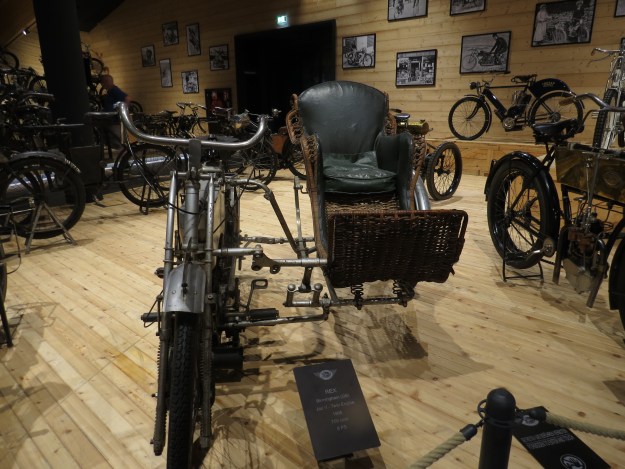
I loved some of the old motorbikes, which looked literally like a bicycle with a rocket attached. Others appeared to have armchairs instead of saddles.


Some appeared to be bathchair/motorcycle hybrids. I imagine travelling in the ‘side car’ would have been quite stressful on a downhill incline.

Of course, sidecars could transport objects as well as people.

The Museum has a ‘Motorcycle of the Month’ – this month it’s this rather fine Honda.

And they have this very fine Indian (name of the company) custom motorbike in pride of place at the end of the museum. If you fancy it, you can also ‘ride’ down from the Timmelsjoch pass, with its multiple hairpin bends, on some stationary bikes in front  of a gigantic screen. You can also press various buttons to hear what the bikes sound like, which is rather cool. Of course, there are now electric motorbikes, but I don’t remember seeing any in the Museum (I might just have missed them). I have a feeling that the smell of the petrol and the roar of the engine might be part of the appeal.

Downstairs in the Museum there’s an exhibition about Austrian travel writer and explorer Max Reisch, who travelled pretty much the whole world in the 1930s and 1940s on various motorbikes and cars. There was a film showing some of his exploits in Afghanistan, India and China, and they pretty much all involved lots of local people digging him out of the mud/helping him through swamps/pushing him uphill/pushing him downhill. I wonder how many of the customs that he documented still exist? In what used to be Indo China, for example, people had an interesting rowing style where they wrapped their leg around the oar and used the power of their lower body to row the boat – they had the equivalent of dragon boat races and seemed to get to a remarkable speed, so it was clearly quite a good way of doing things.

Max Reisch’s expeditions in the 1930s and 1940s

Max Reisch’s car

Max Reisch’s motorbike

This museum is pretty much the work of Alban and Attila Scheiber (remember that name? The Scheiber family also own many of the hotels and lift complexes in the area), and if you had any doubt that they are motorcycle fans of the first order, you have only to visit the toilet.

Puch early motorcycle permanently parked in the WC

And so, the weather dried up, and we headed home, completely motorcycled out but pleased to have seen the museum. Well worth a couple of hours if you’re in this area and it’s a rainy day (or more if you’re a petrol head :-)). I enjoyed it more than I expected to, and it was only the fact that there is no bus between 11.17 and 13.47 that stopped me having a lazy lunch and then heading up the attached cable car. Something to remember if you’re ever holidaying in these parts.