Obergurgl Day Eight – The Ötztaler Cycle Marathon

Dear Readers, we are in Obergurgl for one of the sporting highlights of the summer season, the Öztaler Cycle Marathon (or Radmarathon which sounds even cooler to me, though I suspect that ‘Rad’ means ‘Road’ rather than anything more exciting). It covers 227 kilometres, and over 5500 metres of ascent and descent, including the Brenner, Timmelsjoch and Jaufen passes, and the Kuhtai saddle). The fastest cyclists will do the whole lot in less than seven hours. It makes me feel exhausted even reading about it. It’s warm today too – in the mid twenties here in Obergurgl, so it will be a lot warmer down the valley in Söelden, where the race starts and finishes. As I write this, the first man across the line was Manuel Senni  who managed the whole lot in 6 hours and 49 minutes, with Janine Meyer first woman across the line in 6 hours and 55 minutes. It makes me feel exhausted even reading about it, but 4400 people started the race this year, and the last ones will complete it around 21.30 tonight. In some ways it feels like an even bigger achievement if you aren’t a super athlete. Good luck to all of them!

For us here in Obergurgl however, the road closures mean that we are somewhat confined to quarters, with no buses and most of the lifts and huts closed too. Fortunately we’ve decided to have a little rest day, as various parts of my body are complaining, as they do, and this cold seems to be lingering on. What a pleasant day for a walk in the good old Zirbenwald, though, followed by a coffee at the Zirben Alm. This used to be called David’s Hutte and was not a very happy place when we visited, but there are new owners and it feels much more welcoming, though I’m not sure if there isn’t something a tiny bit sinister about that smiley face.

On the way back down, I stop to take some photos of the various shrines along the way. In some places, these are placed beside roads where accidents have happened, but in Obergurgl I think that they are more meant as remembrances of people who have passed, and as reminders of Jesus and Mary, and the local saints such as John of Nepomuk. They are very beautiful, and often appear in unexpected places.

This one is at the entrance to the Zirbenwald.

This one is on the bridge before the Zirben Alm, and below it there is a small collection of engraved padlocks. It doesn’t seem to have grown much since I first noted it a few years ago, which is probably for the good – there are bridges in Paris and Prague where the whole superstructure has been compromised by the weight of all that romance. There must be a metaphor in there somewhere…

And then there’s this one, which I hadn’t noticed before – the carving of the Virgin and Child is really lovely. This is a valley of woodcutters, so it’s nice to see the tradition being continued.

And then it’s back to the hotel to have a cheese roll on the balcony and watch the swifts, who clearly have a nest nearby. I didn’t realise until recently that they basically hoover up insects until they have a kind of ball of food in their crop, to bring home to their nestlings. We spotted the lesser kestrels who live in the valley yesterday, and when one of them appeared the sky cleared of birds, even though the kestrels live on  small mammals. I hope to get a photo of them at some point to share with you, but they were feeling uncooperative today, and who can blame them?

I spent some time watching the tiny bit of path down from the Hochgurgl lift which should contain cyclists, but they are either too fast or taking an alternate route, because I didn’t see one. I did see a helicopter though, so I can’t have been too far off the mark. Fingers crossed for a safe and happy outcome for all the participants.

Obergurgl Day Seven – Hochgurgl to Obergurgl, and Attacked By Goats!!!

View from the start of the walk.

Dear Readers, today we took a bus to Hochgurgl, which is an ‘interesting’ ride – it’s hairpins all the way, and you are sharing the road with cyclists who are plodding their way up the curves, motorcyclists who are frustrated with being behind a bus and so overtake without being able to see what’s coming, and vehicles coming down much too fast, who are then surprised at how much room it takes for a bus to get around a tight corner. Still, we arrived in one piece at the old Hochgurgl Lift middle station – it’s sad to see it unused in the summer, especially as it used to give easy access to some of the valleys around here.

The Hochgurgl Middle Station

In the winter there is a toboggan-run, which starts from this hut, currently occupied by a shade-loving cow, who was eating all the green shoots that were popping up underneath.

I love this walk. We said hello to the snow blowers, which sit here in the summer like so many jet engines just waiting to take off.

I love this walk – usually, when we get to this point, there are ponds with tadpoles and dragonflies, but this year there’s just mud, which surprises me as we’ve had a fair bit of rain.

And, after a bit of uphill, I suddenly remember how much downhill there is on this walk – you can see the path in the photo below, and this is only the start – the path winds on through the woods all the way to Obergurgl. It can be a bit hard on the knees and ankles (and toes if your boots aren’t tied up properly). It goes down, crosses the next valley (the Konigstal) and then down again.

But this path is also a great site for black vanilla orchids(Gymnadenia rhellicani), one of my favourites. I managed to get a blurred photo (probably being so close to the edge of a precipitous drop didn’t help), but I’ve also attached a decent one. They are said to smell very faintly of chocolate.

Black Vanilla Orchid

Photo By © Hans Hillewaert, CC BY-SA 3.0, https://commons.wikimedia.org/w/index.php?curid=5463004

It’s these little things that are what I come to Austria for – the sheer abundance of plant life just popping up along a footpath, and probably going largely unnoticed.

At the entrance to the Konigstal you have to cross a rather rickety bridge over a vigorous mountain stream. A few years ago it had been washed away and so you had to walk up another couple of hundred metres and then cross the torrent. It’s always a relief to see that it’s actually in place.

And then the descent becomes much steeper, and wetter and more slippery. Oh joy! As we head into the trees, I can hear multiple nutcrackers calling but couldn’t see a single one. However, I did find this feather as a momento. I do hope that I catch more than a glimpse of a whole bird one of these days.

Nutcracker feather

Nutcracker (Nucifraga caryocatactes) Photo By Dominik from Poland – Spotted NutcrackerUploaded by Toter Alter Mann, CC BY 2.0, https://commons.wikimedia.org/w/index.php?curid=18467127

So, after all this excitement, we spotted this lot laying about in a leafy glade.

The second that they saw us their ears pricked up, and then the whole lot stampeded across the undergrowth towards us. Well I’m not usually fazed by domestic animals, and I used to have quite a lot to do with goats in a previous life, so I was more amused than anything. However, I had forgotten that John still had our lunchtime cheese rolls in his backpack. The Billy goat took one sniff of John and started to rub his horns against him very forcefully, while all the female goats galloped past and then stood there to see what would happen. Well it was all getting a bit much with the rubbing (and now the standing up and nibbling at the backpack) especially as we were on a very narrow path with a substantial drop on one side, and the Billy goat was a very robust and determined creature. I drew myself up to my full height and shouted at the Billy, who moved on reluctantly, and not without glancing back wistfully several times. Honestly, these are the cheekiest animals, and as a souvenir we found the ear tag of one of the goats further down the path – she seems to have the name ‘Francesca’ which is rather sweet, though she’s certainly no saint.

So we finally got back to our hotel. it’s surprising how many aches and pains you can acquire in a relatively short walk when it uses muscles that don’t usually get exercised in an urban setting, but I’m sure that a good night’s sleep and a bath will see me ready for anything tomorrow. Let’s just hope that it doesn’t involve goats.


Obergurgl Day Six – The Rotmoos Valley

Dear Readers, after a week of not feeling very well and having weather that was thundery and grey, today dawned in perfect walking weather (sunny but not too hot) so we pounded up the steep service road towards the Rotmoos valley. This is one of my very favourite walks in Obergurgl – at the start of the walk there’s the Schonweissehutte,  which was renovated a few years ago but which still serves a decent goulasche soupe.

From here, you edge past the reservoir, with it’s rather confusing warning sign. I imagine it freezes in winter, so maybe it’s a warning to intrepid skaters that this might not be the best spot. If anyone reads German, feel free to correct me.

Then it’s off along the path towards what’s left of the Rotmoos glacier. In 1872 it came to the location of the boulder with the red and white stripes in the photo below. Today, as you can see, it’s barely there at all.

So this adds a sombre note to this bright and shiny day. I remember the glacier being much more developed when I first came here in 1994. It’s shocking to see how diminished it is. The University of Innsbruck has one of the world’s most important centres for the study of glaciation, and the weather station in the valley has been here since the 1930s, continually recording data.

The weather station

But still, the flowers and the insect life here are absolutely stunning. I saw my very first gentians of the holiday…

This orange plant looks rather like our Fox and Cubs, but is a closely-related species, known here as Golden Hawksbeard (Crepis aurea).

There is the delightfully-named Crimson-Tipped Lousewort, a member of the Figwort family…

…Kidney Vetch, which we have in the UK, though I’ve never seen it in such profusion…

There are no true ‘trees’ at this altitude, but there are these little prostrate willows (Salix retusa), who survive in the poor, thin soil.

Further along the path there’s Moss Campion (Silene acaulis), hunkering down close to the ground to survive the cold and the scouring wind (even today there was a chill breeze blowing from what’s left of the glacier). The Alps are a paradise for members of the Pink family, I must have seen at least eight species.

And there’s some Round-Headed Rampion (Phyteuma orbiculare), another plant that I associate very strongly with Alpine meadows.

We were surprised not to see any marmots, though there were a few whistles from the other side of the valley. But there was this female Northern Wheatear with a beak full of bugs – clearly she has a nest somewhere near, and kept a very close eye on us. The birds spend the winter in Africa, but in summer they spread out across the rocky places of Europe. Here in Austria they often make their nests in disused marmot burrows. I’d never been able to identify these birds before, so it was lovely to be able to do so with the assistance of the European Bird Identification Facebook page.

And of course, the paths are full of butterflies and moths. Have a look at these blue butterflies, feeding on a patch of earth that I suspect had been peed or pooed on by some passing creature, leaving behind minerals that the insects needed.

And then, there is a sight that has lifted my heart every time I’ve visited Obergurgl. The local Haflinger horses spend the summer in the meadows around the village, pleasing themselves about where they go and when, and only coming back to their stable if they sense an oncoming storm. They are all palominos, and are led by an experienced mare who knows the territory and calls the shots. I honestly believe that they are some of the most beautiful horses on earth. Once I’ve seen them, I know that I’m truly back in the Tyrol.

Obergurgl Day Five – Around the Village

Edelweiss, but not as we know it….

Dear Readers, my cold is starting to improve but the weather today has been pretty appalling (though things are meant to brighten up from tomorrow). Still, there was a brief window this morning, so we popped out to have a look around the meadows and the village to see what’s new.

First up, the Edelweiss and Gurgl hotel, the oldest and arguably the most prestigious hotel in Obergurgl, has built some raised beds containing, well, Edelweiss. This is an extremely difficult flower to find around here, even on the high mountain slopes: there is said to be one location in the Gaisbergtal on some of the steep, inaccessible areas, which is just as well as it is a rare and protected plant. These days they are also cultivated for displays such as the one at the hotel. I always think that they look slightly strange and out of place if not nestled in a granite cleft, but as most people will never see one, it is at least nice to see what they look like up close.

The Edelweiss and Gurgl’s new rock garden.

The church of St John Nepomuk was consecrated in 1737 – last time we were here one of the cranes that was building the new ‘town hall’ had accidentally damaged the spire. But who was John of Nepomuk? He was a Bohemian priest who was drowned in the river Vltava on the orders of  King Wenceslas IV (presumably not the one from the Christmas carol). Apparently John Nepomuk refused to betray the confessions of the queen, which angered Wenceslas as he believed that the queen had taken a lover. St John Nepomuk is therefore designated as the patron saint protecting against false accusation and, because of the manner of his death, against floods and drowning.

The Church of St John Nepomuk

In the centre of the village is the statue of Martinus Scheiber, who built the Edelweiss and Gurgl hotel and the Ramolhaus, a famous mountain hut perched like an eagle’s nest above the glacier – he was clearly pioneer, and many of his descendants are still actively involved in tourism today. Now that the building work in the village is largely finished he is now clearly pointing towards the Ramolhaus, rather than towards a building site as he has been on previous visits.

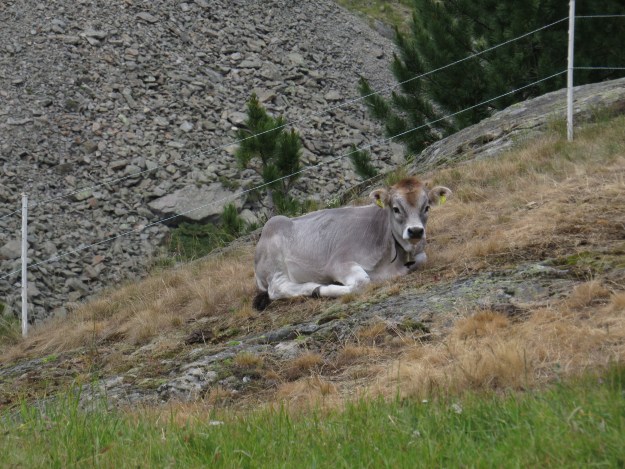
It’s nice to see that the Tyrolean grey cattle are still kept in the village too – every morning they leave their shed to graze on the meadows, and every evening they wander back to be milked. There are pictures of the awards that the cattle have won at shows in the noticeboard outside the shed.

The cow shed

It’s easy to forget how many options for walks there are in the valley. Here is just a selection…

…and some young people were heading off for the Klettergarten, which is a series of bridges and via ferrata for assisted climbing. I admire their courage, but it’s not for me!

The meadows were looking particularly fine after the rain…

Meadow with lupins!

Damp catsear…

…and one of my favourite thistles, the Spiniest Thistle (Cirsium spinosissimum) is just coming into flower. It is most unprepossessing close up, but with the sun behind it it looks rather splendid.

Spiniest thistle (Cirsium spinosissimum)

And finally, there are a few new additions on the hotel front. There seems to be some kind of outdoor pool behind the new Grünerhof hotel, but I’m not sure if it’s for wild swimming or for plunging into after a sauna. It’s also difficult to estimate the size. I shall have to take a cheeky detour one evening to see what’s going on.

And I am very impressed with the paintings on the front of the Grünerhof too. The Grüners are another major family in Obergurgl, and I think this hotel might give the Edelweiss a run for its money!

Finally, we stop for (yet another) coffee, and I’m pleased to see that the bus drivers are doing the same. Here’s to drier weather, the passing of my cold and some more exciting walks from tomorrow.


Obergurgl Day Four – The Zirbenwald

Dear Readers, I’m still feeling a bit under the weather (plus we have storms and rain forecast for later in the day) and so we decided to take a walk around the Arolla Pine Forest. Arolla pines (Pinus cembra) are extremely slow-growing trees: it can take them 30 years to reach more than a metre tall, and 50 years before they reach sexual maturity. However, they can live for a thousand years – some of the trees in this forest will have seen extraordinary changes in this scrap of woodland. The soil is extremely poor, but the pines survive with help from mycorrhizal fungi of various kinds.

This is a tightly-knit ecosystem – the nutcracker (Nucifraga caryocatactes), a kind of jay, caches the Arolla pine nuts that are its main food, much as the Eurasian jay ‘plants’ acorns as winter food. Some of these pine nuts will germinate, and if you look at the hillsides of Obergurgl you will often see lone pines, or small groups of trees, that have emerged from those forgotten food stores. We heard the nutcrackers cackling in the trees, but they are shy and difficult to photograph, so here’s a lovely photo from someone more speedy than me.

 Nutcracker (Photo by bbartlomiej, CC BY-SA 4.0 <https://creativecommons.org/licenses/by-sa/4.0>, via Wikimedia Commons)

The soil in the forest is not only poor, but also acidic, hence the alpenroses, which are actually a kind of rhododendron.

Another favourite plant of mine is this butterwort – its leaves are slightly sticky and capture small insects. Well, when you live in a nutrient-poor environment you need to take your food wherever you find it.

I have no idea what this white plant is, help! It’s very striking with its chocolate-coloured foliage and double flowers. and I’m thinking it’s possibly a cow-wheat species.

And how about this beauty! It’s known as a small white orchid (Pseudorchis albida) and it’s the first time that I’ve ever seen one. Austria is wonderful for orchids of all kinds, and I hope to spot a few more once I’m firing on all cylinders again.

Ants are a very important part of the forest ecosystem – the seeds of many plants include fatty sacks called eliasomes, which the ants eat, and which encourage them  to take the seeds into their nests where conditions are ideal for germination. The narrow-headed ant (Formica exsecta) travelled south from Sweden after the Ice Age, and has now established itself in the Arolla forest. There are a few colonies in the UK too, but it’s vanishingly rare.  Unlike the wood ants, which are also found in Austria, the narrow-headed ant makes very small, shallow mounds less than a foot high. Something had obviously disturbed these ants, who were very excited. Maybe a bird had been pecking at the nest shortly before we came along.

And so we head back down through the wood. I am not yet up to my mountain-goat levels of agility (ahem) and so we took it nice and easy, stopping to let people powering up the hill go past (as is only good manners in the Tyrol) and saying ‘Grüss Gott’ to anyone within hearing range. I am very pleased with my orchid spotting, and, as I look out of the window at what is basically a white-out of cloud and pouring rain, I am very glad that today we weren’t more ambitious. But I can feel all the worries of the past few months starting to fall away. The mountains have a way of doing that.

Obergurgl Day Three – Obergurgl to Hochgurgl

View towards Hochgurgl from Obergurgl

Dear Readers, I suppose it was entirely predictable but I woke up this morning with a sore throat and runny nose – all that stress before I left, coupled with a packed airplane full of people sneezing, has clearly given me a cold. But it does mean that I had a perfect excuse to take things easy today, and the morning was beautiful, so we headed off across the meadows to see what we could see.

And then we heard a familiar high-pitched whistle, and looked around to see an irate marmot about 100 feet away. I’ve never seen them here before, and in fact it’s been a sterling few days for spotting these Alpine rodents – I’ve seen four already, and I’d normally be lucky to see that many in a fortnight. They literally vibrate with fury when they see a walker/dog/sheep/cow. I hope this one soon settled down, it must take a lot of energy to be so hypervigilant. Their main enemies are eagles (not too many  this far down the valley), foxes (I’ve never seen a fox in Obergurgl, but there used to be a stuffed one in our hotel, so presumably they’re around) and probably also off-lead dogs, though people are generally very strict with their hounds, what with all the lifestock that’s about.

Marmot!

Speaking of livestock, it was a delight to see that the herd of Highland Cattle that live in a nearby field are increasing in number. I’m pretty sure that this is a hobby herd,  and that the animals live out their lives here. Very handsome they are too.

But of course the main attraction is the flora around here. Look at this rampion, for example – there are many different species in the Alps so I’m not hazarding a guess about species. They’re members of the Campanula family, but don’t look much like any bellflower that I’ve ever seen.

Then we have my personal favourite, the melancholy thistle. It’s just coming into flower, and who could resist those magenta puffball flowers?

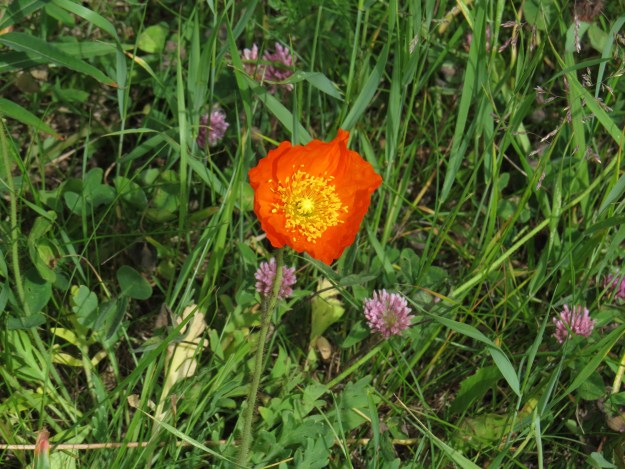
Then there are these beautiful Alpine poppies. These are, I think, Papaver alpinum ssp Rhaeticum – found only in this part of the Alps, they’re orange or yellow rather than the normal white, and very pretty too. These were growing right on the edge of the Hochgurgl lift carpark, where I’d spotted them a few years ago.

And how about this plant? It looks very like a type of catchfly to me, and in fact the closest match that I can see is Nottingham catchfly (Silene nutens).  Feel free to chip in if you’ve got any idea!

And there are the usual clouds of butterflies and moths, like the small tortoiseshell below…

And this swallowtail which landed for approximately half a second before heading off, goodness knows where.

Anyhow, by this time I was feeling a bit ropey so we headed up to the Hochgurgl  Lift Station to get a bus back  to Obergurgl. We used to love getting the lift from here up to the space-age Top Mountain Star, but apparently it hasn’t run in summer since 2019. Why, might you ask. Well, therein hangs a tale. The people who own the Hochgurgl life and Top Mountain Star also own  a motorcycle museum  a few miles away,  on the way to the Timmelsjoch pass. A few years  ago, the museum, containing the life-long collection of the owner, burned down,  so he has spent time and money salvaging what could be saved  and no doubt buying new bikes. So now,  he wants people to visit the museum, and so he has opened a life there, alongside the museum and the very highly-rated cafe. At least, this is the story in the village and I can imagine that, after the hardships of lockdown, followed by the landslide in 2021 that cut the village off from June to August, everyone is looking for a way to survive and to recoup some of the money they’ve lost. I will definitely visit later in the week, and report back.

The Top Mountain Star in winter

For now, though, we get the bus back to Obergurgl, head up to the Hohe Mut for some goulasch souppe, and of course take  a few photos, arriving back just in time to avoid the loudest thunderstorm that I’ve heard for quite some time. Let’s hope that I’m feeling a bit less ‘bunged up’ tomorrow.

View from the Hohe Mut, with the Rotmoos valley to the right, and the Gaislach valley to the left.

Obergurgl Day Two – Zwieselstein to Solden

Dear Readers, our go-to walk when we first get to Obergurgl is to get the bus to Zwieselstein, a little village located at the pinchpoint between the Obergurgl and Vent valleys, and to walk into Solden. It’s only a few miles, but it takes us alongside the Gurgl river and through the pine forest, so it’s cool and undulating without being too challenging. First up, though, we get off the bus a stop earlier than we should have (as usual) and so we walk past the eighteenth century church known as the Maria Hilf Kapelle. You can see the onion-shaped spire in the photo  below.

Then we come to a covered bridge dating from 2006. They definitely like a covered bridge around here.

I love all the wood piled up for the winter. The whole of Obergurgl is now powered by a district heating system using wood – previously many buildings were oil powered, which involved tankers travelling huge distances to get to the village. While I’m not overall keen on biofuels, they seem to make much more sense here, where there’s wood in abundance, than in many other places (like the UK for example, where the Drax power station uses wood imported from North American old-growth forests). Let me know how that’s sustainable.

But enough, I’m on holiday!

There is a very nice drinking fountain close to the main hotel, and I notice how the various ‘weeds’ prefer the splash zone. Very sensible.

Then it’s on, into the woods…

Alongside is the River Gurgl, milky with glacial run-off and looking quite the challenge for anyone into white-water canoeing or rafting. There are enormous boulders the size of houses, a testament to the power of wind and water over time – there are several huge areas of landslip too.

Some of the boulders are ecosystems in their own right, covered with moss and lichen and Alpine plants such as houseleeks.

There are a few patches of yellow foxgloves (Digitalis luteum) here too.

Then we suddenly come out of the wood and onto the long tarmac road into Solden itself. En route, we pass one of my favourite chalets – the front garden is always full of eclectic sculpture and it’s interesting to see how it’s changed since our last visit four years ago. I wonder if it’s a change of ownership, or just of taste?

Garden in 2023

Same garden in 2019!

Then it’s down into Solden while we consider whether to head up to the top of the Gaislachkoglbahn lift. Our Oetzal card (free to all visitors) gives us one up and down trip on each lift in the valley everyday, and as the weather was clearing we thought it was worth a shot.

Underneath the lift here’s a mountain-bike trail which is immensely popular with young cycling enthusiasts, though it looks pretty hair-raising to me. Cyclists load their bikes into the cable car and go to the first station (2176 metres) and then career all the way down again. I am always impressed at their daring, while being a little worried about what happens if you come off your bike midway down the trail.

The Gaislachkoglbahn heading up the mountain.

Anyhoo, we get to the first station without too much excitement. For the second leg (up to 3,040 metres) we share a gondola with a German family, where the Dad is clearly nervous and spends the entire 15 minutes joking about how much fun it will be if we plummet to the ground. I am glad that my German isn’t any better. I have noticed though that when people are afraid they often talk inanely about the very thing that they’re frightened of, so I have some compassion. It’s nice to get a gondola to ourselves when we go back down, nonetheless.

The view from the top is spectacular.

And for this trip at least, we resist the charms of the Ice Q Bar and Restaurant,  which featured in a James Bond movie ‘Spectre’ (and indeed there is a James Bond museum at the top). I’m sure we’ll be back for strudel and an eiscaffe later in the trip though. During the winter you can have dinner at the restaurant on a Wednesday evening, but they don’t do it in the summer. Harrumph.

The Ice Q Bar and Restaurant

And just to remind us that it’s not all fun and games in the mountains, there’s a rescue helicopter zooming about, and the lift complex is halted for a few minutes.

And then it’s time to head back down for lunch in the village. Of all the lifts that we use, this one has the most precipitous drop from the top station – it feels as if you’re thrown over the edge, which is quite unnerving. Just as well we can have a small scream in our empty gondola without disturbing any children or others of a nervous disposition.

Arrival in Obergurgl

Dear Readers, after a one and a half hour delay on our outward bound flight to Innsbruck (the incoming flight was from Paris and as we know, France is having a few problems at the moment) it was such a delight to get through customs, bag retrieval and transfer to Obergurgl. Incidentally, if you are ever travelling by Easyjet avoid the middle seats if you fancy a snack (round about rows 17-19) – for the second time running, by the time the trollies get to the middle of the plane there is nothing left but Pringles. There are worst fates than Pringles, of course, and all the sensible people had bought food beforehand (including an ill-advised tuna and chickpea salad).

I was a bit worried about how getting through passport control would go, now that we’re no longer part of Europe, but on this trip at least there were plenty of border guards, and I now have the requisite stamp in my passport to make sure that I don’t stay for more than ninety days. And the baggage sailed into view, unlike our last but one visit when John’s luggage stayed firmly in Gatwick.

We are staying at the Hotel Olympia – we used to stay here until, in 2013, they decided that they would take the summers off and do some renovation, and who could blame them? However, there seems to be a concerted effort to turn Obergurgl back into a summer resort. We talked to Evie, one of the owners of the hotel, and were impressed by how much effort she was putting into making the place more climate-friendly. For one thing, she is trying to reduce plastic use at breakfast, so there are some very neat jam machines instead of the usual endless little plastic packages, and she is serving yoghurt in re-usable glass jars instead of plastic tubs.

It has been very hard for all the hotels here: first there was Covid, then in 2021 the whole village was cut off for the whole early part of the summer by a landslide, which meant that all the food and medications for the villagers had to be brought in by helicopter. And until Monday we are the only guests at the hotel. I do hope that some more people turn up soon, lovely as it is to be so spoiled. In all my years of travel, I have never had a hotel to myself.

Anyhow, what is wonderful is that there appears, finally, to be no major building work anywhere in the village, after years of cranes and pile-drivers and earth-movers and, on one stay, dynamite which was being used to create an underground car park for all the skiers. No one can say that the villagers of Obergurgl aren’t keen to maximise on their undoubted advantages – the place is renowned for family skiing (lots of gentle slopes for children and beginners) along with some very challenging runs for the more daring amongst us. Me, I just love walking in the mountains rather than zipping down them, but each to their own.

Much of the building work last time related to the demolition of the old ‘town hall’ and the creation of a new, much bigger one, that would be used to host conventions and conferences – Obergurgl is a centre for glaciation studies as you might expect, what with the glaciers visibly vanishing during the time that I’ve been visiting (my first visit was probably around 1994). The new place looks very modern, but we’ll visit tomorrow to see the presentation about Obergurgl through the seasons that we’ve been to see every year. It was always hosted by Michael, the village walking guide, and his Dad Albert, and we saw them both today, not looking a day older in spite of us not having been here since 2019. I wish we could say the same for us.

The Gurgl Carat, the new ‘town hall’

In front of it is the memorial to balloonists Auguste Piccard and Paul Kipfer, and their rescuer, Hans Falkner, who organised the retrieval of the scientists after the balloon  crash landed on the Gurgler Ferner glacier in 1931. The balloon had reached a height of 15,785 metres, the very edge of the stratosphere, an amazing accomplishment. and the rescue suddenly put Obergurgl ‘on the map’.

Photo Anton-kurt, CC BY-SA 3.0 <https://creativecommons.org/licenses/by-sa/3.0&gt;, via Wikimedia Commons

I have to share this photo of Piccard and Kipfer before their historic flight, if only for their improvised crash helmets. They were both extremely brave, and Piccard went on to design the bathyscope for underwater exploration. He was clearly an innovative inventor.

Piccard and Kipfer beside the balloon which would take them to the edge of the stratosphere.

Last time we were here, the church spire had taken a knock from one of the cranes, but it looks nicely repaired now.

Anyhow, we headed up to the Hohe Mut via the cable car (no point in getting too ambitious on Day One) and spotted a pair of marmots grazing alongside one of the paths. It looks as if the plants are a few weeks behind where they usually are – the Alpenroses (a kind of azalea) are only just coming into bloom, and I suspect the marmots are just waking up from their hibernation and are hungry. I didn’t get a photo of them this time, but I will see what I can do later in the week.

It was cloudy at the Hohe Mut, but look at these fantastic golden retrievers.

And we bumped into two friends that we hadn’t seen since 2018, G and D – they both look well but have both suffered health challenges and the loss of people dear to them since we saw them, as have we of course. It was lovely to see them looking so well now, and we agreed that there is something about this little mountain village that seems to get under your skin – like us, they had visited other places in the Alps, but nowhere seems to tick all the boxes like Obergurgl.

A view along the Rotmoos Valley from the Hohe Mut.

It’s always a bit strange taking the first cable car of the holiday – they are so quiet, and there you are, dangling above a precipitous drop with lots of lovely hard rocks below. It’s even more fun if it’s windy. But once the first trip is out of the way, it seems to just come naturally.

Heading back down from the Hohe Mut

I was a little worried that the meadows, such a high point for me (no pun intended) would already have been mown, as they had been further down the valley, but they are currently splendid, so biodiverse and so full of bees, butterflies and various other pollinators. Here’s a small selection of photos.

Melancholy thistle

Hemp agrimony

Red and white clover

Yellow rattle (important for reducing the fertility of a meadow and so keeping the perennial ‘weeds’ such as dock and thistle under control)

Some kind of yellow compositae (possibly hawkbit/catsear)

Field scabious

Early Marsh Orchid (I think)

Meadow bistort (Bistorta officinalis)

Red campion

And of course, it wouldn’t be Obergurgl without some Tyrolean Grey Cattle. The older calves have been separated from their mothers, but are far from being newborns – I hope that they have a lot more time with their parent than calves in more intensive systems have.

And so, after an easy first day involving Radler (shandy to you and me) and some Tyrolean  spinach and cheese ravioli, it’s home for a rest. I can’t believe that we’re finally here, and yet it feels as if we’ve never been away.

Bugwoman on Location – Obergurgl!

Dear Readers, by the time you read this I will hopefully be on holiday in Obergurgl, the highest village in Austria at 6,330 feet. How I have missed this place! We last visited in 2019, before all that Covid shenanigans started, and it will be interesting to see how it’s changed – there were shedloads of building projects on our last trip, and a general move towards making Obergurgl a winter-only resort. What a shame that would be! Although the winter season is the most lucrative, the walking in the summer is extraordinary, with routes in every direction. The meadows are full of flowers early in the year, and they are a great draw for me personally for sure.

The walking here is not ‘easy’ but there are a number of routes for those of us who spend too much time during the year hunched over our computers (that would be me), plus some more ambitious ones for ‘proper’ year-round walkers. Like the route up Hangerer for example, the highest mountain in the immediate vicinity. In the winter, people walk up and then ski down, and by people I mean ‘over-achievers’.

View towards Hangerer

I love the local domestic animals too, the Tyrolean blue cattle and the Italian floppy-eared sheep, who spend the summer on the Austrian side of the Alps. Plus the local families breed the beautiful Haflinger palomino horses, who also spend the summer ‘wild’ in the valleys.

So, news that my heart is basically ok was such a blessing. I intend to walk, eat strudel, spot plants and birds and generally do all the things I’ve been yearning to do since the last time I was here four years ago. And of course, I’ll be reporting back here, as time and bandwidth and strudel consumption allow. Fingers crossed for reasonable weather, not too many blisters, and some peace and quiet.

Heart-felt – An Update

Dear Readers, you were all so supportive when I announced that I had a ‘dicky ticker’ as Monsieur Alphonse used to say in unreconstructed BBC comedy  ‘Allo ‘Allo that I wanted to send you a quick update. The echocardiogram did confirm that I am the proud possessor of a bicuspid aortic valve, but my GP decided to see if she could find a cardiologist to tell her a bit more about how bad it was, based on the report. At the moment there’s a three-month waiting list to see someone if you have a heart problem, and as I am off on holiday shortly (more details tomorrow) she wanted to check what I could and couldn’t do, and what I should be aware of.

And at this point envisage unicorns and rainbows, because not only did my GP manage to get hold of a helpful cardiologist (a feat in itself considering how overworked everyone in the NHS is) but the consultant said that the report showed that my heart was currently working well, and that all that was required was a routine referral to cardiology, followed by an annual echocardiogram to ensure that all is still well. The cardiologist apparently finished the call by saying ‘tell your patient to go off and enjoy her holiday’.

So that’s exactly what I intend to do, and what a relief! I will still, of course, be sensible and build up gradually to anything strenuous, but at least it looks as if open-heart surgery is not immediately on the cards, and the prognosis for anyone with a bicuspid aortic valve, with monitoring and treatment, is as good as it is for anyone else.

So, while I’m not a great fan of real fireworks, here is a photo from Vancouver, which just about sums up how I feel.

Photo by Larry Chen from Vancouver, Canada, CC BY 2.0 <https://creativecommons.org/licenses/by/2.0>, via Wikimedia Commons