A Lovely Surprise

White Ermine moth (Spilosoma lubricipeda) (Photos copyright entomart)

Dear Readers, this morning I spent a bit of time in the front garden, tidying up the green alkanet and cutting back a little bit of the buddleia where it’s threatening to take the postman’s eye out. I stood up, stretched, and noticed a white moth with a fat yellow abdomen and a sprinkling of black spots feeding on the lavender. What a wonder it was! It was so white and furry that I could see exactly why it was called an ermine moth – you could just imagine them edging some miniature dignitary’s cloak. Alas, it only visited for a second before heading off up Huntingdon Road here in East Finchley. I could see it for a good minute as it sped off, glinting against the background of brick and slate.

White ermine moths can afford to be conspicuous – they are apparently poisonous, though I haven’t gotten to the bottom of whether this is actually true. As usual in internet land, people seem to just copy chunks of the Wikipedia page without checking whether the information is correct or not. But I suspect that that flash of yellow on the abdomen would be a strong warning to any passing bird, plus these are not the most shy and retiring of moths. When I used to visit Mum and Dad in Dorset, I found a very pale White Ermine moth just sitting on a fencepost, where surely someone would have picked him/her off if they’d been edible.

White Ermine moth at Moreton Station in Dorset.

It’s not just the adults who are delightfully furry, it’s the caterpillars as well – they are proper ‘woolly bears’, and as their main food plants include nettles, dandelions and viper’s bugloss you have an excellent argument for letting the weeds be.

White Ermine moth caterpillar (Photo by By Rasbak – Own work, CC BY-SA 3.0, https://commons.wikimedia.org/w/index.php?curid=4613188)

And so, that was my excitement for the day. Incidentally, you might remember me writing about some tent caterpillars called bird cherry ermine moths a year or so ago – these are micromoths, much smaller than today’s moth, although the adults of this species too are white and black. The tent caterpillars have the scientific name Yponomeuta yvonemella which is a bit of a mouthful, but it’s important to be able to distinguish between species without confusion, and this is the perfect way of doing just that – an ermine moth can mean at least three or four different species just in this country, so goodness knows how confusing it would be internationally. People sometimes get annoyed when ‘Latin’ names are used (often not Latin at all, incidentally – all sorts of languages crop up) but the more I study science, the more I realise how valuable these tongue-twisters can be.

And in the meantime, keep your eyes open for moths, those underrated pollinators and creatures of the most exquisite (and usually understated) beauty.


Lost and Found

Skylark (Alauda arvensis) Photo by Neil Smith.

Dear Readers, in my latest copy of British Wildlife, there’s a link to the British Trust for Ornithology’s new ‘Doorstep Birds’ site. You can plug in your postcode, and it will tell you what bird species have been lost from your area, which are declining, which are increasing, and which are colonising. So of course I popped in the postcode for my house in East Finchley, and here are the results. The site compares the 1968-72 Bird Atlas with the 2007-11 one, so the results are not the most up to date, but it’s possible to click on a particular species to look at more recent information on trends etc. The area covered is also not the most granular – it covers from East Finchley in the north east of London to Shepherd’s Bush in the south west. However, it has some very interesting findings, in terms of not only what has been lost, but what has arrived.

On the deficit side, it appears that the area no longer has breeding skylarks or barn owls (though I do note that an individual barn owl was spotted on Hampstead Heath earlier this week, so maybe they’re making a comeback). We used to have grey partridges and cuckoos, yellowhammers and tree sparrows, rooks and nesting swallows, and these had all disappeared by 2011. Surprisingly, it seems that we also had grey partridges. I find the loss of the nesting swallows particularly sad, as I’m fairly sure that this is avoidable – surely we could make space for these birds to make their nests? And the missing rooks are something of a mystery, although these are birds that largely eat worms and leatherjackets and other underground invertebrates, and between climate change increasing drought conditions, trees that used to host rookeries being cut down and generally less tolerance for large, noisy, communal birds it’s probably not that surprising.

On the plus side, however, some birds are colonising the region, and a mixed bunch they are too. We now have little egrets and sparrowhawks: the latter have been something of a success story, and are clearly taking advantage of our penchant for bird tables and  bird feeders.

Sparrowhawk (Accipiter nisus)

Other new birds of prey include peregrine falcons (who have long nested on buildings such as Tate Modern and the Royal Courts of Justice) and hobbies, small falcons with a liking for dragonflies.

Peregrines executing a food drop close to the Royal Courts of Justice.

Apparently kingfishers are back  –  they are certainly doing well at Walthamstow Wetlands, though this is outside my region, but I have also caught a glimpse of one flying along the stream in Regent’s Park. And it appears that nightingales are back too, with one being spotted in Barnes in south-west London a few years ago, at the Wetlands Centre.

Nightingale (Luscinia megarhynchos) (Photo by By Carlos Delgado – Own work, CC BY-SA 4.0, https://commons.wikimedia.org/w/index.php?curid=40703551)

In fact, I think that areas such as the wetlands at Barnes and Woodberry in north London may well be responsible for many of the colonising species, which include common tern and lapwing, shoveler ducks and gadwall, teal, garganey and shelduck. These areas were previously managed purely as reservoirs, but now there is also a strong drive to support wildlife and to increase biodiversity. It feels like a real case of ‘if you build it, they will come’. Who knows what the impact of increasing meadows and grassland, mixed woodland and wood pasture might be? It feels as if there are still possibilities, even now on the brink of climate and ecological disaster.

If you’re in the UK, have a look at the picture where you live, and see what’s been going on.

https://data.bto.org/doorstep-birds/

Common tern (Sterna hirundo) (Photo by By Badjoby – Own work, CC BY-SA 3.0, https://commons.wikimedia.org/w/index.php?curid=4537951)

Pits, Pies and Privet

Dear Readers, I took a quick walk along my street in East Finchley today, and, as usual, I found lots to look at and think about. First up, some lovely people have planted up the tree pits around the street trees, and this one in particular is a lovely mixture of native plants, yarrow, poppies, cornflowers, clover and this little yellow flower which I think is ribbed melilot, and which might well crop up as a Wednesday Weed…

Yarrow and Poppy

Ribbed melilot

Red Clover

Cornflower

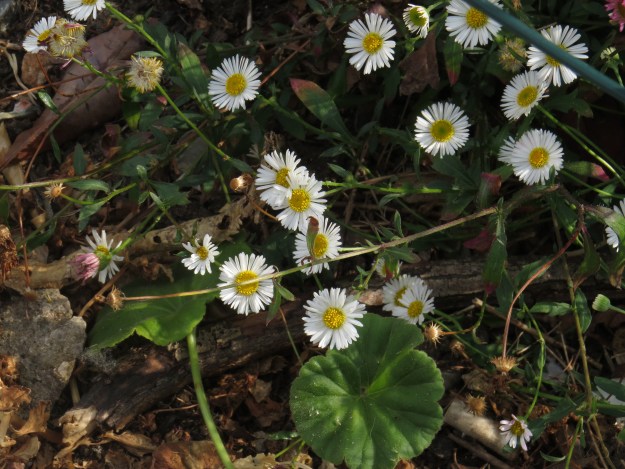
Further along the road, a clump of Mexican fleabane looks as if it’s been caged in, but isn’t too unhappy about it. This is such a happy little plant: it grows anywhere and although modest is a great favourite with hoverflies, those very underrated pollinators. 

I’ve noticed that a lot of people are moving away from box as a hedging plant, and no wonder – most of them have been absolutely destroyed by the caterpillars of the box moth. However, privet seems to be making a comeback, and I’m happy about that – I love the creamy smell of it in the summer (it always reminds me of the scent of lilies, without the sickly overtones), and the bees absolutely love it.

And finally, the magpies are up to no good, as usual. This one is a fairly young one, and was very curious about whatever was hiding in the interstices of this satellite dish. I only hope that the signal isn’t degraded.

And so, as usual, a leisurely stroll outside presents all kinds of interesting things, and is enough to lighten my mood regardless of what else is going on. Plus, magpies are so incessantly curious that they put me in mind of small children, always on the verge of getting into trouble and impossible to leave alone without some mischief taking place. No wonder they’re doing so well in our cities, they remind me of Dickensian urchins.

Some Interesting Cemetery Wildlife

A Eurasian Hamster (Cricetus cricetus) in a cemetery in Vienna

Dear Readers, the only time I have ever seen a wild European hamster was when I spotted a very dead and squished one on a path above Sölden in Austria, but it appears that I was looking in the wrong place. Although this little rodent is critically endangered across its whole range (generally eastwards from Belgium), there is a growing population in the cemeteries of Vienna. There, the hamsters are said to steal the candles from the graves and pull them into their underground dens: the wax is a  a useful source of fat during the cold Viennese winters. I for one would not begrudge them.

Another Viennese cemetery hamster (Photo Sphoo, CC BY-SA 4.0 <https://creativecommons.org/licenses/by-sa/4.0&gt;, via Wikimedia Commons)

What is especially interesting to me is that the Vienna Cemetery people have welcomed a citizen science project, where people record their wildlife sightings – there have been a dozen species of mammals (including foxes, who will no doubt enjoy the occasional hamster as a light snack), 80 species of birds, and hundreds of species of other animals across their 46 cemeteries. How fascinating it would be to record something similar in our local cemeteries! I might try and get something going when I retire. I suspect, however, that the presence of endangered species in one of ‘my’ cemeteries might be extremely inconvenient for the management of some of them, where large areas are already being cleared for additional graves.

Most people’s exposure to hamsters consists of having a golden hamster as a pet – these are actually Syrian hamsters, and if handled from very young can become ridiculously tame. We had a ‘free-range’ hamster called Hammy (such imagination) and she was feisty enough to run up to our rabbit (Ben the Bun since you ask) and steal whole baby carrots from him while he looked on with an expression of disbelief. We also had a pair of Russian hamsters, who look adorable but are extremely bitey little things. Nowadays, I can’t help but feel sorry for small animals of all kinds in cages and hutches if they don’t have access to a bigger, more exciting space, and the freedom to live out their lives as they were meant to.

A rather adorable Syrian hamster (Photo By Harpoen – Own work, CC BY-SA 3.0, https://commons.wikimedia.org/w/index.php?curid=23278931)

But back to the hamsters of Vienna. The European hamster is the largest hamster in the world (though admittedly not all that big) and can grow to the hefty weight of one whole pound (that’s 460 grams for anyone metrically minded). The species can also live to eight years, and, as it can start breeding at 43 days, and has litters that number up to 15 young, you would think that the world would be overrun, in much the same way as it was with Tribbles in Star Trek. Alas, between the intensive farming, the light pollution (hamsters are nocturnal), climate change (the hamsters usually hibernate but the warmer temperatures are confusing them) and persecution. Honestly, who could persecute a hamster? We really are shocking sometimes.

A European hamster with cheekpouches full of something tasty (Photo SgH Vienna, CC BY-SA 4.0 <https://creativecommons.org/licenses/by-sa/4.0&gt;, via Wikimedia Commons)

One good thing is that although usually solitary, the European hamster breeds well in captivity – there are breeding programmes all over Europe which aim to release the hamster back into its native habitat, where suitable areas can be found. I note that in 2011, France was threatened with fines of up to 25m Euro by the Court of Justice of the European Union for failing to protect the animal because of their agricultural and urbanisation policies. By 2014 France had started a captive breeding programme which aims to release 500 hamsters into the countryside every year, in areas where the farmers are paid not to harvest their fields. Well, this sounds like a rare and most welcome tiny victory for rodents everywhere.

And just in case you fancy watching a pair of European hamsters having a tussle in a Viennese cemetery, have a look here.

And here is one getting some food in for the winter. 

Honestly, I know where I’m going next time I’m in Vienna.


At The Whittington Hospital

Dear Readers, this morning it rained and rained, after nearly a month of tinder-dry weather and so, as I headed off to Whittington Hospital in North London for a routine thyroid check, I wasn’t surprised to see a whole host of snails enjoying themselves in the damp conditions along by the main hospital wall.  I have always had a soft spot for these molluscs, and I love the way that they glide along.

It’s fair to say that the many, many people walking down from the hospital were a little confused about what I might be doing, but most of them simply glanced and then gave me a very wide berth. After all, there is a wide variety of people in Archway, not all of them 100% benign, and so eccentricity of any kind tends to be a bit of a red flag. One small girl did stop and gaze at me, wide-eyed, before being ushered along by her mother. To think that she could have been another mollusc-fan, and we didn’t get a chance to swap notes! What a shame.

Anyhow, I went up to the imaging department, and was handed a pager (who knew that they still existed?) and told to go to Room 12 when it buzzed, which of course it did as soon as I had my reading glasses on. My appointment was for a thyroid ultrasound – the CT scan that I had a while back to try to find the reason for my cough found all sorts of strange anomalies, one of which was a slightly enlarged thyroid. I wasn’t worried because my thyroid function blood tests had all come back with normal readings, but I do love an interesting (and non-invasive) medical procedure. Fortunately there was also a young medical student in attendance so, as I lay there with my throat exposed like some sacrificial lamb, the doctor talked through everything she was finding – nodules, cysts, colloid and even (get this) some comet-tail artefacts – these happen in an ultrasound when it finds something reflective, usually just some kind of protein. Comet-tails are perfectly normal, and apparently a good sign.

I do have a couple of tiny nodules that are too small for the ultrasound to investigate, apparently, so what the doctor is recommending is that I return for another ultrasound in about six months, and if there’s no change (which is what she expects) I’ll be signed off on the thyroid front.

And so I head off home, passing some more snails en route. What calming animals they are (apologies to anyone trying to grow vegetables; you probably take a rather less sanguine view)!

I have a great fondness for the Whittington – I credit it with saving my mother’s life when she came down with sepsis and complications back in 2015, and I have been here for numerous blood tests and X-rays and CT scans over the last six months. I have always found the people who work here to be helpful, kind and knowledgeable, from the volunteers who direct visitors around this maze of a building to the consultants and radiographers and nurses. Strangely enough, the place is starting to feel like home, much as it did when I was visiting Mum during her long stay eight years ago. I would rather not have any health problems (clearly) but as I do, I am so glad that this is my hospital.

Making the Most of It…

Dear Readers, my buddleia really is in a shocking state this year – there is so much honeydew coming from the greenfly that it managed to stick my green wheelie bin shut. However, it isn’t all bad news because a little flock of sparrows visit more or less every day, to give the insect life the once over and to pick off all sorts of invertebrates.

It’s difficult to see properly, but this bird might even have found a caterpillar, which is clearly what he’s really after – you have to work much harder to get calories from a bunch of aphids than you do from a nice juicy larvae. There are lots of baby sparrows about, so I imagine that the parent birds are having to work very hard, especially with the rain being intermittent and the ground as hard as iron. Goodness knows what the blackbirds are doing, they’ll be needing a pneumatic drill to get into the ground around here.

It is lovely to sit at my desk on a call, and to glance up to see a sparrow or a goldfinch feeding, though. And I’m watching as the flowers on the buddleia start to expand. They look most unpromising now, but will soon be splendid purple pollinator-attracting blooms, and no doubt all manner of insects will take advantage. But for now, back to the day job!

Two Bees or Not Two Bees?

Dear Readers, one of the big pleasures of the time when the lavender is in flower is seeing who turns up. Although the bulk of the visitors are the honeybees from the nearby allotments and some nice big fat bumbles, we do also get the occasional little chap/chapesse, and they are almost invariably a nightmare to photograph. The one in the photo above actually has very pale eyes, and zooms about at such a speed that mostly s/he is just a blur. I rather think that what we have here is a four-banded flower bee (Anthrophora quadrimaculata), largely because I spotted one a few years ago – they are London specialists, fly around between June and August, and are described as ’emitting a high-pitched buzz as they hover and dart rapidly between flowers’.  I couldn’t put it better myself.

Here is a rather better photo from last year. The bee in the photos above looks rather greyer than the one below, but apparently this isn’t unusual in older bees (much as with older people). It’s also not impossible (she says) that the photos above are slightly overexposed (ahem).

Four-banded flower bee (Anthrophora quadrimaculata)

And how about this bee, which very obligingly sat on the wall instead of zipping about like a maniac? Well, now I’m looking at my photos I’m actually sure that  this is also a four-banded flower bee. You can even count the four bands. I am pretty sure that I also saw a leaf-cutter bee but this is Clearly Not It. Oh well. It just goes to show that this bee identification business is not as easy as you’d think.

I still think that bee numbers are down in general, though. Maybe I should start doing an actual scientific survey, and see if the numbers stack up. Any thoughts on what’s happening where you are?


Muswell Hill Playing Fields Meadow Update

Well, Readers, the meadow at the edge of Muswell Hill Playing Fields is looking absolutely splendid at the moment – I spoke to a woman walking her dog who said that she’d been sceptical initially, but that she thought it was absolutely wonderful. And so it is – we have cornflowers and poppies, mayweed and corn marigold, and no doubt lots of other plants just waiting in the wings.

To start with, people weren’t clear exactly what was going on, and there were worries that the plants would be trampled. But as they’ve grown up, the delineation between the meadow and the rest of the area has become clearer, no doubt helped by the wonderful posters from local children, explaining what’s been going on.

There were also worries that the local crows were eating the seeds, but my suspicion is that they were more interested in the worms and other invertebrates that had been turned up when the ground was rotavated to prepare for the seed planting – after all, clouds of crows follow the plough for just this reason (or did back in the day).

There are lots of pollinators about, including the less-appreciated ones such as the beetle in the photo below. The Conservation Volunteers are running pollinator surveys over the summer, and I hope to get along to at least one session, work permitting.

Considering how bare this area was just a few months ago, it’s very impressive how quickly the meadow has grown up. I look forward to monitoring its progress and watching the succession of plants over the next few months. If you live locally and haven’t been down to see it yet, it’s well worth a look, so take a wander down.

The meadow area in March

Monsters – A Fan’s Dilemma by Claire Dederer

Dear Readers, I bought this book while I was in Canada, because I’ve always been interested in how and why we decide what it’s acceptable to enjoy, and how far we are able to separate the artist from the work. This is particularly current when someone was recently arrested for attacking the Eric Gill sculpture outside the BBC with a chisel only last week – Gill, who was instrumental in the design of the typeface for the London Underground, and who was lauded for his artistic works, is also notorious for his sexual abuse of his daughters, and his dog. Dederer doesn’t actually discuss Gill, but she does talk about some of our more recent ‘monsters’ – Michael Jackson, Roman Polanski, Miles Davies etc.

In The Guardian, Rachel Cooke  gave the book a truly terrible review, while Kathryn Hughes kind of liked it. And so, as you might expect, the book turns out to be just as polarising as the question. ‘Should’ we still enjoy the paintings of Picasso, even though he was a serial abuser of women? ‘Should’ we still enjoy the music of Miles Davies, who openly discussed slapping women around? How far does the ‘stain’ of knowing about an artist’s life contaminate the things that they created?

Well it’s a vexed subject and there are no easy answers. One point that is well-made, though, is that this, like so many things, has been turned into an individual decision. If we refuse to listen to the music of Michael Jackson, who are we benefitting (apart from making ourselves feel good?) And how about the fact that Jackson was probably a victim of child abuse himself? We get ourselves tied up in knots, and I can’t help thinking that, compared to the problems that the world is facing, worrying about such things is a luxury. Just imagine if we took all that energy and argument and turned it towards actually changing things that are wrong.

The ‘monsters’ in Dederer’s book are overwhelmingly men, but she has some interesting things to say about what makes a woman artist a ‘monster’. Largely this involves abandoning their children – Doris Lessing took one of her children with her when she left what was then Rhodesia, but left the other two behind. For me, the difference between what Lessing does, and what the male ‘monsters’ do is that Lessing left in order to do her artistic work. I’m not sure that beating up your partner adds anything to your ability to make jazz, or that abusing children makes you a better sculptor. We seem to cut male artists more slack when it comes to terrible behaviour, which comes as no big surprise to me.

Ach, I don’t know. I don’t think that there are any easy answers about what we should and shouldn’t like, and how far we should stop enjoying the art of those who are execrable human beings. The paradox of seeing that something is beautiful, and moving, and true, and that the person who created it is a terrible human being, is one that I don’t think that anyone has ultimately cracked. But I would love to know what you think, Readers. Is there something that you no longer feel comfortable about enjoying, now that you know about the artist’s life? Or are you able to separate the two?

I should say that I found Dederer’s book thought-provoking, frustrating and a little confusing, but then that’s pretty much what the whole subject is like.

Lavender at Last!

Dear Readers, after what feels like months the lavender, which has been on the verge of flowering, has finally started to attract its first bumblebees, and I could not be happier. A few days ago there were just a few common carders, and now the buff-tails and white-tailed bumblebees are here. I hope you’ll forgive a few photographs of them getting stuck into all that nectar. And the front garden smells amazing, although I shall have to don some gloves and clear out the worst of the green alkanet now that it’s gone over.

This being nature, danger also lurks in the form of a quite well-grown spider, who is optimistically slinging her net between the Bowles mauve wallflowers and the lavender. I think she’s still too small to snare a bumblebee, but the honeybees had better watch out…

The bottlebrush plant that my Aunties bought for me is coming into flower – strangely enough the bees are ignoring it, though in the past they’ve always been quite partial. Bottlebrushes are normally bird-pollinated however, as their colour indicates – birds love (and can see) red, while bees seem to prefer the blue end of the spectrum (though of course the flowers can look quite different under ultraviolet light).

And finally (because after four days hunched over my computer catching up with all the stuff that needed to be done after my exams my back could do with a break), here are the flowers that I featured over two weeks ago, and look! I cannot imagine a better advert for buying British flowers. What’s interesting is how many of the blooms have actually changed colour as they’ve gotten older. I have been meticulous about changing the water every two days, and I imagine that might have helped.