A Winter Wonderland

Dear Readers, there’s something about snow that takes me back to being a child – last night I stood on the front door step and watch with wonder as the streetlights lit up the falling flakes. I know that later this week I’ll be worried about the ice, but when the snow first arrives, like a whisper, I am always thrilled. And I must confess that being able to work from home, rather than having to fight onto a crowded tube train and go to the office, makes the situation much more comfortable.

It’s not very comfortable for the birds, though, so the first thing that I did was clear the snow from the bird table.

Then it’s a quick walk to the bird bath with a kettle of boiling water to break the ice. However, before I did I stopped to admire the fox tracks. The fox came in through the front garden and under the somewhat decrepit wooden door at the side of the house…

Then round and round the patio – I hope she could smell the handful of dried dog food that we’d thrown out…

and then back out to the front garden and over the garden wall.

And I am very glad that I took my spider web photos yesterday, as today the weight of snow and ice has destroyed them utterly. It reminds me of that old saying about ‘seizing the day’, and I imagine it especially applies if you’re a photographer of the natural world. A sunset, a bird, a cobweb can all be here and then gone in seconds.

Revelation

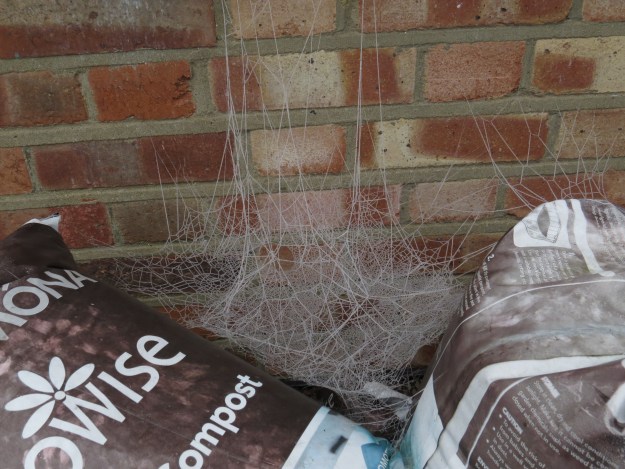
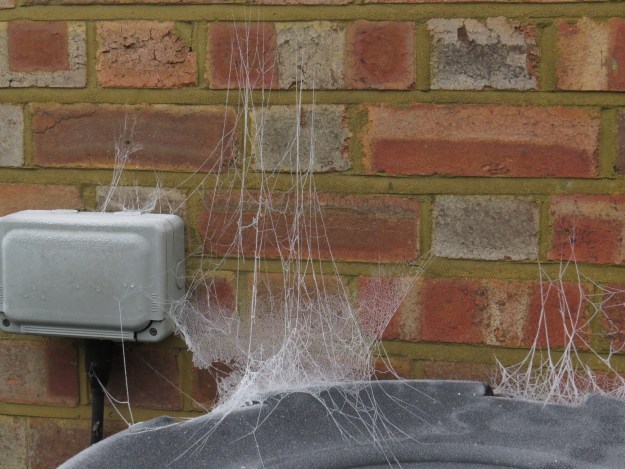
Dear Readers, the cold snap continues – the temperature as I write is a chilly 28 degrees (don’t laugh, Canadian readers). So far there’s no snow, but there’s a chance of some overnight and tomorrow, which, as I am working from home and don’t have to go out in it, makes me rather selfishly excited. But what was even more exciting this morning was the way that the overnight frost had exposed every single spider’s web in the garden. Who knew that they had been so busy?

I suspect that these have been built by lace-web spiders (Amaurobius sp.), though they could also belong to the noble false widows which seem to be cropping up everywhere, and which also make a sheet web. The frost has revealed every strand, and shows the structure, with long, thick strands anchoring the web, and then a multitude of smaller ones forming the basis of the web.

In this web, the spider who made the lacy web at the top has been joined by a garden spider lower down.

The bags of compost that I left on the garden table have formed the basis for some very impressive webs.

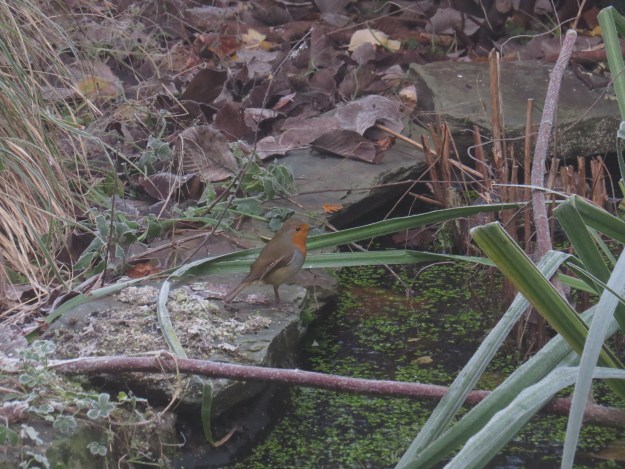
And a poor robin waits patiently above the frozen pond for someone to break the ice. Two minutes after my husband had broken it, the robin was back, having a bath. Clearly s/he got the memo about cold water being good for you.

And finally, a few more orb webs on the garden chairs.

It’s amazing what goes on in the garden that we can only see under very particular conditions. I love that the spiders were so busy during the summer, and that they left us these signs of their passing. These are the loveliest decorations that anyone could ever wish for.

A Cold Snap

Dear Readers, winter has arrived here in East Finchley. For the past few mornings I’ve been hearing the tell-tale sound of windscreens  being scraped as I log in to my computer for yet another day of spreadsheet wrangling. Outside, some of the plants have collapsed temporarily in the frost, though I know that they’ll all revive gradually as it thaws a little during the day. We’re in for another week of temperatures in the low to mid 30s though, so anyone with their pelargoniums still outside is in for a shock.

I’ve had a shocking cough for about three weeks now – everybody that I speak to is suffering from some variant on colds/coughs/Covid/flu. I’ve tested negative for Covid every time I’ve tested, but this does feel like something new. I smoked until I was about 30 and got bronchitis every winter (like the idiot that I was), but since giving up I’ve not had much worse than a tickle, until this year. At what point do I break and actually speak to the doctor (supposing I can get an appointment)? With the NHS under such stress I really don’t want to add to the burden, but this is getting me down a bit now. I keep thinking it’s improving, and then thinking that it isn’t. Oh well, at least I’m not the only one.

Between work and the lurgy I haven’t been outside much, but to my surprise today I spotted that my little clematis, planted last year, has a few fragile flowers. What a sweet little plant! It looks very straggly at the bottom, but then this is going on at the top. It pays to get outside even if it’s just for a few minutes. There are always surprises. I have no idea how to look after this particular clematis re pruning etc by the way, so if anyone has any ideas, fire away!

My poor potted mahonia is flowering again. Every year I think about putting it in the soil, and every year I forget. Maybe 2023 will actually be the year when I release it from its imprisonment. If any bee was so daft as to come out of hibernation today (and it’s sunny, so if the hibernation spot gets the sunbeams it might warm up enough to encourage a queen bumblebee to take a chance) at least there will be something to eat.

And the pond is frozen solid, but we’ll break it a little around the edge so that the birds can drink. My husband has been out in his parka pouring boiling water on the bird bath and filling up all the feeders, bless him. I can hear the goldfinches massing already, and apparently he was mugged by a robin as soon as he came out of the shed with the suet. He has optimistically put some orange segments on the bird table, so I shall be fascinated to see if anyone is interested.

The  leaves on the ribes are looking very splendid in their slightly-frosted condition.

The cold is decorative but for those already struggling with energy bills it’s a disaster. I had a Zoom call with someone yesterday who has had  long covid, and yet is living in a freezing house, to such an extent that he took the call wrapped in a scarf, hat, several jumpers and an anorak. So many people are feeling the strain already. The foodbank collectors on our street have set themselves a target of getting 70 bags of food in the next five days, and I’m sure that they’ll achieve it. If there’s one thing that the last few years have taught us, it’s that we have to look out for one another and help where we can, for both our animal and human communities.

Incidentally, for those of you in the UK who are reeling from your energy company’s estimated bills, here are two calculators so you can see if you’re being ripped off…

https://www.moneysavingexpert.com/utilities/what-are-the-price-cap-unit-rates-/#tool

https://www.moneysavingexpert.com/utilities/lower-energy-direct-debits/#calc

And now I’m off for some ginger and lemon and honey tea, lovingly concocted by my husband. I’ll let you know how it goes !

An Adventurous Listener

William Blake – ‘Angels Hovering over Christ in the Sepulchre’ from http://www.thehypertexts.com/

Dear Readers, you might remember how much I’m enjoying Ronald Blythe’s book ‘Next to Nature’, and last night I read something that I thought I’d share with you all. To set the scene, Blythe is riding home from Bury St Edmunds in a minicab.

‘.…an extraordinary confession from the Polish taxi-driver on the last phase home. Glancing at me, summing up whether I could take it, young, and, I thought, rather sad, he asked if I was ‘religious’. Adding that he could tell that I was ‘a gentleman’. What next?

Swerving past some cyclists, summoning up his courage, he said that he had seen an angel. Did I believe him? I told him about a great English poet called Blake, who saw angels in Golden Square in London. He told me that he was married and had a little girl. I praised his English. He was, I thought, about twenty-two and rather lost. Or maybe found. He was certainly an adventurous driver. There are times when one must be an adventurous listener. 

William Blake wrote:

‘And we are put on earth a little space,

That we may learn to bear the beams of love’.

This reminded me of a taxi ride that I took in Cork, in Ireland. The conversation turned, as it does, to children. The driver wasn’t to know that I had recently had a miscarriage, and so I quickly turned the subject to his little ones, and asked how many he had.

He hesitated for a second.

‘Four’, he said. ‘Three boys and a girl. The girl only lived for a few hours, but I can’t deny her’.

‘She lived, and was loved’, I said, swallowing hard. ‘No need to pretend she didn’t happen’.

And so we drove on, fellow travellers in the truest sense, through the impossible green of the Irish countryside.


A Clever Bustard

A great bustard (Otis tarda) – Photo by By Andrej Chudý from Slovakia

Dear Readers, I have always been fascinated by the way that animals seek out particular plants or other substances when they feel ill, and use them to self-medicate. Lots of grazing animals do this, and chimpanzees were observed to apply small, winged insects to one another’s wounds, though scientists are unsure whether this is because of chemicals in the bodies of the insects (such as formic acid) or just as a caring gesture. Pregnant elephants in Kenya are thought to eat particular leaves to induce birth, and female lemurs eat leaves that kill parasites and encourage milk-production. But in New Scientist this week, there’s the first case that I’ve heard about of a creature using plants to treat a sexually-transmitted disease.

Male great bustard displaying (Photo by Francesco Veronesi at https://www.flickr.com/photos/francesco_veronesi/15370854417)

Great Bustards are amongst the world’s largest flying birds. They used to be native to the UK, until the last one was shot in 1832, but a population of about 40 have been reintroduced to Salisbury Plain, where they benefit from it being Ministry of Defence land which is off-limits to most people. The birds are a real success story – their numbers have been boosted over the years by eggs collected from larger populations abroad (n the wild, they live mostly in Spain and Portugal), but now it’s hoped that they will be self-sustaining going forward. You can watch a short snippet about the reintroduction below – I love the way that humans have to wear ‘dehumanisation suits’ to stop the birds becoming accustomed to people.

https://www.youtube.com/watch?v=iG4z1uvegAQ

As you can see, Great Bustards are impressive birds, especially in the breeding season, when the males gather in leks. The display includes throat-puffing, tail-flashing, and rather importantly for our discussion, revealing the cloaca (the multipurpose orifice which in birds serves for excretion, egg-laying and reproduction), which the female apparently peruses with some interest. Before the breeding season, the males snack upon blister beetles (which contain some very nasty chemicals, but which are thought to reduce parasites). The males also seem to eat common poppy (Papaver rhoea) and purple viper’s-bugloss (Echium plantagineum), plants which have little nutritional value and which are actually toxic, just before they start to breed. Scientists from the Spanish Natural Research Council in Madrid took extracts from these two plants, and tested them against three parasites that can be transmitted during sexual contact  – a protozoan, a worm and a fungus. The plants killed up to 98% of the protozoans and up to 81% of the worms, while the viper’s-bugloss had a moderate effect on the fungus, killing over 50%. It may be that when the females inspect the males, they are looking for signs of the infections that the pathogens cause.

Breeding is a very exhausting time, particularly for male animals like the Great Bustard. Only ten percent of males actually find a mate, but those that do are very successful, mating with at least five females. Parasites are more likely in animals that are already under the weather, and once an infection starts, it can make the animal appear dishevelled, and impact on its energetic display. it’s perhaps no wonder that Great Bustards seem to have hit on a way to make sure that they’re in tip-top condition for the breeding season.

You can read the whole report here.

So, as usual, this is a positive story for Friday, both about the Salisbury Plain Great Bustards (who appear to be on track to be the first successful re-establishment of a population of the species anywhere in the world) and on the subject of the mysterious world of animals and their ability to heal themselves. We clearly have much to learn by paying attention to animal behaviour.

Great Bustards from the Crossley ID Guide


Red List 2022 – Number Seven – Lesser Spotted Woodpecker

Lesser Spotted Woodpecker (Photo by Ron Knight from Seaford, East Sussex, United Kingdom)

Dear Readers, the rarest of our woodpeckers is also the smallest- the Lesser Spotted Woodpecker is scarcely bigger than a sparrow. Not only is it rare, and small, but it’s also much more secretive than its larger cousins – if you catch a glimpse of it, it’s likely to be at the very top of a tree during the early spring, because once it nests, it makes sure that it slips by like a shadow.

Like the Greater Spotted Woodpecker, it ‘drums’ to announce its territory, but as you might expect, the sound is rather different from that of the Greater Spotted Woodpecker. Have a listen below…

This is the Lesser Spotted Woodpecker (recording by Paulo Alves in Portugal)

And this is the Great Spotted Woodpecker (recording by Ulf Elman in Sweden)

As you can hear, one sounds like a teeny tiny typewriter, and the other one sounds like a jackhammer, to my ears at least.

The species has had a catastrophic decline over the past decade – surveys suggest that numbers could have fallen by as much as 50%. The reasons, as usual, are many, but the bird seems to have low breeding success. They are reliant on dead wood to make their nest holes, and are not large enough to push out other birds, or defend their homes against larger woodpeckers or parakeets. They rely on insect food, so a poor spring, or a failure of timing (all the commoner due to climate change) can wipe out an entire brood. But, before we get too despondent, there is hope.

The Woodpecker Network is a Citizen Science group that is keeping an eye open specifically for Lesser Spotted Woodpeckers. The dedicated birdwatchers who report on the bird have found that there are probably about 2000 pairs in the UK, more than was originally thought. They are now turning their attentions to monitoring what the birds are feeding to their nestlings – for example, in a bad year blue tits are reduced to collecting aphids for their chicks instead of caterpillars, which is clearly an inferior food source. Information really is power when it comes to protecting species, and I am reminded that, during a bird survey in our local ancient woodland, Coldfall Wood, the calls of a Lesser Spotted Woodpecker were recorded, so maybe I should get off my own backside and do a bit of bird watching myself.

The photo below is from the Crossley ID guide, and, from left to right, we have a juvenile, a male with his red cap, and a female. They always look a little unkempt to me, but if we only looked after big, flashy birds, where would we be? After all, many human beings are not beautiful to look at, and some are even, dare I say it, scruffy, but none the less worth paying attention to. The woods would be diminished without this diminutive bird.

Lesser Spotted Woodpeckers from the Crossley ID Guide


Wednesday Weed – Chickweed Revisited

Chickweed (Stellaria media) Photo by Kaldari

Dear Readers, I have always been very fond of chickweed – it seems to grow where nothing else will, and yet its flowers are very beautiful when seen close up. It likes disturbed ground, and so will often grace the most unlikely pile of rubble. Its Latin name means ‘medium-sized star’, although ‘tiny star’ would be more appropriate.

This was one of the very first ‘weeds’ that I wrote about, and I still remember what a voyage of adventure those first explorations of my neighbourhood were. As I got to know the various plants, and where they grew, it felt as if a whole new world had opened up. It was like getting to know the neighbours, and indeed my strange behaviour when I was weed-hunting introduced me to many people who wanted to know what on earth I was doing with a field guide in one hand, a camera in the other and my nose two inches from a tiny plant. I am still searching for some ‘weeds’ that should be around, but that I’ve never seen – pellitory-of-the-wall springs to mind. It’s a London plant, but I’ve never seen it in East Finchley. I shall have to go further afield, clearly.

And finally, a poem by Ukrainian-American poet Ilya Kaminsky. The chickweed mentioned here is probably not ‘our’ chickweed, but I love the poem all the same.

A Spell Against Bomb Makers

This, officers, is common chickweed,

cousin of a prickly sow thistle.

If you lean your ear

to her stem

you can hear

yourself leaving.

– Ilya Kaminsky

And now, let’s see what I had to say about chickweed back in 2014.

Chickweed Flower BPWhen I was growing up, we had a blue budgerigar called Fella. He lived in a cage on our sideboard for his entire life. For most of the time, he seemed to be happy enough, as far as we could tell, although I suspect that keeping a single bird when, in his native Australia, he would have been a member of a flock thousands strong was tantamount to cruelty. Still, these were days when most people didn’t think about these things: we did our best to be kind to the animals that we kept, without ever considering whether we should have kept them at all.

Every so often, Fella would flap his wings frantically, sending a cloud of feathers and bird shit all over the carpet and driving the dog into a frenzy of barking.

‘He’s having a mad half-hour’, we would say, trying to shush the dog and sweep up the debris.

But what I remember is that occasionally, I would bring Fella some Chickweed from the garden. I remember the tilt of his head as he pulled it through the bars, the look of concentration on his face as he peeled off the leaves, the way that he used his beak with great gentleness and delicacy.  In such a stultifying life, I wonder if the Chickweed was a highpoint, something that gave him a sense of the world outside the bars, a tiny piece of the wild that he would never experience.

Chickweed (Stellaria media)

Chickweed (Stellaria media)

The Chickweed is coming into flower again at the bottom of the street trees on my road. It forms a kind of green ruffle, covering the chicken bones from the KFC and the cigarette ends. The leaves are so green, the flowers so tiny and star-like that it seems like a last taste of spring in the midst of October. The plant is a member of the same family as Ragged Robin and Red Campion, and, as you might expect from its name, it is popular with chickens as well as budgerigars.

In the spring, Chickweed is considered good eating by humans too, and may turn up amongst the salad leaves at fancy restaurants. It’s also the foodplant of the caterpillars of this beautiful moth:

Yellow Shell moth (Camptogramma bilineata) "Camptogramma bilineata" by Eric Steinert - photo taken by Eric Steinert near Munich, Germany. Licensed under Creative Commons Attribution-Share Alike 3.0 via Wikimedia Commons - http://commons.wikimedia.org/wiki/File:Camptogramma_bilineata.jpg#mediaviewer/File:Camptogramma_bilineata.jpg

Yellow Shell moth (Camptogramma bilineata) “Camptogramma bilineata” by Eric Steinert – photo taken by Eric Steinert near Munich, Germany.

Chickweed also has a reputation for being an anti-inflammatory, especially when turned into an ointment. The water in which Chickweed has been boiled is said, when sipped, to be a cure for obesity, and can also help with the symptoms of rheumatism.

In her wonderful website Plant Lives, Sue C.Eland describes how Chickweed undergoes what is known as ‘The Sleep of the Plants’ – at night, the leaves curl over any new shoots to protect them from the cold, like a chicken snuggling her chicks under her wings.

Chickweed 2 BPChickweed also has a line of hairs on its stem that all point in one direction. These channel dew into a pair of leaves where the water is absorbed and helps to hydrate the plant in times of drought – as the plant often grows in exposed, disturbed areas, this extra fluid must be very useful.

You can just make out the hairs on the stem in this lovely shot by By Kenraiz Krzysztof Ziarnek (Own work)

You can just make out the hairs on the stem in this lovely shot by By Kenraiz Krzysztof Ziarnek (Own work)

As we go on this journey of exploration together, I am constantly surprised by the memories that these plant and animal companions unearth, and  what a new dimension being aware of them brings to my life. Going to the shops means pausing to see what is growing, and often involves a quick about-turn to collect a camera or a plant guide. Having a conversation with a neighbour may mean suddenly swivelling on a heel to watch an unfamiliar flock of birds pass overhead. The flora and fauna  that surrounds me is giving me roots, helping me to find my home here. The least I can do is to acknowledge and to celebrate them, in all their surprising and inspiring variety.


‘Crows Playing in the Wind’ by A.E. Stallings

Dear Readers, as you know I love corvids of all varieties for their playful nature and for their intelligence. I was delighted to find this poem in the London Review of Books this week: it is a long time since I read a rhyming poem that seemed quite so dextrous and unforced. And I love the final stanza. It gave me goosebumps.

A.E.Stallings is an American poet now living in Athens, and she has this to say about her work:

The ancients taught me how to sound modern,” she told Forbes magazine. “They showed me that technique was not the enemy of urgency, but the instrument.

And yes, the bird in the photo is a raven rather than a hooded crow, but the point still applies, though if any of you live near Portland Bill in Dorset, I would recommend a trip to watch the ravens cavorting and tumbling in the wind off the cliff. And if you don’t, and you’re on Facebook, can I point you in the direction of ‘In the Company of Corvids‘ for some truly wonderful photographs?

And now, the poem. See what you think.

Crows in the Wind by A.E. Stallings

Hooded Crow: Corvus cornix

On windy days the crows cavort
Down slides of air for autumn sport.
They dive and spiral, twirl and spin,
Then levitate to ride again.

That wind that makes their airy slide
Comes tumbling down the mountainside,
Tousles the heads of trees and drops
To the sea beyond the cypress tops,

And drinking at the sea’s blue lips
Makes paper sailboats out of ships,
Whose distant swiftness seems repose
Compared to capers of the crows.

Their calligraphic loops concur
In copperplate of signature,
Or in formation they prepare,
Drilling at dogfights with thin air.

Watching them, I want to say
They are intelligence at play
And in their breath-defying flight,
Daredevils of a deep delight.

Of course, who would not rather be
An aerobat of ecstasy?
But it takes grounding to observe
Their every barrel roll and swerve

Against the sky, the way their skill
Makes the unseen visible
With two unlikely forces twinned:
Their turn of mind, the wanton wind.

Sciencing – The Results!

Dear Readers, I know you are all agog to hear the results of my Open University science experiment with doughballs, and now that my assignment has been sent off, I can finally share what the results seemed to show.

You might remember that the task was to prepare some red and some yellow doughballs for the birds to enjoy, Typically for me, I decided that lard and flour wasn’t quite tasty enough, so I also incorporated some whizzed-up dry mealworms and some bird-friendly peanut butter. This all made the balls a little darker in colour than they would have been, and I wondered if the colours would be different enough for the birds to discern. I also took care to use bird-friendly colouring, which was probably not as strong as the artificial colours that some people used.

Then, I had to run twenty trials, ten with 45 red and 5 yellow balls, and then ten with 45 yellow and 5 red balls. The reason for this was that we were testing for two different things.

Firstly, were the birds just taking whichever colour was commonest without any regard for its features? If this was the case, they shouldn’t care which colour was presented, so long as there was lots of it.

Secondly, were the birds choosing one colour in preference to the other?

Well, the results are in, and the magpies were clearly choosing the red balls, even after I’d done all kinds of fancy statistical stuff to make sure it wasn’t by chance. How exciting! We know that birds have colour vision, and in my experience it’s the red berries in the garden that always go first, so I imagine that the red colour is an advertisement for ripeness.

The effect of choosing prey based on colour will depend on what kind of prey it is. If it’s an insect, and the red ones always get eaten, they will become rarer and rarer, until they finally find it hard to survive. If the prey is a berry, however, and it can survive a trip through the bird’s gut, being eaten is a great advantage, as the seeds will be dispersed far and wide. I expect to see lots of baby red doughballs popping up all over the garden.

Of course, like all scientific experiments this one opens up as many questions as it answers. Is it only these two magpies who prefer red, or all magpies, or indeed all birds? I know that many bird-pollinated flowers are red, so that might be an indication. Secondly, I wasn’t as careful as I could have been with the size of the balls, so did the birds also choose larger balls for preference? Finally, would the results have been even more marked if the difference between the colours was clearer?

At any rate, this was a most interesting experience, and it felt as if I was doing ‘real’ science. It will be fun to compare the results with my classmates, and to see if anyone had anything really strange ( I know that one woman was using her pet chickens to test out the theory, and another kept having her doughballs stolen by squirrels, who are pretty much colourblind as far as I know).  And for now, I have so much excess dough that the magpies are enjoying it without having to do any work at all.

Our next experiment is on leaf stomata, which sounds rather less exciting, but I’ll keep you posted!

A Golden Oldie

Jonathan the world’s oldest living tortoise (Photo by By Xben911 – Own work, CC BY-SA 4.0, https://commons.wikimedia.org/w/index.php?curid=103468313)

Dear Readers, I have always had a great fondness for tortoises. When my grandmother was growing up she had a pet tortoise that was very fond of strawberries. If he thought that they were on the menu he would scurry (in a rather undignified manner) up the garden path, and if the kitchen door was shut he would bang on it with his shell until someone opened the door. In those days, no one thought about how many tortoises were being ‘harvested’ from places like Greece, and how few of them actually survived their journey to the pet shop. These days, the pet trade is rather more strictly controlled, and, given how slowly tortoises grow to maturity, this can only be a good thing.

And back in 2000, when I was fifty, we made a once-in-a-lifetime trip to the Galapagos Islands, home to many, many giant tortoises. We visited the scientific research station where some of the subspecies of giant tortoises are bred, and watched as the youngsters were introduced to the tricky volcanic terrain of their home islands in a series of compounds of increasing difficulty. It was important that they built up their balancing skills, and their muscles, so that they could cope with whatever nature throws at them. I will never forget their determined, plucky attitude as they climbed and clambered over rocks and undergrowth. You could imagine them gritting their teeth and getting on with it.

And so, given my love for all things tortoise-related, I was particularly pleased to see that today, Sunday 4th December, is the (official) 190th birthday of Jonathan the Seychelles Giant Tortoise. He was gifted to the governor of Saint Helena, a small island in the middle of the Atlantic in 1882, and he was pretty large then, giving him an estimated birth date of 1832. Although he has cataracts and seems to have lost his sense of smell, he still has very acute hearing, and a few years ago he was given a new diet, which seems to have included such items as tasty watermelon and grapes, guava and banana.

Back in the 1990s, Jonathan was introduced to Frederica, another Seychelles Giant Tortoise, and, as The Guardian coyly puts it, they ‘developed an intimate relationship’. However, the patter of tiny tortoise feet never happened and it wasn’t until 26 years later, when Frederica was examined by a vet, that it was discovered that Frederica was probably a male. Nonetheless, the two tortoises are devoted to one another – the vet noted that Jonathan toddled over during the examination and wouldn’t leave his mate’s side. Love is love, after all.

Jonathan and another giant tortoise (Photo from 1886)

Jonathan and the other tortoises still live in the grounds of Plantation House on St Helena, and there are three days of celebration planned for his birthday, including a tortoise-friendly birthday cake, an animated film about his life, and some special stamps. He currently features on the back of the Saint Helena 5 pence coin.

Although Jonathan is probably the world’s longest living land animal, another giant tortoise, Adwaita, was rumoured to be 255 years old when he died in Kolkata Zoo in 2006. He was said to have been gifted to Clive of India after the Battle of Plassey in 1757, and arrived at the Zoo in 1875. Sadly, the record has never been verified, so Jonathan currently holds the record. It is astonishing to think that he has lived through the Victorian and Elizabethan ages, with all the changes that they’ve wrought. What a venerable being he is! I hope he enjoys his birthday celebrations.