Red List 2022 – Number Five – Fieldfare

Fieldfare (Turdus pilaris) (Photo by Ian Kirk from Broadstone, Dorset, UK)

Dear Readers, when I was growing up I loved my ‘Ladybird Book of British Birds’. In my mind’s eye, I see a painting of ploughed and snowy fields, with fieldfares circling gently down like smuts from a fire. Although we most commonly see these autumn migrants in  hawthorn bushes and rowan trees, they are happier pulling up earthworms and digging for beetle larvae, and much prefer fields and hedgerows to our gardens.

Sometimes, though, when the earth is too frozen to get a beak into, a fieldfare will deign to see what we have to offer. About ten years ago, during a particularly harsh winter, and a fieldfare lost track of his flock and spent a few days in the garden. What a fierce bird he was! I put out a dish of grated apple, and he defended it against all comers, so I had to put out two and then he tried to defend them both. Then, one day, a flock of birds went over and he must have recognised them as his kind, because he flew up and away, leaving the blackbirds to feed unmolested.

This vigour in defence has been noted by many observers. They have been seen to ‘ram’ magpies and crows in flight, and in the British Trust for Ornithology piece on the species there is a report that some birdwatchers believe there are ‘guard’ fieldfares in a colony, who will ‘escort’ predators away. The usual defence, however, is apparently well-aimed defecation in the direction of the intruder. I can’t help thinking that the blackbirds got away lightly.

In Scandinavia, fieldfares are known as ‘birch thrushes’ and they feel quintessentially northern to me, birds of the pale wintery birch forests that I remember from Norway. ‘Fieldfare’ comes from the Old English ‘feld’ (field) and ‘fara’ (to go). In her piece on the bird in the British Trust for Ornithology book ‘Into the Red’, Brigit Strawbridge mentions that this name is sometimes interpreted as ‘the traveller of the fields’. In winter, the fieldfares, along with the smaller redwings, leave the taiga and head south to the UK.

The journey south by the fieldfares is largely determined by the availability of food – the BTO reports that some birds make regular visits to UK orchards, while other Scandinavian birds have been recovered from as far south as Ukraine. The Red List designation refers not to the migrant population, but to the tiny breeding population, which was largely limited to the far north of Scotland. The breeding population has gotten even tinier, but in truth, as the climate warms, it might be easier for the birds to breed further north rather than make a hazardous trip across the water to Scotland. Our breeding population was probably always an outlier, and I suspect that fieldfares will never become a reliable breeding bird in the UK. Let’s just be glad that they visit us at all.

I loved this description of fieldfares by Nick Acheson from the BTO’s previous book about Red-listed birds, ‘Red Sixty Seven’. See what you think.

‘…Fieldfares are birds of the lead and iron late October sky, which bears them from the north. As they come – these fierce-faced Valkyries – they drop their welly-squelch calls to the earth. Next they themselves materialise from the cloud, stroking the wing with their too-large wings, stalling and guiding their fall with their black square tails. Like that the Nordic summer, the Green Sandpiper’s song, the shrill whine of midges and the Crane’s yell fall to the sad mud and the autumn-tousled grass of Britain. In the being of a bird. (pp 102).

I am not 100% convinced about ‘welly-squelch calls’, but maybe I have the wrong kind of wellies. Recording by Stein Ã. Nilsen, from Norway.

So, if it’s a harsh winter, maybe we’ll be graced by one of these elegant visitors, but even if not, it’s well worth surveying the rowan trees and hawthorn bushes to see who has turned up. You never know who you might see.

Photo by Teresa Reynolds

Wednesday Weed – Green Alkanet Revisited

Dear Readers, I hear so many people complaining about green alkanet, the way that it takes over, the way that its tap roots go down to the centre of the earth etc etc. But the blue of its flowers is pretty much unmatched, especially at this time of year, and it is much favoured by pollinators, so that seems like a win to me! In Alien Plants, Clive Stace and Michael Crawley point out that in sensitive habitats, green alkanet can form a monoculture that excludes other plants, and it’s certainly vigorous. They also, however, point out that no native plant in the UK has ever gone extinct because of an alien ‘invader’. For me, I think it’s all about the vulnerability and fragility of the habitat – I love seeing green alkanet in the city, where there’s already an ecosystem of outrageously tough, prolific and hardy plants, but if it took over the undergrowth of my local ancient woodland I would be a little bit less impressed.

In London, green alkanet is the 6th commonest non-native plant (Buddleia is the commonest, you’ll be pleased to hear), and in suburban Berkshire it’s also the 6th commonest, with sycamore being the most often seen. In East Sutherland in the North of  Scotland, however, it doesn’t appear on the list at all – we know that it doesn’t like acidic soil (see below), so this might be the main reason. It might also not be suited to the colder habitat – it comes originally from Western Europe, so I imagine that it’s used to a milder climate. It seems to like urban streets and also motorway verges, so it’s clearly not scared of a little concrete. Stace also describes it as a ‘wall alien’, meaning that it’s a plant that is often found along the bottom of walls, a most peculiar habitat but one that a variety of London ‘weeds’ have taken a liking to, including yellow corydalis and ivy-leaved toadflax.

Incidentally, green alkanet’s Latin name, Pentaglossis sempervirens, means ‘five-tongued’ and ‘ever green’. I’m guessing that the five tongues refers to the petals, and the ‘ever-green’ to the plant’s habit of popping up at any time of year. Seen amongst the dead leaves of autumn, it really is a most toothsome colour.

And look what I found! A poem, and a good one too. See what you think.

Green Alkanet by Meryl Pugh (from her book Natural Phenomena)

From the hot flank of the bus to the pavement lunch between meetings
in the dazed, hot, infinite day of August:
green alkanet in profusion, persistent, taken for granted
between brick wall and tarmac, on vacant sites,
untended verges.
The hairy, blistered leaves,
the robust, fluted stalk; green alkanet in flower stares
with clarity brewed in a white day-for-night pupil – where world
is altered, reversed – and holds in its blue, pitiless iris
the same, blue intensity that drags us, thrashing, on –

And so, let’s move on and see what I said about green alkanet in my first Wednesday Weed, back in 2015.

Green Alkanet (Pentaglossis sempervirens)

Green Alkanet (Pentaglossis sempervirens)

Dear readers, if the county plant of London is the Rose-Bay Willowherb, then the Postal Code Plant of East Finchley must be the Green Alkanet. As I wander the streets, it seems to be obligatory to have at least one of these hairy-leaved beauties peering out from under the Buddleia, or popping forth boldly from the bottom of a fence. And yet, I cannot remember it from my childhood in East London, so I wonder if it has a preference for the heady heights of North London.

IMG_1883It is, in fact, a member of the Borage and Comfrey family, and, as you might expect, is popular with bees, especially early in the season when there isn’t much else about. Its leaves survive right through the winter, hence its Latin moniker, sempervirens, which means ‘always green’.

IMG_1887Green Alkanet was introduced into gardens before 1600, and was first recorded in the wild in 1724, so it has been with us for a long time. It is a true Londoner inasmuch as it can’t abide acidic soils, and so the cold, claggy clay of the capital suits it down to the ground (literally). It is a very hairy plant – the stems are hairy, the lavender buds are hairy, the leaves are hairy (and sometimes feature white spots as well). It is readily attacked by rusts (as in the specimen above). All in all, it is something of a bruiser, a street-fighter of a plant whose toughness belies its delicate flowers.

IMG_1888‘Alkanet’ is an interesting word, thought to derive from the Arabic word for the plant-based red dye Henna. The word is also the root of the names of Dyers’ Bugloss (Alkanna tinctoria) and Common Bugloss (Anchusa arvensis), to which Green Alkanet is closely related. In fact, Anchusa is derived from the Latin word for paint. The  books that I’ve read seem to agree that a red dye can be extracted from the sturdy root of the plant, and the WildflowerFinder website, which has a special interest in plant chemistry, goes further, suggesting that the extracts from the root can be used to make a purple or burgundy dye, with alkaline compounds being used to increase the blue pigment, and acid ones turning it red again. There is also a strong suggestion elsewhere that the plant was deliberately introduced to provide dyes for cloth, being cheaper than true Henna, which is extracted from the Henna tree (Lawsonia inermis).

The Henna Tree (Lawsonia inermis)

The Henna Tree (Lawsonia inermis)

Green Alkanet has several other uses – the flowers are apparently edible, and I can just imagine them frozen into ice-cubes and clinking away in a gin and tonic. Being a member of the comfrey family, the leaves can also be composted, or rotted down to provide liquid fertiliser. But it’s as a plant for pollinators that it finds its true vocation, the white heart of the flower acting as a target for all those thirsty early bees. It is yet another of those plants that we would be delighted with if we planted it deliberately, but which is undervalued because it’s just a ‘weed’. It seems as if we find it difficult to appreciate the beauty that comes to us for free, like grace.

IMG_1815

The Cricket on the Hearth

A House Cricket (Acheta domesticus) Photo by By Geyersberg, Professor emeritus Hans Schneider – Own work, CC BY-SA 3.0, https://commons.wikimedia.org/w/index.php?curid=19915899

Dear Readers, when I was writing my piece about the field cricket on Friday, it suddenly occurred to me that an insect which lived with us for most of our existence as human beings has suddenly been turfed out into the wild. The house cricket was so ubiquitous in Victorian times that Charles Dickens’s Christmas short story ‘The Cricket on the Hearth’ was almost as popular in its day as all that shenanigans with Scrooge and the turkey.

This is the story of the Peerybingle family, their nanny Tilly Slowboy and, more importantly for our purposes, a cricket who lives on the hearth, and who is the family’s guardian angel. The cricket sings when things are going well, and shuts up when tragedy is in the air, as it frequently is in this novella, which has undertones of jealousy, mistaken identity and familial reconciliation. As it’s Christmas, not only does everything work out well for the family, but the villain of the piece is converted to the ways of good fellowship.

Apparently Vladimir Lenin left during a performance of the play in Russia, because he found it boring, and the sentimentality got on his nerves. It seems that some hearts are not meant to be melted. George Orwell apparently mentioned the incident in his book on Charles Dickens, so that might be worth a look.

I might also remind the reader of Jiminy Cricket in Pinocchio, an overly cheerful creature in the Disney version, at least for my taste. I was the only child in the cinema who cried when the whale was killed and Pinocchio was released, so clearly I’m not the best judge. I love the description of him on Wikipedia:

Jiminy Cricket’s appearance differs somewhat from that of actual crickets, which range from black to light brown and have long antennae and six legs; Jiminy Cricket has short antennae, a greenish-brown hue, and four limbs; like most Disney characterizations, he is bipedal. He dresses in the manner of a 19th- or early 20th-century gentleman, characteristically wearing a blue top hat and carrying a burgundy umbrella.”

Indeed.

Why, though, are our houses no longer haunted with crickets? Is it pesticides, or the fact that we generally no longer bring in coal or wood that the cricket might be living amongst? In my British Wildlife magazine this month, Peter Sutton and Björn Beckmann have dug up a letter from the famous Gilbert White (who wrote The Natural History of Selborne ) to a friend on the subject of house crickets in 1778.

When they increase to a great degree, as they once did in the house where I am now writing, they become noisome pests, flying into candles, and dashing into people’s faces; but may be blasted and destroyed by gunpowder discharged into their crevices and crannies”. 

Well that seems a bit harsh. Fortunately, other pest-control measures are available. Here’s White again, in gentler mood:

Crickets may be destroyed, like wasps, by phials half filled with beer, or any liquid, and set in their haunts; for, being always eager to drink, they will crowd in until the bottles are full’. 

And so, it can be seen that species come and go, and presumably the house cricket is now largely confined to those little plastic tubs that people buy when they have tarantulas or poison arrow frogs to feed. But this is the very species which is often mentioned as a possible way out of our need for protein that isn’t as damaging to the climate as beef or chicken (and which is also pretty damaging to the animals themselves I might add). Crispy crickets are sometimes hailed as a delicacy, and I foresee cricket flour becoming a popular additive to all kinds of foodstuffs.

As an insect lover, I feel that this is no way to treat Jiminy. I’ll be sticking to my tofu thank you.

Deep fried crickets from a market in Thailand. You’re welcome (By Takeaway – Own work, CC BY-SA 3.0, https://commons.wikimedia.org/w/index.php?curid=26774492)

The Capital Ring – Streatham Common to Balham Part Two

Well Readers, here we are, advancing across Tooting Bec Common. There’s a lake hidden away behind the woods, and it seems to have been mostly taken over by black-headed gulls, who got very excited at the sight of someone with some crusts for the ducks.

There was an optimistic cormorant watching from the top of a tree too, though these birds seem very unimpressed by our human offerings.

And maybe it’s just the angle, but these guys look rather like rooks (or at least one of them does), a most unusual bird for inner London.

The lake is the source for the Falcon Brook, one of those hidden rivers of London. It’s completely underground now, but according to Paul Talling (whose ‘Lost Rivers of London” book and website are real gems) it burst up through the pavement in 2007 and flooded most of Falcon Road near Clapham Junction. What’s with all these Falcons, though? They were probably named for the Lords of Battersea Manor, the St Johns, whose family crest was a falcon.

Tooting Bec itself was probably named for its granting to the abbey of St Mary de Bec in Normandy in the 12th Century. The Common is a rather damp spot, with some very interesting trees – have a look at this willow, presumably vigorously coppiced and then left to burst out.

There is some gorse here too, and some bumblebees happily foraging on it.

But what’s with the blue spray paint everywhere? It seems pretty random, but it could maybe be marking something up.

And I only learned this week that when a dead tree is allowed to remain standing but has most of its limbs removed, it’s known as ‘monolithing’. At least it retains the rotting wood as habitat for everything from woodpeckers to stag beetles.

And after my post on bollards last week, I bring you this rather particular South London version.

The tree below is a Railway Poplar (Populus x canadensis), so named because of its usual location alongside the railway lines. I imagine the shape means that it doesn’t need as much maintenance as some trees.

And then we’re back into the land of some magnificent houses.

I love how the shingles on this one are mimicked in the concrete tiles on the one below.

But honestly, Balham has definitely come up in the world. Just look at all these cracking architectural details.

All topped off with this splendid tree.

And then we’re on Balham High Street, opposite Du Cane Court. This is an Art Deco building, and very splendid it looks too. Comedian Tommy Trinder used to live here, and during the Second World War the rumour went around that Nazi Officers planned to live here when they invaded, and that the building was shaped like a swastika. And we think that conspiracy theories are a new thing….

It’s a shame that this building doesn’t crop up on Open City,  as I’d love a peek at a flat, but for now, here’s a photo of the lobby…

And what do we find for lunch but a branch of Taro, the Japanese restaurant? Many a bowl of noodles has been slurped down at the restaurant’s Soho branch, and so we had to stop and finish off our walk here. And how nice to go home via the Northern Line from Balham without having to change! And I can also report that my feet have held up nicely, so it’s a win all round.

The Capital Ring – Streatham Common to Balham Part One

The peppermint-green mosque close to Streatham Common Station

Dear Readers, it was a short walk this week – I am road-testing a new combination of walking boots, socks and strategically-placed plasters, plus my Open University assignment is due on 30th November and I have to write up my Sciencing! experiment, so it’s all a bit full-on. Plus, I need to write my Christmas cards for my friends outside the UK, and with the post workers going on strike, I need to allow a bit of extra time.

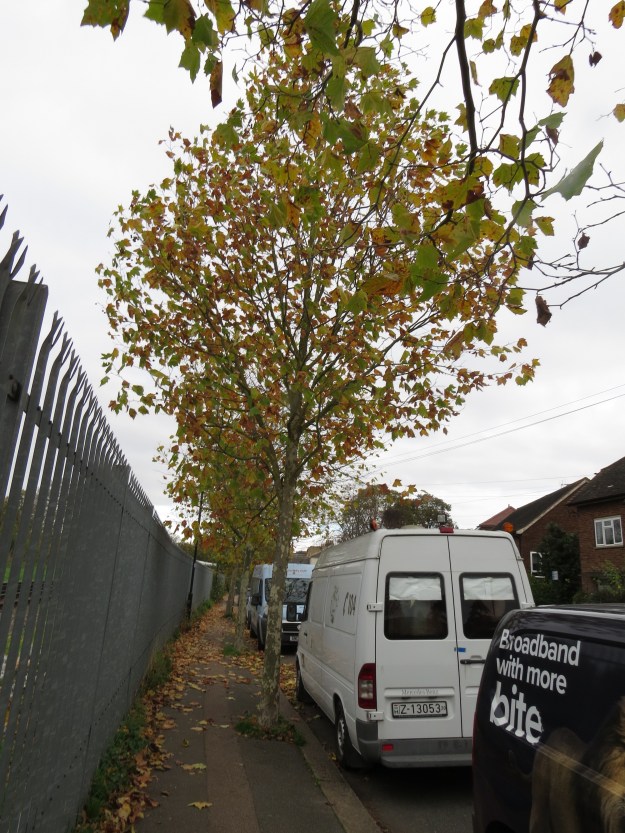
And so off we went on Saturday morning to Streatham Common station. For the first 200 metres we walk alongside the railway line, with the pale-green local mosque on the other side of the road. The council (London Borough of Lambeth ) seems to have planted some London Plane trees here, and I can’t help wondering if they’re storing up trouble for themselves at some point in the future, as we’ve seen how large these trees can grow. At the very least there will be some ambitious pollarding.

On the other side of the fence is the main line to Brighton and Gatwick Airport – the line itself dates back to 1846. In 1953, a short film called ‘London to Brighton in 4 Minutes’ was filmed in the driver’s cab of a train whistling along this route, and great fun it is too. If you have four minutes to spare, buckle up! I must confess to finding it rather exciting. Plus, Victoria Station didn’t look too different to this when I was a child in the 1960s, and there were slam-door trains until the 1980s.

https://www.youtube.com/watch?v=TtiWQkW0v0o

If you want to do a ‘compare and contrast’, they remade the film in 1983, complete with electronic music which sounds like sub-par Kraftwerk to me. It’s very interesting to see how much additional building has taken place in 30 years, and also that the quality of the film has actually gotten worse.

https://www.youtube.com/watch?v=ahabRHUYO4A

And Gawd help us if in 2013 they didn’t do it again, but this time running all three films alongside one another, with slightly better music.

https://www.youtube.com/watch?v=tGTwSNPqAqs

I can’t help thinking about how exciting the first film must have seemed – fast motion photography wasn’t so common then, and I imagine some viewers must have been on the edge of their seats. There’s a real sense of doing something new in the first film that I find rather enchanting.

Anyhoo, today we passed under the railway line via the underpass, which has just about the lowest head room of any such structure that I’ve used recently. The second part has an attractive arch, but the first part is very low indeed.

There are lots of plants still in flower at the moment, among them Green Alkanet, a spikey member of the borage family with the most delicious bright blue flowers.

But what is this on the other side of the road? Is it a temple? Is it some kind of council palace?

No, it’s Streatham Pumping Station, built in 1888 for the Southwark and Vauxhall Waterworks Company.

What a very fine building it is! You might remember that we passed another impressive pumping station many miles ago when we were in East London. Those Victorians loved to make functional buildings such as railway stations and waterworks look like cathedrals, and this one is no exception. Take note, too, of the coloured panes of glass in the left-hand side of the photo above, which are something of a theme on this walk.

When originally built, the pumping station accessed groundwater via a borehole. As with all many water sources, this had started to dry up by the 1940s, and so the pumping station now acts as a booster station, moving water from Norwood Reservoir. Apparently there is still sufficient water in the old borehole to be used in an emergency – the water is stored in an enormous tank under the lawn at the front of the building.

Onwards! We interrupt a large-ish flock of pigeons who are taking advantage of a householder’s generosity.

We pass this magnificent oak tree. There are a number of splendid trees on this walk.

We pass Streatham Methodist Church, which has a little patch of wildflowers at the front. Last time we did this walk (about twenty years ago), we remember the churchgoers setting up for a jumble sale, with someone carrying in trays of cupcakes, and someone else arriving on a bicycle with a hugely precarious bag of clothes tied to the back. Today, all was quiet, and we noted that part of the building now seemed to be being used as a Montessori nursery.

The wildflowers outside Streatham Methodist Church

There are some very, very impressive houses around here, and they haven’t gone unnoticed. Some are looking a little ramshackle and have been subdivided into flats, but still have their original features, like these panes of coloured glass (see, I told you there was a theme).

Some buildings have real terracotta shingles.

There are decorative plaques on some buildings.

But amidst all this splendour, there are some buildings where a whole ecosystem is growing in the gutter, and the damp is spilling down the walls and along the drive.

But wait. Look at this excellent photo of a cat in someone’s front window.

And then the cat blinked, and we realised that s/he was a real cat, and very pretty too. There is something soft-focussed about this photo, as if there was vaseline on the lens, but I fear that it might just be condensation inside the flat.

And then we’re on the corner of Tooting Bec Common, waiting to cross the road, when I see this. Does anybody know what this thing is? I’m inclined to think that it’s the modern day equivalent of a stink pipe, but I could be completely wrong. Let me know if you know! It has a number of big metal boxes at the base that could contain all kinds of measurement equipment.

Finally (for this part of the walk) we pass Tooting Bec Lido, opened in 1906 and named for the famous Venetian bathing beach. It is the largest freshwater swimming pool in the United Kingdom, at 100 metres long and 33 metres wide. It was nearly closed in the 1990s but was saved by the campaigning work of the South London Swimming Club, who have exclusive access to the Lido during the winter months (though anyone can join for an annual fee of £28 plus £110 for year-round access). It looks like a splendid way to spend a couple of hours (or possibly a couple of very invigorating minutes at this time of year).

Tooting Bec Lido (Photo by Nick Cooper)

And so, we head off across Tooting Bec Common, in the general direction of lunch. See how we got on tomorrow!

Rolling Down the Hill…

Dear Readers, this morning I decided to catch the bus from East Finchley down to Islington where I do my pilates (and I’m not sure if a more middle-class sentence than that was ever written). It was the most glorious day, after a week of rain, and I am always awestruck by the view as you head down from Archway towards the City. I didn’t have my camera, so these images are from my (ancient) phone, but hopefully you’ll get the idea. First up, St Pauls Cathedral and the Walkie-Talkie coming into view through the grubby bus window in the photo above.

This is a very complicated junction (the bus is heading towards central London and Holloway) but does anyone else think that this looks like a man standing on one leg while balancing a brick on one arm?

And then there’s the Shard in the distance, which looks ridiculously out of scale with everything else in London, at least at the moment.


The spire of St John the Evangelist church comes into view – at the moment there’s an enormous Christmas Tree ‘plantation’ popping up in the grounds, which will no doubt contribute to the traffic problems of the area.

But what I’m really loving are the leaves, like these yellow specimens close to the junction with Seven Sisters Road.

And how about these at the Nag’s Head junction? Everything really was illuminated this morning, in a last hurrah before the wind and the rain blow the leaves into mulch. And now, for some much-needed stretching and bending, after a week hunched over a computer.

Back From the Brink – The Field Cricket

Field Cricket (Gryllus campestris) (Photo by Roberto Zanon)

Dear Readers, the field cricket is a sturdy insect, and at almost an inch long one of our larger invertebrate inhabitants. Alas, their physical robustness did not save them from coming close to extinction – in the 1980s there were less than 100 individuals at just one site in West Sussex.

Field crickets have only one brood per year and are flightless, so they clearly can’t travel very far. In the spring, the male digs a burrow (a task which takes less than ten minutes), makes himself a little platform and then ‘sings’ his heart out, beating up any other males that wander within range. The females travel about listening to the various ‘songs’, and when they hear one that they like, mating takes place. The female then lays her eggs close to or in the male’s burrow. The nymphs hatch in the summer and shed their skins until they are large enough to survive winter hibernation, finally emerging for their final moult in April of the following year, whereupon they join the chorus. Have a listen to some field crickets in the recording below (made by Gareth K in the UK, these are some of the insects from the species recovery programme)

Field cricket next to his burrow – Photo by Roberto Zanon

So, why were field crickets so endangered? Our old friend intensive agriculture was part of the reason, along with the breaking up and reduction of habitat. But one established way of helping a species to survive is to enlarge the area where they currently live, making the edge of the habitat more suitable, and also to translocate the insects to another suitable habitat. And this is exactly what happened. Field crickets were reintroduced to the RSPB reserves at Farnham Heath and Pulborough Brooks, and corridors were established between parts of the existing sites so that the crickets could travel to ‘meet’ one another more easily. As you can see from the photo above, crickets need areas of bare ground to construct their burrows, and so areas of bramble were cleared from some parts of the reserves.

The results were very heartening.  In 2010, 12 field cricket nymphs were moved to Farnham Heath. By 2013, just three years later, 43 males were heard calling at the reserve. And by spring 2019, 337 males were heard calling, a truly remarkable result, with other populations becoming established at Pulborough Brooks.

As with last week, this success story was the result of collaboration between a number of wildlife and conservation charities, but it was also picked up by the media, and the ever-popular UK wildlife TV programme Springwatch did a feature on the field cricket, an insect that I’m sure most people had never heard of or met. The collaboration continues, with local landowners meeting to discuss ways to extend the range of the field crickets even further. Although this is still a delicate recovery (after all, 337 crickets is not really very many), it is a sign of what can be done when people work together. And here is a short film of a field cricket doing what it does best – stridulating. Long may it continue.

https://www.youtube.com/watch?v=YAaAZdVeoRU

A young field cricket. More of these, please! (Photo By Lilly M)

Red List 2022 – Number Four – Skylark

Skylark (Alauda arvensis) Photo by Corinna John https://www.flickr.com/photos/binarycoco/9208163124/

Dear Readers, when we used to go on holiday to Dorset as children, we would often walk around the ramparts of Maiden Castle, an Iron Age fort with row upon row of grassy ramparts and ditches. We would run up and down, and everywhere there was the sound of skylarks, each one erupting from the grass and singing all the way up until it was just a speck in against the hot blue of those eternal summers.  A male bird can stay up, hovering and singing, for more than an hour, and this ability is taken by the female birds as evidence of fitness and health, both desirable characteristics in a partner.

Maiden Castle (Photo by Chris Downer)

For those of you who have never heard a skylark, imagine a perfect summer day, with a bit of a breeze, and the hills rolling green before you (recording by W. Agster)

And I do think that Vaughan Williams captured something of the sound, though as I chose this for my Dad’s memorial service, I have to listen with care.

Skylarks are essentially agricultural birds, and this is where they have suffered, like so many of our countryside inhabitants. There is less to eat in the stubble, and the use of herbicides means that there is less available for these seed-eating birds. Then, the sowing of late crops meant that the foliage was too high for the birds to nest in. A lot of farmers with their huge machines only leave ‘nature-friendly’ patches at the side of fields, and skylarks prefer to be better protected from predators. Various measures have been tried, but so far none of them have worked. If you have a few pennies (though who has at the moment), the British Trust for Ornithology is running a Farmland Birds Appeal, which will do research into the best ways to restore the habitat not only the skylark but other birds such as the yellowhammer, corn bunting and turtle dove.

https://www.bto.org/how-you-can-help/help-fund-our-work/appeals/farmland-bird-appeal

When I went walking around Milborne St Andrew in Dorset, weighed down with worries about my parents, I was often taken out of myself by the flash of yellow that is a yellow hammer, or a flock of linnets. But one day I walked past a barren field and a skylark erupted from the rubble, singing all the way up, and taking my heart with him. Let’s hope that people of goodwill can save this bird yet.


Wednesday Weed – Moth Orchid

Moth Orchid (Phalaenopsis sp)

Dear Readers, until fairly recently orchids were strange, exotic things, desperately expensive and the preserve of the very rich. And then, suddenly, they were everywhere: in the plant sections of supermarkets, in garage forecourts, on top of the upturned crates in front of the local all-night shops. But we’d better make the most of them, because I read an article earlier this week that suggests that the heyday of the cheap orchid is going to end very abruptly.

Phalaenopsis or moth orchids come from a swathe of India and the rest of south east Asia, with many species in Indonesia and the Philippines, and some in Papua New Guinea and Australia. They are epiphytes (they live on other trees) or lithophytes (which live on rocks) and they are pollinated by a variety of bees and moths, although they don’t provide nectar – many are thought to resemble female insects, and so the males rush in and attempt to mate, getting dusted with pollen in the process.

Producing flowers is extremely expensive for the plant, and so one species of Phalaenopsis recycles the flowers once they’re pollinated and turns them into leaves instead, which is a near trick if you can pull it off.

Phalaenopsis with flowers turning to leaves 

In general, moth orchids have proved to be pretty tolerant in the conditions in your average house. They are tropical species so would probably prefer us to keep our houses a bit warmer, they like high humidity but seem to be able to cope without, and they thrive in relatively low light, ideal for that bathroom shelf or darkish patch in the corner of the living room. However, they must be kept at at least 60 F, and herein lies the rub. In an article by journalist and scientist James Wong in The Guardian this week, he reports being taken to a Dutch bulb grower who was shutting up shop after decades of flower-growing. He walks through a room where there are no less than two million orchids in a steamy room the size of an aircraft hangar. This is where the plants that are bought in their thousands every week are not only grown, but also propagated – every week there seem to be new varieties and new colours.

However, the rising costs of energy are thought to be about to put at least half of all orchid growers in the Netherlands, the epicentre of the potted plant, out of business. An orchid can sell to a supermarket for a euro, but cost five euros to raise.

I’ll leave the summing up to James Wong. I couldn’t have put it better myself.

I have always been torn about plant prices. On one hand, the drive to make plants cost ever less has meant the increasing dominance of a few industry giants that stock an ever-more narrow range of mass-produced offerings. On the other hand, it has meant that species such as moth orchids have been turned from collector’s item for the wealthy to something within reach of almost anyone at supermarket checkouts.

However, the downside of this is, much like fast fashion, these artificially low prices have created a throwaway culture where once-prized plants are just binned when they stop flowering. With the current cost of living crisis, it’s difficult to argue that we should all be paying more for luxuries like plants, yet it’s years of undervaluing their true cost that has got us to a very precarious place. While the knock-on effects haven’t been seen on our shelves yet, maybe over the next few months we will begin to learn to truly appreciate these everyday wonders.” James Wong

https://www.theguardian.com/lifeandstyle/2022/nov/13/the-era-of-cheap-orchids-could-be-over

It is possible to bring orchids back into flower again, as my Mum could testify. There are different techniques, but the plants often need a bit of a rest before they decide it’s time to get going again. As with so many flowering household plants though, I suspect that many of them end up in the bin once they’ve ‘gone over’. Maybe, as they become rarer and the price goes up, we’ll give the ones that we have a little more tender loving care.

Phalaenopsis hieroglyphica.

And of course, here is a poem. Jackie Kay is a Scottish poet, who was adopted as a baby and who met her mother much later in life. I love this, and it deserves a couple of readings. See what you think.

Keeping Orchids by Jackie Kay

The orchids my mother gave me when we first met
are still alive, twelve days later. Although

some of the buds remain closed as secrets.
Twice since I carried them back, like a baby in a shawl,

from her train station to mine, then home. Twice
since then the whole glass carafe has crashed

falling over, unprovoked, soaking my chest of drawers.
All the broken waters. I have rearranged

the upset orchids with troubled hands. Even after
that the closed ones did not open out. The skin

shut like an eye in the dark; the closed lid.
Twelve days later, my mother’s hands are all I have.

Her voice is fading fast. Even her voice rushes
through a tunnel the other way from home.

I close my eyes and try to remember exactly:
a paisley pattern scarf, a brooch, a navy coat.

A digital watch her daughter was wearing when she died.
Now they hang their heads,

and suddenly grow old – the proof of meeting. Still,
her hands, awkward and hard to hold

fold and unfold a green carrier bag as she tells
the story of her life. Compressed. Airtight.

A sad square, then a crumpled shape. A bag of tricks.
Her secret life – a hidden album, a box of love letters.

A door opens and closes. Time is outside waiting.
I catch the draught in my winter room.

Airlocks keep the cold air out.
Boiling water makes flowers live longer. So does

cutting the stems with a sharp knife.

Season of Mists….

Dear Readers, we woke up to a fine old foggy morning this morning – it’s just starting to brighten up but the collared doves are still confused, bless them. It got me to thinking about the only autumn poem that people regularly quote, Keats’s ‘Ode to Autumn’. I think it’s been ruined for many people because it was badly taught at school, which is a shame because it is actually rather beautiful, and well-observed – I love the ‘wailful choir’ of small gnats, and ‘thy hair soft-lifted by a winnowing wind’….

To Autumn

John Keats

Season of mists and mellow fruitfulness, 
   Close bosom-friend of the maturing sun; 
Conspiring with him how to load and bless 
   With fruit the vines that round the thatch-eves run; 
To bend with apples the moss’d cottage-trees, 
   And fill all fruit with ripeness to the core; 
      To swell the gourd, and plump the hazel shells 
   With a sweet kernel; to set budding more, 
And still more, later flowers for the bees, 
Until they think warm days will never cease, 
      For summer has o’er-brimm’d their clammy cells. 

Who hath not seen thee oft amid thy store? 
   Sometimes whoever seeks abroad may find 
Thee sitting careless on a granary floor, 
   Thy hair soft-lifted by the winnowing wind; 
Or on a half-reap’d furrow sound asleep, 
   Drows’d with the fume of poppies, while thy hook 
      Spares the next swath and all its twined flowers: 
And sometimes like a gleaner thou dost keep 
   Steady thy laden head across a brook; 
   Or by a cyder-press, with patient look, 
      Thou watchest the last oozings hours by hours. 

Where are the songs of spring? Ay, Where are they? 
   Think not of them, thou hast thy music too,— 
While barred clouds bloom the soft-dying day, 
   And touch the stubble-plains with rosy hue; 
Then in a wailful choir the small gnats mourn 
   Among the river sallows, borne aloft 
      Or sinking as the light wind lives or dies; 
And full-grown lambs loud bleat from hilly bourn; 
   Hedge-crickets sing; and now with treble soft 
   The red-breast whistles from a garden-croft; 
      And gathering swallows twitter in the skies.

However, it isn’t all about Keats. I make no apology for posting this poem by Clive James again, because it is one of those poems that leaves a silence when you finish it.

Japanese Maple

Clive James

Your death, near now, is of an easy sort.

So slow a fading out brings no real pain.
Breath growing short
Is just uncomfortable. You feel the drain
Of energy, but thought and sight remain:

Enhanced, in fact. When did you ever see
So much sweet beauty as when fine rain falls
On that small tree
And saturates your brick back garden walls,
So many Amber Rooms and mirror halls?

Ever more lavish as the dusk descends
This glistening illuminates the air.
It never ends.
Whenever the rain comes it will be there,
Beyond my time, but now I take my share.

My daughter’s choice, the maple tree is new.
Come autumn and its leaves will turn to flame.
What I must do
Is live to see that. That will end the game
For me, though life continues all the same:

Filling the double doors to bathe my eyes,
A final flood of colours will live on
As my mind dies,
Burned by my vision of a world that shone
So brightly at the last, and then was gone.

On a more cheerful note, this poem by Gillian Clarke is rich and full of the bounty of the time, and the interconnectedness of things.

Plums

Gillian Clarke

When their time comes they fall
without wind, without rain.
They seep through the trees’ muslin
in a slow fermentation.

Daily the low sun warms them
in a late love that is sweeter
than summer. In bed at night
we hear heartbeat of fruitfall.

The secretive slugs crawl home
to the burst honeys, are found
in the morning mouth on mouth,
inseparable.

We spread patchwork counterpanes
for a clean catch. Baskets fill,
never before such harvest,
such a hunters’ moon burning

the hawthorns, drunk on syrups
that are richer by night
when spiders pitch
tents in the wet grass.

This morning the red sun
is opening like a rose
on our white wall, prints there
the fishbone shadow of a fern.

The early blackbirds fly
guilty from a dawn haul
of fallen fruit. We too
breakfast on sweetnesses.

Soon plum trees will be bone,
grown delicate with frost’s
formalities. Their black
angles will tear the snow.

And finally, here’s a John Clare poem that I hadn’t read before. He always paints such a clear picture of the English countryside as it used to be. I particularly like the final verse – I was once lucky enough to see a sow and a dozen piglets in the New Forest feasting on acorns, and what a sight it was!

Autumn

John Clare

I love the fitfull gusts that shakes
 The casement all the day
And from the mossy elm tree takes
 The faded leaf away
Twirling it by the window-pane
With thousand others down the lane

I love to see the shaking twig
 Dance till the shut of eve
The sparrow on the cottage rig
 Whose chirp would make believe
That spring was just now flirting by
In summers lap with flowers to lie

I love to see the cottage smoke
 Curl upwards through the naked trees
The pigeons nestled round the coat
 On dull November days like these
The cock upon the dung-hill crowing
The mill sails on the heath a-going

The feather from the ravens breast
 Falls on the stubble lea
The acorns near the old crows nest
 Fall pattering down the tree
The grunting pigs that wait for all
Scramble and hurry where they fall

And so, over to you lovely readers! Do you have a favourite autumn poem? Share away!