Wednesday Weed – Juniper

Photo One by Krzysztof Golik, CC BY-SA 4.0 <https://creativecommons.org/licenses/by-sa/4.0>, via Wikimedia Commons

Juniper (Juniperus communis) (Photo One)

Dear Readers, when the ice ages carpeted the British Isles thousands of years ago, it spelled the demise of many plants that are still common in mainland Europe (though to be fair, we are one of the world’s moss and liverwort hotspots!) We were left with only two tough native conifers – the Scots pine and this plant beloved of gin-drinkers everywhere, juniper. This is the most widespread of all conifers, growing in the temperate Northern Hemisphere right around the globe. More locally, I have seen several used as low growing structural plants in the front gardens of East Finchley, but left to its own devices, juniper can reach a height of 10 metres and live for up to 200 years. It is a spiky, tough plant, a member of the Cypress family, and is much beloved by many birds who rely on it for dense cover (such as the goldcrest, firecrest and black grouse) and for its berries (fieldfares, redwings, blackbirds and ring ouzels).

Just to digress here for a moment, the smell of gin reminds me of when my Dad, a gin distiller who made Gordon’s gin, used to take us to visit the distillery, then on Goswell Road. The area where the ingredients for the flavouring were kept always had that medicinal twang of juniper, along with mace, orris root and lots of other things that were part of the secret recipe. It seemed like a magician’s laboratory, with the massive vats towering above us. It was a bonded warehouse, which meant that it was subject to very strict regulation and frequent inspections, but that didn’t stop some of the warehousemen from trying to steal the raw gin – one had a go by attaching hot water bottles inside his trousers and filling them with the alcohol. Sadly, it was so strong that it ate through the rubber, and the would-be smuggler was left with wet legs and no job.

Historically, gin was seen as a drink for women (hence ‘mother’s ruin’) and Hogarth’s engravings showed it as a drink of the poor and dissolute. It had a strong reputation as a substance which could bring on an abortion,  which didn’t help. In Lothian, a juniper-induced miscarriage was known as ‘giving birth under the savin (juniper) tree.

By the time Dad was making it, gin had become rather more chic, and these days you can’t move for artisan gins and small producers knocking out various limited-edition products.I recently saw that Gordon’s are making a zero-alcohol gin. Dad would have been horrified.

William Hogarth’s ‘Gin Lane’, (1750-1751)

Anyway, back to juniper. This is a dioecious plant, which means that there are male junipers and female junipers. Only the females have the berries, while the males have these interesting ‘pollen cones’. The berries take more than a year to ripen (well, the plant does grow in some very cold places) and so you can often see the green unripe and the blue ripe berries on the same bush, as in photo one above.

Photo Two by Bff, CC BY-SA 3.0 <https://creativecommons.org/licenses/by-sa/3.0>, via Wikimedia Commons

Male pollen cones (Photo Two)

Native plants often come with a whole raft of folklore, and juniper is no exception. It was thought to deter the devil and any witches who might be hanging around, and it was hung from the lintel on May Day and especially at Halloween. In Mediterranean areas it was believed that if a witch saw a branch of juniper she would be compelled to stop and count the needles, so hopefully that would give the inhabitants time to leave. If you dreamed of gathering juniper berries in winter, you would prosper, and the berries themselves could signify the birth of a baby boy. And then, courtesy of Monty Python’s ‘Life of Brian’, there is the miracle of the juniper bush.

Burning juniper wood gives off a strongly aromatic smoke, and this was used to cleanse houses of evil spirits every year, and when the Black Death came, houses and their inhabitants were sometimes fumigated at the same time. In Scotland, the inhabitants were then revived with whisky (and very sensible too).

It’s also believed that when Joseph, Mary and the baby Jesus were on the run from Herod’s murderous soldiers, their exhausted donkey was hidden by a helpful juniper tree, so there is even a Christmas connection. In some parts of Italy, juniper is hung in stables and cattlesheds to protect the animals within, and when settlers moved to the US, the custom went with them – some coffeeshops even prepare a festive juniper-flavoured latte. Well, it makes a change from the ubiquitous pumpkin spice latter.

Photo Three by Krzysztof Ziarnek, Kenraiz, CC BY-SA 4.0 <https://creativecommons.org/licenses/by-sa/4.0>, via Wikimedia Commons

Juniper seedling (Photo Three)

And finally, a poem. I have chosen the second stanza from T.S. Eliot’s ‘Ash Wednesday’, because I think it is a masterpiece that rewards attention. It is never completely teased-out, but it contains such breath-taking moments. There are layers on layers here, but I think you can take it just as it is and let the visions form in your head. The first four lines are worth the price of entry! You can read the whole thing here.

Ash Wednesday by T.S Eliot (Part 2)

II
Lady, three white leopards sat under a juniper-tree
In the cool of the day, having fed to sateity
On my legs my heart my liver and that which had been
contained
In the hollow round of my skull. And God said
Shall these bones live? shall these
Bones live? And that which had been contained
In the bones (which were already dry) said chirping:
Because of the goodness of this Lady
And because of her loveliness, and because
She honours the Virgin in meditation,
We shine with brightness. And I who am here dissembled
Proffer my deeds to oblivion, and my love
To the posterity of the desert and the fruit of the gourd.
It is this which recovers
My guts the strings of my eyes and the indigestible portions
Which the leopards reject. The Lady is withdrawn
In a white gown, to contemplation, in a white gown.
Let the whiteness of bones atone to forgetfulness.
There is no life in them. As I am forgotten
And would be forgotten, so I would forget
Thus devoted, concentrated in purpose. And God said
Prophesy to the wind, to the wind only for only
The wind will listen. And the bones sang chirping
With the burden of the grasshopper, saying

Lady of silences
Calm and distressed
Torn and most whole
Rose of memory
Rose of forgetfulness
Exhausted and life-giving
Worried reposeful
The single Rose
Is now the Garden
Where all loves end
Terminate torment
Of love unsatisfied
The greater torment
Of love satisfied
End of the endless
Journey to no end
Conclusion of all that
Is inconclusible
Speech without word and
Word of no speech
Grace to the Mother
For the Garden
Where all love ends.

Under a juniper-tree the bones sang, scattered and shining
We are glad to be scattered, we did little good to each
other,
Under a tree in the cool of day, with the blessing of sand,
Forgetting themselves and each other, united
In the quiet of the desert. This is the land which ye
Shall divide by lot. And neither division nor unity
Matters. This is the land. We have our inheritance.

Photo Credits

Photo One by Krzysztof Golik, CC BY-SA 4.0 <https://creativecommons.org/licenses/by-sa/4.0>, via Wikimedia Commons

Photo Two by Bff, CC BY-SA 3.0 <https://creativecommons.org/licenses/by-sa/3.0>, via Wikimedia Commons

Photo Three by Krzysztof Ziarnek, Kenraiz, CC BY-SA 4.0 <https://creativecommons.org/licenses/by-sa/4.0>, via Wikimedia Commons

A Jolly Green Visitor

Dear Readers, when I put up a peanut feeder I was hoping for nuthatches, or even jays, but a ring-necked parakeet is bright enough to cheer up any November afternoon. They are always such a surprise, and at one point there were two of them in the garden (which is 100% more than have ever been here simultaneously in the past). I apologise for the quality of the photo but I was so stunned that I didn’t rush to get my camera and my husband was reduced to snapping the visitors on his phone. Our kitchen window is also filthy because I have been reluctant to cause harm to the spiders who hibernate in the window frame. Being married to me is clearly a bed of roses.

I suspect that Mr/Mrs Parakeet was attempting to dismantle the wire on the nut feeder – they are such dextrous birds, and I fully expect to come downstairs one morning to see a massive hole and no peanuts.

They really are extremely green, but some folk in London are being visited by other colour morphs of the bird, like this yellow one…..

Yellow morph ring-necked parakeet (Photo by Bernard Spragg, New Zealand)

…or this powder-blue one…

Blue morph ring-necked parakeet (Photo by Tanya Dropbear)

These colours do very occasionally appear in the wild, but birds that look like these are probably escaped pets or aviary birds. And when you see the fun that they have in the gardens and woods of East Finchley, careering through the trees like hooligans, scaring the life out of the wood pigeons and making the suburbs ring with their squawking, I can only admire their panache.

What you lookin’ at?

A December Walk in St Pancras and Islington Cemetery

Dear Readers, it can all feel a bit bleak in the UK at this time of year – the days are still getting shorter, the weather is often grey and the trees are leafless. But even so, if you look closely enough there are still signs that beneath the surface, plants are alive and fuelling up for the spring.

The ash trees are full of buds. I’ve mentioned before that they always look to me like the hooves of tiny deer. It will be a while before the tree bursts into flowers and then into leaf, but the sap is still running and the tree is just biding its time.

I found this lovely film showing a year in the life of an ash tree on the Woodland Trust site – do have a look, it’s gorgeous.

And then there are the horse chestnuts. They have a triumvirate of distinctive sticky buds, and the secretion covering the buds has been investigated in this paper, which found that it protected the developing leaves and flowers against differences in temperature during the autumn, spring and winter, against both water loss and excessive water penetration, and against UV rays. It was also surprisingly sticky throughout all these changes in conditions, which made it a substantial deterrent to insect pests.  Quite a substance! And it’s no wonder that scientists interested in biomimicry are investigating it as a possible non-toxic, robust adhesive.

The Woodland Trust has also done a short film on a year in the life of a horse chestnut tree. I like that it doesn’t shy away from the leaf damage done by the horse chestnut leaf miner, which seems to be pretty much universally present these days. Still, these trees are robust and seem to soldier on regardless.

It’s not just the trees who are indicating that they’re still full of vigour. Look at the cow parsley leaves, already showing through the leaf litter! There are lots of lesser celandine leaves starting to poke through too, and some winter heliotrope.

The snowberry comes into its own at this time of year, with the white berries shining bright against the dark background. In my experience, these are the fruits least liked by birds – maybe they don’t associate the whiteness with edibility, or maybe they are just low in food value. Still, the plant is good cover when it’s fully leafed (it was originally imported as cover for game birds).

And the ivy flowers have turned into little sputniks. Soon they will be the black berries beloved by wood pigeons and other birds. Every ivy-covered tree  seems to explode with the clatter of wood pigeon wings as I pass.

The conifers are full of small birds. I hear and identify the calls of several goldcrests, but I haven’t managed to get a decent photo yet. Still, here’s what they sound like (uploaded from my Birdnet app, which I can’t recommend highly enough). You can hear the rumble of the North Circular Road in the background.

And here’s what the little darlings look like. They are the UK’s smallest bird, weighing from 4.5 to 7 grams, and are members of the kinglet family, so my North American readers might be familiar with some of their relatives.

Goldcrest (Regulus regulus) by Gail Hampshire

It’s not just the goldcrests who are active though – small birds of all kinds need to be on the lookout for food during every daylight hour, just to survive through the hours of darkness, especially during a cold snap. This blue tit was probably looking for tiny invertebrates amongst the leaves at the top of this conifer.

Meantime, ‘my’ swamp cypress has passed its peak and is beginning to look a little threadbare…

…and in the category of ‘things that I hadn’t noticed before’ I spotted that one of my favourite crab apples appears to have two trunks. Was this a bit of misplaced pruning when the plant was young, I wonder, or is it an example of a graft? The tree seems all of a piece when in leaf though. Let me know what you think.

This is the same tree in flower back in March this year.

And finally, I hadn’t noticed this baby Scots pine before, planted all on its own in a new part of the cemetery. It’s already getting that windblown look that I associate with the tree, but it will be a while before it reaches the dizzy heights of some of its older neighbours.

Scots pine

And so, although we’re ten days away from the winter solstice on 21st December, there are already signs of the spring to come. Everything is waiting for the starting gun of the longer days, although the weather in January and February can be hard for plants and animals alike. Still, it’s good to realise that nature is ticking away in the background, never stopping.

Sunday Quiz – Musical Christmas Critters (and Plants)

The Schrankogel, a mountain in the Stubai Alps in Austria (Photo by Henk Monster)

Dear Readers, there are certain plants and animals that we seem to associate with winter in general, and Christmas in particular, so this week let’s see if you can identify what some song lyrics are going on about. All you need to do is to identify the animal(s) or plant(s) for one point each, and the song and artist for an additional two points. Please note that some of the songs feature more than one plant or animal, and I’ll give you a clue as to how many are in the song just to help out. Also, some plants and animals are featured more than once! Confusion reigns, I’m sure, but it’s Christmas, so don’t stress!

Answers in the comments by 5 p.m. UK time on Friday 17th December please, and I’ll post the answers on Saturday 18th December. I will disappear your answers as soon as I see them, so that they don’t influence the unwary :-).

I’ll post links to the songs in the answers so you can get your Christmas/winter celebration off to a musical start!

Onwards! Let’s see how we get on.

Song Lyrics

1.There’ll be no more sobbin’ when he starts a throbbin’ his old sweet song.

(Just one creature here)

2. Oh the rising of the sun
And the running of the deer

(Two plants here folks!) 

3. Tiny tots with their eyes all aglow
Will find it hard to sleep tonight

( I can count 2 plants and 2 animals in the lyrics to this song. Let’s see how you all get on)

4. The child is a king, the carolers sing
The old has passed, there’s a new beginning
Dreams of Santa, dreams of snow
Fingers numb, faces aglow

(Two plants – one specific and one generic)

5. You know Dasher and Dancer and Prancer and Vixen
Comet and Cupid and Donner and Blitzen
But do you recall
The most famous xxxxxx of all?

(One animal. But what an animal!)

6. Little xxxxx, little xxxxx
On the dusty road
Gotta keep on plodding onward
With your precious load

(One animal)

7. Have a happy holiday
Everyone dancin’ merrily
In the new old-fashioned way

(Hah! I can count 4 plants in the lyrics for this whole song. One of them is cooked, though :-))

8. Shadows painting our faces
Traces of romance in our heads
Heaven’s holding a half-moon
Shining just for us
Let’s slip off to a sand dune, real soon
And kick up a little dust.

(This one is a bit of a stretch but just think of the Three Kings! And there’s one Christmas animal here, and a plant that isn’t associated with the festive season, though I’ll give you an extra half-point if you can find it).

9. Fare you well my dear, I must be gone
And leave you for a while
If I roam away I’ll come back again
Though I roam ten thousand miles, my dear
Though I roam ten thousand miles.

(One Christmas bird and one generic plant)

10. You know I’m such a fool for you
You got me wrapped around your finger
Do you have to let it linger?
Do you have to, do you have to, do you have to let it linger?

(No plants or animals in the song, but what’s the name of the band? 🙂 )


Sunday Quiz – Evergreen – The Answers!

Conifers in Erlestoke Woods, Wiltshire (by Philip Reed)

Dear Readers, Mike from Alittlebitoutoffocus and Fran and Bobby Freelove both got a perfect 15 out of 15 this week, an evergreen collection of readers if ever I saw one. Thank you for playing, and I’m getting into a festive mood, so let’s see what we have for tomorrow…..

Photos

1) F) Scots Pine (Pinus sylvestris) Photo By Chris Eilbeck / Scots pine, Crow Wood.

2) B) Juniper (Juniperus communis) Photo by Dcrjsr, CC BY 3.0 <https://creativecommons.org/licenses/by/3.0>, via Wikimedia Commons

3) N) Heather (Calluna vulgaris) Photo by Mick Garratt

4) I) Strawberry Tree (Arbutus unedo)  Photo by Fabienkhan, CC BY-SA 2.0 <https://creativecommons.org/licenses/by-sa/2.0>, via Wikimedia Commons

5) C) Cedar of Lebanon (Cedrus libani)  Photo by Christine Matthews / Cedar of Lebanon, Forty Hall, Enfield

6) E) Norway Spruce (Picea abies) Photo by James St John at Picea abies (Norway spruce) 8 | Picea abies (Linnaeus, 1753)… | Flickr

7) M) Rhododendron (Rhododendron ponticum)  Photo by Colin Smith at Rhododendron Hedge © Colin Smith cc-by-sa/2.0 :: Geograph Britain and Ireland

8) H) Box (Buxux sempervirens) Photo by Derek Harper / Box hedges, Greenway

9) O) Cowberry (Vaccinium vitis-idaea)  Photo by By Jonas Bergsten – Photo taken by Jonas Bergsten using a Canon PowerShot G3., Public Domain, https://commons.wikimedia.org/w/index.php?curid=1233144

10) G) Holly (Ilex aquifolium)  Photo by Me haridas, CC BY-SA 4.0 <https://creativecommons.org/licenses/by-sa/4.0>, via Wikimedia Commons

11) A) Yew (Taxus baccata) Photo by David Skinner at Totteridge Yew | At around 2000 years, it’s said to be the o… | Flickr

12) D) Lawson Cypress (Chamaecyparis lawsoniana)  Photo by Rosser1954, CC BY-SA 4.0 <https://creativecommons.org/licenses/by-sa/4.0&gt;, via Wikimedia Commons

13) J) Ivy (Hedera helix) Photo by Evelyn Simak at Ivy (Hedera helix) © Evelyn Simak :: Geograph Britain and Ireland

14) L) Cherry Laurel (Prunus laurocerasus) Photo by Rosser1954 Roger Griffith, CC BY-SA 3.0 <https://creativecommons.org/licenses/by-sa/3.0>, via Wikimedia Commons

15) K) Gorse (Ulex europaeus)  Photo by Bernard DUPONT from FRANCE, CC BY-SA 2.0 <https://creativecommons.org/licenses/by-sa/2.0>, via Wikimedia Commons


Bah Humbug

Dear Readers, every year since 1947 the Norwegians have sent the people of London a Norway Spruce to put up in Trafalgar Square. It’s a way of saying ‘thank you’ for the support that we gave them during World War II. This year’s tree was felled by the Mayor of Oslo, Marianne Borgen and a bunch of (presumably well-muscled) school children, and was transported to England by the Norwegian authorities.

So, were we delighted that someone had gone to all that trouble to cheer us up? Well, some of us were, but others complained that the tree wasn’t symmetrical and had damaged branches. Words like ‘gift horse’ and ‘mouth’ come to mind. One person even asked what we’d done to upset the Norwegians?

Well, all I can say is ‘Bah Humbug’ to all the complainers. Someone goes to all the trouble to send you a tree and all you can do is moan? I imagine the tree will look lovely when it’s all spruced up (sorry).

Oh and look, here it is. The Norwegian government even thought (briefly) about sending us a new tree, but as the Mayor said, the important thing is the symbolism of the thing, which is about gratitude, and relationships between international neighbours. Isn’t Christmas meant to be about love, and generosity, and compassion, and all those other good things? Let’s hope that the Norwegians don’t take the opportunity to end this 63 year-old ritual. Then we’d have to find our own tree, and it would just about serve us right.

Plus, this living thing was hacked down from some peaceful spot in Norway by a gang of youngsters, bunged on the back of a lorry, thrown about as it crossed the North Sea and finally stood back up in Trafalgar Square as a centrepiece for people to get drunk around, and to scoff at. A little more respect, please!

And just look at that little star on the top, reminding us of what it’s all meant to be about. It’s enough to make you cry, if you’re that way inclined.


Parental Love?

Blue tit feeding great spotted woodpecker nestlings – photo by Phil Palmer, from British Birds Volume 114 issue 12

Dear Readers, you might remember how much I love British Birds magazine, and in this issue there were two tales of misplaced parental responsibility that I found absolutely fascinating. The first came from Pauline Hogg and Phil Palmer, who were at the Fairburn Ings RSPB reserve when they noticed a Great Spotted Woodpecker nest in a tree. To their astonishment, they noticed a rather nervous blue tit coming to the nest hole, and feeding the well-grown woodpecker chicks. Furthermore, it quickly became apparent that the lucky nestlings were being fed by two blue tits, a great tit and their actual parents.

It was noticed that, on the second day, the woodpecker parents seemed to want the youngsters to leave the nest – they brought food but then flew away with it to a nearby branch, seemingly in an attempt to persuade the chicks to fledge. However, the blue tits continued to bring green caterpillars to the nest, and the great tit appeared to bring moths. The woodpecker chicks showed no inclination to leave that day, and I can imagine the adult woodpeckers tapping their feet and getting very irritated. Both the blue and great tits seemed very nervous when feeding the woodpecker chicks, as well they might – woodpecker beaks are big, and sharp.

We don’t know the end of the story, but by the time that Mr Palmer and Ms Hogg visited again, the woodpeckers had fledged and the tits had gone. One possible explanation is that the blue/great tits had nested in the old woodpecker holes in the tree, but that the woodpeckers had then eaten their nestlings – certainly great spotted woodpeckers are notorious for drilling into nest boxes and taking the babies. Could it be that the instinct of the parents to provide food was so strong that they continued to feed? It seems not unlikely, but I guess we will never know.

Song Thrush feeding Pied Flycatcher chicks (Photo by Martin Garwood)

Another tale of misplaced parental enthusiasm was reported by Martin Garwood, who was actually looking for Purple Emperor butterflies in Dene Park, Kent, when he noticed a pair of pied flycatchers feeding well-grown youngsters in a nest. After a few minutes he went back to his butterfly-search, only to hear a kerfuffle by the nest. A song thrush with a beak full of invertebrates was attempting to feed the pied flycatcher chicks, with no success. Undaunted, the song thrush settled down to brood the nonplussed youngsters, while their parents tried everything they could think of to unsettle it. Eventually the thrush was disturbed by a passing cyclist but as it only moved a short distance away, I think we can guess that the same nonsense continued.

Pied flycatcher attempting to dislodge song thrush (Photo by Martin Garwood)

Was this a song thrush who had failed to breed, who had lost his/her own eggs, or who was just confused? Again, I suppose we will never know. What these two cases do point up, though, is the pressure that breeding birds are under, which can only be exacerbated by diminishing suitable habitat and continual disturbance. I sometimes think it’s a miracle that any birds actually manage to rear their young to adulthood. It also seems to me to be an indication of how complex the behaviour of birds is, and how little we understand it.

Wednesday Weed – Mistletoe

Mistletoe (Viscum album) in Somerset

Dear Readers, as Christmas is just around the corner I thought I’d share a few thoughts about mistletoe. What a strange plant this is! It’s associated with Christmas because it stays fresh and green even after the trees lose their leaves, but it has a longer association with fertility: the branches, foliage and seeds are said to resemble various sexual organs, though I must admit that I am having to squint to see much of a likeness, innocent soul that I am.

Photo One by By Agnieszka Kwiecień, Nova - Own work, CC BY 2.5, https://commons.wikimedia.org/w/index.php?curid=752332

Mistletoe fruit (Photo One)

Nonetheless, mistletoe has been used as a ‘cure’ for infertility (though as it’s toxic one would have to be very careful), as a charm for young women seeking to find husbands, and, of course, as an excuse for kissing. My latest issue of the Royal Horticultural Society (RHS) magazine has an article on mistletoe, which mentions that the kissing business probably started in the southwest Midlands, which is where mistletoe is commonest, and spread out from there, probably as a commercial enterprise, with the plant being taken to other parts of the country by the rapidly-growing railway network.

What intrigued me most in this article, however, was the story of how the mistletoe is spread. Mistletoe is a hemiparasite, which means that it derives its water and nutrients from its hosts, although it can photosynthesise itself. The plant seems to prefer hawthorn, apple, poplar and linden trees, though it has been found on hundreds of other species. The name ‘mistle’ comes from the plant’s association with thrushes, in particular the mistle thrush, which loves the fruit. It was long believed that mistletoe was spread by the birds wiping their beaks on twigs to get rid of the sticky substance that coats the seeds. However, it seems that mistle thrushes don’t do this, but simply excrete the seeds, only some of which will fall onto the correct type of branch and stick.

Photo Two by By Fir0002 (talk) (Uploads) - Fir0002 (talk) (Uploads), CC BY-SA 3.0, https://commons.wikimedia.org/w/index.php?curid=32885953

Sticky mistletoe seed (Photo Two)

Photo Three by By Yuriy75 - Own work, CC BY-SA 3.0, https://commons.wikimedia.org/w/index.php?curid=8897596

Mistle thrush (Turdus viscivorus) (Photo Three)

However, over the past few decades there has been a large increase in the range of mistletoe in the UK, and the reason cited in the RHS article (by Graham Rice) is the blackcap. These little warblers used to migrate in winter, but an increasing number are staying in the UK all year round. Not only do they love mistletoe, but they do wipe their beaks after eating the fruit.

Although mistletoe feeds from its host trees, it’s not generally seen as dangerous to them. Indeed, there is advice in the RHS article on how to persuade mistletoe to colonise your trees. So this seems like quite a happy partnership between the mistletoe and the blackcap.

Photo Four by By Charles J. Sharp - Own work, from Sharp Photography, sharpphotography.co.uk, CC BY-SA 4.0, https://commons.wikimedia.org/w/index.php?curid=104326583

Male blackcap (Sylvia atricapilla) (Photo Four)

Photo Five by By Vogelartinfo - Own work, GFDL 1.2, https://commons.wikimedia.org/w/index.php?curid=13276336

Female blackcap (Photo Five)

Mistletoes belong to the sandalwood family (Santalaceae), and I’d never really given any thought to whether there were other species. And of course, there are. In Southern Spain there’s the red-berried Viscum cruciatum or red-berried mistletoe.

Photo Six by By Nbauers - Own work, CC BY-SA 4.0, https://commons.wikimedia.org/w/index.php?curid=77809079

Red-berried mistletoe (Viscum cruciatum) (Photo Six)

In central and southern Europe there’s the yellow-berried mistletoe (Loranthus europaeus) which favours oak trees. The plants in the Loranthanceae family are known as ‘showy mistletoes’. I can see why.

Photo Seven by Stefan.lefnaer, CC BY-SA 3.0 <https://creativecommons.org/licenses/by-sa/3.0>, via Wikimedia Commons

Yellow-berried mistletoe (Loranthus europaeus) (Photo Seven)

Another ‘showy mistletoe’ is the Western Australian Christmas Tree (Nuytsia floribunda). This is a hemiparastic tree, of all things – it draws nutrients from the roots of any nearby plants that it can reach. Almost all species are susceptible to attack, but normally the tree only takes a small amount from each individual plant. It will even infiltrate underground cables. This is an extraordinary tree, revered by some of the Aboriginal peoples of the country, who used the bark for shields and harvested small amounts of the sticky gum that it exuded. The flowers, which can grow to up to a metre long, are favourites with pollinators

Photo Eight by By enjosmith - Flickr: WA Christmas Trees, CC BY-SA 2.0, https://commons.wikimedia.org/w/index.php?curid=30325757

Western Australian Christmas Trees (Nuytsia floribunda) (Photo Eight)

Photo Nine by By Photographs by JarrahTree...commons.wikimedia.org, CC BY 2.5 au, https://commons.wikimedia.org/w/index.php?curid=29752289

Nuytsia floribunda flowers abuzz with bees (Photo Nine)

And finally, there are the dwarf mistletoes, which are more closely related to ‘our’ mistletoe than the showy mistletoes above. These can be more serious pests of trees because they are considered to be disease-vectors. They don’t rely on birds to spread their seeds, but can shoot them at up to fifty miles an hour after building up thermostatic pressure within the plant. The species below, Arceuthobium oxycedri, grows on juniper, and can cause problems where the shrubs are being grown commercially (for example, for their berries to flavour gin).

Photo Ten by By Elie plus - Own work, CC BY-SA 3.0, https://commons.wikimedia.org/w/index.php?curid=27859735

Dwarf mistletoe (Arceuthobium oxycedri) growing on juniper in Lebanon (Photo Ten)

So there is a lot more to mistletoes than just our species, but of course, the plain old white-berried one is closest to my heart. And of course, it needs a poem. So how about this one, which is actually a song – the words are by Barry Cornwall, and the poem itself comes from a book called ‘Christmas with the Poets’ by Henry Vizetelly, published in 1851. It’s rather a rambunctious way to finish this post, but as winter comes we need to ‘banish melancholy’ in any way that we can, I find. I hope you enjoy it!

The Mistletoe

Words: Barry Cornwall

Source: Henry Vizetelly, Christmas With The Poets (London: David Bogue, 1851).

When winter nights grow long,
And winds without blow cold,
We sit in a ring round the warm wood fire,
And listen to stories old!
And we try to look grave (as maids should be),
When the men bring in boughs of the laurel tree.
O, the laurel, the evergreen tree!
The poets have laurels, and why not we!

How pleasant, when night falls down,
And hides the wintry sun,
To see them come in to the blazing fire,
And know that their work is done;
Whilst many bring in, with a laugh or rhyme,
Green branches of holly for Christmas time.
O, the holly, the bright green holly!
It tells (like a tongue) that the times are jolly!

Sometimes — (in our grave house
Observe, this happeneth not;)
But at times the evergreen laurel boughs,
And the holly are all forgot;
And then — what then? why, the men laugh low,
And hang up a branch of —— the mistletoe!
Oh, brave is the laurel! and brave is the holly,
But the mistletoe banisheth melancholy!
Ah, nobody knows, nor ever shall know,
What is done under the mistletoe.

Photo Credits

Photo One By Agnieszka Kwiecień, Nova – Own work, CC BY 2.5, https://commons.wikimedia.org/w/index.php?curid=752332

Photo Two by By Fir0002 (talk) (Uploads) – Fir0002 (talk) (Uploads), CC BY-SA 3.0, https://commons.wikimedia.org/w/index.php?curid=32885953

Photo Three By Yuriy75 – Own work, CC BY-SA 3.0, https://commons.wikimedia.org/w/index.php?curid=8897596

Photo Four By Charles J. Sharp – Own work, from Sharp Photography, sharpphotography.co.uk, CC BY-SA 4.0, https://commons.wikimedia.org/w/index.php?curid=104326583

Photo Five By Vogelartinfo – Own work, GFDL 1.2, https://commons.wikimedia.org/w/index.php?curid=13276336

Photo Six By Nbauers – Own work, CC BY-SA 4.0, https://commons.wikimedia.org/w/index.php?curid=77809079

Photo Seven by Stefan.lefnaer, CC BY-SA 3.0 <https://creativecommons.org/licenses/by-sa/3.0>, via Wikimedia Commons

Photo Eight  By enjosmith – Flickr: WA Christmas Trees, CC BY-SA 2.0, https://commons.wikimedia.org/w/index.php?curid=30325757

Photo Nine  By Photographs by JarrahTree…commons.wikimedia.org, CC BY 2.5 au, https://commons.wikimedia.org/w/index.php?curid=29752289

Photo Ten by By Elie plus – Own work, CC BY-SA 3.0, https://commons.wikimedia.org/w/index.php?curid=27859735

A Pet Story

Dear Readers, when I was growing up we had a variety of pets – a cat called Fuzzy, a dog called Spock, and a blue budgie called Fella. Fella lived in a cage on the sideboard for the whole of his life – we feared that if we let him out, either one of the other pets would get him or we’d never be able to get him back. My Mum remembered another caged bird that had escaped and had been chased around the room to try to recapture him until he’d died of fright. So Fella was permanently incarcerated in a cage about the size of a small suitcase.

As a child, I don’t remember him seeming to be unhappy. He loved his millet, and would chirp away to himself. But now and again he would go into a frenzy, squawking and flapping his wings, as if remembering what it was to fly. Feathers and dried droppings would go in all directions, and this was usually a cue to change the sandpaper on the bottom of the cage and generally tidy him up.

Fella must have died, but I don’t recall when – he didn’t come with us when we moved house when I was fifteen, so it must have been before then. I do remember that as I’d grown up, I started to have an aversion to keeping birds in cages – it seemed such a sad and limited life, such an imposition. We had the chance to enjoy the bird, but they got to do so little of what they had evolved to do. What depth of frustration was behind Fella’s ‘mad half hours’ as we used to call them?

And I was reminded of this again when I read this article about wild budgerigars in Australia. After the droughts and bushfires of the past few years, there has been a bumper wet season, and the birds are gathering in flocks up to 100,000 strong to drink, feed, pair up and make nests in the old red gum trees that they rely on (budgies are cavity-nesters, so need dead wood to nest in).

Steve Pearce, the photographer, describes how the sheer number of birds causes the air pressure to change, and the ‘whoosh’ as they fly past.

Budgerigars at a water hole – photo by Steve Pearce

What a rich and varied life these small parrots must lead! Of course, there are risks from hawks and other predators, from climate change and habitat destruction, and yet I have an inkling that any caged bird would prefer to take their chances living as evolution has designed them to do.

Hawk and budgerigars – Photo by Steve Pearce

We yearn for contact with nature, and yet so often we want it on our terms. When I was older and had money of my own, I kept reptiles and amphibians for a while. Sadly, you learn how to care for these creatures, with their complex needs, by trial and error, and it didn’t take me long to realise that my error could easily result in the death of a lizard or a frog, and so I stopped. Plus, where did these animals come from? Some may have come from breeders who were more experienced in the ways of animal husbandry than me, but how many were illegally harvested from the wild?

I think there has been something of a shift in the whole idea of pet keeping – more people take on rescue cats and dogs, and people who keep other animals get better advice about what their pets need. And it isn’t about loving them – I loved Fella, and my reptiles, and it didn’t give them a better life, because I didn’t know how to, and I didn’t take the time to find out.  Our sense of entitlement about the natural world, the idea that it is here to serve us and that that is its only value, is at the root of so much of what is wrong, from climate change to factory farming to the abandonment of ‘lockdown pets’ now that people are going back to work. I applaud that so many more people are thinking about these questions, and are considering other ways to be in relationship with the natural world. A change of attitude can’t come soon enough.

Photo by Steve Pearce

And if you would like to actually see the budgerigar murmuration, head over to this link to see it all happening….

A Bright Saturday in St Pancras and Islington Cemetery

Dear Readers, in winter you have to take your pleasures where you find them, and often nature has a way of hiding beautiful things in plain view, as if inviting us to take our time and pay attention. I was really struck by this skeletal leaf, eaten down to its skeleton by some little detritivore, possibly a slug. I love the way that you can see the intricacy of the structure of the leaf, and the way that it has folded over into itself like a little cage.

And there are still spiders’ webs everywhere, such as the one completely encasing some of the florets on this cypress.

In fact, once you get your eye in the webs are everywhere….

But not all the pleasures are small scale. Of course I had to wander past the swamp cypress to see how it was looking. The whole of the woodland burial site is carpeted in its russet leaves, but there are still plenty more to fall.

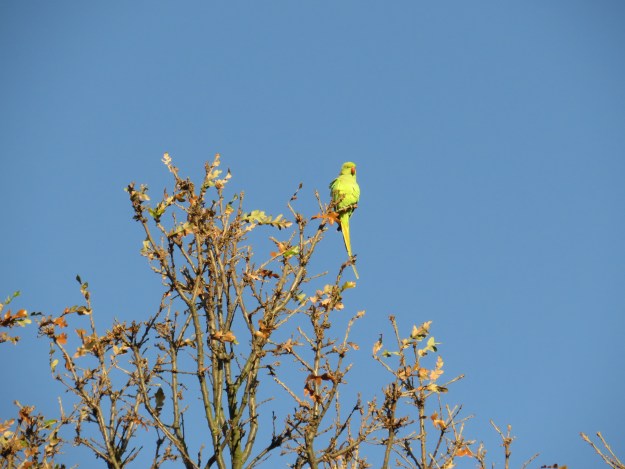
And then, how about this bird! He seemed a bit lost, as if he’d somehow been left behind when the rest of the flock headed off to mangle some Spanish chestnuts or cause havoc somewhere else.

I will never get over the sight of a bright green parrot at the top of an oak tree. I’m sure even a hundred years ago it would have seemed impossible. This parakeet seems very plump though so I imagine he’s doing ok. And after a few minutes he found his little friends and the whole lot of them flew off with all the kerfuffle that I associate with parrots. I have never yet met a shy, quiet, discreet member of the parrot family, though possibly they exist. Do let me know, Readers! I know that my Australian friends have parrots, cockatoos, budgerigars and all manner of Psittacines busting out all over. Are they all as gregarious and chatty as these ring-necked parakeets seem to be?