Wainwright Prize – Featherhood by Charlie Gilmour

Dear Readers, I tore through this book at the proverbial rate of knots, although I am not quite sure what it is. It’s true that one of the central characters is an orphaned magpie called Benzene, named after the film of oil on the puddles by the lockups where the bird is found. She  becomes integral to the life of the author, Charlie Gilmour, but there is such a cast of larger-than life characters, including Gilmour himself,  that it’s hard to call this a nature book.

Charlie Gilmour is the son of Heathcote Williams. Some of my more mature readers (ahem) might remember him from Whale Nation, an extended prose poem about whales and their exploitation by man. He always seemed like a man who was ahead of his time with his environmental concerns, and he seemed like a sensitive and caring soul. However, if you were one of his children, Williams seemed like a very different kind of man. He left his first partner and two children, wooed Gilmour’s mother (the author Polly Sansom), but then abandoned them when Charlie was a baby, leaving mother and child homeless. Much of the book is about Gilmour’s attempts to make contact with his father and to understand why Williams left so abruptly. He comes to a sort of peace by the end of the book, but in the meantime he suffers mental health issues, drug problems and is imprisoned after swinging from a flag pole on the Cenotaph in a drug-fuelled mania. It is telling that one of the presents that Williams sends him is a tiny model Cenotaph. Gilmour says:

“The last time I went chasing after his shadow, it led me to a breakdown of my own, and these days I have a terror of repetition. Sanity sometimes seems like a very thin membrane, through which it would be all too easy to fall again“.

What about Benzene, though? She is one helluva bird (though Gilmour and his wife Jana only realise that she’s female when she starts constructing a nest and paying special attention to Gilmour’s adopted father (Dave Gilmour from Pink Floyd). As a chick, she quickly asserts her presence:

“It scrabbles energetically against the sides (of the box), insisting that I pick it up and allow it to explore the world of our bedroom with pattering steps and clumsy leaps. it runs top-heavy on its long, thin legs, seemingly in constant danger of over-balancing as it races to investigate alluring plug serpents and serpentine electricity cables. It defecates at will”

Yep, living with a magpie is no one’s idea of fun. Gilmour tries to make contact with his father again because of a strange coincidence – Williams too reared a corvid, a jackdaw in his case. He wrote a poem about it, and Gilmour hopes to make some kind of connection through this shared experience. But Williams is always a performer, talking at Gilmour rather than to him, running through a repertoire of magic tricks, anything to keep a distance. I think we all know someone like this, the life and soul of the party but deeply unhappy underneath, and incapable of having a proper relationship with another human being.

So, I found this a compelling book, but not for the reasons I’d expected. I wanted to see if Gilmour would be able to form a relationship with his father, whilst shaking my head in doubt all the way through. Later, the stakes are raised even further, when Gilmour realises that his wife wants a child (though why people don’t discuss this stuff before they get married or commit to one another I have no idea harrumph). Will he take the leap into fatherhood? Well, the clue is rather in the title, but I shall leave it to you to find out. It’s an interesting book, but it’s much more about humans and their complexities than it is about the natural world.


Wednesday Weed – Musk Mallow

Musk mallow (Malva moschata)

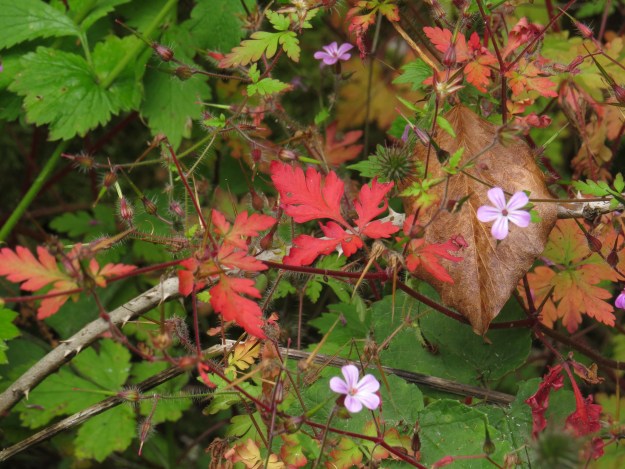
Dear Readers, what a delicate and pretty plant this is! I’ve seen it twice in the past few weeks, once on Hampstead Heath and at the weekend in the woodland grave area of St Pancras and Islington Cemetery, where I suspect it’s been planted as part of a wildflower mix. You can distinguish it from Common Mallow (Malva sylvestris) by its pale pink petals and very fine, feathery leaves. Common mallow is much darker in colour (it can often look almost purple) with dark-coloured veins.

Common mallow (Malva sylvestris)

Musk mallow is so-called because it is perfumed, though you can smell it much more strongly in an enclosed space. The plant is native to Europe and south-west Asia, and is said to have been used by the Ancient Greeks to decorate the graves of their friends. The Anglo-Saxons also planted it on graves, and in Austria it still seems to be a favourite graveyard plant.

All parts of the plant are said to be edible, and in Egypt you can eat Melokhia, or Mallow Soup, made from the young leaves (see here for a recipe). I suspect, though, that the leaves of this species are rather too fine and delicate to eat in anything other than a salad, along with a sprinkling of the flowers. The seedheads of musk mallow turn into little round ‘cheeses’, which are added to many Russian dishes, including borscht.

Musk mallow is also known as St Simeon’s herb, and it has a long association with eye health – St Simeon is said to have cured his blindness by bathing his eyes in a solution made from the plant, and credited it with enabling him to recognise the baby Jesus as the Messiah. It’s said that if you dig up a mallow root on St Simeon’s Day (October 8th) before sunrise, you can use it as an amulet against eye disease, or make a tincture to cure blindness or cataracts.

In the Middle Ages it was also said to be a test for fertility and, conversely, for virginity. The woman in question peed on a mallow. If it dried up in three days, she was either infertile or no longer a virgin. If the plant survived the dousing, the maiden was either, well, a maiden or capable of bearing children (or presumably both). Being a woman in the Middle Ages was clearly fraught with peril.

Like all mallows, musk mallow is rather mucilaginous, and as such its medicinal uses include many ways to soothe. It’s an ingredient in many recipes for cough medicine, and was historically used to soften boils (indeed the word mallow comes from the Greek malakos, meaning ‘soft’). No wonder then that in Christian symbolism the plant came to represent forgiveness, the softening of the heart towards a hardened soul. Galen also considered it to be anaphrodisiac, a plant that cooled the passions.

In the Victorian Language of Flowers, musk mallow is said to represent being consumed by love, persuasion and weakness, so be careful if you pop it into a bouquet for your loved one.

And finally, a poem. I love this, of course I do. Wherever I look, people seem to be losing their loved ones, one way or another. This is for you, brothers and sisters.

Joy
by Ann Gray

When I let the chickens out, I hurl mixed corn
in a golden arc across the frosted ground.
I know it’s junk, they shouldn’t have it, they don’t
need it, but everyone deserves joy somewhere.
I’ve been looking for something I once had and miss
and want again. I meet him in the beach café.
He has soup. I sip tea. He has over-wintered
vegetables on his allotment. I see it on his hands.
I imagine all that soil on my body. Sometimes
you know what’s bad for you, might be good.
I phone my mother every morning to start her day
– the way she knows it’s me, the way she says,
hello dear, before I’m speaking. She needs someone
to complain to. A mother is a precious thing. I know that
now I’m sure to lose her. She’s losing nouns and I have
to rummage in my brain to help her find them. I tell her
yesterday I thought I’d lost a dog and lost my voice calling.
I found her back at home, shaking, not sure if coming home
was good or bad, or neither, or both. There’s no reward
for coming home if no-one’s there, no one you love, no-one
to put out a hand, or smile to see you. My mother knows
and tries to hold me in her voice. Mothers do what they can.
Sometimes they don’t get much to work with. She knows
I’ll chase that golden arc, hoping for the joy in it.
I hope so much, hope the wine, the food, will taste
as it’s supposed to, hope that friends will stay,
their elbows on the table, The Low Anthem singing
To Ohio across the garden, where all those flowers
I fell in love with will be just a promised on their packets:
night scented stock, musk mallow, lunaria, pale phlox.
In this falling dark, when hens shuffle on their perches,
I hold my breath, listen to the sound of my loud heart.

LNHS Talks – Bird Census Methods for Gardens – A Thirty Year Study by Dave Dawson

Dear Readers, those of us who have dipped our toes into the world of citizen science, by participating in the The Great Garden Birdwatch or Butterfly Conservation’s Butterfly Count often wonder what else we should be doing. There are national bird counts, to be sure, but can we sensibly do anything in our own back gardens? Dave Dawson has recorded the birds that he’s seen in his South London garden for the past thirty years, and he would reply with a resounding yes.

Dawson gave a number of reasons for recording the birds in your garden. Firstly there’s the delight of discovery, like the the time that he saw a raven flying over, being mobbed by crows. Then there’s the fact that quantitative information can be extremely useful, both at the time and for posterity. He posited the case of kangaroo numbers in Australia – there are many diary entries that say useful things like ‘we saw lots of kangaroos today but not as many as yesterday’. If only someone had thought to jot down some numbers! Then there’s the importance of documenting things as they actually change – Dawson could never have anticipated that there would be quite so many ring-necked parakeets in London, but neither could he have foreseen that house martin numbers would drop to zero.

Furthermore, counting birds is easily and conveniently done – Dawson remarks that he can do his count in the time that it takes him to brew up his Turkish coffee in the morning. Everyone now agrees that getting out into nature is good for you. And finally, Dawson’s method works – it will enable the user to actually record trends and to gather useful information.

Dawson agrees that to actually record a bird, you need three things – acuity, concentration and knowledge. However, all three can be accumulated by regular observation! He notes that, for himself, he wasn’t sure if the presence of cataracts and his gradual hearing loss impacted on his recording, though on balance I think he concluded that, although without his hearing aids in he ‘lost’ some species, like goldfinches, it didn’t impact on his figures overall. Because, as we’ll see, the recording sessions are so short it shouldn’t be difficult to concentrate. And knowledge of how the different species look and sound can be developed with the aid of field guides and mentors.

So, how does Dawson recommend going about observing and recording the birds in your garden?

  1. Choose a point in your garden to use for observation. Anything within a 25 metre radius of this point counts as a ‘near’ bird, anything further than this (including birds flying over) count as ‘far’. (You can count birds that you see and those that you hear, if you are reasonably confident about bird song (Bug Woman))
  2. Choose a routine that is easy and not too punishing. Most birds can be seen and heard between 8 and 10 a.m. so you won’t gain much by springing up at the crack of dawn.
  3. Choose a point which is ‘sensible’ i.e. with a good view of the garden.
  4. Choose a convenient counting frequency (i.e. a couple of times a week rather than every single day)
  5. Use binoculars
  6. Avoid winds of more than Force 4 or heavy rain
  7. Use a clipboard and a form – you will definitely want to record the date, time and how many birds of each species you saw, but Dawson also records temperature, wind speed, precipitation, cloud cover, and who actually did the count. Much depends on what you are personally interested in.
  8. Count all species – don’t go missing out the feral pigeons, for example,  because chances are you’ll suddenly want to find out something about them.
  9. Count any birds that scatter on your arrival
  10. Count for five minutes
  11. Record the birds that you see within your 25 metres and the ‘far’ birds separately.

So, what sort of information can be produced, and why do this instead of (or as well as) some of the national recording schemes? Dawson found that his results for some species mapped very nicely onto the British Trust for Ornithology’s Breeding Bird survey, but for some his personal records were very different. Although there has been a precipitous decline in house sparrow numbers, for example, the species has disappeared from Dawson’s garden altogether, probably the result of his particular colony dying out. He has also recorded a dramatic fall in the number of blue tits, although they’ve stayed more or less stable in the country as a whole.

Dawson also mentioned another survey that was done in the London Borough of Sutton in 1989. There was a push locally for more high density housing, and Dawson was asked to survey the birds in low, medium and high density areas of the borough to see what the possible impact might be. The study was conducted in a similar way to Dawson’s garden survey, with different areas of similar sizes being compared for their species richness. The only species that favoured the close-packed terraced houses were house sparrows and starlings, but thirteen species were found much less often in such sites, and overall, twenty species were disadvantaged by high-density developments. So, bird counts can reveal a lot of information that can’t be extracted from anecdotal accounts alone. We need quantitative data to make sense of the world sometimes, and Dawson has an infectious love of statistics, honed over nearly sixty years of working in the field. I thoroughly enjoyed his talk, and if you want to watch the whole thing, you can find it here.

Careful Does It….

Dear Readers, today I decided to do a little bit of judicious pruning – my buddleias hang over the road a little, so I try to be a good neighbour and keep the pavement clear. Then, I noticed that some bindweed had infiltrated the hardy geraniums, and I finally paid attention to the elder that was trying to grow out of the wall. I chopped up all the bigger stems and was just about to go indoors when I noticed this shieldbug. My Facebook friends think it’s the last instar of a Hawthorn shieldbug, which makes a lot of sense what with me having a giant hawthorn tree in the garden.

And then these insects started to emerge – there were three of them in total, but they don’t hang around. I think this is probably a Southern Oak Bush-cricket (Meconema meridionale) – the ‘spike’ sticking out at the end shows that this individual is a female, and this is her ovipositor, for laying her eggs into rotten wood. Look at the length of those antennae!

All of the bush-crickets bounced away into the undergrowth. They can jump many times their own body-length, and just as well – being bright green they are far too conspicuous. You can tell this is a Southern Bush-cricket by the yellow dorsal stripe. This is another recent arrival, first recorded in Southern England in 2001. As the animal is flightless, it has probably been ‘hitching a lift’ in plant material that’s transported by vehicle. But here’s a thing – it is said to be a predator of the horse-chestnut leaf miner, the moth that is turning all the horse-chestnut leaves to crisps as we speak. It generally lives in trees, so I’m wondering if it is currently living in the whitebeam? Or was it hanging out in the buddleia, which is now the size of a small tree?

When I remove plant material from my pond, I always put it on the side for a couple of days to allow the little critters to wriggle back into the water, but I’ve always just plonked the lid onto my wheelie bin once I’ve done the pruning. It occurs to me that I should leave the lid open for a few hours, just to allow insects to escape as the vegetation starts to wilt. I’d already removed a two-spot ladybird and a very pregnant spider, so hopefully other creatures will also have a chance to escape.

So this is basically a plea for anyone who has their garden waste recycled, or who has a tightly-enclosed compost bin (like some of the plastic ones I’ve seen) to consider leaving the lid open for a little while, to avoid condemning invertebrates to death. It’s something I’d never thought of until all the action today, and I’d love to hear how you deal with such things.

In other news, the garden is a jungle. Once the angelica fell over and everything around it collapsed, it’s been a tangle of meadowsweet, hemp agrimony and greater willowherb. Chelsea Flower Show it ain’t, but how I love to watch all the pollinators, especially as the plants are at a very convenient height for observation.

The pond has water mint and figwort, with the bees and hoverflies being especially partial to the former.

Water mint

And the bumblebees continue to home in on the bittersweet.

It’s true that soon there will be some tidying to do, but I am just starting to realise how many species the garden supports. I will try to be sympathetic to what the creatures need, while also trying to keep my own sanity. Still, this is all a problem for September. For now, my tidying is done.

An August Walk in St Pancras and Islington Cemetery

‘My’ swamp cypress

Dear Readers, I didn’t get to the cemetery last week because of the interminable rain, so it was a real pleasure to see what was going on this week. For a start, the swamp cypress was looking extremely fine. I know you’re not meant to have favourites, but this tree is very close to my heart.

But then, how about the trunk on this oak? It seems to have been much-lopped in its early years, and it’s covered in puckers and scars, but is no less characterful for its troubles. It reminds me of one of those many-breasted statues of Artemis that you can see in museums, and, like all oaks, this tree probably has been ‘mother’ to many, many other species. Or maybe it’s just me. See what you think

Photo One by Son of Groucho from Scotland, CC BY 2.0 <https://creativecommons.org/licenses/by/2.0>, via Wikimedia Commons

Statue of Artemis from the Ephesus Museum (Photo One)

In other news, one of the cherry laurels has become a refuge for snails of all kinds. I guess that the waxy leaves provide an excellent protection against drying out, though the snails don’t appear to be eating them. This brown-lipped banded snail (Cepaea nemoralis) reminds me rather of a mint humbug.

I think that this is probably a rather worn garden snail (Cornu aspersum). It looks like an elderly snail to me, battered by life but clinging on.

And this is another brown-lipped snail, though not quite as pristine as the first one. Isn’t it interesting how we (generally) view snails as small characters, rather lovable in their way, but don’t extend the same tolerance to slugs? Maybe the shells help to offset the general sliminess.

Late summer is already shading into autumn, with bountiful supplies of conkers…

Elderberries….

And rosehips….

But there are some new plants in flower as well, such as this musk mallow (Malva moschata)…

and these lovely common toadflax (Linaria vulgaris). I love this plant, with its lemon and orange flowers. In fact, I have a great fondness for all toadflaxes – they are often great for pollinators and their flowers just ask for a bee to land on them.

There has been a whole lot of strimming going on on the banks where I’ve seen green woodpeckers in the past, but at the moment the magpies are there, working over the dried grass for tasty insects.

We take a quick run around the field and have a look at the Himalayan balsam. This is such an attractive, showy plant. I can see why people planted it in the past – it’s like having a giant moth orchid in your back garden. What a shame it’s such a thug – the bees seem to love it.

I spot a sparrowhawk flying overhead. I also see a recently-fledged blackbird, looking very small and vulnerable. Fortunately I could hear at least one adult bird in the tree overhead, so I moved quickly on, keeping my fingers crossed that this little one would soon be fully equipped for life in the cemetery. At least there are very few cats.

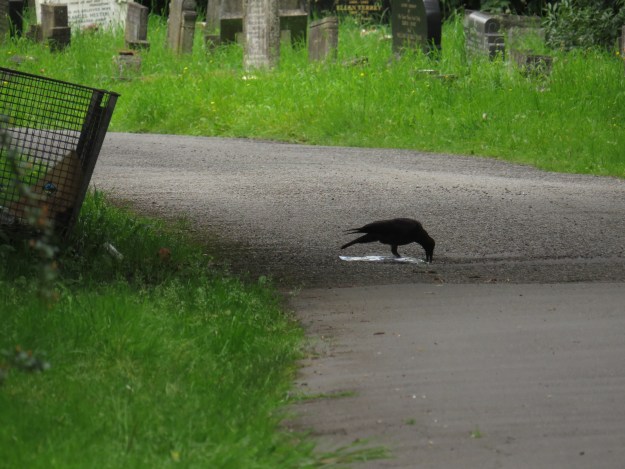
This crow was pecking at a piece of cellophane that had been used to wrap flowers with great determination, and even tried to fly off with it when we approached.

We couldn’t see anything of food value, and so my husband put the cellophane back in the bin. I reminded him that experiments have shown that corvids don’t forget someone who has done them a disservice – it’s been shown that they can identify someone who has wronged them even if they change their clothes and wear a mask. Let’s hope that this act of kindness won’t be misinterpreted, or our walks in the cemetery are about to become much more ‘interesting’.

Photo Credit

Photo One by Son of Groucho from Scotland, CC BY 2.0 <https://creativecommons.org/licenses/by/2.0>, via Wikimedia Commons

Saturday Quiz – Family Favourites!

A pretty plant, but what family does it belong to?

Dear Readers, here’s a challenge for you. Below are photos of some plants. One point if you can say what family it belongs to from the list below, and a further point if you can name the species. The results will be posted next Friday (20th August), so you have until 5 p.m. on Thursday 19th August to pop your answers in the comments. I will ‘disappear’ your answers when I see them, but as usual write your answers down on a piece of paper if you are easily influenced (like me :-))Onwards!

Plant Families

A) Crassulaceae (Stonecrops)

B) Fabaceae (Peas, vetches and clovers)

C) Hypericaceae (St John’s-worts)

D) Geraniaceae (Cranesbills and storksbills)

E) Onagraceae (Willowherbs)

F) Malvaceae (Mallows)

G) Balsaminaceae (Balsams)

H) Primulaceae (Primulas)

I) Solanaceae (Nightshades)

J) Plantaginaceae (Plantains)

K) Scrophulaceae (Figworts)

L) Asteraceae (Daisies)

M) Lamiaceae (Deadnettles)

N) Dipsaceae (Teasels)

O) Apiaceae (Carrots)

So if you think the plant in photo 1 belongs to the Crassulaceae (stonecrop) family, your answer is 1) A).

Happy quizzing!

1)

2)

3)

4)

5)

6)

7)

8)

9)

10)

11)

12)

13)

14)

15)

Book Review – ‘English Pastoral – An Inheritance’ by James Rebank

Dear Readers, there is a lot to love about this book. James Rebank is the third generation to have farmed an area in the Lake District, and he tells of the way that farming has changed in that time, from the mixed-use farm of his grandfather to the more intensive methods that were chosen by his father, and to the way that he is trying to balance the need to make enough money for the farm to survive with the urgency of preserving and enhancing the soil and the habitat. I’ve read many books about the way that the industrialisation of agriculture has impacted the countryside, but this one is deeply personal, and is written by someone who knows the Lake District, and observes it closely. Here’s a lovely description of the goldfinches feeding on the thistles that he’s scything, for example:

Twenty feet away a goldfinch swayed gently on the purple flower of a burr thistle, and rocked back and forth, its little gold wing-bars flashing in the sunshine as it plucked at the thistledown’. 

Or his father, shooting one of the rooks who have been demolishing the barley crop:

A black speck, wings outstretched, moving slowly but so high it seemed tiny. He pulled the trigger gently. The gun recoil sent a shudder through him to me. The shot had gone, but he was still peering up the little sight on the top of the gun. The air smelt of cordite. Then, high above him, the bird crumpled into something smaller and fell from the sky. It landed about five feet from where we were crouching on the bone-hard ground with a feathery thud. All hell had broken loose. The crows knew that we were there now and had a shotgun. They fled like a kind of storm wind that sucked the air from the field’. 

But his grandfather is the last of a generation. The drive to modernise has come to this corner of the Lake District, with its pesticides, its fertilizers, its new crops and its new breeds of animals. Rebanks douses the thistles with herbicide, and they die without all the back-breaking work of scything them down. Is this the future? For a while it looks like it.

And in place of an old patchwork landscape full of working people, diverse farm animals and crops, with lots of farmland wildlife, a blander, barer, simpler denatured and unpeopled landscape had emerged“.

But Rebanks’s father is never convinced. A local man, Henry, who farmed traditionally dies, and when his soil is tested, it’s found that it needs absolutely nothing added to it – the soil is alive, rich and fertile. Everything starts to look less like a revolution, and more like a disaster.

A mile or two past Henry’s land my father pointed to a field being ploughed up by the roadside. A giant red tractor was pulling a huge blue plough. I could sense that he was alarmed by something. ‘Look’, he said, ‘there are no seagulls or crows following the plough’. This was a shocking thing to him. ‘There must be no worms in those fields.”

But the turning point for Rebanks is when he reads a copy of Rachel Carson’s ‘Silent Spring’.

The morning after I had sprayed my first field of thistles, I went down the lane to check on a robin’s nest that I’d found a few days earlier. It was close to where the thistles had curled over from the chemical spray. The chicks were dead in the nest, cold bundles of pink skin and bone and scruffy feather stubs. I knew this was my fault. A tiny voice inside me had said that it was wrong. I think I told myself that three or four chicks were a one-off cost to get a big problem sorted, that they might have been killed by us mowing thistles some other way. I’m not sure I believed it, because when I remembered those dead chicks, I felt ashamed. And now, after reading ‘Silent Spring’, I knew we had been sleepwalking”.

How Rebanks decides to try to farm in a more balanced way takes up the final third of the book, and it is full of  concern for both the environment and the community of the Lake District.  I loved the deeply personal stories and observation that Rebanks brings to this work, and you can feel his passion thrumming through every page. However, when the book moves away from the personal I feel that it’s less successful – I found myself turning the pages at speed at various points when the author starts to move away from the particulars of his story into the more general. I did learn a lot from this book (I had no idea, for example, that slurry was so much worse for the soil than the traditional aged manure and straw mixes that would have been spread), but there was a lot that I already knew, so maybe the problem is with the reader rather than the author.

Let me know what you think, if you’ve had a chance to read it! It’s on to ‘Featherhood’ by Charlie Gilmour next, which promises to be a very different kind of book….


A Trick of the Light

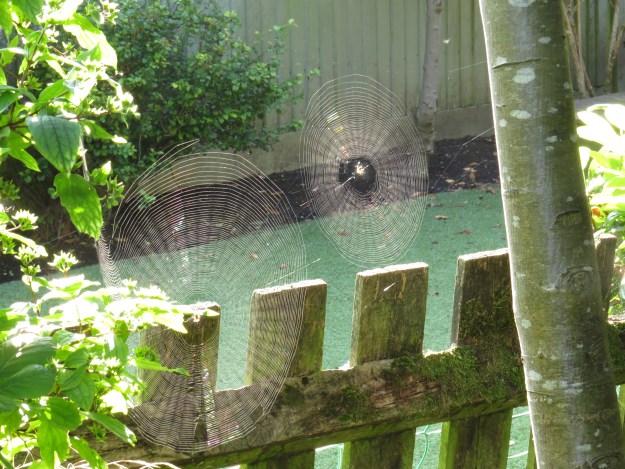
Dear Readers, it’s easy to get so caught up in busy-ness and sorting things out and running around. But the rewards for stopping and looking are so great. Just look at these spiders’ webs in the garden this morning. For just a few moments the sun illuminates every single thread and turns it into a rainbow.

Sometimes things like this make me want to cry. We rush downhill in our lives, and yet look at this beauty. Everything is illuminated. It is heart-stopping. And in a few minutes, as the sun climbs higher in the sky, the moment is gone. Surely the spreadsheets and the laundry can wait? As my dear Dad used to say, you’re a long time dead.

There were four webs in just this tiny corner of the garden. Goodness knows how many there are in the whole place. It’s been so wet that I think they’re making up for lost time, as are the bees, who are all over the hemp agrimony. Summer’s lease hath all too short a date, because when I see the spiders I can almost smell the autumn leaves. Take a few minutes to stop and pay attention today, Readers. I promise that the rewards are bountiful, and surprising.


Wednesday Weed(s) – Reflexed, White and Caucasian Stonecrop

Reflexed stonecrop (Sedum rupestre)

Dear Readers, I have often remarked on the variety of stonecrops that ‘crop up’ (apologies) in St Pancras and Islington Cemetery, so I thought that this week we could have a look at these remarkable plants. All of them grow only on particular graves, normally those that have been covered with gravel. I doubt that they were planted deliberately, and they give a strangely coastal feeling to parts of the cemetery.

All of the stonecrops are members of the Crassulaceae family. They are succulents, and so can thrive on very thin, desiccated soil. All stonecrops operate using a form of photosynthesis called ‘Crassulacean Acid Metabolism’ or CAM for short. Basically, the plant keeps the little holes in its leaves, called stomata, closed during the day so that it doesn’t lose water. Then at night, it opens the stomata so that it can collect the carbon dioxide that it needs for photosynthesis, and stores the gas so that it can continue to operate during the day. This is thought to be an adaptation to hot, dry climates where the plant would not otherwise be able to survive.

I’ve noticed three species of stonecrop in the cemetery, though there may be many more.

Firstly, we have reflexed stonecrop (Sedum rupestre/reflexum). This plant was probably introduced to the UK in the 17th century as a salad crop – those tiny leaves are said to have a bitter, astringent taste. It was recorded in the wild by 1666. In the USA the plant is known as Jenny’s stonecrop. As with all sedums, the delight is in the detail – I love the circlets of golden flowers, and the redness of the stems. No wonder people use these plants on their green roofs – they are superbly adapted to the dryness and thinness of the soil.

The white stonecrop (Sedum album) is just going over now, but at its height it covered some graves in a sea-spume of tiny flowers. This is probably an ancient introduction, or archaeophyte, meaning a plant that was growing in the wild in the UK before 1500 BCE. If you look closely at the photo, you can see how the plant is growing amidst a collection of green frosted-glass pebbles, an environment in which no other plants seem to be able to survive, so the stonecrop has the whole grave to itself.

White stonecrop (Sedum album)

The third stonecrop that I’ve spotted is Caucasian or two-rowed stonecrop (Sedum spurium). This is a much more recent introduction than the other two species, and has undoubtedly hopped over the wall from a garden somewhere, or may even have been deliberately planted on the grave. It comes from Eastern Europe, as its name suggests, and there are a number of cultivars on offer.

Caucasian stonecrop (Sedum spurium)

All the stonecrops seem to be very attractive to hoverflies, and the fact that they flower in the sunniest spots can only help. I wasn’t sure if any insects ate the leaves but a quick look at my ‘Field Guide to the Caterpillars of Great Britain and Ireland’ revealed that the caterpillars of the Mullein Wave (Scopula marginepunctata), Magpie (Abraxas grossulatiata), Scotch Annulet (Gnophos obfuscata) and the Sword Grass (Xylena exsoleta) have all been found munching on various species of stonecrop, including the more ornamental ones, so keep your eyes open if you have some in your garden. The caterpillar of the Sword Grass looks especially spectacular.

Photo One by Ben Sale from UK, CC BY 2.0 , via Wikimedia Commons

Mullein Wave moth (Photo One)

Photo Two by Ben Sale from UK, CC BY 2.0 <https://creativecommons.org/licenses/by/2.0>, via Wikimedia Commons

Magpie moth (Photo Two)

Photo Three by Hectonichus, CC BY-SA 3.0 <https://creativecommons.org/licenses/by-sa/3.0>, via Wikimedia Commons

Sword-grass caterpillar (Photo Three)

And finally, as often happens when you use a word over and over again in a piece of writing, I find myself thinking about the word ‘stonecrop’. It has its origins in Old English, but it can, of course, be read in two ways. It might be that, given the fact that some varieties of sedum are edible (and reflexed stonecrop might actually have been brought here as a herb), the word refers to a ‘crop that is grown amidst stones’. However, what also springs to mind is a crop of stones, a failed harvest, a hard and hungry time. Maybe stonecrop was also sometimes used as a famine food?

And so a poem, by Robinson Jeffers, an American poet from California who died in 1962. I like the way that this poem celebrates the way that nature is reclaiming the industrial site with its ‘rose-tipped stonecrop’. See what you think.

Bixby’s Landing by Robinson Jeffers

They burned lime on the hill and dropped it down
here in an iron car
On a long cable; here the ships warped in
And took their loads from the engine, the water
is deep to the cliff. The car
Hangs half way over in the gape of the gorge,
Stationed like a north star above the peaks of
the redwoods, iron perch
For the little red hawks when they cease from
hovering
When they’ve struck prey; the spider’s fling of a
cable rust-glued to the pulleys.
The laborers are gone, but what a good multitude
Is here in return: the rich-lichened rock, the
rose-tipped stone-crop, the constant
Ocean’s voices, the cloud-lighted space.
The kilns are cold on the hill but here in the
rust of the broken boiler
Quick lizards lighten, and a rattle-snake flows
Down the cracked masonry, over the crumbled
fire-brick. In the rotting timbers
And roofless platforms all the free companies
Of windy grasses have root and make seed; wild
buckwheat blooms in the fat
Weather-slacked lime from the bursted barrels.
Two duckhawks darting in the sky of their cliff-hung
nest are the voice of the headland.
Wine-hearted solitude, our mother the wilderness,
Men’s failures are often as beautiful as men’s
triumphs, but your returnings
Are even more precious than your first presence.

Photo Credits

Photo One by Ben Sale from UK, CC BY 2.0 , via Wikimedia Commons

Photo Two by Ben Sale from UK, CC BY 2.0 <https://creativecommons.org/licenses/by/2.0>, via Wikimedia Commons

Photo Three by Hectonichus, CC BY-SA 3.0 <https://creativecommons.org/licenses/by-sa/3.0>, via Wikimedia Commons

LNHS Talks – CSI of the Sea – What Causes Cetacean Strandings? By Rob Deaville

Dear Readers, while the subject of cetacean strandings is not a happy one, it is something that concerns many people. Are whales stranding themselves more frequently, and if so, why? Rob Deaville is the Project Manager for the Cetacean Strandings Investigation Team (CSI), and has been researching this subject for the past 21 years. He began by defining exactly what a stranding was: it’s

when a live or dead marine mammal swims or floats onto shore and becomes ‘beached’ or incapable of returning to the sea

Strandings can occur with individual or groups of whales, and they have been recorded throughout history. CSI looks at why strandings occur, and looks at whether the reasons are natural, or manmade.

Deaville started out with some historical context. Since 1324, when whales were described as ‘royal fish’, the monarch technically owns any stranded cetaceans that appear around the UK coast. In 1911 there was a mass stranding of over 50 pilot whales at Penzance in Cornwall, though the reaction of the local people was to chop the whales up, presumably for meat. However, it did alert the Natural History Museum (NHM) to the possibilities that strandings presented to learn more about cetaceans, which are very difficult to study in the wild. From 1913 onwards the NHM collected data on 3,949 strandings, and collected material for skeletal preparations from the dead animals (including one whale who was shipped across from Kings Cross on and open-bedded truck and dissected on the front lawn of the Museum). The modern stranding programme that Deaville is involved with started in 1990.

Deaville moved on to talk about 3 whale strandings in the London area. In 1658 a North Atlantic Right Whale stranded on the Thames and was dragged ashore and butchered by the local population for its oil. The skeleton of this whale, still showing the damage from the butcher’s knives, was found in Greenwich in 2010.

In 1954 ‘Jonah’ the whale was hunted off the coast of Iceland, embalmed and then taken round the country as a travelling freak show.

However, in 2006 a Northern Bottlenose Whale was seen in the Thames, as far upstream as the Houses of Parliament. Deaville was involved in the rescue attempt to try to return this whale to the open sea, although the animal unfortunately died in transit. As he says, we have gone from a nation of butchers and gawkers to a nation of conservationists – the response of the public to the rescue attempt was heartfelt and sympathetic.

Deaville then moved on to look at strandings more generally in the UK. He showed a chart that showed how strandings of fin whales and humpback whales had increased in the UK since the moratorium on whale-hunting in 1986, and how this is not necessarily a bad thing, as it can indicate that numbers of the whales are increasing, and hence we are starting to see them stranding (there were no humpback strandings in the UK prior to the ban on hunting).

Over the past 30 years there have been 17,000 strandings in the UK. 88% of these are where the cetaceans are already dead when they appear. By far the largest numbers of strandings are of smaller whales, with 8,615 harbour porpoises and 2915 common beaked dolphins comprising the bulk of the numbers, along with over 2,000 unidentified cetaceans who were presumably too decayed or damaged for the species to be ascertained. 7% of strandings are live animals, and the remainder are whales found entangled or floating at sea. In total, 22 species of whales have been identified from UK strandings, which is a quarter of all the whale species in the world, which reflects the diversity of our coastline, from the shallow coastal areas where harbour porpoises strand to the deeper, pelagic areas where sperm whales and humpbacks come to grief.

Deaville moved on to mass stranding events, which have occurred largely in Northern Scotland with one event in Cornwall. Organisations such as the RSPCA and local diving and rescue groups managed to rescue large numbers of the cetaceans involved (usually dolphins, porpoises or pilot whales) but many of the animals died. In two of the cases there seemed to be a direct link to human noise (probably use of sonar but Deaville didn’t go into detail on this).

Looking at the number of strandings, there seems to have been a marked increase during the period 2016-2019. There was also a reduction in strandings by cold-water species of cetacean, and an increase in strandings by warm-water species, which points to the impact of climate change.

Deaville then moves on to talk about the cause of death of the animals that he sees. A major reason for the demise of harbour porpoises and common dolphins is ‘by-catch’, whereby the animals get entangled in fishing nets. Harbour porpoises seem to be being killed all around the UK, but common dolphins are clearly most frequently killed around the south-west, particularly Cornwall. Deaville spoke of a ‘by-catch season’ for common dolphins from December to April, where they wash up dead but with evidence of damage from fishing nets.

Entanglement is a very specific form of by-catch that affects larger whales such as minke whales. Sometimes they drown because of a sudden entanglement in ship’s ropes, sometimes they die from starvation over a period of time when ropes and nets prevent them from hunting. Most of the cases are in Scotland where there’s a lot more creel-type fishing, using roped baskets to catch lobsters and crabs.

Ship strike, where animals are killed by propellors or being hit by a ship, largely affects harbour porpoises and common dolphins, and occurs, not surprisingly, where there are ports and a lot of shipping activity.

Not all causes of death are man-made, however. A significant cause of death is attack by bottle-nosed dolphins on other cetaceans, particularly harbour porpoises – the dolphins strike the much smaller porpoises, and often bite them with such force that they kill them. It’s still not clear why this happens, but all the observed cases have been by sub-adult male dolphins, so the current theory is that it has some link to sexual behaviour. I had no idea when I used to watch Flipper on television that dolphins could be such violent animals!

In 2015, a Cuvier’s Beaked Whale live-stranded in Scotland, and in spite of several attempts to refloat the animal it eventually had to be euthanised. An underwater necropsy was carried out, and it was found that the poor creature had a large volume of plastic sheeting in its stomach. This particular animal seemed to have some other health problems, which might have brought it closer inshore and resulted in aberrant feeding behaviour. While it might be the case that the ingestion of plastic debris is an increasing problem for cetaceans, Deaville found that there were only 3 cases out of almost 4000 where death was a direct result of an animal eating debris, and 35 cases where debris had been ingested though it was not the direct cause of death. Deaville did flag up that certain species of deep-diving suction-feeding whales could well be more directly affected by plastics, however, but these are whales that are least likely to be recovered for autopsy. He also said that the effect of microplastics was not yet fully understood in cetacean strandings.

He then moved on to infectious disease, which is by far the largest cause of death in cetacean strandings across all species. Deaville has been extensively studying the effect of PCBs (Polychlorinated biphenyls) on cetaceans – although these chemicals are now banned, they continue to persist in the environment, and they accumulate in animals that are at the top of the food chain such as whales. They are immunosuppressant, which might make the whales more vulnerable to infectious disease, and they also affect reproductive success. In studies of PCB levels, striped dolphins, bottlenosed dolphins and killer whales were all found to have toxic levels of PCBs in their blubber, with killer whales being most affected.

Deaville went on to speak about Lulu, a member of the last remaining resident Killer Whale pod in the UK. She was found dead on a beach in Tiree, Scotland, following becoming entangled in creel nets. However, her PCB levels were the highest ever found in any mammal, and her ovaries were non-functional. Lulu’s pod have never had a calf in the 30 years that they’ve been studied, and there is no doubt in Deaville’s mind that that pod will become extinct, and there will be no more coastal killer whales in the UK.

Finally, Deaville went on to talk about cetacean strandings in the Thames. The vast majority of strandings are harbour porpoises (probably about 450 out of the 500 strandings recorded in the past 30 years). However, pelagic species such as minke whales do sometimes find themselves in the shallow seas of the estuary, and unfortunately for them there’s usually only a fatal outcome. However, the Thames is a much healthier environment that it has been historically, and lots of marine mammals make their way up and down the river without coming to any kind of harm.

To conclude, Deaville talked about two high-profile  strandings. In 2019 a humpback whale was seen in the Thames. The animal was clearly unwell, and died two days after its first appearance. On investigation the whale was seen to be a juvenile female, and she had been severely injured in a ship strike probably 48 to 72 hours previously. During 2019 there were 3 cases of entanglement and one of ship strike involving humpback whales, and as the population of this species increases it’s likely that there will be more events of this kind.

In 2021 a small female minke whale stranded in the lock at Richmond. An attempt was made to move her but she escaped, and was later found at Teddington lock, the furthest up the Thames that a whale has ever been sighted. She was eventually euthanised, and necropsy showed that she was extremely thin, and probably hadn’t fed for some time – it’s possible that she hadn’t been completely weaned from her mother, and, having wandered into the Thames, wouldn’t have been able to find any alternative food. Again, this is a species which is increasing, so more strandings might reflect more animals.

So, to conclude:

  • CSI has investigated over 18,000 strandings and has conducted 4500 necropsies.
  • Although its work is opportunistic (inasmuch as it relies on being able to retrieve stranded animals), it is a cost effective method of looking at threats to the marine environment, and its work is used to create policy, to further the science of cetacean strandings, and to educate and inform.
  • CSI looks at the anthropogenic causes of strandings, such as bycatch, entanglement, ship strike, noise, climate change and marine debris, and non-anthropogenic causes such as bottlenose dolphin attack.
  • However, CSI consider that PCB exposure is the biggest single conservation concern for some species, and is a threat to the existence of some populations.

So, an absolutely fascinating talk, and lots that I didn’t know. If you’d like to listen to the whole talk, you can find it here.