Book Review – ‘English Pastoral – An Inheritance’ by James Rebank

Dear Readers, there is a lot to love about this book. James Rebank is the third generation to have farmed an area in the Lake District, and he tells of the way that farming has changed in that time, from the mixed-use farm of his grandfather to the more intensive methods that were chosen by his father, and to the way that he is trying to balance the need to make enough money for the farm to survive with the urgency of preserving and enhancing the soil and the habitat. I’ve read many books about the way that the industrialisation of agriculture has impacted the countryside, but this one is deeply personal, and is written by someone who knows the Lake District, and observes it closely. Here’s a lovely description of the goldfinches feeding on the thistles that he’s scything, for example:

Twenty feet away a goldfinch swayed gently on the purple flower of a burr thistle, and rocked back and forth, its little gold wing-bars flashing in the sunshine as it plucked at the thistledown’. 

Or his father, shooting one of the rooks who have been demolishing the barley crop:

A black speck, wings outstretched, moving slowly but so high it seemed tiny. He pulled the trigger gently. The gun recoil sent a shudder through him to me. The shot had gone, but he was still peering up the little sight on the top of the gun. The air smelt of cordite. Then, high above him, the bird crumpled into something smaller and fell from the sky. It landed about five feet from where we were crouching on the bone-hard ground with a feathery thud. All hell had broken loose. The crows knew that we were there now and had a shotgun. They fled like a kind of storm wind that sucked the air from the field’. 

But his grandfather is the last of a generation. The drive to modernise has come to this corner of the Lake District, with its pesticides, its fertilizers, its new crops and its new breeds of animals. Rebanks douses the thistles with herbicide, and they die without all the back-breaking work of scything them down. Is this the future? For a while it looks like it.

And in place of an old patchwork landscape full of working people, diverse farm animals and crops, with lots of farmland wildlife, a blander, barer, simpler denatured and unpeopled landscape had emerged“.

But Rebanks’s father is never convinced. A local man, Henry, who farmed traditionally dies, and when his soil is tested, it’s found that it needs absolutely nothing added to it – the soil is alive, rich and fertile. Everything starts to look less like a revolution, and more like a disaster.

A mile or two past Henry’s land my father pointed to a field being ploughed up by the roadside. A giant red tractor was pulling a huge blue plough. I could sense that he was alarmed by something. ‘Look’, he said, ‘there are no seagulls or crows following the plough’. This was a shocking thing to him. ‘There must be no worms in those fields.”

But the turning point for Rebanks is when he reads a copy of Rachel Carson’s ‘Silent Spring’.

The morning after I had sprayed my first field of thistles, I went down the lane to check on a robin’s nest that I’d found a few days earlier. It was close to where the thistles had curled over from the chemical spray. The chicks were dead in the nest, cold bundles of pink skin and bone and scruffy feather stubs. I knew this was my fault. A tiny voice inside me had said that it was wrong. I think I told myself that three or four chicks were a one-off cost to get a big problem sorted, that they might have been killed by us mowing thistles some other way. I’m not sure I believed it, because when I remembered those dead chicks, I felt ashamed. And now, after reading ‘Silent Spring’, I knew we had been sleepwalking”.

How Rebanks decides to try to farm in a more balanced way takes up the final third of the book, and it is full of  concern for both the environment and the community of the Lake District.  I loved the deeply personal stories and observation that Rebanks brings to this work, and you can feel his passion thrumming through every page. However, when the book moves away from the personal I feel that it’s less successful – I found myself turning the pages at speed at various points when the author starts to move away from the particulars of his story into the more general. I did learn a lot from this book (I had no idea, for example, that slurry was so much worse for the soil than the traditional aged manure and straw mixes that would have been spread), but there was a lot that I already knew, so maybe the problem is with the reader rather than the author.

Let me know what you think, if you’ve had a chance to read it! It’s on to ‘Featherhood’ by Charlie Gilmour next, which promises to be a very different kind of book….


A Trick of the Light

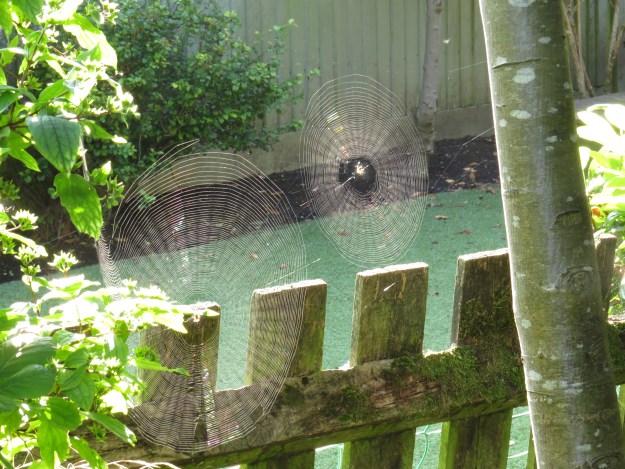
Dear Readers, it’s easy to get so caught up in busy-ness and sorting things out and running around. But the rewards for stopping and looking are so great. Just look at these spiders’ webs in the garden this morning. For just a few moments the sun illuminates every single thread and turns it into a rainbow.

Sometimes things like this make me want to cry. We rush downhill in our lives, and yet look at this beauty. Everything is illuminated. It is heart-stopping. And in a few minutes, as the sun climbs higher in the sky, the moment is gone. Surely the spreadsheets and the laundry can wait? As my dear Dad used to say, you’re a long time dead.

There were four webs in just this tiny corner of the garden. Goodness knows how many there are in the whole place. It’s been so wet that I think they’re making up for lost time, as are the bees, who are all over the hemp agrimony. Summer’s lease hath all too short a date, because when I see the spiders I can almost smell the autumn leaves. Take a few minutes to stop and pay attention today, Readers. I promise that the rewards are bountiful, and surprising.


Wednesday Weed(s) – Reflexed, White and Caucasian Stonecrop

Reflexed stonecrop (Sedum rupestre)

Dear Readers, I have often remarked on the variety of stonecrops that ‘crop up’ (apologies) in St Pancras and Islington Cemetery, so I thought that this week we could have a look at these remarkable plants. All of them grow only on particular graves, normally those that have been covered with gravel. I doubt that they were planted deliberately, and they give a strangely coastal feeling to parts of the cemetery.

All of the stonecrops are members of the Crassulaceae family. They are succulents, and so can thrive on very thin, desiccated soil. All stonecrops operate using a form of photosynthesis called ‘Crassulacean Acid Metabolism’ or CAM for short. Basically, the plant keeps the little holes in its leaves, called stomata, closed during the day so that it doesn’t lose water. Then at night, it opens the stomata so that it can collect the carbon dioxide that it needs for photosynthesis, and stores the gas so that it can continue to operate during the day. This is thought to be an adaptation to hot, dry climates where the plant would not otherwise be able to survive.

I’ve noticed three species of stonecrop in the cemetery, though there may be many more.

Firstly, we have reflexed stonecrop (Sedum rupestre/reflexum). This plant was probably introduced to the UK in the 17th century as a salad crop – those tiny leaves are said to have a bitter, astringent taste. It was recorded in the wild by 1666. In the USA the plant is known as Jenny’s stonecrop. As with all sedums, the delight is in the detail – I love the circlets of golden flowers, and the redness of the stems. No wonder people use these plants on their green roofs – they are superbly adapted to the dryness and thinness of the soil.

The white stonecrop (Sedum album) is just going over now, but at its height it covered some graves in a sea-spume of tiny flowers. This is probably an ancient introduction, or archaeophyte, meaning a plant that was growing in the wild in the UK before 1500 BCE. If you look closely at the photo, you can see how the plant is growing amidst a collection of green frosted-glass pebbles, an environment in which no other plants seem to be able to survive, so the stonecrop has the whole grave to itself.

White stonecrop (Sedum album)

The third stonecrop that I’ve spotted is Caucasian or two-rowed stonecrop (Sedum spurium). This is a much more recent introduction than the other two species, and has undoubtedly hopped over the wall from a garden somewhere, or may even have been deliberately planted on the grave. It comes from Eastern Europe, as its name suggests, and there are a number of cultivars on offer.

Caucasian stonecrop (Sedum spurium)

All the stonecrops seem to be very attractive to hoverflies, and the fact that they flower in the sunniest spots can only help. I wasn’t sure if any insects ate the leaves but a quick look at my ‘Field Guide to the Caterpillars of Great Britain and Ireland’ revealed that the caterpillars of the Mullein Wave (Scopula marginepunctata), Magpie (Abraxas grossulatiata), Scotch Annulet (Gnophos obfuscata) and the Sword Grass (Xylena exsoleta) have all been found munching on various species of stonecrop, including the more ornamental ones, so keep your eyes open if you have some in your garden. The caterpillar of the Sword Grass looks especially spectacular.

Photo One by Ben Sale from UK, CC BY 2.0 , via Wikimedia Commons

Mullein Wave moth (Photo One)

Photo Two by Ben Sale from UK, CC BY 2.0 <https://creativecommons.org/licenses/by/2.0>, via Wikimedia Commons

Magpie moth (Photo Two)

Photo Three by Hectonichus, CC BY-SA 3.0 <https://creativecommons.org/licenses/by-sa/3.0>, via Wikimedia Commons

Sword-grass caterpillar (Photo Three)

And finally, as often happens when you use a word over and over again in a piece of writing, I find myself thinking about the word ‘stonecrop’. It has its origins in Old English, but it can, of course, be read in two ways. It might be that, given the fact that some varieties of sedum are edible (and reflexed stonecrop might actually have been brought here as a herb), the word refers to a ‘crop that is grown amidst stones’. However, what also springs to mind is a crop of stones, a failed harvest, a hard and hungry time. Maybe stonecrop was also sometimes used as a famine food?

And so a poem, by Robinson Jeffers, an American poet from California who died in 1962. I like the way that this poem celebrates the way that nature is reclaiming the industrial site with its ‘rose-tipped stonecrop’. See what you think.

Bixby’s Landing by Robinson Jeffers

They burned lime on the hill and dropped it down
here in an iron car
On a long cable; here the ships warped in
And took their loads from the engine, the water
is deep to the cliff. The car
Hangs half way over in the gape of the gorge,
Stationed like a north star above the peaks of
the redwoods, iron perch
For the little red hawks when they cease from
hovering
When they’ve struck prey; the spider’s fling of a
cable rust-glued to the pulleys.
The laborers are gone, but what a good multitude
Is here in return: the rich-lichened rock, the
rose-tipped stone-crop, the constant
Ocean’s voices, the cloud-lighted space.
The kilns are cold on the hill but here in the
rust of the broken boiler
Quick lizards lighten, and a rattle-snake flows
Down the cracked masonry, over the crumbled
fire-brick. In the rotting timbers
And roofless platforms all the free companies
Of windy grasses have root and make seed; wild
buckwheat blooms in the fat
Weather-slacked lime from the bursted barrels.
Two duckhawks darting in the sky of their cliff-hung
nest are the voice of the headland.
Wine-hearted solitude, our mother the wilderness,
Men’s failures are often as beautiful as men’s
triumphs, but your returnings
Are even more precious than your first presence.

Photo Credits

Photo One by Ben Sale from UK, CC BY 2.0 , via Wikimedia Commons

Photo Two by Ben Sale from UK, CC BY 2.0 <https://creativecommons.org/licenses/by/2.0>, via Wikimedia Commons

Photo Three by Hectonichus, CC BY-SA 3.0 <https://creativecommons.org/licenses/by-sa/3.0>, via Wikimedia Commons

LNHS Talks – CSI of the Sea – What Causes Cetacean Strandings? By Rob Deaville

Dear Readers, while the subject of cetacean strandings is not a happy one, it is something that concerns many people. Are whales stranding themselves more frequently, and if so, why? Rob Deaville is the Project Manager for the Cetacean Strandings Investigation Team (CSI), and has been researching this subject for the past 21 years. He began by defining exactly what a stranding was: it’s

when a live or dead marine mammal swims or floats onto shore and becomes ‘beached’ or incapable of returning to the sea

Strandings can occur with individual or groups of whales, and they have been recorded throughout history. CSI looks at why strandings occur, and looks at whether the reasons are natural, or manmade.

Deaville started out with some historical context. Since 1324, when whales were described as ‘royal fish’, the monarch technically owns any stranded cetaceans that appear around the UK coast. In 1911 there was a mass stranding of over 50 pilot whales at Penzance in Cornwall, though the reaction of the local people was to chop the whales up, presumably for meat. However, it did alert the Natural History Museum (NHM) to the possibilities that strandings presented to learn more about cetaceans, which are very difficult to study in the wild. From 1913 onwards the NHM collected data on 3,949 strandings, and collected material for skeletal preparations from the dead animals (including one whale who was shipped across from Kings Cross on and open-bedded truck and dissected on the front lawn of the Museum). The modern stranding programme that Deaville is involved with started in 1990.

Deaville moved on to talk about 3 whale strandings in the London area. In 1658 a North Atlantic Right Whale stranded on the Thames and was dragged ashore and butchered by the local population for its oil. The skeleton of this whale, still showing the damage from the butcher’s knives, was found in Greenwich in 2010.

In 1954 ‘Jonah’ the whale was hunted off the coast of Iceland, embalmed and then taken round the country as a travelling freak show.

However, in 2006 a Northern Bottlenose Whale was seen in the Thames, as far upstream as the Houses of Parliament. Deaville was involved in the rescue attempt to try to return this whale to the open sea, although the animal unfortunately died in transit. As he says, we have gone from a nation of butchers and gawkers to a nation of conservationists – the response of the public to the rescue attempt was heartfelt and sympathetic.

Deaville then moved on to look at strandings more generally in the UK. He showed a chart that showed how strandings of fin whales and humpback whales had increased in the UK since the moratorium on whale-hunting in 1986, and how this is not necessarily a bad thing, as it can indicate that numbers of the whales are increasing, and hence we are starting to see them stranding (there were no humpback strandings in the UK prior to the ban on hunting).

Over the past 30 years there have been 17,000 strandings in the UK. 88% of these are where the cetaceans are already dead when they appear. By far the largest numbers of strandings are of smaller whales, with 8,615 harbour porpoises and 2915 common beaked dolphins comprising the bulk of the numbers, along with over 2,000 unidentified cetaceans who were presumably too decayed or damaged for the species to be ascertained. 7% of strandings are live animals, and the remainder are whales found entangled or floating at sea. In total, 22 species of whales have been identified from UK strandings, which is a quarter of all the whale species in the world, which reflects the diversity of our coastline, from the shallow coastal areas where harbour porpoises strand to the deeper, pelagic areas where sperm whales and humpbacks come to grief.

Deaville moved on to mass stranding events, which have occurred largely in Northern Scotland with one event in Cornwall. Organisations such as the RSPCA and local diving and rescue groups managed to rescue large numbers of the cetaceans involved (usually dolphins, porpoises or pilot whales) but many of the animals died. In two of the cases there seemed to be a direct link to human noise (probably use of sonar but Deaville didn’t go into detail on this).

Looking at the number of strandings, there seems to have been a marked increase during the period 2016-2019. There was also a reduction in strandings by cold-water species of cetacean, and an increase in strandings by warm-water species, which points to the impact of climate change.

Deaville then moves on to talk about the cause of death of the animals that he sees. A major reason for the demise of harbour porpoises and common dolphins is ‘by-catch’, whereby the animals get entangled in fishing nets. Harbour porpoises seem to be being killed all around the UK, but common dolphins are clearly most frequently killed around the south-west, particularly Cornwall. Deaville spoke of a ‘by-catch season’ for common dolphins from December to April, where they wash up dead but with evidence of damage from fishing nets.

Entanglement is a very specific form of by-catch that affects larger whales such as minke whales. Sometimes they drown because of a sudden entanglement in ship’s ropes, sometimes they die from starvation over a period of time when ropes and nets prevent them from hunting. Most of the cases are in Scotland where there’s a lot more creel-type fishing, using roped baskets to catch lobsters and crabs.

Ship strike, where animals are killed by propellors or being hit by a ship, largely affects harbour porpoises and common dolphins, and occurs, not surprisingly, where there are ports and a lot of shipping activity.

Not all causes of death are man-made, however. A significant cause of death is attack by bottle-nosed dolphins on other cetaceans, particularly harbour porpoises – the dolphins strike the much smaller porpoises, and often bite them with such force that they kill them. It’s still not clear why this happens, but all the observed cases have been by sub-adult male dolphins, so the current theory is that it has some link to sexual behaviour. I had no idea when I used to watch Flipper on television that dolphins could be such violent animals!

In 2015, a Cuvier’s Beaked Whale live-stranded in Scotland, and in spite of several attempts to refloat the animal it eventually had to be euthanised. An underwater necropsy was carried out, and it was found that the poor creature had a large volume of plastic sheeting in its stomach. This particular animal seemed to have some other health problems, which might have brought it closer inshore and resulted in aberrant feeding behaviour. While it might be the case that the ingestion of plastic debris is an increasing problem for cetaceans, Deaville found that there were only 3 cases out of almost 4000 where death was a direct result of an animal eating debris, and 35 cases where debris had been ingested though it was not the direct cause of death. Deaville did flag up that certain species of deep-diving suction-feeding whales could well be more directly affected by plastics, however, but these are whales that are least likely to be recovered for autopsy. He also said that the effect of microplastics was not yet fully understood in cetacean strandings.

He then moved on to infectious disease, which is by far the largest cause of death in cetacean strandings across all species. Deaville has been extensively studying the effect of PCBs (Polychlorinated biphenyls) on cetaceans – although these chemicals are now banned, they continue to persist in the environment, and they accumulate in animals that are at the top of the food chain such as whales. They are immunosuppressant, which might make the whales more vulnerable to infectious disease, and they also affect reproductive success. In studies of PCB levels, striped dolphins, bottlenosed dolphins and killer whales were all found to have toxic levels of PCBs in their blubber, with killer whales being most affected.

Deaville went on to speak about Lulu, a member of the last remaining resident Killer Whale pod in the UK. She was found dead on a beach in Tiree, Scotland, following becoming entangled in creel nets. However, her PCB levels were the highest ever found in any mammal, and her ovaries were non-functional. Lulu’s pod have never had a calf in the 30 years that they’ve been studied, and there is no doubt in Deaville’s mind that that pod will become extinct, and there will be no more coastal killer whales in the UK.

Finally, Deaville went on to talk about cetacean strandings in the Thames. The vast majority of strandings are harbour porpoises (probably about 450 out of the 500 strandings recorded in the past 30 years). However, pelagic species such as minke whales do sometimes find themselves in the shallow seas of the estuary, and unfortunately for them there’s usually only a fatal outcome. However, the Thames is a much healthier environment that it has been historically, and lots of marine mammals make their way up and down the river without coming to any kind of harm.

To conclude, Deaville talked about two high-profile  strandings. In 2019 a humpback whale was seen in the Thames. The animal was clearly unwell, and died two days after its first appearance. On investigation the whale was seen to be a juvenile female, and she had been severely injured in a ship strike probably 48 to 72 hours previously. During 2019 there were 3 cases of entanglement and one of ship strike involving humpback whales, and as the population of this species increases it’s likely that there will be more events of this kind.

In 2021 a small female minke whale stranded in the lock at Richmond. An attempt was made to move her but she escaped, and was later found at Teddington lock, the furthest up the Thames that a whale has ever been sighted. She was eventually euthanised, and necropsy showed that she was extremely thin, and probably hadn’t fed for some time – it’s possible that she hadn’t been completely weaned from her mother, and, having wandered into the Thames, wouldn’t have been able to find any alternative food. Again, this is a species which is increasing, so more strandings might reflect more animals.

So, to conclude:

  • CSI has investigated over 18,000 strandings and has conducted 4500 necropsies.
  • Although its work is opportunistic (inasmuch as it relies on being able to retrieve stranded animals), it is a cost effective method of looking at threats to the marine environment, and its work is used to create policy, to further the science of cetacean strandings, and to educate and inform.
  • CSI looks at the anthropogenic causes of strandings, such as bycatch, entanglement, ship strike, noise, climate change and marine debris, and non-anthropogenic causes such as bottlenose dolphin attack.
  • However, CSI consider that PCB exposure is the biggest single conservation concern for some species, and is a threat to the existence of some populations.

So, an absolutely fascinating talk, and lots that I didn’t know. If you’d like to listen to the whole talk, you can find it here.


Name That Butterfly – The Answers

Gatekeeper (Pyronia tithonus)

Dear Readers, apologies, I forgot to give out the awards! Great results this week – Leo got 13 out of 15 ( a tiny mix-up with the large and small whites), and Mike from Alittlebitoutoffocus and Fran and Bobby Freelove both got 15 out of 15. Well done, everybody, and stay tuned for the next quiz…

Photo One by Charles J. Sharp, CC BY-SA 4.0 <https://creativecommons.org/licenses/by-sa/4.0>, via Wikimedia Commons

1)J) Marbled White (Melangaria galathea)

Photo Two I naturen, CC BY-SA 4.0 <https://creativecommons.org/licenses/by-sa/4.0>, via Wikimedia Commons

2.F) Ringlet (Aphantopus hyperantus)

Photo Three by Zeynel Cebeci, CC BY-SA 3.0 <https://creativecommons.org/licenses/by-sa/3.0>, via Wikimedia Commons

3.B) Small White (Pieris rapae)

Photo Four by Ian Kirk from Broadstone, Dorset, UK, CC BY 2.0 <https://creativecommons.org/licenses/by/2.0>, via Wikimedia Commons

4.L) White-Letter Hairstreak (Satyrium w-album)

Photo Five by Ben Sale from UK, CC BY 2.0 <https://creativecommons.org/licenses/by/2.0>, via Wikimedia Commons

5.A) Jersey Tiger (Euplagia quadripunctaria)

Photo Six by Charles J. Sharp, CC BY-SA 4.0 <https://creativecommons.org/licenses/by-sa/4.0>, via Wikimedia Commons

6.G) Wall (Lasiommata megera)

Photo Seven by Charles J. Sharp, CC BY-SA 4.0 <https://creativecommons.org/licenses/by-sa/4.0>, via Wikimedia Commons

7.K) White Admiral (Limenitis camilla)

Photo Eight by Zeynel Cebeci, CC BY-SA 4.0 <https://creativecommons.org/licenses/by-sa/4.0>, via Wikimedia Commons

8.O) Clouded Yellow (Colias croceus)

Photo Nine by Charles J. Sharp, CC BY-SA 4.0 <https://creativecommons.org/licenses/by-sa/4.0>, via Wikimedia Commons

9.C) Painted Lady (Vanessa cardui)

Photo Ten by gailhampshire from Cradley, Malvern, U.K, CC BY 2.0 <https://creativecommons.org/licenses/by/2.0>, via Wikimedia Commons

10.I) Large White (Pieris brassicae)

Photo Eleven by Charles J. Sharp, CC BY-SA 4.0 <https://creativecommons.org/licenses/by-sa/4.0>, via Wikimedia Commons

11.E) Silver-Washed Fritillary (Argynnis paphia)

Photo Twelve by Charles J. Sharp, CC BY-SA 4.0 <https://creativecommons.org/licenses/by-sa/4.0>, via Wikimedia Commons

12.H) Meadow Brown (Maniola jurtina)

Photo Thirteen by Charles J. Sharp, CC BY-SA 4.0 <https://creativecommons.org/licenses/by-sa/4.0>, via Wikimedia Commons

13.N) Wood White (Leptidea sinapsis)

Photo Fourteen by Charles J. Sharp, CC BY-SA 4.0 <https://creativecommons.org/licenses/by-sa/4.0>, via Wikimedia Commons

14.M) Red Admiral (Vanessa atalanta)

Photo Fifteen by Nzhymenoptera, CC0, via Wikimedia Commons

15.D) Cinnabar Moth (Tyria jacobaeae)

Photo Credits

Photo One by Charles J. Sharp, CC BY-SA 4.0 <https://creativecommons.org/licenses/by-sa/4.0>, via Wikimedia Commons

Photo Two I naturen, CC BY-SA 4.0 <https://creativecommons.org/licenses/by-sa/4.0>, via Wikimedia Commons

Photo Three by Zeynel Cebeci, CC BY-SA 3.0 <https://creativecommons.org/licenses/by-sa/3.0>, via Wikimedia Commons

Photo Four by Ian Kirk from Broadstone, Dorset, UK, CC BY 2.0 <https://creativecommons.org/licenses/by/2.0>, via Wikimedia Commons

Photo Five by Ben Sale from UK, CC BY 2.0 <https://creativecommons.org/licenses/by/2.0>, via Wikimedia Commons

Photo Six by Charles J. Sharp, CC BY-SA 4.0 <https://creativecommons.org/licenses/by-sa/4.0>, via Wikimedia Commons

Photo Seven by Charles J. Sharp, CC BY-SA 4.0 <https://creativecommons.org/licenses/by-sa/4.0>, via Wikimedia Commons

Photo Eight by Zeynel Cebeci, CC BY-SA 4.0 <https://creativecommons.org/licenses/by-sa/4.0>, via Wikimedia Commons

Photo Nine by Charles J. Sharp, CC BY-SA 4.0 <https://creativecommons.org/licenses/by-sa/4.0>, via Wikimedia Commons

Photo Ten by gailhampshire from Cradley, Malvern, U.K, CC BY 2.0 <https://creativecommons.org/licenses/by/2.0>, via Wikimedia Commons

Photo Eleven by Charles J. Sharp, CC BY-SA 4.0 <https://creativecommons.org/licenses/by-sa/4.0>, via Wikimedia Commons

Photo Twelve by Charles J. Sharp, CC BY-SA 4.0 <https://creativecommons.org/licenses/by-sa/4.0>, via Wikimedia Commons

Photo Thirteen by Charles J. Sharp, CC BY-SA 4.0 <https://creativecommons.org/licenses/by-sa/4.0>, via Wikimedia Commons

Photo Fourteen by Charles J. Sharp, CC BY-SA 4.0 <https://creativecommons.org/licenses/by-sa/4.0>, via Wikimedia Commons

Photo Fifteen by Nzhymenoptera, CC0, via Wikimedia Commons

Goldfinches and Squirrels…

Dear Readers, there really seems to be no limit to the acrobatics that our local squirrels will perform to get at the sunflower seeds. Look at those toes, just about hanging on! I’m guessing that it’s all worth it. When the leaves fall off of the whitebeam I’m fully expecting there to be at least one drey, and possibly two. I think that the mother squirrel has had a pair of babies for the last two years. After all, with food and water available on your doorstep, why would you move?

But prior to the arrival of the squirrel, there was a largish party of goldfinches, including two fledglings.

One of the fledglings

Now, people sometimes ask how to tell the difference between a male and female goldfinch. In species such as chaffinches it’s very straightforward – males are pink and females are beige. But in goldfinches, it’s a bit more subtle. If you look at the photo below, however, it’s fairly clear (even though the photo is a bit on the murky side). The bird on the left of the photo is a male – the red colour on his face clearly extends above and beyond the eye. If the photo was clearer, you could also see that the feathers just above the beak are black (they are usually grey in the female. The bird on the right is a female – the red coloration doesn’t extend back beyond the eye. However, be warned – it’s practically impossible to sex juvenile birds, like the one on the top perch, and there can be lots of variation between individual birds due to their condition, whether they’re moulting or not and their age.

Male to the left, female to the right, juvenile at the top.

What I am really hoping, though, is that at some point the goldfinches take advantage of the teasels that I’m growing. I do like the idea of having wild food in the garden, but maybe the sunflower seeds are just too easy. Let’s see what happens as the year progresses.

And it’s still raining.

A Wet Saturday in East Finchley

Rain dripping from the awning outside Coffee Bank

Dear Readers, our usual Saturday walk in St Pancras and Islington Cemetery was terminated abruptly today in favour of a flat white in Coffee Bank on East Finchley High Road. What a morning! It poured down relentlessly, and I look forward to the statistics which are going to announce that this was the wettest August ever. Even in the rain there are still things to see, but I wanted to start by showing you who popped into the garden yesterday.

This little one is very skinny but otherwise healthy – her tail looks mangey in the photo but it’s actually just a lighter silvery colour. She is all legs, and ears,  and is clearly one of this year’s cubs. Normally they haven’t been visiting until it’s properly dark,  but I imagine this one was very hungry. After about five minutes she loped off into the undergrowth and disappeared. It always feels like such a privilege to be visited by these animals.

Back to the High Road!

Coffee Bank stands right next to what is known as Carol’s Crossing. A wonderful local woman, Carol Jackson, was killed in a car accident at this spot in 2019. There had been many complaints about the difficulties for pedestrians who wanted to cross the road at this point, and it was very sad that the refuge in the middle of the road which makes things so much easier was constructed literally weeks after her death. Flowers are often left here in memory of Carol.

The ‘Carol’s Crossing’ embroidered sign

The crossing that makes life so much easier for East Finchley pedestrians

While I was watching the rain, I suddenly noticed the terracotta panels on the houses opposite. It’s these little details that make the mixed architecture around here so interesting. Clearly Tudor roses were very much in vogue.

And there are some fine floral swags too.

At least the plane trees are enjoying the rain, after the long dry periods of the last few summers.

And above the shop there’s a ‘ghost sign’ for an off licence – it’s interesting that there is still an off licence on this spot.

Then it’s off for a brisk trot along Leicester Road. Someone has planted borage and corn cockle in their front garden, and once it gets a bit drier I’m sure the bees will be delighted. I see some enchanter’s nightshade in there too – for the longest time I never saw this in East Finchley but suddenly it’s appeared.

All Saints Church looks rather forbidding against the grey sky….

But as we turn into my road, there’s a patch of blue sky.

And there is also something of an Alfred Hitchcock moment. Look at all these starlings! What are they waiting for?

They are all clicking and preening and whistling and generally discussing something I’m sure.

Maybe one of these days East Finchley will have enough starlings to have its own murmuration. Wouldn’t that be exciting? As it is, my conscience is unwrung because I topped up the bird feeders before I went out. In the film ‘The Birds’, I don’t think it was ever clear why the birds started to attack humans, but goodness knows they have enough cause. Let’s hope they don’t ever get it into their heads to take revenge.


Book Review – “Vesper Flights” by Helen Macdonald

Well, dear Readers, this lovely book didn’t make the Wainwright Prize shortlist but I thought I’d do a brief review of it here anyway because there is much to ponder in it. Furthermore, it is a collection of essays rather than a long-form piece of nature writing, so it is easy to dip in and out of. However, there is an over-arching theme, and Macdonald describes it here:

Most of all I hope my work is about a thing that seems to me of the deepest possible importance in our present-day historical moment: finding ways to recognise and love difference. The attempt to see through eyes that are not your own. To understand that your way of looking at the world is not the only one. To think what it might mean to love those that are not like you. To rejoice in the complexity of things.

Well, amen to that, and if ever we needed to consider these things, it’s now, when so many topics are so polarised that we can’t hear one another, and when a failure of empathy is quite possibly going to condemn us all to the fire. But how about this description of a wild boar that Macdonald meets. The animal is behind a fence, but allows her to touch him.

I scratched the beast’s broad hump and felt, as the seconds passed, that some tiny skein of aggression in his heart was starting to thrum. I have learned not to distrust intuitions like this. Suddenly we both decided that this was enough, my heart skipping, he grunting and feinting”.

What a complicated thing to describe: the way that we suddenly sense what another creature might be feeling, while recognising that we don’t actually know. Macdonald is never presumptuous about the emotions of animals:

When I was a child I’d assumed that animals were just like me. Later I thought I could escape myself by pretending to be an animal. Both were founded on the same mistake. For the deepest lesson animals have taught me is how easily and unconsciously we see other lives as mirrors of our own“.

None of us sees animals clearly. They’re too full of the stories we’ve given them“.

It seems to me that we so rarely see animals as themselves. Maybe we can’t: maybe we don’t have the imagination. We are so lonely in this world, and yet relationships with animals are almost invariably on our terms. But not always. In her essay ‘An Inspector Calls’, she tells of an autistic child who visits her flat, and forms a brief but intense friendship with her parrot:

His mother looks anxious. ‘Come on, Antek! We are going now’

There is, suddenly, one of the most beautiful moments of human-animal interaction I have ever seen. Antek nods his head gravely at the parrot,, and the parrot makes a deep, courteous bow in return”.

In a piece that reminds me of Mark Cocker’s wonderful book ‘Crow Country‘, Macdonald writes about the feeling of fear that can arise when we are close to a huge murmuration of starlings or flock of birds, how the sheer numbers and noise can cause a kind of rising terror. And yet, when she looks more closely through her binoculars the murmuration resolves to individual birds preening, chattering to one another, perching close together.

In the face of fear, we are all starlings, a group, a flock, made of a million souls seeking safety. I love the flock not simply for its biological exuberance, but for the way it has prompted me to pick similarity out of strangeness, for the way its chaos was transformed, on reflection, to individuals and family groups wanting the simplest things: freedom from fear, food, a place to safely sleep”.

Similarly, how easy it is to condemn ‘refugees’, ‘asylum seekers’, ‘economic migrants’, and how hard it is to judge them when we actually get to know them as people. She shakes the kaleidoscope and looks at the issue in a different way in her essay “A Handful of Corn”:

There are acceptable animals and unacceptable animals, as there have been deserving and undeserving poor, and the lines of respectability are drawn in familiar ways, through appealing to fears and threats of invasion, foreignness, violence and disease…….To purposely feed the wrong animals – sparrows, pigeons, rats, raccoons, foxes – is an act of social transgression that’s liable to get you reported to officials by whistleblowers who are concerned with mess, or health, or noise, or are powered by sheer indignation”.

She also takes issue with some of the arguments currently used for preserving wild places, and again I love how she puts this because in my experiences with our local patch of ancient woodland, I find it viewed again and again as amenity space, useful only for how it adds value to the life of humans:

Perhaps this is why I am impatient wit the argument that we should value natural places for their therapeutic benefits. It’s true that time walking in a forest can be beneficial to our mental health. But valuing a forest for that purpose traduces what forests are: they are not there for us alone”.

That distant sound you hear is me standing up and applauding.

And finally, the last reason for reading this book  is that the writing is so exquisite, so precise.  Macdonald watches the gulls that gather to feast on the flying ants that are rising on the thermals on a hot summer day.

I watch gulls from all points on the compass flying in to join the bonanza. The ants are caught up in a thermal of rising warm air and as the incoming gulls meet its outside edge, the tip of one wing is tugged by the updraught; they straighten their wings, circle into it, and rise effortlessly. This tower of birds is an attraction visible for miles, an ephemeral landmark above a roadside church in a small country town”.

Macdonald manages to combine observation, explanation and reflection in her writing, and every essay made me ruminate. I don’t always agree with her, but she makes me think, she moves me and she teaches me new things. Why is this book not on the shortlist? Well, it doesn’t really matter because for me it will be a difficult book to beat. If you get a chance to read it, let me know what you think.


The Wainwright Prize Shortlist!

Dear Readers, the Wainwright Prize shortlist has been announced for 2021, and typically neither of the books that I’ve already read are on it.  I have just started on English Pastoral by James Rebank, and have been very impressed so far, so look out for a review shortly! If you’re reading along, let me know what you think. The winner is announced on 7th September so I’d better get stuck in. It looks like a very varied and interesting shortlist, even though they missed out Helen Macdonald which is a shame.

The shortlist for the 2021 Wainwright Prize for UK Nature Writing is: 

English Pastoral: An Inheritance, James Rebanks, Penguin Press

Featherhood, Charlie Gilmour, Orion Publishing Group

I Belong Here, Anita Sethi, Bloomsbury

Seed to Dust, Marc Hamer, Vintage

The Screaming Sky, Charles Foster, Little Toller Books

The Wild Silence, Raynor Winn, Michael Joseph

Thin Places, Kerri ni Dochartaigh, Canongate Books

For full details of each book, have a look at my previous post here.

A Hemp Agrimony Half Hour

Dear Readers, it’s been my first week back at work, and while I do love sorting out my spreadsheets I find that I also need a good walk around the garden at lunchtime just to clear my head. I have recently rediscovered a Brain Training app that I last used in 2014 and I am horrified at how much worse my scores are. I’m not sure if the last few years have taken a toll on my mental capabilities or if it’s my ageing brain, but it has brought me up a bit short. I am heartened by the knowledge that brain training only tests how good you are at brain training, but still. I can just about accept that my body is slowing down, but my brain is a different matter.

And so it was that I decided to spend some time with my hemp agrimony.This rather bedraggled flower is so popular with pollinators in my garden that I can forgive it being so dishevelled. It falls over, it turns from an attractive pink to a rather less attractive mottled grey, it drops its petals all over the place and still I love it. Look at this honey bee having a wonderful time on one of the flowers.

But it’s not just the honeybees that love it. Have a look at this chap.

This is a type of hoverfly called a drone fly (Eristalis pertinax), and it bears a striking resemblance to a male honeybee. It flies like a honeybee, it moves its abdomen like a honeybee, and indeed I sometimes think that even the honeybees themselves are confused, though it’s the fly who is more aggressive on the flowers. Here are the two of them together, so that you can compare.

Honeybee on the left, drone fly on the right

One way to tell the difference is to look at the eyes – flies nearly always have much larger compound eyes than bees. The wings sit at a different angle too. Other factors, like the hairiness of the honeybee, is no help at all as many flies are also hairy. If you are able to get very close, you might notice that flies have the most diminutive of antennae, barely worthy of the name, while those of bees and wasps are much longer and often have a distinctive ‘elbow’ in the middle.If you have a look at this very fine honeybee you can see what splendid antennae s/he has. I wonder what she’s doing on my fence, though? I was briefly worried that she’d gotten herself tanged up in the spider’s web that’s draped behind the wire, but she gave a little shake and set herself free. And I also felt much freer for observing her, and for putting all thoughts of Excel IF statements to one side for a few minutes. There’s nothing like a few minutes outside for putting everything into perspective.