A Legal London Tree Walk from London Tree Walks by Paul Wood – Part 2


Dear Readers, after saying goodbye to the falconer and his Harris hawks yesterday, I made my way across the Strand and into the Middle Temple via a twisty little lane called Devereux Court. Wood describes this as ‘entering another world’, and so it is – the sound of traffic falls away, to be replaced, in Fountain Court, by the splashing sound of the oldest fountain in London, dating from 1681.

The two twisted trees to either side of the fountain are black mulberries – although they look ancient, they were planted for Queen Victoria’s Golden Jubilee in 1887. I was just a little early to see them in fruit, so a return journey is definitely in order! Although James I is credited with trying to kickstart the British silk industry by importing mulberries back in the 1600s, Wood explains that archaeologists have found Roman-era mulberry seeds in remains in the city, so the berries have probably been on the menu since well before the silk link was established. Incidentally, black mulberries are the wrong species for silk worms, who prefer white mulberries, but black mulberries are apparently infinitely better eating.

Leaves of the black mulberry

One of the black mulberries being given a helping hand…

The gardeners in the various parts of the Temple are obviously extremely busy people, as we shall shortly see. I love that they have adopted that most insect-friendly of plants, the echium, as a statement in some of their beds – they crop up everywhere, and I am possessed with a need to try to grow one, after my success with my giant angelica this year. Echiums are in the borage family, and viper’s bugloss is an echium, though this plant is probably Echium pinana from the Canary Islands, otherwise known as Giant Echium, for obvious reasons.

On I go, past some more magnificent plane trees and the Middle Temple Hall, said to be central London’s finest Elizabethan building. This is probably where the first ever performance of Twelfth Night was held, and Shakespeare himself is thought to have been in attendance.

Middle Temple Hall

I have a quick look at Middle Temple Garden, which is a lovely spot, notable for its splendid acers and a particularly lovely peach-coloured climbing rose.

Middle Temple Gardens

A splendid rose…

Then it’s off into Pump Court. I am rather taken by the geometrical branches of the Tree Cotoneasters in this gloomy spot – they seem to be trying to sketch out a Mondrian painting.

A pump in Pump Court

Some very geometrical cotoneaster branches

I pause briefly at Temple Church (where a barrister friend got married), and am very taken by the pale blue clematis (possibly Blue Angel, but feel free to put me right) growing up the banisters to the Master’s House. This is my kind of garden, and I know how much effort it takes to make something look this informal. However, I haven’t seen anything yet.

Steps up to the Master’s House

Clematis (Blue Angel?)


Then it’s a quick turn into King’s Bench Walk, which is mostly a car park, though again the London planes are magnificent.

London Planes in King’s Bench Walk

There is a heap of building work going on, and I felt a little sorry for these poor echiums peering out over a hoarding…

But then I entered Inner Temple Garden. Oh my goodness! If you have never been here before, do make time when you come to London – it’s one of the most idyllic, beautifully designed gardens that I’ve ever come across. It has a breezy informality and romanticism that must take a shedload of work. It’s extremely pollinator-friendly which of course keeps me happy, and, as you would expect from a tree walk, it has some magnificent trees.

So, here we go. First up is a hybrid strawberry tree with rust-red bark, which was full of fledgling blue tits when I visited.

Hybrid Strawberry Tree

Mexican fleabane and ox-eye daisies have seeded themselves in the cracks on the steps.

The entrance/exit to the gardens

On one side of the path, euphorbia and verbena and a host of other flowering plants pour over the gravel….

Euphorbia

…while on the other side, there is a meadow of mixed grasses, poppies, ox-eye and other daisies.

There is a magnificent Atlas Cedar with blue-grey foliage, and the sound of goldcrests coming from the branches…

Atlas Cedar

…and the bed on the other side of the path as I turn towards the Thames is themed in dark red and white, with the largest scabious I’ve ever seen….

…some amazing white foxgloves with deep magenta centres and a kind of lacy frill around the edge (much appreciated by bumblebees as you can see)…

and some deep purple poppies…

There is a very unusual Manchurian Walnut…

Manchurian walnut

And although the alliums are going over, their seedheads are still very striking.

Allium seedheads

There is a magnificent dawn redwood….

Dawn Redwood

And then there’s an avenue of London planes. I defy anyone’s blood pressure not to drop as you walk along this green passage, regardless of the traffic belting past just over the wall.

There are 3 enormous plane trees planted in the lawn which are thought to date to the 1770s, but the avenue is younger – Wood thinks that the trees on the northern side (on the right-hand side of the first photo above) are probably nineteenth century, the ones on the southern side (closest to the river) are early twentieth century. When you look at the girth of the trunks you can see that those on the left are clearly still slim and youthful, while middle-aged spread has taken the ones on the right.

There is a lovely little fountain with the waterlilies just coming into flower.

And a splendid view back to the Manchurian Walnut.

The next border is a positive cornucopia of different varieties of hydrangea – it’s not my favourite plant, but some varieties are attracting bees who are after the pollen.

I have just missed the flowering of the tulip tree, but it does gift me with one blossom. This is a very fine tree. Its branches look like a cupped hand. I also appreciate the way that the gardeners have left a wide circle unmowed under pretty much all the trees in the lawn.

Tulip Tree

Tulip Tree flower

Tulip Tree

I walk past a young woman who has posed a china tea set with a shortbread biscuit on a tiny miniature table with a gingham table cloth against a backdrop of pink hydrangeas, and who is clearly taking a photo for her Instagram feed. I imagine it will be very pretty.

I am rather taken by this enormous plant. The chair underneath it is full-size. It looks a bit like Gunnera but not as spikey – some giant version of Rodgersia perhaps? I obviously have a thing for giant plants currently….

And then there’s this very unusual fuchsia.

A final turn, and I’m heading back towards the gate. It’s like being kicked out of Narnia…..

…because just a few hundred metres out of the garden I come to the Embankment, and this is the sight that awaits me.

Holy moly, what’s going on? Well, apparently it’s the Tideway Super Sewer, which aims to collect and transport more of London’s sewage (the current Bazalgette sewer was built when London’s population was only half the size). Every year, millions of tonnes of raw sewage end up in the Thames and its tributaries, so if this can be cleaned up it can only be a good thing. At the moment it looks a bit of a nightmare, but it will no doubt be great once the carpet’s down, as my Nan used to say. In the meantime, I would stick to the peace and tranquillity of the Inner Temple Garden if I was you. It’s open from 12.30 to 15.00 on weekdays (nb not weekends or public holidays), and I would check before making a special journey as I think it’s sometimes closed for special events. Well worth a look though, and another splendid walk from Paul Wood’s book.

London Tree Walks by Paul Wood is available here.

One of the older plane trees, probably dating back to about 1770.

A Legal London Tree Walk from London Tree Walks by Paul Wood – Part 1

A Venerable London Plane on Kingsway

Dear Readers, doing Paul Wood’s ‘arboreal ambles’ has been a lovely way of reacquainting myself with London, after an absence of nearly eighteen months. I had forgotten how much I loved the city, and how a leisurely walk can bring so much more than you expect. So it was today, when I had a splendid and totally unexpected encounter with two species of birds of prey, discovered a ‘secret’ garden in the heart of the legal district, and met some of the most extraordinary London plane trees that I’ve ever come across. I’ve lived in the capital for my entire life, and yet there’s still so much to discover.

Anyhow, we commence on Kingsway, which runs past Holborn station. The road is lined by London plane trees and a few Trees of Heaven, all of which seem to lean out away from the buildings, presumably to catch more sunlight. These are not old by plane tree standards – these were planted after the Second World War, in 1947.

Next, I duck through a narrow lane towards the entrance to Lincoln’s Inn Fields. The square is lined by some fine early nineteenth-century buildings, including the Sir John Soane’s Museum, which I haven’t yet visited (some Londoner I am, but isn’t it always the way?)

The Sir John Soane’s Museum – a treasure chest of collected antiquities

I have to stop to admire a crow who is trying to work out how to get into the litter bin, and is trying to pretend that he isn’t.

‘Nothing to see here!’

Then it’s into Lincoln’s Inn Fields. For a while there was an encampment of homeless people here, in the middle of the biggest square in London, and one of the richest areas. In 1993 the fences were raised, and the people were booted out. Since then, the gates have been locked at dusk, but I noticed some people sleeping on the benches, and one soul curled up in a sleeping bag behind one of the shrubs. During the Covid lockdown we managed to provide a place to sleep for all the homeless people in London, which proves that it can be done, but as everyone seems to think we’re getting back to normal, it’s business as usual for the destitute.

There is a fine Canadian Sugar Maple enclosed in it’s own little paddock, as if the park keepers are afraid that it will uproot itself and catch the first plane back to British Columbia (though with temperatures in the 40s at the moment I would advise it to stay put). It was planted by Jean Chrétien, and as it’s a source of maple syrup it occurs to me that maybe the fencing is to keep sugar addicts out. It’s true that I would certainly do a lot for maple syrup, food of the gods.

The plane trees in the square are some of the oldest in London , and are certainly some of the stoutest. Many of them look as if all the weight has settled on their bottom halves. I can relate.

This one, to the left of the path, is particularly splendid. I had no idea that plane trees could grow into such robustness.

At the bottom of the path there’s an area planted with some very unusual tropical plants. As I nearly needed a machete to get through it’s safe to say that it isn’t much populated. My eye was much taken by this furry plant, hiding in the grove like a skinnier version of Chewbacca. If you know what it is, please tell!

And then, I leave the Fields and head towards Lincoln’s Inn itself.

The gates to Lincoln’s Inn

And I couldn’t have been more astonished to see this handsome chap.

This is a Harris hawk, one of two that are regularly flown in the area to try to deter the seagulls who have been digging up the lawns for worms and dive-bombing the lawyers on their way to and from their chambers. I had a great conversation with  the falconer who flies the birds, and found out a good deal about them. For one thing, they are weighed before being flown, because this gives an indication of how hungry they are, and how ready they will be to fly – a heavy hawk is more likely to disappear into a tree or not fly at all. The male hawk is very fond of the leather falconer’s glove (the falconer thinks that the bird likes the glove more than him), and comes readily to the hand of anyone who wears it, while the female bird is much more nervous around strangers, gloved or not.

The female is in moult at the moment, hence her slightly shabby look. Female hawks are always a good bit bigger than the males.

The female Harris hawk

These birds really are built to take small mammals rather than birds – the male hawk was recovering from a bite on the leg from a rat which he had taken before the falconer was able to separate them. Look at those talons! The beak is built for tearing, the eyes are protected by a ridge of bone which both keeps the sun out of their eyes and gives some protection from thrashing prey.

And then I got a chance to actually fly the bird! Glove on the left hand and arm outstretched (away from the face, just in case), I watched as the bird swept in and landed on the glove to tear into a morsel of food. The falconer said that there always has to be food, otherwise the bird (particularly the female) feels as if a deal has been broken. It’s not unheard of for her to head off into a tree and sit there for hours until she feels that her point has been made. It’s all about trust: these are never really tamed, these birds. After all, they could just fly off if the urge took them. They come back because their primary motivation is food, and the falconer is the main supplier.

For wild birds, though, it’s more complicated. The falconer mentioned that peregrine falcons were nesting on the spire of the building behind Lincoln’s Inn, and that the Harris Hawks were very interested when they heard them. As I headed off on the rest of my walk, I heard the familiar mewing sound of peregrines, and took two photos on the off chance that they would at least show something. I got more than I expected.

In the picture below, you can see that there are three birds, one at the top, one to the right, and one perched at the bottom. I’m assuming that this is either a pair of peregrines and a fledgling, or an adult and a couple of fledglings.

And then there was another bout of mewing and I got a second shot. I showed it to the falconer and we both think this is a food drop, where a parent is teaching a youngster to hunt by dropping food for it, or where the male is dropping food for the female. Peregrines are the fastest animals in the world (achieving up to 200 mph in a full stoop) and have been known to attack eagles to force them away from a nest site. I was so lucky to see them, and so lucky to catch even these images.

So, what a spectacular day! And it’s not over yet. Tomorrow we’ll discover one of the loveliest London gardens that I’ve ever seen, and meet some more very venerable trees…

Wednesday Weed – Meadow Cranesbill

Meadow cranesbill (Geranium pratense)

Dear Readers, as a break from all the bugs, here is what I think of as the quintessential meadow plant, a deep-blue geranium known as meadow cranesbill. Like so many native plants it has a whole raft of pet names, from ‘Jingling Johnny’ and ‘blue basins’ to ‘grace of God’ and ‘Loving Andrews’. In Iceland it was known as ‘Odin’s flower (blue being the colour of Odin’s robe and eyes) and was said to be used to produce a blue dye, although the method is no longer known. It also has associations with St Andrew of Scotland, hence the ‘Loving Andrews’ vernacular name. In the Isle of Man, the plant is known as “Cass-calmane ghorrym” which means ‘blue-dove’s foot’.

Once, meadow cranesbill popped up in hay meadows all over the country, but today it seems to be restricted to places like the cemetery, where the grass is cut intermittently, and to roadside verges. In the North it shows a marked preference for areas with limestone, but in the South it’s much less choosy.

The centre of the plant gives the name ‘cranesbill’ – the central part becomes upright, producing a ‘beak-like pod’ according to Plantlife.

Photo One by By Hardyplants - Own work, CC BY-SA 3.0, https://commons.wikimedia.org/w/index.php?curid=23549950

‘Domesticated’ meadow cranesbill ‘Mrs Kendall Clark (Photo One)

Meadow cranesbill was a garden favourite even before Elizabethan times, and many of our domesticated favourites have some of this species in them. ‘Johnson’s Blue is a hybrid of meadow cranesbill and Himalayan geranium, and you can find other hybrids with white or pink flowers, and even with double flowers (though please don’t, as bees love geraniums but not the ones with complicated flowers).

Photo Two by Normanack at https://www.flickr.com/photos/29278394@N00/547634579

Johnson’s Blue Geranium (Photo Two)

Apparently, in Northumberland meadow cranesbill is known as ‘thunder flower’, and picking it is said to cause bad weather. I wonder if the deep blue of the flowers reminded people of thunder clouds?

On the plus side, the flower was said to be just the thing to help treat dysentery, cholera, diarrhoea, haemorrhoids and nosebleeds, so it was probably worth taking a chance on a soaking.

Meadow cranesbill, like all species geraniums, is great for wildlife: bumblebees love it, especially buff-tailed and red-tailed bumblebees (though the one in the photo below is on viper’s bugloss (Echium vulgare) instead).

Photo Three by By Ivar Leidus - Own work, CC BY-SA 4.0, https://commons.wikimedia.org/w/index.php?curid=49758226

Red-tailed bumblebee queen (Bombus lapidarius)(Photo Three)

The leaves are often nibbled upon by the larvae of the geranium sawfly (Ametastegia carpini), who produce slot-shaped holes in the foliage. Sawflies are relatives of the wasps but are not social, and are much weaker fliers. The youngsters can certainly do a fair bit of damage – this leaf looks it’s been lace-ified (if that’s even a word).

Photo Four fromhttps://www.naturespot.org.uk/species/geranium-sawfly

Geranium leaf after a visit from geranium sawfly larvae (Photo Four)

And finally, because today is a work day and my back is killing me so I no longer want to sit at my desk, here is a poem. This work, by Thomas Clark, has appeared here before, but there is something so meditative about it, and there is so much in it, that I thought it could do with a repeat airing. It’s worth pausing after each ‘verse’, much as the poem does…

Riasg Buidhe

Thomas A. Clark

A visit to the island of Colonsay,
Inner Hebrides, April 1987

There are other lives we might lead, places we might get to know, skills we might acquire.

When we have put distance between ourselves and our intentions, the sensibility comes awake.

Every day should contain a pleasure as simple as walking on the machair or singing to the seals.

The ripples on the beach and the veins in the rocks on the mountain show the same signature.

When we climb high enough we can find patches of snow untouched by the sun, parts of the spirit still intact.

The grand landscapes impress us with their weight and scale but it is the anonymous places, a hidden glen or a stretch of water without a name, that steal the heart.

The mere sight of a meadow cranesbill can open up a wound.

We live in an age so completely self-absorbed that the ability to simply look, to pour out the intelligence through the eyes, is an accomplishment.

You will require a tune for a country road, for hill walking a slow air.

When I climb down from the hill I carry strands of wool and fronds of bracken on my clothing, small barbs of quiet in my mind.

At dawn and again at dusk we feel most acutely the passing of time but at dawn the world is with us while at dusk we stand alone.

The farther we move from habitation, the larger are the stars.

There is a kind of bagpipe and fiddle music, practiced in a gale, which is full of distance and longing.

A common disease of sheep, the result of cobalt deficiency, is known as ‘pine’.

The best amusement in rain is to sit and watch the clouds negotiate the mountain.

Long silences are as proper in good company as a song on a lonely road.

Let everything you do have the clean edge of water lapping in a bay.

In any prevailing wind there are small pockets of quiet: in a rock pool choked with duckweed, in the lee of a cairn, in the rib-cage of a sheep’s carcass.

When my stick strikes a stone, it is a call to order.

The most satisfying product of culture is bread.

In a landscape of Torridonian sandstone and heather moor, green and gold lichens on the naked rock will ignite small explosions of sensation.

Whatever there is in a landscape emerges if we just sit still.

It is not from novelty but from an unbroken tradition that real human warmth can be obtained, like a peat fire that has been rekindled continuously for hundreds of years.

After days of walking on the moor, shoulders, spine and calves become resilient as heather.

The hardest materials are those which display the most obvious signs of weathering.

We can carry a tent, food, clothing or the world on our shoulders, but how light we feel when we lay them down.

Just to look at a beach of grey pebbles can cool the forehead.

On a small island, the feeble purchase that the land obtains between the sea and the sky, the drifting of mist and the intensity of light, unsettles the intellect and opens the imagination to larger and more liquid configurations.

Although the days should extend in a graceful contour, the hours should not be accountable.

A book of poems in the rucksack – that is the relation of art to life.

On a fine day, up on the heights, with heat shimmering from the rocks, I can stretch out on my back and watch all the distances dance.

The duty of the traveller, wherever he finds himself, is always to keep faith with the air.

We should nurture our own loneliness like an Alpine blossom.

Solitude and affection go well together – to work alone the whole day and then in the evening sit round a table with friends.

To meet another person on a walk is like coming to a river.

In the art of the great music, the drone is eternity, the tune tradition, the performance the life of the individual.

It is on bare necessity that lyricism flourishes best, like a cushion of moss campion on granite.

When the people are gone, and the house is a ruin, for long afterwards there may flourish a garden of daffodils.

The routines we accept can strangle us but the rituals we choose give renewed life.

When the lark sings and the air is still, I sometimes feel I could reach over and take the island in my hand like a stone.

Photo Credits

Photo One by By Hardyplants – Own work, CC BY-SA 3.0, https://commons.wikimedia.org/w/index.php?curid=23549950

Photo Two by Normanack at https://www.flickr.com/photos/29278394@N00/547634579

Photo Three By Ivar Leidus – Own work, CC BY-SA 4.0, https://commons.wikimedia.org/w/index.php?curid=49758226

Photo Four from https://www.naturespot.org.uk/species/geranium-sawfly

What’s Around Now….

yellow-barred longhorn moth (Nemophora degeerella)(Photo by Leo Smith)

Dear Readers, it’s certainly all kicking off on the invertebrate front – my friend Leo over at Barnwood spotted clouds of these yellow-barred longhorn moths ‘dancing’ above a patch of nettles. Just look at those extraordinary antennae! This is technically a ‘micro-moth’ but it doesn’t look that titchy to me. It likes damp woodland, and the adults feed on the pollen of nettles, bistort and ox-eye daisies, while the larvae eat birch litter. The caterpillars hibernate in a cocoon made up of dead leaves and bits of twig, normally in a characteristic violin shape and up to 2 cms long. These can often be found under the plants around which the adults were flying, so it might be good to have a look later in the year.

And this wasn’t the only flying insect that’s been attracting attention. Mike from Alittlebitoutoffocus found these two mayflies mating in Derbyshire. These are some of the oldest species of insect that we have, and probably the first extant family to develop flight, though it is a rather weak, fluttering affair. They are also the only insect group to moult when fully-winged. Whilst the nymphs can live at the bottom of sandy or gravelly rivers for several years, the lifespan of the adult can sometimes be only a couple of days. These two are obviously making the most of their short stay on the earth.

Green Drake Mayfly (Ephemera danica)(Photo by Mike Hawtree)

And finally, we are whizzing back to North London to see Leo’s nursery web spider, also found at Barnwood.

Nursery Web spider (Pisaura mirabilis) (Photo by Leo Smith)

What a handsome spider this is! She was guarding her eggs, which have subsequently emerged as spiderlings, and she will guard them for a few days before leaving them to their own devices. This is the only British spider species where the male presents the female with a gift of a wrapped fly before eating, probably to distract her while mating takes place. There is another nursery web spider species, the fen raft spider, which is semi-aquatic, but ‘our’ spider is a creature of grassland and hedgerows. Apparently this spider can sometimes be seen ‘sunbathing’ with her legs in the air, so let’s hope she has a chance to do that in a day or so when the youngsters are ‘off hand’.

What a fine variety of invertebrates there are out and about at the moment! Let me know if you’ve seen anything spectacular where you are.

A Bit More on the Thick-Legged Flower Beetle

Dear Readers, I was so entranced by these beetles yesterday that I thought I’d seek out a little more information to share with you all. I have seen the common name vary between Thick-thighed beetle, Swollen-thighed beetle and Thick-legged beetle, so hooray for scientific nomenclature, because all of these titles relate to Oedemera nobilis, a false blister beetle in the family Oedemeridae. According to the charity Buglife, they are a fair-weather beetle, usually seen nibbling pollen from open-faced flowers such as ox-eye daisies or yarrow or hogweed. Only the males have those impressive thighs and they remain a bit of an enigma – the males beetles don’t jump, or burrow, or even perform some Coleopteran variation on a Cossack dance. I did notice the sun positively glinting off of these appendages, though, so maybe they are just there to impress the ladies. There is also a theory that the thighs are used to grip on to the female beetles during mating, but then most male beetles get on very well without such enhancements. Maybe it’s one of those things that’s not harmful and so persists.

Incidentally I didn’t see a single female, so maybe the thighs aren’t all that attractive after all. Here is a photo just so that you can compare.

Photo One by By Luis Miguel Bugallo Sánchez (http://commons.wikimedia.org/wiki/User:Lmbuga) - Commons., CC BY-SA 3.0, https://commons.wikimedia.org/w/index.php?curid=935030

Female thick-legged flower beetle (Photo One)

It’s easy to forget that beetles can fly, and when I was watching these beetles I was mildly surprised when one of them flipped open his wing-cases and bumbled over to the next hogweed flower. It’s certainly a lot easier than going down to the ground, running over the soil and then climbing up the next stem. A thick-legged flower beetle seems to have a rather idyllic life, feeding on pollen and nectar and then drifting over to the next plant. The young live in the hollow plant stems of flowers such as thistles, another reason not to be in too much of a hurry to cut back your ‘weeds’ when they’ve finished flowering.

Thick-legged beetle to the right, long-horned beetle to the left….

And if you’ll forgive me another brief digression, I was surprised when I really looked at the flowers of the hogweed to see that they aren’t a mass of symmetrical daisy-like flowers at all – each individual flower looks very wonky, rather like someone in a white-flared body suit. I’m guessing that this is one way of fitting the maximum number of small flowers onto one flowerhead, but who knows?

All members of the Oedemeridae contain cantharidin, otherwise known as Spanish fly – this is a defensive substance which deters predators from eating them, and may be why they can display such fine metallic colours without having to worry about being detected. If handled, the beetles can exude a fluid which irritates and blisters the skin, one reason for the family name being ‘False Blister Beetle’. I’m not sure what the ‘false’ bit refers to though, as it appears that the blisters are very real. However, some naturalists are trying to rename the family as ‘pollen beetles’, which is an adept piece of public relations for sure ( and descriptive, because as adults they eat nothing but pollen and the odd sip of nectar).

Doing my cemetery walk every week has proved to be a fascinating calendar of what appears when – last week I didn’t see a single one of these beetles, but this week they’re everywhere. Or maybe I just didn’t look closely enough? The world certainly becomes a richer place when we spare a few minutes to really look at things.


A Late-June Walk in St Pancras and Islington Cemetery

Well, Dear Readers, there were no mammalian foxes in the cemetery today, but there was certainly lots of botanical fox and cubs (Pilosella aurantiaca), which is fast becoming my favourite June flower. Just look at it! Absolutely beautiful….


But there are lots of new things happening as well. The horse chestnuts have gone from upright to hanging down, in preparation for ripening and dropping to the ground.

And I noticed this rather fine lichen growing on an angel’s arm. Funny how it’s just in the one spot!

But this week really is insect week. The hogweed is attracting all sorts. Firstly, there are the trivial plant bugs that I wrote about last week. Apparently if they have white spots on the carapace and are largely green, they’re female (which I think these two are).

Some Trivial Plant Bugs (Closterotomus trivialis)

And then how about this handsome fellow? This is a male swollen-thighed beetle (Oedemera nobilis) – the female has much less impressive legs. The beetles feed on the pollen of the hogweed, and the young live in hollow plant stems.

Then they were joined by a long-horn beetle who was twice their size, but is equally harmless, feeding on pollen. I think this is a four-banded longhorn beetle (Leptura quadrifasciata).

We got great views of the buzzard riding the thermals today. For a good five minutes the bird circled in splendid isolation…

Until the crows started to appear to chase it out of town…

The salsify has gone over, leaving these fluffy seedheads…

But when we pop round to the toilets, there is fluff absolutely everywhere. There’s a hybrid black poplar, and the female catkins produce prodigious volumes of cotton wool.

Hybrid black poplar is (not surprisingly) black poplar crossed with American cottonwood. It makes for a rather lovely tree.

And here, for your delectation, is a film of the seeds falling, with an accompaniment of North Circular Road traffic. If you listen carefully, you can hear a wren bellowing above the din.

So, what else? There was this male Adonis blue butterfly (Polyammatus bellargus), which you can tell from the common blue by the chequerboard effect on the edges of the wings.

And there was this rather worn small copper butterfly (Lycaena phlaeas) – this species packs three generations into every year, so I’m thinking that this was a first generation insect who had already bred, and is now enjoying the sunshine.

On the plant front, there is the first of the meadow cranesbill (Geranium pratense) joining the many other cranesbills that are in flower at the moment.

And some of the graves are covered in sedums: there’s the white stonecrop (Sedum album) that looks like seaspray…

and reflexed stonecrop (Sedum rupestre). These two plants are confined to graves that have been covered with decorative stone chippings or gravel, which must make the perfect substitute for the scree slopes and shingle banks where you would normally find the plant.

And finally, another favourite member of the clover family, common birdsfoot trefoil (Lotus corniculatus), adding its yellow and orange flowers to the riot of colour in the grassy areas. I feel as if this week really has hit the peak for flowering in the cemetery. Let’s see if next week can outdo it!

A St Paul’s Perambulation from London Tree Walks by Paul Wood – Part Three

Tree Fern in Postman’s Park

Dear Readers. I have always had a great fondness for Postman’s Park, which is is today the churchyard for St Botolph’s church, Aldersgate. You enter the park past a venerable plane tree, wander over to check if the handkerchief tree is in flower (it isn’t) and pause to admire the tree ferns. But the real interest of Postman’s Park is not so much botanical as human – it’s the site of the Memorial to Heroic Self-Sacrifice, the idea of George Frederic Watts, opened in 1900. Watts himself died in 1904 with only 4 plaques installed, but his widow Mary Watts took charge of the memorial subsequently. The park is right next door to the original headquarters of the  General Post Office (which has a statue of Rowland Hill, the inventor of the Penny Post outside it to this day). The Post Office workers used to take their lunch in the park, hence its popular name of ‘Postman’s Park’.

Photo One by By Tony Hisgett from Birmingham, UK - George Frederic Watts's Memorial to Heroic Self Sacrifice, CC BY 2.0, https://commons.wikimedia.org/w/index.php?curid=64137154

The Memorial to Heroic Self-Sacrifice ({Photo One)

This is a unique spot, which both celebrates the heroism of ordinary men and women and is simultaneously a memorial of its time. I rather love the colonial overtones of this plaque, for example. ‘A Foreigner’ indeed!

And I think that this is an accident unlikely to happen in present-day Hyde Park (though a runaway electric scooter is a definite possibility)

There are many, many incidents involving fires: sometimes house fires, sometimes terrible events where a dress or other clothing was set alight by a naked flame used for heating or lighting. The advent of electric lighting must have been such a change to people’s way of life.

And tales of child heroism were particularly popular with the Victorians. Did Charles Dickens create this, I wonder, or was he just reflecting the Victorian view of children?

And if it wasn’t fire, it was water. People were falling through the ice, drowning in lakes, drowning in canals.

But people still are drowning, and the most recent plaque, installed in 2009 after a gap of 78 years, commemorates Leigh Pitt, who rescued a nine-year-old child from the lake at Thamesmead but drowned himself. The Diocese of London have said that they’ll now consider other heroic acts for inclusion on the memorial, which sounds like a good thing to me – there’s plenty of space, and heroism is still alive and well. It’s easy to be amused by the tone of some of the plaques, but each of these people did an extraordinary thing, ignoring their own safety in order to save someone else. Aren’t these acts the very best of us? It makes me think of all the people who have risked their own safety during the pandemic, of the doctors and nurses and care staff going to work with inadequate PPE, knowing that if they caught Covid they stood a good chance of being sick or even dying. It’s very difficult to leave Postman’s Park in anything but a contemplative mood.


A St Pauls Perambulation from London Tree Walks by Paul Wood – Part Two

London plane tree in Bow Churchyard

Dear Readers, the second part of my tree walk features lots of plane trees. This is hardly a surprise in the middle of London, but what was startling was the size of some of them. Look at this one for example, in the courtyard of St Mary Le Bow, thought to be the ‘Bow Bells’ that Cockneys need to be born within the sound of (rather than the church at Bow in East London). However, spectacular as this is, there is another a few hundred metres away on the corner of Cheapside and Wood Street. This is the Cheapside Plane, a landmark for several hundred years, and a truly venerable tree.

The Cheapside Plane

In London Street Walks, Wood is of the view that the tree is likely to have been planted in the eighteenth century (there are older planes in the capital), and not only is it protected by local bye-laws, but the shops underneath it are too. The square that the tree stands in was the site of one of the 37 churches that was destroyed during the Great Fire of London: the tree also survived a direct hit during the Second World War. It stands with its roots in a very tiny, dark, damp square, surrounded on three sides by the fire escapes and air conditioning units of the adjacent buildings, but it looks healthy and strong. According to ‘The Great Trees of London’ it used to hold a rookery, but rooks are a very rare sight in even Greater London these days: it’s thought that the rooks left when the horses did, and when people no longer raised sheep locally. The rooks used the fur from these animals to line their nests, and the fact that the last major stronghold of rooks in the capital is close to Richmond Park, with its large herds of deer, supports this theory.

The shadows of the branches of the Cheapside Plane on nearby buildings.

At the end of Wood Street lies a most peculiar tower: this is St Alban Wood Street, all that remains of a Wren church destroyed in the Blitz. The tree at the bottom is a nettle tree (Celtis australis) which can live for 1000 years in its native Southern Europe, but is often seen off by the frosts in the UK. I imagine that living in the middle of an urban heat island must be helping this one to survive, The building is now a private residence, and I would give several eye teeth to have a look inside and see how they’ve managed to make it  habitable.


I love how the new and old buildings in London suddenly come into stark juxtaposition. Sadly I haven’t noted down which church this is, but I’m sure you get the general idea.

On I go to St Mary Aldermanbury, close to the Guildhall and site of a rather splendid copper beech.

But I managed to miss the Judas Tree, which I’d written about in an earlier post. Still, it’s looking very healthy, and there’s always next year. I’ve always wanted to see the magenta flowers bursting out from the branches and even the trunk. My tree book describes them as ‘budding endearingly’, and who could resist such a description? I must make a date in my diary.

Judas Tree (Cercis siliquastrum)

And now, here’s a thing, and many thanks to Wood for pointing it out. As you walk around the corner onto Aldermanbury Square, there are some plane trees which are being trained into a kind of pergola, akin to a wisteria or a vine. I imagine that this is a phenomenal amount of work – as we know, plane trees seem to want to grow up, rather than out. The shadows are very fine, however, and several people were enjoying a sandwich and a coffee under their shade. I was a little flabbergasted that plane trees could be ‘persuaded’ to grow in such a way, and I did wonder why the planners hadn’t chosen something more amenable to this kind of treatment, but I guess that only time will tell.

There are some Himalayan birch on the other side of the square, bang smack up against the hoardings for a major refurbishment of the Brewer’s Hall, rebuilt after the Great Fire of London so probably in need of some tender loving care. I have a strong suspicion that a couple of the birches have been removed to make room for the skips, though.

Himalayan birch plus skip.

On the other side of the passageway that skirts the Brewer’s Hall I stopped to listen to a blackbird singing from somewhere very high up. I thought that it might be in the Honey Locusts that shaded the spot, but I couldn’t see it. Maybe it was on top of one of the many, many cranes. I paused to look at this statue of ‘The Gardener’, by Swedish sculptor Karin Jonzen. It looked very familiar to me, and when I did some research I discovered why – he used to be in the gardens at Moorgate where I would often meet Mum before we travelled home together. Now he’s in this shady spot next to a building site, serenaded by blackbirds.

On I go, under the Terry Farrell-built Alban Gate and past Richard Rogers’s ’88 Wood Street’ with its brightly coloured steam-ship inspired heating outlets.

Air conditioning by Sir Richard Rogers

I pause to have a quick look at the Roman Wall on Noble Street, uncovered by war damage in the Second World War and now surrounded by a rather nice mixture of wildflowers of various kinds and ferns.

The Roman Walls

Trailing bellflower on part of the Roman Wall

On the roundabout there are some Chinese Red Birches, which Wood explains can be distinguished by the reddish-brown bark on the younger branches. They are a welcome sight in this traffic-heavy, intensely urban area.

Chinese Red Birch (Betula albosinensis)

But, Dear Readers, there is one more thing that I want to share with you, but to do it justice, I’m going to leave it until tomorrow. Not far to go now, I promise!

A St Paul’s Perambulation from London Tree Walks by Paul Wood – Part One

St Paul’s Cathedral with American Sweet Gum

Dear Readers, I have a great affection for the City of London, with its strange mixture of skyscrapers and old churches, broad avenues and higgledy-piggledy backstreets. As you might remember, when I was first going into the office at the Bloomberg building, I was desperate to find some green space, and finally managed it, so today I felt a strange urge to go and see what was happening. It was almost as if it might not be there, just because I hadn’t been there to see it.

I wanted to have some purpose rather than just a wander, so I took my cue from Paul Wood’s (relatively) new book, ‘London Tree Walks‘. Regular readers will remember that I did one of his walks from an earlier book and goodness only knows why I haven’t done some of the others because it’s a great way to pay attention to the magnificent trees that are all around us. This walk is a circular one from St Pauls, and I did a detour to check that my workplace did, in fact exist.

The walk begins in St Paul’s churchyard, but there was a small problem.

I can only assume that opening hours are more limited because of the Covid restrictions, but some signage explaining this would be good. However, I was undeterred – I particularly wanted to see the American Sweet Gum, because Wood points out that this has become a popular City street tree in the past few years. On Cheapside, the main route from St Pauls to the Bank of England, there are American Sweet Gums on the northern side of the road, and Spathe’s Alders on the shadier southern side. The one at the side of St Paul’s, though is truly spectacular. I have been doing a few calculations. The height of the top of the dome of St Pauls is 365 feet, and the dome itself is 278 feet tall. That means that the main building is about 87 feet tall and, although it’s not clear from the photo, the tree is nearly to the top of the windows.

American sweet gums can reach 45 metres tall, so this one is just a baby (it was planted just after the Second World War). However, they love swampy ground, which is clearly not available around St Paul’s, and the trees are also relatively short-lived. Nonetheless, this tree is a cracker even if I had to view it from outside the churchyard, and apparently its autumn colour is really something to behold, so I shall have to go back.

And how about this? Can anyone guess what it is?

How about now?

This is a tulip tree (Liriodendron tulipfera var Aureomarginata) and I think I was either just too late to catch it in full flower, or it didn’t have a great year – as we know, trees don’t always flower prolifically every year, and maybe this one is having a break. And who would blame it? This, too was an impressive tree, and as they can grow to nearly 200 feet tall I’m sure they need to put at least some of their energy into bark and woody stuff.

Then it’s across the road in the general direction of Tate Modern, and something was going on with these ladies in red. One reason that I love London so much is that there’s always something out of the ordinary to see. Last time I was around St Pauls, some photographers were using it as a backdrop for some pictures of a Chinese bride, and very lovely she looked too. Apparently having your photo taken in your wedding dress in front of a variety of iconic buildings is all the rage in China at the moment.

And if you want a little clip of the dancing, here we go…

Anyone who wants to point out that I missed a trick by not getting a photo with St Paul’s as the backdrop is probably right, but I was on a bit of a mission to find trees, as you will hear.

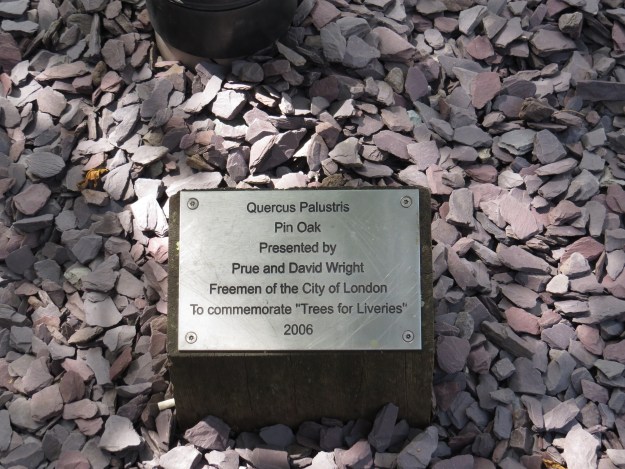
I made a brief stop to visit another North American tree, a Pin Oak on Old Change Court.

Pin Oak (Quercus palustris)

Pin oaks are part of the red oak family, and this is another tree that will look wonderful when autumn comes. But what’s this ‘Trees for Liveries’ business? A bit of digging has made some progress: The Liveries Wood Group is a collaboration between the five Livery companies who use wood in their craft, the Carpenters, Turners, Furniture Makers, Upholders and Joiners & Ceilers. The group exists to promote the use of wood, and protect this natural resource. So while I haven’t quite got to the bottom of exactly what was going on when this tree was planted, it’s interesting to know that these ancient companies, who go back to the Medieval period, are still promoting their skills.

Incidentally, an Upholder is an Upholsterer. Who knew?

Retracing my steps, I pass a row of recently planted Italian alders. I am very fond of alders, as you know, but the UK species likes wet feet, which they wouldn’t get here. My tree guide describes it as a tree of ‘vigour and polish’, and it is certainly doing very well, even though it’s the shady side of the road.

Italian Alders (Alnus cordata)

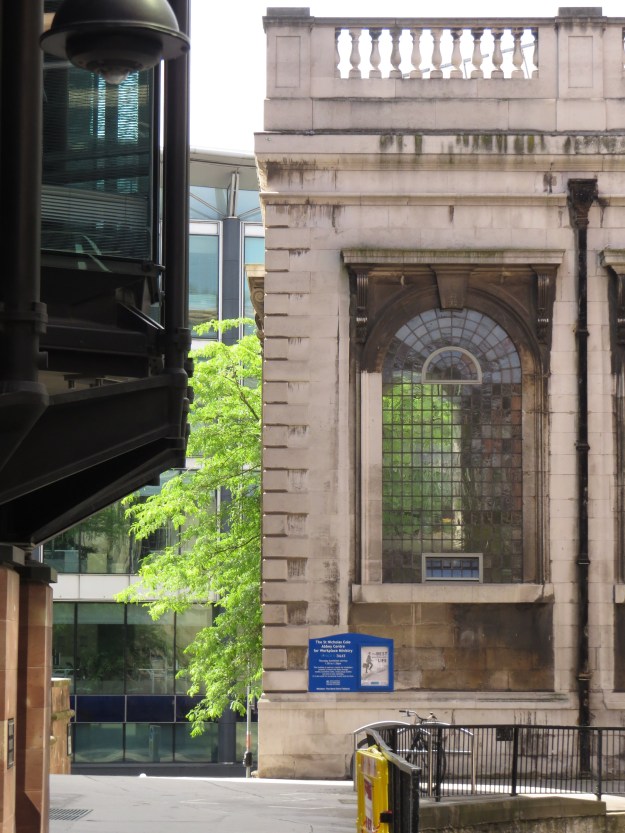
Then I nip down Distaff Lane, and pass the church of St Nicholas Cole Abbey, with its clear glass windows.

Then it’s time to cross Queen Victoria Street to visit an old favourite haunt, the Cleary Garden. This is a bittersweet place for me: when I was in my thirties I would sometimes meet Mum for lunch here, and I can still see her sitting on a bench with a sandwich. There is a new office building with some Snakebark Maples outside – I would never have noticed the astonishing stripy bark if Wood hadn’t mentioned it.

Snakebark maples

And then it’s into the Cleary Garden. There aren’t as many people around for sure (though to go by the queues outside some of the sandwich shops you wouldn’t necessarily think that), and the garden is so peaceful that I can sit down and commune with the swamp cypress (the first one I ever saw).

I’d already seen a wren singing its head off in the cypress, and I could hear baby birds, so I wasn’t so surprised to see this.

The great tits have some babies, and handily there’s a great selection of bird feeders right next door, enclosed in a cage to keep the squirrels and the big birds out.  How handy to have everything that you need right on your doorstep! My only worry would be dispersal – there are lots of trees around, but there are also a lot of crows and seagulls who love a tasty fledgling if they can catch one. Good luck, great tits!

And before I start on the second half of my walk, I pop down to my workplace to see how it’s looking. Quiet would be one description. The complicated fountain outside, meant to represent the river Walbrook which runs under the building, is fenced off for repairs yet again. Another part of the fountain has several workmen sitting in it and lovingly trowelling the gunk out of the spigots.

But here’s a thing! My favourite City pizza place has survived. Fingers crossed that we’ll be able to have a team get together soon…

And now, it’s time to cross the road and head towards one of my favourite trees in the whole of London. But for that, folks, we’ll have to wait until tomorrow….


Wednesday Weed – Meadow Vetchling

Meadow Vetchling (Lathyrus pratensis)

Dear Readers, one of the things that I love about St Pancras and Islington Cemetery is the sheer variety of habitats. We have damp woodland and dry woodland, grasslands and scrub, meadowy bits and watery bits, and I think it’s probably the best place for plants of anywhere locally because it is relatively little visited. When I saw the meadow vetchling this week it really made me think of the meadows of Austria, which are full of ‘beans’ – members of the Fabaceae family, such as clovers and trefoils and peas. These plants are able to process the nitrogen in the atmosphere (or rather, the bacteria in their root nodules are) and as such are a great help in returning the fertility to the soil. Plus, they are very popular with bees and pollinators of all kinds.

Meadow vetchling is also known as ‘meadow pea’ and ‘fingers and thumbs’. It’s a scrambler, which means that it intertwines with other plants, creating a tangled web of stems.  A similar thing is going on underground – the plant proliferates via rhizomes, which can reach up to 7 metres in length. The seedpods ripen to black, which is a good way of identifying them once the flowers have gone. The plant is native to the whole of Europe and Asia, but has also been introduced to North America, and is doing particularly well in Alaska and Oregon.

Photo One by By Didier Descouens - Own work, CC BY-SA 4.0, https://commons.wikimedia.org/w/index.php?curid=105462864

Meadow Vetchling (Photo One)

The flowers of all vetches are very particular and, botanists being how they are, you won’t be surprised to hear that the different parts of the bloom have specific names. In the flower below, the petal at the top is known as the ‘standard’, the two petals below are the ‘wings’, and the bottom two petals, which are joined together, are known as the ‘keel’.

Photo Two by By Ivar Leidus - Own work, CC BY-SA 4.0, https://commons.wikimedia.org/w/index.php?curid=96576036

Meadow vetchling flower (Photo Two)

Meadow vetchling is also the food plant for the caterpillar of the wood white butterfly (Leptidea sinapsis). This is the most delicate of our white butterflies, and has declined in number, largely because plants such as the meadow vetchling will not thrive in the complete cover of a mature woodland, and because so often the understorey of woods is neglected until only holly and the odd yew bush remain.

The male performs an extensive courtship ritual to attract the female, who is very choosy – the female will only mate once in her life, whereas the male will try to mate with as many females as possible. The males dance involves fluttering his wings and extending his proboscis. If the female remains still, it means that she’s either already mated or isn’t interested, but if she is attracted to the male she will move her abdomen in his general direction.

Photo Three by By Feel free to use my photos, but please mention me as the author and if you want send me a message. or (rufre@lenz-nenning.at) - Own work, CC BY-SA 3.0 at, https://commons.wikimedia.org/w/index.php?curid=25277317

Wood White Butterflies courting (Photo Three)

The wood white lays her eggs only on meadow vetchling and one or two species of trefoil. If given the choice, she prefers tall plants, and will lay more eggs on lanky specimens. The butterfly identifies the species of plant through chemoreceptors on her feet, and flies low over the foliage, occasionally touching down on a leaf to see if it’s the right one. The caterpillars, when they hatch, are beautifully camouflaged against the vetchling leaves. I wonder if the conditions in the cemetery would be right for wood whites? However, they tend to be local and are not expert fliers, so this would be a bit of a stretch. Plus, I’m not sure how far the gardeners at the cemetery use pesticides – fortunately the wilder bits look as if they aren’t sprayed.

Photo Four by By Gilles San Martin - Flickr: Leptidea sinapis egg, CC BY-SA 2.0, https://commons.wikimedia.org/w/index.php?curid=17005838

Egg of the Wood White butterfly (Photo Four)

In Ireland, meadow vetchlng is said to repel mice (and is known as mouse-pea in Donegal), and was also used to feed cattle in the past. But although the plant has been used medicinally to ease coughs and bronchitis, it is also said to be poisonous, causing a condition called lathyrism which can paralyse the limbs of human beings or grazing animals. However, you would have to eat an awful lot of the ‘peas’ to get this effect, so no reason to be pulling it up just yet!

And finally, a poem. This feels just right for the days after the summer solstice (here in the Northern Hemisphere anyway), as the year turns yet again. I hadn’t heard of K.V. Skene before, but she’s a Canadian poet, and I love this poem. I can just imagine every flower as she mentions it. My head is full of yellow blossom.

I am drinking yellow flowers

by K.V. Skene

After ‘At the Quinte Hotel’ – Al Purdy

daffodils       forsythia       marsh marigolds
the mellow meadow vetchling
last year’s dandelion wine       yesterday

I unfriended Facebook       Twitter       LinkedIn       quit
http://www.youtube.com       cached the laptop       iPhone       Fitbit
and hit the road unravelled       today

I am drinking buttercups       loosestrife
birdsfoot trefoil       lesser celandine       so long ago
those honeysuckle days

so short these sunflower years

Photo Credits

Photo One By Didier Descouens – Own work, CC BY-SA 4.0, https://commons.wikimedia.org/w/index.php?curid=105462864

Photo Two By Ivar Leidus – Own work, CC BY-SA 4.0, https://commons.wikimedia.org/w/index.php?curid=96576036

Photo Three by By Feel free to use my photos, but please mention me as the author and if you want send me a message. or (rufre@lenz-nenning.at) – Own work, CC BY-SA 3.0 at, https://commons.wikimedia.org/w/index.php?curid=25277317

Photo Four By Gilles San Martin – Flickr: Leptidea sinapis egg, CC BY-SA 2.0, https://commons.wikimedia.org/w/index.php?curid=17005838