A Quick Walk Around the County Roads

Dear Readers, it’s been a long, long time since I’ve taken a leisurely walk around the County Roads in East Finchley, and I’m not sure why – it would have been a logical thing to do during lockdown, but somehow it seemed as if walking in the local woods or hanging out in the garden was safer, and once a habit has been put in place it’s very hard for me to break it! But on Monday I was happy to have a little walk around and see what was happening, and I was instantly rewarded by this gorgeous, well-loved front garden – it just goes to show how a few well-loved pots can cheer people up.

But the wild plants are very cheering too. I am trying to learn the difference between the two different kinds of bellflower that pop up around these parts. I am fairly sure that this one is Trailing Bellflower (Campanula poscharskyana) – my Harrap’s Wildflower Guide describes the petals as ‘widely spread into a star shape’ so I am feeling fairly confident. It is popular with the bees and seems to grow everywhere, but it came originally from the Dinaric Alps in Serbia.

Trailing Bellflower (Campanula porscharskyana)

And then there’s Adria Bellflower (Campanula portenschlagiana) – the flowers are described as ‘funnel-shaped’ (much longer than wide). This plant comes from the Dalmatian mountains of Croatia originally. I think the one below fits the bill, though the photo isn’t great for ID purposes. In botanical circles the plants are known as ‘posh and port’ which is a lot easier than getting your tongue around the Latin names. To add to the confusion there is also a Peach-leaved Bellflower (Campanula persicifolia) but I haven’t stumbled across that yet. All three are garden escapes which have happily set up home in the crevices and pavements of North London, and I for one am delighted to see them.

Adria Bellflower (Campanula portenschlagiana)

So, what else is going on? Well, in one front garden I see some scarlet pimpernel, the first time I’ve seen any in East Finchley although I was positively tripping over them when I used to go to Dorset. I wonder if a packet of wildflower seeds was involved, or if it got here under its own steam?

Scarlet pimpernel (Lysimachia arvensis)

There was a truly fabulous large-flowered clematis – I normally think of them as not as good for wildlife as the more discreet, small-flowered types, but there was a honeybee collecting the pollen on this one. And it’s difficult not to smile at those flowers.

Bees were hard at work on some hardy geraniums as well – these were a lovely veined pink. I am still campaigning for more species geraniums in gardens, as you can see – they flower for ages and you can cover most of the spring and summer-flowering periods if you pick the right ones.

I was happy to see that lots of people are growing red valerian(Centrathus ruber) too, though I’d like to put a word in for our native white valerian(Valeriana officinalis), which I shall be having a go at once I can find a spare square inch that isn’t already covered in plants. I have seen hummingbird hawkmoths feeding from red valerian, so if that isn’t a reason for growing it, I don’t know what is.

Red valerian (Centrathus ruber)

And how about this rock rose (Cistus) (I think)? Never was a plant so happy in full sun.

And here’s something else I want to grow – some Columbine, another plant that is popular with bees in spite of its complicated flowers. I really like the smaller-flowered dark blue and pink ones, though I have seen some truly spectacular varieties. Who knew that it was a member of the buttercup family? Not me for sure.

Columbine (Aquilegia vulgaris)

And finally, I lingered in the church yard of All Saint’s Church in Durham Road to watch the sparrows. At this time of year they eat not only the young chard leaves of my dear friend A, but also nectar (I watched them pecking at the flowers on an indigo bush) and, most especially, insects. I am fairly sure that this female sparrow was pecking the aphids off of the roses. If only she would come round and do the same on my buddleia I would welcome her with the proverbial open arms.

Which just goes to show how much there is to see in a walk around my local streets. I heartily recommend it if you’re feeling a bit uninspired or fed up.

Wednesday Weed – Sweet Woodruff

Sweet Woodruff (Gallium odoratum)

Dear Readers, I bought some sweet woodruff because I thought it would be perfect for the shady side of the garden. It was lovingly planted, watered and tended, and within about three days it had practically disappeared, with no sign of obvious nibbling. On the other hand, my good friend A has banks of the stuff in her garden, and so I know that the local conditions are not the problem. Still, that’s gardening for you, a succession of small disasters and happy accidents. If you have any illusions that you’re in control, I suggest you get a garden. It certainly put me right.

Anyhow, sweet woodruff is a really delightful plant. It’s a member of the bedstraw family (Rubiaceae), and is a plant of ancient woodland, with leaves that are said to be hay or vanilla-scented when bruised. It’s native to the UK but grows in a great swathe across Europe and Asia all the way to Japan, taking in Iran, Turkey and the Caucasus en route. In German it’s known as ‘waldmeister‘ or ‘Master of the Woods’ which seems a bit martial for this delicate beauty. It’s also known as ‘Wild Baby’s Breath’ – I assume that the ‘wild’ refers to the plant, not the baby (or indeed the breath).

As you might expect for something so sweet-smelling, sweet woodruff has been used for a variety of purposes. The sweet smell lingers on after the plant is dried, so it has often been used in pot pourri and cosmetics. It seems to have been particularly favoured as a flavouring in Germany, where it’s used in May Wine (Maitrank), an alcoholic beverage traditionally served on May Day. Maitrank involves steeping sweet woodruff in white wine, and very refreshing it looks too.

Photo One by By Dr. Bernd Gross - Own work, CC BY-SA 4.0, https://commons.wikimedia.org/w/index.php?curid=49057025

German May Wine (Photo One)

The plant was also used to flavour beer (Berliner Weisse), ice cream, brandy and a Georgian soft drink called Tarhun. It was used to flavour sherbet powder, though in the UK I’m sure we’re all much more familiar with the zesty lemon-flavoured substance that used to be eaten with a liquorice stick. Alas, the substance that gives woodruff its flavour is called coumarine, and in 1974 the Germans banned its use in products for children because it was found to cause liver damage (and children, being smaller, are more susceptible). Adults can still lay their hands on sweet woodruff-flavoured alcohol, but artificial substitutes are now used in sweets.

In Flora Britannica, Richard Mabey describes how dried woodruff was hung in wardrobes and laid amongst stored linen to deter moths. The leaf whorls were apparently used as bookmarks, and during Georgian times the leaves were placed in the cases of pocket-watches, so that the user could inhale their fragrance whenever they needed to tell the time. Mabey reports that woodruff no longer grows wild in London, but that it was once hung in churches on St Barnabas Day, the 11th June. And a turning close to the Tower of London, now called Cooper’s Row, was once called Woodruff Lane.

And finally, a poem. A few posts back, I wrote about friendship, and how it’s undervalued in our society compared with the love we feel for family and romantic partners. This feels like an intensely personal poem, and yet it made me think of so many of my female friends, past and present, and the things that we’d shared. See what you think.

Up, Over the Steep Hill
by Kathleen Ripley Leo

‘May we strive to touch and to know the great common woman’s heart of us all…’ Mary Stuart

Catch her by the waist, a woman friend,
whose laughter you hear in the night
ringing in your ears: over your elaborate strategy to lose weight;
over the grand joke you keep to yourselves;
over swearing her to secrecy for driving you
to the Secretary of State when you’re late renewing.

Catch her by the waist, a woman friend,
whose baby daughter crawls through your dining room
looking for all the world
like a pink shell on the carpet, she moves so sweetly;
whose son shares his bike lock with your son at school,
the son she cheers on to win the race, to make the grade,
to stay alive one more day in the isolette.

Catch her by the waist, a woman friend,
whose hostas and phlox bloom in your garden;
with whom you kneel and pray for peace;
with whom you silently walk in the woods
hoping the raccoon, sunning itself
on the branch overhead, does not wake up,
hoping the deer in the clearing does not bound away,
who watches with you, both apprehensive and in awe,
as two snakes curl and dance in the sun
on the cement pavement at Maybury;
who takes care of the cat, the mail, the paper,
the broken ground between your houses,
picking you up at the side of the road
when you’ve locked your keys in the car,
quelling the shaking wings of your heart.

Catch her by the waist, a woman friend,
who has lunch with you after the angel tour at the Art Institute;
who helps you overcome your panic attack at the mall,
or on that crowded street in Washington DC,
or at that Brighton home tour;
who asks you to write your poems and to read them outloud;
who helps you pick out glasses to fit your odd and funny face;
who carefully tends to the basil parmesan bread,
so you can take it to your progressive dinner party
and claim you made it;
who washes your clothes in her machine when yours gives out.

Catch her by the waist, a woman friend,
who tells you what happened to the bank of sweet woodruff you dug out
the spring your father died, because in the fall
you couldn’t remember doing that;
who tells you how to think about toxic criticism;
who helps you cope with aggressive jealousy;
who drives you to the hospital when your baby needs x-rays,
and then when your husband’s there;
who drives you to the doctor for the procedure,
and carefully holds you when you cry;
who sees your letters unanswered,
and your invitations refused, sees your hurt and stays quiet;
who catches your waist, too, and together, laughing and crying,
you pull each other up, over the steep hill.

Photo Credits

Photo One by By Dr. Bernd Gross – Own work, CC BY-SA 4.0, https://commons.wikimedia.org/w/index.php?curid=49057025

Tuesday Gardening Update

Dear Readers, I thought you might like to see my angelica aka ‘the triffid’ – the handrail is about three feet high, and the ground is about a foot below the stairs, so I think this plant is about ten feet tall. What a beauty! It’s still abuzz, mainly with honeybees but bumblebees and some tiny wasps/hoverflies have got in on the act too.

My plant guide suggests that in the wild it can grow to about eight feet tall, so this is clearly an outlier, but then I seem to have picked the perfect spot for it, largely by accident – it’s right by the pond, so it’s nice and damp at the root, but it gets sun for most of the day. Plus by the time it goes over the hemp agrimony will be coming into flower, so I’ve extended my flowering season. I just love it when there is a happy accident.

If you look very closely at the middle of the first photo you’ll see that there’s a little wasp/hoverfly, but I need him/her to stay still for a bit longer so I can get a better view. I do love the way that each individual flower on the angelica looks like a tiny acorn though.


Now, I wouldn’t want you to think that I’m so enamoured by the angelica that I’ve forgotten everything else. My blue water irises have buds on them now, which is very exciting, and one of the yellow flags has produced a flower too, the first of many I hope.

Blue water irises

And at the end of the garden, the mock orange is smothered in flowers and bumblebees, and the scent is extraordinary. In fact, there are so many bumblebees that I’m wondering if there’s a nest close by. That would really be a bonus.

I did see one ashy mining bee earlier on (typically when I didn’t have my camera handy), but I’m hoping that they’ll discover the climbing hydrangea flowers, which were a big favourite a few years ago. I’m seeing lots of ladybirds about too, but masses of aphids which are taking over the buddleia in the front garden again as they did last year. I think I’ll send my husband out with the hosepipe to give them a good dousing, that seems to slow them up a little bit.

And so, with the heady scent of the mock orange blossom indicating that summer is truly here, I shall bid you adieu until tomorrow.

LNHS Virtual Talk – ‘When Will It Flower? Plants and Climate Change’, by Alastair Fitter

Dear Readers, every gardener or natural history enthusiast that I bump into has something to say about the way that plants are changing their habits. So often, though, the information is anecdotal, because we don’t tend to actually record things when they happen. So, it was wonderful to attend this talk by Alastair Fitter, son of Richard Fitter, who wrote the first book about London’s wildlife in the New Naturalist series back in the 1940s and who was, among many other things, president of the London Natural History Society. From 1954 to 2000, Richard Fitter recorded the first flowering dates of various wildflowers growing in his garden and this produced a data set that turned into the first major study of the impact of climate change on the flora of the UK. That document was published in 2002, a collaboration between Richard and Alastair Fitter, when Fitter Senior was nearly 90 years old. The Fitters were interviewed on Radio Four’s Today programme, and when Richard was asked why he’d done all that recording, he replied that as a boy he’d been told that it was always good to write things down. As Alastair Fitter remarked, thank goodness he did!

Another very useful resource is the Woodland Trust’s ‘Nature’s Calendar’, which recorded ‘First Flowering Days’ for a selection of different plants between 2001 and 2016.

What is very clear is that plants are coming into flower earlier, and that this process has speeded up over the past 25 years. From the Woodland Trust data, we see that:

Hazel (Corylus avellana) produced its catkins 31 days earlier in 2016 compared to 2000.

Hazel (Corylus avellana) (Photo One)

Lesser celandine (Ficaria verna) has advanced its flowering date by 27 days between 2001 – 2016, but Richard Fitter recorded the flowering had already come forward by 20 days between 1954 and 2000, making a total advance of an astonishing 47 days between 1954 and 2016.

Photo Two by By Michal Osmenda from Brussels, Belgium - https://www.flickr.com/photos/michalo/2425723494/, CC BY-SA 2.0, https://commons.wikimedia.org/w/index.php?curid=46945738

Lesser celandine (Ficaria verna) (Photo Two)

English bluebells have advanced their flowering date by three weeks since 2001.

Photo Three by MichaelMaggs, CC BY-SA 3.0 <https://creativecommons.org/licenses/by-sa/3.0>, via Wikimedia Commons

English bluebell (Hyacinthiodes non-scripta) (Photo Three)

From Fitter’s data, if you took all the different species in the sample, there had been a general movement towards earlier flowering of about 6 days by 2000, but this hid some major movements by individual plants. For example, white deadnettle (Lamium album) flowered 55 days earlier in the 1990s than it had in the 1950s (and indeed now flowers all year round).

Photo One by Rosser1954, CC BY-SA 4.0 <https://creativecommons.org/licenses/by-sa/4.0>, via Wikimedia Commons

White deadnettle (Photo Four)

There are some very strange anomalies, however: our old friend Buddleia flowered a whole 36 days later in the 1990s compared to the 1950s, and it’s still unclear why. All theories duly considered!

Photo Five by Agnieszka Kwiecień, Nova, CC BY-SA 4.0 <https://creativecommons.org/licenses/by-sa/4.0>, via Wikimedia Commons

Butterfly Bush (Buddleia davidii) (Photo Five)

And while we’re on the subject of garden plants, Fitter describes how Fred Last studied his garden and recorded first flowering dates from 1978 to 2007. Mahonia advanced its flowering time during this period by an extraordinary 3 months (which now makes it one of the handiest garden plants for early bumblebees).

Photo Six by Photo by David J. Stang, CC BY-SA 4.0 <https://creativecommons.org/licenses/by-sa/4.0>, via Wikimedia Commons

Mahonia japonica (Photo Six)

More recent data comparisons by Alastair Fitter show that over 50% of plants are coming into flower by the end of April, an advance of about 5 weeks. But the question is, why?

Fitter explained that flowering times are determined by a number of factors. Firstly, there’s the question of when the flower buds form. For spring bulbs, next year’s flowers are formed during the previous summer, but the actual flowering time is determined by the temperature in the spring.  Fitter used the example of the Tulip Society shows to illustrate this. The date of the Wakefield and North of England Tulip Society’s annual show is determined by when the ‘English florist tulips’ are thought to be coming into their best. The Society was founded in 1836, and Fitter showed a lovely slide, where the date of the show has been coming forward on a smooth curve that exactly matches the average mean temperature in March: for every degree increase, the show comes forward by three days. The show is now commonly held in the second week of May, compared with the very end of May in the mid 1800s.

Photo Seven from https://www.pontefractandcastlefordexpress.co.uk/news/tulips-be-displayed-wakefields-181st-show-778917

Tulips at the 181st Wakefield and North of England Tulip Society Show (Photo Seven)

Another factor that determines flowering time is day-length, with some plants coming into flower as the days lengthen, and others as the days get shorter. Fitter points out that for the majority of plants, we simply don’t know how day-length affects them but for a few, such as red campion (which responds to lengthening days) and hops (which react to shortening days) we can see a correlation.

Temperature is, however, critical. Fitter showed how the flowering time of Coltsfoot was dependent on the mean temperature in February but, more generally, an increase in temperature of 1 degree in the four months before flowering could advance the flowering date by about three days. However, a warm summer and autumn could act to delay flowering by about the same amount. Go figure!  I wondered if a warm summer and autumn might mean lower rainfall, which could delay bud formation. What is clear is that a lot more research is needed, and there is still a lot that we don’t know. The pattern is clear, however: most plants are flowering earlier, and flowering patterns are becoming a lot less predictable.

Photo Eight by Andreas Trepte, CC BY-SA 2.5 <https://creativecommons.org/licenses/by-sa/2.5>, via Wikimedia Commons

Coltsfoot (Tussilago farfara) (Photo Eight)

Fitter’s final point was, do these earlier flowering times matter? And of course, there are a number of problems not just with earlier flowering, but also with the increased unpredictability of flowering times. Some pollinators, for example, will take advantage of earlier flowering, but where there is a very specific relationship, such as that which occurs with orchids, the plant may come into flower but the pollinator will not yet have emerged. Sometimes, as in the case of the orange-tip butterfly, the insect is responding to earlier flowering times of cuckooflower, so that its caterpillars, which feed on the seedpods of the plant, are still ‘in sync’.

Photo Nine by Jessica Towne, CC0, via Wikimedia Commons

Female orange-tip butterfly (Anthocharis cardamines) (Photo Nine)

However, something that had never occurred to me was that, as flowering times change, some plants will be more or less likely to hybridise because their flowering times will move further apart, or begin to overlap. Sweet violets (Viola odorata) will be less likely to crossbreed with hairy violets (Viola hirsuta) because their flowering times are now 15 days further apart. Red campion (Silene dioica) and white campion (Silene latifolia) are, however, coming closer together, and so hybridisation is more likely. As Fitter points out, hybridisation is a major driver of evolutionary change, and so some groups may become less able to adapt over time as their flowering times grow further apart.

Photo Ten by The original uploader was Sannse at English Wikipedia., CC BY-SA 3.0 <http://creativecommons.org/licenses/by-sa/3.0/>, via Wikimedia Commons

Hybrid Campion ( red campion (Silene dioica) and white campion (Silene latifolia) (Photo Ten)

And so, Fitter ended by saying that earlier flowering times are a clear harbinger of climate change, and an indicator that things were changing rapidly in the natural world. We owe a debt of gratitude to Richard Fitter for ‘writing things down’, and it seems to me that this illustrates yet again the importance of citizen science, of recording these extraordinary times that we live in. And Fitter finished as he’d started, with a quote from Shakespeare, in which Titania blames Oberon for the strange changes in the climate. I think we need to look a little closer to home.

‘And thorough this distemperature we see
The seasons alter: hoary-headed frosts
Far in the fresh lap of the crimson rose,
And on old Hiems’ thin and icy crown
An odorous chaplet of sweet summer buds
Is, as in mockery, set: the spring, the summer,
The childing autumn, angry winter, change
Their wonted liveries, and the mazed world,
By their increase, now knows not which is which.’

I cannot recommend this talk highly enough, and you can watch the whole thing here.

Photo Credits

Photo One by Agnes Monkelbaan, CC BY-SA 4.0 <https://creativecommons.org/licenses/by-sa/4.0>, via Wikimedia Commons

Photo Two by By Michal Osmenda from Brussels, Belgium – https://www.flickr.com/photos/michalo/2425723494/, CC BY-SA 2.0, https://commons.wikimedia.org/w/index.php?curid=46945738

Photo Three by MichaelMaggs, CC BY-SA 3.0 <https://creativecommons.org/licenses/by-sa/3.0>, via Wikimedia Commons

Photo Four by Rosser1954, CC BY-SA 4.0 <https://creativecommons.org/licenses/by-sa/4.0>, via Wikimedia Commons

Photo Five by Agnieszka Kwiecień, Nova, CC BY-SA 4.0 <https://creativecommons.org/licenses/by-sa/4.0>, via Wikimedia Commons

Photo Six by Photo by David J. Stang, CC BY-SA 4.0 <https://creativecommons.org/licenses/by-sa/4.0>, via Wikimedia Commons

Photo Seven from https://www.pontefractandcastlefordexpress.co.uk/news/tulips-be-displayed-wakefields-181st-show-778917

Photo Eight by Andreas Trepte, CC BY-SA 2.5 <https://creativecommons.org/licenses/by-sa/2.5>, via Wikimedia Commons

Photo Nine by Jessica Towne, CC0, via Wikimedia Commons

Photo Ten by The original uploader was Sannse at English Wikipedia., CC BY-SA 3.0 <http://creativecommons.org/licenses/by-sa/3.0/>, via Wikimedia Commons

An Early June Walk in St Pancras and Islington Cemetery

Dear Readers, this might not look like much but it gives me hope for the future. Traditionally, cemetery lawns have always been close cut and relatively lifeless, but I noticed that, in the sweeping sward of the green closest to the entrance, some little patches of grass have been left unmown, and the daisies, buttercups, speedwell and cut-leaved geranium were all the happier for it. Well done, L.B. of Islington!

Cut-leaved geranium in the sward.

It’s definitely dog rose time too, with bushes bursting into flower all over the cemetery.

However, I have officially designated this week as buttercup week. Just look at them! And they are popular with bees too, something that I’d never noticed before.

And look at this handsome little chap, sunning himself in the woodland grave area – it’s a small copper (Lycaena phlaeas), and at this time of year the males establish territories close to areas where females might want to lay their eggs (usually on sorrel, of which there is a plentiful supply). The male flies up in the hope of intercepting any passing females, but will also see off other males, and butterflies of other species. This one was particularly brightly coloured, and for a moment I imagined myself amongst the alpine meadows of Austria, which is where I usually see these creatures.

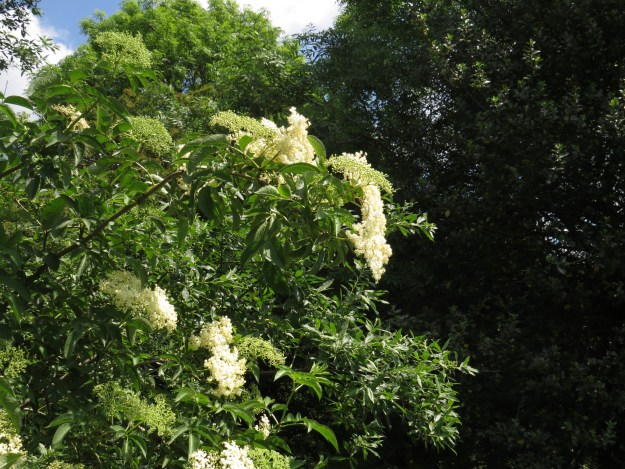
The elder is in flower too, and in the sun there was that faint smell of gooseberry. There seems to be salsify everywhere as well – last year it was just along the path next to the North Circular, but this year it’s busting up all over.

Two other great pollinator favourites are the flowers on the pyracantha (firethorn) which are now studded with bumblebees, and the various forms of comfrey in the damp areas close to the stream.

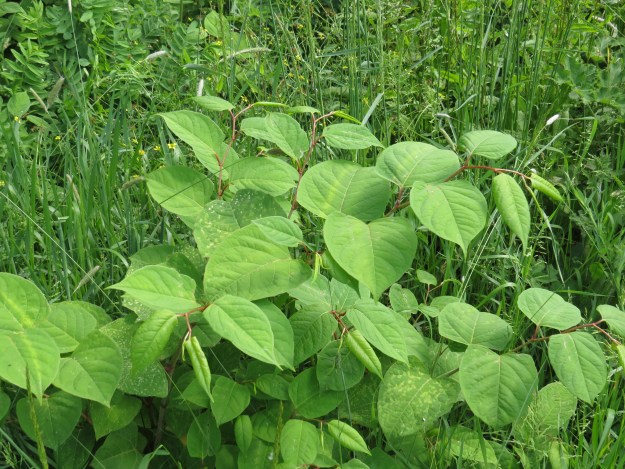
Sadly the Japanese Knotweed continues to gather pace right along the stream and the edge of the playing field. It really is such a thug – there are thickets twenty or thirty feet deep in some places now. I am a little intrigued by the leaf damage on this plant though. Could it be leaf miner damage? I shall do some research and let you know. It would be great if some creature decided that it was dinner and started to bring it into check.

There was a rather tired-looking speckled wood butterfly along one of the walks. I hope that it has done its duty by the next generation and can have a bit of a rest now. It flew up at another butterfly but seemed a bit half-hearted, I thought. Spring is tough on all kinds of animals, and this spring has been colder and harder than many.

As we left a woodland path and started walking in the sunshine, something enormous shot past. At first I wasn’t sure what it was, but then I spotted it perching in the long grass. It wasn’t until it flew up and started quartering the grass again that I realised it was a male broad-bodied chaser, using this spot to survey its kingdom with those enormous eyes before setting off on patrol again. I always get a frisson when in the company of large dragonflies – this one circled us with what I’d describe as curiosity before returning to exactly the same place on a sturdy stem. I like this shot because you can see the way that the wings are stacked on the body.

Now, have you ever noticed the way that teasels develop little ponds at the base of their leaves after it’s rained? I hadn’t this week, but I was very curious about it. I had no idea that an alternative name for the plant is ‘Venus’s Basin’, and that the water was said to have healing properties. In one experiment, where some plants were allowed to ‘keep’ their water and others had it emptied out, the plants where the water was allowed to stay set more seed and were taller.  There is one theory that teasels are on the evolutionary path towards becoming insectivorous although this is usually an attribute of plants that live in extremely inpoverished soils such as bogs. More likely is a second theory that the water acts as a way of stopping insects climbing up the stem, though as aphids in particular can fly I wouldn’t have thought that this was so much of an advantage. What do you think, readers? All theories gratefully considered. If only there was a little frog that could live in the pools, like the tree frogs in the tropics who live in the middle of bromeliads.

Water at the base of teasel leaves.

I am going to make a point of taking a photo of the Scotsman so that I can see how the wood changes during the year, so here is this week’s shot. Lots of tree cover but no lesser celandine or crocuses. The next plant to put in an appearance will be hogweed I suspect.

And so we meander home, past the daisies, pausing only to look at the sculptural form of some ivy working its way up a tree. The cemetery is about the only place round about here where you can walk for a couple of hours and see just a handful of people. Unlike so many of our green places, which have been trampled relentlessly for the past eighteen months, the cemetery retains a kind of serenity that is very pleasing in these fraught times. Long may it remain so.

The Queen of the Wood

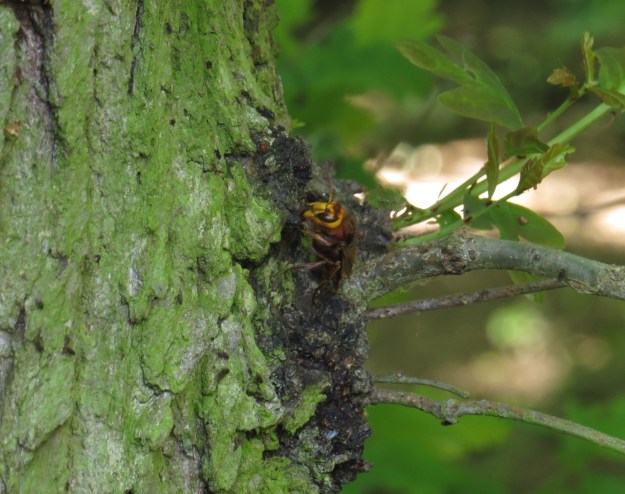
Queen hornet (Vespa crabro)

Dear Readers, is there any flying creature in the UK that is more feared than the hornet? Wasps may induce a bout of counterproductive flapping at a picnic, a bee in close proximity can be loud and intimidating, but the mere sight of a hornet droning like a Lancaster Bomber across a woodland glade is enough to make many people take a step back. I spotted this queen hornet in Coldfall Wood, and very impressive she was too. They are big insects – workers can be an inch long, but a queen can easily be an inch and a half (don’t laugh, folk in tropical climes! It’s what we count as large here in the UK). In spite of their reputation, hornets are actually much less aggressive than wasps, unless you are unfortunate enough to disturb a nest, at which point I would hope I had my track shoes on. Hornets not only emit an ‘alarm pheromone’ which attracts the attention of other hornets in the event of danger, but also perform a dance outside the nest to gather reinforcements. Hornets are mentioned three times in the Bible, and every time they were enlisted to drive out enemies of ‘the children of Israel’, so we can imagine that our ancestors were well aware of the salutary effect of an airborne army of hornets on the rampage. Having said all this, however, hornets generally just want to get on with their business of making a nest and raising their young, pretty much like the rest of us.

This hornet was very interested in the decaying wood on this oak tree, so I suspect she was gathering wood to make her impressive paper nest, which is often made in the vacated nest holes of birds such as woodpeckers or nuthatches. She chews up the wood to make ‘paper’ and then constructs her nest – the proportion of saliva to wood determines how water-resistant the nest will be. All members of the wasp family like to make their nests in dark places, and so if they can’t find a shady spot they will enlarge the ‘envelope’ around the outside to make it darker inside.

Photo One by By Ocrdu - Own work, CC BY-SA 4.0, https://commons.wikimedia.org/w/index.php?curid=76554042

Hornets’ nest (Photo One)

Sadly, everybody these days seems to have read about the Asian hornet (Vespa volutina), which has got as far as France. It is feared because it preys on honeybees, and can destroy whole hives, particularly ones already weakened by lack of food or by disease. All the nests spotted so far have been destroyed, but many of the ‘sightings’ were of European hornets . Nonetheless, folk only have to see a large stripy insect to lose all rational thought. Here, for the record, is an Asian hornet. If you see one, and particularly if you think you know of a nest, do let DEFRA know. As you can see, Asian hornets are much darker in colour than European hornets.

Photo Two by By Siga - Own work, CC BY-SA 3.0, https://commons.wikimedia.org/w/index.php?curid=12029632

Asian Hornet (Vespa volutina) (Photo Two)

The European hornet is a creature of ancient woodland, and spends much of its time hunting for prey such as caterpillars, moths, and even dragonflies. They are also known to steal food from spider webs, and as some species of wasp will take spiders as prey, arachnids usually keep a low profile while this is going on. It’s easy to forget what beneficial creatures members of the wasp family are: for most of their lives they are carnivorous, taking cabbage white caterpillars and all manner of other larvae by the bucketload.

In ‘Bugs Britannica’ by Peter Marren and Richard Mabey, there is this wonderful tale.

‘ I watched a hornet mining its way into a ripe apple’, says Lawrence Trowbridge. ‘Having dug out a tunnel about the width and length of the hornet’s body, it flew to a perch about a metre away. After a short while, flies began to be attracted to the hole in the apple. The hornet waited patiently until several flies were inside feasting on the sweet juice. Then it suddenly darted out, perched on the apple and killed one fly after another as they tried to escape. Soon afterwards it returned to the apple and carried off the corpses, one at a time, presumably to its nest to feed its brood’. 

Whether the hornet had worked out what would happen or was simply taking advantage of the situation, it reminds me that the ability to capitalise on a situation is characteristic of the wasp family – I well remember a wasp returning again and again to the remains of my salmon sandwich to carve off slivers of fish, surely a food that it had never come across before. Soon I realised that it had told its friends too. In the end half a dozen wasps were attending my sandwich in relays, until not a scrap was left.


In some parts of Asia, particularly Japan and China, wasp and hornet larvae have traditionally been eaten, and in the village of Kushihara in Japan they are even ‘farmed’ – small nests are gathered, and ‘grown’ inside special huts. The wasps are fed with raw meat and the nests looked after with great care until the larvae and pupae are ‘harvested’ in autumn, with a special wasp festival, hebo matsuri, being held on 3rd November. You can read more about it here, and fascinating it is too.

I prefer my hornets unmolested though. Watching this one flitting around the oak tree, going about her own business filled me with a sense of wonder, and the feeling that at least some things are still happening in the way that they should. After the coldest May on record, which has led to the failure of so many nests, it’s good to have something to be glad of.

By the way, for anyone  who is interested in wasps, I can recommend this fascinating book by Eric R. Eaton – ‘Wasps: The Astonishing Diversity of a Misunderstood Insect‘. Excellent bedtime reading.


A Bank Holiday Walk in East Finchley Cemetery

Dear Readers, as you might remember there are two cemeteries within easy walking distance of my house. One is St Pancras and Islington Cemetery, with its many wild spaces, and the other is East Finchley Cemetery, which is a lot more manicured. Both are splendid places for a walk when everywhere else is jammed – parks and the seaside are full to busting this year, what with people not being able to travel abroad very much. During our hour’s visit, we probably saw no more than a dozen people, and two of them were strimming the grass.

We saw this insect dangling above a patch of bramble, and very fine s/he was too, with the sun glinting off the little triangular patch at the base of the wing covers. I suspect that this is a Dock Bug (Coreus marginatus). Apparently it mostly eats dock (as the name suggests) but this one was advancing along the stem of some sorrel. The other member of the family that you’re likely to see is the Box Bug (Gonocerus acuteangulatus), which I spotted in the other cemetery a few weeks ago. It’s funny how once you’ve spotted a particular kind of plant or animal, it seems to pop up everywhere.

Last time I was here, this patch of hedgerow geranium was just coming into flower. Look at it now! it was abuzz with bees, in spite of being in a relatively shady spot. Every UK wildlife garden should have some species geraniums in it, I’m convinced.

Hedgerow geraniums (Geranium pyrenaicum)

And I was much taken by this lovely little tree. We used to call this a Spanish Chestnut, but according to my tree book it’s a Red Horse Chestnut, a cross between Red Buckeye (Aesculus pavia) and a standard Horse Chestnut (Aesculus hippocastanum). The tree guide calls it ‘an abundant plant of rather endearing ugliness’. Hah! I obviously have strange tastes, because I think it punches well above its weight in terms of spectacular blossom.

By the way, has anyone ever noticed how the flowers of ribwort plantain look like tiny solar systems, with the planets all orbiting around the central sun? Or maybe it’s just me.

Then we headed off to the crematorium. What a splendid Italianate building this is! It is owned not by the council, but by the London Cremation Company, who also own the crematorium in Golders Green, which is also very fine.

We weren’t expecting this though!

Sadly no one was at home when we visited. Though this might seem like a most unpleasant place to nest, most birds have no sense of smell (with kiwis and turkey vultures being two notable exceptions), and also some birds used cigarette ends to help to remove parasites, so maybe it wasn’t such a terrible idea.

And here is another splendid tree. I’m thinking this could be Yellow Buckeye, yet another member of the horse chestnut family, but no doubt my North American readers can put me right if not.

And finally, my eyes were drawn to this bank of wallflowers from several hundred metres away. I’ve never seen them in such bold colours, they were so bright that I’m sure they left a shadow on my retina, as if I’d looked at the sun for too long. The bees didn’t seem to mind though. As with geraniums, I think that wallflowers are not always given the respect that they deserve as plants for pollinators – they flower for a long period and, in my garden at least, the bumblebees are always hovering around my Bowles Mauve wallflower, which is two years old and hasn’t completely stopped flowering for a single day in all that time. Sometimes, plants are popular for a reason, and I daresay there are things I’ve planted that were much more expensive that haven’t done as well as my ‘cheap and cheerfuls’.


Wednesday Weed – California Poppy

California poppy (Eschscholzia californica)


Dear Readers, some of the tree pits along the County Roads in East Finchley have been planted up with seeds, and I’m always fascinated to see what ‘escapes’ and starts to grow in the cracks and crevices of the pavement. Poppies seem to be particularly fond of doing this: there are very pretty lemon-yellow Welsh poppies in several locations, and there was an abundance of opium poppies outside my friend A’s house a year or so ago. These are plants of poor soil and disturbed ground, so a north London street is very little problem for them.

Welsh poppies on Trinity Road, East Finchley

Opium poppy (Papaver somniferum)

California poppy is one of those plants that grows from seed without any messing about – throw a handful in the soil and off it goes. This one had attracted a marmalade hoverfly (as you can see from the photo), and cheap and cheerful doesn’t even begin to cover its attractions – it seems perfect for a child’s garden to me, when you want something reliable, bright and long-flowering. The commonest varieties are golden or orange, though I have seen some dusky pink ones too.

As you might expect from the name, California poppies come from the Western United States, from Washington in the north all the way down to Baja California in the south. It’s said that the whole 1745 acres of the Antelope Valley California Poppy Reserve is carpeted in orange when the poppies are in flower. What a sight that must be! It’s said that the early Spanish explorers could navigate by the sight of the orange hills, and that they called the plant ‘Cup of Gold’ (copa de oro). Very appropriate.

Like many flowers, California poppies open up when it’s sunny, and stay closed when it’s chilly. The flowers also close at night time, giving it another Spanish name, ‘Dormidera’, meaning ‘to fall asleep’.

Photo One by By User:Vsion - Own work, CC BY 2.5, https://commons.wikimedia.org/w/index.php?curid=209016

California poppies at the Antelope Valley reserve in California (Photo One)

There is a subspecies of the poppy that can be found in the Monterey Bay area, and is yellow and much lower growing.

Photo Two By Peter D. Tillman - Own work, CC BY 3.0, https://commons.wikimedia.org/w/index.php?curid=38654420

Maritime poppies (E. californica subsp. californica var. maritima) (Photo Two)

Poppies of all kinds are attractive to insects because of their pollen – both the UK’s field poppy and the California poppy produce abundant amounts of this protein-rich bee food. The flowers are edible by humans (in moderation) and are sometimes used as a garnish, though they aren’t much used for their seeds as other species are. In the UK the plant is largely grown as an annual, but as it self-seeds everywhere I suspect that once you have it it will be with you forever. It is drought-tolerant but doesn’t like heavy clay soils, which is a bit of a pity as that’s exactly what I have. No wonder ‘my’ plant is lurking outside my front door in a crack in the pavement.

The golden poppy (another name for the California poppy but the same species) has been the state flower of California since 1903, and can be seen on many of the road signs.

Photo Three by CC BY-SA 2.5, https://commons.wikimedia.org/w/index.php?curid=397719

Route 1 road sign in California (Photo Three)


Medicinally, the plant seems to be associated, like so many poppies, with treatments for various forms of anxiety, from insomnia to bed-wetting. It’s said that it isn’t an opioid like other poppies, and has been used to help those addicted to morphine/heroin to ‘kick the habit‘. Native American peoples thought it gentle enough to be made into a tea to soothe their children. The Plant Lore website reports that

‘My grandfather used to pick and dry California poppies (the whole plant), then grind it all up and roll it into cigarette papers and smoke it. This gave him and his friends a mild euphoric feeling, with no known side effects [Andover, Hampshire, December 2013].’

Was there anything that folk haven’t dried and tried to smoke, I wonder? I remember a friend of mine smoking a cigarette through the shell of a green pepper because he was told that it would make him feel euphoric. I have no idea if it worked, but it certainly ruined my intended stir-fry.

‘My’ California poppy popping up outside the front door.

And finally, a poem. I rather liked this by Sandra McPherson, a poet that I hadn’t come across before. I think she captures the strange cruelty of cutting a flower for our own pleasure – the image of the twitching frog’s legs will stay with me for quite a while. See what you think.

Poppies by Sandra McPherson (1943 – )

Orange is the single-hearted color. I remember
How I found them in a vein beside the railroad,
A bumble-bee fumbling for a foothold
While the poppies' petals flagged beneath his boot.

I brought three poppies home and two buds still sheathed.
I amputated them above the root. They lived on artlessly
Beside the window for a while, blazing orange, bearing me
No malice. Each four-fanned surface opened

To the light. They were bright as any orange grove.
I watched them day and night stretch open and tuck shut
With no roots to grip, like laboratory frogs' legs twitching
Or like red beheaded hens still hopping on sheer nerves.

On the third afternoon one bud tore off its green glove
And burst out brazen as Baby New Year.
Two other poppies dropped their petals, leaving four
Scribbly yellow streamers on a purple-brimmed and green

Conical cadaver like a New Year's hat.
I'd meant to celebrate with them, but they seemed
So suddenly tired, these aging ladies in crocheted
Shawl leaves. They'd once been golden as the streets

Of heaven, now they were as hollow.
They couldn't pull together for a last good-bye.
I had outlived them and had only their letters to read,
Fallen around the vase, saying they were sorry.

Photo Credits

Photo One By User:Vsion – Own work, CC BY 2.5, https://commons.wikimedia.org/w/index.php?curid=209016

Photo Two By Peter D. Tillman – Own work, CC BY 3.0, https://commons.wikimedia.org/w/index.php?curid=38654420

Photo Three by CC BY-SA 2.5, https://commons.wikimedia.org/w/index.php?curid=397719

A Tiny Visitor

Celery Fly (Euleia heraclei)


Dear Readers, I was absolutely fascinated by this tiny fly on my angelica yesterday. I know that it’s a celery fly, and that its larvae will happily mine the leaves on what is currently my favourite pondside plant, but what a performer it is! My photo is far from perfect, but hopefully you can see that it has a shiny black body, wings rippled with chocolate, a bright yellow head and green eyes. All this in a critter smaller than my little fingernail.

It seemed to be displaying, though I couldn’t see anyone apart from me who was enjoying the show. The fly twisted its wings from side to side, hopped from one leaf to another, investigated the fallen pollen from the angelica flowers, disappeared briefly and then hopped back again.

And to my delight, a bit of research showed me that this male fly is actually displaying, and furthermore you can watch it too:

https://en.wikipedia.org/wiki/File:Euleia_heraclei_-_2015-06-17.webm#file

Celery flies lay their eggs on the leaves of the host plant, and the larvae burrow in and mine the inside, leaving a brown or yellow blotch. After four weeks, the larvae drop to the ground and pupate in the soil, with a second generation emerging later in the summer. I found it very interesting that the first generation of larvae burrow to a measly four or five centimetres down into the ground, but the second generation, who have to survive through the winter, will dig down to about 10 centimetres. Nature really is quite remarkable.

I would never have seen this fly if I hadn’t grown my angelica, and so it seems that whenever yo you plant something, you don’t just get the flora, you get the fauna that it attracts too. The angelica is now taller than me, and is attracting not just bees, but an early blue butterfly too – this one is a holly blue, and I hope that it’s found the ivy that’s overtaking my shed for its eggs. I am so delighted with this plant, and if you have a damp patch in the garden and don’t mind something huge, I’d definitely plant this beauty.

The End of May in St Pancras and Islington Cemetery

The highpoint of the cow parsley show?

Dear Readers, I have been fascinated by the speed at which the massed ranks of flowers come and go in the cemetery. One week it’s full of forget-me-nots and the next it’s ablaze with buttercups. This week, the rhododendrons have just opened, and, in spite of the honey made from it being hallucinogenic, the bumblebees were very enthusiastic (see the pollen baskets on the bee on the right of the photo).

The meadow in the woodland grave area is full of red campion…

And the swamp cypress is greening out nicely…..
Under the horse chestnut trees, the masses of ground ivy and violas have been completely submerged under a sea of black medick, a tiny yellow clover.

But what really catches my eye this week are the patches of germander speedwell. I thought that the forget-me-nots were blue, but this plant is an intense lavender-blue colour.

Germander speedwell

Elsewhere, the red clover is coming into flower, and I am wondering if some of these flowers are actually the slighter rarer zigzag clover (Trifolium medium). I should have bent down and had a closer look – the flowers of zigzag clover are on a stalk, whereas those of red clover are more or less stalkless. Maybe next week I’ll have the wit to bend over for a closer look.

On the path next to the North Circular Road the salsify flowers are out in force, and very pretty they look too, though I remain puzzled as to how on earth they got here.

Salsify flowers

The herb Bennett (wood avens) is in flower too.

Herb Bennett (Geum urbanum)

I have this all over my garden, along with herb Robert, greater celandine and green alkanet, and to tell you the truth I’ve rather given up the battle in some of the damper, shadier places. The plants that thrive there are perfectly suited to the habitat, and only this week I got into a gentle Facebook argument with someone who, when told that the plant they’d photographed was herb Robert, said ‘Oh, I thought it was a wild geranium’. It is, of course, a wild geranium, and not only is it very pretty in its place, but it is also often visited by pollinators, like this green-veined white (Pieris napi).

And finally, here is a last burst of germander speedwell blue, to power us through the week. Who knows what will have taken over from it by next week?