My Favourite Things….

Dear Readers, over the years I’ve built up a collection of objects that remind me that insects and other invertebrates have been essential to my love of the natural world. When I was a little girl, our tiny back garden was a haven for all kinds of creeping and crawling things, and I was taking notice of their lives from as soon as I could walk. And so, I suppose it’s not surprising that if I’m going to wear clothing or a piece of jewellery, it’s likely to have an entomological theme.

Take the brooch above, for example. It’s made by Canadian designer Danny Pollak, and is a combination of vintage stones and new materials.  My Aunt Rosemary bought it for me in Creemore, Ontario, on a visit to Canada many years ago.  It was on this very same visit that I made the close acquaintance of a young turkey vulture, who was perching on the roof of someone’s car, oblivious to the stir that he was creating. And I also bought a vegan cookbook in the  local bookstore by a Canadian author, Angela Liddon – it has the most fabulous recipe for a sweet potato, peanut and red pepper soup. Highly recommended.

This brooch was made by Annie Sherburne, who uses salvaged stones to make one-off pieces. I fell in love with this beetle, and dropped enough hints to get it as a Christmas present from my lovely friend J. I think of her whenever I wear it, and there is something very special about owning something that brings together a warm feeling of friendship and the joy of a very quirky object.

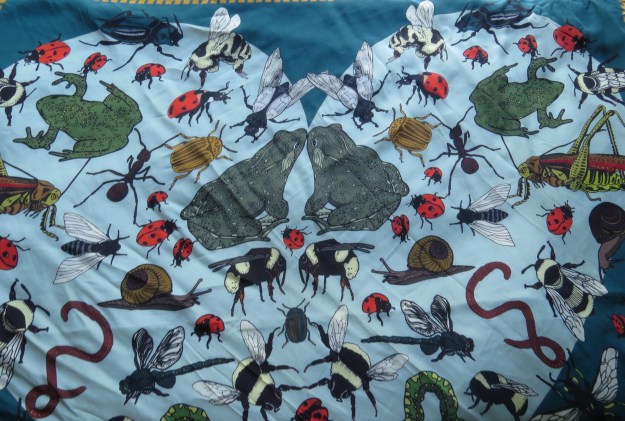
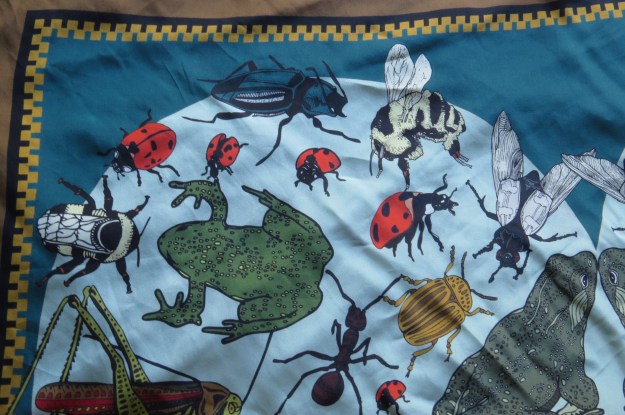
J also bought me this scarf for my birthday a few years ago. It has images of pretty much all my favourite creatures – frogs and toads, bees and beetles, earthworms and ants. I’m just sorry I didn’t iron it before I took the photograph. I love that it looks like one of those elegant lady scarves, but turns out to be covered in creepy crawlies. Many a person has done a double-take when they’ve looked at it closely.
And this is the brooch that got me into trouble with my boss, who I was meeting ‘in real life’ for the first time in Dublin. We’d gone out for a team dinner, and it turned out that she was arachnophobic. I ended up popping the poor spider into my pocket for the duration.

And of course I could never resist a bee. I had a lovely holiday with my dear friend S, who was working in Washington D.C, so I got a chance to go to the Smithsonian Museum of Natural History. A visit to the museum shop is obviously essential, and they had the best selection of insect jewellery that I’d ever seen in one place. Sadly most of the pieces aren’t online, and my friend works from London now.

Smithsonian bees!

I fell in love with this quirky chap when I saw him at a craft market in London. Sadly, the pink gemstones have been falling out all over the place – I used to wear him a lot when I was travelling for work in Europe, and I know for a fact that one stone is in Prague, one is in Helsinki and another one is most likely in Copenhagen. Never mind. Whenever I look at him, I’m reminded of the days when such lunatic levels of travel were not only condoned but expected, and I’m happy to be more settled, and less of a carbon liability.

And finally, how about this Bugwoman-themed cardigan? If I ever do personal appearances, I shall have to wear this.

It’s funny how I am so drawn to images of ‘bugs’, even after all these years. For me, they are still a source of fascination, and nothing cheers me up more quickly than the discovery of a new insect, or a new piece of information about their lives. I can quite see myself as an elderly lady in a care home with a secret pet spider in the corner of the room. This last few years have really made me consider what is important, and what isn’t, and I know that being connected to the natural world is so fundamental to me that without it, life wouldn’t be worth living. It’s always worth thinking about and stating these things while you still can.

An Insect-Filled Walk in St Pancras and Islington Cemetery

Dear Readers, it was the most beautiful spring today, and while the cherry plums in the cemetery have mostly lost their blossom, the heavy candy-floss pink flowers of the cherry trees are just starting to emerge. It’s a shame that many of the prettiest are behind fencing at the moment, while the cemetery tries to turn yet another area of rough scrub into a site for graves, but nonetheless the tree is still exuberant. The blossom on these trees can sometimes seem almost too much: I suspect that these trees are of the Kanzan variety, with each blossom having up to 28 petals. There is a road close to where I used to live in Islington which was lined with these trees on each side: when the blossom started to fall, it could be like scuffling through a thin layer of pink snow.

The cherry plums have lost every last flower now, and are instead glorying in their copper foliage.

The cow parsley is just starting to flower in the woodland grave area, and is already attracting pollinators, like this little hoverfly. The photo is not good enough to identify the species, but it does give an indication of how varied this group of insects can be – at first glance you’d think this was a flying ant.

I had to pause for a quick look at the swamp cypress, which appears to have been in suspended animation for weeks. Not for much longer, though! I can’t wait until it’s decked out in fluorescent green.

I had to pause for a quick look at the cherry laurel by the main path – it is covered in strange, spidery flowers, and has a most nose-tingling smell, somehow dusty and honey-ish at the same time.

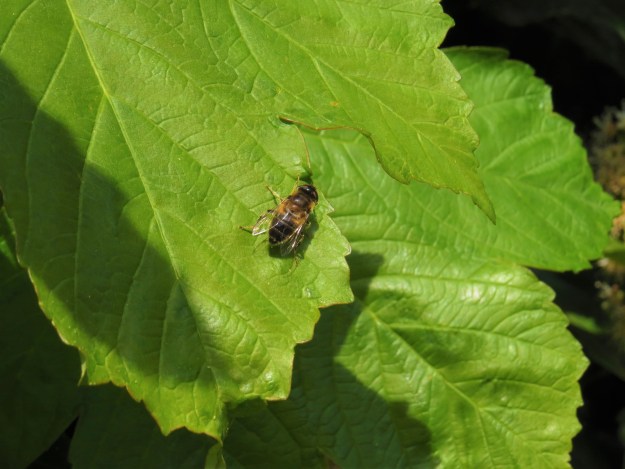
Another hoverfly was sunning itself on the leaves. I’m going to hazard a guess and say that this is probably a female Eristalsis pertinax. The males of this fly defend territories around flowering plants, and I imagine that the cherry laurel must be a very appealing site. The young go by the appealing name of ‘rat-tailed maggots’, and live in drainage ditches and other stagnant water: the ‘tail’ is actually a breathing tube.

And here’s an insect that I haven’t come across before. Superficially it looks rather like a shield bug, but it is narrower in the body and has much thicker, more pronounced antennae. This is a box bug (Gonocerus acuteangulatus) and it isn’t named after the plant directly but after Box Hill in Surrey (which was, admittedly, named after the box hedges that grew there).  The bug was considered endangered, and in 1990 it was known only in the area around the eponymous Box Hill, but since then it has expanded its range to most of south-east England. It seems to have expanded the variety of foodplants that it eats to include hawthorn, bramble and rose, and I predict a sunny future for it as it munches its way northwards.

The dandelions are still out in force.

The leaves on the horse chestnut are getting bigger every week.

And the first flowers are opening on the hawthorn.

But what I’ve really noticed this week are the bluebells. The vast majority of the ones in the cemetery are hybrids, and they come in the most astonishing array of colours. I doubt that the cemetery was ever a pristine environment for bluebells, and in fact I suspect that if there weren’t hybrids here, there wouldn’t be any bluebells at all.

  The primroses are doing their hybridizing thang as well. In the beds at the entrance to the cemetery there is the most extraordinary range of primulas and polyanthus, and I suspect that they are all cross-breeding and coming up with multiple varieties across the rest of the area. Genetic exuberance is certainly in evidence here.

In one of the sunnier parts of the cemetery I saw, in quick succession, a brimstone butterfly, a peacock butterfly, and a male orange-tip. I managed to get photos of two out of the three, which wasn’t bad considering how quickly the brimstone was flying. They apparently emerge from hibernation from March onwards, and will only be on the wing till May, so I cherished this glimpse of a butterfly in a tearing hurry!

Brimstone butterfly(Gonepteryx rhamni)

And then we almost trod on two peacock butterflies in quick succession, both of them sunning themselves on the path. These adults will have been hibernating over winter, and are now looking for someone to mate with, and somewhere to lay their eggs. They looked very ragged and tired, poor things.

The orange-tip will have been very happy to see the abundance of garlic-mustard which has popped up everywhere, and is now coming into flower. It’s good that there is so much of the stuff, as the caterpillars are cannibalistic and so the female normally lays each egg on a different plant – when an egg is laid, the female also deposits a pheromone which will prevent other females from laying there. Furthermore, the females will only lay their eggs on plants which are already in flower, but will also refuse to lay if the flower is starting to age. This is an insect which wants to give their young the very best start in life, for sure.

Photo One by By Charles J. Sharp - Own work, from Sharp Photography, sharpphotography, CC BY-SA 4.0, https://commons.wikimedia.org/w/index.php?curid=48875414

Male orange-tip (Anthrocharis cardamines) (Photo One)

Garlic mustard and lesser celandine

I couldn’t resist getting a photo of this watchful crow, and I rather liked the backlit dandelions too.

And for my final butterfly of the day, here’s a newly-minted speckled wood (Parage aegeria). These are woodland butterflies, flitting through the dappled shade. The males are fiercely territorial, and spend a lot of time flying into the air to investigate every insect that goes past. If it’s another male, an aerial battle will take place that could last up to 90 minutes. The battles are fiercest if the incumbent male has already been visited by a female – presumably this proves that his territory is a good spot. What a lot of hard work this reproduction business is.

Speckled wood (Parage aegeria)

And so, it seems that, with the arrival of flies and bugs and butterflies, and with bluebells and garlic mustard springing up all over the cemetery, we are now into what I think of as ‘mid-spring’, the period when the battle to mate and rear young and get pollinated is at its height. All I need now is the arrival of the house martins to know that spring is fading, and summer is beginning.


Saturday Quiz – The Joys of Spring

Dear Readers, we haven’t had a poetic quiz for a while, and as spring is the season that gets all red-blooded poets into a frenzy of verse-making, all I need you to do this week is to match the photo to the quote, with one extra point for identifying the poet and a further point for identifying the animal or plant, so that makes 45 points going begging in total.

As usual, all answers in the comments by 5 p.m. on Thursday 29th April (UK time) please; I’ll publish the results on Friday 30th April. And where did April go, exactly? They say that time speeds up as you get older, but this is ridiculous.

Also as usual, I will ‘hide’ your answers as soon as I see them but if you are easily influenced you might want to write your thoughts down on a piece of paper before you put them in the comments 🙂

So, if you think Quote A refers to the bird in Photo 1, your answer is 1) A. which, if correct will give you one point. If you think the poet is William Shakespeare and the bird is a penguin, you would get a further two points if you were correct (unlikely in this case :-))

Onwards!

Quotes

A) ‘When he perches on a stone
it’s a wet one.
He stands there, bobbing and bobbing
as though the water’s applauding him’

B) ‘Gave thee life, and bid thee feed,
By the stream and over the mead;
Gave thee clothing of delight,
Softest clothing, woolly bright’.

C) ‘Yet there it was content to bloom,
In modest tints arrayed;
And there diffused its sweet perfume,
Within the silent shade’.

D) ‘ Yet Spring’s awakening breath will woo the earth,
To feed with kindliest dews its favourite flower,
That blooms in mossy banks and darksome glens,
Lighting the greenwood with its sunny smile’.

E) ‘ I watched them leap and run,
Their bodies hollowed in the sun
To thin transparency,
That I could clearly see
The shallow colour of their blood
Joyous in love’s full flood’.

F) ‘ Loveliest of trees, the xxxxx now
Is hung with bloom along the bough,
And stands about the woodlands ride
Wearing white for Eastertide’.

G) ‘ Continuous as the stars that shine
And twinkle on the milky way,
They stretched in never-ending line
Along the margin of the bay:
Ten thousand saw I at a glance,
Tossing their heads in sprightly dance’.

H) ‘ The phrases of his pleading
Were full of young delight;
And she that gave him heeding
Interpreted aright
His gay, sweet notes,-
So sadly marred in the reading,-
His tender notes. ‘

I) ‘ What pretty, drooping weeping flowers they are,
The clipt-frilled leaves the slender stalk they bear
On which the drooping flower hangs weeping dew’.

J) ‘ The xxxxx she’s a pretty bird,
She sings as she flies,
She brings us good tidings,
She tells us no lies;
She sucketh white flowers
For to make her voice clear,
And the more she sings ‘xxxx’
The summer draws near.’

K) ‘Ethereal minstrel! Pilgrim of the sky!
Dost thou despise the earth where cares abound?
Or, while the wings aspire, are heart and eye
Both with thy nest upon the dewy ground?
Thy nest which thou canst drop into at will,
Those quivering wings composed, that music still!’

L) ‘That thou, light-winged Dryad of the trees,
In some melodious plot
Of beechen green and shadows numberless,
Singest of summer in full-throated ease’.

M) ‘ Under the after-sunset sky
Two xxxxx sport and cry,
More white than is the moon on high,
Riding the dark surge silently;
More black than earth. Their cry
Is the one sound under the sky’.

N) ‘ Incorrigible, brash,
They brighten the cinder path of my childhood.
Unsubtle, the opposite of primroses,
But unlike primroses, capable
Of growing everywhere, railway track, pierhead,
Like our extrovert friends who never
Make us fall in love, yet fill
The primroseless, roseless gaps.

O) ‘ I love its growth at large and free
By untrod path and unlopped tree,
Or nodding by the unpruned hedge,
Or on the water’s dangerous edge
Where flags and meadowsweet blow rank
With rushes on the quaking bank’.

Photos

Photo One by cheloVechek / talk, CC BY-SA 4.0 <https://creativecommons.org/licenses/by-sa/4.0>, via Wikimedia Commons

1)

Photo Two by Philip Halling / Wild daffodils in Hallwood

2)

Photo Three by © Copyright Andrew Curtis and licensed for reuse under this Creative Commons Licence.

3)

Photo Four by Ómar Runólfsson, CC BY 2.0 <https://creativecommons.org/licenses/by/2.0>, via Wikimedia Commons

4)

Photo Five by Andrew2606 at English Wikipedia, CC BY 3.0 <https://creativecommons.org/licenses/by/3.0>, via Wikimedia Commons

5)

Photo Six by By Phil Nash from Wikimedia Commons CC BY-SA 4.0 & GFDLViews, CC BY-SA 4.0 <https://creativecommons.org/licenses/by-sa/4.0>, via Wikimedia Commons

6)

Photo Seven by Caroline Legg from https://www.flickr.com/photos/128941223@N02/49898514632

7)

Photo Eight by Laura Nolte at https://www.flickr.com/photos/laura_nolte/5602766470

8)

Photo Nine by PiggiusMax, CC BY-SA 4.0 <https://creativecommons.org/licenses/by-sa/4.0>, via Wikimedia Commons

9)

Photo Ten by Artur Rydzewski at https://www.flickr.com/photos/119200904@N07/24395314677/

10)

Photo Eleven by Mike McKenzie, CC BY-SA 2.0 <https://creativecommons.org/licenses/by-sa/2.0>, via Wikimedia Commons

11)

Photo Twelve by Joe Pell, CC BY 2.0 <https://creativecommons.org/licenses/by/2.0>, via Wikimedia Commons

12)

Photo Thirteen by gailhampshire from Cradley, Malvern, U.K., CC BY 2.0 <https://creativecommons.org/licenses/by/2.0>, via Wikimedia Commons

13)

Photo Fourteen by Greg Hume, CC BY-SA 3.0 <https://creativecommons.org/licenses/by-sa/3.0>, via Wikimedia Commons

14)

Photo Fifteen by Takuya Matsuyama, CC BY 3.0 <https://creativecommons.org/licenses/by/3.0>, via Wikimedia Commons

15)


Saturday Quiz – International Orchid Appreciation Day – The Answers

Title Photo by Velella, CC BY-SA 3.0 <https://creativecommons.org/licenses/by-sa/3.0>, via Wikimedia Commons

Title Photo – Dune Helleborine (Epipactis dunensis)

Dear Readers, two excellent results this week,  with Mike from Alittlebitoutoffocus with 13 out of 15 and our old friends Fran and Bobby Freelove taking the top spot with 15/15. Thank you for playing,and let’s see what the challenge is tomorrow….

Photo One by Björn S..., CC BY-SA 2.0 <https://creativecommons.org/licenses/by-sa/2.0>, via Wikimedia Commons1.D – Dark Red Helleborine (Epipactis atrorubens)

Photo Two Björn S..., CC BY-SA 2.0 <https://creativecommons.org/licenses/by-sa/2.0>, via Wikimedia Commons

2.G – Autumn Lady’s-Tresses (Spiranthes spiralis)

Photo Three by John Game, CC BY 2.0 <https://creativecommons.org/licenses/by/2.0>, via Wikimedia Commons

3. H – Frog Orchid (Coeloglossum viride)

Photo Four by Björn S..., CC BY-SA 2.0 <https://creativecommons.org/licenses/by-sa/2.0>, via Wikimedia Commons

4 I – Greater Butterfly Orchid (Platanthera chlorantha)

Photo Five byLairich Rig / Heath Spotted-orchid (Dactylorhiza maculata)

5. F – Heath Spotted Orchid (Dactylorhiza maculata)

Photo Six by AJC1, CC BY-SA 2.0 <https://creativecommons.org/licenses/by-sa/2.0>, via Wikimedia Commons

6.L – Man Orchid (Orchis anthropophora)

Photo Seven © Hans Hillewaert

7. C. – Burnt Orchid (Neotinea ustulata)

Photo Eight by Orchi, CC BY-SA 3.0 <http://creativecommons.org/licenses/by-sa/3.0/>, via Wikimedia Commons

8.E – Lady Orchid (Orchis purpurea)

Photo Nine by Holger Krisp, CC BY 3.0 <https://creativecommons.org/licenses/by/3.0>, via Wikimedia Commons

9.A – Military Orchid (Orchis militaris)

Photo Ten by Muséum de Toulouse, CC BY-SA 4.0 <https://creativecommons.org/licenses/by-sa/4.0>, via Wikimedia Commons

10.B – Lizard Orchid (Himantoglossum hircinum)

Photo Eleven by Ivar Leidus, CC BY-SA 4.0 <https://creativecommons.org/licenses/by-sa/4.0>, via Wikimedia Commons

11.O – Fly Orchid (Ophrys insectifera)

Photo Twelve by Patrice Bon, CC0, via Wikimedia Commons

12 M – Early Purple Orchid (Orchis mascula)

Photo Thirteen by By The original uploader was (Automated conversion) at English Wikipedia. - Transferred from en.wikipedia to Commons., CC BY-SA 3.0, https://commons.wikimedia.org/w/index.php?curid=2471900

13 N – Pyramidal Orchid (Anacamptis pyramidalis)

Photo Fourteen by Bernard DUPONT from FRANCE, CC BY-SA 2.0 <https://creativecommons.org/licenses/by-sa/2.0>, via Wikimedia Commons

14 K – Bee Orchid (Ophrys apifera)

Photo Fifteen by CC BY-SA 3.0, https://commons.wikimedia.org/w/index.php?curid=35786

15 J – Early Spider Orchid (Ophrys sphegodes)

Photo Credits

Title Photo by Velella, CC BY-SA 3.0 <https://creativecommons.org/licenses/by-sa/3.0>, via Wikimedia Commons

Photo One by Björn S…, CC BY-SA 2.0 <https://creativecommons.org/licenses/by-sa/2.0>, via Wikimedia Commons

Photo Two by Björn S…, CC BY-SA 2.0 <https://creativecommons.org/licenses/by-sa/2.0>, via Wikimedia Commons

Photo Three by John Game, CC BY 2.0 <https://creativecommons.org/licenses/by/2.0>, via Wikimedia Commons

Photo Four by Björn S…, CC BY-SA 2.0 <https://creativecommons.org/licenses/by-sa/2.0>, via Wikimedia Commons

Photo Five by Lairich Rig / Heath Spotted-orchid (Dactylorhiza maculata)

Photo Six by AJC1, CC BY-SA 2.0 <https://creativecommons.org/licenses/by-sa/2.0>, via Wikimedia Commons

Photo Seven © Hans Hillewaert

Photo Eight by Orchi, CC BY-SA 3.0 <http://creativecommons.org/licenses/by-sa/3.0/>, via Wikimedia Commons

Photo Nine by Holger Krisp, CC BY 3.0 <https://creativecommons.org/licenses/by/3.0>, via Wikimedia Commons

Photo Ten by Muséum de Toulouse, CC BY-SA 4.0 <https://creativecommons.org/licenses/by-sa/4.0>, via Wikimedia Commons

Photo Eleven by Ivar Leidus, CC BY-SA 4.0 <https://creativecommons.org/licenses/by-sa/4.0>, via Wikimedia Commons

Photo Twelve by Patrice Bon, CC0, via Wikimedia Commons

Photo Thirteen by By The original uploader was (Automated conversion) at English Wikipedia. – Transferred from en.wikipedia to Commons., CC BY-SA 3.0, https://commons.wikimedia.org/w/index.php?curid=2471900

Photo Fourteen by Bernard DUPONT from FRANCE, CC BY-SA 2.0 <https://creativecommons.org/licenses/by-sa/2.0>, via Wikimedia Commons

Photo Fifteen by CC BY-SA 3.0, https://commons.wikimedia.org/w/index.php?curid=35786


A Quick Trot Around the Garden

Marsh Marigold

Dear Readers, by the time you read this I will be on holiday (in the sense of ‘not working’ rather than ‘ going off somewhere exciting’) so there is the usual palaver around making sure nothing will blow up in my absence. Being a recovering perfectionist is a hard road to travel – I have to accept that a) I’m not irreplaceable and b) the organisation can get along very well without my presence. However, I do love to leave things in a tidy condition, and so for my blog post today I have spent a whole fifteen minutes in the garden before getting back to the grind.

I wouldn’t even have done this if a huge cardboard box containing 3 water irises hadn’t turned up – they were already potted up and ready to be dropped into the pond, so it seemed like the least I could do for the poor things. Can I just put in a plug here for Puddleplants if you are in the UK and want some pond or bog garden plants? I have been so impressed by the standard of the plants that they provide, and if they aren’t happy with the quality of anything they will let you know and ask if you want a refund or a different plant. Their customer service really is second to none.

Anyway, today’s delivery was of three Iris x robusta ‘Gerald Darby’, and if they thrive they should look like this:

Photo One from https://www.bethchatto.co.uk/conditions/plants-for-damp-conditions/iris-x-robusta-gerald-derby.htm

Iris x robusta Gerald Darby (Photo One)

…though at the moment they look like this:

And yes, the water level in the pond is down yet again. We’ve had no rain for weeks. I am growing creeping/dangling plants along the pond edge and may gradually remove some of the stones to get a more natural look, but in the meantime I’m looking to the skies.

Everything seems to be taking off. The water mint is extending its little invasive fingers and will no doubt be planning to take over the pond shortly.

Water mint (Mentha aquatica)

The water figwort plants look extremely happy.

Water figwort (Scrophularia auriculata)

The yellow flag iris are shooting upwards. I love its butter-yellow flowers though it can be a bit of a thug. This one will need dividing for next year.

Yellow flag (Iris pseudacorus)

The leaves of the first water lily have broken the surface, though whether that’s because the leaves have grown up or the water level has gone down I shall leave for you to judge….

The yellow loosestrife (Lysimachia vulgaris) has just broken the surface of the water. One of the pots slid off the ‘shelf’ around the edge of the pond and has upturned and disappeared into the depths. I shall try to retrieve it soon – my planting guide suggests that it should be under no more than 10 cm of water, and it must be in about 70 cm so that isn’t going to work. The other three are wedged in, so should be safe!

And finally the purple loosestrife is springing forth. Every year it gets so big that it ends up toppling over, and every year I think to myself that I should try to prevent this from happening. Sadly, ‘think’ is all I seem to do, being a bit short of inspiration. Maybe another case of dividing and putting into a heavier pot?

Away from the pond, there has been some cat-on-bird action – I ‘discouraged’ one slinky black and white marauder who was hiding under the bushes but he or she might have been back. Fortunately there are usually so many birds in the garden that someone sounds the alarm. Plus, fortunately, the feathers of woodpigeons are very loosely attached, so all a predator often gets is a mouthful of fluff.

I rather liked these grape hyacinths, but the bees don’t, much preferring the dark blue ones. Still, you live and learn.

The forget-me-nots that my friend J gave me are out…

And so are these wallflowers. I bought them thinking they would be cream and mauve, and instead I have one yellow one and two red ones, which rather mucks up my colour scheme. Never mind. Also, what’s with the leaves going brown around the edges? All advice gratefully received. I’ve been watering them religiously (or rather my husband has).

The ferns are looking good too! I have a couple more that have been in a pot for ages so I’m planning to liberate them this year.

And look, here is my one English bluebell (it’s a darker blue than it looks here, and the flowers do flop endearingly to one side so I’m fairly confident that it is Hyacinthoides non-scripta, as purchased). And yes, there are some stinging nettles next to it which will most likely be coming out when I have something to plant in its place.

And finally, I have planted up some honesty seeds (also given to me by my friend J) and have taken delivery of three woodruff plants (Gallium odorata), all of which will be popped into the shady side of the garden.

Woodruff and honesty seeds….

And finally, how about this red valerian that’s planted itself next to. the water butt? Whenever I see this plant it makes me think of Dorset and my time with Mum and Dad – the Red valerian there used to self-seed in every crook and cranny, and there were white and pink forms too. I don’t have the heart to pull it up.

Red valerian

And so, it’s back to work to tidy up a few more things. I hope to be having a few more exciting trips over the next few weeks – there are wetlands to visit locally, (Walthamstow and Woodberry), parks to walk in, and all sorts of places to explore. But I hope to be spending lots of time sitting in the garden too. After all, the lilac is almost in flower.

Lilac buds….

Photo Credits

Photo One from https://www.bethchatto.co.uk/conditions/plants-for-damp-conditions/iris-x-robusta-gerald-derby.htm


Wednesday Weed – Crown Imperial

Crown Imperials (Fritillaria imperialis)

Well Readers, there are some plants that are not meant to be ignored, and crown imperials are right up there at the head of the group. Look at those extraordinary blooms! The plant looks as if it’s wearing a spiky hat for a start, and then there are those Dundee United coloured flowers. Who would ever guess that the plant is a close relative of the delicate little snakeshead fritillaries in my garden?

Snakeshead fritillaries (Fritillaria meleagris)

Another puzzle for me is the location where I found the crown imperials – right next to a pond in Golders Hill Park. The Royal Horticultural Society website says that the plant doesn’t like damp or heavy clay soil, requires full sun, and the bulb is prone to rotting, so this not an ideal site. Apparently the plant might flower like a good ‘un in its first year, but will then have an attack of the vapours and refuse to produce anything interesting for the rest of its life. Let’s hope that plans are afoot to look after these lovelies once they’ve flowered.

Crown imperials (Fritillaria imperialis)

The plant comes originally from a broad swathe of land, starting with the  Anatolian plateau in the west and ending up in the foothills of the Himalayas.However, it has apparently naturalised itself in Austria, Sicily, and Washington state in the US. I found it difficult to imagine this flower growing in the wild so here’s a lovely panoramic shot of wild crown imperial in Fars, Iran.

Photo Two by By Sahehco - Own work, CC BY-SA 3.0, https://commons.wikimedia.org/w/index.php?curid=26320080

Wild Crown Imperial in Fars, Iran (Photo Two)

And here is another shot of wild crown imperials in Kurdistan. Goodness how I miss travelling….

Photo Three by By Khezriyani - Own work, CC0, https://commons.wikimedia.org/w/index.php?curid=40594934

Crown imperials in Kurdistan (Photo Three)

The flowers, which can be red, orange or yellow, apparently have a strongly foxy odour, which deters mice and other creatures who might otherwise eat the bulbs and flowers.

But here’s a thing! Apparently the flowers are pollinated by blue tits, a most unusual thing in the northern hemisphere where we don’t have hummingbirds or sunbirds to rely on. This was apparently featured in this week’s ‘Gardener’s World’ for those of you in the UK. For a more science-y view, here’s an article from New Scientist which explains that crown imperials produce a special kind of nectar, containing sucrose, which is specifically adapted to birds. Blue tits are the only birds who are light enough, and dextrous enough, to access the flowers without doing them any damage, though other species do destroy the flower to get at the sweet stuff.

Photo One by Mark Williams from romhttps://kensingtongardensandhydeparkbirds.blogspot.com/2020/08/it-was-another-hot-day-but-spell-is.html

Photo of blue tit under crown imperial by Mark Williams (Photo One)

Apparently, the nectar is so copious that it trickles out of the flower if you give it a tap, and therein hides a legend. Apparently, the crown imperial was once pure white, but when Jesus passed by in the Garden of Gethsemene it refused to bow its head like all the other plants. When Jesus reprimanded the plant, it blushed in shame and cried, hence the colour of the flowers and the ‘tears’.

I must say that I am becoming fascinated with the fritillary genus. While the crown imperial doesn’t particularly appeal to me, some of the others certainly do. How about Fritillaria persica, the Persian Lily,  which comes in black or white?

Photo Four by Hari Krishnan, CC BY-SA 4.0 <https://creativecommons.org/licenses/by-sa/4.0>, via Wikimedia Commons

Fritillaria persica (Photo Four)

Or Fritillaria acmopelata, the Anatolian fritillary?

Photo Five by Zeynel Cebeci, CC BY-SA 4.0 <https://creativecommons.org/licenses/by-sa/4.0>, via Wikimedia Commons

Fritillaria acmopetala, the Anatolian Fritillary (Photo Five)

It’s always useful to remember that all these plants are members of the Lily family, however, and to keep an eye open for those bright maraunders, the lily beetles, adorable-looking as they are.

Photo Six by Charles J. Sharp, CC BY-SA 3.0 <https://creativecommons.org/licenses/by-sa/3.0>, via Wikimedia Commons

Scarlet lily beetles (Lilioceris lilii) (Photo Six)

To get back to the crown imperial, however: its bulb is poisonous, but apparently can be eaten when cooked. I suspect you’d be much better off with an onion, and that would be cheaper, too.

And finally, a rather enigmatic poem. What do you think, Readers?

Otherwise Known

by Diana Brodie

My room feels crowded, stuffy,
and I open windows wide.
The tallest officer stands close
as he stares out at my garden.
He asks the names of flowers
and trees: Sophora, walnut,
sweet chestnut. He points
to the flame-coloured flowers
pressed against the wall –
Fritillaria imperialis, I reply,
otherwise known as crown imperials.

It seems someone has died, alone,
whose name I have never heard.
And in another continent.
I do not know, I say.
No relative of mine.
I hope you trace his family,
he had a sister, did you say?
They thank me for my time, drive off.

Left on my own, I know. I know.
I pick up the phone, call them,
tell them that I know. I know.


Photo Credits

Photo One by Mark Williams from romhttps://kensingtongardensandhydeparkbirds.blogspot.com/2020/08/it-was-another-hot-day-but-spell-is.html

Photo Two By Sahehco – Own work, CC BY-SA 3.0, https://commons.wikimedia.org/w/index.php?curid=26320080

Photo Three by By Khezriyani – Own work, CC0, https://commons.wikimedia.org/w/index.php?curid=40594934

Photo Four by Hari Krishnan, CC BY-SA 4.0 <https://creativecommons.org/licenses/by-sa/4.0>, via Wikimedia Commons

Photo Five by Zeynel Cebeci, CC BY-SA 4.0 <https://creativecommons.org/licenses/by-sa/4.0>, via Wikimedia Commons

Photo Six by Charles J. Sharp, CC BY-SA 3.0 <https://creativecommons.org/licenses/by-sa/3.0>, via Wikimedia Commons

New Scientist – Our Daily Bread

Title photo by Chris R. Sims (Simsc), CC BY-SA 4.0 <https://creativecommons.org/licenses/by-sa/4.0>, via Wikimedia Commons

Some very fine loaves (Title Photo)

Dear Readers, during the first lockdown it suddenly seemed as if every second person that I spoke to was experimenting with sourdough bread. I imagine there were many reasons for this – the extended period at home meant that the starter could be nurtured, for one thing. For another, there’s something about kneading the dough that is very therapeutic – I have certainly gotten Zoom calls out of my system by being overly assertive during bread-making. And then there’s that sense of connection with all those generations of bread-makers who went before. The fact that many of my loaves turned out like slightly-more-porous bricks didn’t take away from the sense of accomplishment – at least the bread had the right smell and appearance (generally).

But what I hadn’t thought about was that sour dough in particular actually gives us a connection not just to our ancestors, but but to the unique microorganisms that live in our houses, and even on us.

In New Scientist, someone raised the question of why sourdough tastes so different in San Francisco compared to the loaves in London. To understand why, it helps to know a bit about the process of making it.

Most bread (including my bricks) is helped to rise using commercial yeast, either fresh or dried. But sourdough is different. Water and flour are mixed together and then exposed to the natural microorganisms in the air. The yeasts produce the carbon dioxide bubbles as they respire – this is what enables the bread to rise during proving and cooking. But other bacteria (particularly from the Lactobacillus genus) produce lactic and acetic acid, which contribute to the flavour. The flour also contains bacteria  – as you might expect, the less processed the flour, the more opportunity for microorganisms to survive, and to contribute to the flavour of the finished load.

Then, there are the bacteria that live on us, particularly our hands (hence all the calls for increased hand washing during the pandemic). Some people swear that the loaves made by a particular baker can be identified purely by the taste that their bacteria impart. This is about as far as you can get from the identical loaves created in supermarkets and commercial bakeries.

The amount and type of water added to the loaf will affect the final result – a wetter loaf makes it easier for the dough to rise, but the flavour of the water will also add its own special twang. Plus, sourdough needs a long, slow fermentation, and during this process different microorganisms will thrive or die, according to the conditions in which the starter is kept – different temperatures will affect different bacteria.

As the loaf containing the starter is baked, the yeasts first go into overdrive because of the heat, producing the carbon dioxide that contributes to the rise. But as the heat continues to increase, the yeast can no longer metabolise and finally they die, along with the vast majority of the bacteria. It seems like a poor reward for all the work that these microorganisms have done, but it’s all the better for us humans.

However, the rest of the starter remains.It’s easy to forget that a sourdough starter is actually a living thing, a community of microorganisms. The starter should be fed regularly and can last for years if properly looked after.  Maybe this is part of the reason for the whole sourdough phenomenon – the sense that what is being made requires careful nurturing and is also completely individual must add to the pride at the finished result. No wonder that, in Sweden, a ‘sourdough hotel’ was set up to look after your sourdough starter when you went on holiday, feeding it with the requisite amount of flour and making sure that it didn’t dry out.

So, over to you readers. Have you been ‘sourdoughing’ during the pandemic, or before? I am tempted to give it a go, but oh! the responsibility. I know that the whole phenomenon has taken on the aura of extreme middle-classness here in the UK, with the notion that sourdough can only be created if you have an Aga and a man-bun (if you’re a chap) and if you holiday in a yurt (presumably taking your starter with you), but I do know some perfectly non-yurty people who swear by the whole process. Let me know what you think!


Sunday in the Pond

Dear Readers, after a chilly couple of weeks I was delighted to see that the tadpoles are finally emerging from their spawn. What extraordinary little question marks they are! In the photo above you can see some tadpoles that are quite well grown and others, like the one with the straight tail that seems to be ‘crossing swords’ with the one above, who have just struggled out of the egg. Most of them are currently hanging around the plants, but one or two brave souls have crossed the pond to feed on the abundance of algae growing on the liner.

In the photo below I love the way that the shadows of snail and pond skater can be seen on the bottom right, while a lone tadpole keeps a very low profile. The pond skater went over to investigate the snail, but these insects are largely scavengers, who will take advantage of any invertebrate unfortunate enough to fall into the water. You might sometimes notice ‘rafts’ of pond skaters all feeding on a dead bee or clumsy fly. They have the piercing mouthparts of all bugs, and will make short work of any little corpses.

Pond skaters are superbly adapted to living on the surface of the water – their bodies and limbs are covered in tiny hairs which increase the insect’s surface area and make it easier for it to stay on the surface. If the creature is submerged by a wave (not likely on my pond where all is currently tranquil) the air bubbles trapped in the hairs will help the insect to right itself. The long middle legs are used for ‘rowing’, the back ones for steering, but to the naked eye they seem to move across the water by magic.

For pond skaters it’s all about the vibrations that they can feel through their limbs – they take a while to settle down if I walk past, even if I tiptoe. Once they’re relaxed again, you can see all sorts of shenanigans going on. Pond skaters signal to one another using different frequencies: one to repel, one as a threat, and one to signal amorous intentions. When two pond skaters notice one another, one will send out a ‘repel’ signal. If it isn’t responded to by another repel signal, or even a threat signal, the pond skater knows that it’s happened upon a female, and will send out a courtship signal. A receptive female will respond with a courtship signal, and the male will then mate and stay with her until her eggs are laid. This means that the female (who is larger than the male) will have to ferry her lover about, possibly for weeks.

Photo One by By Markus Gayda, CC BY-SA 3.0, https://commons.wikimedia.org/w/index.php?curid=198901

Pond skaters in flagrante (Photo One)

When the young hatch, sometimes they will have short wings, sometimes long wings,  and sometimes no wings at all. Wingless forms obviously can’t leave the water body where they were born, but this isn’t a problem if there is plenty of food – I suspect that ‘my’ pond skaters hibernated in the pond over the winter to get a head start this spring. However, if a pond gets too crowded, or dries up, it’s useful to have wings so that the young can disperse – short wings enable a local flight, long wings can carry the new pond skaters to exciting new ponds and lakes. However, this has to be balanced against the disadvantages of wings for a surface-living insect like a pond skater – wings are extra weight, and can get tangled. It’s likely that because my pond is stable and the water level is lovingly tended by a mammal (me) most of ‘my’ pond skaters will be wingless. I shall pay attention over the next few months and see what happens.

Although pond skaters in the UK are modest little chaps, the Giant Pond Skater of Vietnam (Gigantometra gigas) has a ‘legspan’ of twelve inches, and you can read all about them here.

While I was sitting on a stone with my camera trained on the pond skaters, who should pop by but Bailey King of the Cats. He is now twenty years old, and so a little bit stiff, but he is still every bit the monarch that he was previously, so much so that his minions (aka his owners) popped by to pick him up and take him home.

Bailey asking where his taxi is.

And finally, here is a little film of the goings on in the pond. Do not be alarmed (overly) by the appearance of two leeches from under the edge of the plant pot – this species lives by funnelling up tiny invertebrates and so the tadpoles will go unmolested.

A Mid-April Walk in St Pancras and Islington Cemetery

Dandelions!

Dear Readers, it was a beautiful day for a walk in the cemetery. It’s warmed up a bit, and the dandelions and daisies are open to the sun. When I started this blog, I thought that a dandelion was just a dandelion, but things are much more complicated than that – botanists have identified more than 230 separate microspecies of Taraxacum officinale (the common dandelion) in the UK alone. While some dandelions reproduce in the normal way, by seed, some populations are clones of one another because they spread only asexually. I suspect that the detail is much more complicated than that, but that’s as much as my brain can cope with before it explodes. Let it be said, though, that those butter-yellow flowers are extremely useful for pollinators, and that the dandelion ‘clocks’ that will follow are as much fun now as they were when I was a child.

Incidentally, ‘Taraxacum‘ is thought to come from the Arabic word for a bitter herb, though it might also be related to the Latin word for ‘to disturb’. ‘A bitter herb that grows in disturbed places’ is about as good a description of a dandelion as you’re likely to get. As regular readers will know, whenever a species is designated as ‘officinale‘ it means that it was a highly-regarded medicinal plant, the ‘official’ one to use.

And while we’re on the subject of etymology, on a day like today it’s easy to remember that ‘daisy’ is thought to derive from ‘the day’s eye’. You can almost feel the flowers drinking the sun in on a day like today.


I had to have a quick look at the horse chestnut to see how the leaves and flowers were coming along. Very well, it seems.

And how about this small white butterfly (Pieris rapae), my second of the year? You can tell that it’s a female because of the three spots on the upper wing (males just have one spot), and you can tell it from a large white (Pieris brassicae) because the wing tips are pale grey, rather than black in the bigger species. I suspect it will be off to lay its eggs on the Jack-by-the-hedge (garlic mustard) which seems to have popped up overnight.

Last week I was lamenting that the lesser celandine has already gone over, but I spoke much too soon – in some places it’s blanketing the ground, making a patchwork with the primroses, the daisies and the aforementioned dandelions. Yellow is definitely the colour at the moment.

Lesser celandine

And here was a real treat. I heard a bird call, and spent some time looking for the songster. The call sounded familiar yet strange, as if I was remembering it from a long time ago.


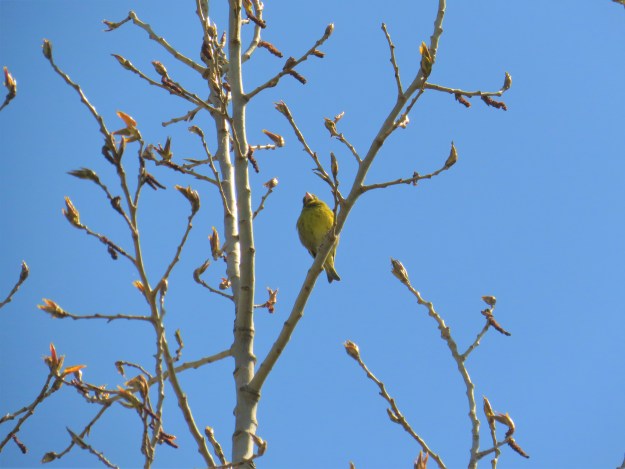
The stubby tail, yellow-green plumage and chunky beak gave it away as a greenfinch (Carduelis chloris). This was an extremely common garden bird, forever bullying the goldfinches away from the seed feeders and more than holding its own on the bird table. Sadly, a parasitic disease called trichomonosis had a devastating effect on populations in Europe – it’s thought that greenfinch numbers might have dropped from 4.3 million birds to 2.8 million during the period to 2006. As there is less food in the countryside for finches due to more efficient harvesting techniques, the decline of hedgerows and increased use of herbicides and pesticides, they have moved into gardens, where the concentration of birds helped to spread disease. However, the numbers seem to be recovering, and it was certainly a pleasure to see this little chap singing his head off.

Further into the woody part of the cemetery I noticed some yellow archangel (Lamiastreum galeobdolon ssp argentum). This is the garden variety, with its variegated silver leaves – the plain green-leaved variety is a native, but I have a suspicion that this variety has more tolerance for shade, and it also flowers earlier. It’s very pretty but doesn’t seem to be as attractive to insects as white and red deadnettle.

And here is the garlic mustard (Alliaria petiolata), just waiting to pop into flower. The kidney-shaped leaves are not typical for a brassica, but the garlicky smell of the crushed leaves makes me think that maybe this was once a useful addition to an otherwise bland diet: many other wild members of the cabbage family also have interesting flavours, be they peppery like mustard or wild radish, or oniony as with this plant. Plus in addition to the ‘cabbage white’ butterflies, this is a favourite foodplant of the caterpillar of the orange-tip butterfly (Anthrocharis cardamines), who might derive some protection from the flavour of the leaves, which probably make it a pungent little mouthful.

Garlic mustard (Alliaria petiolata)

And I hope you’ll excuse a few more photos of the lesser celandine. It feels as if they are at their absolute height of perfection this week, and it’s such a joy to see them.

And in keeping with our yellow/green theme, the flowers of the field maple are emerging, so new and fresh. I am really hoping that this is a field maple (Acer campestre) rather than a Norway maple (Acer platanoides) but let me know, readers, it’s the only way I learn 🙂

And finally, as I head back past the War Graves part of the cemetery, I pause to look for the stumpery that I’d photographed on previous visits. But it’s gone, along, it appears, with another tree. I imagine that the stump might be the result of honey fungus, though it was a most interesting and varied spot. Still, in its place is a neat pile of logs, and I suppose I’ll have to be content with that. There are plenty of spots in the cemetery that are overgrown and perfect for wildlife, so I shall have to forgive the powers-that-be for their spot of tidying-up.

The stumpery at the end of January

The stumpery today


Saturday Quiz – International Orchid Appreciation Day!

Title Photo byVelella, CC BY-SA 3.0 <https://creativecommons.org/licenses/by-sa/3.0>, via Wikimedia Commons

Title Photo – Dune Helleborine (Epipactis dunensis)

Dear Readers, on 16th April it was International Orchid Appreciation Day. Who knew? There are 26,000 species worldwide, but for this quiz I am going to concentrate on the European ones. Many of them are named after their physical features, although with some of them I fear that you’d have to squint to see the resemblance. However, I have every confidence that you will be able to match the photo to the species without TOO much trouble.

As usual, answers in the comments by 5 p.m. (UK time) on Thursday 22nd April, and as usual the answers will pop up on Friday. I will ‘disappear’ your answers as soon as I see them, but do write them down first if you are easily influenced (like me). Have fun! I was amazed at how many of these beautiful plants we have in the UK, nearly all of them scarce or rare. How I would love it if some of them popped up in my garden, but as it is I think I’ll have to make do with the green alkanet.

Just match the name to the photo. So, if you think the orchid in Photo 1 is a Military Orchid, your answer is 1)A.

Onwards!

Orchid Species

A – Military Orchid (Orchis militaris)

B – Lizard Orchid (Himantoglossum hircinum)

C – Burnt Orchid (Neotinea ustulata)

D – Dark Red Helleborine (Epipactis atrorubens)

E – Lady Orchid (Orchis purpurea)

F – Heath Spotted Orchid (Dactylorhiza maculata(

G – Autumn Lady’s-Tresses (Spiranthes spiralis)

H – Frog Orchid (Coeloglossum viride)

I – Greater Butterfly Orchid (Platanthera chlorantha)

J – Early Spider Orchid (Ophrys sphegodes)

K – Bee Orchid (Ophrys apifera)

L – Man Orchid (Orchis anthropophora)

M – Early Purple Orchid (Orchis mascula)

O – Fly Orchid (Ophrys insectifera)

N – Pyramidal Orchid (Anacamptis pyramidalis)

Photo One byVelella, CC BY-SA 3.0 <https://creativecommons.org/licenses/by-sa/3.0>, via Wikimedia Commons

1.

Photo Two Björn S..., CC BY-SA 2.0 <https://creativecommons.org/licenses/by-sa/2.0>, via Wikimedia Commons

2.

Photo Three by John Game, CC BY 2.0 <https://creativecommons.org/licenses/by/2.0>, via Wikimedia Commons

3.

Photo Four by Björn S..., CC BY-SA 2.0 <https://creativecommons.org/licenses/by-sa/2.0>, via Wikimedia Commons

4.

Photo Five byLairich Rig / Heath Spotted-orchid (Dactylorhiza maculata)

5.

Photo Six by AJC1, CC BY-SA 2.0 <https://creativecommons.org/licenses/by-sa/2.0>, via Wikimedia Commons

6.

Photo Seven © Hans Hillewaert

7.

Photo Eight by Orchi, CC BY-SA 3.0 <http://creativecommons.org/licenses/by-sa/3.0/>, via Wikimedia Commons

8.

Photo Nine by Holger Krisp, CC BY 3.0 <https://creativecommons.org/licenses/by/3.0>, via Wikimedia Commons

9.

Photo Ten by Muséum de Toulouse, CC BY-SA 4.0 <https://creativecommons.org/licenses/by-sa/4.0>, via Wikimedia Commons

10.

Photo Eleven by Ivar Leidus, CC BY-SA 4.0 <https://creativecommons.org/licenses/by-sa/4.0>, via Wikimedia Commons

11.

Photo Twelve by Patrice Bon, CC0, via Wikimedia Commons

12.

Photo Thirteen by By The original uploader was (Automated conversion) at English Wikipedia. - Transferred from en.wikipedia to Commons., CC BY-SA 3.0, https://commons.wikimedia.org/w/index.php?curid=2471900

13.

Photo Fourteen by Bernard DUPONT from FRANCE, CC BY-SA 2.0 <https://creativecommons.org/licenses/by-sa/2.0>, via Wikimedia Commons

14.

Photo Fifteen by CC BY-SA 3.0, https://commons.wikimedia.org/w/index.php?curid=35786

15.