Primroses on one of the graves
Dear Readers, spring is really gathering pace in the cemetery, in spite of the fact that the temperature has gone from the low ’70’s at the beginning of the week to the mid 40’s Fahrenheit today. It’s a worrying time for gardeners with half-hardy plants, but the natives could care less about the cold. I saw my first wood forget-me-nots (Myosotis sylvatica) today….

and my first cuckooflowers, also known as lady’s smock (Cardamine pratensis), which are another real sign of spring for me. The cemetery has several patches of these delicate flowers. Who’d look at them and think ‘cabbage?’ but that’s exactly what they are (or members of the Brassica family at any rate).

The cherry laurel (Prunus laurocerasus) will be abuzz soon as well – it’s naturalised itself all over the cemetery. I have one in the garden just behind my semi-circle of sleepers at the back of the garden, so I know how it self-seeds. The flowers have a heavy, almond scent that I find borderline sickly.

But look at the horse chestnut leaflets! Last week they were just emerging from their buds, but this week the familiar hand-shaped leaves and candelabra flowers are already unfurling. It’s a shame that these leaves will be blasted by fungus and leaf-miners in a few months time, but at the moment they look young and slightly fuzzy and very, very green.


It’s fair to say that the grape hyacinths are doing very well on some of the older graves.

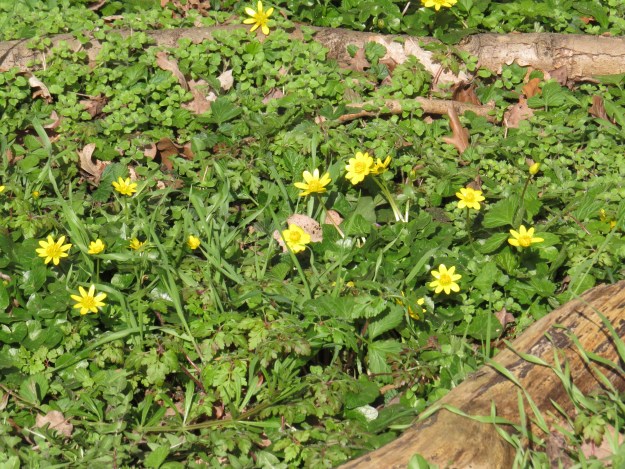
And while the lesser celandine is disappearing in some places, it’s at its peak in others, forming a carpet of yellow flowers.

Down by the stream, the blackthorn is in flower.

And the creeping comfrey is, well, creeping along the river bank. Later on it will be overwhelmed by the Russian and white comfrey that also grows here, and so the bees will be happy for months.

‘My’ cherry plum has stopped flowering, and so it’s the copper-coloured leaves that are coming into prominence now.


On the way back, we passed a man who was planting up one of the graves. I paused to tell him how lovely it looked, and he mentioned that his wife had passed away in March and that he was sorting out her grave, and the grave of her parents and grandparents. He had a pile of paving slabs next to him and while he wanted to let me know what had happened he clearly didn’t want to talk about it. I see what a help hard physical labour is for people who are mourning, and I suspect this is for a variety of reasons: exercise brings endorphins that help to soothe, physical exhaustion is good for sleep, and I think that the physical pain can be a kind of counter-irritant for the emotional pain. Plus, I suspect that making a grave beautiful is a way of communing with the loved one who is gone, and of serving them even though they are no longer here. Finally, there is meaning in the creation of beauty, and after a bereavement everything can seem very empty. Working in the midst of the new spring flowers and the bird song may bring a kind of solace, if even only for a moment.
I look at this Cedar of Lebanon, and think of it spreading its branches over all the many, many corteges who have passed under it. Whenever I look at it I somehow breathe in some of its peacefulness.