Along the Playing Fields

View from Muswell Hill Playing Fields towards the cemetery

Dear Readers, I have always been interested in the edges of things, the places where one landscape bleeds into another, and so this morning I took a walk along the edge of Muswell Hill Playing Fields. Before the lockdown this would have been full of people playing football, walking their dogs, flying kites and picnicking, but today there was a handful of pooches illicitly chasing the crows, a couple of runners and us, puffing along on our daily exercise. The Fields are bordered on one side by the cemetery and on another by the woods, so there is a fair variety of things to look at.

Horse chestnut (Aexsculus hippocastanum)

Look at this sapling horse chestnut, for example. I love the way that the leaves unfurl and turn into loose shuttlecocks. When the tree is older there will be those ‘candle’ flowers that look so exotic close up, with their long stamen and carmine centres. According to my Collins Tree Guide, the middle of the flower starts off yellow and goes red after pollination. Sadly, by about July the tree’s leaves are likely to already be turning crisp and brown, having been mined by a tiny moth caterpillar. If the tree is particularly unlucky, it may also suffer from horse chestnut leaf blotch fungus. Such diseases weaken a tree, but don’t usually kill it. There was some evidence that blue tits were learning to eat the moth caterpillars, so let’s keep our fingers crossed that some ecological balance is soon reached.

Ash (Fraxinus excelsior)

There are lots of ash trees in the cemetery, many of them self-seeded, but this one has ‘escaped’ onto the edge of the fields. I love the way that the buds of ash look like the sooty-black hooves of tiny deer. I have learned so much about my local environment through writing this blog, and through the people that I’ve gotten to know through it: a friend mentioned the hoof comparison and it stuck, so that I can now instantly recognise an ash when I see one. We learn through metaphor, through making the connections between what we already know, and what we are trying to understand. I love that sense that we are able to constantly enlarge our mental territory, just by pushing on through the undergrowth.

Brassica

This plant has always puzzled me. It grows in swathes along the edge of the playing fields, in shades from butter-yellow to palest cream. It is definitely a brassica, but which one? My suspicion is either oilseed rape (Brassica napus) or wild turnip (Brassica rapa). Both have waxy green foliage, and the leaves ‘hug’ the stems, but in rape the buds are higher than the flowers on the flowerhead, producing a ‘domed’ effect. In wild turnip, the flowers overtop the buds, leaving a little dimple.  Goodness only knows what’s going on with these – I shall have to have a proper look next time I’m there. Whichever they are, they are going strong and seem to be increasing.

I remember as a child being enchanted by the fields of acid-yellow oilseed rape when we went for a drive in the country. How beautiful they looked against the green trees and the blue sky! However, when they moved to the country, Mum hated the stuff because she always said that it had a strong smell. I have to say that I never noticed, but then Mum always was sensitive to these things. Has anyone else noticed?

It certainly makes a pretty picture alongside the cow parsley.

Now, unless I’m mistaken this little tree is a crack willow (Salix fragilis) – the shiny green foliage and the very long fruits seem indicative to me. This tree grows elsewhere in the damp places in the wood, and so I’m not surprised to see it here. What an elegant plant it is! Left alone it can grow to about 20 metres tall, but its sideshoots often break (hence the name ‘crack’ willow). Fortunately, the broken twigs can take root easily and, as the plant often grows alongside water, this forms a handy way of colonising the whole river bank. The catkins are very popular with bees, who collect the pollen for their developing broods.

I think of elder as the quintessential ‘edge’ plant, growing in hedgerows and in the places where woods thin out to meet open ground. There is an elder right at the very entrance of Coldfall Wood, and I think it might be at the very limit of its tolerance for shade. I love those big, open clusters of white flowers, beloved by hoverflies and, more recently, by those with a taste for elderflower cordial, which has become Quite the Thing here in the UK. If the flowers are left along you will end up with heavy dangling bunches of elderberries, which are full of vitamin C. I suspect that elder kept our elders healthy for many millenia.

Elder (Sambucus nigra)

And finally, at the start of May, the May (or hawthorn) blossom is out in abundance, spreading its slightly sickly sweet vaguely fishy smell out on the warm air. Hawthorn is another plant which gives multiple gifts – it supports a whole range of invertebrates, the blue tits in my garden have been plundering my hawthorn for caterpillars, and in the autumn the blackbirds will be gobbling up the haws.

May (Hawthorn) blossom (Crataegus monogyna)

And finally, here among the Japanese knotweed is a dock that is in absolutely pristine condition. Later in the year it will look blotched and tatty – so many insects and fungi feed on it that it inevitably looks like something the cat dragged in. And yet, at the moment, I think it looks rather magnificent. My guess is that it’s broad-leaved dock (Rumex obtusifolius) because the leaves are only very slightly wavy at the edges (unlike the inventively-named curled dock (Rumex crispus) which has something of the Mobius strip about its foliage. However, I will have to wait for the summer to be sure. If it sends up great spikes of rusty-red branched flowers, I was right. Anything else, and it’s back to the drawing board (or to Harrap’s Wild Flowers in this case).

And so we head home as one of us has a nine a.m. team call (and one of us is free to write their blog). On the way, I notice the crows, who are socially distanced and are pecking for earthworms – it was very wet yesterday so their lives have been made a bit easier. i watch as an over-excited young dog tries to catch a crow, who only flies up at the very last minute, before settling down again just far enough away for the dog to keep a vestige of hope in its little canine heart. So many animals like to tease dogs that it seems a bit unfair – I’ve seen squirrels taunting them, crows chasing a greyhound and once, in India, some Hanuman langurs jumping down from a tree, slapping a poor sleeping hound and bouncing back into the branches before the dog could even look round. What is that about, I wonder? Dogs are so intelligent but they also have a kind of innocent naivete that other intelligent creatures seem to take as carte blanche to be hooligans.

Crows socially distancing

Incidentally, when I was growing up I was taught that crows were anti-social creatures, hanging out in pairs. If I saw a lot of black crows together, they were undoubtedly rooks. However, I think it’s different in the cities, where there is abundant food – I regularly see a dozen crows bathing in the stream in the woods for example, and I pass a park in Hackney where there are hundreds of crows. There is a scientific study going begging on urban corvids, I’m sure. What have you noticed? I wonder if this is just a London thing, or if, like many animals, crows in cities lose their territoriality. And I further wonder if, with food being scarcer during the lockdown, things will change.

Some Favourite Illustrated Books

Dear Readers, what a day! I have been beset by brain-fog, and have been chasing an amount of 36 euros round and round my financial statements until I feel like throwing my laptop out of the window. I don’t think people talk enough about how being recently bereaved takes about a hundred points off your IQ, makes you completely incapable of concentrating on anything for more than thirty seconds, and completely wrecks your short-term memory. And then, I had an 8 o’clock call so I didn’t get out for my brisk walk (extremely bad planning on my part). Finally, every time I look up it has been pouring with rain. But nonetheless, here I am, still. And I wanted to share some of my very favourite books with you, because my library is full of well-thumbed, much-loved favourites and also because I might do this regularly, if anyone is interested. There’s so much out there that’s it’s sometimes difficult to know what to buy, so let me do a little filtering for you first.

My favourite guide to what I see in the garden is Richard Lewington’s Guide to Garden Wildlife. This is the second edition, and I am still holding onto the first one. Many fieldguides are just too overwhelming, but I think this is a great book both for those who already know a lot of the creatures that they see, and for complete beginners. The illustrations are utterly beguiling. Richard Lewington, who also wrote the text, has done the paintings for most of the book, but his brother Ian Lewington does the birds. This is a real labour of love, and I especially like the detail and care that has been brought to the illustrations of insects, who are often not depicted in all their beauty.

Birds by Ian Lewington

Dragonflies by Richard Lewington

It’s not just about the illustrations though – I often turn to this book when I’m writing the blog, because each entry has at least one fact that I didn’t know. Plus, the illustrations show male and female of a species alongside examples of typical behaviour.

If I knew someone who was just getting interested in their garden wildlife, this is the book that I would buy them as a present.

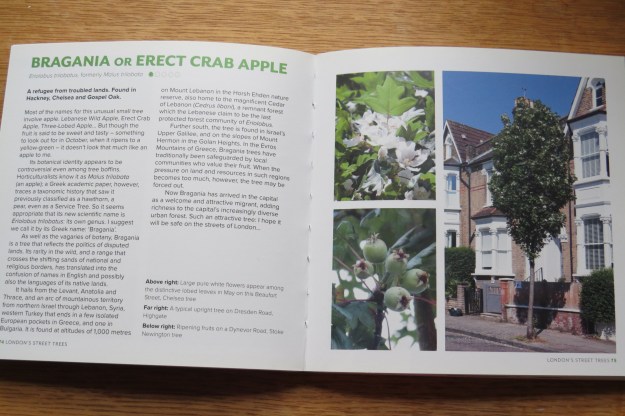
Now, a more London-centric book, but one that I think has something of interest for all you dendrophiles out there. Paul Wood’s ‘London’s Street Trees – A Field Guide to the Urban Forest’ is packed full of stories about urban trees, different species, and features such as ‘what does a London Tree Officer do all day’ and ‘what does the future hold for London’s planes (as in tree rather than airplane). Furthermore, it contains four guided walks, one of which kept this blog occupied for a whole two weeks The Street Trees of Archway Part One and The Street Trees of Archway Part Two. The first thing I shall do when this lockdown finally ends and I can loiter without attracting opprobrium is go on another tree walk, and I am in luck, because the book is being reprinted with more trees and additional walks in May.

I remember that when I was visiting my Mum in Whittington Hospital in 2016, I was often intrigued by some huge trees planted on the other side of the road. They looked familiar, but strange at the same time. On my street tree walk I revisited the site and discovered that one of them was the tallest lacebark elm in the UK. So many street trees go unremarked, and Paul Wood is here to bring them back to our attention. I know that during the lockdown many people have been paying attention to their immediate surroundings in a way that they never have before, and I know that trees can bring so much pleasure at any time of year. This is a great book for getting to know your local planting. There is something about being able to put a name to a tree that is very satisfying, and shows a kind of respect. Not all trees are the same, just as not all people are the same, and it’s good to recognise the fact.

And finally, this one.

In some ways this is a very strange book indeed. Each page shows a gathering of a particular species, in all its variations: adult, juvenile, male, female, flying, perching. The illustrations are a kind of collage of photos of the species, making it look as if Alfred Hitchcock’s ‘The Birds’ was happening with every kind of flying animal. And yet, I love it! Have a look at the pages on pigeons, for example.

Having seen this, could you ever get a stock dove and a woodpigeon muddled up again? Richard Crossley even has a woodpigeon in the picture of the stock doves so you can tell the difference. Both species are flying about so you can tell the difference when they’re on the wing, and the woodpigeon has a handy juvenile just in case you’ve not come across one before. The whole thing is a bit mad, but it works for me. It’s not a straightforward field guide (and I’d love to know what you birders out there think of it), and it’s certainly not for purists, but it has that ineffable spirit of fun and a sense of abundance that I find very appealing.

I like the rather disgruntled- looking juvenile heron, and that the cattle egrets are pecking around behind a herd of what look like Guernsey cows to me. There is even a purple heron at the top of the left hand page, just in case you get really lucky. I think that having photos of the birds in the landscape adds something too – having lots of pictures gives a sense of the ‘jizz’ of the bird in a way that just a single, beautifully executed portrait doesn’t. The only problem is that it makes me yearn to go out to the RSPB reserve at Rainham, or Woodberry Wetlands with my binoculars. Never mind. Like everyone else, I’ll have to pay extra special attention to my poor neglected local birds. Who knows what we might turn up?

Violence and Maternal Love in North London

Dear Readers, once I’d finished work yesterday I decided to sit quietly in the garden and enjoy the serenity. Hah! Fat chance. For no sooner had I sat down than I realised that no less than three woodpigeons were eyeing up the suet pellets on the bird table. There was plenty for all of them but, sadly, these are not birds that like to share.

First there was the inevitable eyeball to eyeball confrontation between two of the birds, while the third watched and waited. Each bird stands up on its tippy-toes and tries to look as large as possible.

Neither bird dares to put his/her head down to actually feed, because the other one will undoubtedly give a ferocious peck.

Then they begin to flick one another with their wings. This gives a surprisingly loud report, like someone cracking a small and inadequate whip.

And then, if neither bird backs down, the whole thing escalates. Both birds fly into the air, flicking and kicking and pecking and generally being antisocial. I have no doubt that the lack of food from restaurants and takeaways and garbage means that these birds are genuinely hungry, poor things.

In the end, it seemed to me that each of the three birds had a bit of time on the bird table, so they all had something to eat, but what a palaver! Later, one flew onto the bird bath, and when another woodpigeon arrived the first one gave it such a clap around the ear with its wings that it echoed around the garden. They seem to me a bit like those Regency gents who used to slap one another around the face with their gloves. Just as well the woodpigeons don’t have pistols, that’s all I can say.

But after all the flying of feathers, calm was restored. Remember me mentioning that I thought one of the squirrels who visits the garden had babies hidden away somewhere? Well, I was right, and I managed to get a few photos of the well-grown youngsters as they explored the world under the watchful eye of their mother. One of them fell out of the whitebeam, and another one appeared to be trying to eat leaves.

The mother was very watchful, as well she might be: these little ones have no idea of the hazards that they’ll face.

Mum and baby


The mother has done a very good job with these kits though – they both look in excellent condition, no doubt having been fed on milk that is powered by all those sunflower seeds from the bird feeders.

So, I don’t know about you but I have found sitting in the garden and just watching is as good as any television programme. I am starting to know the different individual animals, to recognise their calls and to be drawn in emotionally to their life stories. Already I am worrying about that swooping magpie and what will happen when the baby starlings emerge, and I am wondering where the hell the foxes have gone over this past few weeks. But what an antidote it all is to the news and the misery that is piped into our homes every minute of the day. Outside of our little human lives, life goes on as usual, and the world is all the better for us not being so visible.


Wednesday Weed – Bluebells Revisited

Bluebell (Hyacinthoides non-scripta)

Dear Readers, I thought that I’d said everything that I had to say on the subject of bluebells back in 2016, but it seems that I was wrong. As everyone seems to be turning to gardening if they’re lucky enough to have a bit of soil to play with, I am hearing some positively rabid reactions to ‘Spanish bluebells’ (not here on Bugwoman obviously). One poor lady was told to dig up and burn all the hybrid bluebells that she had in her garden, even though she loved them in their delicate shades of white, pink and pale blue. Other folk. have apparently been told to dig up these plants in woodland, even where there aren’t any native bluebells.

This isn’t really anyone in particular’s fault – back when I wrote my original piece, there was a fear that hybrid bluebells were going to ‘swamp’ our native ones. My impression then was that the biggest single risk to native bluebells was climate change and the impact that it would have on the ecosystems of woods, not to mention habitat destruction (HS2 anybody?). Furthermore, there was a lot of illicit digging up of bluebells, both to plant in the garden and to sell (although this is actually illegal). However,  the thought of foreign invaders encroaching on our land and ravishing our native plants seemed to be a more romantic explanation.

First things first.

Native bluebells tend to be a much deeper blue in colour, the flowers have a ‘nodding’ habit, and the smell is absolutely gorgeous. If you are out walking, you can gaze into the heart of one of the bells and if the pollen is purest white, you are looking at a native. They don’t travel far and are an indicator of ancient woodland for that reason. When I re-read my original post I was reminded that I’d been to visit the bluebell wood close to my Aunt Hilary’s house in Somerset, and had been positively entranced by the spectacle. I have never seen a photo that does such a wood justice. As the UK is home to over 50% of all the native bluebells in the world, it would be a tragedy if they disappeared, for sure.

Native bluebell – White pollen

Secondly, there are Spanish bluebells. These are native to (as the name suggests) Spain, Portugal and North Africa, where the conditions are hotter and drier than in the UK. They are commonly planted in gardens, and in fact it is illegal to plant them in woodland or hedgerows (though, as I know from our local wood, people often cheerfully dump their plants in such places). They are more upright, paler coloured and have blue-green pollen, plus they have very little smell. However, the ‘pure’ Spanish bluebell is actually quite a rare plant.

Photo One bySchnobby / CC BY-SA (https://creativecommons.org/licenses/by-sa/3.0)

Spanish bluebell (Hyacinthoides hispanica) (Photo One)

What are much more common are the hybrids between these two species. They come in all shapes and sizes but tend to be midway between their parents in the shape of the ‘bell’. However, none are the deep blue of the native bluebell, and none (as far as I’m aware) have pure white pollen.

Bluish-green pollen in what is probably a hybrid

And so, what is the truth concerning the hybrid bluebell and its rampant habits? A recent study (published in 2019) involved planting Spanish and native bluebells next to one another in large numbers, and then standing back to see what would happen. As it turns out, the Spanish bluebells are much less fertile than the native ones: it was even thought that the Spanish bluebell ‘species’ might already be a a hybrid. Professor Pete Hollingsworth, Director of Science at the Royal Botanical Gardens in Edinburgh, had this to say:

“The greater fertility of the native British bluebell coupled with the huge numbers of individuals that exist in the wild means that it’s got considerable resilience against any threat from these introduced plants”.

So, it seems that the threat of all our bluebells turning into hybrids is overstated. My anecdotal impression is that non-native bluebells can often be seen on the edges of woody patches, in the cemetery for example, but they don’t penetrate into it: maybe they have a preference for brighter environments. At any rate, I suspect that a lot of non-native bluebells appear where native bluebells would find it too dry and exposed to survive, and that native bluebells specialise in the dark, damp heart of the wood.

Should we be careful? Of course. Native bluebells are extremely vulnerable to trampling, and this is thought to be an increased risk where people are looking for the perfect Instagram post (hopefully not at the moment however). As we know, bulbs build up their strength during the summer via photosynthesis (one reason why, however tempting, you shouldn’t tie the leaves of your daffodils into neat little knots). I have already mentioned habitat loss, bulb-stealing and climate change. But in some habitats I suspect that the choice is not between native bluebells and hybrids, but between some bluebells and none at all.

Let me know your experiences, and what you think.

Hybrid bluebells from the cemetery.

Photo Credits

Photo One bySchnobby / CC BY-SA (https://creativecommons.org/licenses/by-sa/3.0)


The Cemetery Reopened

St Pancras and Islington Cemetery

Dear Readers, before we get started on my cemetery walk here is an update on yesterday’s Pigeon quiz. The winner was Alittlebitoutoffocus with 8 out of 10, closely followed by Andrea Stephenson with 7 out of 10. And an honourable mention to Vinod, who pointed out that the Eurasian collared dove’s species name, ‘decaocto’, is one interpretation of the bird’s call, so that it is in effect saying its own name. Thanks Vinod!

How did the rest of you get on? Would you like a bit more time to have a go? I could always postpone the answers for a day or so…just let me know.

And now, back to the business in hand.

Dear Readers, when I got back to London after the death of my Dad in Dorset a few weeks ago, I found a lot of solace when I walked in our local cemetery, St Pancras and Islington. As regular readers will know, it’s a wild and woolly Victorian spot, with areas of manicured graves constrasting with  paths meandering through hornbeam and ash, oak and horse chestnut. Although Dad isn’t actually ‘here’, I could feel his presence very strongly.

Imagine my distress, then, when the cemetery was closed a fortnight ago. The reasons were unclear, but the local consensus was that it followed a barbeque at one of the gravesides, with people sunbathing and drinking. The police were called, and apparently the whole thing got out of hand, which is often the result of a  combination of beer and sunshine . There are very few staff to cover the whole of the cemetery, and their role shouldn’t be to put themselves in danger. I wasn’t the slightest bit surprised to hear that the place was being closed to all except those actually attending a funeral or cremation.

The people who visit every day to tidy a grave and to sit for a while beside the last resting place of a loved one were very distressed. For many people a walk among the trees and the flowers brought a calmness to this difficult time. But we were prepared to wait and see what happened.

And then, there was an announcement during this week that the cemetery would be open from 10 a.m. to 3 p.m. during the week to those visiting the graves, and for the same hours at the weekend for all visitors. Hooray! It won’t be the same as sneaking in for a quick walk at 7.30 a.m. before work starts, but it’s much, much better than nothing. And so I was excited to head off today and see how the place was doing in my absence.

Cow Parsley

The cow parsley (Queen Anne’s lace to some of you) was in full flower, and how splendid it looks with its feathery foliage and pristine white flowers. I think I should find some seeds for the garden, it feels like the epitome of the woodland flower to me.

Lesser celandine (Ficaria verna)

The lesser celandine is still in full flower in the darker parts of the cemetery – in most other places it has already gone over, and the foliage is starting to disappear.

Bluebells, native and hybrid

There is a mixture of bluebells, small patches of native ones and a vast mixture of hybrids in all shades of white, pink and pale blue. There is a lot of nonsense spoken about bluebells, and so I feel I must revisit the subject tomorrow, to see what the latest thinking is. Getting the balance right between protecting our native wildlife and accepting that we live in a changing, globalised world is often a difficult one, so let’s see what the experts have to say.

And to return to my lovely peaceful walk in the cemetery, I am seeing orange-tip butterflies all over the place, and this is the reason.

Garlic mustard (also known as Jack-by-the-hedge) is the foodplant for the caterpillars of the orange-tip, who particularly like the seed pods. 59 other invertebrate species are also associated with the plant, which is probably why it isn’t a huge problem in this country, unlike in North America where it doesn’t have so many insect predators.

And I love the goldilocks buttercups, with their tatty little flowers, every one of which is missing at least a couple of petals.

If you know your way around the cemetery, it’s easy to find lots of quiet corners and unexplored lanes.

But in the main part of the cemetery it is absolutely rammed. I have never seen it so busy: Sundays usually have a few visitors, but there are minor traffic jams and cars parked all over the place. It goes to show how much people have missed being able to visit their beloved dead, and how anxious they are (at this time of high anxiety) to follow their established routines, and to make sure that honour is done to those who have gone before. We are, I think, in the middle of a situation in which many of us are thinking more about mortality, and what it means to be alive. We are struggling to find purpose, and to do the right thing at a time of great uncertainty. Of course, we never really know what’s going to happen next in our lives, but when things are ‘normal’ we’re able to convince ourselves that we have some power and control (though how much depends on our circumstances and where in the world we live). Now, nothing is clear.

I wonder what will have changed for us all when our various lockdowns are over, when restrictions are lifted and we emerge, blinking, into the new ‘normal’?

What I would like is for us to take a step back from the cult of individuality that has ruled for the past fifty years, and for us to recognise our interdependence and connection.

I would like us to do honour to those who have continued to work at great personal risk during this crisis: the health and care workers, the teachers, the people who work in shops and run our transport systems, the people who have kept the lights on and the water and sewage systems going, the people who have made it possible for us to work from home by keeping IT infrastructure going, the dustbin men and the street cleaners, the post office workers and so many, many more. And by ‘honour’ I don’t mean clapping on our doorsteps every Thursday (though this has its place) but by supporting them in their struggles to be paid fairly and to have decent terms and conditions.

I hope that we can do honour to ‘nature’ by ensuring that it survives.

I hope we can do honour to those from other countries who have put their lives at risk in our hospitals and buses and care homes by making this a country where they can feel welcome and where they can build their lives.

And I hope that we will never again measure the value of a human being’s life according to whether they had ‘pre-existing conditions’, their age or their level of disability.

Out of the last major challenge that this country faced came the National Health Service. Who knows what could be born out of this pandemic? One thing’s for sure. Life for many of us will never be the same again.


The Answers – Peerless Pigeons

Dear Readers, let’s see how well you did on your pigeons. I featured all five of the species that can be seen in the UK, but I’ve only been fortunate enough to see four.

1. Feral Pigeon (or Rock Dove – (Columba livia)

These come in all colours, shapes and sizes, but the red eye is diagnostic (unless it’s surrounded by a big halo of red skin, in which case see (5). The ones in the photo are pretty close to the wild type, which has two dark wing bars and a white rump.

2.Stock Dove (Columba oenas)

This rather attractive dove is more common than you might think: you can tell it from the woodpigeon by its soft, dark eyes, and the lack of a white patch on the neck. It’s also smaller, but not so much as you would normally notice. It’s a bird of woodland, and nests in hollow trees: I’ve found it regularly in Coldfall Wood, around the corner from me.

3. Woodpigeon (Calumba palumbus).

The biggest of the pigeons, this bird has a white, slightly manic-looking eye, a white patch on its neck and a very visible white band on its wings in flight. It also has a splendid display flight where it soars into the sky, claps its wings and then zooms down again, as if on an invisible roller coaster.

4.Collared dove (Streptopelia decaocto)

Delicately-coloured in shades of taupe and grey, this slender dove has a single line of black edged with white on its neck. The photo shows the splendid tail, which is black at the base but with a fringe of white around two grey feathers in the centre. This bird has increased greatly in numbers over the past twenty years, probably moving into the vacated sites of the fast-disappearing turtle dove (see below)

By Yuvalr - Own work, CC BY-SA 3.0, https://commons.wikimedia.org/w/index.php?curid=16798749

5.Turtle Dove (Streptopelia turtur)

A bird that is gradually being lost: it was a summer visitor who fed at the woodland edge and in hedgerows, and is dependent on weed seeds, particularly those of fumitory, black medick, red and white clover, common vetch and birds foot trefoil. All these plants are being squeezed out of most farmland, and as we know, hedgerows are often replaced with barbed wire fences, which are easier to maintain. Plus, the turtle dove passes over Malta (where migrating birds are still shot). The bird of ‘the Twelve Days of Christmas’ may soon no longer be present in the country where the song originated. The charity ‘Operation Turtle Dove’ is doing its best to conserve the species, and jolly good luck to them too.

And now to the songs. Always tricky, but I have added in a few mnemonics to help.

6. This is a woodpigeon. In my Crossley Guide to the Birds of Britain and Ireland, it’s suggested that the call sounds like ‘my TOE BLEEDS Betty’, and it’s certainly a five-syllable call, with lots of emphasis on the second and third syllables. I have one local bird who repeats this pattern three times and then sticks an extra ‘word’ on at the end. The call is particularly fine when heard down a chimney.

7. This is a bunch of feral pigeons. The actual call is, I’m sure, a male doing his little ‘whirligig’ dance to impress a female. I particularly like the wing claps as they all take off.

8. This is a turtle dove. The call is supposed to sound like ‘turrr-turrr’, and the bird is named for its call, rather than any resemblance to a marine reptile. The call reminds me of an old-fashioned ‘ringing’ tone on a telephone, but I bet most of you are Far Too Young to remember such things.

9. This is a stock dove, which has the most unassuming call of all the pigeons, to go along with its generally placid and gentle nature. The call is basically a series of ‘ooo’ sounds, but, as the Crossley guide puts it, it’s ‘a soft sound from the treetops very easily missed in bird chorus’.

10. And this is a collared dove. The first sound is the ‘landing call’, which sounds to me a bit like a kazoo. The normal call is a quite fast three-note cooing: Crossley says that it’s in the rhythm of ‘U-NIII-ted’ and I think that’s just about right. See what you think.

So, that’s pigeons done. Next week I’m going to have a look at the crow family. All those black birds! Let’s see how we get on.

The Sunday Quiz – Peerless Pigeons

Dear Readers, my quiz last week went so well that I thought I’d tax all of your brains some more! Let’s see how good we all are at identifying the various pigeon and dove species that you can find in the UK, not only by sight but also (gasp!) by sound. Several people seemed keen to learn a bit more about bird calls, so let’s start with these most familiar birds of all (at least in the UK). It’s true that we don’t have pigeons as splendid as the green ones that you can see in Asia, but to my eyes they all have a subtle beauty. So, without further ado, tell me what species of pigeon we’re looking at.

1.

2.

3.

4.

By Yuvalr - Own work, CC BY-SA 3.0, https://commons.wikimedia.org/w/index.php?curid=16798749

5.

And now for the tricky bit. Below are the calls of the five species shown above. Can you match the call to the bird?

6. This is a very ardent individual, but which pigeon is it?

7. How about this little lot?

8. This is an amazing sound, but have you ever heard it?

9. And who is this?

10. And finally, who is this?

And what do you think are the similarities between the calls of all the pigeons? To me, the calls always sound a bit laboured, as if they’re an effort for the bird, and also a bit muffled, as if they’re being produced from deep inside the body, rather than the cleaner, higher notes of other birds. I wonder if it’s anything to do with the structure of pigeon species? I know that they are one of the few families of birds who can suck up water when they drink, rather than having to take a mouthful and then throw their heads back.

Answers tomorrow! Have fun!

The Patter of Little Feet?

Dear Readers, I wonder if any of you have noticed your local wildlife behaving extremely strangely during this past few weeks? For example, a magpie has been swooping down into my whitebeam tree every morning in a most very predatory way, resulting in all the starlings flying out in a most agitated state. Sometimes I see the magpie chasing the other birds with a steely glint in its eye, but it isn’t the most agile of birds so there is no obvious damage so far. I dread to think what will happen when the fledgling starlings blunder out into the world in a few weeks though, with their wide-eyed innocence and complete lack of common sense.

I imagine that the closure of Kentucky Fried Chicken (and all the other takeaway shops) has had a dreadful impact on the food supply of many critters. What are the foxes doing these days, I wonder? I know that earlier this week I had an entire family of jackdaws in the garden munching on the suet pellets, and they are usually seen eating chips and looking a bit shifty at the top of my road. And what the feral pigeons are eating instead I have no idea. At any rate, it’s open house in my garden, and so that brings me to this extremely confident squirrel who was eating the sunflower seeds from the bird feeder yesterday evening.

You can’t see it in this photo, but I’m pretty sure that this squirrel is a mother – she looked to me as if she had some milk. This would be completely in keeping with their usual patterns – grey squirrels give birth in the spring (from February to April) and the older, more experienced females might breed again in the late summer (July to September). You’ve probably seen those big messy dreys in the top of trees: they are an untidy mass of leaves from the outside, but are often lined with moss and even the mother’s own fur. The babies are completely helpless when they’re born, and while a normal litter is three kits, an unfortunate mother can have up to eight babies, who would certainly keep her busy.

Photo One by By Hameltion - Own work, CC BY-SA 4.0, https://commons.wikimedia.org/w/index.php?curid=71712499

Baby grey squirrel (Sciurus carolinensis) (Photo One)

I love how ‘chatty’ grey squirrels are: they can be extremely fierce and I have often been told off by one for some trespass or bad behaviour that I was completely unaware of. You can hear a slightly irritated squirrel at the link below. I used to hear this and mistake it for a bird.

https://sounds.bl.uk/Environment/British-wildlife-recordings/022M-W1CDR0001470-1200V0

And finally, one of my favourite saints is (of course) St Francis of Assisi, the patron saint of animals. He once spoke of a visitation with a squirrel, and this was paraphrased by poet Daniel Ladinsky. I love the way that it seems to capture the essence of the busy squirrel, and of the saint. See what you think.

The Sacraments

I once spoke to my friend, an old squirrel, about the Sacraments—
he got so excited

and ran into a hollow in his tree and came
back holding some acorns, an owl feather,
and a ribbon he had found.

And I just smiled and said, “Yes, dear,
you understand:
everything imparts
His grace.”


In Praise of Sycamore


Sycamore sapling in Coldfall Wood

Dear Readers, since the lockdown I feel as if my focus has been tending towards the wonder of the common and the unremarked. Indeed, I sometimes wonder if I have ever truly ‘seen’ any of these plants or animals at all. Take this sycamore sapling for example, which had plonked itself in the stream in Coldfall Wood, not very far away from its parents. It looks so exotic at the moment that I honestly thought it was an Australian kangaroo paw plant, or maybe some peculiar spider lily, but no. It’s just a little sycamore, gently opening its leaves like so many hands unclasping and waiting to be held.

Tucked in among the hornbeam leaves, with their origami-precise veins, this sycamore is in its element – they love damp, shady places. There are some wonderful examples along the edge of the cemetery by Muswell Hill Playing Fields, and they are full of catkins. I had never noticed them until today – by the time sycamore comes into my consciousness the leaves are inevitably marked with the tar spot fungus that is probably the best way to identify them.

Sycamore (Acer pseudoplanatus) leaves with Tar Spot (Rhytisma acerinum) fungus

But look how pretty they are at this time of year! The sycamore has a most complicated sex life, with both female flowers (shown here) and male flowers, which are smaller. On any given tree, either the female or the male flowers will open first, so that the plant avoids pollinating itself. Furthermore, a tree might start with female flowers in one year, and start with male flowers in another year. To add to the complication, the change from one sex to another may take place in different areas of the crown at different times.

The female flowers produce lots of green-grey pollen and profuse, sweet nectar, which is attractive to pollinators, and is used by honeybees to make sycamore honey.

Sycamore is such a familiar sight that it’s easy to forget that it was introduced to Britain as recently as the sixteenth century from mainland Europe, probably as a timber tree. Their samaras (those winged ‘helicopter’ seeds that we loved so much as children) seem to germinate at the drop of a hat, and so sycamore has a reputation as a weed tree. Furthermore, although it is a woodland species it has a high tolerance for pretty much everything: it laughs at wind and exposure, and thumbs its nose at pollution. Indeed, it is so hardy that it is pretty much the only wild tree of any size on the Shetland Islands. It supports a pretty good population of insect species considering that it hasn’t been here for that long: 58 species of moth, 16 species of beetle and 25 bugs, which is less than the alder but, surprisingly, more than the ash (according to ‘Alien Plants’ in the New Naturalist series by Clive Stace and Michael Crawley). Furthermore, aphids love it, and hence at the moment the branches are full of blue tits plucking the greenfly and looking for caterpillars.

It’s also easy to forget that sycamore is actually a member of the maple family, and apparently it is possible to tap the bark to obtain the sap, which resembles my favourite sweetener, maple syrup. This seems to me to be a major reason for growing it, but I do note that in Scotland it was a popular tree for hangings, because the lower branches rarely broke, so maybe it isn’t as sweet as all that. Like all trees, your average full-grown sycamore has ‘seen’ a whole lot of things in its life. I wonder what the ones in the cemetery are making of the strange current season? We will never know.

A Favourite Front Garden – Part One

Dear Readers, the front gardens in the County Roads are not very large, and it can be quite a challenge to know what to do with them. Of course, my heart is always with those who have gardens that are both kind to pollinators and kind to people, and so I am kicking off this occasional series with a garden that is always full of interest, whatever the time of year. At the moment, the wisteria is just starting and the wacky yellow shrub/tree next to the gate is almost finished.

At the side of the house there is a very pretty perennial wallflower (not Bowle’s Mauve for once) and some bluebells that look the right colour for English ones to me, at least in this photo. And there is some green alkanet. Yes, it can be a bit of a thug, but if it wasn’t so common we’d all be out at the garden centre buying some. Look how blue the flowers are!  I love forget-me-nots too, but for sheer outrageous, decadent blue, green alkanet takes the prize.

Green alkanet (Pentaglottis sempervirens)

There is a patch which is full of wild strawberry, green alkanet, dandelions, white comfrey, and a tiny bit of yellow corydalis. Honestly, if I was a bee I couldn’t be happier. I suspect that as the council weed killing has ground to a halt, all the local wild plants are taking advantage. I will do a post soon on the mysterious things that are appearing in our local walls and crevices. But again, the combination of blue, yellow and white really is most appealing.

White comfrey

Now, I know that the lady who lives in this house will probably say that the garden is a mess, and I suspect that it’s not what she intended. But nature is a splendid gardener, and takes advantage as soon as our backs are turned, or as soon as a pandemic crops up. All i can say is that as i march past on my daily walk, it always brings a smile to my face. And as I have just started back at work and am battling daily with spreadsheets, that’s something to cherish.