Blossom

Magnificent Kanzan cherry tree at the bottom of Durham Road, East Finchley on Sunday

Dear Readers, when we awoke this morning the temperature had dropped by twenty degrees Fahrenheit, and the wind was whistling in the chimney. I thought about putting a hat on before my daily walk to exercise, and was sorry that I hadn’t when the chill blast insinuated itself into my inner ear. Still, I was determined to see what was going on on my patch, and today I decided to tune into blossom because, with this wind, a lot of it was  likely to be gone by tomorrow.

I had been particularly taken by the cherry tree above. It was positively laden down with candy-pink, puffball flowers. The photo above shows it on Sunday.

By Monday, it looked like this: you can see some of the areas where the green leaves are showing through.

Cherry blossom today

And the pavements look as if there has been a wedding.

Incidentally, Durham Road also has one of my favourite, favourite trees, which I am slipping in here even though it’s its leaves, not it’s blossom, that makes it so gorgeous. I love the way that the colour shades from crimson to coral.

Japanese acer on Durham Road

But as usual I digress.

Our street on the County Roads has a variety of very pretty street trees. This is a crab apple that produces a whole mass of fruit in the summer, and turns golden and red in the autumn. Not bad value for a single tree, plus the parakeets sometimes strip its blossom.

Further down the street there are two striking pink crab apple trees: these might be of the old variety ‘Purple Crab Apple’ (Malus x purpurea), and at the moment they are spectacular.

Purple crab apple

Incidentally, if you live in London and want to know about your street trees, the London Street Trees map will give you a reasonable idea of what’s what (though not the individual cultivars, and some of the trees are irritatingly described as ‘other’ which is not abundantly helpful). You can access it here. Just enter your postcode, and away you go! Might be useful for an exercise session (but be careful of your social distancing, as always).

Off we go into the woods, and there are the wild relatives of some of these trees blossoming away. They may not be as fluffily-adorned as some of the ‘domesticated’ trees, but they have a delicate beauty all of their own, the pristine white flowers standing out against the crisp green foliage. Being in the wood at this time of year can feel like being at the bottom of the ocean: there is a strange otherworldly feel to it, even as we sashay past runners and children on scooters. There was a husky howling its head off as we strolled through this morning, and it reminded me that there were once wolves here, though a very, very long time ago.

The plant below, for example, is Midland hawthorn (Crataegus laevigata) – the leaves are much less deeply lobed than in the common hawthorn, and this is a plant of ancient woodlands and clay soils. Apparently, when those pretty flowers are cut they have such an unpleasant smell that medieval people said it reminded them of the stench of the Great Plague. It’s probably best to leave the flowers right where they are, especially at the moment. Hawthorn generally has a rather feral scent, and one wouldn’t want to encourage it to get any worse.

And what about this tree? Looking at the leaves, I am thinking wild cherry (Prunus avium): the flowers are so white that they glow in the semi-shade. Like a lot of woodland trees, this is a rather scrappy little chap, surviving in the filtered sunlight that comes from being slightly closer to the stream than many other trees.

And so we loop back and head for home. I cannot resist taking a photo of this goat willow catkin though: soon the bees will be all over it (though it will need to warm up a bit first).

And look at this splendid single paeony just waiting to erupt in a front garden close to the woods.

I don’t know about you, but being in lockdown seems to have heightened all my senses, so that I am primed to notice the changes that happen every day in my immediate environment. It is a real privilege to be able to go out at all, and walking the same routes on a regular basis reminds me of the pleasure that there can be in observing a local ‘patch’ in all weathers. I am waking up to the delights of slowing down, and of making the most of a bad job. Dad was a very pragmatic man. I can see him now, shrugging his shoulders and settling back into his recliner with a cup of tea and the TV remote, ready for a Last of the Summer Wine marathon. He always reminded me a bit of a cat, ready to curl up in the sun and disinclined to get excited unless there was something worth getting excited about. I could learn a lot from his example.


The Dance of Two Metres in Coldfall Wood

Sign at the entrance to Coldfall Wood

Dear Readers, time was that a walk in Coldfall Wood would involve a gentle stroll, with me pausing every five minutes to take a photo of something or other. Not now! In the UK we are allowed out once a day for exercise, but all that loitering business is definitely frowned upon. After all, we are all trying to preserve this business of being two metres apart from people who aren’t part of our household, and that’s difficult enough when everyone is travelling at the same pace.

What a dance the good burghers of East Finchley are currently performing! There’s a step to the left, and then a step to the right, usually involving getting off the path to avoid a runner who is puffing energetically along. The biggest hazard, however, is people looking at their phones, oblivious. It would be very easy to become a curmudgeon (and I have tendencies in that direction as we know), but a piece of advice that I read at the start of all this shenanigans has stood me in good stead. It suggested that I am only responsible for my own social distancing, and that there’s little I can do about people who have other ideas about it. So true! I make sure that I step off the path or take the other route, because it costs me nothing, and it might keep both me and the other person safe. I have a suspicion that chaps might find this more difficult, as there is a definite dominance game played on the pavement at the best of times – what do you think? I know that women are not immune to this kind of gameplaying, but in my experience, a lot of blokes naturally take up as much space as they can, as if they are entitled to it. And I know that it’s not just women who are affected by ‘manspreading’ on the tube, for example – other men are as well.

Anyhoo, off I go into the woods, making sure to preserve not just my horizontal distance but my vertical distance as well, as instructed.

Gosh, two metres is quite a distance, isn’t it? I think if my husband fell flat on his face he’d be about two metres, so this makes it relatively easy to envisage (not that a tumble is desirable, obviously).

But how beautiful the woods look. The marsh marigold is just coming into flower along by the culvert, although it’s been extremely dry for the past few weeks, and the river is reduced to a trickle.

The crows are delighted though – there is a ‘secret’ spot in the woods where the crows go to bathe, and until recently the  whole area was flooded. Not anymore, though, and the birds are back.

I am loving the way that the hornbeam leaves are bursting through, so fresh and green. They look as if they are getting bigger every day, and I’m sure they are.

Hornbean leaves

At this time of year, you can clearly see the structure of the standard oaks that were planted many years ago. As you might remember from previous posts, Coldfall Wood is an ancient wood, where hornbeam was planted around an oak (a forestry method known as ‘coppice and standard’). The hornbeam would be cut back every year for kindling and charcoal (there are the remains of an old charcoal pit in one corner of the wood) but the oak would be allowed to grow for up to a century, at which point it would be cut down, and the wood would normally go to the Lord of the Manor. The oaks have magnificent full crowns, but at some point the tree will no longer be able to pump its sap all that way, and the top branches will die, with the crown retreating to a point lower down, giving us a ‘stag-headed’ oak. I will have a look next time I’m in the woods to see if any of the trees have reached this point, but for the moment have a look at these beauties.

Everything comes to an end, however, and there are a few enormous fallen trees in the wood. They always remind me of some kind of prehistoric monster, lurking in the undergrowth. We had a few bouts of very high winds during the winter, and maybe they were the final straw. Dead wood is normally left so that it can break down naturally, and provide a home for all kinds of beetles and other insects.

And so we circumnavigate the wood, waving hello to people as we dance around them, admiring dogs from a distance and listening to the parrots being rambunctious. It seems to me that pretty much everyone around here is doing their best under very difficult circumstances, and most people have now gotten the memo about what they’re meant to be doing. One thing this past few years has taught me is that it’s so important to take a breath and choose the kinder option – you never know what people are going through privately.

And, when I walk back along Creighton Avenue, I notice that two pigeons are happily ensconced in a nest in the eavestrough of one of the houses. It looks almost as if they’ve built a substantial nest, which would be unusual because, as we know, pigeons normally just throw a few sticks down and call it home. Maybe the plant was growing in the gutter already, and they are taking advantage? At any rate, they looked very content, and I thought I heard the tiny wheezing call which indicates that a happy event has occurred. Hooray for life! It seems to be popping up everywhere.


Home

Whitebeam leaves emerging

Dear Readers, this morning I got up a little late, after a disturbed night’s sleep, and decided to sit on the patio for my morning coffee. I haven’t been doing this and I have no idea why – I suppose everything has felt like too much effort. But as I looked around I realised that the world has been getting on very nicely without me. Look at the leaves on the whitebeam for example – at this time of year they sparkle silver in the slightest breeze.

A blue tit sits on the highest branch and scolds everything in the vicinity.

It’s a veritable Noah’s ark: there are a pair of blue tits, a pair of great tits, a pair of robins (I  know they’re a pair because they aren’t fighting), a pair of blackbirds and a pair of collared doves.

Some  of the animals are looking distinctly ropey though. This great tit looks decidedly below par.

Great tit (Parus major)

I am hoping it’s not the dreaded Avian Pox, but I will be giving all the feeders a good douse in antiseptic just in case. If I see any more birds that are affected the advice is to reduce feeding, which I will do. It’s just a shame at this time of year, when so many birds are incubating or feeding young.

And just to add to the drama, this collared dove has obviously had a close encounter, though I’m not sure with what.

Collared dove with chest injury

The bird seems to be flying and feeding normally but it’s difficult to see how deep the wound is. Pigeon feathers are very loosely attached, and come away easily, so maybe it’s not as dramatic as it looks. I shall keep an eye on the bird, but the chance of getting any treatment for it at the moment seems very slim. The bird’s mate is in the garden too and seems completely unconcerned.

But the main glory of the garden at the moment is the congregation of starlings. One sat in the tree and gave a great impression of a dog, following much whistling and tzicking and dancing. Sadly there was no point in recording it because the warm weather has also brought out the strimmers and lawnmowers and, dare I say it, a distant leaf blower.

The blackbirds are a delight: looking at my photos of the male, the slight chestnut tinge to his primary feathers makes me think that he might be a first-year bird, with his first mate. I wonder if the responsibility weighs heavily on him? I was pleased to observe that he saw off another male, so he is appropriately territorial. The female foraged for worms right next to the table where I was sitting: it has been very dry, so I think I might get the hose out later and give the place a water. The damper soil might bring some worms to the surface so that the hen blackbird can get a meal. I noticed that she didn’t seem to be collecting anything to take back to the nest, so probably she’s just incubating at the moment.

Young male blackbird

The goldfinches are looking splendid, and are dividing their time between the nyjer seed feeder next door and the sunflower seeds in my garden. In an ideal world everyone could work together to create one big, long habitat, with a whole variety of different food plants and niches for a range of creatures. But maybe that happens accidentally already? Certainly no two gardens are the same on the County Roads.

Goldfinches

I am delighted to see that the hairy-footed flower bees are out and about: they seem to love the flowers on my flowering currant, and it’s all the nicer because this was a self-seeded plant that I moved a couple of years ago. It is a much lighter pink than its parent, which gives me a whole new appreciation for genetic diversity. The bee in the picture is a female (they are a jet-black colour). The males are tawnier with a white stripe on their face, but they seem few and far between around here at the moment. Have you noticed any, UK friends?

Hairy-footed flower bee

And I’m pleased to say that after my drastic clear-out of the garden a few months ago, some of my favourite weeds are coming back.

I love the shadow of this greater celandine, and the lovely hairy buds. This was the plant that was carved onto Wordsworth’s tomb, even though his actual favourite plant was the lesser celandine. Oh well, we can’t always get everything right.

Greater celandine

My lovely friend J gave me some forget-me-nots last year, and they have taken to life in the garden with great enthusiasm. I am trying to get that ‘woodland glade’ look, and they are helping no end, along with the windflowers that I planted.

Forget-me-nots

Windflowers

And I am extremely tolerant of the dandelions, with their abundant pollen and sunny little faces.

Dandelion

I had forgotten the great calm that descends when I sit in the garden and get engrossed in all the goings on. I am still numb from the shock of losing Dad, but somehow listening to the birds and the hum of the bees makes room for a little window of feeling to open. I can feel sad, but somehow held at the same time. When Mum died, everything was still normal for everyone else, and that could sometimes make it very hard: I felt as if I was walking through the world having lost a layer of skin. But everything is so out of joint at the moment, and everyone is struggling, so strangely enough I don’t feel so alone. We live in such peculiar times, but having the chance to just sit and listen, to unfurl like one of the leaves on my tree, seems such a blessing. I am so, so lucky to have a little bit of outside space, to have good neighbours, and to still be being paid, and I never for a second forget that for other people the current lockdown is unbearable. I wish everyone the solace of the natural world, the chance to be among plants and animals, and the opportunity to find some peace there.


The Last Day

Female Eastern Bornean Grey Gibbon and baby (Hylobates funereus) (Photo by Jan Young)

Dear Readers, as the time for our departure from Borneo drew nearer, we were all anxious about whether we were going to make it home. Every day brought news of lockdowns and transport cancellations, and we had to take three flights to get back to London. As we left each lodge, it was closed behind us. We knew that there were roadblocks in place. But I was determined to try to enjoy the last days of the trip, in spite of everything.

“Whatever the future holds, at this precise moment I am standing in woodland looking up to the top of a tree and listening to the call of the gibbons”, I told myself.

Photo by Jan Young

The lodge at Tabin is home to a small family group of Bornean grey gibbons – a mother, father, baby and adolescent. They have been resident for years, and every morning they sing from the treetops. The male and female harmonise so closely that you’d almost think it was one animal, and the youngster joins in, somewhat haphazardly at the moment. No doubt at some point he’ll get in the swing of things. Literally.

Photo by John Tomsett

The song of the gibbon every morning announces that the territory is occupied, but I wondered if it had another social function. The distant calls of other families echoed in the stillness. Our guide explained that these were the children and grandchildren of the pair that we were watching. I wonder if there is some comfort for all these creatures in knowing that their offspring are still alive and thriving, that their parents are still there, even if they never see them? I know that I would take great joy in that situation, even if I was unable to actually meet my loved ones. And when a territory goes silent, another male gibbon will try his luck, much as if a blackbird doesn’t sing from the rooftops for more than a week, another male will move in. Simply stating ‘I’m still here’ can be a way of asserting that the normal order of things is maintained, for another day at least.

Gibbons are very faithful to their home range, even in times when the fruit that they eat is very scarce. This can make it very difficult for young males (who leave ‘home’ when they are about eight years old) to find a territory of their own, especially when the forests are as fragmented as those in Borneo. The North Bornean grey gibbon is listed as endangered, but how endangered isn’t clear, because very little is known about them. What is known is that there are four species of gibbon in Borneo, all found nowhere else on earth, and all confined to their own little patch of the island.

Photo by John Tomsett

On the very last morning, we awoke to the calls of the gibbon family, who were sitting in a tree just above our lodge. As we bundled into the minibuses that took us to the airport for the first of our flights, I thought back on what a remarkable trip it had been, and how lucky I had been with the timing of it all. Another week later, and we would not have been able to go. We had a scary moment at a roadblock outside Lahad Datu, where it looked as if we would be turned back, but once we were able to prove that we were heading to the airport they were delighted to see the back of us. We had our temperatures taken several times during the trip back, but we arrived at Heathrow with nothing to indicate that there was a crisis going on except for a couple of bottles of hand sanitizer and a few notices. And no sooner had I got home and started unpacking than I got the news that Dad had been admitted to hospital. And we all know how that ended. 

I look back on the holiday now as if it were a dream, a remarkable interlude in the middle of a strange, upsetting and disorientating time. It raised my spirits to see so many iconic species in the wild, and cast me down to see how delicate their situation was. I could weep for what we are doing to our planet, and yet the dedication of the people at the many conservation organisations and sanctuaries gave me a tiny bit of hope.We are capable of so much goodness and courage, and yet so often what we are told about is the wickedness. It feels better to me to concentrate on what we can do to help, because while the human capacity for stupidity and cupidity is pretty much endless, so is the power of community.

I am very grateful to the other members of our group who provided me with some wonderful photographs. John Tomsett, one of the people featured most frequently, has a Flickr account with some particularly fine photos, and you can view it here.

Going forward, I will be posting a little something everyday during lockdown. I have been noticing some very fine goings-on through my window, and on my daily walks, and I think we could all do with a bit of perspective during these tricky times. Meanwhile, thank you for following on my Bornean adventures, and for sticking with me through my personal Odyssey over these past few years. Who knows where we shall go next?

Photo by John Tomsett


Borneo – Small Wonders

Common tree nymph (Idea stolli) Photo by John Tomsett

Dear Readers, there are so many splendid insects lurking in the rainforests of Borneo that I spent much of my time swivelling around to watch a butterfly float past, or stopping abruptly when I realised that a twig was in fact alive. The common tree nymph, pictured above, is a real showstopper in flight: it has such large wings, and glides past so gracefully, that you might almost mistake it for a tiny owl, or a fairy. Much of Borneo resembles being in a butterfly house, complete with steamed-up glasses, and this species helps by sitting prettily on a leaf and posing for photos, unlike some other species which require much more activity.

Large Snow Flat (Tagiades gana) Photo by John Tomsett

Snow flat butterflies are widespread throughout Asia, but the large snow flat has this interesting white colouration at the bottom of the hind wings, which makes it look as if it is fading from colour into monochrome.

Clipper (Parthenos sylvia) (Photo by John Tomsett)

The clipper butterfly was one of those fast-flyers that proved so difficult to photograph for most of us. They look to me as if they are rowing through the air with fast, shallow strokes, unlike the wafty, balloon-like flight of the tree-nymph. It is a member of the Nymphalidae, the same family as our red admiral and painted lady butterflies and the North American monarch butterfly: all of these are migratory insects, so it’s no surprise that the clipper is powerful in the air. It was named for the clipper ships of the nineteenth century, which were built for the speedy transportation of commodities such as tea.

Spotted judy (Abisara geza niya) Photo by John Tomsett

The spotted judy is a member of a most unusual butterfly family called the Riodinidae. Butterflies in this group are commonly known as ‘metalmarks’ because of the metallic-looking marks on their wings, but they are also known as the ‘punch and judy’ family: many of the species are known as ‘judy’. Nearly all the species are found in the tropical new world (and amongst them is a carnivorous caterpillar), but there are (obviously) species in Asia as well, of which the spotted judy is a fine example. These are rare creatures, usually found flittering in forest glades. The UK has a single species from this family, the Duke of Burgundy, which is also vanishingly rare.

Common sailor (Neptis hylas) Photo by John Tomsett

The common sailor is another Nymphalid, and reminds me rather of a purple emperor. I wonder if those black and white stripes mimic the patterns of light and shadow in the depths of the forest?

Malay yeoman (Cirrochroa emalea emalea) Photo by John Tomsett

The Malay yeoman is often spotted on footpaths, drinking from the tiny puddles left in the indentations from many walking boots. I love it when I read about the behaviour of a species, and it’s then verified by what the creature is actually doing. Or maybe the butterfly read the book and decided to do what was expected?

Of course, it wasn’t all pretty butterflies, and we were dreading the appearance of one invertebrate in particular.

Tiger leech (Photo by Jan Young)

This rather pretty creature is a tiger leech (Haemadipsa picta). It is a relatively large leech and preys mainly on medium-sized mammals, including any human beings unlucky enough to encounter it. From my research, it appears that it lives on branches up to a metre above ground, and favours the arms, shoulders, neck and even head of anything passing underneath. This one was on the ground on a leaf however, so they are obviously not that fussy about what part of the body they attach to. The mouth is actually at the narrow end, while the stripey part is what swells up. We were all protected by our leech socks, which made us look like slightly out-of-condition Morris dancers, though without the bells. What a picture of elegance we were!

Leechsock-wearing humans (Photo by Jan Young)

In the forest at Tabin the air was alive with the prettiest burgundy-coloured dragonflies.

Red dragonfly (Neurothemis sp.) Photo by John Tomsett

Dragonflies mating – Photo by Jan Young

As a group, these dragonflies are known as parasols, and I love the way that the dark red of their wings fades to transparency at the tip. They were everywhere as we walked through the forest, and the smaller males seemed to be guarding little territories above the drainage ditches, occasionally darting to see off a rival or to investigate a female. The eyes on the head the female above look to me as if they’ve been carved out of mahogany and polished to a high shine.

And of course there were spiders…

Golden Orb spider (Photo by Jan Young)

I had met the golden orb spider before in the Spider exhibit at London Zoo, so it was a pleasure to see her here in her native habitat. She is a very large spider, probably no smaller than my hand, but she lives outside and eats many biting insects, so she is something of a blessing. People in the tropics have learned that co-existing with the small predatory animals in their houses, be they spiders or geckos,  brings benefits in the form of fewer pesky mosquitoes.

And finally, how about this amazing creature?

Thorny stick insect (Aretaon asperrimus) (Photo by John Tomsett)

The thorny stick insect is perfectly camouflaged as a dead twig, and little else is known about it. Probably, like most stick insects, it is capable of reproducing without mating, though most of this family can also produce offspring through sexual reproduction. The one in the photo is likely to be a female: the males are smaller and thinner. The creature is mostly nocturnal (we found this one on a night walk) and in spite of their fearsome appearance they are the most inoffensive and gentle invertebrates that you could hope to meet, with a purely vegetarian diet. They have become popular as pets, but like all tropical creatures require specialised care to make sure that the humidity and temperature are just right. I remember seeing chameleons for sale in a shop in Manchester, and being concerned that whoever bought them should be aware how delicate and difficult to look after they were. After I had dissuaded two potential customers who were enticed by their little faces and those strange eyes that point in different directions, I was gently but firmly ushered to the exit and sent on my way. I often wonder what happened to them.

Lantern bug (Photo by John Tomsett)

And so, we are nearly at the end of our Borneo trip. Just one more creature to meet, in the forest reserve of Tabin, and then we’ll be home in the less exotic but no less interesting environment of the County Roads in East Finchley. See you tomorrow!


We Interrupt This Broadcast…..

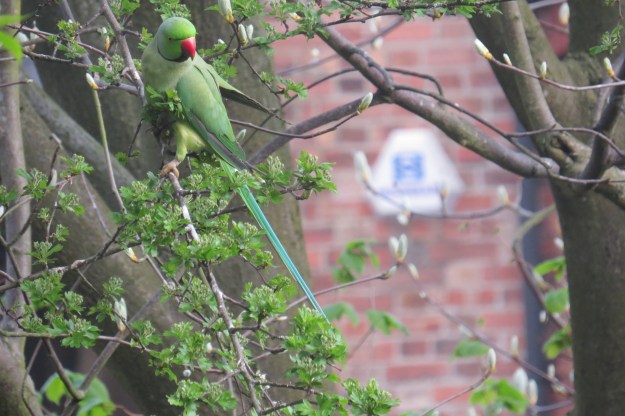
Rose-ringed parakeet (Psittacula krameri) in my garden

Dear Readers, today I was going to write something about the varied invertebrate life of Borneo, but events this morning have necessitated a quick change of plan. I was standing at my window, cleaning my teeth and wondering whether cleaning out the freezer was more of a priority than sorting out my desk when there was a flurry of grass-green feathers and this bird arrived in the cherry tree next door. Foaming at the mouth (literally) I ran for my camera only for the battery to die. How those wildlife photographers manage to capture images of anything, I have no idea. But the parakeet was a very obliging bird, and so I had plenty of opportunity to both admire him and to take a few shots.

I know that, for many people, rose-ringed parakeets are pests. I have seen them taking over the nesting holes in Coldfall Wood, eating the cherry blossom, and behaving like a bunch of noisy hooligans. They are the living embodiment of the worst neighbours you can imagine – they hang out in gangs, they are always making a racket and stick a finger up at social distancing. But just look at them. This one first surveyed all the feeders to decide which worked best, and then got stuck into the sunflower hearts, delicately plucking them out one at a time and testing them on his tongue to make sure they were to his liking. As with crows, you can feel their brains working.

This one is a very fine adult male – the black collar, and the pale-pink nape, are missing in the female. As they are early nesters, this one could already have a couple of parrotlets in a tree hole somewhere. I always thought that parakeets mated for life, but apparently this is not so: the birds might stick together, or they might choose a new partner every spring. Whichever they do, the birds will defend a nesting site right through the winter, which is why they can get going so early when spring rolls around.

Photo One by By Sarthak Shah - Own work, CC BY-SA 3.0, https://commons.wikimedia.org/w/index.php?curid=17915010

Baby rose-ringed parakeets (Photo One)

In these times of lockdown, the view from my kitchen window seems more and more important, especially at the moment, when my Dad’s passing occupies a lot of my thoughts. He was always so eager to point out something new that he’d seen, and so I come by the tendency honestly. A parakeet in the garden is not a novelty for many people, but in the ten years that I’ve lived in East Finchley I have had only one or two brief visits from these birds, and those were fleeting. Rose-ringed parakeets bring a touch of the exotic to my garden, and I can never see one without hearing the voice of David Attenborough. I was delighted to see one in the garden this morning, and it makes me think of all these tales of ‘nature returning to the city’. Someone else mentioned that they’d seen a red kite soaring over Coldfall Wood this morning. I suspect that in many places, nature is not ‘returning to the city’ (although the lack of people and the improvement in air pollution will certainly be helping). I think that we are just noticing what is already there.

Rose-ringed parakeets in the wild have two distinct populations: one in a broad belt right across Africa, and one that encompasses Pakistan, India, Nepal and Bangladesh. The Romans kept the African parakeets as pets, and the ancient Greeks kept the Indian ones. In captivity the birds can learn to talk, and a blue morph of the parakeet has been developed. But these adaptable birds are best known for their feral populations all over the world. In the UK the jury still seems to be out about how much competition they create for nest holes for other species, such as woodpeckers and stock doves: both of these species seem to co-exist with the parakeets in Coldfall Wood, but it would need a survey over time to be sure. I read a study of the social impact of parakeets in a book called ‘The Parakeeting of London – An Adventure in Gonzo Ornithology‘, and it really showed how our attitudes to parakeets can be more or less predicted from our attitudes to other social issues. It’s also a very good read.

Will the parakeet be back with a whole host of little friends, I wonder? Will they soon be unraveling the wire on the birdfeeders and picking the buds off the whitebeam? I am in the mood for welcoming, for embracing our wildlife even as we can’t embrace one another. Life is too short to be picky about who gets the sunflower seeds.


Borneo – Beautiful Birds

Two young olive-backed sunbirds (Photo by Jan Young)

Dear Readers, Borneo is full of living jewels – I have never seen so many splendid birds in one place, and although rainforest birdwatching is notoriously challenging we managed to spot some very obliging creatures. It helped that the gardens and surroundings of the places that we stayed were so lush: these two little olive-backed sunbirds (Cinnyris jugularis) were cuddling up together in the gardens at Sepilok, and there was a nest dangling above the entrance to reception.

Olive-backed sunbird nest, with female inside (Photo by Sue Burnley)

The nest is a wonderful construction of leaves, lichen, twigs and spiders’ web, and both parents help to make it. No doubt it helps to protect the eggs and young from the ubiquitous snakes. Sunbirds feed mainly on nectar, but like many birds they will take insects for their protein content when they have young: closer to home you may see house sparrows hawking for flies when they have youngsters. I remember reading that blue tits also switch from the normal caterpillars to spiders at a certain stage of the development of their fledglings.

We weren’t lucky enough to get a photo of a male olive-backed sunbird, but he is a magnificent creature.

Photo One by By Doug Janson - Own work, CC BY 3.0, https://commons.wikimedia.org/w/index.php?curid=6219217

Male olive-backed sunbird (Photo One)

And how about this fabulous chap? This is a male Temminck’s sunbird, who tends towards eating insects with a bit of nectar thrown in, rather than the other way round. The species is named for Coenraad Jacob Temminck, a Dutch aristocrat who founded the National Museum of Natural History in Leiden in 1820, and who wrote the definitive guide to European birds in 1815. Over twenty species of bird and fourteen species of mammal are named for Temminck, which then, as now, was a way of honouring someone. Who can forget Attenborough’s long-beaked echidna, for example, or indeed Attenborough’s goblin spider, both named for Sir David Attenborough? I do wonder, however, whether there was a degree of sucking up involved in the naming of so many creatures for Temminck – he was an aristocrat, a very rich man, and could probably provide significant patronage. Or maybe I’m just a tired old cynic.

Temminck’s sunbird (Aethopyga temminckii) (Photo by John Tomsett)

The broadbills are a group of big-eyed, large-billed birds who look to me like cartoon characters. I half expected them to speak. They eat mainly insects, frogs and lizards, and catch these mainly in flight, pulling unsuspecting frogs from the branches and plucking bugs from the air.

The black and yellow broadbills space themselves through the forest, announcing their presence with loud, high-pitched calls, which are answered by their neighbours, much as the wrens are doing in the UK at the moment.

The beaks of the black and red broadbills are almost luminous when they are alive but fade to dullness after death, like a candle gently going out.

Black and yellow broadbill (Eurylaimus ochromalus) (Photo by Sue Burnley)

Black and red broadbill (Cymbirhyncus macrorhyncos)(Photo by John Tomsett)

And then we come to the kingfishers. Holy moly. In the UK you might occasionally catch a breath-taking glimpse of electric blue. In Borneo, an oriental dwarf kingfisher popped into the restaurant while we were having breakfast and hung around for ten minutes. This species doesn’t need to live near water, and feeds mainly on insects: like all kingfishers, though, it likes to perch and survey the scene before plunging down onto its unfortunate prey.

Oriental dwarf kingfisher (Photo by Toni Burnley)

The stork-billed kingfisher is almost three times the size of the dwarf kingfisher, and hunts bigger prey, taking small mammals, fish and crustaceans. It is a feisty bird that has been known to drive eagles away from its territory, and it has a general air of ‘don’t mess with me’ about it.

Stork-billed kingfisher (Pelargopsis capensis) (Photo by Toni Burnley)

And while the chap below might look familiar-ish (we know he’s a chap because the whole of the lower bill of the female is orang-red), he is in fact a blue-eared kingfisher. His habit is very similar to ‘our’ kingfisher, though: this one sat beside the water, looking for movement, and pounced down upon the many little fish below.

Blue-eared kingfisher (Alcedo meninting)

I can’t leave Borneo’s birds, however, without some photos of a much less brightly-coloured bird, but a notable one nonetheless. This is Storm’s stork, a bird so rare that there may be less than 400 individuals left in the world, and certainly the world’s rarest stork. This is, despite appearances, a secretive bird, who haunts the small forest pools of the deep forest, hunting for frogs and fish. As these pools are disappearing, along with the rest of the forest, the bird has nowhere to go. Pollution from oil-palm plantations in the form of run-off of fertilizers and pesticides has reduced the frog, fish  and invertebrate populations to a fraction of what it once was. The species is extremely sensitive to human intrusion: if it sees a human while it is on the nest it will fly away, and may not return for two to three hours. And then there’s this:

‘Anthropogenic noise sources such as from motorboats and chainsaws may also affect this stork; in response to such noises that penetrate the forest matrix, adult birds have been observed to press their head and body into the nest with only the eyes showing‘.

So, what is the future for the species? Two zoos have managed to breed Storm’s storks (including San Diego Zoo), but the birds become too tame to be released. Plus, with the peat-swamp forests that they evolved in disappearing, where could they be released to? Some animals can adapt to human encroachment, like our dwarf kingfisher and the sunbirds: some even take advantage of the new opportunities that our buildings and agriculture create. But for the specialised creatures like the Storm’s stork, the future looks bleak. I would like to think that it will somehow hold on in the little pockets of forest that it currently inhabits, until the tide turns and we start to become willing to buy up land to preserve it. For now, though, I leave you with these few photographs, of a Storm’s stork surveying the forest from his lofty perch.

Storm’s stork (Ciconia stormi)

Photo Credit

Photo One by By Doug Janson – Own work, CC BY 3.0, https://commons.wikimedia.org/w/index.php?curid=6219217


Borneo – Cheeky Monkeys

Pig-tailed macaque (Macaca nemestrina) picking figs (Photo by Jan Young)

Dear Readers, macaques might not be the rarest of the primates in Borneo, but they are fascinating animals to watch. There are two species: the pig-tailed macaque, which is pretty much ubiquitous across southern Asia, and the long-tailed macaque (Macaca fascicularis) (also known as the crab-eating macaque) which is equally wide-spread. Both species have a troubled relationship with humans: as their forest homes are destroyed they venture into towns and cities and, with their intelligence and highly-evolved social structures, can wreak havoc on households, agricultural land and food markets. We have retaliated by culling them, and by using them as experimental animals: indeed, the population increase in Malaysia happened after a ban on exporting the macaques for drug and cosmetic research in 1982 (previously 10,000 animals were sent into captivity every year). One could argue that if we hadn’t cut down their homes they wouldn’t be being a nuisance in ours of course.

Long-tailed macaques (Photo by John Tomsett)

I loved watching the macaques: their lives are so complex, their interactions mirror ours, and they are so agile. Plus, generally, they seemed completely indifferent to our presence, and had no desire whatsoever to interact, apart from an alpha male occasionally blinking at us or bearing his teeth half-heartedly if our boat drifted too close (we would immediately withdraw). Macaques have a very complicated dominance hierarchy: the males protect ‘their’ females but the females determine pretty much everything else, from where to feed to how long to linger. The youngsters are just youngsters, playing, running, getting into scrapes and generally being a nuisance. Anyone locked down with small children can relate, I’m sure.

Photo by John Tomsett

Mother macaque with baby

We were stunned into silence by the appearance of the young macaque pictured below, however. It took us a second or so to realise that he had lost both his hand and his foot on the right hand side. Was this from a close encounter with a crocodile or other predator? Was he injured by another macaque? Was this even the result of a snare? We will never know but what was remarkable was that the wounds seemed to have healed, the monkey seemed alert, and that s/he was hopping along with the rest of his troop without obvious distress. Of course, s/he will always be more vulnerable to predators than her companions, but she will also benefit from their group cohesion when it comes to finding food and identifying predators. A lot of good things accrue from being part of a community, as many of us are finding during the current crisis.

Macaques are interwoven into the ecology of the rainforests in which they live in many different ways. Other mammals such as bearded pigs and mouse deer will follow the sounds of macaques as they search for food, and may be able to identify the different calls that the monkeys make when they find a fruiting tree. Indigenous hunters of the Penan people have learned to copy these calls to lure pigs, and apparently the contented ‘mmm’ of a macaque feeding on fruit is enough to bring the unsuspecting prey within reach of a spear. Macaques also store fruit in their cheek pouches to eat later, and will spit out the seeds a good way away from the parent plant, hence helping with dispersal. Macaques have also taken to hunting the rats that live in the oil-palm plantations, and, being creatures of broad taste, will also eat the oil palms themselves. In the mangroves the long-tailed macaques will find and eat crabs and shellfish. Macaques will eat the fruit of up to 90% of the trees in the forest, and seem to be immune to some of the defences of the plants – they can tolerate some the highly-corrosive sap of some members of the mango family, for example. However, they cannot survive ingestion of the calcium oxalate crystals, or rhapides, produced by some palms and other plants (I talked about them in my post on Virginia creeper).


We had the good fortune to catch up with some macaques again at the Mud Volcano in Tabin – an area of salt-rich minerals which are visited by many animals. On the morning that we visited, the macaques were dominating the area – an unfortunate bearded pig who popped in for a chance to get some mud therapy took one look at all the monkeys and ran off. Very sensible too. These guys might argue amongst themselves, but they are a formidable force when they band together.

Pig-tailed macaques at the mud volcano. Notice the alpha male keeping watch.

Macaque drinking the therapeutic muddy waters

Young macaque considering his options

We witnessed some very interesting behaviour while we were at the mud volcano, including a female who, while happy to mate with one male, saw another off most determinedly when he attempted to get friendly. Macaques have been the centre of many long-term studies of primate behaviour and I have no doubt that once individuals were identified, it would become as fascinating as any soap opera, though trudging through the hot, humid rainforest while being pestered by a wide range of bitey little critters would dampen the enthusiasm of all but the most determined scientists. Secretly, though, I envy those who’ve had the chance to do such things: my short stints of observing primates have filled me with an urge to understand more about our cousins, who are so like us in some ways and so completely different in others. Long may they play, unhindered, in the forests of Asia.


Sunday Lockdown Report

Horse chestnut leaves unfurling

Dear Readers, how are we all doing? What a bittersweet week it has been for me: I got out more than most, all the way to Dorset and to the nursing home where my dear old Dad died on Tuesday, but mostly it’s been four walls. It has been day after day of perfect spring weather here in London, and so we have been going out for an early morning walk to the cemetery every day. I can see this too being curtailed at some point in the near future, as people seem to be unable to resist gathering and meeting their friends, but for the moment it’s a sanity-saver. There’s something about walking (and writing) that helps to ‘right’ things: there’s a lot of evidence that it re-wires our brains, and mine could certainly do with some help at the moment.

I have been getting on with the practical things that have to be done after a bereavement. The cremation will be, of necessity, a very low-key event: just immediate family, which means me, my brother and our respective partners. Social distancing is going to be observed, which means I can’t even hug my brother, or get a lift to the station, as we come from separate households. Sad but necessary, and I know how incredibly lucky I’ve been, when you think that lots of people are saying goodbye to their loved ones via I Pads. The cremation is going to be webcast, which makes for a very strange situation – I will watch with interest to see how it affects the whole thing. The vicar who gave the service for Mum is able to conduct the ceremony, and as I love her this is a great thing. And how I’m looking forward to being able to see Dad off properly, when all this is over and things get back to whatever we decide is normal.

It’s hard telling people that Dad has gone too, but I have had great solace from what people have said. Dad retreated in his mind to the days when he was a boy, and his cousin Derek was his substitute brother – he often mistook my brother for him. When I chatted to the real Derek, he sounded so like Dad that I choked up. There is a certain East End accent that is disappearing from the world, and the world will be worse off without it. I once stayed on a bus past my stop because the lady in front was talking to her friend in exactly the same way as Mum talked, the same accent and the same cadence.

And I have been thinking a lot about Dad’s passing on Tuesday, how it seemed to be such a struggle, and yet was then so utterly peaceful. Death is a mystery, and nothing in my life has felt so profound. I was moved to tears by this blog by Radical Honey, who is a blessing at the best and worst of times. I too felt that Dad was intensely in dialogue with something beyond my comprehension during his last days, and that when he died it was because he’d made some kind of peace. With Mum it was even more explicit: she told me, several days before she died, that ‘someone is helping me’, although she wasn’t sure who. With both of my parents, I felt that death seemed like hard work, but that my role was as a witness: they had moved beyond earthly concerns, and were engaged with something else. May that give those of us who aren’t able to be at our loved ones’ bedsides in their final hours some solace.

And in another not-so-profound statement, I have decided to let my hair go grey. Partly it’s because at the moment I have no choice, but also because I want to mark all these rites of passage physically – Mum and Dad’s death, my sixtieth birthday. I feel an urge to move into elderhood, to accept the changes that are happening rather than cover them up. In this time of strangeness I feel a sense of letting go: what really is important? And how can I express myself fully?

I wonder what the new normal will be? It would be wonderful to think that some good things will have come out of this: new networks of community, new respect for the nurses and doctors, the bin men, the teachers, the supermarket workers, the postmen who have gone about their business in spite of personal risk, a new resilience which tells us that we didn’t need a lot of the things that we thought we did. I suspect that all of us will be touched by the tragedy of this situation, and that the meaning that we make of it will determine how our society functions going forward. Will we look after one another, or will we fall to blaming others? Will we hold our government to account? We live in interesting times, and I suspect that future generations will judge us on how we manage this crisis, and how we apply what we learn to the bigger challenge of climate change. Let’s see how it all comes out.

And on Tuesday I have some of the cutest photos I’ve ever seen, when we go back to Borneo to suss out the macaques. Stay tuned….

Borneo – Glossy Swiftlet

Glossy swiftlet (Collocalia esculenta). Photo by Toni Burnley

Dear Readers, it isn’t always the big, charismatic animals that move me when I’m on a trip: sometimes it’s the little creatures that make my heart race. When we were coming back from seeing the mother orangutan and her baby, our guide Hazwan gently manoeuvred the boat close to a rocky outcrop. In a small cave just above the water’s edge we could see small brown shapes clinging to the walls. At first I thought they were roosting bats, but as we got closer I could see that each shape was a beautifully-constructed nest. Glossy swiftlets use their own saliva to make the main construction, but then camouflage it with grass, although they have been spotted using other materials, according to what’s available – lichen, straw and moss have all been included, making me think that birds are not just adaptable, but may have personal preference when it comes to making a ‘home’.

 The parent birds had been zipping around our heads since our first arrival in Borneo, and they flit in and out of the cave with mouthfuls of insects. I dread to think what the insect population of Borneo would be without all these insectivorous birds and bats.

Glossy swiftlets at the nest site (Photo by John Tomsett)

Glossy swiftlets really are little creatures: at only 10 cm long they are half the size of a European swift. Like all of the swift family, they have tiny feet, which are only really useful for clinging onto the side of their nests, and are useless for walking. They have a large gape, for capturing all those bugs, and enormous eyes. Those long wings make them supremely flexible in the air, and they change their flight pattern according to where their prey is: this in turn depends on the air pressure. Sometimes the swiftlets were so high that they looked like tiny specks of dust, other times they swept just above the surface of the water. I could watch them all day.

Photo by John Tomsett

These swiftlets are not the ones whose nests are harvested for birds’ nest soup (the intermingling of grass with the saliva means they can’t be eaten), but they are closely related to that species, and there has been some talk of using glossy swiftlets as foster parents for abandoned eggs and fledglings of their more ‘valuable’ cousins. We saw several ‘swift houses’ in Borneo – these buildings are constructed to encourage the wild edible-nest swiftlets (Aerodramus fuciphagus) to build their nests inside. The humans protect the swiftlets from all persecution, in return for harvesting their nests once they’ve finished with them. What I couldn’t find out is whether the swiftlets would normally return to an existing nest, or if they made a new one every year. If the latter then it seems to me that very little harm is done, but if It means that the birds have to rebuild every year, it must surely add to their stress (imagine coming home after six months away to find that someone had eaten your house).

Incidentally, can I recommend a most fascinating book on the subject of human/animal interactions of this kind? ‘Harvest: The Hidden History of Seven Natural Objects‘ by Edward Posnett covers eiderdown, civet coffee and, yes, birds’ nest soup, and there was something to muse about in every chapter.

Onwards! For once, it is nice to report on a species which is ‘least concern’ as far as conservation goes. Glossy swiftlets can be found not just in Borneo but all over this part of Asia, from India in the west as far as the Solomon Islands. It is an adaptable little bird, nesting in the suburbs of Kuala Lumpur as happily as in a cave in Borneo. How happy they made me feel as they rocketed in and out of their colony, oblivious to the snap-happy crew on our little boat. There is something about being lost in a moment in the company of animals that can wash away everything else.

Photo by John Tomsett