Wednesday Weed – Verbena Bonariensis

Verbena bonariensis

Dear Readers, what a strange plant this is, with its stiff stems and heads of tiny purple-pink flowers! I until a few years ago it was a relative rarity in London gardens, and I can see why – the flowerheads are small for the size of the plant, which can grow up to six feet tall. But then the other day I saw some planted with grasses and Japanese anemones, and I finally appreciated its delicate beauty. Plus, it is a great late summer plant for butterflies, and as so many people are trying to do their bit for wildlife these days it has grown in popularity. Finally, it is drought-tolerant, and we all need a bit of that in London, what with it being nearly 90 degrees Fahrenheit.

Verbena bonariensis in Muswell HIll, with grasses….

The name ‘Verbena’ means ‘sacred bough’, but this refers to Verbena officinalis or Vervaine, a plant used for medicine and for sacred ritual from the Druids onwards and introduced to the UK in the Stone Age. You can see the family resemblance in the photo below, especially the stiff stems.

Photo One by Andreas Rockstein at https://www.flickr.com/photos/74738817@N07/28519290812

Vervaine (Verbena officinalis) (Photo One)

‘Bonariensis’ means ‘from Buenos Aires’, indicating that the plant originated in South America. It has naturalised in the warmer parts of North America and is considered a noxious weed in some states.

In the US, the plant is known as ‘purpletop’ or ‘South American vervaine’. It seems strange to me that the plant doesn’t yet have a common name in the UK, considering how popular it’s become. In their book on Alien Plants, Clive Stace and Michael J. Crawley call it ‘Argentine Vervaine’, so maybe this will catch on. However, a new variety of the plant, which is smaller with larger flowers, is known as ‘Lollipop Verbena’ so maybe this is the name that will stick.

Photo Two from https://www.crocus.co.uk/plants/_/verbena-bonariensis-lollipop-pbr/classid.2000017445/

Verbena bonariensis ‘Lollipop’ (Photo Two)

In ‘Alien Plants’, Verbena bonariensis is described as being one of the UK’s fastest spreading non-native plants. It certainly loves to self-seed and, as it gives height to plantings in supermarket car parks and municipal beds it’s easy to see where the spread is coming from. Plus you can grow it from seed, which saves lots of money, no small thing if you’re a cash-strapped council. I foresee fields of ‘purpletop’ in our future.

Medicinal uses for the plant seem to be few and far between, at least in Europe. One site describes it as useful for love potions. Another mentions how their dog seems to love eating it. Humans, however, do not appear to eat the plant in any form that I can find. I suspect that it might be useful as a dried flower, and Alys Fowler describes the blackened seed heads as ‘most arresting’. But if you have a patch of the garden in full sun, you might want to grow the plant just to see which insects turn up.

Photo  Three by By Dinkum [CC0], from Wikimedia Commons

With honey bee (Photo Three)

With Skipper butterfly (Public Domain)

Photo Flour by Dave Merrett at https://www.flickr.com/photos/davehamster/3896579963

With red admiral butterfly (Photo Four)

Photo Five by Dwight Sipler at https://www.flickr.com/photos/photofarmer/272560745

With monarch butterflies in North America (Photo Five)

I always have a bit of a problem with what to plant for once my buddleia and lavender have finished, and I am thinking of getting a raised bed for my south-facing front garden, to replace the selection of pots that I currently have – even with daily watering the plants have suffered this year, and I think they might stand a better chance in deeper soil. I suspect that some Verbena bonariensis will definitely feature after the display of insects above, especially if I can grow it from seed. It’s good to have a gardening project to consider when I have so much else going on. It’s difficult to dwell on dark thoughts when leafing through a seed catalogue.

Photo Six by By RedR [CC BY-SA 3.0  (https://creativecommons.org/licenses/by-sa/3.0) or GFDL (http://www.gnu.org/copyleft/fdl.html)], from Wikimedia Commons

Hummingbird Hawkmoth (Photo Six)

And so to a poem, and what a sock in the eye this one is, especially as we all pant in the grip of a heatwave that is longer than any I can remember.

‘Sorry, I’m sorry, I’m so sorry‘……

Anthropocene Pastoral by Catherine Pierce

In the beginning, the ending was beautiful.

Early spring everywhere, the trees furred

pink and white, lawns the sharp green

that meant new. The sky so blue it looked

manufactured. Robins. We’d heard

the cherry blossoms wouldn’t blossom

this year, but what was one epic blooming

when even the desert was an explosion

of verbena? When bobcats slinked through

primroses. When coyotes slept deep in orange

poppies. One New Year’s Day we woke

to daffodils, wisteria, onion grass wafting

through the open windows. Near the end,

we were eyeletted. We were cottoned.

We were sundressed and barefoot. At least

it’s starting gentle, we said. An absurd comfort,

we knew, a placebo. But we were built like that.

Built to say at least. Built to reach for the heat

of skin on skin even when we were already hot,

built to love the purpling desert in the twilight,

built to marvel over the pink bursting dogwoods,

to hold tight to every pleasure even as we

rocked together toward the graying, even as

we held each other, warmth to warmth,

and said sorry, I’m sorry, I’m so sorry while petals

sifted softly to the ground all around us.

Photo Seven by By frank wouters (Flickr) [CC BY 2.0 (https://creativecommons.org/licenses/by/2.0)], via Wikimedia Commons

Photo Seven

Photo Credits

Photo One by Andreas Rockstein at https://www.flickr.com/photos/74738817@N07/28519290812

Photo Two from https://www.crocus.co.uk/plants/_/verbena-bonariensis-lollipop-pbr/classid.2000017445/

Photo Three by By Dinkum [CC0], from Wikimedia Commons at https://commons.wikimedia.org/wiki/File:Verbena_bonariensis_with_a_bee.JPG

Photo Flour by Dave Merrett at https://www.flickr.com/photos/davehamster/3896579963

Photo Five by Dwight Sipler at https://www.flickr.com/photos/photofarmer/272560745

Photo Six by By RedR [CC BY-SA 3.0 (https://creativecommons.org/licenses/by-sa/3.0) or GFDL (http://www.gnu.org/copyleft/fdl.html)], from Wikimedia Commons

Photo Seven by  frank wouters (Flickr) [CC BY 2.0 (https://creativecommons.org/licenses/by/2.0)], via Wikimedia Commons

Bugwoman on Location – A Dilemma

Dear Readers, here I am again in Milborne St Andrew. It’s fair to say all is not well with the parents – since I last wrote about what has been going on, Dad has been in and out of hospital for short stays twice. He is currently at home, though he insists that, while he was in hospital with pneumonia, Mum moved house to somewhere that looks exactly the same, with the same address and phone number. Apart from that he is fairly cheerful, but he is losing weight and is very frail and unsteady. I am trying to remedy this with a constant supply of ‘rocky Magnums’ – chocolate-coated ice cream bars with flaked almonds on the outside.

On Wednesday he took a tumble, but was rescued by a lovely neighbour with tremendous upper body strength, who was able to hoist him back into a vertical position.

Mum is stressed, depressed and increasingly forgetful. She abhors her new custom-made reclining chair (although it is doing wonders for her back) and has summoned the chair company by leaving a message to say that she hates the new chair, the new settee, and even Dad’s new chair, although Dad is actually very happy with it.  The technician is coming to have a look on Tuesday, and I just hope he’s wearing a tin hat. Although Mum might be little (and getting littler), she is fierce.

And so, you can imagine my delight when I sat on the bench outside their house to get a breather from all the excitement and noticed a wasp flying around my bare legs. I watched it idly, wondering how long I could linger until I was summoned again, and then I noticed another wasp. And another. I levered myself up  and had a look at the air brick in the wall under the bench.

Oh dear.


I have a lot of respect for wasps, and their role in the ecosystem. If you watch the movie carefully, you can see a wasp entering the nest on the right hand side, carrying what is either a grub or a lump of peach. I have watched wasps hunting for caterpillars on my sprouting broccoli, their eyes like searchlights. I’ve watched them tugging and pulling until the caterpillar loses its grip, and then fly off with the grub hanging from their undercarriage like a bomb.

In other words, if it had been my house, I would probably have left them alone.

But this is not my house. Mum had a very bad reaction last time she was stung by a wasp (many years ago), and is terrified of them. Although they were not coming into the house, their flight path was right across the area that Mum and Dad cross when they are getting into the car, and I could easily see one of them falling if a wasp flew near them. And so I called a local pest controller, who was there within a couple of hours, and who sprayed some insecticide into the nest.

‘Keep the windows closed for a couple of hours, because they’ll be cross now’, he said.

As well they might be, under the circumstances.

And I know this wouldn’t be a dilemma for many people because, for them,  humans come ahead of animals, especially where vulnerable family members are concerned. But I have often talked about how easy it is to exterminate creatures, instead of living alongside them, and there is something about the killing of an entire colony, with all its complexity and richness that makes me feel uncomfortable. If I had to make the same decision again I would still reach the same conclusion, but my heart would be as heavy as it was this time. Sometimes there is no right answer, just the least worst solution.

Back indoors, I gave Mum an Exotic Fruit Solero, which is flavoured with mango and passion fruit. This is not the healthiest food but at the moment, I’m just glad that the parents are eating something with lots of calories. Mum unwrapped it gingerly, gave it a lick, then another. She paused to consider the lolly for a moment.

‘Who’d have thought’, she said, ‘that at 82 I’d discover a whole new taste sensation?’

Mum and Dad’s current predicament has broken me open. I cry secretly when I see Mum and Dad’s former carer, who is regrowing her hair following chemotherapy, and who has the sweetest, most beautifully- formed head under her cap of fuzz.  I cry at the dead woodpigeon that I found in Mum and Dad’s garden, her eyes closed as if she was just asleep, and then I cry some more at the witless baby woodpigeon bumbling around on the lawn as if death were just a fairy story, and everything is going to live forever. And then I wipe my eyes and put my shoulders back, and get on with what needs to be done, like carers have always done, because there is respite in action. There’s something about making gravy or peeling potatoes or sliding a perfect pancake onto a warmed plate that soothes the soul, makes me feel as if I’m doing something to balance the scales that are tilting towards darkness.

I don’t know what is going to happen in the future, but I do know that we need more Solero moments, more pancakes, more roast potatoes. We need the scent of roses and the cool softness of a breeze through an open window. We need fresh clean cotton sheets and the sound of jackdaws chuckling outside. These small moments of pleasure are what make the difference to a life, even if they aren’t remembered. Just because Mum and Dad’s short-term memory might be in tatters doesn’t mean that they can’t enjoy things in the moment.


Wednesday Weed – Acanthus (Bear’s Breeches)

Bear’s Breeches (Acanthus mollis)

Dear Readers, what a striking plant this is, with its dark brown bracts and gently striped white flowers! Although it does grow wild in some parts of the UK (and was probably introduced from Italy in the 16th Century), in East Finchley it is confined to gardens. It is what many gardening books call an ‘architectural plant’, which generally means something strident and upstanding, but Acanthus has played a part in the architecture of the Classical world in a much more direct way. The leaves of the plant are magnificent in their own right, as you can see from the photograph below. The name ‘Acanthus’ comes from the Greek for ‘thorn’, probably because of the spiky leaves and seed capsule, but the species name ‘mollis’ means ‘soft’, maybe to distinguish this plant from it’s much spikier relatives. I assume that the name ‘bear’s breeches’ comes from the way that the flowers look like trouser legs protruding from the bear-coloured bracts, but why it is also sometimes called ‘oyster plant’ I have no idea.

Photo One by By Hectonichus - Own work, CC BY-SA 3.0, https://commons.wikimedia.org/w/index.php?curid=15808180

Bear’s breeches leaf (Photo One)

The leaves were the inspiration for the top part of the Corinthian columns (the Capital) used in Greek buildings from the  5th Century BCE. The design is attributed to the architect Callimachus, who is said to have seen Acanthus leaves growing around some statuary on a grave and been struck by the beauty of the accidental arrangement.  As the plant is widespread throughout the Mediterranean, it is not surprising that it became synonymous with this particular era and style.

Photo Two by By Cimoi [GFDL (http://www.gnu.org/copyleft/fdl.html) or CC BY-SA 3.0  (https://creativecommons.org/licenses/by-sa/3.0)], from Wikimedia Commons

Corinthian column from the Grand Moszue in Kairouan, Tunisia (Photo Two)

Photo Three by By Original uploader was Wetman at en.wikipedia - Transferred from en.wikipedia, CC BY 2.0, https://commons.wikimedia.org/w/index.php?curid=3846707

Wild Acanthus growing amidst the ruins on the Palatine Hill in Rome (Photo Three)

Virgil states that Helen of Troy wore a dress embroidered with Acanthus leaves, and I suspect that she looked very good in it, though if legend is to be believed she’d have looked good in a jute sack.  William Morris was also very taken with the leaves as a design for his fabrics and wallpaper.

Photo Four by Plum Leaf at https://www.flickr.com/photos/eoskins/25665188540

Acanthus leaf wallpaper by William Morris (Photo Four)

The design became so widespread that it even reached the post boxes of England during the Victorian era. No wonder that, in the Language of Flowers, an Acanthus means ‘art’.

Photo Five by By © Andrew Dunn - Self-photographed, CC BY-SA 2.0, https://commons.wikimedia.org/w/index.php?curid=125504

A Penfold-design post box in Cambridge (1866-79) with Acanthus leaf motif on the top (Photo Five)

Acanthus is what is known as entomophilous (or ‘insect-loving’), and is pollinated by big, heavy insects such as bumblebees, who are the only ones strong enough to force their way into the flower. The plant also spreads by means of its rhizomes, and can be quite invasive in the right conditions. It is a remarkably unfussy plant, happy in shade or in drought, and it certainly packs a punch appearance-wise. I need to have a garden about three times as large as my current one to accommodate all these plants that I keep finding out about.

Medicinally, the leaves were used as a poultice for burns and scalds, sprains and dislocations. Tea made from the leaves was also used to soothe digestive and urinary upsets.

I can find no references to anybody (except snails and slugs) eating the leaves, though they don’t appear to be poisonous either. Better to stick to that bag of curly kale, I think.

And finally, here’s a poem, to balance the Ted Hughes that I posted a few weeks ago. This is by Sylvia Plath. I suspect she might have invented the word ‘Acanthine’, and this poem is a remarkable evocation of Plath’s father, who died when she was eight years old. You could say that she searched for him, in vain, for the rest of her life.

The Colossus by Sylvia Plath

I shall never get you put together entirely,
Pieced, glued, and properly jointed.
Mule-bray, pig-grunt and bawdy cackles
Proceed from your great lips.
It’s worse than a barnyard.
 
Perhaps you consider yourself an oracle,
Mouthpiece of the dead, or of some god or other.
Thirty years now I have labored
To dredge the silt from your throat.
I am none the wiser.
 
Scaling little ladders with glue pots and pails of lysol
I crawl like an ant in mourning
Over the weedy acres of your brow
To mend the immense skull plates and clear
The bald, white tumuli of your eyes.
 
A blue sky out of the Oresteia
Arches above us. O father, all by yourself
You are pithy and historical as the Roman Forum.
I open my lunch on a hill of black cypress.
Your fluted bones and acanthine hair are littered
 
In their old anarchy to the horizon-line.
It would take more than a lightning-stroke
To create such a ruin.
Nights, I squat in the cornucopia
Of your left ear, out of the wind,
 
Counting the red stars and those of plum-color.
The sun rises under the pillar of your tongue.
My hours are married to shadow.
No longer do I listen for the scrape of a keel
On the blank stones of the landing.


Photo Credits

Photo One by By Hectonichus – Own work, CC BY-SA 3.0, https://commons.wikimedia.org/w/index.php?curid=15808180

Photo Two by By Cimoi [GFDL (http://www.gnu.org/copyleft/fdl.html) or CC BY-SA 3.0 (https://creativecommons.org/licenses/by-sa/3.0)], from Wikimedia Commons

Photo Three by By Original uploader was Wetman at en.wikipedia – Transferred from en.wikipedia, CC BY 2.0, https://commons.wikimedia.org/w/index.php?curid=3846707

Photo Four by Plum Leaf at https://www.flickr.com/photos/eoskins/25665188540

Photo Five by By © Andrew Dunn – Self-photographed, CC BY-SA 2.0, https://commons.wikimedia.org/w/index.php?curid=125504

The Long Hot Summer

Shed London Plane Bark

Dear Readers, as I was walking home from East Finchley Station earlier this week, I was hit on the head by a chunk of bark from a London Plane tree. No damage was done, but it did get me thinking. As you might know, London has been in the grip of a heat wave for the past six weeks – there was one brief thunderstorm while I was in Austria, but apart from that everything is bone dry. What, I wondered, was the effect of these hot, dry conditions on the plants and animals in East Finchley? And so, smothered in Factor 50 and clutching my camera, I headed out to find out.

Superficially, the plane trees on the High Road are looking splendid as always.

And it’s at this point that I wish I paid more attention when conditions were normal, for what I’m going to write on this page is much more anecdotal than scientific. The plane trees do seem to have shed a lot of bark, but is this usual for the summer, or is it a sign of stress? And if it’s stress, is it simply lack of water, or has the hot weather increased the amount of air pollution – bark shedding is the way that the plane tree gets rid of noxious substances.

I take a little trip through Cherry Tree Wood to see what’s going on there. Last time I was here, the Cow Parsley was in full flower. Not any more.

Cow Parsley (Anthriscus sylvestris) seedhead

The fallen stems criss-cross the understorey in the wood. Soon they’ll be providing hibernating places for solitary bees, and fertilising the forest floor.

And blackberries are ripe before the end of July. This autumn fruit has taken advantage of the warm weather to get a move on and ripen. I ate a few handfuls, even though they were surprisingly tart. That’ll teach me to be greedy.

Blackberries, already ripe

The ground is baked hard, making it difficult for any creatures that eat worms. No wonder the mealworms that I put out in the garden are so popular.

Many of the young ash trees are losing their leaves already – once trees are established, their roots can tap into very deep water, but saplings rely more on surface water. All the more reason to water any young street trees on your street, folks! I am off out to water the Amelanchior canadensis that was planted a year or so ago as soon as I’ve finished writing this piece.

Ash grove

An established oak tree has more access to water. It has survived worse than this drought.

The cleavers has turned into corn-coloured lace.

Cleavers (Gallium aparine)

I pop along to the bird-cherry trees to see how the ermine moth caterpillars are doing. They’ve pupated, and are all cuddled up together in their little white cocoons. I couldn’t see any holes indicating that they’ve emerged yet, so I put the cocoons back where I found them.

Bird cherry ermine moth cocoons

The trees are showing their stress in other ways too, besides wilting and shedding bark: many leaves are under insect attack, a sure sign that their defences are not as strong as usual.

In good news, however, I have never seen as many butterflies and moths as this year. My garden has featured about 12 species so far, and the buddleia outside is being regularly visited by bees and butterflies. It is very important to water these plants even if you don’t water others – if the plant doesn’t have enough water, the nectar will dry up. As bees and butterflies get both food and water from nectar, it’s vital that they have access to it.

There have been a number of pieces in the press about feeding bees and butterflies with sugar water – in fact there was a fake David Attenborough page on Facebook recommending a strange device made out of bottle tops. My general advice is: don’t. It’s great to provide plain water for insects, preferably in a shallow tray filled with pebbles so they don’t drown themselves. Nectar is a very complex substance, but many insects will collect sugar water in preference because we make it easy for them to harvest, with a detrimental effect on the larvae back in their nests.

The only exception is if you find a ‘grounded’ bee – sometimes they run out of energy because they can’t find enough ‘fuel’ in the form of nectar. Early in the season you will sometimes see freshly emerged queen bees on the pavement, unable to fly, and in this case you could offer her some sugar water on a spoon to give them a quick boost. At this time of year, if you want to help a grounded bee, I would place her on a nectar-rich flower such as a buddleia, and she will revive if lack of food is her problem.

And finally, back to my garden, where the pond has never been so low. You can see about eight inches of the pond liner. Normally the frogs have left by now, but this year they’re sitting tight. My pond is basically frog soup.

And finally, an update on the parents. Dad was admitted back into hospital on Saturday, but came out again on Monday. He was returned to the house in a private ambulance, and was well chuffed.

‘Maybe it’s because I’m a Frequent Flyer’ he said.

Whatever else is happening, Dad hasn’t lost his sense of humour.


Wednesday Weed – Zonal Pelargonium

Pelargonium x hortorum

Dear Readers, was there ever a plant as ubiquitous in municipal displays as the red pelargonium? As I strolled through leafy Muswell Hill today every ancient horse-trough and corner flower bed was stuffed to the gunnels with them. Most of us think of these plants as the ‘true’ geraniums, although this is not technically true: geraniums are those attractive hardy perennials that pop up in semi-shade and flower for ages. This year, pelargoniums have proved their worth during our extended period of hot, sunny weather: they are remarkably drought-proof, probably one reason why the pelargonium is such a stalwart of  shallow-soiled hanging baskets. I think that they look very attractive when  I see them in Austria, dangling from the window boxes, and I can forgive them there because the meadows are so full of plants for pollinators. What annoys me  is seeing them everywhere in city plantings in the UK, because these plants are totally and utterly hopeless for pollinators, like so many bedding plants. If I had my way we would have meadows of thyme and oregano, lavender and rosemary, followed by asters and Japanese anemones and cosmos and single dahlias, but in these days of austerity they are probably too expensive.

The pelargoniums that we see in the UK had their origins in South Africa. In their native land, the flowers of the plant are used as food by several butterfly species, including the Geranium Bronze, whose caterpillars also feed on the leaves and can be something of a pest in commercial nurseries.

Photo One by M.violante 12:38, 28 June 2006 (UTC) - Own work

Geranium Bronze butterfly (Cacyreus marshalli) (Photo One)

There are various groupings of pelargoniums, but the most common bedding ones are known as zonal pelargoniums, because of the patterns in the centre of their leaves, whichs  are derived from one of their ‘parents’, Pelargonium zonale. This wild plant is known as the horse-shoe pelargonium in South Africa because of the shape of its leaves. Its flowers are remarkably like those of ‘our’ pelargonium, except that they are pink, rather than red. The red colour comes from one of the other parents, Pelargonium inquinans. There are various other species in the mix as well, but the result has been a plant that is remarkably long-suffering in exposed, sunbaked sites, although it cannot bear damp conditions and is not tolerant of frost.

Zonal pelargonium – note the pattern on the leaves

Photo Two by By Koppchen - Own work, CC BY-SA 3.0, https://commons.wikimedia.org/w/index.php?curid=8280120

Wild Pelargonium zonale (Photo Two)

Photo Three by By Magnus Manske - Own work, CC BY-SA 3.0, https://commons.wikimedia.org/w/index.php?curid=10221697

Pelargonium inquinans (Photo Three)

Red pelargoniums have played a role in the story of colour blindness, and how it was first identified. The chemist John Dalton (after whom Daltonism, the technical name for colour blindness, is named) first realised that he didn’t see the world in the same way as other people when, in 1794, he heard people referring to the colour of a red pelargonium that looked either pink or blue to him. He went on to meticulously research the phenomenon, and described how the world looked to him:

‘That part of the image which others call red, appears to me little more than a shade, or defect of light; after that the orange, yellow and green seem one colour, which descends pretty uniformly from an intense to a rare yellow, making what I should call different shades of yellow.’

I have always been fascinated by colour blindness: for one thing, why would it persist in populations if it was a disadvantage? One theory is that colour blindness enables people to see through camouflage more easily, which might have helped both in catching prey and in avoiding being eaten by large striped furry creatures. It’s all very interesting, though I suspect these theories are usually not the whole story. After all, not being able to identify ripe berries would also have been a disadvantage. Colour blindness is also much more common in males, and is seen more frequently in Northern populations – I guess that knocking a walrus on the head with a stick doesn’t require colour vision, and so maybe not being able to distinguish red from green wasn’t a problem. Enough already! My head is gently spinning.

White zonal pelargonium

Pelargonium flowers are said to be edible, but most culinary uses refer to the scented-leaf pelargoniums.  I used to have a big pot of these plants in my front porch (when I had a front porch) and they were a pleasure to brush past with their scents of lemon, chocolate and rose. However, I didn’t know the half of it. You can get scented-leaf pelargoniums that smell of celery, hazelnut, camphor, pineapple and peach and two dozen other things besides. I am half-tempted to start a collection. I know that you can use the leaves for everything from jellies to ice-cream, cakes to tea, and asking visitors to fondle my plants and guess the scent would be an unusual way to get a party started.

Attar of Roses, a scented-leaf pelargonium (Public Domain)

But back to the ‘ordinary’ zonal pelargonium. While many species of pelargonium have been used as a cold and bronchitis cure in their native South Africa, the garden variety seems to be strictly for decorative purposes. However, one interesting side effect of munching on those red petals has been noticed in the Japanese Beetle, a species imported accidentally to the US during the early part of the last century. This insect ( a type of scarab beetle, and rather handsome in my view) has had a lovely time gobbling up roses and crape myrtles, hops and lime trees and about a hundred other plant species with none of its Japanese predators to keep it in check. However, it comes to a sudden stop when it eats the flower of a pelargonium: apparently the chemicals in the plant are very similar to the beetle’s own neurotransmitters, and so it falls to the floor, paralysed. Poor thing. However, I can find no studies that suggest that this has actually been  used as a way of controlling the creature. Presumably, with such a wide range of preferences, it can easily avoid pelargoniums in favour of a potato or a blueberry. I do notice that it also eats Japanese knotweed and poison ivy, however, so perhaps it is not an absolute menace after all.

Photo Four by By Bruce Marlin - Own work http://www.cirrusimage.com/beetles_japanese.htm, CC BY 3.0, https://commons.wikimedia.org/w/index.php?curid=6076675

Japanese beetle (Popillia japonica) (Photo Four)

The potted pelargonium was a favourite of the artist Henri Matisse, who returned to it as a subject again and again. This is an excellent example of working with what you have in front of you, rather than lamenting that one is not in the South of France or New York or halfway up the Limpopo, and therefore can’t find anything to paint/write about. Our ordinary lives are more than rich enough to find inspiration everywhere.

Geraniums by Henri Matisse (1910) – Public Domain

And so, to finish, here is a poem which is sadly very close to my heart. Christian Milne was born in Scotland in 1773, and wrote one book of poetry, ‘Simple Poems on Simple Subjects’ in 1805. The poor lass was a ‘rhymer’ from when she was a child, but was sent into service in Aberdeen at age 14 and it must have felt as if that was that. However, her work was shown to a ‘man of influence’ who enabled her to have the book published, and with it she raised £100, which she promptly invested in a fishing boat for her husband. As she had eight children and was ‘afflicted with ill health’ I find it miraculous that she found the time to write anything at all. It just goes to show that the creative spirit will find a way with the slightest encouragement.

Sent With a Flower Pot Begging a Slip of Geranium

I’ve sent my empty pot again   

 To beg another slip;

 The last you gave, I’m grieved to tell

  December’s frost did nip.

   I love fair Flora and her train

    But nurse her children ill;

    I tend too little, or too much;

    They die from want of skill.

    I blush to trouble you again,

     Who’ve served me oft before;

     But, should this die, I’ll break the pot,

     And trouble you no more.

Christian Milne 1805

Photo Credits

Photo One by M.violante 12:38, 28 June 2006 (UTC) – Own work

Photo Two by By Koppchen – Own work, CC BY-SA 3.0, https://commons.wikimedia.org/w/index.php?curid=8280120

Photo Three by By Magnus Manske – Own work, CC BY-SA 3.0, https://commons.wikimedia.org/w/index.php?curid=10221697

Photo Four by By Bruce Marlin – Own work http://www.cirrusimage.com/beetles_japanese.htm, CC BY 3.0, https://commons.wikimedia.org/w/index.php?curid=6076675

Bugwoman on Location – News from Milborne St Andrew

Dear Readers, last week I reported that my Dad had been in hospital for over a fortnight while I was on holiday. This week I rushed down to Milborne St Andrew, and Dad was at home.

The good news is that his ‘chest infection’ (actually pneumonia) is much better.

The bad news is that Dad isn’t really clear who anyone is, can’t find his way around the house, and thinks that his home is a new place that closely resembles where he used to live.

Sample conversation:

Dad: ‘That tree looks exactly the same as the one that was outside the old house’.

Mum: ‘What old house?’

Dad: silence

Mum: ‘This is the house we’ve lived in for 16 years, love. It’s the same tree’.

Dad: ‘If you say so’.

We call out the GP, who does a memory test on Dad. Dad does much better than we expect, but still badly enough to be referred to the Memory Clinic for a diagnosis. The doctor thinks that it’s not ‘classic’ dementia but a form of confusion brought on by the effect of not getting enough oxygen to the brain over a long period of time (because of the COPD) exacerbated by his recent pneumonia. COPD is the gift that just keeps on giving, and one lesser known effect is brain damage.

The doctor doesn’t think it’s going to get any better. The unstated conclusion that I’ve come to is that it will probably get worse. There might be peaks and troughs, and Dad might gradually come to feel more confident and relaxed in his own surroundings, so I’m not catastrophising, but it’s clear that things will need to change.

The doctor thinks that the options are residential care or a live-in carer. Mum doesn’t want either, but isn’t physically strong enough to cope with Dad if he needs help getting dressed or going to the toilet. Mum and Dad have always said that they want to be together in their own home if at all possible. So we’re going to investigate the live-in carer option. We are lucky that, as a family, we can scrape together the resources to even start to consider this.

I spend ten minutes in the garden, watching the bees riding the lavender as if each sprig was a bucking bronco.

We are lucky that Dad is such a stoical man – he takes each explanation of what’s going on with a surprised and suspicious scepticism, but is happy to sit in his recliner and take things as they come.  He is eating next to nothing, but can be tempted with creme caramel or anything with custard. There are long periods in the day when Mum and Dad are both snoozing peacefully away and I can get on with cooking and organising, or sitting in the garden with my camera. So often nature comes to the rescue. I am watching the bees and butterflies on  the buddleia when it occurs to me that one of these things is not like the others.

Hoverfly, possibly Eristalis pertinax

I think that this might be a drone fly, a type of hoverfly that looks superficially like a honeybee and probably gets some protection as a result. The eyes give it away, though – that line between them is indicative of a fly, not a bee. And for just a few minutes I’m immersed in something that isn’t care rotas or sorting out medication.

And then there’s a call from the living room and it’s back to that other real world, the one where people I love get sick and confused and cantankerous and infuriating.

I am stressed beyond anything I’ve known previously – I feel myself floating above some situations as if it’s not me at all. The first time I actually spoke the ‘Dementia’ word out loud I ended up crying all over the shop assistant in my local greengrocer. And yet, I also feel my heart opening. As I left on Friday I looked at Dad, with his hair all over the place like Sid Vicious, and felt such an overwhelming tenderness for him that all I could do was kiss him on the top of his head and tell him how much I loved him.

‘Love you n’all’ he said.

And I know that, whatever happens, he always will.


Wednesday Weed – Melancholy Thistle

Melancholy Thistle (Cirsium heterophyllum)

Dear Readers, after two weeks in Austria I am back in an over-heated, parched London and find myself yearning for the fresh breezes of the Alps. So what better to do than to write about one of my favourite plants, the melancholy thistle (Cirsium heterophyllum)? It is true that this is not a southern plant in the UK, preferring the uplands of northern England (where it is known as the shaving-brush plant) and Scotland, but I have occasionally seen it in wildlife gardens in the Capital. Generally, it is found in cold and mountainous areas of Europe and Western Asia, and with its big, solitary flowerheads it is one of the highlights of an Alpine meadow. No sooner has it come into bloom than it is descended upon by bees, butterflies and flower beetles, who seem to swoon into its cerise embrace.

As my regular readers will know, my Dad became ill while I was in Austria, and I am heading off to Dorset to see what’s going on. It’s been a stressful time, and as at today (Sunday) Dad is still in hospital, and is very confused. So, you might think that a subliminal reason for picking the ‘melancholy’ thistle is because of my general mood. I had assumed that the epithet ‘melancholy’ came about because of the single, statuesque flowerheads of the plant, which may appear to slump lethargically when in bud,  but  Nicholas Culpeper viewed the thistle as a cure for sadness, saying that

the decoction of the thistle in wine being drank, expels superfluous melancholy out of the body, and makes a man as merry as a cricket; … my opinion is, that it is the best remedy against all melancholy diseases”.

It maketh the finches as happy as crickets in the autumn too, as they love the seeds. Plus, melancholy thistle has no spines. When I think back to those banks of flowers in Obergurgl, it fills me with a kind of joy that, every year, I have been there just at the right time to see the buds opening, and the creatures coming to feast. As I’ve grown older I’ve changed from wanting to skim the surface of a wide range of places to wanting to know them deeply, and it does my heart good to know where I might find the rose chafers, and the secret places where the fritillaries come to feed.

Rose chafer beetles (Cetonia aurata)  on melancholy thistle head

Apparently both the root and the leaves of melancholy thistle are edible, but the roots of all thistles are liable to produce flatulence, and the leaves are too prickly to eat raw. I’d be inclined to leave this one for the critters if I were you. However, the Speyside Distllery has been making some flavoured spirits using ingredients found in the Highlands, and to my delight they have one that includes melancholy thistle, along with

Scot’s Pine, Sweet Vernal-grass, Juniper, Rowan, Downy Birch and Aspen

My Dad used to be a distiller of Gordon’s and Tanqueray gin, and he is very unimpressed by the current trend for fancy flavours. Nonetheless I am much intrigued by such concoctions, although at 43% proof a bottle would last me a very, very long time.

Photo One from http://speysidedistillery.co.uk/product/byrons-gin-melancholy-thistle/

Melancholy Thistle Gin. You’re welcome! (Photo One)

I have been considering which poem to use for this plant, and naturally many of them are Scottish – after all, the thistle is the symbol of that fine country. However, the question is, which thistle? While the melancholy thistle has the magnificent flower that we might expect, it is, as already noted, without thorns, and surely part of the symbolism of the Scottish thistle is that it is not to be trifled with. I have therefore, with regret, set Hugh MacDiarmid’s ‘A Drunk Man Looks at the Thistle’, and several works by Robert Burns, to one side, as I believe that they refer to the much feistier Spear Thistle.

However Ted Hughes, always a close of observer of nature, wrote a poem about thistles that somewhat hits the spot. I  suspect that even this is about a rather spikier thistle than the gentle Cirsium heterophyllum, but it is much too hot here in London to be particular.

Thistles

Against the rubber tongues of cows and the hoeing hands of men
Thistles spike the summer air
And crackle open under a blue-black pressure.

Every one a revengeful burst
Of resurrection, a grasped fistful
Of splintered weapons and Icelandic frost thrust up

From the underground stain of a decayed Viking.
They are like pale hair and the gutturals of dialects.
Every one manages a plume of blood.

Then they grow grey like men.
Mown down, it is a feud. Their sons appear
Stiff with weapons, fighting back over the same ground.

Ted Hughes

How martial Ted Hughes sometimes seems! In so many of his poems, nature seems to be about nothing but scrapping and fighting. There is a lot of this, of course, but there is also a lot of co-operation and harmony. I prefer to think of the way that the melancholy thistles open to the fumblings of bees and beetles as being of benefit to both the insects and the plant, but Hughes is much keener on conflict. Ah well. Both our views are true, and they are not mutually exclusive. But just as Western society seems to see tragedy as more ‘real-world’ and more important than comedy, so the gentler aspects of life do not seem as worthy of celebration. I sometimes wonder how the concentration of the arts and media on conflict and destruction skews our psyches, and affects our view of the world.

And so, as a balance to the view of nature as ‘red in tooth and claw’, here is one of my very favourite poems, which doesn’t mention thistles at all, but which somehow accords with my current mood. I am not a creationist, so in answer to the question ‘ Who made the world’ I would answer ‘ a complex interaction between forces’, but the close attention to the grasshopper, and the plea to be in the moment both appeal to me very much.

The Summer Day

Who made the world?
Who made the swan, and the black bear?
Who made the grasshopper?
This grasshopper, I mean-
the one who has flung herself out of the grass,
the one who is eating sugar out of my hand,
who is moving her jaws back and forth instead of up and down-
who is gazing around with her enormous and complicated eyes.
Now she lifts her pale forearms and thoroughly washes her face.
Now she snaps her wings open, and floats away.
I don't know exactly what a prayer is.
I do know how to pay attention, how to fall down
into the grass, how to kneel down in the grass,
how to be idle and blessed, how to stroll through the fields,
which is what I have been doing all day.
Tell me, what else should I have done?
Doesn't everything die at last, and too soon?
Tell me, what is it you plan to do
with your one wild and precious life?

—Mary Oliver


Photo Credits

Photo One from http://speysidedistillery.co.uk/product/byrons-gin-melancholy-thistle/


Bugwoman on Location – A Walk to Solden

View towards the Wildspitze mountain from Solden

Dear Readers, it all started when I got a phone call last Thursday from the care agency who look after Mum and Dad.

‘Hi’, said the Manager. ‘I was just wondering if your mum will need extra carers next week to help her while your Dad’s in hospital’.

Dad’s in hospital? I had no idea. I texted my brother, who had been sworn to silence so that I could have a trouble-free holiday.

Indeed, Dad had been in hospital since the day I left for Austria – he’d been in and out of hospital for weeks with a chest infection, but this had now developed into something more troubling. He was confused and had bowel problems, and the hospital wanted to make sure that the infection was cleared up before he was allowed home. As at today, he’s been in hospital for two weeks.

I spoke to Mum and she sounded pretty chipper, all things considered – she was eating and drinking and taking all her many tablets, and was hoping that Dad would be out soon.

Unfortunately, what we didn’t realise was how dependent she’d become on her morning carer to help her sort out her medication. And the carer was taking a well-earned week’s break.

Mum decided not to take any of her tablets because she didn’t trust herself to sort them out. And then she decided she wasn’t hungry, and stopped eating.

We only  discovered this after my brother popped in to see her and take her to the hospital to see Dad, only to find her confused and disorientated.

Fortunately, we got a morning carer to help her with her medication and her porridge, and one of her friends in the village (who is in her late 70’s herself) slept over on the sofa to keep her safe.

Suffice it to say that I’m hotfooting it to Dorset next week, and we’re going to have a family conference to make sure that things are in place in case Mum or Dad are ever left in the house alone again.

For the past week all I’ve been able to think about is a) how guilty I feel that I’m not in Dorset looking after Mum (although my brother is there) b) how terrified I am that Mum is going to fall over and there will be no one to help her and c) how it feels as if none of us can catch a break at the moment – it’s just one thing after another, and I can’t see an end to it (well, not one that I want to see). I have to get comfortable with the fact that I can’t plan with any certainty for anything , that I will always be afraid when the phone rings, and that the constant knot in my stomach is something that I will have to get used to. At the same time, I recognise how much worse it is for Mum and Dad, and I often feel so helpless in the face of what happens to them.

And meantime it is so beautiful here. I find myself weeping at everything from snowy mountains to baby birds. I think that I’m on an even keel, and then something as simple as an alpine flower growing out of a slab of rock breaks me open. I am surrounded by so much fragility, and yet so much resilience. Mountain plants and animals have such a brief season that they throw everything into the short period of summer. They flower and breed with such exuberance, making the most of every bright moment, and I know that there’s a lesson here for me too, if I choose to take it. There are still sun-kissed moments with my parents when things are ok, when it isn’t all about sickness and medications and emergency buttons, although this is part of it too. It’s all part of it, and the more that I push it away, the worse it gets.

Anyhow, I seem to have developed a dicky tummy during this past few days, and so I’ve stopped pushing myself to harder and harder walks, envigorating though they can be. I feel a need to be gentle with myself, and so today we went for a little walk, mostly downhill, alongside the river at Zwieselstein and down to Solden for cake and the bus home.

There is already plenty of wood gathered in for the winter. I love woodpiles, and wood is what people used to use for everything.

The Oetz valley has a number of covered bridges, some modern, some old.

The clover is spectacular this year.

The path down to Solden is lined with gigantic boulders, and the river itself is full of them.

The boulders themselves form a mini habitat for all manner of shallow-rooted plants, especially different kinds of saxifrage and stonecrop.

Mountain houseleek (Sempervivum montanum)

White mountain saxifrage (Saxifraga cernua) ( I think)

There is an enormous chunk of driftwood by the path – was it put here by humans, or was it thrown up in an exceptional flood?

And further along the path, some pretty yellow foxgloves.

Small Yellow Foxglove (Digitalis lutea)

And on the path is a poor dead forest dormouse, looking rather as if s/he has been run over by a mountain bike. It’s such a shame that the only time I’ve ever seen one is as a corpse.

Dead forest dormouse (Dryomys nitedula)

Up one more hill, and we’re into the outskirts of Solden. Someone has made a very fine rock garden.

But what have we here? These cute frogs are just the kind of thing that mum would stick in the garden. And underneath, there is some edelweiss, actually a rarity around Obergurgl because it prefers limestone, and most of the area is composed of something called gneiss, which is acidic.

And then we go to our favourite cafe in Solden for a coffee, and end up having some more apricot cake. We watch the gondolas of the Gaislachkogelbahn go up and down for a bit.

And then I spot a mother alpine swallow swooping up and down under the eaves of the parking garage opposite, so of course I have to go and investigate. And what do I see?

Baby alpine swallows

Is that mum?

All this waiting around for food is sooooo boring…

And so we head back on the bus. I feel my spirits lifted, almost as if I’d been pulled out of myself for a while. I’ve loved our more ambitious walks here in Austria: I feel fitter, and leaner, and a bit stronger. But for sorting out my head, there’s nothing like a (fairly) leisurely stroll, with lots of time to ponder on what I’m seeing, and to try to understand how things fit together. How does a boulder become a habitat? Where did these fledgling alpine swallows nest originally, and how long will it be before they, too, take to the wing? How does this incredibly complicated ecosystem fit together?

And also, time to just stand in wonder at this extraordinary, sacred world.

Wednesday Weed – Selfheal

Selfheal (Prunella vulgaris)

Dear Readers, my friend J has had some work done in her garden, and a fine crop of selfheal has popped up as if by magic. I love the way that some seeds will bide their time, maybe for years, until the conditions are right for them to germinate. This plant is a member of the dead nettle and mint family (Lamiaceae) and if you look closely, the flowers have the characteristic ‘tongue’ at the bottom, which makes them look almost like tiny orchids.

Selfheal is a widespread plant, growing in Europe, Asia and North America. It can look very different, according to where it grows: in a much-mowed lawn it can be tiny, but alongside a woodland path it can grow to a foot high.

The name ‘selfheal’ indicates that the plant has a variety of medicinal uses. In the UK it has largely been used to treat bruises and cuts (probably one reason for the alternative name ‘carpenter’s plant’, at least if woodwork is something of an ordeal as it has always been for me). The leaves were combined with lard and smeared onto the wound. In Chinese medicine, however, it was considered to be much more powerful, and capable of changing the course of a chronic disease. Even its Latin generic name, Prunella, comes from the German word for a kind of throat infection, known in the UK as quinsy – the plant was said to be able to cure such ailments. These days, it usually blooms away unnoticed, like so many medicinal plants.

Selfheal is edible, and its leaves can be used in a salad or as a pot herb. Unlike many members of the Lamiaceae such as mint and basil,  selfheal has no smell and little flavour, although the young leaves have a fresh green taste, and I can imagine the flowers added to a gin and tonic (but then, I am a distiller’s daughter). In the USA the Cherokee cooked and ate the leaves, and the Nlakapamuk made a beverage from the whole plant.

While I was looking for recipes that contain selfheal, I discovered Prunella cake, an American recipe from the 1930’s, on the Yesterdish website. Unfortunately it doesn’t contain any selfheal (it seems to mainly consist of prunes and sugar), but the icing would have been a delightful purple-blue colour from all the prunes, so maybe that was part of the link with the plant. The author of the website also believes that the name is a hint that the cake is as healthful as the plant, though with all that Crisco I’m not totally convinced.

Selfheal is one of those native plants that you can buy for your garden ( at £3.99 a pop). However, if you want one of those bowling-green lawns with not a blade out of place, you may find selfheal an implacable enemy, what with its self-seeding and spreading rhizomes and all. I would rather find space for such a useful little plant in my garden. Life is enough of a struggle without going to war against the natural world.

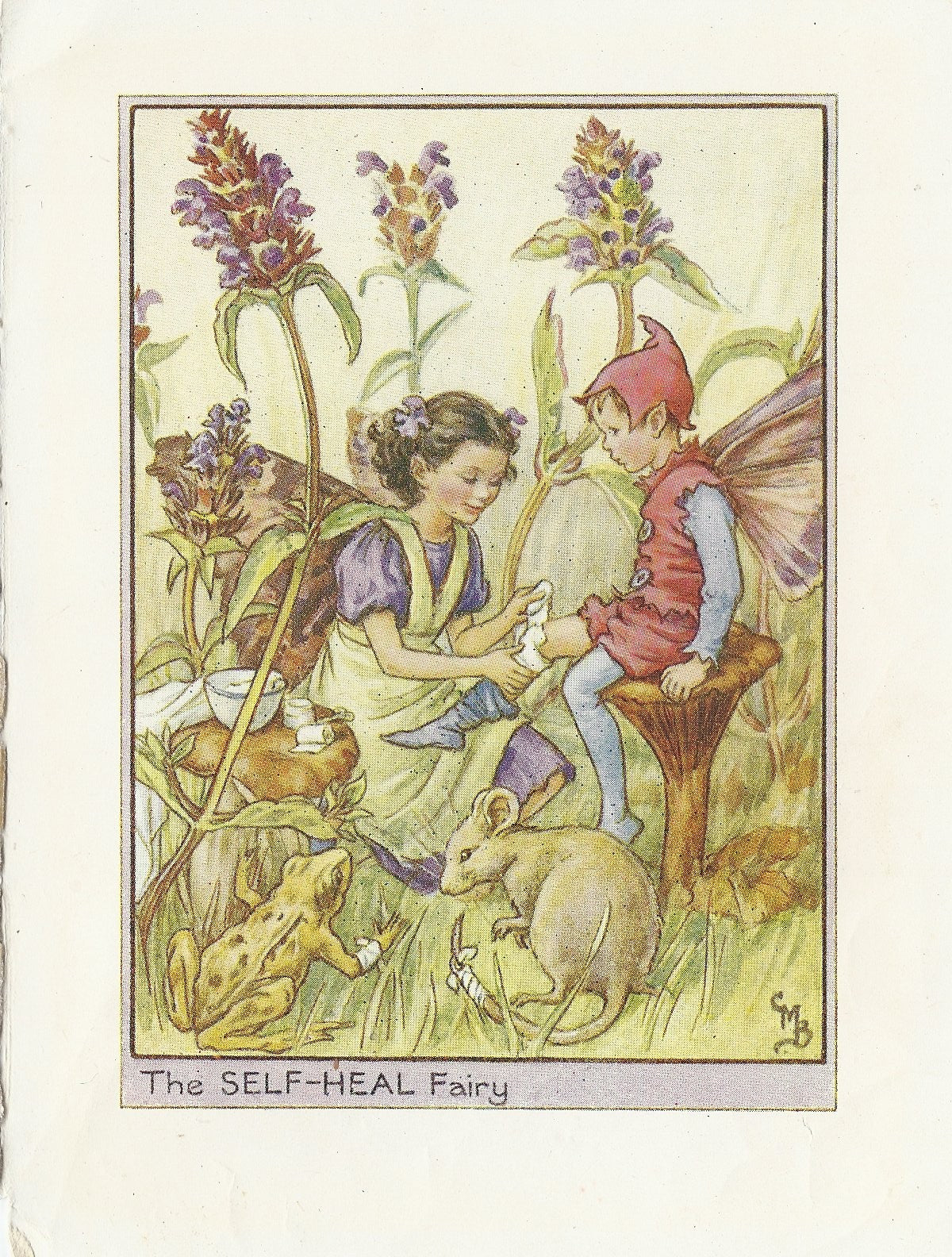
And how could I resist the Selfheal Flower Fairy, sorting out the elves and the mice and the frogs with her healing balm?

Photo One at http://www.mapsandantiqueprints.com/wp-content/uploads/2010/07/p-762-195-248.jpg

The Selfheal Flower Fairy by Cecily Mary Barker(Photo One)

For my poem this week I offer you this extraordinary work by Northern Irish poet Michael Longley, one of my very favourite writers. Although Self-Heal is about the west of Ireland, rather than the Troubles in the north, it’s difficult not to read this and consider how an act can spiral into violence and yet more violence. It’s not an easy read.

(Mayo Monologues 3)

I wanted to teach him the names of flowers,
Self-heal and centaury; on the long acre
Where cattle never graze, bog asphodel.
Could I love someone so gone in the head
And, as they say, was I leading him on?
He’d slept in the cot until he was twelve
Because of his babyish ways, I suppose,
Or the lack of a bed: hadn’t his father
Gambled away all but rushy pasture?
His skull seemed to be hammered like a wedge
Into his shoulders, and his back was hunched,
Which gave him an almost scholarly air.
But he couldn’t remember the things I taught:
Each name would hover above its flower
Like a butterfly unable to alight.
That day I pulled a cuckoo-pint apart
To release the giddy insects from their cell.
Gently he slipped his hand between my thighs.
I wasn’t frightened; and still I don’t know why,
But I ran from him in tears to tell them.
I heard how every day for one whole week
He was flogged with a blackthorn, then tethered
In the hayfield. I might have been the cow
Whose tail he would later dock with shears,
And he the ram tangled in barbed wire
That he stoned to death when they set him free.

Photo Credits

Photo One at http://www.mapsandantiqueprints.com/wp-content/uploads/2010/07/p-762-195-248.jpg


Bugwoman on Location – Obergurgl, Austria – The Path to the Sahnestuberl

The river Gurgl.How I love an onomatopoeic name!

Dear Readers, as you will know if you follow the blog regularly, I spend a fortnight every year in the alpine village of Obergurgl, skipping about like a (middle-aged) mountain goat and eating prodigious quantities of cake to make up for the calories expended. This year, alas, my skipping was halted by a rather unfortunate incident. Under every Tyrolean hotel there is a Boot Room, and as I made my way to the one under the Hotel Wiesenthal on the first day of the holiday, I neglected to notice a tiny step down and crashed dramatically to the ground, twisting my ankle and feeling like an idiot to boot (sorry). Fortunately I was able to spend the rest of the afternoon with my leg raised and my ankle completely wrapped in a bag of ice (courtesy of the Picnic restaurant across the way), and after taking it easy the following day, I was up for a very small adventure. What could be better than a slow amble down to the Sahnesturbel, a mountain hut which serves the best cake in the village?

So off we went, climbing slowly up amongst the meadow flowers. Some farmers are already cutting their fields for the first time, so I was glad not to have arrived later in the year. I am always stunned by the sheer variety of flowers, and the concomitant biodiversity – there are butterflies, day-flying moths, beetles and flies of all kinds. The yellow rattle helps to reduce the fertility of the soil and keep the docks and nettles in check, and the many species of clover and vetch put nitrogen in the soil.

Yellow rattle and clover

A swallowtail butterfly put in an appearance, feeding on clover. One of its wingtips was missing, perhaps the result of a close encounter with a bird, but its flight was still strong. Several of the larger butterflies that I saw looked a little worn – the summer season is short here in the Alps, and I imagine that many of these insects have already had their share of drama.

Swallowtail butterfly (Papilio machaon)

Every time that I come to Obergurgl, it seems that several plant species are doing particularly well. 2018 seems to be the year of the bladder campion (Silene vulgaris)….

Bladder campion (Silene vulgaris)

and the round-headed rampion (Phyteuma orbiculare).

Round-headed rampion (Phyteuma obiculare)

But I confess to really loving the melancholy thistles. They are so dramatically pink, and such a magnet for insects of all kinds. The bees sometimes seem to collapse into them in a nectar-induced coma, and I can imagine no finer bed for a sleepy insect. Plus, this year was the scene of some drama. I noticed a fritillary feeding from one of the flowers, and for once my camera was handy.

IMG_4865

Shepherd’s fritillary (Bolaria pales)

A male flew in, attempting to mate with the female.

Then he was chased off by another male.

All this time the female carried on feeding. Sometimes it’s best to just ignore this kind of shenanigans I guess.

It’s easy to forget how territorial butterflies can be – I watched several orange-tips guarding their patch of plants against all comers, including various species of white butterfly who were twice their size. Of course, they could also have been mistaking them for female orange-tips. These idyllic mountain pastures are the scenes of so much drama at the micro level, and as I was moving more slowly than usual I had a chance to really watch what was going on.

Crossing the Gurgl

Once we crossed the river again, we had a walk along the river bank, where the flora is completely different. Several species from the Apiaceae or carrot family dominate here, and I love the way that the broad flowers become a huge dinner plate for many species of pollinating flies. Flies get a bad press, but they are important for the fertilisation of many species of plant.

Plus, the blooms are very beautiful, especially in these damp, shady places, where they seem to glow and burst like fireworks.We cross the road (carefully, this is prime motorbiking country, and those guys are often travelling very fast) and head up into the pine forest. We manoeuvre round some lively calves, and their many and varied cowpats, and then we’re into the woods.

This has been a good year for the broad-leaved marsh orchids – the central reservations of the roads are full of them, and the woodland paths are lined with their pink-speckled flowers. These plants prefer poor-quality, wet soils, and they are profuse in the boggier areas of the region. They are, however, not quite as sensitive to the soil conditions as some orchids, and so are usually the last to be lost when a meadow is drained, or when nitrogen run-off from farms becomes a problem. Long may they, and their rarer relatives, survive here in the Tyrol, one of the last places where they are common.

Broad-leaved marsh orchid (Dactylorisa majalis)

The gondolas from the Hochgurgl lift glide silently overhead. It’s rather surreal.

One of the Tyrolean grey cows gives us a look as we advance, but can’t be bothered to move, and who can blame her? We scoot round her respectfully.

We pass by the Piller See, a little pond stocked with trout, at some speed – a few years back we stopped to eat our sandwiches. It wasn’t until I got home that I realised that every midge and mosquito in the area had fed on me while I was eating my cheese roll. My husband didn’t have a single bite. Go figure.

The Piller See

Then it’s down to the river again, which has picked up pace by now and is whooshing past with some vigour. In the end, this water will join the river Inn ( for which Innsbruck is named) and will eventually become part of the Danube. This is a most ambitious little stream. We cross one of those see-through metal bridges that the Austrians (who obviously have no fear of heights) are so fond of, and plonk down on a bench to sort out our socks and boots and have some Toblerone.

A way-marker en route to the Sahnesturbel

By now, however, the clouds are starting to set in, and my ankle is starting to twinge. Just as well we’re on the home straight.

We cross the bridge. Landslides are common here, and rocks that vary in size from house-sized boulders to pebbles have been washed down by the glacial waters. I pick my way gingerly along the riverside, and then up through the woods for the last time. I can see the flag of the Sahnestuberl through the trees. And then, at last, just as the rain comes on in earnest, we’re there.

The Sahnestuberl is one of the last old-fashioned huts in the valley, with a mish-mash of deckchairs and wobbly tables and umbrellas outside. But the owners are friendly, the food is good and wholesome, and the cat is still here. He is clearly in charge, as you can see.

There is only one home-made cake every day, so you take your pick. But today it’s apricot, my favourite. We were going to share a piece in the interest of our waistlines, but really, life’s too short to share a cake. So here it is. I’m sure it’s helped to cure my ankle.

Apricot cake. Yum.