Wednesday Weed – Fourth Annual Report – Weeds of the Year Part Two

Dear Readers, here are the remaining contestants for ‘weeds of the year’. Let me know what you think!

August

Tomato (Solanum lycopersicum)


I might not like fennel very much, but I am a great fan of tomatoes, what with their health-giving lycopenes and all, and so I was delighted to find a couple growing beside a lamp post in Muswell Hill. It appears that they ‘escaped’ from a vegetable delivery van, and were doing very nicely though, knowing the association of dogs and lamp posts, I was not going to harvest any from this particular site. Tomatoes, like all plants in the family, need to be ‘buzz-pollinated’ by bumblebees, and in some countries with no bumblebees of their own, people are paid (a tiny amount) to go to every tomato flower and pollinate it using a special device. I had no idea. And in a piece of most excellent synchronicity, I witnessed buzz-pollination myself only a few days later.

September

Mugwort (Artemisia vulgaris)


Mugwort (Artemisia vulgaris)

I have chosen mugwort as my September weed because it is such an unassuming plant that it’s very easy to walk right past it and not notice, surely the defining characteristic of a true ‘weed’. Yet, it has a very long association with the people of the UK – it’s been smoked, turned into beer (the ‘mug’ part of the name may refer to the days before glass tankards) and it is said that, if you stuff it into your shoes, it will stop you from tiring on a long journey. It may, of course, give you blisters, but that’s another story.

October

Fig (Ficus carica)


My choice of fig for October is because it gave me the opportunity to talk about the delights of eating the fruit (in spite of the possibility of each succulent morsel bearing a few crunchy wasps). Even more excitingly, I was able to report that, in Victorian times, plaster figleaves were created which could be hung from naked Classical statues in the event of a visit from Queen Victoria and her ladies-in-waiting. Rarely has a factoid made me so delighted.

November

Ginkgo (Ginkgo biloba)


The Gingko is 270 million years old and the very last of its kind.Its leaves are reputed to fall all at once, overnight, leaving the bare tree standing in a golden pool. They survived the bombing of Hiroshima, and there are trees that are over a thousand years old and still producing new shoots. Ok, so the rotten fruit smells of vomit, and the pollen is highly allergenic, but this looks like a very special tree indeed.

December

Red-hot poker (Kniphofia uvaria)


On a grey December day, the orange and yellow flowers of the red-hot poker, or torch lily, were just what I wanted. It brings a touch of African heat to the cold of winter, and I could just imagine a sunbird perched on top, or feeding from the tubular blossoms. I love the way that our native bumblebees have learned to navigate the flowers: they truly are the Einsteins of the insect world (although who knows what other six-legged geniuses are waiting for their chance at an intelligence test? Let’s hope that we haven’t made them extinct before we grow to appreciate them).

January

Winter-flowering heather (Erica carnea)


And so we come to the beginning of this year, and I would like to celebrate the charms of the winter-flowering heather, boon for sleepless bumblebees and the subject of a rather amusing April Fool’s Day joke in The Independent newspaper a few years ago, when the flowers were described as ‘natural Viagra’. I cherish anything that is in flower during these cold, dark days, and this plant really hits the spot.

So, dear readers, what do you think? Do you have a ‘Weed of the Year’  from the twelve posted over the past two weeks, or is your favourite plant something completely different? Are there any plants that I’ve never covered that you think deserve a bit of attention? Just let me know. And thank you for all your comments and ideas, and your never-ending support. It makes all the difference.


Bugwoman’s Fourth Annual Report – Part One

Dear Readers, it’s that time of year when I review what’s been going on during my fourth year of producing the Bugwoman blog. What’s been happening in the past twelve months? This week, we’ll be looking at February 2017 through to July 2017 – the rest of the year will make an appearance next week. Stay tuned!

February 2017


We started the Bugwoman year in a celebratory mood. After a year of no blackbirds (following the death of a male at the hands of the local sparrowhawk) a new couple moved in, and it was such a pleasure to hear the song of the male from the rooftop in the evening. I’m pleased to report that I still have a pair of blackbirds in 2018, and I’m hoping that they’re the same ones.


March 2017

In March London suffered the first of several terrorist attacks last year, when a car was rammed into pedestrians as they crossed Westminster bridge. I was on the South Bank when it happened, and wrote a piece about it here.  I find that nature has a way of restoring balance to our troubled minds in times of trouble, and it was especially consoling during my walk, the arrival of spring coinciding with the terrible injuries and loss of life.

And I also made a visit to Crossbones Graveyard, close to London Bridge. This is a site for the outcast dead, and they are remembered in a ceremony every month at the main gates. It is a very special place, and it felt entirely appropriate to be making my first visit there in the week after the terrorist attack. I hope to visit it again soon.


The gates at Crossbones Graveyard

‘A poor man taken out of the street, December 2 1725 – one of the ribbons from Crossbones Graveyard

A bee feeding on willow in the graveyard

And the frogs were back, singing away in the pond.


April

April kicked off with a garden visit from a female sparrowhawk, who plucked and ate a collared dove that she’d knocked out of the whitebeam tree. A spectacular but discomfiting event.

And then some Bohemian Waxwings visited a tree at the end of my road, something I hadn’t seen for years.

April also found me on my annual visit to Canada – my husband John is Canadian, and I love observing the wildlife on the other side of the Atlantic. The similarities and differences always intrigue me. For example, we have no grackles in the UK.

Grackle


And our goldfinches are not North American goldfinches…

And we don’t have any cardinals..

But we do have house sparrows.

And these guys of course….


May 2017

At the beginning of May I was still in Canada, and paid a visit to the Royal Botanical Gardens in Burlington (just outside Toronto). I met up with my lovely friend M, who lives in the States but had motored across the border. She is also a writer and a nature-lover. We had a wonderful day!

Trillium (Trillium grandiflorum)

Red-winged blackbird

Back in London, I took a walk to look at the street trees of Archway, just down the hill from where I live. It was based on one of my favourite books from last year, ‘London Street Trees: A Guide to the Urban Forest‘ by Paul Wood, and it was so much fun that I plan to do another walk later this year. You can read about the walk here and here.

Chinese Lacebark Elm

A Dawn Redwood (Metasequioa glyptostroboides) just off Holloway Road in North London.

A Bragania visited by a carder bumblebee in Dresden Road, a few hundred metres from the hubbub of the Archway junction.

June

June saw my monthly visit to my elderly parents turning into something of a drama, after Dad got a chest infection and had a fall. Still, spending time in Milborne St Andrew in Dorset is always a pleasure, and even if I didn’t have much time to admire the scenery, I did get a few brief minutes to look at the garden and take a deep breath.

White-tailed bumblebee on the ceanothus in Mum and Dad’s garden

June also saw the great willowherb in my garden infested with the caterpillars of a tiny moth. Surprisingly, they still flowered rather splendidly. ‘Weeds’ are resilient plants, for sure.

July

In July I made my annual visit to Obergurgl in Austria, for walking in the mountains and admiring the flowers and the insects. Oh, and for cake.

Large Copper butterfly on yarrow

Hoverfly on rampion

Early flowering orchid

Cake!

Closer to home, I paid a visit to East Finchley Station, and to the N2 Community Garden beside it. There are many new goings on in the entrance to the station…


…on the platforms


….and in the garden itself. It was lovely to go travelling, but it’s always nice to be home.

Fennel (Foeniculum vulgare)

I also spent some time posting about my amazing artist friend, Robin Huffman, and her portraits of the monkeys and apes that she cares for when she volunteers at wildlife sanctuaries in Africa. I think her work is absolutely stunning, and to see more of it you can visit her website here. She is currently in Cameroon at the  Ape Action Africa sanctuary in Mefou, looking after several baby monkeys. I imagine that she’s covered in poo, bitten half to death and dreaming of Japanese food, but I bet she’s also deliriously happy.

Sunshine, Olive Baboon (Robin Huffman) (after a photo by Perrine DeVos)

Diva, moustached guenon

Ayla, vervet monkey

So, Dear Readers, that’s the end of part one of my annual review. Stay tuned for next week!


Wednesday Weed – Fourth Annual Report – Weeds of the Year Part One

Dear Readers, goodness only knows what happened to the formatting of my photos this week! Here is an amended version with what I hope are the correct photos.

Dear Readers, as we come to the Fourth Anniversary of the commencement of this blog,  I thought it might be fun to nominate a few ‘weeds’ as my favourites of the past year. As you know, my definition of ‘weed’ is any plant that I haven’t planted deliberately myself – the Wednesday Weed has been an excuse for me to learn something about the plants that surround me here in East Finchley, whether they’ve been planted on purpose or have sprung up of their own accord. After four years it’s become increasingly difficult to find truly wild plants that I haven’t already discussed, and so you might have noticed an increase in ‘domesticated’ plants this year. Personally, I’ve found it fascinating to discover the histories of some of our garden plants, though my heart does belong to wildflowers, especially those who survive, like many city dwellers, in impoverished and difficult habitats. With that in mind, let’s have a quick gallop through February 2017 to July 2017, (August 2017 to January 2018 will appear next week), to see who’s made my (extremely biased) list of Weeds of the Year. To find the original pieces, just click on the links in each section.

February

Stinging Nettle (Utrica diocia)

Stinging Nettle (Urtica dioica)


I know, I know. Most of us have had a close encounter with stinging nettle at some point in our gardening lives, and as I get older I find that the stings seem to persist for ages, even after an application of dock leaves (as recommended by my Dad, who knows what he’s on about). But who could resist a plant that feeds peacock and red admiral butterflies, that has been woven into cloth, and which can be turned into a delicious nettle risotto? I rest my case.

March

Lungwort (Pulmonaria officinalis)

Lungwort(Pulmonaria officinalis)


This was a difficult month to judge, but what tipped it for lungwort was the way that the flowers change colour from pink to blue once the plant has been pollinated, possibly giving an indication to bees that they shouldn’t waste their valuable time on blooms that have gone over. Plus, the spotted, lung-shaped leaves were said to indicate that the plant was useful in the treatment of pleurisy and other pulmonary complaints (hence the Latin name Pulmonaria officinalis). I have even succeeded, for one year at least, in growing this in my garden, and I will be delighted beyond measure if it pops back up this spring. Fingers crossed.

April

Windflower (Anemone nemerosa)

Windflower (Anemone nemorosa)


I love this plant because it is an indicator of ancient woodland, because it is so ephemeral, and because it seemed to welcome me when I first came to East Finchley and discovered Coldfall Wood. Its flowering was said to mean that the ‘March winds’ were on their way and Pliny believed that it only opened on windy days. In another story, the flowers sprang from the tears of Aphrodite as she mourned Adonis, killed by a wild boar. Its brief flowering is a result of it taking advantage of the sunshine before the leaves on the trees shade out the forest floor. If I wanted to take a lesson from it (and experience tells me that plants and other living things have much to teach us if we have ears to listen) it would be to grasp opportunities when they present themselves, because it might be a while before they come round again.

May

Welsh Poppy (Meconopsis cambrica)

Welsh Poppy (Papaver cambrica)


I do love a ‘new’ urban weed, and Welsh poppy is a plant that has escaped only recently, and is spreading through the neighbourhood with great enthusiasm. It is a native plant, but is listed as ‘nationally scarce’ in its original habitat. Not here in East Finchley, where it has taken to the shale and gravel front gardens of the County Roads as if they were the shady dells of Snowdonia. There is a legend that the plant doesn’t flourish away from Welsh soil, but it has obviously not read the book. It is the symbol of Plaid Cymru, and is closely related to the Himalayan Blue Poppy. Pollinators of the hoverfly and beetle variety seem to love it, so I am content.

June

Flax (Linum usitatissimum)

Flax (Linum usitatissimum)

This little beauty erupted from some spilled birdseed, and I have not been so excited about a plant in a long time. After all, when your Latin name means ‘really, really, really useful’ it’s worth doing some research. Flax is used to make linen, linseed oil, flaxseed (as sprinkled on your muesli in these health-conscious days), and, best of all, linoleum! Plus the flowers are exquisite and delicate, and much beloved by equally exquisite hoverflies. I am very pleased to have made its acquaintance.

July

Fennel (Foeniculum vulgare)

Dear Readers, I actually loathe things that are aniseed or licorice flavoured: I can just about cope with fennel seeds, or the domesticated fennel bulb if roasted gently until the taste is somewhat constrained. But who can argue with the pollinators who were hovering above this fennel flower in the N2 Community Garden next to East Finchley Station? They were positively queuing up for some of that delicious pollen and nectar, and in these difficult times for insects that is a great thing. Plus, fennel is one of the ingredients of absinthe, that mainstay of French poets and artists for years immemorial, so it well deserves its place in the Hall of Weedy Fame.


So, what do you think so far? Stay tuned for the August to January ‘weeds’ next week!


The Great Garden Birdwatch 2018

Dear Readers, the last weekend in January is the RSPB (Royal Society for the Protection of Birds) annual citizen science event, the Big Garden Birdwatch. All over the country, people sit and watch the birds in the garden or local park, and record the maximum number of each species that they see. It started in 1979, and was aimed at junior members of the society, but when the event was featured on Blue Peter, the most popular children’s TV programme at the time, more than 34,000 school children submitted their forms. Today, over 40 years of data has been collected, and over half a million people, from residents of care homes to private individuals (like me) take part.

Usually, for whatever reason, the birds opt to stay away in my garden for the hour of the count, only to come back in their dozens as soon as I submit my results. I did wonder if this was because of my presence looming at the kitchen window, but this year, the birds didn’t care. As soon as I started my timer, a great flock of starlings descended. I have noted before that I’m convinced that they watch from one of the big trees on East Finchley High Road and swoop down as soon as the feeders and bird table are topped up.

I had recorded 17 starlings when a charm of goldfinches flew into the whitebeam. I love the way that they approach at speed, jinking at right angles as if to confuse any passing predators. And what splendid birds they are!

A wren has recently taken up residence in the garden, and stayed long enough for a brief portrait. Everything about them seems explosive: they burst from cover like feathery bullets, and their whole bodies vibrate with song. I was very lucky to get any photograph at all.

The chaffinches appeared, a group of six, with their elegant mothy flight.

But then, something flew in fast over the roof, and seemed to wipe the whole garden clean of birds with a stroke of its wing.

Sparrowhawk.

It sat in the tree for a few minutes, surveying the garden with monomaniacal yellow eyes. Where do the little birds go, I wonder, it was as if they had dematerialised. I was able to walk out into the garden and get a few shots of this juvenile (there have been a pair of adults around for a while). I suspect it was only the inexperience of the bird that protected his prey, for other visitors have been much luckier in their pursuit of something to eat.

Well, I thought, that puts the kibosh on my bird count, and indeed for a full ten minutes there was not a single visitor of a feathered variety, though someone popped in to take advantage of the peace and quiet.

But then, the birds started to drift back. Of course, the starlings were first, bold characters that they are.

And then the resident robin.

And one of the pair of blackbirds. A few years ago, a male fell prey to a sparrowhawk, but the territory was reoccupied the following year. So far, so good.

The pond has always been a great draw for creatures of all kinds, and the blue tit often perches on the branch that I’ve partially submerged to attract dragonflies, and has a little bath.

The finches are back on the seed feeder. Although the chaffinches are larger, the goldfinches are more aggressive, and usually win any perches that they contest.

And then, something catches my eye down by the pond.

A blackcap! This is a kind of warbler that has historically been a summer visitor, but increasingly blackcaps from central Europe have been overwintering here. I was visited by a female a few years ago, but this is my first male. They have a lovely song, described in my Crossley Bird Guide as ‘somebody cheerfully whistling as they walk through the wood’. See what you think.

And so, my hour came to an end. Of the twenty species on the list that were seen as ‘general’ garden birds, I’d recorded ten, and some regular visitors, such as the long-tailed tits and the coal tit, hadn’t put in an appearance in the hour. On the other hand, I’d had two species, the sparrowhawk and the blackcap, who weren’t on the list at all, and that always makes me happy.

I have two thoughts at the end of my hour. Firstly, this was a lot of fun, and gave me an excuse to do nothing but watch, listen and record for an hour. Did anyone else do the Birdwatch, or do you have an equivalent where you live? Or do you take part in any other citizen science events? In the UK there are recording events for everything from moths to earthworms.

And secondly, I wonder what else I would see if I took an hour a week, maybe at the same time of day, to sit and watch and record? I have an urge this year to look at things in more depth, rather than being distracted by the sheer wealth of things that there are to pay attention to. Does anyone else keep some kind of record of what they see, maybe a diary or a photo album? The blog encourages me to pay attention and to share what I see, but I am very curious about what you get up to. Let me know what helps you to appreciate nature, and what helps you to make the most of your garden or local area. I am definitely up for new ideas.

Wednesday Weed – Spider Plant

Every Wednesday, I hope to find a new ‘weed’ to investigate. My only criterion will be that I will not have deliberately planted the subject of our inquiry. Who knows what we will find…..

IMG_3141

A very fine spider plant (Chlorophytum comosum) at East Finchley Station

Dear Readers, when I was growing up my paternal grandmother had a number of houseplants. There was a rubber plant that had grown almost to the ceiling, with leaves that were lovingly wiped once a week. There were various ferns with fronds browning in the dry air (these were cut off with nail scissors as soon as they began to look untidy). And there was the most magnificent spider plant, bursting forth like a fountain and producing little starry white flowers which would, in due course, turn into new spider plants. If not transplanted quickly enough, these would root into the carpet, but this was an unusual happening in a house where no grain of dust was allowed to languish.

I have two spider plants myself, acquired because they are believed to be particularly good at cleaning up household air, and because they are tolerant, hardy plants, prepared to forgive negligence and mishandling. For a while, I was giving my plants a ‘holiday’ on the patio in the summer, but soon discovered that they are a favourite with slugs and snails. One plant came back into the house with a positive colony of tiny snails living under the rim of the pot, and they could be caught shimmying forth across the Persian carpet if you got up during the night.

I note that there are also several spider plants now living in the entrance to East Finchley tube station, and these are rather fine specimens, standing on a plinth and cascading down. They are a good choice for this spot because they don’t seem to mind low light, draughts, people accidentally knocking them off their podium, and the other hazards of being in a public space. And so I got to thinking. What on earth are they? And how did they get to become one of the most popular houseplants in the world?
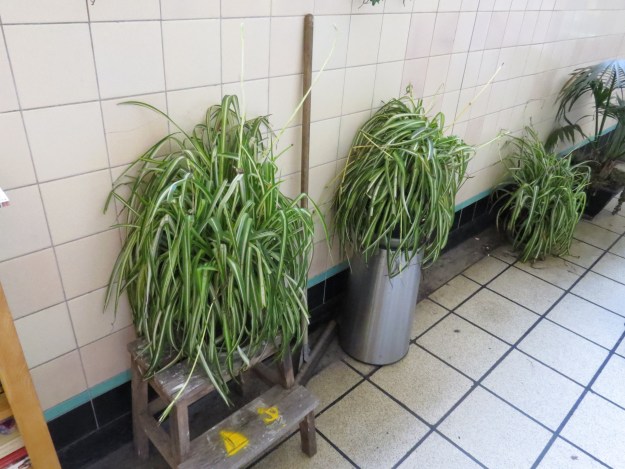
IMG_3142

The Latin name for the spider plant is Chlorophytum comosum, and popular names include airplane plant and spider ivy. Interestingly, none of the names include the word ‘grass’, in spite of the fact that this is what the plant most closely resembles. However, its closest relatives are actually agaves, aloes, hostas  and the Joshua tree, members of the Agavoideae family. There are some 200 members of the spider plant genus, but our plant comes from tropical and southern Africa originally. In the wild there seem to be three subspecies: one with very narrow leaves that grows along the margins of forests, and two others that live within the forest itself, and have broad leaves which help to make the most of the dappled sunlight.

In cultivation there are two popular variegated varieties. One, ‘Vittatum’, has a broad white stripe down the middle of each leaf, and the flower stalks are white.

Photo One (Vittatum) by By Hierbabuena_0611.JPG: Dtarazonaderivative work: Peter coxhead (talk) - Hierbabuena_0611.JPG, Public Domain, https://commons.wikimedia.org/w/index.php?curid=16710171

‘Vittatum’ variety of spider plant (Photo One)

The other, ‘Variegatum’ has leaves with white margins, and the flower stalks are green. It goes to show how much attention I’ve paid that I’ve never noticed the difference.

Photo Two by By Digigalos - Own work, CC BY-SA 3.0, https://commons.wikimedia.org/w/index.php?curid=4746014

Spider plant ‘Variegatum’ variety (Photo Two)

To return to the subject of using spider plants to clean air: they are said to be particularly good at neutralising formaldehyde (which can be found in automobile exhausts and cigarette smoke, among other pollutants). However, you would need 70 plants to clean the air in a 160m square energy-efficient house, so I’d better be encouraging mine to produce some plantlets at speed. A spider plant will also give you a hand (leaf) with toluene and xylene, should you be suffering from such noxious substances. And all for the price of a regular watering and an occasional (very occasional in my case) feeding when you get round to it.

Spider plants are also said to be very good at absorbing the smell of fresh paint. Let me know if you have any experience of such a phenomenon – my house is due for a ‘freshen up’ on the paint front, and the smell always gives me a sore throat.

Incidentally, my spider plants were for a while displayed elegantly on top of my husband’s expensive speakers. One day I was watering the plants and didn’t notice that the leaves had directed the water into the equipment. One of the speakers is currently with the Hi-fi doctor, and I am keeping an unusually low profile.

Photo Three by CC BY-SA 3.0, https://commons.wikimedia.org/w/index.php?curid=66830

A magnificent spider plant in full breeding condition (Photo Three)

It appears that spider plants are eaten in the regions of Africa where they grow wild – they apparently have a bitter taste, but are full of vitamin C and various micronutrients. If you had the 70 plants recommended to reduce your in-house pollution, you would have an abundance for your eggs Florentine or spider plant omelette. The plant, especially the stem, is also relatively high in protein.

In Polish-American folklore, the white flowers on a spider plant signify a birth or a wedding.

Photo Four by By Wildfeuer - Self-photographed, CC BY 2.5, https://commons.wikimedia.org/w/index.php?curid=1460984

Spider plant flower (Photo Four)

Medicinally, the plant has been used by the Nguni people of South Africa as a charm to protect a pregnant mother and her baby. The plant is kept in the room where the mother and child are staying, and the roots are dipped into water which the mother then drinks. The child is also given an infusion of the leaves.

Apparently some cats develop an attraction to spider plants, and get ‘high’ much as some cats do with catnip. Although the plants are not toxic, this is probably a good reason for hanging them up somewhere high (though not on top of expensive speakers, see above).

Incidentally, the two biggest problems that spider plants suffer from are red spider mites (ironic, given the name) and browning leaf tips. For the spider mites, the recommended treatment is to blast the little arachnids with strong alcohol on a cotton bud (should you have such a substance in the house, of course).

Photo Five by By Charles Lam from Hong Kong, China (Red Dot) [CC BY-SA 2.0 (https://creativecommons.org/licenses/by-sa/2.0)], via Wikimedia Commons

Red spider mite (Tetranichidae sp.) (Photo Five)

Those brown leaf tips, though, are due to an accumulation of fluoride, which the plant can’t tolerate. The recommended treatment is to cut off the affected leaf tips, and to water the plant with rain water or, at a pinch, with water that’s been allowed to stand overnight so that some of the fluoride evaporates off. Who knew? The things that I learn in the course of this blog never fail to amaze me.

Strangely enough, this common, cheerful, easily nurtured houseplant seems to have inspired a raft of sinister poetry. Here, for example, is a found poem by Lori Davis, a poet about whom I can find almost nothing.

Caring for Your Spider Plant
Lori Davis
A found poem dedicated to Andrea Yates,
the mother from Texas who drowned
her five children

The more root-bound your plant is,
the more babies it can produce.
The more babies on the plant,
the more attention the plant will need.
Most problems arise from overwhelming.
You will first notice a darkening heart
with a yellow halo,then all-black lower leaves.
If it dries out between waterings,
keep an eye on the foliage.
It will become pale and limp
when it is ready for water.
The root system is large and tuberous,
allowing it to store distress longer
than most hanging plants.
Naturally, the bigger the babies are
the more strain they put on the mother.
Since their roots are already formed,
the babies can be removed
rather easily. To remove babies from the mother,
trim the stem off both mother and baby.
It looks better if there are no stubs showing.
Then you can plant directly into moist soil
or simply place in water, holding them under
until their little roots start to recoil.

and this one, called ‘Last Nostalgia Starting With a Piece of Spider Plant on our Car’s Backseat‘ by Anna Journey: if the last stanza doesn’t demand a sudden intake of breath, i don’t know what does.

But after all that misery, here is a post that stopped me in my tracks. From the website ‘Vision Loss and Personal Recovery‘ it details how, even without sight, a person can enjoy and nurture their houseplants, and the information included is useful for everyone who loves plants. Here, for example, is a very happy spider plant:

‘My heartiest plant currently is a huge spider plant that I bought at a yard sale four years ago. At that time it was unhealthy and about the size of the circumference of a dessert plate. Today it fills a pot that has the circumference of a small laundry basket and is very hearty. I routinely first set it on my office chair at home, wheel it into the bathroom and set it in the tub and then give it a 15 minute shower. It cleanses the leaves and saturates the soil quite nicely. Then I set something under one side of the pot to tip it in order to allow it to drain for a couple of days until I can again lift it and return it to the bedroom window. During its short stay in the shower, I cover it with plastic while Nick, my husband, or I shower so that soap or shampoo does not get in the plant. Nick is never more thrilled than when showering with this monster plant.’

Showering with monster plants? That’s an idea whose time has come.

Photo Credits

Photo One (Vittatum) by By Hierbabuena_0611.JPG: Dtarazonaderivative work: Peter coxhead (talk) – Hierbabuena_0611.JPG, Public Domain, https://commons.wikimedia.org/w/index.php?curid=16710171

Photo Two by By Digigalos – Own work, CC BY-SA 3.0, https://commons.wikimedia.org/w/index.php?curid=4746014

Photo Three by CC BY-SA 3.0, https://commons.wikimedia.org/w/index.php?curid=66830

Photo Four by By Wildfeuer – Self-photographed, CC BY 2.5, https://commons.wikimedia.org/w/index.php?curid=1460984

Photo Five by By Charles Lam from Hong Kong, China (Red Dot) [CC BY-SA 2.0 (https://creativecommons.org/licenses/by-sa/2.0)], via Wikimedia Commons

Bugwoman on Location – A Damp Birthday in Somerset

Dear Readers, last Saturday was my 58th birthday and I would very much like to know where the past twenty years have gone. It seems as if everything has speeded up , the days whizzing past like hailstones, and no sooner have I put the Christmas decorations away than it’s time to put them up again. But I do have a secret for helping time to slow down, and it’s this. Walk along a country lane very slowly on a damp day, and exercise your five senses to their utmost.

It helps if you are witnessed by a lone magpie, who chucks away at the top of a tree without ever launching into a full cackle.

And it also helps if there are hazel catkins about, and if they are sulphur yellow and shell pink. Perhaps some are fully open, exposing their pollen to the breeze, while some are still emerging and are tight speckled sausages.

The hedgerows are full of chirruping birds, and occasionally one stops on the top of a twig to survey the scene, like this great tit, before flying off in a flurry.

And while you’re standing there, you notice the small, damp world created by moss on a dead branch.

There is a new robin singing every fifty feet, defending their tight territory.


The snowdrops are already out in the small field by the stream.

The lane is alive with harts tongue and male ferns, giving the feel of a temperate rain forest.

The wild garlic is already showing through with its shiny green leaves.

Some long-tailed tits are feeding from a peanut feeder hanging over the fence, until seen off by a robin.

A female blackbird is harvesting worms, an easier job when the weather is damp.

And the snowberry still goes unmolested, as if the birds are working their way through the berries from black to white.

Snowberry

Ivy berries

And here, of course, is a splendid horse. He was in the mood for a chat, but I sense he would much rather be trotting up the lane.

The rooks are building and repairing their nests, and chatting amongst themselves. Like so many country birds, they take off as soon as I raise my camera.

The stream is high, so it’s over the bridge for me….

And look, the sun popped out for a few minutes, warming up all the colours.

Back in Aunt Hilary’s garden, there were naturalised cyclamen and snowdrops everywhere.

And, as the rain came in again, pure white periwinkles glowed at the base of the shrubs.

I think that I’ve noticed more in the past hour than I have in the previous seven days combined. It’s so easy for me to live in my head, thinking about the past, planning for the future, without ever paying attention to what’s actually going on. Creating this blog  reminds me that wherever I am, there is always something interesting going on if I just open up to it. And if life is richer, time seems to go more slowly, which is one explanation for why the days seem so long when we’re children – every thing that we see and do is filled with novelty, and piques our interest. There’s much to be said for spending at least part of every day in a state of ‘beginner’s mind’, as if everything is new. Because, in a way, it is.


Wednesday Weed – Wild Garlic

Every Wednesday, I hope to find a new ‘weed’ to investigate. My only criterion will be that I will not have deliberately planted the subject of our inquiry. Who knows what we will find…..

Wild Garlic (Ramsons) (Allium ursinum)

Dear Readers, during a very wet walk in Somerset last week, I was delighted to see that the wild garlic is already putting in an appearance. I couldn’t help myself – I had to stop and pluck a leaf and take a little nibble. I love the delicate flavour of wild garlic, but by spring the whole of this lane will have a distinct whiff of allium, and the leaves will be topped with a froth of white flowers.

Photo One (garlic flowers) by By Kurt Stüber [1] - caliban.mpiz-koeln.mpg.de/mavica/index.html part of www.biolib.de, CC BY-SA 3.0, https://commons.wikimedia.org/w/index.php?curid=5352

Wild garlic in flower (Photo One)

I was delighted to learn that the species name, ursinum, comes from the brown bear’s habit of digging up the bulbs and eating them. I suppose if you’re walking through the woods and get a blast of onion breath it might be your cue to head up a tree at speed. Wild garlic often grows alongside bluebells, and both are known as indicators of ancient woodland (woodland that existed before 1600) – both plants spread slowly, and so if they are present in a wood, it means that the wood has been there for a considerable period of time.

Photo Two (ancient woodland) by By No machine-readable author provided. Naturenet assumed (based on copyright claims). - No machine-readable source provided. Own work assumed (based on copyright claims)., CC BY-SA 3.0, https://commons.wikimedia.org/w/index.php?curid=134686

Bluebells, wild garlic and hazel in ancient woodland on the Isle of Wight, UK (Photo Two)

Wild garlic is also known as ramsons (often misremembered as ‘ransoms’) or buckram, and is native to the UK and to the rest of Europe and Asia. The Old English root name for the plant, hramsa, appears in place names such as Ramsbottom and Ramsey Island, which I had previously thought related to sheep rather than a plant. It can indeed be an invasive little number (indeed, the vernacular name ‘ramsons’ comes from the same root as ‘rampant’), and when I was treasurer at Culpeper City Garden in Islington, I remember how we were inundated with the stuff for a season. Our lovely volunteers managed to dig most of it out, but it was very hard work.

It appears that I took a chance with my nibble, as it has been known for people to mistake the poisonous leaves of the lily-of-the-valley or the arum lily for the edible leaves of our plant. The scent test (rubbing the leaf and smelling the fingers to check for the garlicky smell) is a good way of identifying an individual plant but won’t help with subsequent plants. Fortunately, once the flowers are out everything is clear. Unfortunately, by this time the flavour has changed from ‘subtle’ to ‘brash’.

There is a limit to how much of the plant anyone wants to take home, although it has been growing in popularity as a culinary ingredient just lately, and it sometimes feels as if I’m tripping over wild garlic pesto every time I go to a posh restaurant. However, it’s not just about the pesto, as you will see from the fine selection of recipes here.

I was interested to find out that the plant has also been used as fodder, although like most members of the onion family it taints the milk produced by the cows and goats who feed on it. In Switzerland, garlic-scented butter made use of this natural feature, and was apparently quite popular. I am reminded of an episode from ‘Tess of the D’Urbervilles’ by Thomas Hardy, where the cows eat wild garlic in the orchard and ruin their milk, so Tess and Angel Clare end up working together with the rest of the village to clear the plant. Hardy is not my favourite author, but I do love the set pieces that he creates, and I must admit that since spending so much time in Dorset with my parents I am warming to his descriptions of the countryside and the people and animals that live there.

Wild garlic pesto

Like most alliums, wild garlic also has a whole raft of medicinal properties: it is antibacterial, and is said to be the best of all the onion and garlic family for lowering blood pressure (unless you’ve let it get out of hand in your garden of course). A 17th Century saying has it that if you :

Eat leekes in Lide (March) and ramsins in May,
And all the yeare after physitians may play.

Wild garlic was also a useful source of Vitamin C, and was said to have been taken to many parts of Europe by the Vikings: in Finland, it was planted at the ports and around the harbours to make it easy to pick and take on board. It was believed by the Vikings to protect against the evil eye, and of course we know how useful garlic is against vampires.

For my poem this week, I’ve chosen one by the Welsh poet Leslie Norris, who died in 2006. His poem honours fellow poet Edward Thomas, whose poems conjure the British countryside, wild garlic and all.

Ransoms
(for Edward Thomas)What the white ransoms did was to wipe away
The dry irritation of a journey half across
England. In the warm tiredness of dusk they lay
Like moonlight fallen clean onto the grass,And I could not pass them. I wound
Down the window for them and for the still
Falling dark to come in as they would,
And then remembered that this was your hill,

Your precipitous beeches, your wild garlic.
I thought of you walking up from your house
And your heartbreaking garden, melancholy
Anger sending you into this kinder darkness,

And the shining ransoms bathing the path
With pure moonlight. I have my small despair
And would not want your sadness; your truth,
Your tragic honesty, are what I know you for.

I think of a low house upon a hill,
Its door closed now even to the hushing wind
The tall grass bends to, and all the while
The faroff salmon river without sound

Runs on below; but if this vision should
Be yours or mine I do not know. Pungent
And clean the smell of ransoms from the wood,
And I am refreshed. It was not my intent

To stop on a solitary road, the night colder,
Talking to a dead man, fifty years dead,
But as I flick the key, hear the engine purr,
Drive slowly down the hill, I’m comforted.

Leslie Norris (b. 1921 d.2006)

Photo Credits

Photo One (garlic flowers) by By Kurt Stüber [1] – caliban.mpiz-koeln.mpg.de/mavica/index.html part of http://www.biolib.de, CC BY-SA 3.0, https://commons.wikimedia.org/w/index.php?curid=5352

Photo Two (ancient woodland) by No machine-readable author provided. Naturenet assumed (based on copyright claims). – No machine-readable source provided. Own work assumed (based on copyright claims)., CC BY-SA 3.0, https://commons.wikimedia.org/w/index.php?curid=134686


…And Home by Tube

IMG_2951

Dear Readers, when I left you last week I had just disembarked from the bus and was making my way towards Tate Modern, on the other side of the Thames. The quickest way is across the Millenium Bridge, which rises like a whale’s back and seems to float across the brown water. From here, it looks almost ethereal, suspended by a delicate tracery of cables.

IMG_2953

However, I was not expecting the Arctic wind that hit me as I started to cross. It sang in the cables, it chilled my face into a rictus grin, and I even had to take my hat off in case it was lifted off my head in a gust and deposited in the water. I stopped briefly in the middle of the bridge for the obligatory picture of Tower Bridge, and then made my way very briskly to the south bank. I confess, I was a little afraid – I felt as if it would be very easy to be blown over the edge, and the Thames looked both very choppy and a long way down.

IMG_2954

I did stop again for another obligatory photo. This one, of St Pauls ‘balanced’ on the bridge is a mainstay of many a suite of holiday pictures, I’m sure.

IMG_2957

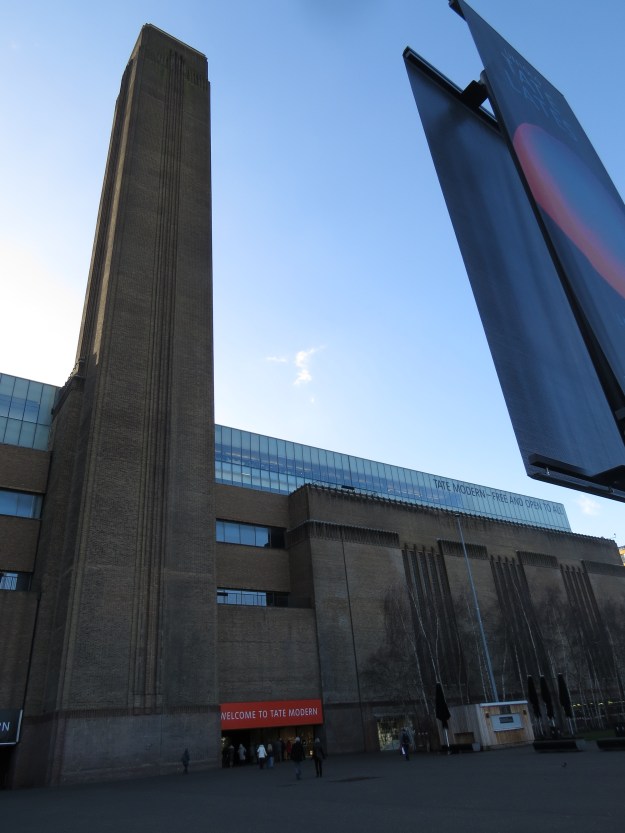
And then it was off to Tate Modern, so that I could thaw out a little. The building is home to a pair of peregrine falcons and their young every year, but nobody was around today.

IMG_2958

I was here to see an exhibition by a pair of Russian installation artists, Ilya and Emilia Kabakov. Their exhibition is called ‘Not Everyone Will Be Taken Into the Future’, and there is a theme of escape, of flying and of angels. In one exhibit, you peer into a room in which there is a hole in the ceiling and a kind of sling, as if someone has been catapulted into space – it’s called ‘The Man Who Flew Into Space From His Apartment’, and it was created in 1985.

Ilya Kabakov The Man Who Flew Into Space From His Apartment

But my favourite was this one, at the end of the exhibition – a rickety scaffold where a tiny figure reaches out his hands to an angel. It’s called ‘How to Meet an Angel’ and dates from 1998.

Ilya and Emilia Kabakov How to Meet an Angel

If you’re in London and you want to see it, you will need to leave now, because it finishes on 28th January.

Fortified with coffee, I head off home, stopping first to look back at the new extension to Tate Modern, which looks a bit ziggurat-ish to me. There is a viewing gallery at the top, from which you can look right into the living rooms of the very expensive flats opposite, which has caused some discomfort to those who live there. I think I might be looking at installing some blinds on that side of my apartment if I was discomforted (the planning permission for the extension had been granted before the flats were even built), rather than demanding that the viewing gallery be shut down, but there we go.

IMG_2961

On the way back to Southwark Station, I took a walk through the gardens at the base of the aforementioned luxury flats. They are rather cleverly designed, as the space is extremely shady, but plants, carefully chosen, are thriving. I always make a mental note when I walk through, as I too have a very shady garden.

IMG_2964

Sarcococca (Christmas Box)

IMG_2967

Some fine ferns and mind-your-own-business used imaginatively between the tiles

IMG_2969

Hebe, rocks, silver birch

IMG_2970

The obligatory bronze statue of a family. It looks as if Henry Moore met Picasso and the two decided to disagree…..

IMG_2973

Some gorgeous red berries, let me know if you can identify the plant!

IMG_2974

Dogwood

IMG_2975

So much of our public space is not public space anymore….

As I approach the station, I notice a couple of things that I hadn’t seen before. One is the exuberant Lord Nelson pub. It was recently voted the Best Pub in Southwark by readers of The Londonist website, and apparently it’s even more fun inside. It has a menu of 20 different kinds of burger, including six veggie options.


IMG_2977

And then there’s this. Why is there a statue of a dog feeding from a pot on the corner of Union Street and Blackfriars Road?

IMG_2979

Well, it’s a recreation of a shop sign that the twelve year-old Charles Dickens used to see when he was on his way to work at the blacking factory.

‘My usual way home was over Blackfriars Bridge and down that turning in the Blackfriars Road which has Rowland Hill’s chapel on one side, and the likeness of a golden dog licking a golden pot over a shop door on the other.’

The statue is by Michael Painter, an artist and sculptor who has worked at Windsor Castle and St Paul’s Cathedral, and is made of elm wood. It even has its own Twitter account, for those of you who are Twitter-minded.

Onwards, then, to Southwark Station, which is on the Jubilee Line. From the outside it doesn’t look particularly impressive, but it is one of my favourite tube stations.

IMG_2980

As you leave the station, you ascend into a shiny blue dome, which reminds me a little of a planetarium. The glass wall is made of 660 individually cut pieces of blue glass, and was designed by Alexander Beleschenko. One lovely thing about the Jubilee Line stations in central London is that they are architecturally very interesting, and embodied a kind of exuberance that I fear the Crossrail stations will not. But maybe I’ll be surprised. I hope so.

IMG_2988

IMG_2989

And there is also a feeling of space and light, an industrial edge coupled with the feeling of being on a cruise liner.

IMG_2987IMG_2982

And so, out by bus and home by tube, down to the river and back again. London is such an extraordinary city (and yes, I know I’m biased, being born and bred here). I wouldn’t swap it for anywhere in the world, partisan that I am. But I do love walking in the country as well, as next week’s post is likely to reveal…..


Wednesday Weed – Winter-Flowering Heather

Every Wednesday, I hope to find a new ‘weed’ to investigate. My only criterion will be that I will not have deliberately planted the subject of our inquiry. Who knows what we will find…..


Winter-Flowering Heather (Erica carnea)

Dear Readers, some plants just look at home in dank, drizzly weather, and the winter-flowering heather at my Aunt Hilary’s house in Somerset was bejewelled with raindrops when I spotted it this weekend. Each of the bell-shaped blooms seemed to be clutching its own crystal beach-ball of water, and the contrast of the magenta anthers to the pale pink petals was a lovely surprise.

Heathers (or ‘heaths’) are indeed plants of acid heathland, and there are several native varieties which can be found all over the West Country, and of course in their heartland in Scotland. This winter-flowering species comes originally from the mountainous areas of south and central Europe, where it grows amongst the conifers and on the rocky slopes. It is less of a calcifuge (acid-lover) than many of the other species, which means it will tolerate a much greater range of soil types. This burst of colour in the middle of the greyness of January is welcomed by many gardeners, and many early-rising bumblebee queens in need of a burst of nectar to keep them going for the rest of the winter.

Photo One by By Heinz Staudacher - Own work, CC BY-SA 4.0, https://commons.wikimedia.org/w/index.php?curid=63328580

Close up of Erica Carnea flowers (Photo One)

The name ‘Erica’ actually means ‘heath’ in Ancient Greek, while the species name carnea means ‘flesh-pink’, probably also the derivation of the name ‘carnation’. As with carnation, however, winter-flowering heathers now come in a wide variety of colours, from white through to darkest pink. You may also find the plant with the earlier name of Erica herbacea. Tis the same plant! Life is most confusing sometimes.

Surprisingly enough, the motherlode for heather species is not the damp uplands of Northern Europe, but the sunny fynbos area of South Africa, where there are no less than 690 species of Ericas. Have a look at this post here, showing the sheer variety of shapes, colours and sizes. It’s enough to make me start saving up for a plane ticket to the Cape. Wednesday Weed from the fynbos, anyone? in the meantime, here are a few examples.

Erica abietina (Public Domain)

Erica verticillata (Public Domain)

Erica nevillei (Public Domain)

Well, after that blast of sunshine, let’s go back to considering our winter-flowering heather. One question that occurred to me was ‘if this is a winter-flowering plant, who pollinates it?’ Aside from the aforementioned bumblebee queens, no self-respecting insect is going to be about in January. However, this is a plant with a very long flowering season, and it will quite likely still be flowering in March and April, when things warm up and the daylight increases. And, in mountainous areas, the pollinators will be up and about as soon as they possibly can, because the season is so short.

One interesting article that I found suggested that, unlike most heathers, which are largely fertilised by honeybees (hence heather honey), the winter-flowering heather seems to be more adapted for the long proboscises of butterflies, particularly the painted lady (Vanessa cardui). This is an abundant species in the Alps in early summer for sure, and I have seen it feeding on heather myself, so maybe the author of the article here has a point. What are your observations, gardening friends?

Photo Two by By Michael Apel (photo taken by Michael Apel) [GFDL (http://www.gnu.org/copyleft/fdl.html), CC-BY-SA-3.0 (http://creativecommons.org/licenses/by-sa/3.0/) or CC BY 2.5 (http://creativecommons.org/licenses/by/2.5)], via Wikimedia Commons

The exquisite painted lady (Vanessa cardui) showing off its proboscis (Photo Two)

And for those of you with winter-flowering heather in the garden, keep an eye open for the caterpillars of the true lover’s knot moth (Lycophotia porphyrea).

Photo Three by By This image is created by user Han Derks at waarneming.nl, a source of nature observations in the Netherlands. - This image is uploaded as image number 2581108 at waarneming.nl, a source of nature observations in the Netherlands.This tag does not indicate the copyright status of the attached work. A normal copyright tag is still required. See Commons:Licensing for more information., CC BY 3.0, https://commons.wikimedia.org/w/index.php?curid=20588445

True lover’s knot caterpillar (Photo Three)

Photo Four by By Donald Hobern from Canberra, Australia - Lycophotia porphyrea, CC BY 2.0, https://commons.wikimedia.org/w/index.php?curid=4935147

True lover’s knot (Lycophotia porphyrea) (Photo Four)

Now, while we’re on the subject of true lover’s knots and such, you might be as interested (and surprised) as I was to find that the flowers of winter-flowering heather apparently have a similar effect to Viagra. An Independent article from 2007 describes how stocks of the plant were selling out at Wyevale Garden Centres, A spokesperson explains:

At first, it was just a trickle of inquiries, but now stores are virtually being besieged each weekend. We have had men buying dozens of the plants and, at one store in Croydon, there were men old enough to know better fighting over the last remaining trays.”

And what a picture that conjures up! As does the one below:

It’s amazing. My husband has never shown any interest in gardening before, but now he’s out there night and day fussing over his heathers. Frankly, I preferred it when he left the garden to me and wasn’t so frisky.”

For a further description of how to actually turn the innocent blooms of the winter-flowering heather into a love potion, you can read the whole article here. Note that includes the mention of quality full-strength vodka.

Note also that the byline of the article is just before 1st April 🙂

Sadly, I can find no mention of actual medicinal uses for this particular plant, though our native heathers have a whole raft of applications, from cough medicine to the making of heather beer. I shall save those stories until I am lucky enough to stumble over a native heather, so watch this space!

Heather (and quite possibly this species) was sacred to the goddess Venus Erycina (the name means ‘of the heather). She was the Sicilian goddess of love, so maybe the Viagra link is so outlandish after all. Her cult was transmuted into respectability in Rome, and she was worshipped by respectable Roman matrons at a temple on the Capitoline Hill, and at another temple outside the boundaries of Rome by ‘common girls’ and prostitutes.

Photo Five by By Classical Numismatic Group, Inc. http://www.cngcoins.com, CC BY-SA 2.5, https://commons.wikimedia.org/w/index.php?curid=36650506

A coin showing Venus Erycina from 57 BCE (Photo Five)

As you know, I like to round off my celebration of a Wednesday Weed with a poem if I can find one.  I found these verses by Maria Grace Saffrey, a Baptist poet who died in 1858,  very moving, in spite of my not being a conventional Christian. For the whole poem, click here.

Nature his faithfulness can tell

Where hath he left his work undone?

The dew-drop on the heather-bell

The burning pathway of the sun

Alike the constancy record

Of Him who is Creation’s Lord


Forsaken seem’d the winter flower

Before she felt the breath of spring:

But then he sent the dewy shower,

With sunbeams on the morning’s wing;

And all her summer bloom shall say

He watch’d her in the wintry day.

Photo Credits

Photo One by By Heinz Staudacher – Own work, CC BY-SA 4.0, https://commons.wikimedia.org/w/index.php?curid=63328580

Photo Two by By Michael Apel (photo taken by Michael Apel) [GFDL (http://www.gnu.org/copyleft/fdl.html), CC-BY-SA-3.0 (http://creativecommons.org/licenses/by-sa/3.0/) or CC BY 2.5 (http://creativecommons.org/licenses/by/2.5)], via Wikimedia Commons

Photo Three by user Han Derks at waarneming.nl, a source of nature observations in the Netherlands. – This image is uploaded as image number 2581108 at waarneming.nl, a source of nature observations in the Netherlands.This tag does not indicate the copyright status of the attached work. A normal copyright tag is still required. See Commons:Licensing for more information., CC BY 3.0, https://commons.wikimedia.org/w/index.php?curid=20588445

Photo Four by By Donald Hobern from Canberra, Australia – Lycophotia porphyrea, CC BY 2.0, https://commons.wikimedia.org/w/index.php?curid=4935147

Photo Five by By Classical Numismatic Group, Inc. http://www.cngcoins.com, CC BY-SA 2.5, https://commons.wikimedia.org/w/index.php?curid=36650506


A Bus Trip to Tate Modern….

Dear Readers, I have always loved taking the bus. My father was a conductor on the trolley buses that used to ply their trade in London in the ’50’s and early 60’s, and I remember him remarking how much he hated going upstairs to collect the fares: the combination of cigarette smoke and perfume was nauseating, especially first thing in the morning. But there were happy memories too: Mum would often get the bus when Dad was ‘conducting’ and would sit and watch him running up and down the stairs and being cheerful and pleasant to everyone. Who knows if love was born on the number 25 bus between Stratford and the West End? I can think of much worse starts.

However, it was some trolley bus rails that nearly caused Mum and Dad’s relationship to come a cropper in the early days. Dad had bought a tandem bicycle, and the loving couple were taking it for a (wobbly) spin when it somehow got caught in the groove between the metal rails. The bike crashed to the ground, and Mum and Dad fell off. On picking himself up, Dad went over and retrieved the bike while Mum was still laying there, dazed. When ‘asked’ about his priorities, he said

‘Well, the bike might have got run over’.

Yes indeed. But Mum soon put Dad straight, and, a few years later they were married, as they still are sixty and a bit years later.

So you can see that I have acquired my love of buses honestly. I would always rather take the bus than the tube if I have time, because it helps me to see how the different parts of London fit together. Plus, there is always something going on outside to attract the attention. So, today,  I decided to take a trip to Tate Modern on the bus. I take the 263 to Archway, and then the 17 to St Pauls, where I can walk over the Millenium Bridge. Thanks to the new Hopper fare I only pay once, which is very gratifying. And I have such plans for taking photos through the window as the bus crawls slowly down the Archway Road! Unfortunately, there is no traffic, and so the bus speeds along and photography, already a challenge what with the dirty windows and the bright, bright sunshine, becomes a game of ‘snap and hope for the best’.

So, here is what I managed to capture.

Some tiles on the front of a group of rather run-down houses. Once upon a time, I suspect that they were rather grand.

This is known locally as ‘the suicide bridge’, as it’s a place where folk in the deepest despair come to end their lives. I wonder why the powers-that-be can’t make it more difficult for people to do this? Although, to be fair, I haven’t walked over it for a long time, so maybe there are some measures in place.

In other news, the view as we go under the bridge soon turns into one of the finest in London…The view starts to open up….see how tall The Shard is compared to everything else!

And if you look carefully, you can see my destination, St Pauls Cathedral.

Off the bus at Archway, and I have about 20 seconds to get a snap of the street trees that were planted recently. One of the stone pines looks very unhappy, maybe it’s the pollution, but the other trees seem to be doing well.

My husband swears that I have a little friend called ‘The Bus Fairy’ who produces a bus whenever I get to a stop. It certainly worked today, as a 17 pulled up before I could say ‘Blimey,  it’s freezing’ (which it was). There was a determined Arctic breeze, and I was to meet it full on later.

A young chap was taking advantage of the downhill to use his skateboard. Be careful, young chap!

Many of the trees are not only trussed up in fairy lights, but have solid municipal nest boxes attached to their trunks. I’m assuming that the boxes are reinforced to prevent squirrels, rats and woodpeckers from getting in, but I do wonder how many little birds would choose this particular spot to rear their young, so close to buses and general urban vibrance. Also, what’s with the miscellaneous bits of tin foil? You do get a different view of the world from the upper deck, that’s for sure.

The roofs of the older bus shelters become micro-habitats in their own right, places for birds to drink and for little creatures to breed. The newer bus shelters have convex roofs so that the water runs off. Much less interesting.

We turn onto Caledonian Road, and pass a most splendid example of what The Gentle Author calls ‘Facadism’ – the way that developers preserve the front of a building, whilst tearing down everything else. If you look closely you can see that a one-brick thickness of the original building has been attached to what looks like a very mediocre modern construction.

‘Facadism’ – look at the right hand edge to see how the old front has been attached to the new building

And it looks as if London has been taken over by an epidemic of cranes.

Cranes seen from Caledonian Road, with the BT tower and the tower of St Pancras

The crane, looking rather like a prehistoric animal

A ‘ghost sign’ on Euston Road

There are some truly remarkable plane trees in this part of London. I am always intrigued by the way that they seem to carry their seeds all year round.

London Plane seedheads

At the bottom of Gray’s Inn Road, there are some enormous London planes which lean out over the road at a most alarming angle.

And just in case the bus driver didn’t notice them, there are signs attached to some of these behemoths.

A dragon marks the edge of the City itself.

And then we turn the corner, and St Pauls shows itself, but gradually. It is so enormous, compared to the buildings round about, that it can only be seen in its full glory when you are very close.

And even in these hallowed grounds, there are nest boxes.

And now, it’s time to cross the Thames and head to Tate Modern. But for that, dear readers, we’ll have to wait till next week.