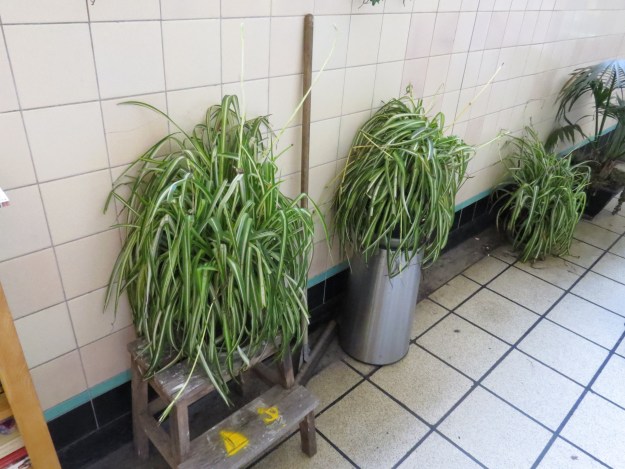
Bugwoman on Location – Coming Home

Coming home….

Dear Readers, this week I thought I’d share my train ride from Mum and Dad’s home in Dorset back to the Big Smoke in London. I’ve taken one picture at each station, through the window (because heaven help any one who gets off – there would have been many pictures of my train disappearing out of the platform with all my luggage on it). I start from Moreton (down in the bottom left hand corner) and end up at Waterloo.

Before I start, however, here is a brief interlude on the party planning for Mum and Dad’s 60th Wedding Anniversary in September. We now know pretty much who is coming, and people are starting to let me know their menu choices. We met with the events manager at the hotel who is very obliging, so now we have Deadlines and such. There is some debate over whether or not to have a champagne toast after the main course and before dessert, with Dad saying this is what normally happens at Weddings, not Anniversary parties, and Mum and I  saying that there is never a wrong time for a champagne toast. I suspect we shall have our own way in the end. The flowers are sorted (roses, freesias, whatever else is in season), the table decorations and layout are agreed and the harpist is booked. In short, I am planning it like a military operation, minus the amphibious landing craft and trebuchets, though I shall have these in reserve in case of any shenanigans.

And then, there is the  vexed question of presents. Mum and Dad maintain that they Don’t Need Anything and even if they did, it would be rude to ask. On the other hand, lots of people have asked me what they should buy for Mum and Dad. I maintain that if you don’t give people some hints, they will get what they think. So, we have (finally) agreed that I will let the guests know that their presence is present enough, but if they do want to get something, we’ll go for garden centre gift vouchers. That way, Mum and Dad will have something to look forward to after the party, when I suspect their spirits might slump a bit after all the excitement. The autumn is a great time to buy perennials and get them planted, and every time they look at the plants, they’ll be reminded of their special day. An outing to the garden centre, plus lunch, will be just the tonic required to restore optimism I hope.

Moreton

Anyhow, back to my train journey. Dad gave me a lift to Moreton station, the first time he’s felt able to drive there for over five years, so it just goes to show that even when someone is in their eighties they can still recover from illness – it’s not an inexorable, one-way decline. And as I was standing on the platform, I noticed this fluffy character. I love the antennae, and the ‘furry’ legs. And then it was time to throw myself onto the train and settle back for the two and a half hour ride with my sandwiches.

Moreton Station – a white ermine moth (Spilosoma lubricipeda)

The journey from Moreton to Waterloo is wonderfully varied. The first part goes through farmland, with Jacob’s sheep grazing in the fields and deer nibbling at the bushes. The trackside vegetation is a mix of self-seeded sycamore, and buddleia. Lots and lots of buddleia.

Wool

Wool Station – a cheeky buddleia.

The first station is Wool, presumably named for it’s sheep-farming heritage. Today, it is the closest stop to Bovington army camp and the world-renowned Tank Museum. More importantly,  it’s home to Monkey World, a sanctuary which, despite its name, mainly specialises in rescued chimps and orang-utans from the despicable tourist photography trade in Europe and Asia. Some of these creatures arrive at the sanctuary completely bald from stress, and the last member of their species that they saw was probably their mother. Recently, Monkey World rescued a large number of capuchin monkeys from a research centre in South America, and they also have many small monkeys who were previously kept as pets. I only wish my friend Robin had been here long enough to visit it, though we’d probably never have got her home again.

I think that the buddleia pictured above has something of the dirty old man about it, but maybe that’s more a reflection on the sad state of my psyche.

Onwards!

Wareham

Wareham – more buddleia.

Wareham – some broad-leaved ever-lasting pea

Wareham is the next stop. It was probably founded by the Saxons, and is a great spot for anyone wanting to tour Dorset, with Studland Bay and the Purbeck Hills close to hand, and the Jurassic Coast (where Mary Anning found her fossil ichthyosaurus) close by. On a more sinister note, it was one of the spots where the notorious Judge Jeffries held his Bloody Assizes following the Monmouth Rebellion of 1685, and five rebels were hung, drawn and quartered on the West Walls of the town. I had no idea that this barbaric practice was still going on in the seventeenth century.

And a note to for the poor traveller; Wareham is the only spot on this stretch of line that you can get a cab, in the event of your train misbehaving. As my journey to Dorset was delayed by over three hours (thank you, Woking signals) this can be extremely useful. The company I used was called Elysium Taxis, and although the ride did not remind me too much of the resting place of dead heroes, it was certainly extremely efficient and friendly.

Wareham station itself is a little bleak, but it’s always nice to see some interesting ‘weeds’ bursting forth, as seen above.

Holton Heath

Ribwort Plantain at Holton Heath

Holton Heath is the next stop, and the only plant life visible was some ribwort plantain on the other side of the chain-link fence. I wonder why one plant has grown twice as tall as the others? Is it genetic, or is there some source of water or food here?

Holton Heath was the site of the Royal Navy Cordite Factory during both the First and  Second World Wars – cordite is a propellant used in guns, and replaced gunpowder. One of the key ingredients is acetone, and to make this requires a source of starch, usually grain. As grain ran short during 1917, local children were asked to gather horse chestnuts (conkers) as an alternative source. They were so ardent that eventually six enormous grain silos were filled with the chestnuts that the children had gathered.

However, such dangerous manufacturing lead to accidents, with the worst being in 1931, when an explosion occurred in a nitroglycerin preparation chamber, killing 10 and injuring 19. Three buildings were destroyed and a storage tank was ruptured, spilling sulphuric acid in to the area. The explosion, which occurred at 10.45 am, was heard 20 miles away and people working outdoors 2 miles away were knocked over by the blast wave. Houses situated on the main road approximately 1 mile from the blast suffered extensive damage.

These days, Holton Heath is a ghost town, with industrial units and razor wire. I have never once seen anyone get on or off the train at Holton Heath, and the wind whistles through the grass and the ribwort plantain.

Hamworthy

Sycamore keys at Hamworthy

On we go to Hamworthy, another ‘ghost stop’ where tall, self-planted sycamore trees are heavy with their fruit. This was an Iron Age settlement, and is situated on a peninsula, making it ideal for ferries and cargo to France, Jersey and the isle of Wight. A rather elegant new bridge has opened recently, to work alongside the existing bridge, and ensure that traffic can always get from Poole town centre to the ferry port.

Photo One (Bridge) - By Chris Downer, CC BY-SA 2.0, https://commons.wikimedia.org/w/index.php?curid=18372969

The Twin Sails bridge at Hamworthy (Photo One – see credit below)

Poole

Groundsel at Poole station

As you head to Poole station, you pass wetlands and sailing ponds with gigantic plastic swans on them, but at the station itself my spirits were barely lifted by some struggling groundsel and a few leaves of grass. There wasn’t even a seagull. The train meanders through the middle of town, and you can gaze out at some of the most expensive real estate in the world (on Sandbanks in Poole), and also see the mixture of holiday-makers and locals waiting patiently for your train to pass so that they can get on with their shopping.

Bournemouth

Ironwork at Bournemouth station

For the traveller, the fine Victorian station of Bournemouth is important because this is where the refreshments trolley boards. Sure enough, I had some sandwiches, but  this is where you can avail yourself of what passes for coffee on South West Trains. Plus, the driver changes over, so I had five minutes to survey the scene. They certainly don’t want any pigeons nesting here: I have rarely seen such prolific anti-pigeon measures, though I suspect that from the occasional feathers and droppings some such avian trespassers haven’t read the rules.

But how my heart lifted at the sight of a few weeds who had, miraculously, managed to find a root-hold. Life will always find a way, I see.

Buddleia on the roof at Bournemouth station

A fern making itself at home on a ledge

Another happy fern at Bournemouth

Christchurch

The next part of the ride is through the New Forest, which is neither New (it probably dates from about 12,000 years ago, after the last Ice Age) nor a Forest (being mostly heathland these days). However, it was William the Conqueror who called the area the Foresta Nova, and reserved it for hunting purposes.  It is one of the largest remaining tracts  of unenclosed land left in south-east England, and ponies, pigs and other domestic animals still have the right to roam here. It is a biodiversity hotspot, and I often see grazing roe and red deer from my train window. Several of the villages and towns on my route are in the New Forest, and there seems to be a new enthusiasm for making the stations pretty.

Tub at Christchurch Station

Here is a splendid tub at Christchurch station – the town has one of the oldest populations in England (with 30% of its residents being over 60). Maybe a preponderance of people with time on their hands makes for a pretty platform. However, they have strong competition from the folk just along the line at New Milton.

New Milton

New Milton – winning the prize for the prettiest station so far. But is it my favourite?

New Milton dates back to the arrival of the railway in 1888. It, and the surrounding villages, were the centre of the seaborne smuggling trade, and a detachment of armed ‘Coast Guards’ were stationed here to try to stop them. These days, we think of the main job of the coast guard as being the rescue of folk who drift away on their lilos or of fishermen who get into trouble in heavy weather, but in those days they literally ‘guarded the coast’. Some of the offshore sea routes were actually named after the main smuggling families. I Imagine it was a time of intrigue and double-dealing. These days, it’s all a bit more sedate.

Brockenhurst

Some floral decoration at Brockenhurst

At last, a seagull

Brockenhurst is the most popular stop in the New Forest – you can hire a bike here, there are many small hotels and bed and breakfast establishments, and lots of walking trails start here. However, they need to pull their socks up with the floral decoration, as I would say that New Milton and Christchurch are currently in the lead. The town itself has a long military tradition, with a hospital for Indian and New Zealand soldiers wounded in the First World War. The woods around Brockenhurst were used for jungle training for soldiers destined for the Pacific during the Second World War. I imagine they weren’t much of a substitute for the environment that the soldiers were soon to face.

Photo Two (wounded soldiers) - PD-US, https://en.wikipedia.org/w/index.php?curid=12300298

Wounded New Zealand soldiers on the platform at Brockenhurst station during the First World War (Photo Two – credit below)

Photo Three (trainees in the woods) - By Oulds, D C (Lt), Royal Navy official photographer - http://media.iwm.org.uk/iwm/mediaLib//31/media-31047/large.jpgThis is photograph A 27308 from the collections of the Imperial War Museums., Public Domain, https://commons.wikimedia.org/w/index.php?curid=25076005

Trainees learning jungle tactics in woods around Brockenhurst (Photo Three – credit below)

Southampton

I was at university at Southampton. It wasn’t a particularly happy time for me: I missed my home and family. Also, it was the first time that I realised that I was a different class from everyone around me: one of the ‘posh’ girls told me that ‘when I first heard you speak, I thought you were common, but actually you’re ok’. Gee, thanks. But it was nice to see happier students sitting at the station, although their floral decoration could definitely do with some work.

Floral decoration at Southampton station

Southampton Airport Parkway

Strangely enough, though, the planting that I like most is at Southampton Airport Parkway. Someone has taken a tiny strip of ground behind the fence and in front of the boxes for the telephone exchange, and has turned it into a little spot of insect heaven. Technically, i suppose it isn’t even in the station, but hey.

The guerrilla garden at Southampton Airport Parkway

Winchester.

Ah, Winchester. How prosperous. How pretty. How august. But what on earth is happening on your station platform? Surely there is room for a pot or two.

I must admit to having a dislike for Winchester, having been knocked into a bramble patch by a completely naked man whenIi was a student here back in the early eighties, but I am prepared to be converted. Just sort out some pollinator-friendly plants and I’ll reconsider, I promise.

Some nice pillars, but no planting at Winchester station

Basingstoke

I rather like this planting at Basingstoke. I am wondering what on earth the fruit is? Could it be nectarines, or is it just some small, colourful apples? Help me out here, gardening friends.

A splendid bed at Basingstoke station

Although we think of Basingstoke as a new town, it is probably on the site of an Anglo-Saxon village settled by ‘the people of Basa’, Basa being the tribal leader. The word ‘stoke’ probably derives from the word for a stockade.

Clapham Junction

And now, I’m eight minutes from Waterloo and, if all goes well, about forty minutes from East Finchley. Clapham Junction is the busiest station for trains (though not passengers) in the whole of Europe, with 200 trains passing through per hour. However, what it is not is plant friendly. There are some isolated buddleia plants, and a few sad weeds, who look as if they have been sprayed (this is often the case if the plants would impede the progress of the trains). However, maybe the seeds from the willowherb below will find more inviting ground – there are huge drifts of them all the way along the edge of the lines.

A sorry willowherb at Clapham Junctiion

The Entry into Waterloo

It’s funny. You’d think I’d love the countryside, and yet my heart lifts at the sight of the building work on the way into Waterloo station and the little glimpses of the London Eye. I’d like to share a few of the final moments of the journey with you below. And then, I’m off. Home, a cup of tea and my husband await!

Photo Credits

Photo One (Bridge) – By Chris Downer, CC BY-SA 2.0, https://commons.wikimedia.org/w/index.php?curid=18372969

Photo Two (wounded soldiers) – PD-US, https://en.wikipedia.org/w/index.php?curid=12300298

Photo Three (trainees in the woods) – By Oulds, D C (Lt), Royal Navy official photographer – http://media.iwm.org.uk/iwm/mediaLib//31/media-31047/large.jpgThis is photograph A 27308 from the collections of the Imperial War Museums., Public Domain, https://commons.wikimedia.org/w/index.php?curid=25076005

Wednesday Weed – Knotgrass

Every Wednesday, I hope to find a new ‘weed’ to investigate. My only criterion will be that I will not have deliberately planted the subject of our inquiry. Who knows what we will find…..

Knotgrass (Polygonum aviculare sp)

Dear Readers, you will know by now that I love investigating the most common and overlooked of ‘weeds’, and this week’s subject is what my American friends would call ‘a doozy’. Knotgrass is popping up all over East Finchley at the moment, straggling from between paving stones and emerging from cracked concrete. It has a sprawling, nonchalant habit, tiny flowers and a jointed stem that reminds me a little of bamboo. But as usual, there is more to knotgrass than meets the eye.

Knotgrass is a member of the Polygonaceae, a family that includes redshank, Japanese knotweed and Russian vine . The name ‘Polygonaceae’ derives from the Greek phrase meaning ‘many knees’ – if you look at the stem of knotgrass you can see lots of little ‘joints’ or nodes. I learned with some delight that the Middle English name for this plant is ‘ars-smerte’ – it was once used in a lotion for haemorrhoids, and as many of the plants in this family are hot and peppery, I think we can imagine the reason.

Although knotgrass is a relatively uninteresting plant to the casual observer, I would draw the attention of anyone with a magnifying glass to the flowers and buds, which are rather delightful.

By Dalgial (Own work) [CC BY-SA 3.0 (http://creativecommons.org/licenses/by-sa/3.0)], via Wikimedia Commons

Knotgrass flowers (Photo One – see credit below)

As you will know, I am often flabbergasted when I am researching my ‘weeds’ and today is no exception. In his novel ‘The Man Who Laughs’, Victor Hugo tells of how ‘artificial dwarves’ were created by Spanish child-buyers or Comprachicos. Hugo compares their work of deliberate mutilation to those who create bonsai trees. The Comprachicos stunted the growth of the children   “by anointing babies’ spines with the grease of bats, moles and dormice” and using drugs such as “dwarf elder, knotgrass, and daisy juice”, in order to create tiny people who could be sold as entertainment at court, or as beggars. Although there is some question about how accurate Hugo’s depiction of these practices was, Shakespeare certainly knew that knotgrass had a reputation in this regard. Here is a description of the diminutive Hermia from A Midsummer Night’s Dream:

Get you gone, dwarf;
You minimus, of hindering knot-grass made;

And here, in a play by Beaumont and Fletcher, the Coxcomb says that they

Want a boy

Kept under for a year on milk and knotgrass‘.

The illustration below is of the Hermia scene described above in  A Midsummer Night’s Dream, painted by none other than William Heath Robinson (1872-1944), the man who created the extraordinary pictures of machines that have led to any ingenious, Wallace and Gromit-esque contraption being described as being ‘Heath Robinson’.

A Midsummer Night’s Dream (illustration by William Heath Robinson) (Public Domain)

And here, for your delectation, is the William Heath Robinson Naval Cloud Dispeller.

William Heath Robinson (Naval Cloud Dispeller) (Public Domain)

But I digress, as usual.

You might think that knotgrass looks most unappetising, but it has been used as food all over the world (the plant seems to be pretty much universal).In Vietnam, the plant is known as rau đắng, and is used in a hot and sour stew called Canh chua, which looks most delicious.

By Jason Hutchens - Flickr: Canh Chua, CC BY 2.0, https://commons.wikimedia.org/w/index.php?curid=2500892

Canh chua (Photo Two – see credit below)

Several foragers mention that the young leaves can be used in salads, and that the seeds can be milled into flour (knotgrass is closely related to buckwheat). You would need a lot of patience and a clean supply of the plant for either of those activities, however: because of its low-growing habit and preference for paving stones, knotgrass is frequently trampled underfoot and peed upon by dogs, neither of which makes it particularly appetising.

I do wonder if the species name of the plant, aviculare, refers to small birds being partial to the seeds, though. They look just about the right size for goldfinches.

By Stefan.lefnaer - Own work, CC BY-SA 4.0, https://commons.wikimedia.org/w/index.php?curid=53572135

A knotgrass seed. You’d need a few for a loaf, that’s for sure….(Photo Three – credit below)

I did learn that the plant has a single taproot which can penetrate to nearly four feet, which makes it very drought-resistant, another desirable attribute in an exposed city plant. It is also said to be rich in zinc.

In Turkey, the plant is known as Madimak, and here is a recipe from the Turkish Yummies website

Generally, knotgrass has been seen as a famine food, something to get people through when nothing else was available. It is, however, seen as food by many insects, including the bloodwing moth, whose caterpillar tries to camouflage itself as a thorny twig.

By Bj.schoenmakers - Own work, CC0, https://commons.wikimedia.org/w/index.php?curid=53374298

Bloodwing (Timandra comae) caterpillar (Photo Four – see credit below)

By Marcello Consolo at https://www.flickr.com/photos/marcelloconsolo/29141640432/

Adult Bloodwing (Timandra comae ) (Photo Six – credit below)

As well as being used for piles, knotgrass has been used as a diuretic, and for the treatment of urinary tract infections. It is an antihelminthic (I love this word – it means that it can be used to expel parasitic worms), and has been used to break down mucus when people have lung and throat infections.

You might think that such a small and humble plant would not have made much of an impact on poets (except for its child-shrinking abilities, of course). But here is Keats, in ‘The Eve of St Agnes’:’

A casement high and triple-arch’d there was,
       All garlanded with carven imag’ries
       Of fruits, and flowers, and bunches of knot-grass,
       And diamonded with panes of quaint device,
       Innumerable of stains and splendid dyes,
       As are the tiger-moth’s deep-damask’d wings;
       And in the midst, ‘mong thousand heraldries,
       And twilight saints, and dim emblazonings,
A shielded scutcheon blush’d with blood of queens and kings.


And here is Oliver Wendell Holmes from his poem ‘The Exile’s Secret’

Who sees unmoved, a ruin at his feet,
The lowliest home where human hearts have beat?
Its hearthstone, shaded with the bistre stain
A century’s showery torrents wash in vain;
Its starving orchard, where the thistle blows
And mossy trunks still mark the broken rows;
Its chimney-loving poplar, oftenest seen
Next an old roof, or where a roof has been;
Its knot-grass, plantain,–all the social weeds,
Man’s mute companions, following where he leads;
Its dwarfed, pale flowers, that show their straggling heads,
Sown by the wind from grass-choked garden-beds;
Its woodbine, creeping where it used to climb;
Its roses, breathing of the olden time;
All the poor shows the curious idler sees,
As life’s thin shadows waste by slow degrees,
Till naught remains, the saddening tale to tell,
Save home’s last wrecks,–the cellar and the well?

‘Man’s mute companions’, indeed. But I sometimes wonder if they would still speak to us, as they used to, if we paid them more attention.

By Dalgial - Own work, CC BY-SA 3.0, https://commons.wikimedia.org/w/index.php?curid=7036011

Photo Six (Credit below)


Photo Credits

Photo One (knotgrass flowers) – By Dalgial (Own work) [CC BY-SA 3.0 (http://creativecommons.org/licenses/by-sa/3.0)], via Wikimedia Commons

Photo Two (Vietnamese hotpot) – By Jason Hutchens – Flickr: Canh Chua, CC BY 2.0, https://commons.wikimedia.org/w/index.php?curid=2500892

Photo Three (knotgrass seed) – By Stefan.lefnaer – Own work, CC BY-SA 4.0, https://commons.wikimedia.org/w/index.php?curid=53572135

Photo Four (Bloodwing caterpillar) – By Bj.schoenmakers – Own work, CC0, https://commons.wikimedia.org/w/index.php?curid=53374298

Photo Five (Adult bloodwing) – By Marcello Consolo at https://www.flickr.com/photos/marcelloconsolo/29141640432/

Photo Six (Knotgrass) – By Dalgial – Own work, CC BY-SA 3.0, https://commons.wikimedia.org/w/index.php?curid=7036011


Bugwoman Presents Robin Huffman, Primate Portrait Painter

Dear Readers, I hope that this week you will forgive me for venturing many miles from East Finchley, into the forests of Cameroon and South Africa. My artist friend Robin Huffman is staying with me for a few days and I want you to meet her .Our relationship started with a photograph of a sleeping talapoin monkey called Yoda.

Yoda Asleep (Photo by Robin Huffman)

I saw it on a site called, of all things, Cute Overload. Of course, I didn’t know anything about Robin then, but I was impressed by the way that, when the comments stream filled up with people gushing that they ‘wanted a monkey’,  the photographer commented that this monkey was from a sanctuary, and that monkeys should never be kept as pets.

My husband looked at the photo too, and clicked through to find out some more details.

‘You know’, he said, ‘the sanctuary where this photo was taken is asking for volunteers’.

Two years later, I was bumping over the dusty red roads of Cameroon on my way to the Mefou Primate Sanctuary. It is home to orphaned gorillas, chimpanzees and monkeys. Most of them are refugees from the bushmeat trade – the adults are killed for meat, and the babies suffer a miserable fate as ‘pets’. I was to spend most of the next month looking after young chimps (which basically involved being a climbing frame, sweeping and mopping floors, sorting out food and playing pat-a-cake).

Playing pat-a-cake with M’Boki

There was a constant war of attrition with the soldier ants, who were dangerous to caged animals because they will eat anything in their path. In the film below, the soldier ants are moving their larvae and eggs to the next place where they will form a nest. The column is defended by the ‘soldiers’, who have heads the size of blueberries and strong, sharp jaws. Many days saw me getting too close to an ant column and having to run through the compound ripping off clothes as the ants headed up a trouser leg.

And one day I rescued this extraordinary giant stick insect from the curious young chimps who would have torn her to pieces out of pure curiosity.

Cameroonian giant stick insect

But what was most surprising was that my room mate in our cozy Nissen hut turned out to be Robin, who had taken the picture of the talapoin monkey that had brought me to Cameroon in the first place. She had discovered her calling here in  the rainforest of Cameroon after 29 years working for Gensler, one of the most prestigious design consultancies in New York. Robin had thrown up the schmoozing and the Manhattan condominium in order to volunteer at various wildlife sanctuaries, where her passion was looking after orphaned baby monkeys. The job could sometimes be heartbreaking, but this didn’t dent Robin’s commitment to these vulnerable, fragile creatures. And latterly, she’d discovered that not only could she rear these animals, she could also paint them.

Robin’s painting of Yoda (after a photograph by Ian Bickerstaff)

Robin started off by painting signs for the sanctuaries that she volunteered at, often working on hardboard and using house and roofing paint. Then one day, one of the sanctuary staff asked if she could ‘paint a monkey’. The rest is history.

Robin painting a sign at the Ape Action Africa sanctuary in Mefou, Cameroon (photo by Liliane Eberle)

Nowadays, she uses acrylic paints, which dry quickly and are non-toxic. Robin has no permanent home base, so she has to be able to work quickly wherever she is in the world. Her aim is to present the creatures that she loves, and their stories, to people who might not otherwise have thought about the issues of deforestation and bushmeat, animal research and the pet trade. She is a witness to the suffering and the spirit of these animals, and an advocate for them. When you look into the eyes of these monkeys, it’s impossible not to see them as individuals, with personalities and desires and fears. Her paintings stake a claim for their place in the world, and speak up for those who cannot be heard above the whine of chainsaws and the jingling of money.

Sunshine, Olive Baboon (Robin Huffman) (after a photo by Perrine DeVos)

Mowgli, vervet monkey

Diva, moustached guenon

Recently, Robin had a solo exhibition at the prestigious Explorers’ Club in New York, the first exhibition of paintings ever held by the organisation.

Robin with her painting of Keksie the vervet monkey at the Explorers’ Club exhibition. https://www.ecowatch.com/explorers-club-primate-paintings-2403325036.html Cassie Kelly

And for the next few weeks, one of Robin’s portraits is part of the Wildlife Treasures exhibition at the Nature in Art Gallery and Museum. The gallery is based in Wallsworth Hall, a magnificent stately home in Twigworth, Gloucestershire, and Robin will be giving a talk about her work with primates on Saturday and Sunday this week (29th and 30th July). The exhibition itself runs until 3rd September, but if you are unable to visit, you might like to see some more of Robin’s work on her website here.

Ayla, vervet monkey

Robin normally paints her monkeys from life: she knows each one, and her love for them as individuals shines through her work. But there is one exception. Here is what she says about ‘Witness’.

‘I saw the photograph of this monkey on the Internet.  It is the newest species of monkey identified in Africa.  It was recorded in the Democratic Republic of the Congo by the bushmeat-fighting TL2 Project, headed up by Drs. Terese and John Hart.  This monkey, in the photograph, had a heavy chain around its neck and was being held prisoner as a village pet.  It may have eventually ended up in someone’s stew pot.  It wore its fate in its eyes.’

Every time one of these small souls dies, it is as if, somewhere, a star blinks out. But there are many people working to preserve the light. Robin is one of a growing army of warriors whose weapons are paintbrushes, and cameras and the written word. They are fighting for nothing less than the right of others to live their lives unmolested on this small blue planet.

Can a painting change the world? Let’s hope so.

‘Witness’ – Robin Huffman (after a photo by Maurice Emetshu)

For details of how to volunteer at or donate to Ape Action Africa, click here

For details of the Vervet Monkey Foundation, click here

You can see some more of Robin’s artwork here


Wednesday Weed – Fennel

Every Wednesday, I hope to find a new ‘weed’ to investigate. My only criterion will be that I will not have deliberately planted the subject of our inquiry. Who knows what we will find…..

Fennel (Foeniculum vulgare)

Dear Readers, this member of the carrot family is easily distinguished by its yellow flowers and its very delicate, frond-like leaves that taste strongly of aniseed. If you were to dig it up, you would discover that it also has a fleshy bulb that has a similar flavour. The plant in the photo above was planted in the N2 Community Garden next to East Finchley Station, but I noticed that an intrepid seed had germinated in the gutter nearby, and at this rate it will be popping up all over the place.

Buddleia and fennel making a bid for freedom

Fennel  loves disturbed ground and has naturalised in many places in the south of England. Vigorous stands of the plant may often be found at the seaside, as if advertising fennel’s long association with fish.

Fennel is said to have been brought to this country by the Romans, and it is a Mediterranean plant. In fact, the Greek name for the plant is Marathon, and the plain where the Battle of Marathon took place means, literally, ‘the plain of the fennel’. The capital of Madeira is also named from the Portuguese word for the plant, giving us Funchal.  The English name ‘fennel’ apparently came from the Middle English for ‘hay’.

There can be little doubt that fennel was a deliberate introduction in this country, unlike some plants which probably stowed away in seed crops. Fennel has a long history of culinary use throughout its range, and many parts of the plant are used. The flowers, often described as ‘fennel pollen’, are currently cropping up in fine dining establishments across the land, and the seeds are a popular ingredient in bread and in spice mixtures such as panch phoron (from Assam and Bengal) and Chinese Five Spice. Plus, who can forget the little round steel dishes of mukhwas given with the bill at the end of an Indian meal? The seeds help to freshen the breath, but fennel also has a long-standing reputation for assisting with the digestion, hence this delightful ditty from the Middle Ages, reported by Richard Mabey in Flora Britannica:

In Fennel-seed, this vertue you shall finde,

Foorth of your lower parts to drive the winde.

By Nicolas1981 - Own work, CC BY-SA 3.0, https://commons.wikimedia.org/w/index.php?curid=18773548

No winde here! (Photo One, credit below)

The leaves and bulb are also widely used, in everything from salads to sauces. I must confess to having an aversion to the raw bulb: I am not a great lover of aniseed flavours at the best of times, probably due to the effects of an unfortunate cocktail of Ricard and Tizer imbibed at a friend’s house when I was fifteen (never again). However, when cooked slowly, or gently caramelised, I find it much more palatable.

By Darya Pino at https://www.flickr.com/photos/summertomato/3440076844

Grilled fennel. Yum! (Photo Two – see credit below)

Fennel is also one of the key ingredients of absinthe, that delightful green liqueur that is about as far from Baileys as it is possible to get. Otherwise known as ‘the green fairy’, the drink was said to have hallucinogenic properties, and was a favourite tipple of, among others Edgar Allen Poe, Oscar Wilde, Pablo Picasso and Aubrey Beardsley. One wonders how much of its fearsome reputation was due to, well, its reputation – it was a strong spirit for sure, but no stronger than many others on offer at the time. Maybe it suffered because of the Bohemian nature of many of its drinkers. And I’m sure that Dega’s picture ‘L’Absinthe’ wouldn’t have helped with the marketing. The spirit was banned in many parts of Western Europe at the beginning of the Twentieth Century, on the basis that:

Absinthe makes you crazy and criminal, provokes epilepsy and tuberculosis, and has killed thousands of French people. It makes a ferocious beast of man, a martyr of woman, and a degenerate of the infant, it disorganizes and ruins the family and menaces the future of the country.

‘L’Absinthe’ by Edgar Degas (1876)

However, the spirit was never banned in the UK (we never seem to have developed a taste for ouzo, or raki, or Pernod, although we are partial to licorice allsorts). Hence, quite recently there’s been a new interest in the spirit here, with initial imports coming from Czechia (where it was also not banned in the past). I suspect that drinkers of the spirit will not seem out of place on the streets of many parts of the country on a Saturday night, though the top hat might need to go…

Edouard Manet’s The Absinthe Drinker (1859)

It seems strange that a plant associated with making people go blind (among other things) should have a long history as something that strengthened eyesight. Here is Longfellow’s poem from 1842:

Above the lower plants it towers,
The Fennel with its yellow flowers;
And in an earlier age than ours
Was gifted with the wondrous powers
Lost vision to restore.
Pliny believed that when snakes shed their skins, they rubbed themselves against a fennel plant in order to restore their eyesight – the eyes of such creatures go milky just before they lose their skins, so it’s not a big jump to assume that they are blind.
It was also said to be a cure for obesity:
‘Both the seeds, leaves and root of our Garden Fennel are much used in drinks and broths for those that are grown fat, to abate their unwieldiness and cause them to grow more gaunt and lank. (William Coles, ‘Nature’s Paradise’ (1650) (Thanks to A Modern Herbal))

Lots of fennel in the N2 Community Garden next to East Finchley Station

We should not assume that we are the only creatures who enjoy fennel, however: the caterpillars of the swallowtail butterfly (Papilio machaon) are fans. This is a butterfly which is now confined to the fens in the UK, but is rather more widespread in Europe (indeed I saw one powering past when I was in the Alps last week).

By Superdrac - Own work, CC BY-SA 3.0, https://commons.wikimedia.org/w/index.php?curid=33329657

Swallowtail caterpillar on fennel (Papilion machaon) (Photo Three – credit below)

By Entomolo - Own work, CC BY-SA 4.0, https://commons.wikimedia.org/w/index.php?curid=48664965

Swallowtail (Adult) (Photo Four  – see credit below)

In North America, where fennel is an introduced plant, it may be used by the caterpillars of the anise swallowtail(Papilio zelicaon). How subtly different this species is, with its powerful wings and yellow and black livery – I wondered if it was migratory and needed to do a lot of flying, but apparently not.

By Calibas - Own work, GFDL, https://commons.wikimedia.org/w/index.php?curid=3514460

Anise Swallowtail (Papilio zelicoan) Photo Five (Credit below)

Finally, let’s have a look at the use of the plant in Hamlet. When Ophelia has ‘gone mad’, she speaks to her brother Laertes:

There’s fennel for you, and columbines.—There’s rue for you, and here’s some for me. We may call it “herb of grace” o’ Sundays.—Oh, you must wear your rue with a difference.—There’s a daisy. I would give you some violets, but they withered all when my father died. They say he made a good end (sings) For bonny sweet Robin is all my joy—

Fennel (and columbine) are presented to Gertrude. There was an Italian phrase ‘to give the fennel’, meaning to compliment falsely, and this is thought to have been the origin of the later Cockney phrase ‘to give flannel’ (i.e. to try to fool someone). More directly, fennel was a symbol of adultery, so wholly appropriate for the fickle Queen.

Like all members of the carrot family, the flowerheads of fennel are great favourites with the little pollinators like hoverflies and honeybees (I imagine that fennel honey would be a most interesting foodstuff). And so, it is something of a delight, even to those of us who are not overly keen on the flavour that it imparts so relentlessly to everything that it comes into contact with. Thank you once again to the Romans!

Photo Credits

Photo One (Fennel seed digestif) – By Nicolas1981 – Own work, CC BY-SA 3.0, https://commons.wikimedia.org/w/index.php?curid=18773548

Photo Two (Grilled Fennel) – By Darya Pino at https://www.flickr.com/photos/summertomato/3440076844

Photo Three (Swallowtail caterpillar) – By Superdrac – Own work, CC BY-SA 3.0, https://commons.wikimedia.org/w/index.php?curid=33329657

Photo Four (Swallowtail Butterfly) – By Entomolo – Own work, CC BY-SA 4.0, https://commons.wikimedia.org/w/index.php?curid=48664965

Photo Five (Anise Swallowtail) – By Calibas – Own work, GFDL, https://commons.wikimedia.org/w/index.php?curid=3514460


Home Again

Dear Readers, two weeks isn’t very long, but how things can change! As I stagger off the train after my fortnight in Austria, laden down with sweaty laundry and in need of a cup of tea and a cuddle with the cat, my mood is much brightened by how splendid East Finchley station is looking.  I suspect that those good folk at the N2 Community Garden have been hard at work. A range of containers in pastel colours are chock-full of plants and buzzing with bees.

And there is even more fun to be had once you’re through the ticket barriers.

The banner is made of buttons, and I love the upcycling of the boots and the globe. It goes to show that, with a bit of imagination, many things can be transformed from useless to useful.

Well, once the laundry was on and the tea was drunk and the cat was cuddled, I headed off to see what else was going on. The little garden beside the station was looking particularly splendid.

I adore the seedheads on the alliums, they remind me of a firework display, but without all those annoying bangs.

My old friends the opium poppy seedheads are growing fat.

The Florence fennel is a huge draw for bees and hoverflies.

The marjoram is proving popular too.

Furthermore, some of the plants are making a bid for freedom and are advancing along the gutter towards the coffee stand. And who can blame them?

Buddleia and fennel making a bid for freedom

Across the road, outside the children’s nursery, the lavender is in full bloom, while the fine Victorian building that used to house the GLH taxi company now stands forlorn behind a plywood barricade, waiting for its imminent demolition.

I wrote in the Wednesday Weed this week about my discovery of a patch of lucerne on Park Hall Road, but I am still amazed today. Where on earth did it come from? It certainly gave me lots to think about.

But then, as I walk home, I look up and am for a moment extremely excited. What on earth is this?

Well, I once saw a red kite drifting over Durham Road, but I have never seen a condor in East Finchley, and obviously I haven’t seen one this time either. I am a little puzzled though.

My guess is that the kite is to deter pigeons, although I would have thought that the four-inch pins around the edge of the roof would have been deterrent enough. Still, this is an imaginative and humane solution, and it seems to be working, as the pigeons are all still hanging out on the roof of the Bald-Faced Stag. I’m not sure whether this fine bird would provide a lightning rod in the event of a thunderstorm, so perhaps if there are any physicists out there someone could tell me. In the meantime, the bird soars on, perhaps dreaming of the Andes and surveying the streets for a defunct llama to eat. I would hate to be the one to tell him that the best he can hope for around here is some Kentucky Fried Chicken.


Wednesday Weed – Lucerne

Every Wednesday, I hope to find a new ‘weed’ to investigate. My only criterion will be that I will not have deliberately planted the subject of our inquiry. Who knows what we will find…..

Lucerne( Medicago sativa sativa)

Dear Readers, I am sometimes astonished at the plants that crop up in East Finchley. Where do they come from? How did they get here? One particular ‘weed’ hotspot is a little bed outside the corner house on Park Hall Road. One month it’s full of cleavers, the next it’s full of thistles, and this week, it’s full of lucerne.  And very pretty it is too, in its many shades of lilac and purple.

Lucerne is a member of the Fabaceae family, which includes peas, vetches and clovers, and if you look at the flowers you can see the characteristic lower ‘lip’. The leaves are in groups of three, but the most characteristic feature is the tightly-curled seedpod, which spirals around itself like one of those wacky Carsten Holler helter-skelters that were at Tate Modern a few years ago. The name ‘lucerne’ is said to have come from the Latin ‘lucerna’ or lamp, which makes me wonder if there were oil lamps that resembled the shape of the seedpod.

By Philmarin (Own work) [CC BY-SA 3.0 (http://creativecommons.org/licenses/by-sa/3.0)], via Wikimedia Commons

Lucerne Seedpods (Photo One – credit below)

Kirsteen at https://www.flickr.com/photos/commonorgarden/300219278

Photo Two (Credit below)

Lucerne was introduced to the UK in the 17th century as a fodder crop, and is otherwise known as alfalfa (which is from the Arabic name for the plant). It probably came from south west Asia, and was first noted in the wild in the UK in 1804. The plant was first cultivated in ancient Iran, and in a fourth-century book about agriculture, Palladius notes that it can be cut four to six times in 12 months, and that a quarter of a hectare of lucerne will feed three horses for a whole year. Palladius also notes that fresh lucerne should be fed sparingly to cattle, who may develop bloat, and indeed domestic animals have a paradoxical relationship with the plant, sometimes developing photosensitivity and jaundice. However, it is a major source of hay and silage for cows and horses, particularly in North America, where in Arizona and Southern California a single field can be cut up to twelve times in a year.

It has never been much used for human food in the West, with most people encountering it as alfalfa sprouts. It was used as famine food during the Spanish Civil War, but in China the young leaves are used as a salad vegetable.

By Thesupermat (Own work) [CC BY-SA 3.0 (http://creativecommons.org/licenses/by-sa/3.0)], via Wikimedia Commons

Photo Three (Credit below)

Incidentally, anyone getting excited at the plants’ Latin species name (sativa) should note that, although lucerne was used unsuccessfully as an ingredient in cigarettes, ‘sativa’ simply means ‘cultivated’.

Like most members of the pea family, lucerne is a magnet for bees. There is a story that lucerne could not be grown commercially in the US until the honeybee was introduced to the country (it is not native north of Mexico), and pollination became possible. It is often the case that introduced plants do not become a problem if their pollinators do not arrive – Dave Goulson, who wrote the wonderful book ‘A Sting in the Tale’ describes how Tree Lupins only became problematic in Australia once the bumblebee arrived. I always find it interesting how these complex webs of life change when one of the elements is missing.

Indeed, there is a problem with the pollination of lucerne. When Western honeybees visit a lucerne flower, they are knocked on the head by the keel of the plant, which transfers the pollen. Neither you nor I would like to be hit on the head every time we went to work (though I’ve been employed at places where every day felt a bit like that was what was happening). So, the honeybees take to nectar-robbing – piercing the side of the flower to get at the nectar store without being walloped. Unfortunately this does not result in the pollination of the plant.

To avoid this happening, the beekeepers employed to pollinate the lucerne fields use a high proportion of young, innocent bees, who have not yet become jaundiced and cynical by their daily experiences. However, young bees are also not as expert at performing their tasks. Also, the bees quickly suffer from a protein deficiency induced by only eating lucerne pollen, which is missing one of the key amino acids.

By Ivar Leidus - Own work, CC BY-SA 4.0, https://commons.wikimedia.org/w/index.php?curid=50280387

Honey bee on lucerne (Photo Four – see credit below)

One answer is to use alfalfa leafcutter bees (Megachile rotundata) to do the pollination. These solitary bees, native to Europe,  produce no honey, but are very efficient pollinators of lucerne. They are transported in hollow plastic tubes, which they fill with leaves and use to raise their young. These are the bees of choice in the Pacific Northwest, with the poor old long-suffering honeybee being used in California.

By Pollinator at en.wikipedia, CC BY 2.5, https://commons.wikimedia.org/w/index.php?curid=16375247

Alfalfa leafcutter bee (Megachile rotundata) (Photo Five – see credit below)

In parts of the US lucerne is used as an insectary, a nursery for all kinds of predatory insects, and is often interspersed with cotton. The various ladybirds and lacewings and wasps that hatch in the lucerne go to work on the grubs that would otherwise eat the cotton. In return, the lucerne is harvested in strips to avoid killing the entire insect population.

Lucerne is a very drought-hardy plant -it has a root-system that can penetrate almost 50 feet to find ground-water. It can live for more than twenty years, but the plant is autotoxic – lucerne seeds cannot grow where there is already lucerne, and so crop rotation needs to be practiced. Like all members of the pea family, the roots contain nitrogen-fixing bacteria, which means that it improves the soil. As such, it was the most widely grown fodder crop in the world in the early 2000’s, with over 436 million tons grown, not just in North America but in China, Russia, Europe and Argentina. In 2009 over 74 million acres of the planet were used to grow lucerne. Not satisfied with this, the biotech giant Monsanto developed a GMO version of the plant that was resistant to glyptosate. This meant that fields could be sprayed with Round Up, which would obliterate all the ‘weeds’ but spare the lucerne. There has been a long-running court case in the US about the use of this plant, with many concerns about the possibility of cross-contamination with non-GMO lucerne. You can read all the gory details here, but suffice to say that Monsanto appears to have won, as usual.  Whilst here in Europe we tend to be cautious about GMOs, there are far fewer restrictions in the US. I shall watch with interest to see how this all plays out. I am not anti-science, but it seems to me that obliterating biodiversity in this way runs counter to the health of the environment. I sometimes wonder at what point we will stop messing with delicately poised ecosystems. As the Buddha once said, we are children playing in a burning building.

So, generations of domestic animals have been fed on this delicate ‘weed’ that has appeared, surprisingly, on a London street. And when I go hunting for a poem about lucerne, I find this by Les Murray, the extraordinary Australian poet. ‘The Cows on Killing Day’ is not an easy read, but I don’t think I have ever read a poem that imagines so sensitively what it would be like to be an animal. Have a look, and let me know what you think!

Photo Credits

Photo One (Lucerne Seedpods) – By Philmarin (Own work) [CC BY-SA 3.0 (http://creativecommons.org/licenses/by-sa/3.0)], via Wikimedia Commons

Photo Two (Carsten Holler Slides) – Kirsteen at https://www.flickr.com/photos/commonorgarden/300219278

Photo Three (Alfalfa sprouts) – By Thesupermat (Own work) [CC BY-SA 3.0 (http://creativecommons.org/licenses/by-sa/3.0)], via Wikimedia Commons

Photo Four (Honeybee on lucerne) – By Ivar Leidus – Own work, CC BY-SA 4.0, https://commons.wikimedia.org/w/index.php?curid=50280387

Photo Five (Leafcutter bee on lucerne) – By Pollinator at en.wikipedia, CC BY 2.5, https://commons.wikimedia.org/w/index.php?curid=16375247

Bugwoman on Location – A Walk in the Ferwalltal

Dear Readers, after our rather easy and domestic walk to the Sahnesturberl last week, this week we’re trying the slightly more difficult trails. But nothing should be attempted without a cappuccino and a biscuit with ‘Otztal’ on it. There are limits.

There are five valleys all leading away from Obergurgl, and today we were aiming for the Ferwaltaller, one of the more difficult areas to reach. If you look at the photograph above, you can see our path leading up away from the service road. As is usual, it zig-zags backwards and forwards across the slope, so that every time you think you’ve reached the summit, you discover there’s a bit more climbing to do. Still, off we went….

After about twenty minutes stiff climbing, we stopped for a break, and to admire the hills on the other side of the valley. This area is called the Seenplatte, and is part of the national park. There is no skiing development there, and so it is much wilder, and snow lies in pockets for a long time. One of these days I’ll be in good enough shape to attempt it, but my knees are a bit dodgy this year.

The cable car is just a little dot below. I love the way that its shadow seems to hang from it.

I like to look back and see how far we’ve already come. In the foreground above there are the last of the alpenroses, the diminutive rhododendrons that have just stopped flowering here. Obergurgl had a very hot June, and so there are marmots everywhere, but never when I have my camera unfortunately.

A male chaffinch makes his presence felt in the arolla pine trees below.

There are butterflies and moths everywhere. Six-spot burnet moths fizz about, like red blurs.

I’ve noted before that the butterflies love salt, and can  often be found in swarms on any kind of fresh dung. But I didn’t know that they’d feed from sweaty humans as well. My husband had a particularly friendly Meadow Brown.

And so we walked on up, and crossed under the chairlift which they are testing for the winter. Every chair is weighted down with a dozen filled water canisters. The air was filled with beeping from the machinery and cursing in Austrian by the operators. But soon we were far away from all such goings-on.

This is the start of the Ferwalltaller – a stream runs through it, and also a strange clay pipe half-buried in the bank. Who knows what it’s for? But the worst of the climb was over, and we could start to enjoy the scenery.

There are some boggy areas, squelchy with moss and dotted with these white-flowered succulents which I think are a kind of saxifrage. The seedheads of the mountain avens (Geum montanum) remind me of little clematises.

The spiniest thistles (Cirsium spinosissimum) are just coming into ‘flower’. From a distance they look as if each one has been touched with an individual sunbeam.

Close up, however, they are most unprepossessing, and are largely pollinated by clouds of alpine flies. Nothing wrong with that, of course.

The weather forecast for the day was decidedly dodgy, and so, as the clouds started to gather, we decided to head for home. It’s possible to feel very exposed out here in the mountains when there are storms forecast. The official advice if caught in a storm (of which there have been several in the last few days) is to separate yourself from anything metal (i.e. your walking poles), avoid any trees , large boulders or other ‘prominences’, and lay on the ground on top of your rucksack. I figured that this would be a most undignified position to be in, and so we made all reasonable haste to get back down to the village, hotly pursed by most unpromising thunderheads.

And when we got back to village level, it was to discover that the wind had dropped, the sun had come out, and all was delightful. And so there was nothing for it but to return to the Edelweiss and Gurgl hotel for an Eiscaffe (coffee and icecream with whipped cream on the top). What a tough life I have.

On Saturday, we head back home. I cannot wait to see what’s happened in the garden. I think a machete might be in order so that  I can get to the shed.

In the meantime,  here is a question for you all. What on earth do you think this machine does? It was parked on the road and looked like some kind of alien. I’m thinking some kind of road-sweeping, but do let me know if you have a more imaginative answer…..


Wednesday Weed – Dwarf Mallow

Every Wednesday, I hope to find a new ‘weed’ to investigate. My only criterion will be that I will not have deliberately planted the subject of our inquiry. Who knows what we will find…..

IMG_1009

Dwarf Mallow (Malva neglecta)

Dear Readers, I found this tiny plant in the grass in front of our local children’s nursery. It is so small and delicate that it’s hard for me to believe that it’s a close relative of the stonking great pink mallow in my back garden, but indeed it is, for this is the dwarf mallow (Malva neglecta). It is an ancient introduction, possibly brought here by the Romans. So many plants arrived with the Romans (everything from radishes to walnuts) that I sometimes imagine them skipping along Watling Street scattering seeds in all directions. Why this little plant would be one of them I have no idea, but it was probably an interloper, maybe arriving with harvested seed and setting up home when it was planted.

IMG_1013

All of the mallows have been used widely for medicinal purposes (herbalists call the mallows ‘innocents’ because they have no bad qualities), and the name ‘Mallow’ and genus name Malva come from the Greek word Malakos, meaning soft and soothing. Dwarf mallow has been used to make salves and lotions for bruises, inflammation and insect bites (the herbalist Gerarde said that it was ‘good against the stinging of scorpions, bees, wasps and such’), and as a treatment for lung and urinary complaints. The plant is said to be better than common mallow (Malva sylvestris) for these purposes, but the creme-de-la-creme of mallows for medicine is the marsh mallow (Althea officinalis). Dwarf mallow is also described as an excellent laxative for small children, though here, as in all matters medicinal, extreme caution is advised.

IMG_1010

The leaves of dwarf mallow are edible, though most foraging websites mention that the mucilaginous quality of the leaves, which make them so effective in treating bruises and skin problems, is rather unpleasant when the leaves are cooked. So, in other words, if you don’t like the slimy quality of okra, you’d be better eating dwarf mallow raw. However, as I mentioned in my post on common mallow, if the leaves are steeped in water the resulting fluid can be used as an egg white substitute in meringues and souffles, which seems like a minor miracle to me. It can also be used as a binding agent in vegan cookery, as in this recipe for Mallow Leaf and White Bean Burgers.

One potential problem is that dwarf mallow seems to concentrate nitrates for fertilizer in the leaves, so be careful where you harvest from.

The round fruits are said to look like tiny cheeses (and in Yorkshire were known as ‘fairy cheeses’) and are full of nutritional value, though a bit on the small side in this species. On the other hand, they were used in a dormancy experiment and apparently germinated after a hundred years, so there can be no doubt that they are well protected and full of everything that a plant might need to grow when the conditions are right.

By Stefan.lefnaer (Own work) [CC BY-SA 4.0 (http://creativecommons.org/licenses/by-sa/4.0)], via Wikimedia Commons

A dwarf mallow ‘cheese’ (seedhead) – Photo One (see credit below)

I must add a small note of sadness here as well. Just along from the nursery where the dwarf mallow is growing was the car park for GLH, the cab company. The wall along the front was full of willow herb and ragweed, and there was a fine buddleia growing at the front. Well, the building has been sold to erect some new flats. I’m all for affordable housing, as you know, but more than a thousand local people objected to the design of the building on the basis of its design, the risk of over-development and the way that the project added to the chronic traffic congestion in the area (there is no on-site parking) and this was completely ignored by Barnet Council.  All the weeds have been sprayed, and a man was erecting a plywood hoarding with a door in it. As he stepped through to the demolition site and shut the door behind him, it reminded me of how much seems to be going on behind closed doors at the moment. Let’s hope that there’s still a way to moderate this most grandiose design.

Image may contain: sky and outdoor

The proposed flats on East Finchley High Street (Photo from The Archer)

Photo Credit

Photo One (Mallow seed head) – By Stefan.lefnaer (Own work) [CC BY-SA 4.0 (http://creativecommons.org/licenses/by-sa/4.0)], via Wikimedia Commons


Bugwoman on Location – A Walk to the Sahnestuberl

Large Copper (Lycaena dispar) on yarrow

Dear Readers, today I would like to take you on one of my favourite early holiday walks in Obergurgl, Austria. It isn’t very rugged, or very challenging, though as I arrived with a sore throat and cough, and as the sole of one of my boots has decided to drop off, it was quite challenging enough. I love it because of the sheer variety of terrain, from meadow to pine forest to scree to mountain hut. I also love it because it has some uphill and some downhill, and so my muscles can start to get into the swing of things.

The village of Obergurgl

Here is the view back to the village at the end of the first climb. Obergurgl is at the end of the Oest valley, which is one reason why we love it – it doesn’t have through traffic, the curse of many an alpine village, and it is the epicentre of numerous side valleys. One of the glories of the surrounding hills are the meadows, at their very best at this time of year, just before the first hay cut. And I am in my element – the sheer variety of insects makes my head spin.

A very fine ichneumon wasp

Bright pink yarrow!

Flies are important pollinators in the Alps, but these two are thinking of other things…

Hoverfly on rampion

Clouds of butterflies descend on the dusty paths to feed on the salts in animal droppings, whirling up as we pass.

We look to see what cows are about, and as usual there are some fine Highland Cattle, who seem to do very well in spite of the Austrian summers being considerably warmer than the Scottish ones.

And then it’s on into the woods. These are mostly Arolla pines, and at this time of year you can hear the local jay, the spotted nutcracker, leading the fledglings through the branches. The youngsters make a call a bit like a car alarm.

By Original author and uploader was MurrayBHenson at en.wikipedia - Transferred from en.wikipedia, Public Domain, https://commons.wikimedia.org/w/index.php?curid=3708573

Spotted nutcracker (Photo One – see credit below)

The woods are cool and quiet after the meadows, apart from the occasional sound of cow bells from the Tyrolean blue cattle that graze here, and the roar of motorbikes from the road below. Many biking folk choose to go into Italy via the Timmelsjoch pass, just half a kilometre from where we are walking, and there is also a Motorcycle Museum beside the tollroad.

Soon we reach a little lake called the Pillersee, which has a most attractive duck house in the middle, though I have never seen a single duck take advantage of it. You might think that this would be an ideal spot to stop for a sandwich, but be careful, gentle traveller! On our last visit, we stopped here for the time it took to eat a cheese sandwich (approximately four minutes in my case) and I acquired 12 mosquito bites. My husband didn’t get one. I have recently read that mosquitoes prefer people who have Type O blood, and as my husband has Type A maybe this is the explanation. Or it could just be that I was sweatier than he was. Anyhow, take this as a warning, and glance at the duck house while rushing past at speed.

Just a little further on, we found a patch of early flowering orchids popping up among the buttercups. There are lots of orchids here. In fact, the whole flora is so diverse and plentiful that it makes me weep for our intensively managed, vanishing meadows  in the UK. Nearly all the plants here can also be found at home, but I rarely see such variety.

Then, it’s over a moderately scary bridge. There are a variety of scary bridges in these parts – there’s a delight in bridges that you can see through, which doesn’t help my slight vertigo.

However, this is as nothing compared to the new suspension bridge, just opened on Thursday, over the nearby Gurgler glacier. Methinks I will be giving this one a miss.

Copyright Berger and Brunner https://www.facebook.com/obergurgl/photos/pcb.10154787951209888/10154787912744888/?type=3&theater

The new Obergurgl suspension bridge (Photo Two – credit below)

Once over the bridge, we walk alongside the glacial river which is in full spate at this time of year, making it difficult to hear. The plants along the path are lush and green, with lots of meadow cranesbill.

Soon, we come to a much more substantial bridge, below the main road, which is protected from avalanches and landslides by a rather attractive ‘avalanche gallery’.

The rocks roast beside the river, and there are very few plants – tiny willows and rosebay willowherb survive in the flood zone, but that’s about it.

But now we are nearly at the Sahnestuberl, which bakes the best cakes in the valley in my opinion. We always come at least once, and sometimes twice.

The very welcome sight of the Sahnestuberl

Last year’s cat is still in residence.

And here is the cake of the day. Apple cake. Note the two forks. We’re not greedy.

Four minutes and thirty seconds later. And no, we didn’t fight.

So, my throat is now better (thanks to some very fine throat lozenges), I have new boots (after spending a week patching the old ones up with glue I decided that they really were done for), and we have another week here in Obergurgl. Who knows what we will get up to this week?

Photo Credits

Photo One (Nutcracker) – By Original author and uploader was MurrayBHenson at en.wikipedia – Transferred from en.wikipedia, Public Domain, https://commons.wikimedia.org/w/index.php?curid=3708573

Photo Two (New Suspension Bridge) – Copyright Berger and Brunner https://www.facebook.com/obergurgl/photos/pcb.10154787951209888/10154787912744888/?type=3&theater


Wednesday Weed – Enchanter’s Nightshade

Every Wednesday, I hope to find a new ‘weed’ to investigate. My only criterion will be that I will not have deliberately planted the subject of our inquiry. Who knows what we will find…..

DSC_0054

Enchanter’s Nightshade (Circaea lutetiana) (Photo by Shona Mackintosh)

Dear Readers, sometimes there’s a strange synchronicity about the Wednesday Weed. When I had lunch with my friend S earlier this week, she mentioned a plant with tiny white flowers that was taking over her garden. She sent me the photo above, and I was very puzzled. Then, on my way to teaching an English class in Wood Green, I saw a huge patch of exactly the same plant, mixed in with some black medick.

20170628_114504

Thanks to some help from some botanists on the Wild Flowers of Britain and Ireland Facebook page, it was identified as Enchanter’s Nightshade. And a very confusing plant it is too. For a start, it isn’t a nightshade at all, but yet another willowherb. It is a native plant but, as my friend has noticed, it can be a very persistent garden weed. However, Richard Mabey finds a subtle beauty in this modest plant, and notes how the flowers are ‘mounted like butterflies on pins’. He describes how many parts of the plant, from the leaves to the stamen to the petals, grow in pairs.

CC BY-SA 3.0, https://commons.wikimedia.org/w/index.php?curid=256430

Enchanter’s Nightshade flowers (Photo One – see credit below)

By Willow (Own work) [GFDL (http://www.gnu.org/copyleft/fdl.html), CC BY-SA 3.0 (http://creativecommons.org/licenses/by-sa/3.0) or CC BY 2.5 (http://creativecommons.org/licenses/by/2.5)], via Wikimedia Commons

Enchanter’s Nightshade demonstrating its ‘persistent weed’ characteristic (Photo Two – see credit below)

The Latin name for this plant, Circaea lutetiana, links it to Circe, the sorceress of Greek mythology who turned Odysseus’s men into pigs so that he wouldn’t leave her island. According to Virgil, she could turn men into lions and wolves as well. This humble little plant was thought to be her ‘charm’. When I was a child, I longed to be able to talk to the animals, but turning the people who bullied me into pigs and cows would have been just as gratifying. There is much wish-fulfillment in some myths, and a great fear of the secret powers of women. Even today, I can think of a few men who would be able to do much less harm if they were four-legged animals without opposable thumbs, but then I wouldn’t wish their company on the rest of the creatures.

The species name ‘lutetiana’ comes from the Latin name for Paris, which was sometimes known as the ‘Witch City’, according to Wikipedia. However, Witchipedia thinks that the name refers to the character of Paris from the Iliad. Curiouser and curiouser.

In the painting below, Circe seems to have transformed a woman into an animal as well, judging by the lionesses. Also, her jumper seems to have fallen off.

Circe_by_Wright_Barker_(1889)

Circe by Wright Barker (1889) (Public Domain)

Strangely, though, in spite of its fascinating name, enchanter’s nightshade does not appear to have a wide variety of medicinal uses. It is used to make herbal tea in Austria (which figures, as the plant has a high concentration of tannins). Where it is mentioned as a cure, the active part appears to be the berries of the plant but, not being a true nightshade, the plant has burrs rather than berries. A case of mistaken identity, I fear.

However, it was used in an aphrodisiac potion in the Highlands of Scotland, which would be slipped into the unsuspecting chap’s evening tipple. I am sure that much merriment ensued.

By Kristian Peters -- Fabelfroh 14:54, 10 November 2005 (UTC) (Self-photographed) [GFDL (http://www.gnu.org/copyleft/fdl.html) or CC-BY-SA-3.0 (http://creativecommons.org/licenses/by-sa/3.0/)], via Wikimedia Commons

The burrs of enchanter’s nightshade (Photo Three – credit below)

I can find no edible uses for enchanter’s nightshade, although when I was identifying the plant, one of the botanists mentioned that it had a pronounced peppery taste.

To return to Circe and her ability to transform men into animals: I wonder if there is a deeper suggestion here that, rather than taking the tale literally, we are meant to question if all men are animals under the skin, with just the merest skim of ‘civilisation’ on top? How easy it is in these troubled times to see the more ‘bestial’ of our instincts coming to the fore. There is more than a hint of this in Louise Gluck’s poem ‘Circe’s Power’.

I never turned anyone into a pig.
Some people are pigs; I make them
Look like pigs.

I’m sick of your world
That lets the outside disguise the inside. Your men weren’t bad men;
Undisciplined life
Did that to them. As pigs,

Under the care of
Me and my ladies, they
Sweetened right up.

Then I reversed the spell, showing you my goodness
As well as my power. I saw

We could be happy here,
As men and women are
When their needs are simple. In the same breath,

I foresaw your departure,
Your men with my help braving
The crying and pounding sea. You think

A few tears upset me? My friend,
Every sorceress is
A pragmatist at heart; nobody sees essence who can’t
Face limitation. If I wanted only to hold you

I could hold you prisoner.

However, if we are going to claim that our aggression and violence came from animals, we have to acknowledge that so did our capacity for love and compassion. There are many scientists now looking at the altruistic behaviour of animals, the development of culture and the lengths that non-human animals will go to to look after one another. We can’t have it both ways, as if our ability to make war came from our primate ancestors while our ability to sacrifice ourselves was sprinkled on us by angels. We are part of a continuum, remarkable as our species is, and we can’t disown our heritage. The gap between us and the intelligent, resourceful, affectionate pig is not as big as we  think.
Character_sketches_of_romance,_fiction_and_the_drama_(1892)_(14785118515)

Circe and her swine (Briton Riviere, 1896) (Public Domain)

Photo Credits

Photo One (Flower close-up) – CC BY-SA 3.0, https://commons.wikimedia.org/w/index.php?curid=256430

Photo Two (Patch of enchanter’s nightshade) – By Willow (Own work) [GFDL (http://www.gnu.org/copyleft/fdl.html), CC BY-SA 3.0 (http://creativecommons.org/licenses/by-sa/3.0) or CC BY 2.5 (http://creativecommons.org/licenses/by/2.5)], via Wikimedia Commons

Photo Three (enchanter’s nightshade burrs) – By Kristian Peters — Fabelfroh 14:54, 10 November 2005 (UTC) (Self-photographed) [GFDL (http://www.gnu.org/copyleft/fdl.html) or CC-BY-SA-3.0 (http://creativecommons.org/licenses/by-sa/3.0/)], via Wikimedia Commons