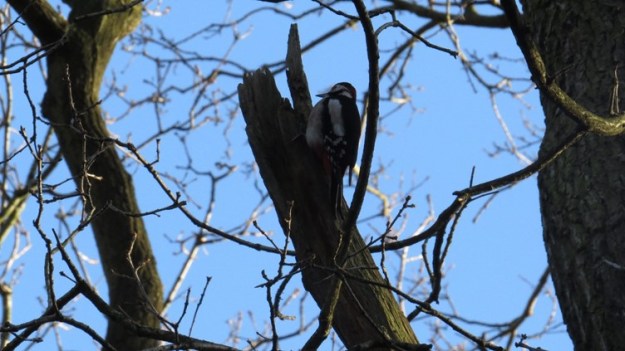
The Mondrian Bird

Great Spotted Woodpecker (Dendrocopos major)

Great Spotted Woodpecker (Dendrocopos major)

Dear readers, there is something about the stark black and white patterning of the Great Spotted Woodpecker, combined with the red patch of the vent, that reminds me of the paintings of Mondrian.

Piet Mondrian, 1926 - Composition in Red,Blue, Gold and Black

Piet Mondrian, 1926 – Composition in Red,Blue, Gold and Black

This bird is a female – the males have a small patch of red on the back of their heads, and the juveniles have a complete red cap.

Male Great Spotted Woodpecker (By Ken Billington (Own work) [CC BY-SA 3.0 (http://creativecommons.org/licenses/by-sa/3.0)], via Wikimedia Commons)

Male Great Spotted Woodpecker (By Ken Billington (Own work) [CC BY-SA 3.0 (http://creativecommons.org/licenses/by-sa/3.0)], via Wikimedia Commons)

Juvenile Great spotted Woodpecker (By Jason Thompson (Flickr: Great Spotted woodpecker (juvenile)) [CC BY 2.0 (http://creativecommons.org/licenses/by/2.0)], via Wikimedia Commons)

Juvenile Great spotted Woodpecker (By Jason Thompson (Flickr: Great Spotted woodpecker (juvenile)) [CC BY 2.0 (http://creativecommons.org/licenses/by/2.0)], via Wikimedia Commons)

But, regardless of sex, these birds are in charge of the suet feeder from the moment that they arrive on their stiff wings. They stab the suet pellets with their stiletto beaks, propping themselves up with their stiff tail feathers. They live their lives at forty-five degrees to the vertical, hopping up the trunks of trees and hammering away with such vigor that they would no doubt give themselves concussion if they didn’t have shock absorbers in their skulls.

I tend to see the woodpecker in the garden during the winter. In spring and summer, they spend much more time in Coldfall Wood. Last week, as I walked through the hornbeams, I heard an extraordinary sound, midway between a creak and a drumroll. I followed the noise, eager to see if it was what I thought it was. After some time standing at the bottom of a tree, almost falling backwards as I leaned further and further back, I saw this:

A woodpecker was drumming away on a dead branch, the sound echoing through the trees. The bird’s head was just a blur as he knocked his beak repeatedly against the wood – he is able to make between five and twenty strikes per half second. This wasn’t an attempt to make a nest hole – he was declaring his territory. After every session of drumming he looked around, as if listening, and sure enough, another bird was answering his challenge from the other side of the wood. Both male and female Great Spotted Woodpeckers drum, which makes me think that they share a territory during the breeding season, and that both sexes are involved in defending it.

I wondered if the Woodpecker was choosing his branch with care, in order to make the maximum amount of noise. If so, he joins an elite company of animals who use the world around them to create displays. I am thinking particularly of a male chimpanzee that I knew in Cameroon, who would choose a hollow tree to kick when he was displaying over all others, presumably because of its deep, bass-drum quality.

And then there was a cackle and another Great Spotted Woodpecker appeared. The two birds flew up and clashed wings, like dragonflies, before heading out over the houses. A third bird also joined in, possibly the original bird’s mate, so for a few seconds the blue sky was patterned with black and white and red shapes. And then, all was silent again. But there was no doubt in my mind that spring had already begun, and the great battle to reproduce had started all over again. As broken as the world sometimes seems, the great engine of the seasons is still working.

To see a short video of one of the woodpeckers drumming, please see below. Quality isn’t great, but you can hear the bird (though you might want to take a seasickness pill before viewing 🙂 )


Wednesday Weed – Box-Leaved Honeysuckle

Every Wednesday, I hope to find a new ‘weed’ to investigate. My only criterion will be that I will not have deliberately planted the subject of our inquiry. Who knows what we will find…..

Box-leaved Honeysuckle (Lonicera pileata)

Box-leaved Honeysuckle (Lonicera pileata)

Dear Readers, when I was in Coldfall Wood last week I found this plant lurking by the Everglades, a winter pond where the water level is now nearly up to the boardwalk.

IMG_1107I must admit I was stumped. There is something a bit privet-like about it, but I had a feeling I’d seen the plant somewhere before.

IMG_1103And then I remembered. I’d seen it in supermarket car parks! A little research was in order and, with the aid of my botanist friends, I discovered that it was Box-Leaved Honeysuckle. It is being used in a lot of municipal planting to replace Box (Buxus sempervirens), as there is a lot of Box Blight about, a fungal disease which turns the leaves brown and leaves big bare patches. Members of the honeysuckle family are immune to Box Blight, and so have become very popular.

Of course, this doesn’t explain what my plant is doing, bang-smack in the middle of a wood.

IMG_1105We normally associate Honeysuckle with the golden-flowered climbing plant, spilling its scent into the warm summer air. But there are 180 species, of which over a hundred, including my plant, originated in China. Box-leaved Honeysuckle was brought to England in about 1900, and has been recorded ‘in the wild’ since about 1950. So this is a neophyte, a newbie, a brand new addition to our semi-wild flora.

‘If I were you, I’d dig it up’ said one of my botanical correspondents.

Box-leaved Honeysuckle in flower ("Lonicera pileata flowers 001" by User:SB_Johnny - Self-photographed. Licensed under CC BY-SA 3.0 via Wikimedia Commons - http://commons.wikimedia.org/wiki/File:Lonicera_pileata_flowers_001.JPG#mediaviewer/File:Lonicera_pileata_flowers_001.JPG)

Box-leaved Honeysuckle in flower (“Lonicera pileata flowers 001” by User:SB_Johnny – Self-photographed. Licensed under CC BY-SA 3.0 via Wikimedia Commons )

But here I have a problem. This is an urban wood, surrounded by gardens, allotments and a cemetery. If I start digging up all the plants that aren’t native, I will need a veritable army of minions with spades to help me. There’s the cherry laurel, the horse chestnuts (well, they’re Roman), the sycamores, the stray pyracantha and even, hidden away, a teeny-tiny monkey puzzle tree. Plus, it would be a battle against overwhelming odds, as new plants are ‘jumping over the fence’ all the time. Finally, with climate change, everything is up for grabs. Plants that used to thrive are likely to start having problems. Plants that used to struggle may seize their moment. Each will bring opportunities and challenges for the creatures that rely on them.

Box-leaved Honeysuckle has several things in its favour. It provides cover for a variety of birds and small mammals, and is planted as such for game birds in some parts of the country. No less than 347 species of butterflies and moths worldwide feed on the leaves of the different Honeysuckle species, and the berries are popular with all kinds of thrushes (which probably explains how my plant got to this spot in the wood). Am I going to reject this largesse on the grounds that the plant is in the wrong place?

The berries are located on the underside of the branches, and so are very easy to miss! Thanks to the wonderful Landscape Architects' website (https://davisla.wordpress.com)

The berries are located on the underside of the branches, and so are very easy to miss! Thanks to the wonderful Landscape Architects’ website (https://davisla.wordpress.com)

It would be different, I think, if Coldfall Wood was that rarest of things, a pristine environment, or if Box-leaved Honeysuckle really presented some kind of threat to the ecology of the wood. But my guess is that it will enhance, rather than detract from, the biodiversity of the area. I look forward to seeing if it will flower, in spite of the deep shade, and if it will produce berries. It seems something of a free spirit, relaxing under a hornbeam tree instead of being blasted with diesel fumes in a supermarket car park. I find myself wishing it luck.


How to Save a Wood

Brighter.....

Dear Readers, you might think that a wood that has been in existence for more than a thousand years would be well able to look after itself, but in fact such spaces are often in need of both management and protection. Fifteen years ago, Coldfall Wood was far from being the biodiverse, much-loved urban woodland that it is today. I met Linda Alliston and Ann Bronkhorst, long-time members of the Friends of Coldfall Wood, in Ann’s cosy kitchen. How had things changed?

“The Wood was full of burnt-out cars”, said Linda. “People would drive in across the Playing Fields and leave all these wrecks. Youngsters would ride their motorbikes through the Wood and buzz the dog-walkers and the mums with their prams. It was a terrible mess and it made me angry to see it”.

It was not, however, the state of the Wood that was the initial impetus to action.

Muswell Hill Playing Fields today

Muswell Hill Playing Fields today

IMG_0718

“Word got out on the rumour mill that someone was planning to turn the Playing Fields into a Golf Driving Range”, Linda said.

I remember a Driving Range close to where I used to live. The floodlights were on until late at night, and the whole place was surrounded by an enormous chain link fence. It was an ecological desert.

“Can you imagine the impact on the bats and the other wildlife?” asked Ann.

“So, a group of us dog-walkers and some of the regular footballers who used the playing fields got together, and spoke to the council to try to prevent it”, said Linda.

This was an excellent example of ‘nipping things in the bud’. The council decided not to sell the Fields when they recognised the strength of local feeling, and so, as nothing formal had been set into motion, that was the end of that. Flushed with success, the Friends of Muswell Hill Playing Fields and Coldfall Wood was born.

Once the threat of the Driving Range was seen off, Haringey Council set about securing the Fields so that the cars and motorbikes couldn’t access them. However, this still left the problem of the existing dumped vehicles.

“We took truck-load after truck-load of debris out”, said Linda. “We could not believe how much there was.”

Once the wood felt a little less wild and dangerous, more people felt safe about using it. But there were still several problems.

An uncoppiced area of the wood

An uncoppiced area of the wood

One was that the Hornbeam trees, which from medieval times would have been cut down regularly to make charcoal and wheel axles, had been neglected for years. The process of cutting them back, called coppicing, means that the Hornbeams don’t grow so tall and dense, and a greater variety of plants can grow. This in turn attracts more insects and birds. As it was, most of the wood was dark, gloomy and overgrown. Some management was in order.

“We were lucky to get a grant via the Lottery in 2006 to renovate the Wood”, explained Ann. “The funding was secured with Haringey’s help, and they project-managed the restoration work.”

The partnership with Haringey was a fertile one, literally. The coppicing work undertaken opened up the wood and a whole range of plants appeared. Seeds that have been buried for many years can germinate once given a little warmth and sunlight. More species of plant means more opportunities for insects and other woodland creatures. It is exciting to see new and unusual plants peeping shyly through, including Heath Groundsel, unknown elsewhere in the Borough.

In 2013, more funding was identified, again with the assistance of Haringey Council. It was decided to cut another coppice. A local woodsman, Iain Loasby, undertook the work, and used a heavy horse to take the wood out. It was a wonderful sight, which attracted a lot of local interest, even though it all took place in cold, wet January and February in order to avoid the nesting season.

The area coppiced in 2013

The area coppiced in 2013

IMG_1063

The coppiced area looks a little stark, with the magnificent Oak trees standing amongst what looks like a wilderness of brambles and tree stumps. But looks can deceive. Again, a wide range of plants are bursting into life. Wrens sing from the wood stacks, and I cannot wait until spring to see what plants have emerged from their long sleep.

“The thing I’m most proud of, though, is the rejuvenation of the stream”, said Linda. “For years, we went from pillar to post between the council, Thames Water and the Environment Agency, but finally we got it sorted out”.

Linda handed me a newspaper clipping, showing the stream that runs through the Wood. The article describes it as an ‘open sewer’.

“It used to absolutely stink”, said Linda. “It was polluted and dangerous”.

Following a survey by Thames Water, it turned out that some of the houses that surround the wood had been victims of ‘cowboy builders’. Their plumbing had been set up so that their household waste went directly into the stream. Couple that with run-off from the roads, and you have a recipe for a very unpleasant health-hazard.

“Of course, most people didn’t even know that they were dumping their sewage into the stream, so they were horrified”, said Linda. Once the problem was identified, it was simply a case of sorting out the pipework. But there were still other sources of pollution.

“In 2006 we used some of our funding to plant a reed-bed, to help to filter out some of the run-off from the main road”, said Linda. The reeds form an interesting habitat in their own right, and I must admit to checking them for Bearded Tits every time I pass. No luck so far, but who knows? And it is certainly a fine resting place for dragonflies.

IMG_1062

The Reed Bed. No Bearded Tits yet…..

IMG_1061

Today, I can vouch for the crystal-clear waters of the stream, and the complete lack of smell.

Crows 17

In 2012 the Fields were granted Queen Elizabeth II Playing Fields status, which gives them protection in perpetuity. And in 2013, the Woods were designated as a Nature Reserve, which should mean that they are free from the threat of development. However, the Friends remain vigilant: they meet ten times a year to discuss what’s going on, and to plan events that will help more local people enjoy and appreciate the wonder of this little piece of ancient woodland and common ground that was so nearly ruined.

What advice, I asked, would you give to anyone who wants to protect or improve a piece of local green space?

“ You need to be persistent”, said Linda, “And I personally don’t think that shouting at people does any good. After all, the people who work for the council are human beings too. It’s much better to build relationships, so that you work together”.

“And it’s good to make links with other community organisations”, said Ann. “The Woodland Trust and the Forestry Commission are both good sources of support and information. The Haringey branch of the Trust for Nature Conservation have done lots of very useful work in the wood too. And it’s also important to share information with other Friends groups. You can talk about what you’re doing, how you’re involving other local people. You can pick up excellent ideas, and make links with other people”.

“And the local press”, said Linda. “They’re always in need of copy, and can be your best friends if there’s an issue that you want to highlight or to publicise”

“You have to accept that the group itself will ebb and flow”, said Ann. “Sometimes there will be lots of people, sometimes not so many. But I do think that if there was a threat to the Wood, people would mobilise. It means a lot to a lot of people”.

For me, it was clear that a small group of people, if motivated enough, can make a huge difference to the quality of an area. What a loss it would have been if the Driving Range had been built, and if the wood had continued to be a focus for anti-social behaviour, making it feel dangerous for everyone else. As it is, it is still a wild area, but one which can accommodate everyone from children to dog walkers to runners to slightly scruffy, middle-aged women with binoculars around their necks. I am eternally grateful for the hard work and persistence of the Friends of Muswell Hill Playing Fields and Coldfall Wood. They are true friends to these green spaces, and have helped to protect the plants and animals that regard them as home, and to ensure that future generations of humans can walk amongst the trees, take a long, deep breath and feel themselves gently relax.

The Friends of Muswell Hill Playing Fields and Coldfall Wood meet on the first Tuesday of the month at 7.30 pm at Coldfall Primary school. Their next event is a Winter Tree walk with Iain Loasby, the woodman who did the most recent coppicing. For more information, have a look at the Coldfall Wood website here.

Wednesday Weed – Hazel

Every Wednesday, I hope to find a new ‘weed’ to investigate. My only criterion will be that I will not have deliberately planted the subject of our inquiry. Who knows what we will find…..

Hazel Catkins (Corylus avellana)

Hazel Catkins (Corylus avellana)

Dear Readers, this week the search for a Wednesday Weed sent me in a completely different direction from my usual route. On a rainy, blustery day, I headed off towards our local primary school, to see if the playing fields there had anything growing that I had not already covered. In vain I peered through the fence at the turf, until my eyes refocused and I realised that I’d been looking at my subject all along. For what is more surprising on a January day than a plant that is already in full flower, ready to reproduce when everything else is still in bed?

Male Hazel Catkin

Male Hazel Catkin

The male Hazel catkin has the delightful colour of a sherbet-lemon. With every damp gust, invisible clouds of pollen are released. With any luck, they will be captured on by the red female flowers  who wait with open arms, a little like sea anemones.

Female Hazel Catkin

Female Hazel Catkin

It is these female flowers that will eventually turn into hazelnuts. They will promptly be nibbled off by squirrels or, if we are extremely lucky, by dormice. Kentish Cobnuts, with their creamy white interiors and little hats of pale green, are a domesticated variety of the hazelnut, but the wild variety is perfectly good to eat, and was, indeed, one of the staple foods of prehistoric peoples. Hazel has grown in the UK for at least the last 6000 years, and only birch was quicker to colonise the country after the last Ice Age. The spread of the plant throughout Europe has been attributed to its being carried from place to place by humans. After all, nuts are a concentrated, portable form of protein and carbohydrate. What better food if you’re embarking on a (very) long walk?

Hazel leaves and nuts ("Corylus avellana". Licensed under CC BY-SA 3.0 via Wikimedia Commons - http://commons.wikimedia.org/wiki/File:Corylus_avellana.jpg#mediaviewer/File:Corylus_avellana.jpg)

Hazel leaves and nuts (“Corylus avellana”. Licensed under CC BY-SA 3.0 via Wikimedia Commons – http://commons.wikimedia.org/wiki/File:Corylus_avellana.jpg#mediaviewer/File:Corylus_avellana.jpg)

The Hazel growing beside the school playing fields has turned itself into a small tree, but historically it is much coppiced, the stems being used for a wide variety of purposes. They are extremely flexible, and can be turned back upon themselves or knotted. They were woven together to form both hurdles and fences, and were also used as the framework for wattle and daub walls. They are still used in thatching, to hold the thatch down, because the hazel stems can be bent through 180 degrees. A more modern use is in the creation of sound screens alongside motorways.

A Wattle Hurdle ("Wattle hurdle" by Richard New Forest - Own work. Licensed under CC BY-SA 3.0 via Wikimedia Commons - http://commons.wikimedia.org/wiki/File:Wattle_hurdle.JPG#mediaviewer/File:Wattle_hurdle.JPG)

A Wattle Hurdle (“Wattle hurdle” by Richard New Forest – Own work. Licensed under CC BY-SA 3.0 via Wikimedia Commons – http://commons.wikimedia.org/wiki/File:Wattle_hurdle.JPG#mediaviewer/File:Wattle_hurdle.JPG)

Here, a Wattle gate is used to keep the animals out of the 15th Century cabbage patch ("Tacuinum Sanitatis-cabbage harvest". Licensed under Public Domain via Wikimedia Commons - http://commons.wikimedia.org/wiki/File:Tacuinum_Sanitatis-cabbage_harvest.jpg#mediaviewer/File:Tacuinum_Sanitatis-cabbage_harvest.jpg)

Here, a Wattle gate is used to keep the animals out of the 15th Century cabbage patch. This is from the Tacuinum Sanitatis, a medieval handbook on health and well-being, and well worth further study.

And here we can see a wattle and daub construction, with the twigs visible behind the mud used to make the walls (By MrPanyGoff (Own work) [CC BY-SA 3.0 (http://creativecommons.org/licenses/by-sa/3.0)], via Wikimedia Commons)

And here we can see a wattle and daub construction, with the twigs visible behind the mud used to make the walls (By MrPanyGoff (Own work) [CC BY-SA 3.0 (http://creativecommons.org/licenses/by-sa/3.0)], via Wikimedia Commons)

A plant which has lived alongside us in these islands since the very beginning, Hazel has many associations with Druid and Celtic beliefs. Its stems have been used for water divination, and for the making of shepherds’ crooks and pilgrims’ staffs. A Hazel tree was believed to be the home of Bile Ratha, the poetic fairy of Irish folklore, and it was believed that eating hazelnuts would bestow wisdom. On Dartmoor, Hazel was said to be the cure for snake and dog bites. And, to prevent toothache, you simply have to carry a double-hazelnut in your pocket at all times.

IMG_1044The catkins are shivering in the wintry blast, and so am I. Parents are tearing past me in their cars, hurrying to pick their children up from the school gate and giving me a decidedly funny look as I stand in the rain, peering through the fence with my camera.  I wonder if any of the children will get the chance to admire the catkins, the first sign that the long dark is finally loosening its grip. I hope that someone will take the time to show the little ones the ‘lambs tails’, and explain to them about this plant. After all, we have been living together, side by side, for six thousand years.

Spring is coming….

IMG_1010-1

Dear Readers, the wind is whistling down the chimney, the rain is racketing on the skylight and the bird feeders are blowing almost horizontal in the gale, and yet I have indisputable evidence that, for some at least, spring is on the way. Earlier this week, during a muddy, blustery walk in my beloved Coldfall Wood, I heard an extraordinary cacophony coming from an area which has been coppiced, so it is a little more open than other parts of the forest. There is a large dead tree there which, with great wisdom, has been left standing. It was attracting a lot of attention.

IMG_1002The Ring-necked Parakeets, which I’ve written about in an earlier post, have arrived in force to look for nest sites. They investigated the dead tree with much interest, peering into holes, biting off chunks of bark and hanging almost upside down to make sure they had viewed their new ‘property’ from all angles. There was much ‘discussion’ about which was the best site, and much to-ing and fro-ing as each pair flew from hole to hole.

IMG_1018Here, we can see a pair – the male is the one with the dark ring around the neck. What handsome, unexpected birds they are, livening up the woods with all that lime green and teal blue, and the bright red of their beaks! They are Britain’s only parrots, and the RSPB estimates that there are about 8600 breeding pairs in the UK, nearly all of them in urban or suburban areas. A recent study showed that their presence at garden birdtables ‘put off’ other birds, but I would be interested to see, firstly, whether the parrots actually stay for very long, and also how they compare in deterrent effect with other large, energetic birds. Certainly, no one in my garden, not even the Woodpigeons, feeds near the Great Spotted Woodpecker or the Jay when he visits.

IMG_1022By staking a claim to their nest sites now, the parakeets gain an advantage over other birds, who won’t start pairing off until later in the year. By doing this, they compete with Green and Great Spotted Woodpeckers, who would normally use the holes. At present, though, there seems to be enough dead wood around, both in the wood and the cemetery nearby, for all three species to jog along nicely together.

IMG_1011In much of their range overseas, Ring-necked Parakeets have become a significant agricultural pest, and indeed Natural England have put them on their ‘General Licence’ of birds that can be shot without special permission if they are causing damage. One vineyard owner in Kent lost his entire crop of grapes when a flock of the birds descended and ate the lot. However, at present, this is a rare occurrence, and the sight of parakeets setting up home in a North London wood is more a cause for delight than trepidation. Let us be generous here, and enjoy these vivid, feisty birds as they bring a hint of the summer to come to our windswept, damp, dreary landscape.

IMG_1025

Wednesday Weed – Hedge Mustard

Every Wednesday, I hope to find a new ‘weed’ to investigate. My only criterion will be that I will not have deliberately planted the subject of our inquiry. Who knows what we will find…..

Hedge Mustard (Sisymbrium officinale)

Hedge Mustard (Sisymbrium officinale) with caterpillar ‘guest’ at the bottom left….

At this time of year, nearly every plant that I look at seems tired and worn, as if hanging on desperately waiting for spring to come. So imagine my surprise to find this plant looking  green and new and ready to flower. Furthermore, it came with its own little green caterpillar attached, which I didn’t notice until somebody pointed it out to me. This is Hedge Mustard, and I think that its three-lobed leaves look a little like peacocks in flight, or even angels.

IMG_0943Hedge Mustard is a member of the Brassicaceae, or cabbage family, and its leaves are edible, though the wonderful Permaculture website suggests using them in a stir-fry rather than raw. It also has a long history as an ‘Official’ herb of apothecaries (hence it’s Latin name, Officinale). Hedge Mustard was considered by the Greeks to be the cure for all poisons, and in Tibetan medicine it is used to help in cases of food poisoning.

Hedge Mustard is considered particularly useful for throat ailments – one alternative name is ‘Singer’s Plant’. In my ‘day job’ I am an IT Trainer, and so I spend a lot of time trying to teach people to use some financial software. Much of this involves persuading people not to do a particular thing, or press a particular button. As soon as I have said this, someone is always drawn irresistibly to do what I’ve asked them not to. I am sure that the slightly shouty aftermath of these events is one of the causes of my occasional voice loss, which results in my having to make do with gesticulation and sad little raspy noises, much like a snake with laryngitis.  I have therefore made a note of exactly where this patch of Hedge Mustard is, lest I need to gather some leaves and mix them with honey or sugar to make a syrup to restore me to my usual emphatic self.

I must confess that I had some difficulty in identifying this plant, and had to call in some help from the British Wild Flowers Facebook group. The consensus is that it is most likely Hedge Mustard, but could possibly be something slightly more interesting and obscure – Sisymbrium loeselii or False London Rocket. However, as the leaves are practically identical, I am going with the most likely identification, and if it turns out to be something rarer I will let you know. Plants in leaf are often a little tricky. There isn’t so much of a problem once the plant is in full flower.

Hedge Mustard in flower (By H. Zell (Own work) [GFDL (http://www.gnu.org/copyleft/fdl.html) or CC BY-SA 3.0 (http://creativecommons.org/licenses/by-sa/3.0)], via Wikimedia Commons)

Hedge Mustard in flower (By H. Zell (Own work) [GFDL (http://www.gnu.org/copyleft/fdl.html) or CC BY-SA 3.0 (http://creativecommons.org/licenses/by-sa/3.0)], via Wikimedia Commons)

One difficulty with identification is that the shape of the leaves changes so drastically as the plant ages. A mature plant might spend the winter as a mere whirl of leaves before breaking into exuberant growth. If you look at the photograph above, you can see how the characteristic ‘angel’ shape of the lower leaves has changed into something much more elongated. I will go back to visit ‘my’ plant later in the year to see how it is metamorphosing. The more I learn, the more I realise what I don’t know. It’s as if I am climbing an endless hilly landscape – every time I get to the top, new areas ripe for investigation appear. But oh, how I love the view!

Hedge Mustard flower (By Andreas Kammann; Dr. Heike Esch (pfanzenfotos.de) [GFDL (http://www.gnu.org/copyleft/fdl.html) or CC-BY-SA-3.0 (http://creativecommons.org/licenses/by-sa/3.0/)], via Wikimedia Commons)

Hedge Mustard flower (By Andreas Kammann; Dr. Heike Esch (pfanzenfotos.de) [GFDL (http://www.gnu.org/copyleft/fdl.html) or CC-BY-SA-3.0 (http://creativecommons.org/licenses/by-sa/3.0/)], via Wikimedia Commons)

And, for anyone curious about the caterpillar in the first photograph, this is what it will look like when it grows up…

Angle Shades Moth (Phlogophora meticulosa) (Stu's Images [CC BY-SA 3.0 (http://creativecommons.org/licenses/by-sa/3.0)], via Wikimedia Commons)

Angle Shades Moth (Phlogophora meticulosa) (Stu’s Images [CC BY-SA 3.0 (http://creativecommons.org/licenses/by-sa/3.0)], via Wikimedia Commons)


The New Feeder

IMG_0893As a Christmas present to myself, and to the birds, I decided to buy a new bird feeder. I don’t usually include peanuts on the bill of fare, but this terracotta acorn rather took my fancy. I dangled it from a branch of next door’s cherry tree, filled it up, and sat back to see what happened.

“Well,” I thought to myself. “For once, the little birds will have somewhere to feed that isn’t mobbed by squirrels or bigger birds”.

And to start with, I was right.

Great Tit checking out the new feeder

Great Tit checking out the new feeder

But not for long.

IMG_0878

Jay (Garrulus glandarius) sussing out the new feeder

I have been visited by Jays before. With the oak trees of Coldfall Wood less than a quarter of a mile away, it’s not surprising that they sometimes pop in. In the fall, Jays eat thousands of acorns and bury what they can’t eat immediately. Many an oak seedling has started its life as a forgotten part of a Jay’s larder. But it has been over a year since I’ve seen a Jay. How did this one work out that there was something of interest? I know of their intelligence, but their food-finding ability is uncanny.

IMG_0872The Jay is one of the shyest of the British crows and is also the most brightly coloured. This has not always been to its advantage: the iridescent blue wing feathers were much coveted by milliners, and were used to make fishing flies. These, coupled with its  striking russet-pink body feathers, and the sharp black-and-white markings on the face, combine to make a bird that looks, as W.H. Hudson once wrote, ‘not altogether unworthy of being called the British Bird of Paradise’. Many a novice birdwatcher has mistaken it for something altogether more exotic and rare, such as a Roller.

A good view of those turquoise wing feathers

A good view of those turquoise wing feathers

The bird turned his head from side to side, trying to judge his angle of approach. After all, the feeder was hanging from a flimsy branch, and had no obvious perches.

IMG_0892Not that that was going to stop him.

IMG_0888Each visit was so fast that it felt like a smash and grab. The jay hoovered up a beakful of peanuts and flew off.

IMG_0885It was as if I’d imagined my visitor. Surely nothing so bright and daring could have stopped by this ordinary suburban garden? The feeder swung gently from side to side, rocked by the Jay’s volition, until finally it hung still. When I checked it later, it was as if it had been wiped clean. Not a single peanut was left.


Wednesday Weed – Yew

Happy New Year to all my readers – may 2015 bring you peace, health and inspiration, and may you encounter remarkable plants and animals to intrigue, delight and fascinate you.

Every Wednesday, I hope to find a new ‘weed’ to investigate. My only criterion will be that I will not have deliberately planted the subject of our inquiry. Who knows what we will find…..

The Totteridge Yew

The Totteridge Yew (Taxus baccata)

I have always felt a little melancholy at New Year. Maybe it’s because I’m an introvert, and I no longer drink alcohol, both of which make me uneasy in situations of forced jollity and large crowds. Or maybe it’s because January feels more like a time for staying in bed, preferably with an excellent novel and a bowl of syrup pudding and custard, than a time for taking up jogging and eating kale. I feel a little out of step with the current need to be happy and shiny and full of vim on all occasions, and it’s difficult to escape a sneaking suspicion that I am some kind of alien as I watch the end-of-year shenanigans unfold.

So to give myself some perspective I went to see the oldest living thing in London with my long-suffering husband, John. This magnificent Yew tree lives in St Andrew’s churchyard in Totteridge, a twenty-minute bus ride from East Finchley. It has seen at least two thousand New Year’s days come and go, and is still full of fresh growth and vigor. To ensure its health, a team from Kew Gardens visited some thirty years ago and did a little judicious pruning and shoring up of the centre of the plant, which invariably becomes hollow as the plant ages.  The trunk is over twenty-six feet in circumference, and the wood is remarkable. In some places, it looks almost as if it is encrusted with sea creatures.

IMG_0935In others, there are little interstices which form homes for spiders and other invertebrates.

IMG_0926IMG_0925IMG_0924

Yew is often found in churchyards. In some cases, it was deliberately planted to provide wood for longbows, but in this and many other cases, the tree long predates the church (there has been some kind of ecclesiastical building here since about 1250). It is very likely that the church was built on a site that was already sacred to the people of the area, and that the tree, then a stripling of just over a thousand years old, would have been locally important as a site for ritual and for meetings. Later, it was a site for the gathering of the Hundred, the medieval equivalent of the Magistrate’s court. In 1722, a baby was found under the tree, and was named ‘Henry Totteridge’ and made a ward of the parish.

IMG_0919

Part of the reason for the longevity of Yew is that it is very slow-growing, and some scientists believe that the trees could reach ages of four to five thousand years. The Totteridge Yew is one of ten trees in the UK that date back to before the tenth century. Yew is very resistant to the fungal diseases which can cause the death of other trees by infecting the spot where a branch has dropped off. The tree can also regenerate from cut surfaces and from the base of the trunk even when it is of advanced years.

Yew berry (By Didier Descouens (Own work) [CC BY-SA 3.0 (http://creativecommons.org/licenses/by-sa/3.0)], via Wikimedia Commons)

Yew berry (By Didier Descouens (Own work) [CC BY-SA 3.0 (http://creativecommons.org/licenses/by-sa/3.0)], via Wikimedia Commons)

Yew has a long association with pagan rites and beliefs, perhaps because, like Holly, it is evergreen, long-lived and bears berries. The oldest wooden artifact ever found in Europe, a 450,000 year-old spearhead found in Clacton-on-Sea, is made of Yew.   All parts of the Yew are poisonous, except for the red flesh on the berry. A chief of the ancient Celtic tribe the Eburones (the ancient word for Yew was Eburos) killed himself by ingesting a toxin from the Yew tree rather than submitting to the Romans. It is known to be poisonous to horses, and the foliage, in hot weather, can produce a gas which is said to cause hallucinations. This same chemical, however, can be used to produce a drug for use in breast cancer, and for a while pharmaceutical companies were traveling the world, looking for substantial Yew forests to buy and destroy. What is new to science is often long-known by local peoples, however, and Yew has long been used by Himalayan people as a treatment for breast and ovarian cancer.


IMG_0932

This is not the first time that Yew has been subject to a threat of over-harvesting. Its wood is perfect for the making of longbows, and in the fifteenth century compulsory longbow practice for all adult males was introduced. This depleted the supplies of these slow-growing trees so profoundly that Richard III introduced a ‘tax’, insisting that every ship bringing goods to England had to include ten bowstaves for every tun of goods. During the sixteenth century the supply of Yew dwindled to such an extent that there was none to be had in Bavaria or Austria. The habit of planting Yew trees in churchyards to ensure future demand may have begun during this time.

Yew trees have a dark, sombre aspect to them and yet, as one of our few native conifers, they provide some greenery when the other leaves have fallen. Their red berries provide a useful source of food for the birds, and I have often watched Goldcrests working their way through the needles with their needle-sharp bills, searching for any hibernating insects or badly-hidden cocoons. I shall be keeping my eyes and ears open in future for the high-pitched piping calls of these birds. Goldcrests are the smallest birds in the UK, with each one weighing less than a two-pence piece.

Goldcrest (By Missy Osborn from New Forest, England (GoldCrest  Uploaded by Snowmanradio) [CC BY-SA 2.0 (http://creativecommons.org/licenses/by-sa/2.0)], via Wikimedia Commons)

Goldcrest (By Missy Osborn from New Forest, England (GoldCrest Uploaded by Snowmanradio) [CC BY-SA 2.0 (http://creativecommons.org/licenses/by-sa/2.0)], via Wikimedia Commons)

There is something about spending time outdoors that soothes the soul, and this is particularly true, I find, when I am in the company of a tree of such remarkable character as the Totteridge Yew. It has experienced so much in its long life that my mind is fairly boggled when I think about it. It was already a thousand years old when the Normans came with their stone masonry and castle-building and taste for wine. How many babies have been borne past it in their mother’s arms for Christening, how many young couples have passed under its branches on their wedding day, how many sombre coffins have been carried under the lych-gate to the freshly-dug graves that surround it? Once, people came up to the church on foot or in horse-drawn carts, where now they swoosh past in cars. If only it could tell me what it has seen. As I go, I rest my hand for a moment on that smooth, rose-pink bark, as I suspect so many have done before me. I feel a sense of calm descend, as if I have been holding my breath for a week, and have finally let it out.

Dear Readers, I am occasionally castigated by your good selves for designating a particular plant as a ‘weed’. People have been roused to fury by my inclusion of Feverfew and Yarrow, Holly and Ivy as ‘weeds’, and I understand how for many people (including me) these plants are helpmates and sources of wonder rather than problematic. You can imagine, then, how nervous I am about including that most venerable of plants, the Yew tree, as a ‘Wednesday Weed’, let alone the oldest Yew in London. However, my point is this: no plant is quintessentially a ‘weed’ – this is a purely human label. There is not a single plant that I have included in this series, from the fecund  Duckweed to this week’s remarkable conifer, that doesn’t have much to fascinate and amaze the keen observer. Our urge to classify the natural world into ‘good’ and ‘bad’, ‘useful’ and ‘useless’ is what got us into the mess that we’re currently in in the first place. We need to understand the connections between things, even the most commonplace of ‘weeds’, in order to make sensible decisions about everything from the plants in our gardens to the future of the planet. Every week, I learn more about my local environment, but I have also glimpsed the limitless depths that I have yet to understand.  This blog has made me humble, which I have grown to think is the only sensible reaction to the complexity and beauty of the natural world.

The Occasional Visitor

Greenfinch (Carduelis chloris)

Greenfinch (Carduelis chloris)

I always think of Greenfinches as the cargo planes of the finch world, compared to the Concord-like elegance of the Goldfinches and Chaffinches who normally visit the garden. Greenfinches are heavy-set birds with jutting brows, which makes them appear ‘a bit  ‘ard ‘, as my London relatives would say. Add to this the weighty beak, and the Greenfinch’s dominance on the birdfeeders, and you have a bird of some substance. This little chap dropped in a few days before Christmas, and was gone before I could get my camera properly  focused, as you will no doubt notice.

IMG_0827These creatures are not the psychedelic green of the parakeets – they are more towards the khaki end of the spectrum. However, in the early light when these photos were taken, the bird has a kind of unearthly glow. The yellow feathers in the wing help to identify the bird, which otherwise might be mistaken for a particularly well-fed female sparrow.

IMG_0830Greenfinches are common in some people’s gardens, but not in mine. I am always much cheered when one puts in an appearance. I would love to see the ‘butterfly’ display of the male, who uses exaggeratedly deep, slow wingbeats in order to impress the females with his strength and powers of endurance, but I have not (yet) been lucky enough. Mark Cocker, in ‘Birds Britannica’, describes how the display is accompanied by ‘a liquid twittering song, and often terminates in a drawn-out sneezing note’. Definitely something to watch out for once spring arrives.

IMG_0826

This bird has been known as the ‘GreenFynche’ since about 1400.  It was so common in London at the turn of the century that the birds were trapped by the thousands, and sold in the shops on Seven Dials for a few pennies each. I am always puzzled that people eat these creatures – surely there is barely a mouthful of food on each of those little bodies? But then, as we know, all kinds of songbirds are a delicacy even today, and many of our migratory birds fall prey to the taste for such food in Malta and Cyprus and many other Mediterranean countries.

In recent times Greenfinches have become much more common in suburban areas than in agricultural areas, staying fiercely loyal to particular birdtables, and relishing the abundance of Leylandii hedges for roosting and nesting. For many years they have been in the top ten commonest birds in the RSPB’s annual bird survey. However, there has been a falling off recently due to an outbreak of Trichomonosis, a protozoan disease which has already killed off over a third of the Greenfinches in affected areas. This is yet another reason to ensure that feeders are cleaned regularly, and if you are interested in more details, there is information from the RSPB website here.Fortunately, the Greenfinch in my garden seemed full of vim, ready to fight off any delicate Chaffinch or dandy-ish Goldfinch.

It is a real pleasure to walk to the kitchen, bleary-eyed and in need of a cup of tea, and to suddenly be jolted into action by the sight of an unfamiliar visitor on the bird feeder. Much as I love my ‘regular’ birds, I am also delighted when someone unusual turns up. After all, isn’t the festive season about providing hospitality to wanderers of all descriptions?


Wednesday Weed – Holly

Happy Christmas/Winter Solstice/Hanukkah/Holidays to all my readers. Thank you for your comments, support and kindness this year. I look forward to finding many more ‘weeds’ and natural wonders for us to share in the year to come…..

IMG_0711

Common Holly (Ilex aquifolium)

‘Of all the trees that are in the wood, the Holly bears the crown’. Could there be a better plant than the noble Holly with which to celebrate Winter Solstice and Christmas? The Holly King is said to rule from Midwinter to Midsummer, carrying life through the winter in his leaves, until the Oak King takes over for the rest of the year. Right into the twentieth century, people would use small Holly trees as Christmas trees, rather than the fir trees that we use today, and most of us will still have some Holly in the house at this time of year, even if it’s only in the form of a plastic sprig on top of the Christmas pudding. In England, there is a tradition of growing it close to the house to protect those inside from evil spirits, whilst in Ireland it is grown away from the house so as not to disturb the fairies that live in it. It is also said to deter lightning, and so alcohol vendors would set up their stalls under Holly at markets, hence the large number of pub names that include a reference to Holly.

Holly is one of the few plants that survives deep in the uncoppiced parts of Coldfall Wood, where it is too dark for other vegetation to thrive. For thousands of years, many different species of Holly grew in a habitat known as the Laurel Forest, which was wet and dark, and which covered most of Europe. However, as the climate dried out only Ilex Aquifolium, the plant that we know as Holly, survived and prospered in the new Oak and Beech forests. Most of the Laurel Forests had died out by the end of the Pleistocene, ten thousand years ago.

The plant above was the first one that I’ve ever seen in flower, and led me to think about Holly reproduction. Although the plant is often associated in folklore with the male principle (as opposed to Ivy, which represents the female principle), the flowers can be either male or female. A female plant will need pollen from a male plant in order to produce the berries. What puzzles me a little is that the flowers are meant to be produced in May, when there are pollinators about, but my photograph was taken on the sixteenth of December. I suspect this is yet another sign of the confusion that climate change is creating in the natural world, much like the snowdrops that I saw in full bloom a few weeks ago, or the crocuses already flowering in a neighbour’s garden. Without bees to carry the pollen, these flowers are doomed to blush and fade, unconsummated. There is an old tradition of putting a sprig of Holly berries onto a beehive on Christmas Day to wish the bees ‘Merry Christmas’. Who would have dreamed that it would be equally possible to adorn it with a sprig of Holly flowers?

Here, the male Holly flowers are at the top, the female flowers (which will turn into berries) at the bottom. File courtesy of GB. Wiki.

Here, the male Holly flowers are at the top, the female flowers (which will turn into berries) at the bottom. File courtesy of GB. Wiki.

Gulls Crows Holly Coldfall Wood 003The berries contain three to four seeds, each of which takes two to three years to germinate. Holly is a plant which grows slowly – it doesn’t start to flower until it’s over four years old (sometimes as old as twelve), and an individual shrub can live to be five hundred years old. A mature Holly can be ten metres tall, but most are much smaller than this.

Gulls Crows Holly Coldfall Wood 006What a boon to wildlife Holly is! My parents have a mature Holly tree which is about six metres tall, and at the slightest sign of trouble all the local sparrows fly into it, turning it into a mass of chirping. The spines on the leaves require quite a lot of energy for the plant to produce, so, as it grows above the level of grazing creatures the leaves become smoother. Ironically, Holly was cultivated as fodder for cows and sheep until the eighteenth century, and the smoother leaves at the top of the tree were obviously preferred, so it seems as if there was no escape from being gobbled up.

There is an old tradition that if Holly foliage is brought into the house, both the ‘He-Holly’ (the prickly leaves) and the ‘She-Holly’ (the smooth leaves) must arrive at the same time, otherwise the partner whose leaves are brought in first will dominate for the rest of the year. There is also a tradition that bad luck will come down the chimney on Christmas Eve if the Holly is hung up before the Mistletoe (who presumably takes offence). I have a big box of Holly and Mistletoe in the shed, awaiting the arrival of my mother so that we can decorate together. Who knew that it was going to be such a complicated business? At least all the leaves and the two species will arrive together, so hopefully we’ll avoid upsetting anyone.

IMG_0574

See how the leaves here are becoming less spikey than those in the previous pictures.

The ‘berries’ of the Holly (technically Drupes for my botanist friends) are very tough and bitter early on in the year. However, they are softened by the frosts, and become more palatable to the many birds and rodents that eat them, and by doing so help to spread the seeds through the forest. I put some Holly berries on the bird table, and they were gone by the following morning, so this might be a good use of any Holly decoration that is still in good condition by Twelfth Night.

IMG_0570Holly is one of the ‘original’ plants of the British Isles, with a history longer than that of human habitation here. It is no wonder that such a wealth of folklore and traditions have grown up around it. Its shiny, evergreen leaves and blood-red berries do seem to be holding the secret of life during these short, dark days, and it stands as protector and food-source to so many small birds and shy rodents. In winter-time, the Holly really is a kind of king.

For this post, I am grateful to the wonderful Poison Garden website, and to Plant Lives, another source of endless fascination. And I am eternally grateful to Richard Mabey for Flora Britannica, surely the most informative text on the folklore and traditions of British plants ever compiled.