Solar Eclipse, Toronto

Solar Eclipse Glasses at the Ready…

Dear Readers, today was the day for the solar eclipse in North America, to be seen by millions of people from Mexico to Canada. Everyone had been watching the weather forecast with trepidation, as the perfectly clear, sunny weather over the weekend was replaced by cloudier conditions here in Toronto. Niagara Falls had declared a state of emergency because they were expecting so many people, but in Toronto, people were, well, copacetic.

We are really here to visit my husband’s 95 year-old Mum, who has dementia and is pretty much bedridden these days, but we were determined to take some time out to see the eclipse. We headed over to Rachel’s Coffeehouse on Yonge Street for a quick bite beforehand. At about 2.20, one of the waitresses popped out with her eclipse glasses, and then popped back in.

“You can see it!” she said.

And so we paid, and there was a break in the clouds, and we looked at the sun, which looked as if it had had a big bite taken out of it. And just as well we did, because after that the clouds rolled in, and that was the last we saw of the sun until now. As I write, the skies are clear and blue again. Shucks.

Still, just because the sun was hidden doesn’t mean that there wasn’t anything to see. We took ourselves over to Mount Pleasant Cemetery and sat on the steps of the Massey Mausoleum (he of tractor fame). I was much amused by the squirrels, who are clearly fed over here, and give everyone the once over to see if they have any peanuts in their pockets.

A blond squirrel

A chestnut-coloured squirrel

I took a few shots to give you all an idea of how the sky darkened over the next hour – in Toronto the moon covered over 99 per cent of the sun at totality, so it wasn’t pitch black, but it did become eerily colder and darker.

About 2.45 p.m.

About 3 p.m.

About 3.10 p.m

3.19 p.m. (totality)

What amazed me was that the birds started to alarm call in the trees.

And some of them were singing, almost as if they couldn’t decide whether it was time for the last song of the evening or the dawn chorus.

And then the light came back up, and things went back to some sort of normal. A young woman who was expecting it to go completely dark was somewhat underwhelmed, but then I do sometimes think that many people have lost their capacity for wonder. For 4 minutes, the moon and the sun were poised so perfectly against one another that the light that powers everything on earth was blocked out, and I for one was delighted to have been here in Toronto to see it.

And on the way home through the cemetery, we spotted this horse head-shaped tree trunk. I’m seeing faces everywhere at the moment – I know that pareidolia is the word for seeing human faces in inanimate objects, but I’m not sure if there’s an equivalent for heads and faces in general.

Plus it appears that people have been racing cycles through the cemetery. Um, no, people.

And finally, how about this squirrel in a tree? This one is black, as you can see – Toronto has a high number of grey squirrels (yes, the same ones that I have at home) but these are coloured black, and very fine they look too.

And if you’re wondering when the next solar eclipse will be visible in the UK, there’s one on 12th August 2026 which will be 90 percent total, so not quite as impressive as this one, but still worth a look (through your eclipse glasses of course!)

Hello, Toronto!

Air Canada Boeing 777 (Photo Vismay Bhadra, CC BY-SA 4.0 <https://creativecommons.org/licenses/by-sa/4.0&gt;, via Wikimedia Commons)

Dear Readers, well, here I am on the other side of the Atlantic, having made the trip from Heathrow to Canada in 6 hours and arriving into Lester Pearson Airport a whole hour early. Holy Moly! Usually it’s the return leg from Toronto to London that gets the tailwind, so this was very satisfactory, even though we did have to wait half an hour for a gate which takes the shine off a tiny bit.

I have to tell you about the Captain, though. When his voice came through the cabin, I had one thought:

‘Barry White is piloting this plane’.

For those of you not familiar with Barry White, he had one of the deepest voices in popular music. He was also a large chap, and was nicknamed ‘The Walrus of Love’ (rather unkindly I thought).

Barry White (Photo by Fotograaf Onbekend / Anefo, CC0, via Wikimedia Commons)

And you get the general idea about his voice here.

Anyhow, the captain then proceeded to tell us the flight path, and named every one of his Fantastic, Wonderful team, from Toby the co-pilot via Cheyenne in charge of the in-flight service and about twenty other people, which was extremely sweet, especially when delivered in a voice that had more than a touch of maple syrup and smoke about it.

I was slightly disappointed that he didn’t do the usual and name all of the different languages spoken by the crew, because Air Canada staff usually have at least ten between them, and I’m sure this crew were no different.

And they had apple and maple syrup pancakes for breakfast!

And we were sitting in a row with just two seats, instead of the usual three – this is great because normally I end up in the middle as John has to have an aisle seat for various reasons.

And finally we whizzed through customs (if you’re travelling to Canada any time soon, it’s worth noting that you can do all the customs form stuff in advance, and then you can just whisk through the express lane. I do love an express lane.

And now here we are at our usual hotel (Cambridge Suites) where we’ve stayed every year for the past 21 years, and the sun is shining. But as I’ve been up since 4 a.m. this morning I’m going to spare you any more random impressions for now. You’ll be reading this on Tuesday, by which time I will have experienced my first ever solar eclipse, so watch this space!

A Gift

Dear Readers, when I posted about spring poems a while back, sllgatsby shared this one in the comments. It’s not your normal spring poem, but it has some lines that seem so appropriate for the times that we live in that I wanted to share it more widely. See what you think.

Citizen of Dark Times

by Kim Stafford

Agenda in a time of fear: Be not afraid.

When things go wrong, do right.
Set out by the half-light of the seeker.
For the well-lit problem begins to heal.

Learn tropism toward the difficult.

We have not arrived to explain, but to sing.
Young idealism ripens into an ethical life.
Prune back regret to let faith grow.

When you hit rock bottom, dig farther down.

Grief is the seed of singing, shame the seed of song.
Keep seeing what you are not saying.
Plunder your reticence.

Songbird guards a twig, its only weapon a song.

—from Wild Honey, Tough Salt

Snow in East Finchley?

Well, no, but what we do have is a high-ish wind, and the Juneberry/Shadbush opposite is positively raining white petals. It always feels like such a waste when the blossom is blown off, but I wonder if, like leaf fall in the autumn, the petals detach more easily once the flower has been pollinated and/or is already fading? Either way, as I gaze out of the office window it looks as if there’s been a light fall of snow.

We used to have two of these trees very close to where I live, but one of them blew over at about this time last year.

Here it is in fine fettle…

And here it is leaning at a most peculiar angle last year…

And here it is after the inevitable high winds did their work…

The poor thing seemed to have some kind of fungal infection right where the trunk met the pavement, and it had snapped clean off. Since then, the tree pit has been tarmacked over so I suppose we won’t be getting a new tree, at least for a while.

The tree opposite is also leaning at a dodgy angle  – if it’s something to do with the way that the species roots, or if it’s just inadequate planting in what must be a fairly shallow site? And it seems to be getting worse. Here’s a photo from 2019…

And admittedly camera angles can be deceptive, but here’s a photo from today…Hmm, I’m not sure if it’s getting worse or not, what do you think, Readers?

At any rate, the white flowers will soon be replaced by very pale bronze new leaves, which turn green as they mature. The autumn colour is quite something too, so these trees really do punch above their weight as trees for small gardens or as street trees. Let’s hope that the one opposite manages to stay vertical for as long as possible.

Red List Thirty – Willow Tit

Willow Tit (Poecile montanus) Photo By © Francis C. Franklin / CC-BY-SA-3.0, CC BY-SA 3.0, https://commons.wikimedia.org/w/index.php?curid=30949154

Dear Readers, a few weeks ago I wrote about the remarkable comeback of the Cirl Bunting, and how the targeted research on this bird and its habits had enabled farmers in the West Country to change some of their farming methods in order to support its recovery. Alas, for the Willow Tit nobody seems to know exactly why it has declined by a shocking 94 percent during the last century, though there are plenty of theories.

This bird is described thus by Laurence Rose in ‘Into The Red‘,

“It’s a bull-necked, plain-clothed, rough-voiced hewer of wood: a no-bullshit plain-speaking rough-diamond worker. Keeps itself to itself. Doesn’t prance about for all to see (unlike some). Gets on with stuff, checking for rot, hacking out test holes, that kind of thing”.

And for sure, this bird hasn’t got the bright colours of the Blue Tit, the in-your-faceness of the Great Tit. It hid in plain sight until 1897, when ornithologists realised that it was a different species from the still-endangered but slightly commoner Marsh Tit. Partly, this was due to where it lives: it seems to have a love for wet woodland, and indeed some of its last strongholds were old colliery spoil slacks and areas of disused, damp, scrubby woodland, full of abandoned cars and fly-tipped dustbin bags. It just goes to show that animals just need the right conditions in order to do well, without any concern for our sense of what a beautiful landscape should look like. In this case, it’s all about damp, rotting wood that provides a nesting hole (which the bird hollows out itself). One theory is that these areas of wet woodland are being drained, or are drying out. Add into this an increase in the number of Blue Tits, who will take over the nest holes given half a chance, and the fact that woodpeckers predate on nestling tits of all species, and you can see how these factors could  contribute to the decline of the species.

However, in my British Birds magazine this month, a study of the complete extinction of Willow Tits in the Dearne Valley in Yorkshire pretty much discounts all these factors as a root cause. The area has not gotten any drier, and there has been no increased in either Blue and Great tit numbers or Great Spotted Woodpecker numbers. Furthermore, a very similar site nearby has at least twenty pairs of Willow Tits. Sometimes it’s a scramble to try to save a species from local extinction, and although a great deal of work has been done on this particular site, the bird seems to have gone from 70 territories in 2015 to none in 2023.

Incidentally, if any of my North American friends think the bird looks rather like a chickadee, that’s because it’s in the same genus, and so very closely related.

Photo By © Francis C. Franklin / CC-BY-SA-3.0, CC BY-SA 3.0, https://commons.wikimedia.org/w/index.php?curid=31622934

Here’s the song of the Willow Tit, recorded in Dumfries and Galloway, Scotland by Dave Pullan. What a sweet, sad sound it is.

And here’s something beautiful. The Back From the Brink project is trying to raise awareness of a number of endangered species through art and poetry. Local artist Linden Katherine MacMahon worked with the Astrea Academy in the Dearne Valley (where the recent study found that the bird had died out) to create a pamphlet of poetry, featuring both the Willow Tit and the Ancient Trees project. You can read what MacMahon has to say about the project here, and can have a look at the poetry here. There are some wonderful pieces of poetry and prose. Such imagination! And that’s  the skill that we’ll need, in the end, if we are to preserve species like this  – to imagine ourselves into the feathered body of a bird and see what straightforward science has missed.

Juvenile Willow Tit (Photo Wald1siedel, CC BY-SA 4.0 <https://creativecommons.org/licenses/by-sa/4.0>, via Wikimedia Commons)

The Guardian’s Invertebrate of the Year

Four-banded Flower Bee (Anthophora quadrimaculata)

Dear Readers, in a bid to ‘big-up’ the invertebrates that are so often overlooked when people think about animals, The Guardian has launched a competition to nominate your ‘Invertebrate of the Year’. But how could one possibly choose? From the super-intelligent octopus to the leopard slug, from the enigmatic New Forest Cicada to the innocent froghopper, our gardens and rivers and seas are full to the brim with fascinating life, most of which we know next to nothing about (unless they’re a ‘pest’ and we decide that we want to eradicate them). I wonder how many entomologists began by studying insects that they loved, and ended up planning how to poison them for a living?

I think it would be well worth nominating an insect – I’ve already nominated mine though it was a hard decision. But I think that the sheer range of possible species is almost more important than what wins (though I shall be mightily fed up if it turns out to be the honeybee, which, for all its sterling work is a most unimaginative choice, and practically a domestic animal to boot).

Here are a few that I considered. First up, the four-banded flower bee pictured above, because it is a fast, high-pitched, energetic little critter that is also mostly a Londoner (at the moment at least), and because it has green eyes, and that’s good enough for me.

And then there are jumping spiders in general, and the Fencepost Jumping Spider in particular. I love the way that, when you look at them, they look back at you. I love that they stalk their prey like tigers and then leap several times their body length to capture an unsuspecting fly. And they eat flies! Honestly, how could you resist voting for him?

Fencepost Jumping Spider (Marpissa muscosa)

How about a new arrival, the Jersey Tiger moth, with its Vulcan bomber-shaped wings, and caterpillars that feed on green alkanet, that most divisive of weeds?

Jersey Tiger (Euplagia quadripunctaria)

Or the Emperor Dragonfly, surely the most adept flying insect of all?

Emperor Dragonfly (Anax imperator)

And to go completely off-piste, how about the leopard slug? What’s not to like about a slug that eats other slugs?

Leopard slug (Limax maximus) (Photo by Michal Maňas – Own work, CC BY 2.5, https://commons.wikimedia.org/w/index.php?curid=7984616)

Or, seeing as I am Bug Woman, how about a bug, like the froghopper who protects its youngsters in a bubble of froth?

Meadow froghopper (Philaenus spumarius) Photo by Charles J Sharp – Own work, from Sharp Photography, CC BY-SA 4.0, https://commons.wikimedia.org/w/index.php?curid=38317620)

Or the pondskater, that communicates with other pondskaters by vibrating the surface of the water at a certain frequency?

Pondskaters in flagrante (Photo by Markus Gayda)

But, in the end , it had to be my very favourite bees, the hairy-footed flower bees. There might be a bit of ‘recency effect’ about this, but this species is one of the first to appear in the garden in any numbers, and there’s so much to love about them, from the fact that the sexes are different colours, to the way that they fly around with their tongues poking out, to their loud and determined buzz, to the fact that they have such a short flight season – come summer, they’ll be gone. Don’t let me influence you though! And do vote – the more people vote for their favourite invertebrate, the more people will actually think about the little things that basically run the world.  And let us know your favourite invertebrate, and why. We can have our own little contest here!

Hairy-footed flower bee (Male)

Hairy-footed flower bee (Female)


Spring in Coldfall Wood

Dear Readers, everything is budding and singing and greening up in Coldfall Wood, just round the corner from where I live in East Finchley. It’s true that it’s damp and muddy underfoot, but there is still the sound of bird song, including the flutey warblings of this male blackbird. I’m trying to remember which poet described it as having a ‘crocus-yellow bill’, but it’s exactly right.

And there was an unexpectedly friendly jay poking about too. Normally you get a quick flash of pink and blue and then they’re off – if you’re lucky, you get to see how rounded their wings are. They almost seem to float. That  electric-blue stripe on the wing psychedelic – so few animals are truly blue (and in fact these feathers reflect blue light rather than being blue themselves). Alas, the blue feathers have been cause enough for people to shoot them, as Mark Avery suggests in his article here. Technically, a jay can only be shot after non-lethal methods of control have been tried, but as people seem to be able to shoot golden eagles without being found and prosecuted, I imagine that the odd dead jay would be as nothing. Still, in urban ancient woods the jays seem to be thriving.

Jay

And then there are the wild cherries (Prunus avium), just coming into bloom. They look positively ethereal. I love how the one below is doing well in one of the coppiced areas, which is giving it a bit more light.

Overall, though, a lot of the wood has no understorey at all, as I’ve mentioned at least three times this week (sorry everyone! It just makes me sad).

Coldfall Wood

Still, generally most dead wood is allowed to rot in place (except where people are using it for dens) which leads to a fine selection of fungi, especially in autumn.

Standing dead wood near the stream

Someone was mentioning how ‘yellow’ the spring flowers are, what with all the dandelions and lesser celandine and marsh marigolds. I’m not sure this is 100% true, but it might be because yellow flowers are very visible to flies, who don’t have colour vision but who can tell light from dark. Flies are generally out and about earlier than most bees, and as I’ve mentioned before are important but underrated pollinators, especially of early flowers.

Marsh Marigolds by the wet woodland

And the corrugated leaves of the hornbeam are just emerging. Coldfall is a hornbeam and oak wood –  the hornbeam would have been cut back pretty much to the ground every year, with the twigs being used for kindling or charcoal. The oaks would have been left for up to a century and then harvested. It always moves me to think of people  planting these trees that they would never see fully grown, but then that’s what legacy is about – paying things forward for a future that we won’t see. And every spring brings a feeling of hope, of possibility. A walk in the woods always cheers me up.

Hornbeam leaves emerging


Wednesday Weed – Wild Garlic Revisited

Dear Readers, as you remember I was in Canons Park in Edgware at the weekend, and was completely amazed by the sheer volume of wild garlic (or ramsons as they’re also known). As I mentioned, one lady stopped to pull up a single handful of the plant, and in truth that’s quite enough for some pesto or to flavour a loaf. I used to find it growing along a lane in Somerset when I used to visit my Aunt Hilary, but it doesn’t grow in my local wood, in spite of it being an ancient woodland indicator, probably due to all the trampling.

Below is a piece I wrote back in 2018 with lots more information about this interesting allium, but first, here’s another ramson poem, by Jo Bell. I love it! See what you think.

Working Pair
by Jo Bell

I have asked for a poem about love.
The woman I have asked to write this poem
knows nothing about love.

Of boats, she knows a little.
When she tries to write of love
it often looks exactly like a boat; and so

she found herself remembering a rusty day
in Birmingham. From an arm of water known,
and so invisible, to all the city drinkers

came the slow nose of a narrowboat –
Aries, heading for the Old Turn Junction
at an angle made for public pain.

But then behind her, shark-smooth,
slid the snub-nosed Malus
hitched on short lines so that both boats

took the corner in a perfect coupling,
right as knee or elbow. The first
was pushed around the narrow turn:

the second paused, then took the rope
and both moved on. Each line and angle,
each response and strain was halved

and doubled. This is of course
a clumsy metaphor. The woman I asked
to write this poem knows that,

but it is the best way she can find
to show how, moving light or laden,
two bodies could help each other

so that both are more than helpful;
each is needful to the other’s passage.
She cannot write a piece that will explain

the love that I’ve laid down for you, my love
in ramson and in bramble season, through our days
of rush and rest, of hills and homecomings.
I had not known there was a home to come to, till you came.

Wild Garlic (Ramsons) (Allium ursinum)

Dear Readers, during a very wet walk in Somerset last week, I was delighted to see that the wild garlic is already putting in an appearance. I couldn’t help myself – I had to stop and pluck a leaf and take a little nibble. I love the delicate flavour of wild garlic, but by spring the whole of this lane will have a distinct whiff of allium, and the leaves will be topped with a froth of white flowers.

Photo One (garlic flowers) by By Kurt Stüber [1] - caliban.mpiz-koeln.mpg.de/mavica/index.html part of www.biolib.de, CC BY-SA 3.0, https://commons.wikimedia.org/w/index.php?curid=5352

Wild garlic in flower (Photo One)

I was delighted to learn that the species name, ursinum, comes from the brown bear’s habit of digging up the bulbs and eating them. I suppose if you’re walking through the woods and get a blast of onion breath it might be your cue to head up a tree at speed. Wild garlic often grows alongside bluebells, and both are known as indicators of ancient woodland (woodland that existed before 1600) – both plants spread slowly, and so if they are present in a wood, it means that the wood has been there for a considerable period of time.

Photo Two (ancient woodland) by By No machine-readable author provided. Naturenet assumed (based on copyright claims). - No machine-readable source provided. Own work assumed (based on copyright claims)., CC BY-SA 3.0, https://commons.wikimedia.org/w/index.php?curid=134686

Bluebells, wild garlic and hazel in ancient woodland on the Isle of Wight, UK (Photo Two)

Wild garlic is also known as ramsons (often misremembered as ‘ransoms’) or buckram, and is native to the UK and to the rest of Europe and Asia. The Old English root name for the plant, hramsa, appears in place names such as Ramsbottom and Ramsey Island, which I had previously thought related to sheep rather than a plant. It can indeed be an invasive little number (indeed, the vernacular name ‘ramsons’ comes from the same root as ‘rampant’), and when I was treasurer at Culpeper City Garden in Islington, I remember how we were inundated with the stuff for a season. Our lovely volunteers managed to dig most of it out, but it was very hard work.
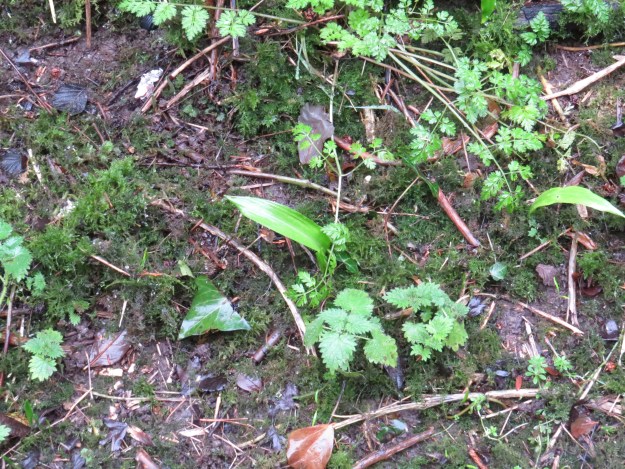
It appears that I took a chance with my nibble, as it has been known for people to mistake the poisonous leaves of the lily-of-the-valley or the arum lily for the edible leaves of our plant. The scent test (rubbing the leaf and smelling the fingers to check for the garlicky smell) is a good way of identifying an individual plant but won’t help with subsequent plants. Fortunately, once the flowers are out everything is clear. Unfortunately, by this time the flavour has changed from ‘subtle’ to ‘brash’.

There is a limit to how much of the plant anyone wants to take home, although it has been growing in popularity as a culinary ingredient just lately, and it sometimes feels as if I’m tripping over wild garlic pesto every time I go to a posh restaurant. However, it’s not just about the pesto, as you will see from the fine selection of recipes here.

I was interested to find out that the plant has also been used as fodder, although like most members of the onion family it taints the milk produced by the cows and goats who feed on it. In Switzerland, garlic-scented butter made use of this natural feature, and was apparently quite popular. I am reminded of an episode from ‘Tess of the D’Urbervilles’ by Thomas Hardy, where the cows eat wild garlic in the orchard and ruin their milk, so Tess and Angel Clare end up working together with the rest of the village to clear the plant. Hardy is not my favourite author, but I do love the set pieces that he creates, and I must admit that since spending so much time in Dorset with my parents I am warming to his descriptions of the countryside and the people and animals that live there.

Wild garlic pesto

Like most alliums, wild garlic also has a whole raft of medicinal properties: it is antibacterial, and is said to be the best of all the onion and garlic family for lowering blood pressure (unless you’ve let it get out of hand in your garden of course). A 17th Century saying has it that if you :

Eat leekes in Lide (March) and ramsins in May,
And all the yeare after physitians may play.

Wild garlic was also a useful source of Vitamin C, and was said to have been taken to many parts of Europe by the Vikings: in Finland, it was planted at the ports and around the harbours to make it easy to pick and take on board. It was believed by the Vikings to protect against the evil eye, and of course we know how useful garlic is against vampires.

For my poem this week, I’ve chosen one by the Welsh poet Leslie Norris, who died in 2006. His poem honours fellow poet Edward Thomas, whose poems conjure the British countryside, wild garlic and all.

Ransoms
(for Edward Thomas)What the white ransoms did was to wipe away
The dry irritation of a journey half across
England. In the warm tiredness of dusk they lay
Like moonlight fallen clean onto the grass,And I could not pass them. I wound
Down the window for them and for the still
Falling dark to come in as they would,
And then remembered that this was your hill,Your precipitous beeches, your wild garlic.
I thought of you walking up from your house
And your heartbreaking garden, melancholy
Anger sending you into this kinder darkness,

And the shining ransoms bathing the path
With pure moonlight. I have my small despair
And would not want your sadness; your truth,
Your tragic honesty, are what I know you for.

I think of a low house upon a hill,
Its door closed now even to the hushing wind
The tall grass bends to, and all the while
The faroff salmon river without sound

Runs on below; but if this vision should
Be yours or mine I do not know. Pungent
And clean the smell of ransoms from the wood,
And I am refreshed. It was not my intent

To stop on a solitary road, the night colder,
Talking to a dead man, fifty years dead,
But as I flick the key, hear the engine purr,
Drive slowly down the hill, I’m comforted.

Leslie Norris (b. 1921 d.2006)

Photo Credits

Photo One (garlic flowers) by By Kurt Stüber [1] – caliban.mpiz-koeln.mpg.de/mavica/index.html part of http://www.biolib.de, CC BY-SA 3.0, https://commons.wikimedia.org/w/index.php?curid=5352

Photo Two (ancient woodland) by No machine-readable author provided. Naturenet assumed (based on copyright claims). – No machine-readable source provided. Own work assumed (based on copyright claims)., CC BY-SA 3.0, https://commons.wikimedia.org/w/index.php?curid=134686


At Canons Drive, Edgware – Part Two

tEntering Canons Park

Dear Readers, when you left us yesterday I’d just been walking through the redwood and cedar trees on Canons Drive. Opposite North London Collegiate School there’s a most inviting path into the woods and, as the sun was shining (for once), off we went. Now what impressed me most is the understorey here. Just look at this sea of lesser celandine!

Not to mention the wild garlic – a couple walking ahead of us pulled up a handful, but there is certainly lots to go round.

And a few bluebells are just raising their little heads – judging by the colour, the drooping stems and the curled-back petals I’d say that, miraculously for an urban setting, these could actually be English bluebells rather than hybrid ones. Correct me if I’m wrong, lovely people! At the very least, these don’t look particularly ‘hybridish’ if there’s any such word.

What I want to know is, what is going on here that isn’t happening in other North London Woods? Is it just that people are sticking to the paths, or that it just isn’t as well used as my local woods? Bluebell Wood in Bounds Green doesn’t have a single English bluebell (as far as I’m aware) and my beloved Coldfall Wood has practically no understorey at all. Here’s a photo from today. The green that you can see is growing along the stream. It isn’t just to do with dense leaf cover either, as neither Canons Park nor Coldfall Wood are in full leaf yet.

Coldfall Wood

Anyhow, back to Canons Park. The Cow Parsley is coming into flower too.

And soon we leave the wood and see another church in the distance. I do like a walk with a bit of symmetry, and after exploring St Margaret of Antioch church yesterday, we come to St Lawrence Whitchurch today.

St Lawrence Whitchurch

The stone tower dates back to 1360 but the rest of the church is apparently in the Continental Baroque style (18th century), which is unusual in England. Alas, the church was closed so we couldn’t have a look. It contains the Chandos Mausoleum – the Duke of Chandos was responsible for the original estate that Canons Drive and the wood were part of, and he also ‘messed around’ with the original medieval church building. The Mausoleum was designed by Grinling Gibbons, though the architectural writer Pevsner is a bit sneery about it and thinks that it was probably knocked up by his workshop rather than the man himself. It shows the Duke as a Roman citizen, with two of his wives kneeling beside him (he was married three times in all, so I guess the third one survived him)

The Chandos Memorial (Photo by By Doyle of London – Own work, CC BY-SA 4.0, https://commons.wikimedia.org/w/index.php?curid=140541390)

Furthermore, the church is home to an organ that was played by George Frederic Handel himself, who was composer-in-residence from 1717/1718. He composed a setting of the psalms known as the Chandos Anthems while he was there, living with the Duke in his stately home (demolished in 1747). I have a great love for ‘Mr Handel’ – it’s difficult to be sad when listening to all that exuberance! But I had no idea that he’d been composing away in Edgware, and playing the organ in this little church. I must go back to see what I make of the interior – it looks quite something!

And then it’s time for a wander around the graveyard, where a parakeet is stripping the cherry blossom, bless her…

There are some graves here from the 18th century…

And some more recent ones. This one tells of an entire family wiped out in a WWII air raid, with possibly just the son (who was maybe on active duty) surviving.

Such terrible stories, but it is so peaceful here. I can imagine when the roads and houses were open fields and countryside. As with so many churches, they seem to have seen it all.

And the church still has its lychgate. This is where a coffin would have waited, under cover, until the first part of the burial service had been read and it was time for the deceased to be brought into the church.

So, what an interesting walk in Edgware! London never ceases to amaze me, with its infinite variety. And all because of an article about redwood trees! You never know where a trail will lead you next.

At Canons Park, Edgware – Part One

St Margaret of Antioch


Dear Readers, you might remember my piece about Sequoias earlier this week, when I mentioned that there was reported to be a row of these majestic trees in Edgware, a few miles away from where I live. So, as it’s Easter weekend, how could I resist an expedition to see what’s going on? Plus, I have never actually been to Edgware, even though it’s so close. So, on Saturday we jumped onto a bus to Golders Green and a Northern Line tube to Edgware to see what gives.Well, there’s certainly a lot of independent shops and cafés about, selling all sorts of different cuisines – Indian, Chinese, Lebanese, Afro-Caribbean, Romanian, and lots of others. But we’d just stuffed our faces in East Finchley, so on we went. First up was the rather intriguing church in the first photo. St Margaret of Antioch is the Church of England parish church for Edgware, and was first mentioned in the 13th century, where it was used by the Knights Hospitaller – this was a military order based in the hospital of St John of Jerusalem. These days, it runs the St John’s Ambulance Brigade, and the Saint John Ambulance Brigade in Jerusalem. The tower dates to the 15th century, but the rest of the building has been rebuilt and renovated several times, most recently in the 19th century.

St Margaret of Antioch was one of the saints that Joan of Arc was said to have conversed with. She was born a pagan, but was reared as a shepherdess by a Christian woman after she was disowned by her father for her conversion. Legend has it that she was devoured by a dragon, but that the cross she was carrying irritated the dragon’s innards so much that she was able to make her escape, though exactly how is not entirely clear. She also did battle with a demon in her cell and won by battering him with a brass hammer. She was clearly a woman after my own heart, but alas she was decapitated in the end. She is the patron saint of pregnant women, servant maids, kidney-sufferers and can be invoked against demonical infestations, should you have any.

Saint Margaret of Antioch, with a dragon (Photo by By Postdlf, CC BY-SA 3.0, https://commons.wikimedia.org/w/index.php?curid=2679945)

On we go, past a rather fine stone war memorial, and some buildings that I originally took to be mock Tudor, and which are actually real Tudor, with some of them dating back to the 16th century. Who knew that Edgware had such a rich architectural heritage? They currently house a range of restaurants and bars (one of which was serving flagons of beer though it was only 10 a.m.)  and a driving school.

Actually it’s not so surprising that Edgware has a long history as it’s situated on Watling Street, a Roman road that linked St Albans and the northern cities to London.

And now, we reach Canons Park, a conservation area with a long history. It was originally part of the lands of the Augustinian Priory of St Bartholemew, who also ran St Bartholemew’s Hospital in London. Later, a magnificent house was built in the estate grounds, which now forms North London Collegiate School. The avenue that led up to the entrance still exists, and was planted in 1910 with a variety of magnificent trees. This was the main reason for the expedition, and as they say in Tripadvisor Restaurant reviews, ‘They didn’t disappoint’.

View along Canon’s Drive

We have a mixture of trees here – lots of Giant Sequoia (Sequoiadendron giganteum), one California Redwood (Sequoia sempervirens), some Dawn Redwoods and a whole variety of cedars and monkey puzzles and goodness knows what else. I was utterly amazed. For those who would like to be able to tell the difference between the Giant Sequoia and the California Redwood, help is at hand below. First is the cone and leaves of the Giant Sequoia – see how the leaves are tiny, in long sprays. The trees themselves also have a more conical, heavily leafed shape than the California Redwoods.

Giant Sequoia leaves and cone.

Cones and leaves of California Redwood (Sequoia sempervirens) Photo from https://www.picturethisai.com/wiki/Sequoia_sempervirens.html)

Giant Sequoia


Cedar (not sure what type, possible Deodar)

Giant sequoia

Nearly all of the trees have tree preservation orders (TPOs), but this hasn’t stopped some insurance companies from asking for them to be cut down – I recently signed a petition stating that three of the trees had been blamed for subsidence and were threatened with destruction. I’m pleased to report that two of the trees have now been saved, but the petition is still stating that one tree is under threat (though I do note that the petition is more than two years old, so maybe this is old news). Anyhow, it just shows that even with trees as impressive as these, it still pays to be vigilant.

And let’s not forget a) that these trees are relatively just babies (redwoods can live to 3000 years old), and b) are nothing like at their full height yet – the tallest is a mere 110 feet tall, when they can grow to 380 feet. Plus they were planted before there were any houses here at all. Honestly, councils and insurance companies have to sort this stuff out. Too many trees are cut down purely for financial reasons.

Can anyone else see a face in the trunk below? It definitely looks like an Ent to me….

All too soon, we’re at the end of Canons Drive, peering through the fence into North London Collegiate and wondering what to do next. But lo, what is this?

A leafy path through a little wood on a sunny day? Looks good to me! Let’s see how we get on tomorrow.