Bugwoman on Location Day Six – The Accademia, and Acqua Alta Averted!

Dear Readers, there was a sense of impending doom in Venice this morning. We were able to get a whole table to ourselves at the Parlamento coffee bar, just along the canal from where we were staying, and furthermore the chocolate croissants hadn’t sold out. The reason was two fold. First up, there was a vaporetto strike, so lots of people were working from home and hence not grabbing a coffee en route to the University or to the other places round about. But secondly, the first serious Acqua Alta of the year was planned, with the tide forecast to reach 120 cm. At 90 cm Venice gets a bit of flooding, but at 120 cm it starts to get serious in most parts of the city. We were planning our day on the basis that we should be back close to home by lunchtime – it’s true that the highest tide only lasts for an hour or so, but it’s easy to get stuck somewhere, and as today was our last day we were reluctant to be caught out.

So, after refuelling (there’s been a lot of refuelling on this trip) we headed off to the Accademia, to see the St Ursula Cycle of paintings by dear old Carpaccio. Sadly, someone (i.e. me ) hadn’t done their research, as the Carpaccios are actually in an exhibition at the Ducal Palace. Sigh. St Marks always floods the worst as it’s the lowest part of the island, so that was a non-starter. We did get to see ‘The Dream of St Ursula’ though, and it reminded me very much of ‘The Vision of St Augustine’ yesterday – the same light, the same precision, the same air of expectation. I also noticed the small cat at the foot of the bed for the first time. Vittore clearly couldn’t resist sticking in one more detail.

The Dream of St Ursula (Vittore Carpaccio, 1495)

Anyhow, not seeing the whole St Ursula cycle means I’ll have to visit Venice again, which is no bad thing. And there was also this wonderful Veronese (probably my second-favourite Venetian painter). Veronese always seems to give a real sense of what life was like in sixteenth century Venice, and got into a lot of trouble with the painting below. It clearly shows the Last Supper, but the Venetian Inquisition were very unhappy with it. What’s with the dwarves, and the drunken people, and the dogs and cats, and the geezer in the bright red costume who looks like Santa Claus? They asked. This is no fit subject matter for a religious painting. Aha, said Veronese, this is not actually the Last Supper, but a depiction of the Feast at the House of Levi. Fair enough, said the Inquisition, no doubt to everyone’s surprise. And so it has remained. The more I look at it, the more shenanigans I spot. It’s endlessly entertaining, and just busting with life.

Veronese ‘The Feast in the House of Levi (1573)

The dog eyeing up the cat under the table, plus the guy in the red costume on the left.

A jester and a servant boy having an argument over a parrot

And then there’s this stunning painting by Tintoretto – a master was about to have his slave tortured for having the audacity to visit the relics of St Mark on a visit to Venice. St Mark swoops down like a superhero and breaks the instruments of torture, which can be seen at the bottom of the picture. There’s much wish-fulfillment in this for me. If only such things could be destroyed so easily. 

Incidentally, one thing that I love about Venice is the prevalence of terrazzo floors, and the Accademia is full of them – little bits of stone set in cement and then polished. While common in municipal buildings, you can also see these floors in some domestic buildings, and they’re both attractive and easy to maintain and keep clean. Indeed, it’s noted that when a terrazzo floor cracks it’s usually because the surrounding structure has moved, a not-uncommon occurrence in Venice.

Terrazzo floor

And so, as we prepare to wade back home, we hear that the Mose has been activated. This is very exciting. The Mose is the new flood barrier that’s been installed along the edge of the lagoon, and it comprises a number of gates that can be raised from the seabed at three key locations – the entrance to the Lido, Malamocco and Chioggia. The gates are only raised for exceptional combinations of tides and weather events – there’s no chance that Venetians and visitors will have completely dry feet, as the normal spilling-over of the tide on the canals is essential to not only the ecosystem of the lagoon, but also the sewage system (don’t ask). So, at the moment the gates are raised if the expected tide is above 110 cm, which today’s clearly was. So far, the gates have been raised more than 50 times since they started operation in 2020, whereas the expectation was that they would only need to be raised three times per year. The question of whether this will be enough to save Venice from sea-level rise and extreme weather events remains to be seen.

Acqua alta in Venice, Campo Santa Margherita, 2019 (Photo byBy Marco Ober – Own work, CC BY-SA 4.0, https://commons.wikimedia.org/w/index.php?curid=94906890)


Bugwoman on Location – The Scuola di San Giorgio degli Schivoni

San Giorgio degli Schiavoni (Photo by By Didier Descouens – Own work, CC BY-SA 4.0, https://commons.wikimedia.org/w/index.php?curid=19834519)

Dear Readers, Venice has a long history of immigration, particularly of skilled craftsmen from other parts of Europe. In the fifteenth century, sailors and workers from recently-conquered Dalmatia, known as Schiavoni, decided to form a fraternity or guild to support one another, and they bought an old hospital as the base for their school. They asked a young artist, Vittore Carpaccio, to produce some paintings based on the lives of their patron saints: St George, St Tryphon and St Jerome, and so he did. The result is probably my favourite place in the whole of Venice. There is something about these paintings that I find intriguing, and sometimes moving.

The Scuola is one of the few places in Venice that still doesn’t take credit cards, but fortunately we had some cash, enough not only to pay for the tickets but also to buy a guidebook, which I’ve been meaning to do every time I’ve visited for the past fifteen years. The woman behind the desk spoke Italian, English, German and French, and was obviously in love with Carpaccio – she whispered that her name was the same as that of Carpaccio’s mother. In between juggling languages and dishing out change, she ran around the building keeping an eye on a young family. The smallest child was cheerfully opening the drawers of a fifteenth century cabinet and nearly pulling it down on top of him while his mother wandered, oblivious.

Since I was last here in 2016, several of the paintings have been restored, and you can really see the details once again. First there are three paintings of the life of St George. First up, as you might expect, he’s killing the dragon. Note the many body parts laying about on the ground. If you look very closely, you can see various toads and frogs and other creeping creatures.

San Giorgio e il drago (1502)

In the next painting, we see St George bringing a much-diminished dragon into town for everyone to admire.

In the third St George painting, the people in the second painting are so impressed with St George and his taming of the dragon that they convert to Christianity. You can see a turban laying on the steps at the front of the picture.

The Baptism of the Selenites (Carpaccio, 1507)

Then there’s a painting of St Tryphon extracting a demon from the daughter of the emperor. The demon is known as a basilisk, and here looks rather like a cross between a donkey, a pigeon and a lizard. St Tryphon was the patron saint of the town of Cattaro on the Dalmatian coast.

St Tryphon and the Basilisk (Carpaccio, 1507)

My very favourite paintings, though, depict the life of St Jerome. One of them is away for restoration at the moment, but it shows St Jerome with a lion that arrived at the monastery. The other monks very sensibly ran away, but St Jerome greeted it as a guest and discovered that it had an injured foot, which he treated with ointments. The lion then lived amongst the brothers as a companion. In the painting, I love the way that the monks are fleeing with their habits flying, like so many birds.

St Jerome and the Lion (Carpaccio, 1502)

In the next painting, we see St Jerome’s funeral. Whereas the one above is all movement, this one is all stillness and contemplation.

The Funeral of St Jerome (Carpaccio 1502)

And then there is this. I wrote about it a few days ago: it shows St Augustine in his study at the moment when he is ‘visited’ by a vision of his dear friend St Jerome’s death. When I see the real painting, there are so many details that are astonishing, and unlike any of Carpaccio’s other paintings here – the realism of St Augustine’s half rising from the table, the way the little dog has sat back on his haunches as if stunned by the light. This is Carpaccio’s masterpiece, for me.

St Augustine in his study (Carpaccio, 1502)

And one last thing. At the bottom right of the painting there are two sets of musical notation. Following the restoration of the painting, there have been a number of attempt at actually bringing these to life. The one below is a choral version, but my new best friend, the curator, had a piano version which she played for me. It matches the mood of the painting perfectly, and I can’t help but wonder if viewers of the painting would have heard the music in their heads, or if there were ever musical performances around the work. This extract is from here.

And so, it was goodbye to the Carpaccios (though we’re hoping to get to the Accademia tomorrow to see some more). Incidentally, a ‘carpaccio’ of meat was named for the prevalence of red in many of Carpaccio’s paintings, which makes a bit of a nonsense of the idea of a ‘carpaccio’ of melon or kiwi fruit or any of the other versions that are around.

Heading home, it’s clear that the Aqua Alta is reaching its height – tomorrow we’re expecting 125 cm, which means that there will definitely be some flooding around here at about lunchtime. And there’s a vaporetto strike! And some thunderstorms! Looks like our trip will end with a bang. But in the meantime, here’s a little egret, making the most of whatever the tide brings in. Note those sweet little yellow feet. S/he could do ‘jazz feet’ in a Bob Fosse movie any day of the week.

Bugwoman on Location Day Four – Giudecca and the Redentore Church

View from Giudecca

Dear Readers, it’s fair to say that we’ve probably had the best of the weather for this week – today there’s a bit of mizzle, but we’re promised downpours tomorrow, and thunderstorms on Friday. In addition, there’s a transport strike on Friday which means some vaporetto lines will run and others will not, in a Byzantine combination of times and conditions that even I am having trouble intrepreting. Never mind! We shall make the best of it as always, and Venice is such a walkable city that a little bit of vaporetto/weather-based inconvenience will be as nothing.

Today, we crossed the lagoon on the number 2 vaporetto to have a wander around in Guidecca, a long, thin strip of land which is actually about a dozen tiny islands, each joined by bridges. First up was a coffee in the Hilton Hotel, which is based in the old Stucky flour mill which has dominated this part of the coast since it was built between 1884 and 1895. Stucky was a Swiss businessman who made his fortune in flour and pasta – the mill was steam powered and pumped out ridiculous quantities of both commodities. Stucky was rich enough to buy the Palazzo Grassi as his home in Venice, and was the richest man in the city. Alas, in 1910 he was murdered at Santa Lucia station in Venice by a former mill worker with mental health problems. Today the building is a very fancy hotel, with a shop that sells Rolexes and its own water taxi landing stage. It’s glitzy but strangely un-Venetian – you could be at any five-star hotel anywhere in the world, in spite of the extraordinary location. What happened to vernacular, and to quirky?

The new Hilton Hotel in the Stucky flour mill

By now the water is slopping over the dock, and I see that high tide will bring the water up to a maximum of a metre, which means some places will be underwater. But here on Giudecca we seem to be mostly ok, provided you walk away from the edge.

It seems that the weather is very tough on the street trees here though, what with all the inundation in salty water and the wind. The tamarisk below is definitely the worse for wear.

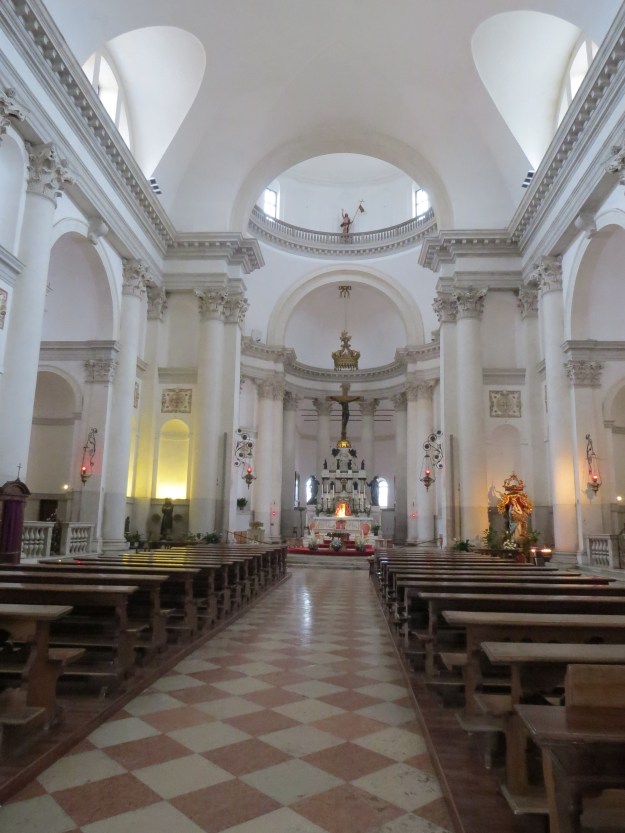
And then it’s off to the Il Redentore church, which was built to a design by Palladio and was consecrated in 1592. The church was built to give thanks for deliverance from the plague that raged through Venice in 1575/6, killing 46,000 people (about 20 % of the population). Whenever I think about how crowded some streets are it puts me in mind of what it must have been like to live here during this time.

The church was taken into the care of Capuchin monks after its consecration, and one of their conditions was that they could receive no profit from looking after the building. This meant that rich people could not pay to have elaborate tombs built here, and the monks could not spend their time praying for their souls. What this has meant in practice is that the church has been preserved pretty much as Palladio intended, without the Baroque flourishes that decorate so many other Venetian churches. There is a single nave with three chapels on either side depicting scenes from the life of Christ.

There is an ornate-ish altar, and a round dome.

During the third Sunday in July the Festival of the Redentore takes place, with a pontoon bridge constructed from Zattere on the other side of the Giudecca canal to the church. The Doge and the Senators used to walk across this bridge, which was originally constructed from boats, and would go to Mass in Il Redentore. The Festival is still a huge celebration, with a massive firework display, after which young Venetians head off to the beach at the Lido and wait for dawn. That must be something to see but strangely enough it doesn’t make me want to be in Venice at the time – too many people, too much noise and hubbub. The Venice that I love is a place of misty early mornings, quiet courtyards, narrow streets and people going about their day-to-day business. But then, the city has always been all things to all people, and I suspect that everybody has a ‘real’ Venice all of their own.

Side canal in Guidecca

Venetian Ducks!

More Oleander

Bugwoman on Location Day Three – Dursodoro

The old Stucky Flour Mill in Giudecca (now a Hilton Hotel)

Dear Readers, I love exploring the lesser known parts of Venice – they’re quieter than the main St Marks/Rialto route march, and they tend to be places where Venetians still live and work. Today, we had a wander around Dursoduro, which is home to the Gallerie d’Accademia, probably Venice’s most famous art gallery, though the weather was so glorious that we stayed outdoors for most of the time. This part of Venice was the first to be colonised (once the Venetians had moved on from the island of Torcello, which is truly the birthplace of Venice), and the name ‘Dursoduro’ means ‘hard back’ – the land was much less marshy than in other places.

I love just walking alongside the water here, gazing over at Giudecca and admiring the oleander. The super yacht in the first photo is the Lady Marina, owned by Sergio Mantegazza, owner of Globe Travel. He is worth $3 billion, and the yacht cost a mere $50 million. How the other 0.5% live, eh.

Canalside walk with superyacht (the Lady Marina in case you’re interested)

Oleander tree – my goodness, just look at the colour of that sky!

The ever-present herring gulls (of which more later) are using one of the super yacht moorings as a place to rest (and would probably nest there given half a chance).

We are on a mission, though, to find the Campo St Margherita. I’m not quite sure why we love this square so much, but one reason is definitely the people-watching. We settle down at a table outside our favourite sandwich bar, and the elderly man a few tables over starts singing in Italian with his friends. The song mentions ‘Venezia’ and ‘St Marco’ and so we assume it’s a local ditty. When he finishes we all clap, which encourages him to greater and greater efforts. More people sit down, most of them with very small fluffy dogs – pomeranians seem like particular favourites. We are close to the university, so students sit earnestly at another table, discussing ideas. Remember when we used to be earnest and discuss ideas? More of this, please. Several people are pushing wheelchairs, containing husbands or wives or friends – Venice is a difficult city for people with limited mobility and I can’t begin to imagine how they manage, although the chance to sit in the sun with an Aperol spritz and discuss the state of things with passing friends and neighbours must make up for a lot.

In front of us, on the left, is the fish stall, which has been here every time we’ve visited. Eager seagulls wait on the roofs of the adjoining buildings. The fishmongers stand behind the stall, gutting and chopping up fish, including a large swordfish, and the gulls wait their chance to steal some guts or a fish head, while their youngsters urge them on with those high-pitched musical cries that seem so out of place coming from such a large bird.

I am not sure what the small shaggy shrub in the photo below is, but every dog that passed decided it was an ideal place to lift a leg.

The building below is very handsome, but has been falling gently into disrepair over the past twenty years. When you see the prices of property you can see why Venice is in crisis – who can afford 380k euro for a one-bedroomed flat?

Across the Campo, there’s the deconsecrated church of St Margherita. The bell tower lost its top in 1808 when the structure was declared unstable, and the whole building is now an auditorium for the local university. I have a suspicion that while most of Venice is actually a very sleepy place (you could hear a pin drop around Cannaregio after 11 p.m.), this square is probably lively until the wee small hours.

Now, I assumed that the statue in the recess above the door would be St Margaret (the church is named for St Margaret of Cortona, whose lover was murdered and who subsequently became a nun, like you do) but as this is clearly a chap, and he’s standing on a crocodile, I suspect that he’s St Theodore, who is also represented on one of the plinths outside St Mark’s Square. The crocodile is meant to be a dragon, who was slain by the saint. St Theodore was patron saint of Venice until he was displaced by St Mark and his winged lion. No wonder he looks fed up.

St Theodore outside the church of St Margherita

St Theodore on the plinth at St Marks

But as we head back towards home, as usual it’s the quirky things that catch my eye. For instance, is this sign, seen in a shop selling Venetians prints from the 1930s, an instruction or a warning? Incidentally if you still fancy a cappuccino and it’s past twelve and you don’t want to look like a tourist (hah! As if we can avoid looking like tourists) you can order a latte macchiato instead.

And lots of the shops are closed because there’s going to be a power cut (especially pertinent as my husband is, he won’t mind me telling you, an energy-nerd, and it’s his sixtieth birthday today)

And how about this, in a used bookshop? I have certainly met plants who are more useful than some people, what with them sequestering carbon and producing oxygen and all, but this does seem a little harsh.

And then we get to a place where the canal does a sharp left turn, and I couldn’t resist recording a little piece of the goings on for you. I love the tourist gondola, the water taxi and the boat carrying a collection of chairs all trying to negotiate the corner.

And finally, we get to the bridge which crosses the Grand Canal close to the main train station, and I can’t resist taking a photo in each direction. We usually manage to avoid the number one vaporetto which plies its slow and crowded way up and down the Grand Canal, but only because we’ve already done it once. What an extraordinary water way this is! It makes me a little sad to consider how underused the Thames is now, although in its heyday it would have been extremely busy.

The Grand Canal looking towards St Marks

The Grand Canal looking towards Piazzale Roma, with the Ferrovia (the 1930s railway station) on the right.

Bugwoman on Location Day Two – The Arsenale

Dear Readers, the Arsenale in Venice has existed since about 1100, and at the height of Venice’s sea power in the fourteenth and fifteenth centuries it was probably the world’s first production line for ships. At its busiest it employed over 20,000 workers, who were divided into teams who made the frame, the hull, the rigging, the sails and the munitions separately and then put the ship together – legend has it that they could construct a battleship in a single day. Dante described the process in his Inferno:

As in the Arsenal of the Venetians
Boils in winter the tenacious pitch
To smear their unsound vessels over again
For sail they cannot; and instead thereof
One makes his vessel new, and one recaulks
The ribs of that which many a voyage has made
One hammers at the prow, one at the stern
This one makes oars and that one cordage twists
Another mends the mainsail and the mizzen…

Well, these days the buildings are home to the Venice Bienniale. In ‘even’ years, it’s art, but in ‘odd’ years it’s architecture, so for the first time this year we decided to see what was going on. But first, we had to visit the lions that surround the old entrance to the site. First up is the Piraeus Lion. He was originally sculpted in about 360 BC and was stolen from Piraeus in Greece in 1687 by Venetian commander Francesco Morosini. Morosini was something of a character, who apparently always dressed in red from top to toe, and never went into battle without his cat Nini beside him. Nini is embalmed in the Museo Correr on St Marks Square, with an embalmed mouse between her paws.

Francesco Morosini, sadly without cat (Portrait by Giovanni Carboncino)

Anyhow, the Piraeus lion is covered in runes, apparently inscribed by Scandinavians at some point in the eleventh century (they were probably mercenaries hired by the Byzantines, and they were clearly a long way away from home). Some people just can’t resist a bit of graffiti, clearly.

The Piraeus Lion

Some of the many runes.

Because the runes are so weathered, attempts at translation have been somewhat hindered, but the consensus is that the 1914 translation by Erik Brate is probably the closest to what the runes actually say. So here it is:

They cut him down in the midst of his
forces. But in the harbor the men cut
runes by the sea in memory of Horsi, a
good warrior.
The Swedes set this on the lion.
He went his way with good counsel,
gold he won in his travels.
The warriors cut runes,
hewed them in an ornamental scroll.
Æskell (Áskell) [and others] and
Þorlæifʀ (Þorleifr)
had them well cut, they who lived
in Roslagen. [N. N.] son of [N. N.]
cut these runes.
Ulfʀ (Úlfr) and [N. N.] colored them
in memory of Horsi.
He won gold in his travels.

So there.

There are three other pillaged lions sitting in front of the gates (the winged lion is the symbol of St Mark, the patron saint of Venice), but this one is my favourite. Whenever I see him, it makes me laugh. Lion or dachshund? You decide.

And look at that face.

This is the Delos lion, another statue nicked by Morosini during the wars with the Ottomans in the seventeenth century. This lion probably dates back to the sixth century B.C., and the head was added later, probably after the lion arrived in Venice. Incidentally, Morosini tried to hammer off some of the horses and chariots from the Parthenon but they fell out of the frieze and smashed. Dear oh dear.

Anyhow, finally we get into the Architecture Bienniale itself. Sometimes, the language used to describe what’s going on at these events is basically word salad, and I don’t think that it’s always a problem with translation. But several exhibits really did stand out. One was a very thought provoking piece about a city in Ukraine dating to 4000 B.C, contemporary with Uruk, usually thought to be the first city in the world, but I want to do a whole post on this so I will leave it for now.

The other exhibit was the Slovenian display, which wondered why we didn’t learn more from vernacular architecture about how to conserve energy, adapt to climate change etc. They used some excellent examples. One was the way that, in the past, people would use only part of their homes during the winter rather than the whole thing, sharing their space with animals or additional people, closing down some rooms and using things like hangings and tapestries to lower ceilings and insulate walls. Whenever I see the latest enormous white box that someone has built in Grand Designs, I always think how cold it’s going to be, even with our excellent insulation and fancy glass.

There’s also much to be learned from places in North Africa and the Middle East about adjusting to hot weather – smaller windows on the outside, courtyards with fountains in the centre that stop ‘thermal load’ and keep the living spaces cool. I found myself nodding up and down like one of those plastic doggies that people used to have on the rear windows of their cars. Below are just some of the questions asked, and the answers they came up with from the past. People have always adapted to climatic problems with creativity and intelligence. Why reinvent the wheel? There’s much from other times and other places that could be useful. I always fancied one of those little sleeping cubby holes meself.

Anyhow, this all seemed so sensible to me that I feel quite inspired, and it’s no different from what my parents and grandparents used to do to save money on energy bills. I bet if we thought about there are ways that we could use our homes differently to adapt to how the climate is changing.

And then I went for a walk outside the Arsenale, because I just love all the bits of engineering from previous iterations of the building that are still hanging about. Like this Armstrong-Whitworth crane, for example, which would have been used to loading/unloading ships, and for building ships. It was originally built in Newcastle and is the only one of its kind left anywhere in the world – in fact, it was the subject of a ‘Venice in Peril’ appeal about twenty years ago, which looks to have been completed.

I absolutely love these gigantic oil tanks, which are slowly being repossessed by nature. The one in the middle looks to me as if it has a cartoon face.

There is yet another lion, this time just a head, presumably to tie a ship up to.

And then there are these enormous white hands and arms. As we got the vaporetto home, I noticed that they form an arch. The installation is called ‘Building Bridges’ and it’s by Italian artist Lorenzo Quinn. They were put in place for the 2019 Bienniale, but like his previous installation ‘Support’, which drew attention to rising sea levels in Venice, this one was so popular that it’s still in place. Apparently the six sets of hands symbolise friendship, hope, love, help, faith and wisdom, and we could all do with a bit more of all of those.

‘Support’ by Lorenzo Quinn, created for the 2017 Venice Bienniale

And so, it’s time to head home. We get the vaporetto around the east and north of the island, and walk back home. You don’t have to go far in Venice to find a quiet alleyway or a peaceful unpopulated canal if you keep away from the main Rialto/San Marco/Accademia stretch (though if you only have a few days these are the things that you’re definitely going to want to see). It’s worth sometimes just exploring gently, though. Not all who wander are lost, and in Venice even those who are lost are generally unconcerned.


Bugwoman on Location – Venice Day One

Dear Readers, I was wondering if we were actually going to get to Venice, following this news on the night before we departed:

Seagulls Force Venice’s Marco Polo Airport to Close Briefly‘.

Apparently a gang of about 200 gulls landed on the runway at Marco Polo, forcing the plane carrying the president of the Veneto to be diverted to Trieste. The usual measures to dissuade birds were used (which involve a falconer and an ‘acoustic deterrent’) and eventually the gulls sighed and moved on. Here is one waiting on the Canareggio Canal for someone to pass by with an ice-cream or an unguarded pizza slice, though to be fair this is just a young ‘un, it’s the adults who have learned all the tricks of the trade.

Clearly some restauranteurs along the canal have found the birds annoying, as evidenced by these anti-seagull measures:

And I rather like the way that the ‘seagulls’ dance to the sound of the church bells in the clip below.

Anyhow, our flight was perfectly fine and we arrived in Cannaregio, found our apartment and set out to explore. We usually just spend the first day hanging out and drinking too much coffee, but as this is where John proposed to me back in 2000, we always try to find our way back to the café where he popped the question. In previous years it was no longer a café but a pizzeria, but this time it was back to being a café again, so we had to stop for old times sake. When John  proposed we were seated between two German tourists and a Venetian lady with pink hair and a small white poodle on her lap, and when I said yes everyone applauded, so it will always have a special place in my heart.

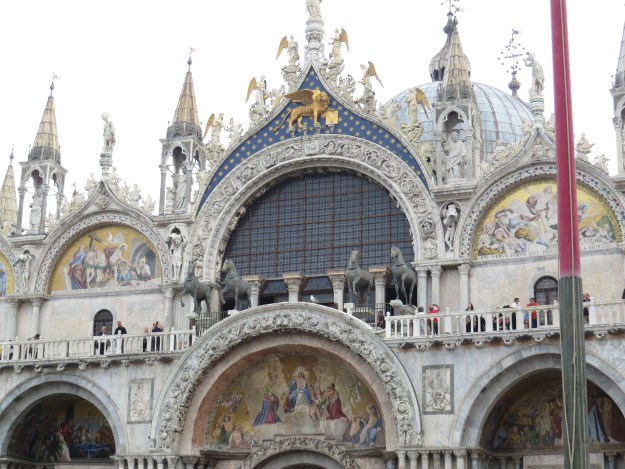
And so we headed off to St Marks Square, because it has to be done at least once. They were clearly expecting an Aqua Alta as they had the raised boards out – these are basically trestle tables, just wide enough for people to pass one another, which make getting around Venice (especially on the path to and from St Marks) even more of a pain than it is usually. But nonetheless it is an extraordinary public square, with something spectacular wherever you turn.

A man was selling pigeon food, but I suspected that it would be the gulls who got most of it – the young ones sit on the ground looking pathetic, while the adults keep an eye on the square for anyone not paying attention.

The best time to visit the main sites of Venice (there are so many, but St Marks Square, the Doge’s Palace and the Campanile are probably the most well-known) is definitely first thing in the morning. Having said which, I have never been inside any of these buildings, because the crush is always too much, and I like the smaller, less well-known sites, of which more later this week. But in the meantime, I’d never had a close look at the capitols on the pillars around the Doge’s palace. What are these monkeys doing? I’m sure there’s a story here.

Then we head in the general direction of the School of the Dalmatians (better known as the Scuola di San Giorgio degli Schiavoni), home to a series of paintings by Carpaccio, probably my favourite Venetian painter. Alas, as we turned the corner a tour group of about 30 people were entering the church, and that’s at least 20 people too many for a comfortable viewing. We’ll be back later in the week for sure, but in the meantime here’s one of my favourites. It shows St Augustine in his study, and while there have been different interpretations, the one that I favour is that it shows St Augustine at the exact moment that his beloved mentor, St Jerome, died – it’s said that a divine light filled the room, which can be seen from the long shadows in the study. What I love most, of course, is the little dog. Carpaccio, as we will see, was a close observer of animals and people, and his paintings are often full of strange creatures and complicated goings on. What I love most about this one is its serenity.

‘The Vision of St Augustine’, Vittore Carpaccio (1502)

And then we head back to Cannaregio via an increasingly confusing set of alleyways and squares. At one point, we head through a covered archway, where a small Italian tour group are gathered. As we wander through, they cry, as one,

“Don’t stand on the red stone!”

Well of course I had to investigate when I got home, and it turns out that this alley way was the turning point in the 1630 outbreak of the plague – it’s said that the disease never got any further than this spot, and therefore it’s very bad luck to step on the red stone. The reason was that a local woman, Giovanna, had a dream in which the Virgin Mary appeared to her and asked for a painting of the Madonna, St Roch and St Sebastian to be painted on the walls of the portico containing the red stone (between Calle Zorzi and Calle della Corte Nova since you ask). After this, the plague dared go no further, and the red stone was placed to indicate where it turned back.

So on we go. Here we have a gas holder. I had no idea that Venice even had gas, but clearly it does.

Of course, in honour of my friend Margaret and her adventures, we had to pay tribute to  the hospital in Venice, right next door to the Basilica Giovanni i Paolo. Because it’s Sunday and services were in progress we weren’t able to go into the Basilica, but I fully intend to light a candle for Margaret, and one for all the other people that I’ve lost over the past few years, which will make for quite a display.

The lion outside the hospital entrance. Most of this archway is trompe d’oeil, though the lion is actually carved in relief.

And by now the water is rising, and it’s definitely time to head home before we get too wet. Plus, it must surely be time for another coffee? You can never have too much coffee in Venice.

Good News For Once

Lundy Island

Dear Readers, Lundy is a small island off the coast of North Devon, and this year it has been the scene of a remarkable rebound in the number of seabirds that nest on its cliffs. 25,000 Manx shearwaters, 95% of England’s population of the species,  nested here this summer, along with 1,335 puffins and 150 pairs of storm petrels, who have only been using the island since 2014. This is in spite of the threat of avian flu, which has severely damaged seabird populations in other parts of the UK, and in spite of the problem of a dramatic decline in the number of sand eels that provide food for the birds.

Puffin (Fratercula arctica) with a beakful of sand eels (Photo by By Charles J. Sharp – Own work, from Sharp Photography, sharpphotography.co.uk, CC BY-SA 4.0, https://commons.wikimedia.org/w/index.php?curid=106949394)

Manx Shearwater (Puffinus puffinus), Photo by By Matt Witt, CC BY-SA 3.0, https://commons.wikimedia.org/w/index.php?curid=25776525

In 2000, just over 7000 Manx shearwaters were counted, and only 13 puffins were seen in 2001. In the 1930s it was estimated that the island was home to more than 80,000 seabirds. So what caused the decline?

Brown rat (Rattus norvegicus) (Photo by By Matt Witt, CC BY-SA 3.0, https://commons.wikimedia.org/w/index.php?curid=25776525)

Now, I love a rat as much as the next person, but there’s no doubt that they can wreak havoc when they find a population of ground-nesting or cliff-nesting birds. The eggs are easy to steal, and the chicks are unprotected when the parents are out fishing. In some places, rats and mice are eating albatross chicks alive as they sit helpless in their nests.

Both black and brown rats came in the supply boats that visited Lundy over many decades, and liked the location so much that they stayed and bred. But from 2002-2004, a coalition of the RSPB, Natural England, the Landmark Trust and the National Trust worked together to completely eradicate rats from the island. They succeeded, and there is an ongoing monitoring programme because clearly the boats that still arrive with visitors and wardens could have furry stowaways.

Black rat (Rattus rattus) – Photo by By Kilessan – Own work, CC BY-SA 3.0, https://commons.wikimedia.org/w/index.php?curid=9002871

Animal rights campaigners were very angry at the destruction of the rats, arguing that the organisations involved were valuing tourist-friendly birds over the rodents. From a purely ethical point of view, I can see where they were coming from – both birds and rats are intelligent, sentient beings, so why would the life of a bird be worth more than the life of a rat? But sadly, human beings travel from place to place, messing things up, taking their rats and cats and rabbits and Dutch elm disease and ash dieback with them, and it’s the local ecosystem that bears the cost. This was, in effect, an attempt to turn back time, to a time before the rats reached critical mass and began to destroy the bird population. With better biocontrol hopefully such a thing will never need to be done again. We are only just waking up to the disastrous effect that alien organisms can have when they find themselves with no natural predators and a conducive environment. Let’s hope that we can nip more problems in the bud, rather than letting them get to the stage where we need to kill thousands of animals in order to protect other animals.

Nature’s Calendar – 13th-17th October – Chestnuts Glisten

Sweet chestnut (Castanea sativa)

Dear Readers, when I see the boxes of chestnuts outside Tony’s Continental on East Finchley High Road I know that autumn is well under way, and it will soon be pumpkins for Halloween and Christmas trees all the way to December. And I remember the smell of roasting chestnuts on the streets of London, though I haven’t noticed the vendors for a while. As Rebecca Warren points out in her post in Nature’s Calendar, chestnuts have been an important autumn food for a long time. Here’s Dickens in ‘A Christmas Carol’:

The poulterers’ shops were still half-open, and the fruiterers’ were radiant in their glory. There were great, round, pot-bellied baskets of chestnuts, shaped like the waistcoats of jolly old gentlemen, lolling at the doors, and tumbling out into the street in their apoplectic opulence’.

The trees themselves can make for an impressive mess, however, with the chestnuts spilling out of their green hairy cases. Being soft, the nuts are easily trodden into a mess, unlike the conkers which are harder and less likely to be crushed. A few years ago I noticed that the ring-necked parakeets had discovered a sweet chestnut tree in St Pancras and Islington Cemetery, and were thoroughly enjoying the nuts. What a source of plenty they are! And yet in the UK they have largely been regarded as a famine food, unlike in France, Italy and Switzerland, as we shall see in my Wednesday Weed post below. Are you a chestnut fan? Do share!

Dear Readers, I confess a great liking for the sweet chestnut tree. It was introduced to the UK by the Romans, who loved its sweet, mealy fruit, and grew it not only for this purpose but also for its timber and perceived medicinal benefits (its Latin name sativa means ‘cultivated by humans’). I love it for its furry fruits, and for those shiny serrated green leaves. The tree can live for several thousand years, and can reach a height of 35 metres.

Sweet chestnut is not closely related to horse chestnut, although the fruits do resemble conkers – sweet chestnuts are members of the Beech family (Fagaceae), while horse chestnuts and buckeyes belong to the soapberry and lychee family Sapindaceae. It just goes to show that superficial differences, such as the ‘hairy’ nut cases and the leaves which spray out like fingers from a central point, do not indicate an actual family relationship.

The bark has a characteristic spiral pattern, which I noted on another sweet chestnut that I saw on Hampstead Heath, and the flowers are in long sprays that are said to smell strongly of frying mushrooms.

Spiral bark on the Hampstead Heath sweet chestnut

Photo One by Viascos, CC BY-SA 4.0 , via Wikimedia Commons

Sweet chestnut flowers (Photo One)

Incidentally, the sweet chestnut catkins bear both male and female parts, with the female flowers at the bottom and the male flowers at the top. It’s the female flowers that will turn into chestnuts if pollinated. The tree is self-incompatible, which means that it can’t fertilise itself – the tree somehow recognises that the pollen grain from the male part of the plant is of the same genetic make-up as that of the stigma (female organ) of the receiving plant, and stops the process of fertilization. This prevents inbreeding, and is considered one of the most important mechanisms for ensuring the genetic diversity and health of a population. Who knew? Certainly not me. I am astonished pretty much every day.

Now, back to the sweet chestnut fruit itself. This is the quintessential chestnut that you smell cooking on braziers all over London at Christmas time, and very tasty the nuts are too. Apparently Roman soldiers were given chestnut porridge before going into battle, and look how successful they were! The French have a particular fondness for chestnuts (marrons) – they turn up as sweets (marrons glacé) and in Mont Blanc, a dish made from chestnut puree fashioned into vermicelli with whipped cream. Italy and Switzerland both claim the Mont Blanc as ‘their’ dessert, in much the same way that hummous is claimed by at least eight different Mediterranean and Middle-Eastern countries. I think that travelling the countries involved and sampling the dish in each region could easily be turned into a gastronomic travel book and if anyone wants to offer me a book deal to do such a thing I am open to offers once the pandemic is over.

Photo Two by By Honio - Own work, Public Domain, https://commons.wikimedia.org/w/index.php?curid=8630026

French/Italian/Swiss/ Mont Blanc (Photo Two)

I thought that marrons glacé were  indisputably French, but apparently Northern Italy, a major sweet chestnut-growing region, also claims them.

Photo Three by By "passamanerie" / flaviab - https://www.flickr.com/photos/flaviab/2013678423/, CC BY-SA 2.0, https://commons.wikimedia.org/w/index.php?curid=4884657

Marrons glacés (Photo Three)

Furthermore, in Corsica polenta (or pulenta as it’s called) is made from chestnut flour, and the Corsicans also make sweet chestnut beer. Chestnut flour has no gluten, and so is useful for people suffering from coeliac disease.

Photo Four By Clément Bucco-Lechat - Own work, CC BY-SA 3.0, https://commons.wikimedia.org/w/index.php?curid=22857997

Corsican chestnut beer (Photo Four)

Historically, sweet chestnut has also been used for timber – like other trees in the Beech family, such as hornbeam, it responds well to coppicing, and produces a good crop every 12 to 30 years. In his book ‘Woodlands’, Oliver Rackham describes how there are possible remnants of Roman chestnut orchards on the edge of the Forest of Dean, but it seems that in the UK chestnut timber was relegated to uses such as hop poles and included in the wattle-and-daub walls of medieval houses. Nonetheless, as noted earlier, if not coppiced these trees can reach an immense size and age. One ancient sweet tree in South Gloucestershire, the Tortworth Chestnut, was called ‘the old Chestnut of Tortworth’ in records from 1150 AD, indicating that it’s over a thousand years old.

Photo Five By Aliasnamesake - Own work, CC BY-SA 4.0, https://commons.wikimedia.org/w/index.php?curid=107161562

The Tortworth Sweet Chestnut (Photo Five)

Medicinally, it’s the leaves of the sweet chestnut that have been used, in particular to cure whooping cough and other ‘irritable and excitable conditions of the respiratory organs’. The belief in the efficacy of the leaves as a treatment for coughs lasted until at least the Second World War, according to the Plant Lore website. Another use for the leaves, also recorded on Plant Lore, was by children playing at running a home – if you strip away the flesh from the leaves they apparently look exactly like fish bones, just the thing for dinner!

And finally, a poem. This is by Thomas James, who was born in 1946 and committed suicide in 1974, a year after this poem was written. I’ve read it over and over, and I see more with every reading, but it still refuses to be nailed down, which is, I think, how it should be with a poem. See what you think, readers.

“The Chestnut Branch” by Thomas James

There is something to be said for darkness
After all. My mother’s hands
Have been full of the dark all winter.

They are hollow boats not going anyplace.
They only pull the blinds
Or gesticulate at some ineradicable star.

Now the backyard unfolds its lacy pleats,
And I bring in a white branch
Because love is the lesson for tomorrow.

Will nothing cure the brightness in these streets?
A million strange petals touch
The panes. Is it a gift of snow?

Is it making up for lack of bandages?
Is it cold, is it hot–
Will it keep, should we put it on ice?

Should my sister sew it into bridal clothes?
Is it lingerie, or just a sheet
To pull across a used-up face?

Will it brighten up the arms of chairs?
It moves. It hurts my eyes.
I am not accustomed to so much light.

It is like waking after twenty years
To find your wife gone and the trees
Too big, strange white growths that flank the street.

Photo Credits

Photo One by Viascos, CC BY-SA 4.0 , via Wikimedia Commons

Photo Two By Honio – Own work, Public Domain, https://commons.wikimedia.org/w/index.php?curid=8630026

Photo Three By "passamanerie" / flaviab – https://www.flickr.com/photos/flaviab/2013678423/, CC BY-SA 2.0, https://commons.wikimedia.org/w/index.php?curid=4884657

Photo Four By Clément Bucco-Lechat – Own work, CC BY-SA 3.0, https://commons.wikimedia.org/w/index.php?curid=22857997

Photo Five By Aliasnamesake – Own work, CC BY-SA 4.0, https://commons.wikimedia.org/w/index.php?curid=107161562


More Frog Shenanigans

Dear Readers, I wouldn’t want you to think that I’m obsessed with the sex life of frogs, but clearly I am. A few weeks ago, I reported on  how male frogs have a tendency to attempt to mate with whatever object comes within range, and it appears that this behaviour goes back a very long way, to when the very first frogs appeared out of the primordial ooze and started ribbiting away. Well, this week the plot thickens, as it appears that female frogs have come up with some interesting behaviours to try to dampen the ardour of these lotharios, who can sometimes drown a female with their overzealous advances.

Scientist Carolin Dittrich, of  the Natural History Museum in Berlin, observed the behaviour of two female frogs, one larger and one smaller, when placed in a miniature pond with a male for an hour. When grabbed by a male, 83% did a sharp rotation, which might have been a way of testing the male’s strength or an avoidance tactic, or possibly both. 48% made a specific call known as a ‘release call’, which basically means ‘get your hands off me you pest”. Usually this call is made by a male when grabbed by another male, but the females have learned to mimic it.

And 33% of the females demonstrated something which scientists call ‘tonic immobility’, and you and I might call ‘playing dead’.

In total, 46% of the females managed to escape from the male, which is reassuring, at least to me: I’ve sometimes seen my pond full to brimming with eager male frogs, and have watched as a newly-arrived female frog sits on a rock surveying the scene, as if deciding whether or not to take the plunge. Of course, I know that I’m anthropomorphising but it’s difficult to avoid making a comparison with when I was 15 and was just about to enter the school disco, though fortunately I didn’t end up drowned or with several thousand eggs to worry about. Incidentally, it was the smaller, younger female frogs who were most able to wriggle out of a male frog’s slippery embrace, so maybe this is a good thing, giving them a bit longer to mature and get up to a proper breeding weight. It’s clear that female frogs don’t just go along with the male’s advances, but make some choices themselves.

I will definitely be paying more attention to ‘my’ frogs next year, to see what they get up to. What a privilege it is to be able to observe the behaviour of these animals in my own back garden! I hope I never forget how lucky I am.

You can read the whole paper here.

Farewell, Margaret Lovett

Margaret in C’a D’Oro in Venice

Dear Readers, back in 2016 I visited Venice with my friend Margaret Lovett. She was 89 and a bit years’ old then, and had mentioned, rather wistfully I thought, that she’d love to see Venice one more time. I had been visiting Venice regularly, and usually stayed in an apartment right on the Cannaregio main canal, so I said I’d be glad to go with her. And so, off we went.

Margaret had had an interesting life. She was the daughter of the Vicar of Sherbourne in Dorset, and lived in the town throughout her life, when she wasn’t off on some adventure or another. She trained as a nurse, and for a while she was living and working in Samoa.  In her forties she had had a spinal fusion operation, which she said had made all the difference to her mobility, helped by the fact that she had assisted the surgeon who operated on her during many similar procedures, and therefore was confident that he ‘knew his stuff’.

When she retired, Margaret took up travelling with a vengeance. We met in China, on a gruelling expedition along the old Silk Road to Kashgar, the centre of the Uigher community at that point. Margaret was in her 80s then but bore with the extreme heat, the dust, the dodgy toilets, the tight timetable, and even the being manhandled on and off of a Bactrian camel in the Gobi desert. We became fast friends, but catching up with Margaret was always tricky – she returned to the Silk Road twice more, and also spent months in Australia, visiting with her nieces and nephews.

Margaret never married, but she has a whole raft of people to buy presents for, and so visiting a gift shop was always high on the agenda. In Venice, we’d accidentally left it until a day when the Aqua Alta (the occasional minor flooding of the streets) happened, but, undeterred, Margaret paddled through the water in her sandals to buy the necessary trinkets. Her suitcase, which was light as a feather when she arrived in a country, was always perilously close to over-weight by the time she left.

Margaret had a tricky relationship with Venice – on her previous visit, she had tripped getting into a Vaporetto, and got a nasty gash on her leg. She told me with some glee that she’d been blue-lighted in a water ambulance to the hospital, and that she’d watched with interest as her leg was sewn up, much to the surprise of the surgeon, who’d expected her to look away squeamishly.  On our trip, she tumbled over once but bounced, and was quickly relieved by a sit down and a prosecco. In fact, Margaret loved a prosecco on every possible occasion – lunch, with dinner, after dinner, and on one memorable occasion, at breakfast.

I thought I knew Venice, but Margaret persuaded me into many churches with Veronese and Titian altarpieces. I’d never visited C’a D’Oro ( a palazzo come art gallery) either, in spite of it being so close to where we always stayed. And when we went to Murano, so that I could buy a genuine Venetian chandelier (a very small one I should add), Margaret galloped through the streets so that we could visit a church with a famous altarpiece before it closed at noon.

It’s rare to find such delightful and congenial company, but Margaret was the perfect travel companion. She never complained, she was clear about what she wanted to see but was always interested in what you wanted to do too. Every morning we’d work out what we were doing, and there was never a cross word. She saw the positive in everything, even when we had to get up at 4.30 a.m. on our last day to beat yet another Aqua Alta. She was learned, but she wore her learning lightly, and her smile lit up the room.

Earlier this week, I discovered that Margaret died back in May, aged 97. I had been meaning to get in touch, but hadn’t done so, and now it’s too late, so let that be a lesson to us all. I am sure that she will be missed in Sherbourne, on the other side of the world in Australia, and by everyone that she came into contact with, and there can be no better memorial than that.  Farewell, Margaret Lovett, and safe travels.