Yet More Ivy Bees

Dear Readers, I was visiting a friend in Walthamstow today when I passed a wall covered in ivy flowers, and I thought I’d stop and have a quick look just in case there were any ivy bees. And indeed there were! The ivy was abuzz with honeybees, hoverflies, bumblebees, ‘ordinary’ flies and a few wasps (of which more later). But of course I was looking for these little stripy critters, and there they were. In comparison to honeybees they are slightly smaller, and somehow ‘zippier’ – they can also stand up for themselves very ably, and weren’t the slightest bit fazed by the presence of a queen bumblebee about four times their size.

If you look closely at the photo above, you can see a) that the stripes on the abdomen really are very distinct. But I think an interesting diagnostic feature might be those little hairy back legs. In social bees, you often see all the pollen bundled together in a structure called a corbicula (literally ‘little basket’), but solitary bees like Ivy Bees don’t have these, and so they have to collect the pollen on their tummies (as in leaf-cutter bees) or on their legs.

In the photo below, if you look at the top left you can just see the backside of a honeybee – note that the stripes on the abdomen are not as distinct as in the ivy bee at the bottom left. You can also see a bright orange ball of pollen attached to one of the honeybee’s legs.

Don’t ask me who the critter on the bottom right is. S/he rather photobombed the scene.


So as you can probably tell I am very excited about finding these attractive little bees again, and to see them foraging so urgently. They must be making their nest tunnels somewhere fairly close by, probably in a garden that doesn’t even know that they’re there. This is the joy of having the time to stop and observe the goings on in nature, even if it’s just for five minutes (and even if it involves blocking the pavement and attracting strange looks from passersby).

Finally, I mentioned wasps, and there are a few about this year. The nests are starting to break up, and the wasps are footloose and fancy free, which is why they’re turning up at picnic tables. But some nests must still be in operational order because some of the wasps were still hunting for protein (which they feed to their larvae) rather than just snacking on the sweet stuff. One wasp was cruising around when it spotted some unfortunate fly trussed up in a spider’s web that was strewn across the ivy. The wasp not only approached and tried to cut the fly out of the web but, when it was unsuccessful, it flew through the web, making quite a kerfuffle of buzzing in the process, and then tried to extract the fly from the opposite side. It was only the sudden appearance of the spider that deterred it and sent it on its way. You might remember that I spotted a wasp actually going into an ants’ nest to remove larvae a few years ago, but this was new behaviour for me. Have you spotted wasps doing anything surprising? I suspect these insects are much more adaptable and opportunistic than we give them credit for.

And I promise to move on from ivy bees tomorrow. If I can tear myself away.

Nature’s Calendar – Bees Cling to Ivy (18th – 22nd September)

Ivy Mining Bee (Colletes hederae)

I am following the 72 microseasons in Nature’s Calendar as inspiration for the next twelve months – let’s see what we can find!

Dear Readers, I spotted my first Ivy Mining Bee in 2019, on some mature ivy in the gardens of the National Archives in Kew. How exciting it was! These little bees first arrived in the UK in 2001 and have made themselves very much at home. Although they look rather like honeybees, ivy bees have a much clearer set of yellow and black stripes on the abdomen and ginger hairs on their thorax. I took the photo above with my phone (and this is an indication that you should always have your proper camera handy – you never know when something exciting is going to pop by)

Here is a much better photo. If you have ivy, and if it ever stops raining, have a look and see if you can spot some Ivy Mining Bees. They are currently only found in Southern England, but are travelling further north every year.

Male Ivy Mining Bee (the female is very similar) (Photo by By Charles J. Sharp – Own work, from Sharp Photography, sharpphotography, CC BY-SA 4.0, https://commons.wikimedia.org/w/index.php?curid=51348998)

When you notice ivy bees, you can be sure that autumn  is underway: this species is the very last to emerge from the nest each year, and the adults will only live for about six weeks. As the name suggests, they feed almost exclusively on ivy flowers, and use the pollen to feed their larvae. Ivy Mining Bees are solitary, with each female bee making a tunnel in soft or sandy soil, and laying a single egg in each one, which will be provisioned with the pollen. Once complete, each tunnel is sealed and the female, her job done, will die. Although the bees are solitary (inasmuch as they don’t make a communal nest) there can be many individual tunnels at a suitable site.

In August, the larvae start to hatch as adult bees, with the males hatching first. The males hang around waiting for the females to emerge a few weeks later (they time their emergence for when the ivy is starting to flower). When the females appear they produce a pheromone so overwhelming that many lust-crazed males may pounce upon a female, forming a mating ball. This reminds me of the frogs in my pond, where again the males emerge (this time from hibernation) first, and hang around waiting for the females (who seem to hibernate elsewhere in the garden) to turn up. Again, a number of males may try to mate with a single female.

A mating cluster of Ivy Bees (Photo by By Charles J. Sharp – Own work, from Sharp Photography, sharpphotography, CC BY-SA 4.0, https://commons.wikimedia.org/w/index.php?curid=51349000)

I’ve written before about how invaluable ivy is, in spite of its reputation as a destroyer of trees and buildings. There is a clump of it in a front garden just up the road from me, and I noted 6 species of insect feeding from it even on a blustery day like today. So I wanted to mention another insect that, if you’re lucky, you might see on ivy flowers: the golden hoverfly (Callicera spinolae).

Golden Hoverfly (Callicera spinolae) Photo By Barry Walter – https://www.inaturalist.org/observations/34871549, CC BY 4.0, https://commons.wikimedia.org/w/index.php?curid=132624690

This is a very handsome fly, and sadly rare too, so you will  be lucky to see one – in the UK it’s mainly confined to East Anglia. The adults feed on ivy, as the name suggests, but the problem is that the larvae (like the larvae of so many hoverflies) need wet rot holes – areas of damaged and decaying wood that hold water. The larvae develop in these miniature pools, feeding on bacteria. This kind of habitat is found largely in ancient deciduous woodland, where fallen trees are allowed to remain, and where there isn’t an urge to cut things down and tidy things up. As we all know, these places are becoming rare in the UK. The Golden Hoverfly has only been seen in four locations in the past ten years, but it could be that it is under reported because it spends most of its time either in the canopy or trying to find places to lay eggs. Your best chance of seeing one is to keep an eye on those ivy flowers. Fingers crossed! And if you don’t see a Golden Hoverfly, there are a whole host of other pollinators (including Red Admiral and Holly Blue butterflies) that make good use of the late pollen and nectar that ivy provides. It’s always worth stopping at flowering ivy to have a look.

Honeybee on ivy

Wasps on ivy

Wednesday Weed – Stargazer Lily

c

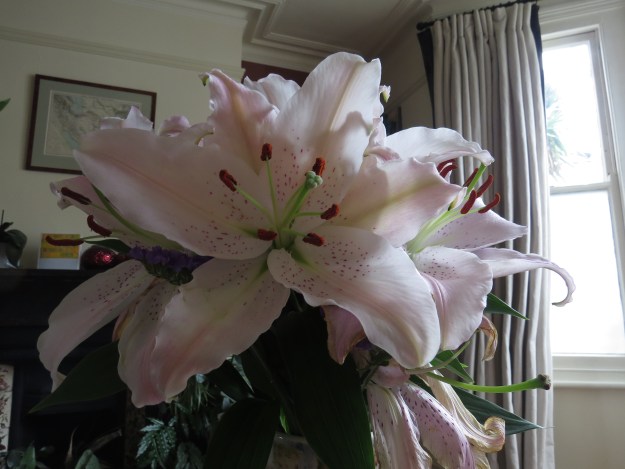
Dear Readers, there can be few flowers that are as spectacular as the Oriental  Lily, and I was gifted some last week when I retired from work. They are extraordinary blooms: some people think that they smell of plastic but these particular ones seem to have a deeply spicy scent, with more than a touch of cloves about them. Interestingly, when a lily that looked like the Stargazer but had no scent was developed, the breeder went out of business, so clearly those who like the scent are in the majority.

The pollen is poisonous to cats – if it gets onto the fur and the cat licks it off, it can cause kidney failure. Fortunately, my elderly cat can no longer be bothered to jump onto anything higher than the sofa, so I can enjoy my lilies without having to worry.

Willow the cat. 16 years old this year!

Stargazers are a specific form of the Oriental Lily – they appeared for the first time in 1974 by California breeder Leslie Woodriff. Woodriff wanted to create a flower that looked upwards, rather than drooping like so many lilies. The original Stargazer lily was mostly pink in colour, as in the photo below, but since then pure white and pink-tinged varieties have been bred. I rather like the delicacy of my pale pink flowers. Plus, do you think there’s the merest touch of ‘Little Shop of Horrors’ about the one below? It looks very slightly hairy to me, which is a little off-putting.

Original ‘Stargazer’ lily (Photo By Jim Evans – Own work, CC BY-SA 4.0, https://commons.wikimedia.org/w/index.php?curid=58312801)

Although they look so delicate and exotic, Stargazer lilies are reputed to be relatively easy to grow. Easy, that is, until this little chap comes along.

Scarlet lily beetle (Lilioceris lilii) Photo By Charles J. Sharp – Own work, CC BY-SA 3.0, https://commons.wikimedia.org/w/index.php?curid=28705466

I think that these are very attractive-looking beetles in their livery of red and black, and note the little indentations in their wing cases (elytra), as if someone has picked them over with a tiny sharp stick. Alas, their larvae eat the leaves of all lily and fritillary species, and they can make short work of your prize specimens. In Europe, the beetle larvae are preyed upon by a variety of parasitic wasps, which helps to keep things in some kind of balance. In North America, however (where they were imported in garden soil) there are no predators at all, and so they are more of a nuisance if you like growing lilies.

Incidentally, a distressed lily beetle can let out a loud squeak if it feels threatened by rubbing its legs together, which may be enough to deter an eager bird (or even an eager gardener). It can also play dead (known as ‘thanatosis’), which is a popular tactic in the invertebrate world.

Back to our lilies.

One thing that lilies illustrate rather beautifully is the way that plants reproduce.

  1. Stigma – this is the tip of the female part of the plant. This is often sticky, and this is the spot where the flower will receive pollen, either from a passing bee or other pollinator, or blown in the wind. Note that it’s held high above the pollen-producing organs – this lessens the chance that the plant will be self-pollinated. Some stigma are also able to reject pollen which is too closely related, or which is from the same plant.
  2. Style – this is the tube down which the pollen will pass in order to connect with the ovule, which is deep in the heart of the plant. Once there, germination will occur and a seed will be created.
  3. Anthers – these are the parts of the plant that produce pollen and, together with the filaments (4) which support them form the stamen, usually considered to be the male part of the plant. Lilies produce a lot of pollen, as anyone who has tried to wash it out of a white teeshirt will concur.
  4. Filament (see above).
  5. Tepal – in many plants, you get petals and sepals – the sepals are the green protective parts that surround the petals when they are developing in the bud, and which are found at the base of the flower once it opens. Lilies, however, don’t have any differentiation between the petal and sepal, so their petals are called tepals. Simples! And if you think there’s a poem in all this, you’re probably right.

In the Victorian Language of Flowers, lilies were said to represent love and affection for your loved ones, so I am especially touched to have received a whole bunch of them from my workmates. They are also associated with funerals (which may be another reason why they’re sometimes disliked), but as they are meant to show that the soul of the deceased has been returned to a state of innocence I think they are wholly appropriate.

And finally, as usual, a poem. There’s something about this short poem by Ben Jonson that I’ve always liked – each line a new image, and the whole thing so sensual and full of life. He might have been a man of the 16th and 17th centuries (1573 – 1637) but he knew how to live, did our Ben.

Have You Seen
but a Bright Lily Grow”

Ben Jonson

Have you seen but a bright lily grow
Before rude hands have touched it?
Have you marked but the fall of snow
Before the soil hath smutched it?
Have you felt the wool of beaver,
Or swan’s down ever?
Or have smelt o’ the bud o’ the brier,
Or the nard in the fire?
Or have tasted the bag of the bee?
O so white, O so soft, O so sweet is she!

Zugunruhe

Dear Readers, has anyone else noticed how the starlings seem very restless at the moment? Here in East Finchley they’re sitting on the chimney pots and aerials, singing and chattering and occasionally flying into the air, circling and settling back down. I noticed a similar thing last autumn, but hadn’t put two and two together.

I am wondering if these starlings are experiencing Zugunruhe, which roughly translates from the German as ‘migratory restlessness’. I’ve noticed the same in birds such as swallows and house martins, who seem to be almost crawling out of their skins in the days before they migrate, as if they don’t know what to do with themselves. The phenomenon was first observed when migratory birds were kept captive – it was found that they would not only orientate themselves in the direction in which they would normally fly, but that the length of the period of Zugunruhe would be related to the distance of the normal migration.

What’s interesting is that the majority of starlings in the UK no longer migrate (though they are joined in the winter by birds that migrate from northern Europe and return south in the spring). However, it’s been shown that even birds that are now resident seem to have some sort of ancestral memory of the days when they used to take flight in the autumn for a long trip south. Studies have shown that most birds have the potential for migration, which makes a lot of sense: if the food runs out in the area where you live and breed, you might need to move in order to raise your young successfully. Various bird species are changing from being migratory to being resident – some blackcaps, for example, now spend the winter in the UK, a result of milder winters and increased levels of garden feeding. Some birds are not migrating as far as they used to, because food is available closer to home (again, a result of fewer freezing winters). All in all, nature is in a constant state of flux, which is exacerbated by all the human-made changes that are going on. Just as well our feathered friends are as adaptable as they are.

Anyhow, the starlings have now wheeled away, probably to seek out some suet pellets or to sit in one of the plane trees on East Finchley High Street for a good old whistle and bicker. And I need to get stuck into my brand new Open University course (‘Environment: Sharing a Dynamic Planet’), which could not be more relevant. I shall keep you posted of how it’s all going!

Nature’s Calendar – Dew-drenched Cobwebs (13th – 17th September)

Spider’s web from December 22

Dear Readers, you might remember that I’m following along with the 72 microseasons in Nature’s Calendar, and I am already behind because the last day to look out for ‘dew-drenched cobwebs’ was actually yesterday. But! I have always loved spider’s webs, and in this chapter, Kiera Chapman introduces us to a number of new concepts and words that I thought I’d share with you all. You all know that I love a new word, and Chapman has a corker – ‘Biotremology’. This is the study of how animals use vibration in order to gather information about their worlds, and spiders are experts at this. Most spiders (with the exception of jumping spiders) have very poor eyesight, and so they rely on vibrations that they detect both directly and via their webs in order to know when prey has arrived, if a possible mate is in the vicinity and if an approaching wingbeat indicates an predator or a meal.

First up, Chapman explains that spiders have three anatomical features that help them to detect and act upon different kinds of vibration.

Firstly, spiders have lots of hairs that connect to nerves that detect touch directly – this is why they often have such hairy legs, but as humans we should recognise this phenomenon too – we can detect pressure which doesn’t actually touch our skin, but which comes into contact with a body hair.

Secondly, spiders have a special kind of hair called a trichobothrium (another great new word) which is very, very fine, and can detect air movement at a distance, so that an incoming fly is detected by ‘feeling’ the air movement generated by the buzzing of wings. I’ve watched spiders rush to cut a bumblebee free from their web, and also gallop along to wrap up a fly for later consumption, and I’m now thinking that the different kinds of vibration possibly inform the spider’s decision.

Thirdly, the spiders have holes in their skin called ‘slit sensilla’, and these are extremely sensitive, enabling the arachnid to sense vibrations along the silk strands of their webs (the slit sensilla are especially numerous in the legs of web-spinning spiders). This is useful for a variety of reasons – if a spider is hiding away in the corner of a window frame, it enables them to sense the arrival of dinner without being conspicuous. Furthermore, a male spider often plucks the web of a female like a guitar string at a particular speed and frequency so that she knows that he has amorous intentions and isn’t edible.

An autumn spider’s web

Tiny male spider (on the right) courting rather larger female spider (on the left)

So, the spider doesn’t just rely on its own body to sense the world around it – its web is an extension of its senses, enabling it to position itself in space and to know what’s happening even when it can’t see. They can be fooled though: if you are feeling particularly mean, you can take an electric toothbrush and gently touch it on a web. In some cases, the spider will rush out with a look of expectation on its face (well, not that they are very expressive but it’s how I would look if I was a spider and thought that my lunch had been delivered).

Incidentally, though spiders are extremely vibration-sensitive, they are not the most vibration-sensitive. That honour goes to the humble cockroach. But that’s a story for another time.

An autumn spider’s web

Post Retirement Day One!

Dear Readers, it felt very strange to wake up this morning and realise that I had actually managed to get everything done that I wanted to get done yesterday, but I didn’t have long to cogitate as we had an organised Geology walk in Coldfall Wood today. It was on the subject of geology, which for me is the unheralded crux of ecology – what underlies the soil determines so many things, from the soil organisms that will thrive to the plants that will grow, as anyone who has tried growing chalk-loving flowers in a London clay garden will tell you. The walk was led by Diana Clements, who is currently revising her book ‘Geology of London’, which is well worth a look for anyone even vaguely interested in the deep history of our area.

We looked at the main rock types in the area – London clay, Dollis Hill gravel and glacial till. Diana’s walk rather cleverly takes us through the three stages of the history of the wood as reflected in their geological history, and I for one will never look at the them in quite the same way again.

The rather unprepossessing bit of the stream above shows that the banks are London clay, and Diana had a box full of fossils found in clay, from North London molluscs, shark’s teeth, palm seeds and magnolia seeds. The clay was first laid down about 50 million years ago, when the climate was probably tropical (though the magnolia seeds may suggest at least some seasonality). Magnolias are ancient flowering plants that are pollinated by beetles, as there were no specialist pollinators about at the time.

Next it was off to the wet woodland for a look at the Dollis Hill gravel. The Thames used to run to the north of London, through the Vale of St Albans and then into the North Sea at Clacton, until it was diverted by the glaciers of the Ice Age. Some of its tributaries flowed through what’s now Coldfall Wood, depositing gravel as it went. You can find all sorts of interesting things in gravel, including quartz and the flinty Lower Greensand Chert.

The bed of the stream into the wetland area is full of gravel.

And finally, there’s the glacial till. One finger of the last glacier of the Ice Age (which retreated about 400,000 years ago) reached as far south as Coldfall Wood (and also Hornchurch in Essex for anyone who lives in those parts). As it retreated it ‘dropped’ all the rock fragments that it was carrying (to a depth of 14 metres in Finchley), and simultaneously excised deep gullies as the water in the ice sheet melted, while the surrounding soil rebounded after being compressed by the ice. No wonder the woods are so undulating, although they’re probably less so than they used to be, as the London Clay is a very soft material, easily eroded.

So, it was a fascinating walk, and I seem to have retained rather more of it than I thought I had at the time. I will certainly look at the woods in a new light!

And for those of you who read my piece on Crape Myrtle last week, I stopped to check out the bark on the tree and it is indeed both rather attractive and very smooth. What amused me no end is that having noticed one small tree, I completely failed to notice that there was another Crape Myrtle next to it. It just goes to show how distracted I’ve been, but no longer!

Crape Myrtle bark

Well That’s That

Daisy (PhotoElxanQəniyev, CC BY-SA 4.0 <https://creativecommons.org/licenses/by-sa/4.0>, via Wikimedia Commons)

Dear Readers, considering how long I’ve been banging on about retiring, the intensity of the emotion of the past few days has taken me by surprise. Although I am really ready for this next phase of my life, there is also loss, most especially of the many wonderful people that I’ve worked with. But then I remind myself that I have good friends from more or less every workplace that I’ve ever left, and that brightens me up no end.

During one of the farewells yesterday, someone reminded me of the poem below. We had an informal poetry club going on, and I shared this as one of my favourites. I was so moved when one of my colleagues showed me that she’d printed it out and sellotaped it to her wall. Isn’t sharing what’s important to us vital to friendship? And here it is. I actually think it’s Mary Oliver’s best, and it always reminds me of what, for me, it’s all about.

I, also, don’t want to be just a visitor to this world.

When death comes
like the hungry bear in autumn;
when death comes and takes all the bright coins from his purse

to buy me, and snaps the purse shut;
when death comes
like the measle-pox

when death comes
like an iceberg between the shoulder blades,

I want to step through the door full of curiosity, wondering:
what is it going to be like, that cottage of darkness?

And therefore I look upon everything
as a brotherhood and a sisterhood,
and I look upon time as no more than an idea,
and I consider eternity as another possibility,

and I think of each life as a flower, as common
as a field daisy, and as singular,

and each name a comfortable music in the mouth,
tending, as all music does, toward silence,

and each body a lion of courage, and something
precious to the earth.

When it’s over, I want to say all my life
I was a bride married to amazement.
I was the bridegroom, taking the world into my arms.

When it’s over, I don’t want to wonder
if I have made of my life something particular, and real.

I don’t want to find myself sighing and frightened,
or full of argument.

I don’t want to end up simply having visited this world

Mary Oliver
When Death Comes

A Visit to Mudchute City Farm

Dear Readers, Thursday was the day that I had my retirement celebrations at work, and what a delight it was. I worked on a City Farm in Dundee for a couple of years when I was straight out of university – it was a place of education for children, of work for the homeless people who used the adjoining day centre, and of solace for lots of people. There’s something about contact with animals, and with the soil, that is very healing, and going to Mudchute, which is on the Isle of Dogs opposite the towers of Canary Wharf felt like a way of coming full circle, from my first paid job to what is probably my last. I was very moved that the person who arranged it had gotten things so right.

Sheep at Mudchute City Farm

I know that you are not supposed to have favourites, and I loved all the animals that I worked with, from the cantankerous Anglo-Nubian goat who would butt every body out of the way when food was around to the over-sexed male lop rabbit who would attach himself to my wellington boot and hump away whenever I was trying to change his feed. But the pigs really won my heart. Intelligent and wily and full of character, I loved going to visit them. I was a very young person, and I was far away from home and sometimes very hung over in the early morning when I went to feed them. I would try to sneak into the farm without alerting them to my presence but the two sows that we had were often propped up on their stall wall, bawling their heads off as soon as they saw me.

On one occasion, the pigs managed to get through the two locks on their sty and to nudge the bolt on the main gate open. They then managed to make their way to the bus station, where they wreaked havoc with the buses and the passengers.. Eventually I managed to lure them home with a bucket full of chicken legs (their favourite food). Once back in their sty, I fixed an additional lock. They looked at me with an unimpressed expression. The next day, they were still in their sty but the door was open, as if to say ‘look, we can still get out if we choose to’.

The winters in Dundee are freezing, and there were never enough places in the night shelter for the men who wanted to stay there. On one occasion, I came in in the morning to find the two sows exiting their sty for their breakfast along with the notorious Dyke Leslie, something of a local homeless character. He modelled himself on The Outlaw Josie Wales from the Clint Eastwood films, and was once reputed to have stuffed a dead seagull through the letterbox of a girlfriend who’d jilted him. Anyhow, Dyke had apparently had a warm and peaceful night cuddled up with the pigs. What they thought of it wasn’t clear.

Anyhow, I loved seeing the pigs today. It was an emotional day and I feel completely drained, but also content. It was lovely to feel so appreciated, and to have time to tell the people that I’ve worked with how very much I appreciated them. It felt like a fitting finale. I couldn’t be more grateful.

Giant Tamworth Ginger Pig!

Can You Guess?

Dear Readers, can you believe that in two days time I’ll be retired? And the lovely folks at work have planned an exciting lunchtime ‘do’ for me, at a most unlikely (but somehow completely appropriate) place on Thursday (or ‘today’ as it will be then this is posted.  I shall say no more, as I am up to my armpits in accruals and interim reports and overheads and all manner of other lovely things, but I shall report back soon.

And now, it’s back to the laptop. Wish me luck! If I get through the day without drowning everybody in tears I’ll be doing ok.

Wednesday Weed – Crape Myrtle

Crape Myrtle (Lagerstroemia indica)

Dear Readers, the Crape (or Crepe or Crêpe) Myrtle is originally from India, China and other areas of eastern Asia, though I think of it as being a tree that is synonymous with the southern states of the USA. I was in Washington DC a few years ago, and between the singing of the cicadas and the flowers on the Crape Myrtles it felt very sultry. All I needed was a mint julep and I’d have been in my element.

In China, the tree is known as Pai Jih Hung, which apparently means ‘100 days of red’, after the plant’s long flowering time and red flowers (the pink, mauve and white varieties are cultivars). It was also known as the ‘monkey tree’ because the bark is smooth and difficult to climb. So I suppose it should be called the ‘no monkey tree’. Or possibly the ‘monkey puzzle tree’, except that we already have one of those.

But what is this tree doing in East Finchley, parked at the end of Huntingdon Road in the County Roads and blooming away to its heart’s content? A while back I mentioned that the council was getting much more ambitious with its street trees, and Crape Myrtle was one of the trees mentioned. It really is spectacular, and most unexpected. In his book ‘London’s Street Trees’, Paul Wood mentions that in previous years the tree was considered only half-hardy in London’s winters, but as climate change kicks in, it seems to be thriving. Crape Myrtle doesn’t flower every year, so when it does it’s a real treat.

The fact that the tree doesn’t flower annually has led to some brutal pruning practices (actually known as ‘crape murder’) particularly in the US. All the outer branches are cut off in the autumn, leaving just a stump. In fact, the tree will flower whenever conditions are right and it has the resources to do so, and pruning that hard leads to soft growth, which can attract aphids and mildew, and suckering from the bottom. Be kind to your Crape Myrtle, people! It will flower when it feels like it!

Crape Myrtle is a member of the Lythraceae family, which also includes purple loosestrife of all things. Who knew? I guess they’re both pink (though bear in mind that Crape Myrtle comes in a variety of colours, including bright red.

As far as pollinators go, Crape Myrtle doesn’t have a lot of nectar but it is said to have two types of pollen – the usual stuff, which is full of protein, and ‘false’ pollen, which is generated specifically to attract pollinators. As it blooms in September/October in the UK, it could potentially be a good source of late pollen for any bees who are still active. I shall keep an eye on the one on our street to see if anyone is popping in for a bite.

What I’ve found interesting from reading some of the legends about Crape Myrtle is how, all of a sudden, it’s associated with Aphrodite. What? This is a plant originating in eastern Asia and then heading to the US without so much as a stopover in Europe. What’s happened (I think) is that people are getting confused with a European plant that is interwoven with myth called Myrtle. This is a completely different plant, associated with love and marriage and all those other pleasant things. It is not, however, a Crape Myrtle, so enough already. This is where (Pedant alert) those so-called  boring, elitist Latin names come in so handy when we are trying to identify something precisely.

Common Myrtle (Myrtus communis) Photo By LIGURIAN VASCULAR FLORA – https://www.flickr.com/photos/196946800@N04/52505075873/, CC BY 2.0, https://commons.wikimedia.org/w/index.php?curid=125783445

Back to Crape Myrtle. This really is an excellent tree for a small garden if you want something that has more than one season of interest (though for wildlife value I think there are better choices) – the bark of the tree is apparently very smooth (as mentioned above), and I must go and inspect the East Finchley tree to see what it looks like. The author of the photo below says that you have to actually stroke the tree to appreciate the smoothness (from the Wild in Japan blog, which is a very good read). In the photo below it looks rather like a more-refined London Plane, which is anything but smooth, as we know.

Crape myrtle bark – ‘as smooth as a baby’s bottom’ (Photo from https://wildinjapan.wordpress.com/2013/11/13/even-monkeys-fall-from-trees/)

And then there’s the autumn foliage colour, something else for me to look out for later in the year.

Crape Myrtle leaves in autumn (Photo Famartin, CC BY-SA 4.0 <https://creativecommons.org/licenses/by-sa/4.0>, via Wikimedia Commons)

Medicinally, Crape Myrtle is one of those trees that is literally meant to cure everything from diabetes to cancer. stroke to heart attack. A more reasonable assessment is given over on the Plants for a Future website, where it seems to be more use as a ‘drastic purgative’ (yikes!), as a paste for the treatment of wounds, and as a treatment for colds (if you use a decoction of the flowers). As usual, Bug Woman advises extreme caution.

And finally, here’s a poem by Evie Shockley, a black woman who grew in in the Deep South of the US. Here’s what she says about being ‘a southern poet’ –

I grew up: hearing certain accents and vocabularies and speech patterns that were the aural essence of ‘home’ or the audible signal of danger, depending; thinking that racism wasn’t much of a problem in other parts of the country; eating a cuisine that was originally developed under conditions of make-do and make-last; enjoying five- or six-month summers and getting ‘snow days’ out of school when the forecast called for nothing other than ‘possible icy conditions’; knowing that my region was considered laughable almost everywhere else; assuming there was nothing unusual about finding churches on two out of every four corners; and believing that any six or seven people with vocal chords could produce four-part harmony at the drop of a dime—and that all of this informs my poetry, sometimes directly and sometimes in ways that might be unpredictable or illegible.”

I love this, and I love this poem. See what you think.

where you are planted

he’s as high as a georgia pine, my father’d say, half laughing. southern trees
as measure, metaphor. highways lined with kudzu-covered southern trees.
fuchsia, lavender, white, light pink, purple : crape myrtle bouquets burst
open on sturdy branches of skin-smooth bark : my favorite southern trees.
one hundred degrees in the shade : we settle into still pools of humidity, moss-
dark, beneath live oaks. southern heat makes us grateful for southern trees.
the maples in our front yard flew in spring on helicopter wings. in fall, we
splashed in colored leaves, but never sought sap from these southern trees.
frankly, my dear, that’s a magnolia, i tell her, fingering the deep green, nearly
plastic leaves, amazed how little a northern girl knows about southern trees.
i’ve never forgotten the charred bitter fruit of holiday’s poplars, nor will i :
it’s part of what makes me evie :  i grew up in the shadow of southern trees.