The Often-Ignored Hoverfly

Dear Readers, when we think about pollinating insects we often fixate on bees and butterflies, without thinking about the many other pollinator groups, from beetles to wasps to flies in general. But one group that always fascinates me are the hoverflies, with their wide range of sizes and patterns. Some are wasp mimics, like this species (Syrphus sp. I think but happy to be corrected), and very convincing they can be too – this one even moves its abdomen in a particularly waspish way. I love watching the way that they clean themselves by rubbing their ‘feet’ together.

This individual is a female – you can tell because there is a broad band between the eyes, whereas in males the eyes are very close together. The larvae feed on aphids, and the adults can often be seen feeding on honeydew (as here) or on broad, open flowerheads (my hemp agrimony is a great favourite with many species of hoverflies).

In some Syrphus species, the males have hairy eyeballs, which is quite something, though you’d have to get up close and personal to spot them. I have absolutely no idea why.

Now, this particular genus of hoverflies is obviously mimicking a wasp, and doing it with a fair degree of accuracy. I wonder if anyone else has noticed real wasps chasing other insects this year? I watched one wasp harassing a gatekeeper butterfly for over five minutes this morning, following it from flower to flower with definite predatory intent. Many wasps’ nests will be at their maximum size by now, with lots of mouths to feed, and so the workers will be keen to get their jaws around any protein that they can find. If there are not many caterpillars about they will certainly turn their attentions to other kinds of invertebrates, or even human food – I remember one returning again and again to the remains of a salmon sandwich, slicing off tiny slivers of fish and flying back and forth to the nest.

Soon, of course, the nests will break up and the wasps will only have to feed themselves – their preferred food at this stage is nectar, so you’ll often see them on windfall apples or ivy flowers in the autumn. It’s hard to begrudge them something sweet at the end of their lives. May we all be so lucky.

Wasp on ivy flower


Red Admiral Resurgence – The Importance of Citizen Science

Dear Readers, although it’s been a cool and wet couple of weeks, I have been enjoying watching the butterflies on the buddleia outside my office window. My perception was that there has been a huge uptick in the insects this year – as I’ve mentioned, at one point there were no less than six Red Admirals on the plant at the same time. Even as I look out of the window on this wet and windy afternoon, there is a Red Admiral perched on the flowers, hanging on as the whole bush shifts through about 120 degrees backwards and forwards. But individual anecdotal information, though it tells an interesting story, is not as solid as data collected by a whole range of people, and the information coming through from Butterfly Conservation Trust’s Big Butterfly Count (which ends on Sunday 6th August) is utterly compelling. So far, over 170,000 sightings of Red Admirals have been recorded, a 400 percent increase on last year. So, what is going on?

SomeĀ  Red Admirals have always overwintered in the UKĀ  – you will get occasional reports of people finding the insects in their sheds or lofts, and you can see Red Admirals feeding on mild days throughout the winter. However, the historically the vast majority of the butterflies have been migrants – Red Admirals used to spend the winter in the milder parts of southern Europe every year and then, when their foodplants dry up in the spring(their eggs are laid on the stinging nettles upon which the caterpillars feed) they start to move north, reproducing as they go. Peak numbers arrive between July and September.

In August/September, the adults start to head southwards back towards mainland Europe, feeding on ivy, windfall apples and damaged soft fruit and sap. I am tempted to try my ‘rotten banana’ experiment again this year – just as in tropical butterfly houses, UK butterflies (especially those fattening up for a migration) are sometimes glad of some easily digestible sugar. By the time they start their journey home, female Red Admirals in particular are full of fats, for good reason – they are already carrying next year’s unfertilised eggs, and when they reach southern Europe again they will look for a mate, so that the whole cycle can begin again.

Why, though, are there such huge numbers this year? One explanation is that, with the milder winters due to climate change, more Red Admirals are staying put, especially in the warmer south of the UK, and the chances are that more of them are surviving. Red Admirals seen early in the year are likely to be ‘homegrown’, either because they’ve over wintered as adults or hatched from eggs laid much earlier in the year. Numbers are then swollen by migrants from Europe, and my (untested) hypothesis is that, with the very high temperatures and fires right across southern Europe and North Africa, the butterflies are being driven north because their larval foodplants are either dry or burnt. I have a suspicion that more insect species, previously confined to mainland Europe, will arrive on our shores over the next few years/decades, and creatures previously confined to the south of England will be able to make their homes further and further north. What will happen to cold-climate and high altitude specialists remains to be seen, as they run out of places to live as the temperature rises. All I do know is that the situation will be complicated and difficult to predict.

I will be fascinated to see the final results of the Big Butterfly Count. I am sure there will be more surprises. Personally, I have seen far fewer Comma butterflies this year, and very few Small Tortoiseshells, though I am pleased to have seen plenty of Peacocks and a few Painted Ladies. Let me know if you’ve noticed anything unusual, or if you’re also seeing a lot of Red Admirals. It’s interesting to see what’s going on around the country, for sure.

Peacock butterfly

Tree Pits and Bees – A Quick Walk Around the County Roads

Dear Readers, the denizens of East Finchley have become very adventurous with their tree pits just lately. At first glance, the one above seems to be mainly home to some Mexican Fleabane, but a closer look shows us some tomatoes and some very fine courgettes, with the flowers looking just ready to open.

I must admit that with all the dogs about I might be a little nervous about eating them, but I am still very impressed that someone is managing to grow not only plants but actual food in an area less than a metre square.

Just up the road is another tree pit, this time showing some opium poppies on one side….

…and what I’m fairly convinced is some redshank on the other (this is a form of bistort or Persicaria – it’s in the same family as Japanese knotweed, but is a very inoffensive little plant with none of the bad manners of its relative)

Another tree pit has been lovingly planted up with some begonias – not great for pollinators but very pretty nonetheless.

And sometimes things just plant themselves. In this tree pit we have some great willowherb on one side, and one of the smaller willowherbs (probably square-stalked willowherb) on the other.

Great willowherb

Square-stalked willowherb (probably)

But then I have to stop and admire this fantastic stand of lavender, still going strong a good month after mine (on the south-facing side of the street) has gone over. There are a dozen bumblebees on it, and many of them are queens. The one below looks most likely to be buff-tailed bumblebee queen, even though her ‘tail’ looks pretty white – the colour is a bit richer than I’d expect on a white-tailed bumblebee queen, but there is a lot of variability within both species.

No doubt about this one though: this is a red-tailed bumblebee (Bombus lapidarius) queen. She was much larger than I’d have expected the very similar red-shanked carder bee (Bombus ruderarius) to be. It’s lovely to see so many harbingers of next year’s bumblebee colonies already on the wing – although it’s only August many of this year’s colonies have already broken up, and the new queens are feeding up to put on weight for their hibernation.

And finally, as I was about to walk back through the front door I was interrupted by an enormous emperor dragonfly, easily the size of my finger. I didn’t manage to capture it on camera, as it was zooming about, possibly trying to hunt the butterflies and bees on my buddleia. I have been visited by one before, though, and you can read all about it here. To see a creature like this really is an event worth celebrating.

Female Emperor dragonfly (Anax imperator)

Lucky

Gatekeeper (Pyronia tithonus)

Dear Readers, here I am, back in East Finchley after a visit to University College Hospital to check out my thyroid again. Regular readers will remember that I’ve been for a raft of tests on various things that were kicked off back in March when I was referred for a CT scan following a persistent cough. It found all kinds of things, including a congenital heart defect, but I have been waiting for a second ultrasound and possible biopsy on my poor old thyroid gland, which apparently has many nodules. Who knew that you could even get nodules in your thyroid? This health stuff is an education for sure.

There is nothing more humbling than waiting for tests in an NHS hospital. I was seated next to an elderly lady who had been referred for an emergency biopsy today. She was with her daughter, who had an appointment elsewhere in the hospital coming up, and was therefore very anxious about the timing of the procedure, as she wanted to be there with her Mum. The older lady was very relaxed about the whole thing, though, as people often are when they’ve spent a lot of time in the medical system and have pretty much seen it all. She was doing a word search puzzle, while her daughter was getting more and more anxious.

Just up the way were three generations of a family – a toddler, a young mother, and her mother. It was the young mother who was going in for an ultrasound scan. There was a brief flurry of excitement when her first name was called, but it turned out there there was more than one person with the same name, so we all settled down again. There were not quite enough seats so we were all swapping around and I was checking how long I could squat for (answer, not as long as I used to be able to). The baby was charming everyone who looked at him, beaming and grinning as if each new person was the most wonderful thing that he’d ever seen. Then the young mother was finally called, so gran looked after the baby. When the young mum came out, she was crying. As they walked to the lift, all I could here was the anxiety in gran’s voice as she tried to find out what had happened. Then the lift doors shut, and that little family and that story were gone, and none of us will ever know the end of it.

We all looked at one another, and then I was called. The doctor performing the ultrasound was brisk but efficient, and with the waiting room full of anxious people I could see that he wanted to get through as quickly as possible.

Five minutes later he pronounced my nodules benign, a biopsy not necessary, and no need for any further investigations. As I was wiping ultrasound lubricant off my neck, I ventured that it must be good to be able to give a bit of good news.

” We are the centre of human misery here”, he said. I wondered if he was thinking about the young woman who’d been in before me. What a toll it must take, being the bearer of bad news over and over again.

As I walked back, I gave the thumbs up to the elderly lady and her daughter as they stood up to go through for the biopsy.

“Good luck”, I said, and the elderly lady gave me a thumbs up back. It’s extraordinary to me how quickly camaraderie grows in these waiting rooms and queues and wards. We seem to become humbler,gentler, kinder versions of ourselves when we’re exposed to our own mortality and that of others. And after all, today I was lucky, and I am grateful to be able to wander into the garden and admire the butterflies, butĀ  each of us is only a diagnosis away from something that changes our lives utterly. How precious it makes this sunny summer evening as the soft light makes the red brick of the houses opposite glow, and the bees browse drowsily on the buddleia below my office window.

Wainwright Prize – Two Down, Ten to Go

Dear Readers, you might remember that I was celebrating the release of the James Cropper Wainwright Prize longlist a few weeks ago (and lamenting that the shortlist follows on so quickly (on 10th August). Well, I have made a start, and have really enjoyed the two books that I have managed to get under my belt so far. When the shortlist is published I will probably try to get through that, and then return to the rest of the longlist. In the past, some of my favourites haven’t made the final six, so there will be no hardship in that!

First up was ‘A Line in the World – A Year on the North Sea Coast’ by Dorthe Nors, translated by Caroline Waight. I can’t remember a translated book ever being shortlisted before, and I am a great fan of the Pushkin Press, who publish a lot of works in translation. This book introduced me to a part of the world that I don’t know at all – the rugged western coast of Denmark and Germany, down into the Netherlands. This is where Nors grew up, and there is such a strong sense of place. Here Dors discusses the beach at VedersĆø dune:

”Ā It was there, one day when I was eleven, that I was nearly dragged out to sea by a wave. I was holding my mother’s hand: it was August. In those days I wasn’t familiar with the currents, and I didn’t appreciate their strength. But as we walked along the beach, letting the waves splash around our ankles, one of them dragged me out. My mother grabbed my leg and we both skidded on the shingle until it let us go. Afterwards we sat and cried a bit. Grazes on our legs, blood. My mother was clutching my hand and wouldn’t let it go. Since then I’ve called them Valkyrie waves, the kind that rove in from the North Sea in long elegant swells on otherwise mild days. They’ll take you to sea if they can. I’m afraid of them, and everytime I see them I remember love”.

She also gives a strong sense of what it’s like living in one of the small farming and fishing communities that pepper the coastline. After a wolf wanders into the area from Germany, the local people are terrified of it, and when Nors is interviewed on Danish radio and says that you’re more likely to be mown down by a tractor than eaten by a wolf, she becomes persona non grata overnight:

And then I disappeared. So did the man who was painting my woodshed. The woman at the end of the sunken lane didn’t give me any biscuits for Christmas. People stopped saying hello when they passed in their cars. I asked a nice old lady nearby how long I would be invisible before my sentence was served. I said it as a joke, but she answered, ‘A year and a half.’

She is a very close observer of nature. I loved this:

Some birds use their sense of smell to navigate and I have seen the waders’ long bills, the way they bend, double over, and operate in sandy beds like sewing needles.”

I can give this book no higher praise than to say that it not only made me think, about memory and place and how the two are intertwined, but it made me ache to go to those grey, windswept shores, to gaze out to sea and see what happened (hopefully without being grabbed by Valkyrie waves).

And then, howabout ‘The Swimmer – The Wild Life of Roger Deakin’ by Patrick Barkham? Certainly if you think all there is to Roger Deakin was ‘Waterlog’ and ‘Wildwood’, you’re in for a surprise, as I was. Deakin was an endlessly energetic man, full of ideas and schemes and plans. He worked for several advertising campaigns, and came up with the slogan ‘Come home to a real fire’. He was an eccentric but much-loved teacher of English in Diss in Norfolk, where his corduroy trousers and Byronesque curls were the talk of the school. He completely renovated Walnut Tree Farm, and he fought a long and ferocious battle to save the hedgerow at the back of his property. He was heavily involved in the ‘Save the Whale’ campaigns, made a number of documentaries, fell in and out of love repeatedly, and packed more into his short life than most of us will if we live to be a hundred (Deakin died of a brain tumour aged 63).

The biography is largely written in Deakin’s own words, and the words of his friends and family – Barkham has worked very hard to let Deakin and the people who knew him tell their story. This results in some very interesting juxtapositions, especially with regard to Deakin’s love life – sometimes he and his lovers have extremely different opinions about what was going on. Deakin sounds like a man who could be difficult: selfish, single-minded and determined to get his own way. And yet, what comes across most is a sense of how much he was loved, and there could be no greater tribute. I found Barkham’s account completely compelling, and although I knew how it would end I confess to still being greatly moved at the last chapter, telling of Deakin’s death and memorial.

Two very different books, but both highly recommended.

Next up: ‘The Flow – Rivers, Water and Wildness’ by Amy-Jane Beer, followed by ‘Why Women Grow’ by Alice Vincent. One on rivers, one on gardens – let’s see how we get on!

Choughed!

Alpine Chough in Switzerland – PhotoBy Jim Higham from UK – Alpine Chough, Schilthorn, Switzerland, CC BY 2.0, https://commons.wikimedia.org/w/index.php?curid=11377415

Dear Readers, anyone who has ever seen a flock of Alpine choughs ( Pyrrhocorax graculus) inĀ the mountains of Austria or Switzerland will know what social, excitable, energetic birds they are. I’ve loved watching them playing in the wind (and ‘playing’ is the only possible word, as they tumble and dive, seemingly for the sheer hell of it). You can get the idea from the recording below by Stanislas Wroza, taped in the French Alps.

And how about this thoroughly dizzying short film of them flying?

https://www.youtube.com/watch?v=zOC-_z2Hppg

Choughs are members of the crow family, with all the intelligence that that usually indicates, but there are only two species in the genus. While we are not quite mountainous enough for Alpine choughs, we do have a few small populations of the Red-billed chough (Pyrrhocorax pyrrhocorax) –Ā there are some on the Isle of Man, some in North Wales and some in Cornwall, plus some on the west coast of Scotland, largely living in the rockiest possible places. In total there are probably about 400 breeding pairs, making them the rarest UK crows. Some populations, like the Cornish choughs, are probably now becoming genetically inviable, with not enough variation to support the birds going forward.

Red-billed Chough (Photo By Ken Billington – Own work, CC BY-SA 3.0, https://commons.wikimedia.org/w/index.php?curid=12342398)

Enter the Kent Wildlife Trust and the Wildwood Project, where the aim is to reintroduce Red-billed Choughs to the south of England, where the habitat is suitable but the birds haven’t been seen for over 200 years. Young birds from other parts of the chough’s range have been creche-reared, a special type of rearing which involves feeding the birds as a group so that they get to rely on one other rather than imprinting on the humans. The aim is to release up to 50 birds over the next five years, with the hope of establishing a breeding population which will eventually move west and bring some genetic diversity to the Cornish group. It would be wonderful to see these birds performing their acrobatics over more of the country, and it always gives me hope that people are prepared to spend so much time and effort to try to improve our nature-deprived land. Good luck to the choughs! You can read about them here and to learn more about the science, and about how the scientists are hoping to keep an eye on the choughs once they’re free, have a look at the film here.

Summer Sciencing! – Investigation One – The Microbiology of Water

Scanning electron micrograph of Escherichia coli

Dear Readers, I might have mentioned that I was pining for some science, so I’ve signed up for the Open University Summer Science School. My first investigation is, very topically, into water quality, and possible faecal contamination of some imaginary water sources.

Humans and many animals normally live happily with Escherichia coli in their intestines, where it causes no problems at all. However, there are some forms of E.coli which cause disease, and amongst the worst are the enterohaemorrhagic bacteria, which include a nasty bug called E.coli 0157. Not only does this cause the usual bloody diarrhoea and cramps but, in the worst cases, it can damage the blood vessels in the kidneys, leading to kidney failure and even death. My mission on this occasion is to look at water samples from three different areas – two wells and a bathing area – from an imaginary town where people are showing symptoms of E.coli-induced diarrhoea, and first of all to see if there’s been a deterioration in water quality using a technique called the Aerobic Colony Count (ACC).

Lots of different kinds of organisms can live in water, but most of them are rendered harmless in the Global North by chlorination or UV light treatment of the water we drink (clearly not the water that we might swim or paddle in however, as recent sewage releases into rivers and the sea have shown). However, not everyone is so lucky, and so the water that they drink can contain all sorts of organisms. Some of them, known as environmental organisms, live naturally in water, and so while no one wants to drink microorganisms they are usually harmless (and often can’t survive at the temperatures in the human body). Others, such as E.coli 0157, are pathogens, which can survive in the water but really take off when they reach the perfect environment of the human gut.

The Aerobic Colony Count takes a sample of water, and incubates it at two different temperatures – 22 degrees Centigrade and 37 degrees Centigrade. At 22 degrees, any environmental organisms are likely to multiply, at 37 degrees we should see an increase in pathogens if any are present. An increase in environmental organisms indicates a general decrease in water quality, but an increase in pathogens indicates potential faecal contamination.

So, all of this sciencing takes place in an online laboratory (so there’s no danger of me contaminating half of East Finchley with an accidental sample spillage) but all the same I am channellingĀ  my inner Public Health professional and am thoroughly enjoying all this messing about with (virtual) test tubes and petri dishes. Once I’ve taken samples from the wells and the bathing area, it will be interesting to see if there’s a clear indication of where the contamination is coming from. Once we know, I can use some other techniques to try to identify which organisms are involved, and in particular if the dreaded E.coli 0157 is implicated.

Now, where’s me white coat?


The Much-Travelled Painted Lady

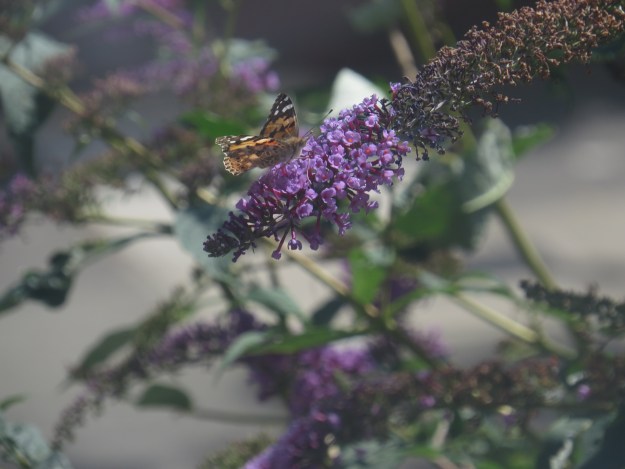
Dear Readers, I am finding the buddleia outside my office window very distracting, with its red admirals and peacock butterflies and even the hummingbird hawk moths, but today was my first painted lady (Vanessa cardui). Every year I become excited at the prospect of a ‘fall’ of this species – it’s migratory, and its numbers in the UK depend largely on conditions thousands of miles away. The ones in England generally arrive over the Atlas mountains in Morocco, driven ever onwards by the need for food: it’s thought that when the population density reaches a certain level in an area, the adults move on to pastures new, being driven as far north as Orkney and Shetland. This is also the only species of butterfly ever to have been found in Iceland. However, some butterflies make an even longer journey: some butterflies were recently found to have originated in Central Africa, which seems to indicate that the painted lady can make an annual round trip of about 12,000 km.

However, it’s important to note that no individual butterfly makes this whole trip: the butterflies will lay their eggs en route, and the life cycle is a short one, with the process of turning from an egg to an adult taking as little as three weeks depending on temperature and food availability. The caterpillars are fond of thistles, burdock, stinging nettles and viper’s bugloss, and will make a little ‘tent’ out of the leaves to protect themselves. The fully-grown caterpillars are black and spikey, like those of their close relatives the red admiral and the peacock. Sadly, the painted lady cannot survive the winters in the UK and further north in any form, so it’s all a matter of timing.

Painted lady caterpillar (Photo Harald Süpfle, CC BY-SA 3.0 <https://creativecommons.org/licenses/by-sa/3.0&gt;, via Wikimedia Commons)

I remember the great ‘fall’ of painted ladies in 2009 – I was still living in Islingon, but was treasurer for our local community garden, Culpeper Gardens. I popped over, as I did every day, and every single flower and wall seemed to be hosting an painted lady. I had never seen such a concentration of insects of one species in one place, and it felt like one of those miracles that we are blessed with a few times in a lifetime. Often these occurrences are correlated with El NiƱo years, maybe because the heat dries up the nectar sources in Southern Europe and North Africa, and so the butterflies have to move on, crossing the Mediterranean and the English Channel and flying over the cliffs of Southern England until eventually they end up on some end-of-season buddleia in a North London front garden. Growing a few plants for these wanderers to feed on feels like such a small thing, and it’s so rewarding.

For a very long time, no one could work out whether painted ladies made the journey back south – everyone figured that they probably did (otherwise where would new adults come from every summer?) but we didn’t have the technology to spot them. But in the early 2000s scientist Jason Chapman used a kind of vertical radar to ‘watch the skies’. During the autumn of 2009, Chapman managed to identify the southwards migration of the species at between 200 and 600 metres, using a tailwind to fly at an average speed of 45 km/h. It’s thought that, unlike on the northerly migration where successive generations are involved, on the flight south it’s likely to be done by individual butterflies, meaning that an adult hatched in Scotland could end up migrating some 5000 km south to its final breeding grounds in sub-Saharan Africa. Whoever thought that butterflies were fragile had clearly not met this species. In Martin Warren’s wonderful book ‘Butterflies’, he calls the migration of the painted lady “one of the most outstanding phenomena of the butterfly world…..eclipsing even the famous migration of the Monarch butterfly in North America’.Ā 

But how does a newly-emerged painted lady know whether to head further north in search of food, or to hurry south to escape the approaching winter? It’s thought that, even in the chrysalis, the butterfly can detect daylength, which will trigger the general direction in which it flies. Once airborne, the insect can use the time of day and the position of the sun to orientate itself – it uses its antennae to detect daylight, and its eyes to find the sun. On cloudy days, it can use polarised light to detect where the sun is, and they also have a magnetic compass. In order to survive the trip, Monarch butterflies increase in size and fat storage, and a hormone delays the development of eggs, which increases the butterfly’s lifespan, and this may also be the case for Painted Ladies.

Sadly, these finely-tuned creatures with their complicated life cycles are often used at weddings, and released as ‘live confetti’. Ā As you might guess, the idea of releasing live creatures, possibly into an unsuitable environment following a wedding, appals me just about as much as the recent fashion for dyeing doves in different colours and then releasing them for gender-reveals and weddings. Have a bit of respect, people! Animals are not toys.

The caterpillars can also be bought to be reared so that children can understand their life cycles. As far as this goes, wouldn’t it be better to grow caterpillar food plants in the garden, and encourage children to watch them in their natural state? There are plenty of wonders out there, we just have to look for them. Admittedly I’ve sometimes ‘rescued’ caterpillars from areas where they looked to be running out of food or in danger of being strimmed, and it’s fascinating to see them change over time, but I think that’s different from buying in caterpillars for the purpose. Or maybe I’m being unfair. In a way, anything that encourages children to take an interest in the natural world is great, but I think we need to move away from seeing it as a commodity that we can buy, and move towards seeing it as part of our environment, and something that needs to be cherished in situ. What do you think, Readers?

A Walk of Small Pleasures

St Pancras and Islington Cemetery

Dear Readers, I haven’t been to St Pancras and Islington Cemetery for months – we went every Saturday during the two years of lockdown, but since then the pace of life has picked up and we seem to be doing so much ‘stuff’ that the simpler pleasures have been squeezed out. But today we returned, and nature has been just doing her ‘stuff’ the whole time.

The dandelions have gone, but the catsears and nipplewort are still in full flower.

I love the way that the leaves of the nipplewort are going purple from the tip, as if gently dipped in ink.

I love this very characterful small tree – I suspect that it’s dead, but with the sun behind it it looked rather like a cartoon character with a particularly hairy wig.

In the woodland graveyard area the ragwort is still in full flower too – I went looking for cinnabar moth caterpillars but couldn’t find any. Still, this plant is extremely popular with all sorts of pollinators. In the countryside it’s reviled for poisoning horses and cattle, but this is really only a problem if it gets mixed up with other hay plants. No chance of poisoning any livestock here.

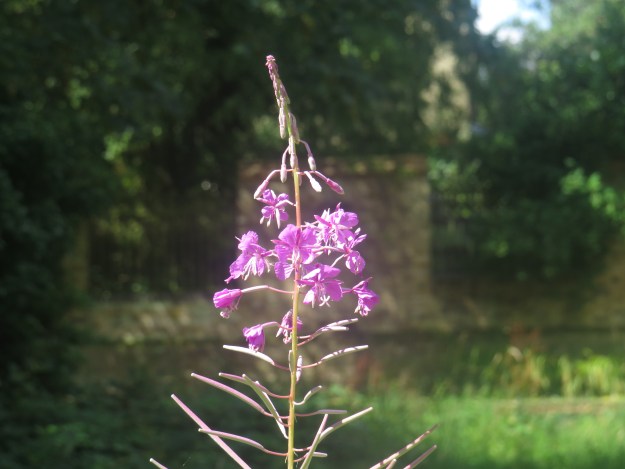
And the rosebay willowherb is coming into flower – always worth a look in case there are any hawk moth caterpillars. In fact, it’s always worth a look anyway.

I said hello to the swamp cypress, my favourite tree. Soon she’ll be turning the colour of rust before she sheds her leaves (an unusual case of a conifer that’s deciduous).

I stopped to admire the flowers on the burr, another popular plant with pollinators (there’s a common carder bumblebee on this one).

And then we had a walk around the new area close to the rear of the cemetery, where a meadow has been cut and re-turfed, and a tarmac path popped in. Just look at the cracks that are appearing already! Nature will have its way, for sure. It’s just a shame that the central area of this path is so bland compared to what was there before. I imagine that some new graves will be going in soon.

But there’s still a wild area at the back of the site, where some teasel is attracting the bumblebees.

I have a friend who has lovingly grown 200 teasel seedlings. She wasn’t impressed when I told her that my crop of teasels has grown from a single teasel that I planted two years ago. Once you have one of these pollinator-friendly plants, you’ll have them forever :-). The only good thing is that the seedlings are relatively easy to identify and remove if surplus to requirements.

An abundance of teasel in the back garden

At the back end of the cemetery path, the brambles are extending their eager fingers across the tarmac. I noticed that in some places the blackberries are already ripe, which is good news for foragers of all species.

And look at the thistledown – it always astonishes me how much can be packed into a single seedhead. No wonder creeping thistle is such a successful plant.

And it’s been a good year for the ash trees too, which is good to see in the light of ash dieback. How many of these ‘keys’ will make it to adulthood is anyone’s guess.

Late July/August is a time for a pause: the birds are moulting, many plants have already flowered, and the heavy labour of spring and early summer is done. It’s time for many creatures to have a rest, and I know how they feel – at work so many people are on holiday and there’s a sense of pause and taking stock. Let’s enjoy this time if we’re able to, before the world turns again towards the work of autumn, with its new academic term and general increase in pace. And let’s take pleasure in the small things. There are plenty around if we give ourselves time to look.

Old Bugwoman’s Almanac – August Updated

Common toadflax

Dear Readers, how did we end up in August already?Ā This can feel like the tipping point of the year – some plants are still in flower, while berries are already appearing on many more. The birds will mostly have done their breeding for the year, and the garden may seem strangely silent. There should still be lots of insects about though, and maybe even the first orb spider webs – the spiders have been in the garden for ages, but this is the first time that they’ve grown big enough to be noticed. Let’s see what else is in store for us….

Things to Do

  • As we get into the second half of 2023, a lot of organisations haven’t yet posted any events. However, I did discover that the Royal Parks have a selection of self-guided walks for you to download – some, such as ‘Music for Trees’ (which has pieces of music to be listened to under particular trees) have an app to download, while others, such as the ‘More Than Bugs’ trail and the St James’s Park Tree Walk have maps for you to follow. Just the thing if it isn’t too hot.
  • The London Natural History Society has a number of very interesting walks in August and you can see the whole programme here. Two particularly caught my eye – the first, ‘Looking at trees around St Paul’s Cathedral‘ could not be more central, and I know from my street tree walk in the area that there are a lot of very interesting specimen trees to be examined. The walk takes place on Saturday 12th August from 11 a.m. to 3 p.m. The second LNHS walk is at Richmond Park, on 5th August and will be looking at the ecology and entomology of this very interesting area.
  • On 10th August at 7.00 pm there’s an online talk by Nathalie Mahieu on ‘Fab Peregrines‘ – although all peregrines are definitely fab, this is particularly about the peregrines that breed on Charing Cross Hospital, otherwise known as the Fulham and Barnes (FaB) peregrines. I’m fascinated by how these birds are adapting to city life, and it will be good to hear what Nathalie has to say.

Plants for Pollinators

The RHS guide to Plants for Bees (in January’s RHS magazine) suggests Field Scabious as the ideal plant for the month – it provides food for two specialised species (the small scabious mining bee (Andrena marginata) and the large scabious mining bee (Andrena hattorfiana), plus many other species, including the beautiful red-tailed bumblebee (Bombus lapidarious) and a whole host of hoverflies and beetles.

Field scabious (Knautia arvensis)

Large scabious mining bee (Andrena hattorfiana) (Photo By Hectonichus – Own work, CC BY-SA 3.0, https://commons.wikimedia.org/w/index.php?curid=14540871)

Red-tailed bumblebee (Bombus lapidarius) Photo Image credit: Tom Ings

Other suggested plants include greater knapweed, globe thistle, catmint (though not if you have feline visitors to the garden as it will most likely get squashed), fuchsia (so good for hawkmoths of various kinds) and my favourite, wild carrot.

Bird Behaviour

  • As I’ve noted before, August can be a very quiet time in the garden – many adult birds are moulting and so are keeping a low profile, and there is starting to be plenty of food in parks and woodland and hedgerows, from acorns and beech mast to berries and rosehips. This is the start of the big autumn feed-up, both for birds who stay in the UK and need to endure the lean months, and for those who are planning to migrate.
  • Juvenile birds may well be forming mixed flocks – tits and finches in particular do this, and it can be fun to see if there’s anyone unusual in amongst the ‘usual suspects’. You might get a brief glimpse of an unexpected young nuthatch or even a lesser spotted woodpecker that has been ‘caught up’ in a flock. There’s strength in numbers, and more eyes means more chances to spot food and avoid predators, plus the pressure to form territories and find partners is off until the spring.
  • The swifts, the last to arrive in the UK in May, are also the first to leave, and you will be lucky to spot any after the end of this month.
  • You might find that your local house sparrows have disappeared, too – they often ‘take a holiday’ in August, if there are seeding plants around. They won’t usually go more than a mile, and will be back by September, homebodies that they usually are.
  • And this is the prime month to see goldfinches feeding on thistles and teasel. The males have slightly longer beaks, and so are more able to cope with the long spines that protect the teasel seeds, leaving the females to eat the thistles.

Juvenile goldfinch on a seedhead at the Olympic Park, Stratford

Plants in Flower

Judging by my posts from previous years, Japanese anemones are putting in an appearance now, along with agapanthus, the small hardy geraniums (such as hedge cranesbill), common toadflax (as in the first photo), bristly oxtongue and nipplewort, and Japanese knotweed (ahem). Buddleia might still be in flower, and so will the more showy hydrangeas. Hemp agrimony and purple loosestrife are both resplendent alongside the pond.

What is really noticeable though is the amount of fruit – everything from elderberries, brambles and rosehips on the dog roses to conkers and acorns, through sea buckthorn and pyracantha. No wonder all the birds have gone AWOL. By the end of the month, most of the haws on my hawthorn tree will be gone.

Hawthorn berries

Other Things to Look/Listen Out For

  • If you’re on a seaside holiday, spend some time watching the gulls and their antics. Many a cafĆ© owner will be patrolling the seafront with a water pistol to try to deter some of the herring gulls. Good luck with that!
  • Six of the nine species of British blue butterfly will be on the wing.

Holly blue butterfly sunning itself

  • The larger bumblebees will be a bit less in evidence, but the common carders will be out and about for a few months yet. In my garden they are late to appear, but are also the last bumbles to be on the wing.

Common carder on Michaelmas daisies in October!

  • Keep an eye open for the sycamore moth caterpillar, a very flamboyant creature. As the name suggests, you’ll find it on sycamore trees, maples and horse chestnuts.

  • Juvenile green woodpeckers might be independent, but they might also be being ‘shown the ropes’ by their parents, as was the case with the one below. The adult was hammering into an ants’ nest when it was ‘seen off’ by a magpie. What outrageously cheeky opportunists they are.

Adult green woodpecker being ‘seen off’ by magpie

Juvenile green woodpecker

  • Keep your eyes open for clouded yellow butterflies – these are migratory, and if conditions are right, you might see them in some numbers in high summer. The last big ‘Clouded Yellow Summer’ was in 2006, so we are well due for another one.

Clouded yellow (Colias croceus) Photo By Charles J. Sharp

  • Generally a quiet month for foxes, but make the most of it – as autumn approaches it can sound like all hell has broken loose in the garden.
  • There are two full moons this month. The first, on 1st August, is known as the Grain Moon or Lynx Moon. The second, on 31st August, is the Wine Moon or Song Moon. When two full moons appear in the same month, the second one is known as a Blue Moon.

Holidays and Celebrations

  • 1st August – Lammas (Christian)/Lughnasa (Gaelic/Pagan) – first harvest festival
  • 7th August – Summer Bank Holiday, Scotland and Ireland
  • 20th August – Women’s World Cup Final in Sydney, Australia
  • 26th to 28th August – Notting Hill Carnival
  • 28th August – Summer Bank Holiday, England, Wales and Northern Ireland