Monthly Archives: November 2020

Notes from an Open University Course – Carbon Footprints and Me

My carbon footprint vs the national average

Dear Readers, part of my assignment for November on my OU Open Science Degree revolves around looking at my personal carbon footprint, and what I can do about it. The average for a UK resident is 14.6 tonnes of CO2e, but mine comes in at 15.86 tonnes. What to do? Plus, even the average is still way above what would be needed to actually keep our projected temperature rise at under 2o going forward.

In some ways, we are in good shape. We don’t own a car, and we are good about recycling, repairing and re-using our goods. I’m not one for fast fashion, and we walk and use public transport for the majority of our journeys. I waste very little food, and we are 99% vegetarian.

That’s where the good news stops, unfortunately.

Our home energy consumption is 2.3 tonnes compared to 2 tonnes on average.  One of our problems is that we live in a Victorian house, with original windows, gaps in the floorboards and various howling draughts that come from we know not where. At some point we will undoubtedly have to replace the windows, but I love the glass, some of which dates back to when the house was built. You can get double and even triple-glazed units in timber these days which will echo how the place currently looks, but we will have to save up like crazy because these are far from cheap.

We have had draught-proofing down already, but still the draughts persist. This is not an exact science, as anyone seeing my husband crawling under his desk with a joss stick to see if he could see where a particularly noxious chilly breeze was coming from would attest. The other option would be external cladding, but there are problems with this too – retro-fitting can cause damp and condensation, and the terrible events at Grenfell testify to the fire-risk from some products.

All of these are quality problems to have. However, they really do point up one of the weaknesses of carbon calculators generally, which is that many, many people do not have control over where they live, either because they are renting, because they are sharing a house with other people, or because they simply don’t have the money to even consider new windows or cladding. Various schemes have been used to encourage the uptake of insulation or energy-efficient appliances, such as new boilers and light bulbs, and this must be part of the way forward.

Another big difference is in flying, where we use 2.2 tonnes of carbon compared to the average of only .54. So much for feeling smug about not having a car! This is largely due to our transatlantic flight to Canada every year to see my husband’s mother and his Aunties and friends, but as regular readers will know, there’s often another long flight (such as the one to Borneo earlier this year) and our regular trip to Austria. We can’t do much about the Canada trip, but I foresee a lot more train travel in our future, particularly for our European trips. This will actually be a nice way to get around if and when the pandemic eases and we retire. Again, this is a quality problem, with many people not being able to afford to travel internationally at all. At least with the advent of remote technology I stopped travelling abroad for work a good fifteen years ago.

And then, there’s the chunk for goods and services, where we have 6.39 tonnes of carbon equivalent per year compared to the average of 4.55 tonnes. Try as I might, I couldn’t get this down, largely because the bulk of it relates to your household income. We aren’t rich, but we are both working, and this section assumes that when you earn more, you spend more. Also, even if you squirrel your money away, at the end of the day it contributes to someone else’s expenditure. The richer you are, the larger your carbon footprint, on both a national and international level. I dread to think what the Queen’s footprint looks like.

So, after promising to fit new windows, draught proof the house, fit external cladding and reduce my flying I managed to get my carbon footprint to 14.78 tonnes, still above average but only just. What could I do to actually get anywhere close to a proper saving?

Well, I could stop work. That would lower our household income and automatically our carbon footprint would come down to 12.1 tonnes. Whilst I would probably enjoy swanning about, blogging and observing the bird life, this isn’t going to happen in the short term. It does point up both the strengths and weaknesses of carbon footprint calculators however. There is no doubt that richer people should make larger sacrifices because their standards of living are already higher, but this goes beyond just a bit of tinkering with your house.

Another way to reduce my carbon footprint would be to live with someone else. Our house isn’t enormous but it’s way bigger than the house that I grew up with, where five of us plus dog, cat, mouse, budgie and hamster lived in a two-up, two-down railway cottage in Stratford. If our household was three instead of two, we would reduce our footprint to 13.47 tonnes. We bought a house that was a little larger than we needed originally because we assumed that friends and family would be staying on a regular basis. Well, ‘family’ for me is now mostly gone, and the pandemic has put paid to visitors, but it is something to think about when things ease.

The third way to reduce my individual footprint would be to reduce my income, but indirectly. For example, an increase of 1% on income tax (to be used to pay for the costs of decarbonisation) would reduce our annual carbon equivalent to 8.6 tonnes. Or, I could voluntarily commit to a decarbonisation offset of 1% on my annual income, and that would reduce my footprint to 10.17 tonnes. The problem with this second idea would be to find decarbonisation schemes that actually make an impact – my experience so far has been with the schemes that are sometimes offered when you book flights so that you don’t have to feel guilty about all the carbon dioxide that you’re pouring into the atmosphere, and I am deeply dubious about whether they actually help. However, a proper accredited scheme might be something to consider, for sure.

All in all this was a fascinating exercise, and it makes me think that the changes that we’ll be required to make if we don’t all want to fry, get washed away or starve will be way beyond what governments are ‘fessing up to at the moment. I heard a climate change activist talking about how he’d been invited to speak on a programme about what would be required for us to become carbon neutral. He sent in his ideas – limits on flying, banning of all petrol-driven cars, heating by hydrogen, an increase in nuclear/wind/solar power – and was told that that wasn’t what they wanted at all. No, what they wanted was for people in the supermarket to know if they were better off buying a mango or a banana.

I think that the climate crisis is rather like a bereavement: as we start to come to terms with the fact that the way that we’re living is not sustainable, there’s all kinds of denial and bargaining going on. For example, China, who plan to become carbon-neutral by 2060, are apparently pinning their hopes on technology which will clean the carbon out of the air, and which doesn’t actually exist yet. On the other hand, I am heartened by Joe Biden’s election this weekend – at least he isn’t an out and out climate change denier like the previous incumbent. We live in interesting times, my friends. It will be fascinating to see how things play out.

London Natural History Talk – ‘The Changing Vegetation of Hampstead Heath’ by Professor Jeff Duckett

Dear Readers, I have been thoroughly enjoying this series of virtual meetings organised by the London Natural History Society – they have been varied, interesting and have introduced me to lots of new facts and ways of looking at the natural world. This talk was no exception – Professor Duckett’s main interests are bryophytes (liverworts and mosses) and he has been studying them for decades. In this talk, he was particularly interested in the effects of air pollution and climate change on London’s plants, especially those that grow on Hampstead Heath, which has been one of his main study areas.

Professor Duckett saw the seminal events of the last 50 years as being:

  • the Clean Air Acts of 1956 and 1968, which led to a dramatic fall in Sulphur Dioxide and soot pollution
  • The rising levels of Nitrous Oxide pollution from car exhausts
  • Climate change

The effects of these three changes were woven through his talk, but first he set the scene. The forest on Hampstead Heath is, like my local Coldfall Wood, ancient woodland with hornbeam coppice and oak standards. This meant that the hornbeams (incidentally the very last of our native trees to arrive before rising sea levels cut the UK off from the rest of Europe about 12,000 years ago) were cut for firewood every few years, while the oaks were left to grow for up to a hundred years before being cut. He estimated that the oldest oaks in the wood were probably about 400 years old, but interestingly the coppiced hornbeams could be older. Some of them were last coppiced as recently as ninety years ago.

The wood itself is probably 6000 to 7000 years old, part of a much larger wood that covered most of this part of the world. Professor Duckett makes the point that a mature tree captures up to 50lbs of carbon every year, while a sapling captures only .1lb. When you hear developers talking about replacing the mature woods that they plan to cut down with saplings, it’s worth noting that this is not a like-for-like replacement, as if we didn’t already guess that this was the case.

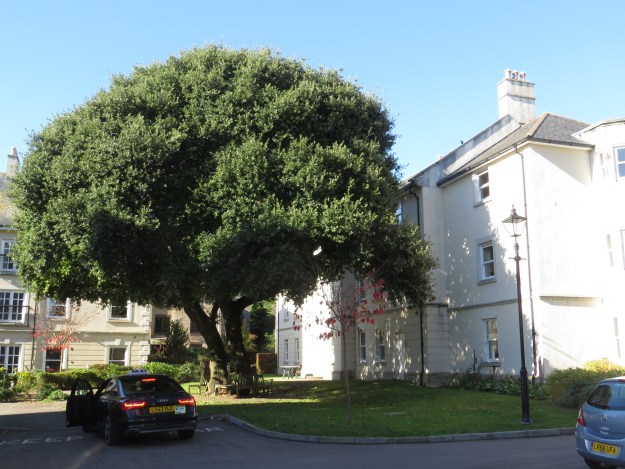
The oaks on Hampstead Heath are both Sessile Oaks (Quercus petraea) and English Oaks (Quercus robur) and Professor Duckett points out that there are also many hybrids between the two in the wood. There are also an increasing number of Turkey Oaks (Quercus cerris) which was introduced as an ornamental tree in the Eighteenth Century, and some evergreen Holm Oaks (Quercus ilex) – long-time readers might remember a pair of these trees growing outside Mum and Dad’s care home in Dorset.

Holm Oaks outside the nursing home

Incidentally, you can tell the acorns of the turkey oak because they have hairy caps! Who knew…

Photo One by Franz Xaver, CC BY-SA 3.0 <https://creativecommons.org/licenses/by-sa/3.0>, via Wikimedia Commons

Turkey Oak acorns (Photo One)

Another common plant on the Heath is Alder Buckthorn (Frangula alnus). Professor Duckett told us that this was the foodplant of the Brimstone butterfly (Gonepteryx rhamni), and he described it as ‘unfortunately not endangered’, for reasons that will become apparent. The butterfly is in fact doing very well as the climate warms, and is moving north at a rate of knots.

Photo Two by Sten Porse, CC BY-SA 3.0 , via Wikimedia Commons

Alder buckthorn (Frangula alnus) (Photo Two)

Photo Three by By Charles J Sharp - Own work, from Sharp Photography, CC BY-SA 4.0, https://commons.wikimedia.org/w/index.php?curid=38298003

Common Brimstone (Gonepteryx rhamni) (Photo Three)

English Heritage have the responsibility to ‘restore and maintain the original landscape’ of the Kenwood Estate (which constitutes an important part of the Heath) whilst maintaining biodiversity. Alas, Professor Duckett points out that a large stand of Alder Buckthorn which wasn’t in Repton’s original design is going to be destroyed, because the brimstone is doing very well. It must sometimes feel as if a species is damned if it’s doing badly, but also damned if it’s increasing in numbers.

Interestingly, although Professor Duckett sees a number of dangers to the wood itself (from ash dieback, from competition from non-native trees such as the Turkey Oak and Norway Maple, and from climate change), he sees the biggest conservation priority in the wood as being….the bog.

At this point, my head swivelled. Bogs are vanishingly rare in London, and I had no idea that Hampstead had one At All. However, sphagnum moss was first recorded in 1877, and there used to be not one but three bogs. The other two are gone, and one remains. This one is a valley bog, where nutrient-poor water drains into a decline, and it used to be much more species-rich – sundew used to grow here, for example. This insectivorous plant exudes drops of a sticky liquid that catch little flies to provide the plant with the nutrients that are missing from the soil.

Photo Four by By No machine-readable author provided. Migas assumed (based on copyright claims). - No machine-readable source provided. Own work assumed (based on copyright claims)., CC BY-SA 3.0, https://commons.wikimedia.org/w/index.php?curid=419620

Sundew (Drosera rotundifolia) (Photo Four)

The bog had been getting rather overgrown with brambles and shrub, but this year a socially-distanced team of volunteers have been clearing the area, and the sphagnum is already regenerating, along with the largest moss in the UK, Polytrichum commune.

Photo Five by ceridwen / Common haircap moss (Polytrichum commune)

Polytrichum commune plus sphagnum moss (Photo Five)

Finally, Professor Duckett returned to his theme of air pollution. The sulphur dioxide in the air from coal-burning during the early twentieth century rendered London a virtual lichen desert – by the time of the Clean Air Acts in 1956 and 1968, there was only one species of lichen left in the whole capital. After this, however, species gradually came back – today, you can see almost 150 species of lichen on Hampstead Heath.

Furthermore, although the Nitrous Oxide pollution along our main roads is bad for most living things, it provides nutrients for nitrogen-loving bryophytes, who can be seen growing on the trees along our main roads. One of these is Syntrichia papillosa or Marble Screw-moss, an urban species which is thriving in the low-sulphur, high nitrogen air.

Photo Six by HermannSchachner, CC0, via Wikimedia Commons

Syntrichia papillosa (Photo Six)

Finally, climate change is improving the conditions for some plants, such as the Mediterranean Liverwort, which used to only live in Cornwall in 1966, and now lives as far afield as the Western Isles of Scotland.

Photo Seven from http://www.dorsetnature.co.uk/pages-liv/lv-02.html

Mediterranean Liverwort (Cololejeunea minutissima) (Photo Seven)

Professor Duckett’s final worry, though, was the lack of botanists being trained up in the UK. He has spent the past five decades studying mosses and liverworts, and has been able to follow the rise and fall of various species. During this time, fewer and fewer universities have been offering courses on botany (or on zoology either). How are we going to monitor what’s going on in our ecosystems if no one is trained? Let’s hope that the generation of citizen scientists who have become involved over the past few years can fill some of the gap.

If you would like to watch the whole talk (and the very interesting discussion that came afterwards) have a look here.

Photo Credits

Photo One by Franz Xaver, CC BY-SA 3.0 <https://creativecommons.org/licenses/by-sa/3.0>, via Wikimedia Commons

Photo Two by Sten Porse, CC BY-SA 3.0 , via Wikimedia Commons

Photo Three by By Charles J Sharp – Own work, from Sharp Photography, CC BY-SA 4.0, https://commons.wikimedia.org/w/index.php?curid=38298003

Photo Four By No machine-readable author provided. Migas assumed (based on copyright claims). – No machine-readable source provided. Own work assumed (based on copyright claims)., CC BY-SA 3.0, https://commons.wikimedia.org/w/index.php?curid=419620

Photo Five by ceridwen / Common haircap moss (Polytrichum commune)

Photo Six by HermannSchachner, CC0, via Wikimedia Commons

Photo Seven from http://www.dorsetnature.co.uk/pages-liv/lv-02.html

St Pancras and Islington Cemetery – A November Walk

Leaf of Norway Maple (Acer plantanoides)


Dear Readers, today was such a perfect autumn day – cold but not too cold, bright sunshine, not a breath of wind – that I wanted to share it with you all. My weekly walk in the cemetery, normally taking the same route, is like taking a snapshot every seven days – it’s extraordinary how quickly things change. The Rayford ash trees that I photographed a fortnight ago have faded, but the silver birches and the maples are coming to the height of their beauty.

Sugar Maple (Acer saccharum) (I think!!)

Silver birch (Betula pendula)

There were redwings in the yew bushes, too fast for me to photograph (this time), and crows everywhere.

The damp soil has enticed down this Herring Gull (Larus argentatus), who is digging for worms, though not doing the version of ‘River Dance’ that you occasionally see (have a look at the one that I spotted in Dorchester below).My Crossley Bird Guide tells me that today’s gull is a third-year one – you can tell by the amount of black on the bill, the ‘eye makeup’ and the dark feathers in the tail. I am always impressed by birdwatchers who specialise in gulls – they have quite the job, what with all the variations between ages and subspecies. Incidentally, the name for a gull enthusiast is a larophile. Just so you know.

We skitter up the hill beside the stream quietly, because I once nearly tripped over a dozing fox here. The ground falls away to a part of the cemetery that is very difficult to access, being bordered by water on one side, and a steep escarpment plus some Japanese knotweed on the other (and you’d definitely need a machete to get through that lot, though it looks rather pretty as it gets its autumnal colour).

Japanese knotweed in autumnal glory

The Michaelmas Daisies that I noted last time have almost gone over, but there’s still some bristly oxtongue to keep this massive queen bumblebee happy. She is probably taking advantage of the sunshine to top up her sugar reserves, and I’m so glad that there’s something for her to eat.

And while there are no foxes, I notice that one of the gravestones is absolutely covered in little dusty foxy footprints. I wonder if cubs play here when no one’s looking?

We walk on along Harwoods Path, where spider silk is streaming from the trees, and little winter gnats are rising from the grass to mate.

The ginkgo has lost all its leaves. Whether they dropped simultaneously or over the whole week I shall never know.

And for some reason I have never noticed the Lombardy poplars before – they are planted in a few places in the cemetery, and certainly have a kind of austere uprightness that reminds me of a Dutch landscape painting.

I noticed a buzzard flying overhead, and then notice that it’s being harried by a crow. I’m under the trees by now so getting a photo is difficult, especially when my camera battery chooses this moment to expire. Photographer friends, why is that do you think? I almost think there is a camera-battery-elf with a mischievous nature. By the time I’m reloaded, the buzzard, now harried by half a dozen crows, has disappeared over the horizon. This the third time in as many weeks that I’ve seen one, though. I wonder if they are roosting in one of the big trees?

Today, my eye has been caught by so many things that it’s been difficult to choose what to show you. For example, I finally realised that the tree that I’d been curious about is a sweet chestnut (hardly Sherlock Holmes levels of deduction, you might think, but then it has been a very, very long year). I am pleased to see that the leaf-miners that are wreaking havoc with the horse chestnuts opposite don’t seem interested in this species.

Sweet chestnut leaves. Like horse chestnut leaves, but not quite.

And finally, I would like to leave you with this little tree, glimpsed through the yews on Harwood’s Path. Just a little maple, I think, but backlit it looks as if its leaves have been hammered out of copper. There is such a variety of plants and animals in the cemetery that it almost deserves a naturalist-in-residence, but then I fear that such a person might not want the wild bits to be dug up to accommodate more graves. I noticed that the grass where I found the fungi last week has been mown, and all the mushrooms (or at least the fruiting bodies) are gone, but then this is a place that is primarily for the mourners, and I suppose that care of the ecosystem must be some way down the list. Still, on balance this is an amazing place, with plenty of room for all its inhabitants, living and dead, plant and animal. Let’s hope that it’s able to stay that way.

Saturday Quiz – Leaves and Buds

Dear Readers, you are all getting far, far too good at this quiz business, so here’s a new twist. Below are pictures of leaves in all their autumnal glory, and pictures of twigs. Can you a) match the twig to the leaf, and b) tell me the name of the shrub/tree? 1 mark for a correct match, and an extra mark for the name of the plant. And this time I’m not going to give you a list to pick from, so this makes it especially important to write your answers down before you go to the comments to respond, in case any speedy people have got there first 🙂

So, if you think that the leaves in Photo 1 belong with the twig in Photo A, and that together they are an English Oak (Quercus robur), your answer is 1)A) (English Oak).

I think this is really tricky this week. We don’t normally pay a lot of attention to twigs, but there are clues in some of the photos, so don’t give up hope! All of the plants are commonly seen in the UK countryside (and many other places in the Northern Hemisphere too).

You have until next Thursday at 5 p.m. UK time to put your answers into the comments.

Onwards, and good luck!

Leaves

Photo One by Oxfordian Kissuth, CC BY-SA 3.0 <https://creativecommons.org/licenses/by-sa/3.0>, via Wikimedia Commons

1)

Photo Two by Oxfordian Kissuth, CC BY-SA 3.0 <https://creativecommons.org/licenses/by-sa/3.0>, via Wikimedia Commons

2)

Photo Three by By Willow - Own work, CC BY 2.5, https://commons.wikimedia.org/w/index.php?curid=2653825

3)

Photo Four by Dominicus Johannes Bergsma, CC BY-SA 4.0 <https://creativecommons.org/licenses/by-sa/4.0>, via Wikimedia Commons

4)

Photo five by Peter O'Connor aka anemoneprojectors from Stevenage, United Kingdom, CC BY-SA 2.0 <https://creativecommons.org/licenses/by-sa/2.0>, via Wikimedia Commons

5)

Photo Six by Giovanni Caudullo, CC BY 4.0 <https://creativecommons.org/licenses/by/4.0>, via Wikimedia Commons

6)

Photo Seven by AnRo0002, CC0, via Wikimedia Commons

7)

Photo Eight by Yoan MARTIN, CC BY-SA 2.0 FR <https://creativecommons.org/licenses/by-sa/2.0/fr/deed.en>, via Wikimedia Commons

8)

Photo Nine by Krzysztof Golik, CC BY-SA 4.0 <https://creativecommons.org/licenses/by-sa/4.0>, via Wikimedia Commons

9)

Photo Ten by CC BY-SA 3.0, https://commons.wikimedia.org/w/index.php?curid=232790

10)

Photo A by Peter O'Connor aka anemoneprojectors from Stevenage, United Kingdom, CC BY-SA 2.0 <https://creativecommons.org/licenses/by-sa/2.0>, via Wikimedia Commons

A)

Photo B by Peter O'Connor aka anemoneprojectors from Stevenage, United Kingdom, CC BY-SA 2.0 <https://creativecommons.org/licenses/by-sa/2.0>, via Wikimedia Commons

B)

Photo C by <a href="https://pixabay.com/users/_alicja_-5975425/?utm_source=link-attribution&utm_medium=referral&utm_campaign=image&utm_content=3139517">_Alicja_</a> from <a href="https://pixabay.com/?utm_source=link-attribution&utm_medium=referral&utm_campaign=image&utm_content=3139517">Pixabay</a>

C)

Photo D by Muriel Bendel, CC BY-SA 4.0 <https://creativecommons.org/licenses/by-sa/4.0>, via Wikimedia Commons

D)

Photo E by Muriel Bendel, CC BY-SA 4.0 <https://creativecommons.org/licenses/by-sa/4.0>, via Wikimedia Commons

E)

Photo F by Chmee2, CC BY-SA 3.0 <http://creativecommons.org/licenses/by-sa/3.0/>, via Wikimedia Commons

F)

Photo G by AnRo0002, CC0, via Wikimedia Commons

G)


Photo H By Stefan.lefnaer - Own work, CC BY-SA 4.0, https://commons.wikimedia.org/w/index.php?curid=46841517

H)

Photo I by Peter O'Connor aka anemoneprojectors from Stevenage, United Kingdom, CC BY-SA 2.0 <https://creativecommons.org/licenses/by-sa/2.0>, via Wikimedia Commons

I)


Photo J by Peter O'Connor aka anemoneprojectors from Stevenage, United Kingdom, CC BY-SA 2.0 <https://creativecommons.org/licenses/by-sa/2.0>, via Wikimedia Commons

J)

Saturday Quiz – Halloween Beasties! – The Answers

Dear Readers, another bumper week for our quiz goers – Christine (and her partner Daan in the Netherlands), Fran and Bobby and Mike at Alittlebitoutoffocus all got 15 out of 15. Well done everyone!

Photo One by By Mvuijlst at English Wikipedia, CC BY-SA 3.0, https://commons.wikimedia.org/w/index.php?curid=3456255 Woodlouse spider (Dysdera Crocata)
1)j) Woodlouse Spider (Dysdera crocata)
2)i) Greater Horseshoe Bat (Rhinolophus ferrumequinum)
3)b) Cellar Spider (Pholcus phalangiodes)
4)c) Giant House Spider (Tegenaria gigantea)
5)g) Black Rat (Rattus rattus)
6)h) Ladybird Spider(Eresus Sandaliatus)
7)d) Noctule (Nyctalus noctula)
8)m) Noble False Widow Spider (Steadota nobilis)
9)l) Pipistrelle species (Pipistrellus)
10)e) Harvestman (Phalangium opilio)
11)a) Brown Rat (Rattus norvegicus)
12)o) Garden Spider (Araneus diadematus)
13)n) Brown Long-eared Bat (Plecotus auritus)
14)f) Nursery Web Spider (Pisaura mirabilis)
15)k) Fen Raft Spider (Dolomedes plantarius)

Photo Credits

Photo One By Mvuijlst at English Wikipedia, CC BY-SA 3.0, https://commons.wikimedia.org/w/index.php?curid=3456255

Photo Two Gilles San Martin from Namur, Belgium, CC BY-SA 2.0 https://creativecommons.org/licenses/by-sa/2.0, via Wikimedia Commons

Photo Three by Olei, CC BY-SA 2.5 https://creativecommons.org/licenses/by-sa/2.5, via Wikimedia Commons

Photo Four by Judy_and_Ed at https://www.flickr.com/photos/65924740@N00/5163153538/

Photo Five By Kilessan – Own work, CC BY-SA 3.0, https://commons.wikimedia.org/w/index.php?curid=9002871

Photo Six By Viridiflavus – Own work, CC BY-SA 3.0, https://commons.wikimedia.org/w/index.php?curid=4956453

Photo Seven by Kamran Safi, CC BY-SA 4.0 https://creativecommons.org/licenses/by-sa/4.0, via Wikimedia Commons

Photo Eight by Stu’s Images, CC BY-SA 4.0 https://creativecommons.org/licenses/by-sa/4.0, via Wikimedia Commons

Photo Nine by Gilles San Martin from Namur, Belgium, CC BY-SA 2.0 https://creativecommons.org/licenses/by-sa/2.0, via Wikimedia Commons

Photo Ten by Mathias Krumbholz, CC BY-SA 3.0 https://creativecommons.org/licenses/by-sa/3.0, via Wikimedia Commons

Photo Eleven by Dunpharlain, CC BY-SA 4.0 https://creativecommons.org/licenses/by-sa/4.0, via Wikimedia Commons

Photo Twelve by krzysztofniewolny on Pixabay, CC0, via Wikimedia Commons

Photo Thirteen by Dave at https://www.flickr.com/photos/83993153@N00/123404678

Photo Fourteen by Björn S…, CC BY-SA 2.0 https://creativecommons.org/licenses/by-sa/2.0, via Wikimedia Commons

Photo Fifteen by Natural England at https://www.flickr.com/photos/naturalengland/6122837987

Thursday Weed – Field Maple

Photo One By AnemoneProjectors (talk) - Field Maple (Acer campestre) autumn leaves, CC BY-SA 2.0, https://commons.wikimedia.org/w/index.php?curid=75305174

Field Maple leaves (Photo One)

Dear Readers, the Wednesday Weed has moved temporarily to Thursday this week – work got a little bit out of hand yesterday, and these posts take rather more time than some of the others. However, having waxed lyrical about the Japanese Maple last week, I thought it was only fair to spend some time with our native maple, the Field Maple, this week. Although this is not as showy a plant as its Asiatic relative, it has a certain charm, with its yellow leaves in winter which, unlike those of its close relative the Sycamore, are not besmirched with tar spot fungus. This is a tree that pops up once a woodland is beginning to grow on disturbed ground – in its early years it is very shade-tolerant, and so can grow underneath the foliage of the pioneer species such as birch. It is always a small-ish tree (though in good conditions it can reach 20m), but it can make a lot of growth early in its life as it reaches for its ‘place in the sun’. It can live for 350 years, and although it loves chalky soil, it seems happy enough in London clay to be a popular street tree. In his book ‘London’s Street Trees‘, Paul Wood mentions a favourite Field Maple on Hornsey Road in North London:

Drunks lean against it, powerfully-jawed dogs are tethered to it, buses brush past it, a cocktail of Thunderbird, 7 Up and worse is frequently fed to it. Despite all this tender, loving care the tree is doing just fine‘.

How can you identify a Field Maple, and, just as importantly, how can you tell the difference between this tree and the ubiquitous Sycamore? Firstly, the leaves of the Field Maple are smaller than those of the Sycamore, and are not serrated. Plus there’s the aforementioned tar spot. The bark of a mature Field Maple has a corky quality.

Photo Two by By Marija Gajić - Own work, CC BY-SA 4.0, https://commons.wikimedia.org/w/index.php?curid=45034594

Bark of the Field Maple (Photo Two)

The flowers are held in what my Collins Tree Guide describes as ‘little erect yellow-green posies’.

Photo Three By Willow - Own work, CC BY-SA 2.5, https://commons.wikimedia.org/w/index.php?curid=2041490

Field Maple flowers (Photo Three)

And the ‘helicopters’ are similar to those of the Sycamore, but are held horizontally rather than dangling.

Photo Four by CC BY-SA 3.0, https://commons.wikimedia.org/w/index.php?curid=737185

Field Maple ‘keys’ (Photo Four)

Sycamore keys

As you might expect from a native tree, there is a variety of folklore around the Field Maple. It used to be believed that it would deter bats from entering the house, if a bough was hung in the doorway. Carrying a child around a Field Maple, or passing them through the branches, was thought to guarantee the infant long life, though presumably not if you dropped them. There is a variant that says that waving a branch of Field Maple over a newborn will give them lifelong protection from the evil eye, so this might be a safer course of action.

Field Maple leaves are the food for many caterpillars. Some species are pretty much totally reliant on this species, including the Mocha moth (Cyclophora annula)..

Photo Five by Patrick Clement from West Midlands, England, CC BY 2.0 <https://creativecommons.org/licenses/by/2.0>, via Wikimedia Commons

The Mocha (Cyclophora annularia) (Photo Five)

…the Maple Prominent (Ptilodon cucullina)

Photo Six Ben Sale from UK, CC BY 2.0 <https://creativecommons.org/licenses/by/2.0>, via Wikimedia Commons

Maple Prominent (Ptilodon cucullina) (Photo Six)

and the Plumed Prominent (Ptilophora plumigera)

Photo Seven By Patrick Clement from West Midlands, England - 71.024 BF2013 Plumed Prominent, Ptilophora plumigera, CC BY 2.0, https://commons.wikimedia.org/w/index.php?curid=63728673

Plumed Prominent (Ptilophora plumigera) (Photo Seven)

Although Field Maple hasn’t been used extensively for timber, owing to its slow growth and small size, it was the wood used by Stradivari for his violins. The sound of these instruments have proved difficult for modern-day luthiers (what a great word!) to reproduce, and  chemical analysis has shown why. For one thing, the wood in the 18th Century violins appears to have been treated with a substance containing aluminium, calcium, copper and a variety of other elements, though whether this was done deliberately in order to change the tone of the instrument, or was simply a way for the woodsmen to prevent fungal infection in the wood, is unknown. But other qualities are simply the result of age – the wood appears to have gradually dehydrated, and constant playing has shaken some of the fibres until they have detached from one another. The authors of the study believe that this might contribute to the expressiveness and tone of the instrument, but if you haven’t yet purchased a Stradivari violin you might want to get a move on (if you have several million pound to spare) – the wood is gradually decaying, and the violins will not last forever.

Photo Eight by By User:Husky - Own work, CC BY 2.5, https://commons.wikimedia.org/w/index.php?curid=1052941

A 1703 Stradivari violin from the Berlin Musical Instrument Museum (Photo Eight)

And if you want to hear what one sounds like, have a listen here. This music, and this instrument, and this violinist, are what human beings are capable of. I think that’s worth remembering when so much of what’s going on at the moment tends one towards despair.

And here, of course, is John Clare, catching the beauty of the Field Maple with his usual precision.

The Maple by John Clare

The Maple with its tassell flowers of green
That turns to red, a stag horn shapèd seed
Just spreading out its scallopped leaves is seen,
Of yellowish hue yet beautifully green.
Bark ribb’d like corderoy in seamy screed
That farther up the stem is smoother seen,
Where the white hemlock with white umbel flowers
Up each spread stoven to the branches towers
And mossy round the stoven spread dark green
And blotched leaved orchis and the blue-bell flowers –
Thickly they grow and neath the leaves are seen.
I love to see them gemm’d with morning hours.
I love the lone green places where they be
And the sweet clothing of the Maple tree.

Photo Nine by © Copyright Derek Harper and licensed for reuse under this Creative Commons Licence.

Photo Nine

Photo Credits

Photo One By AnemoneProjectors (talk) – Field Maple (Acer campestre) autumn leaves, CC BY-SA 2.0, https://commons.wikimedia.org/w/index.php?curid=75305174

Photo Two by By Marija Gajić – Own work, CC BY-SA 4.0, https://commons.wikimedia.org/w/index.php?curid=45034594

Photo Three By Willow – Own work, CC BY-SA 2.5, https://commons.wikimedia.org/w/index.php?curid=2041490

Photo Four by CC BY-SA 3.0, https://commons.wikimedia.org/w/index.php?curid=737185

Photo Five by Patrick Clement from West Midlands, England, CC BY 2.0 <https://creativecommons.org/licenses/by/2.0>, via Wikimedia Commons

Photo Six by Ben Sale from UK, CC BY 2.0 <https://creativecommons.org/licenses/by/2.0>, via Wikimedia Commons

Photo Seven By Patrick Clement from West Midlands, England – 71.024 BF2013 Plumed Prominent, Ptilophora plumigera, CC BY 2.0, https://commons.wikimedia.org/w/index.php?curid=63728673

Photo Eight by By User:Husky – Own work, CC BY 2.5, https://commons.wikimedia.org/w/index.php?curid=1052941

Good News for Once

Photo One by Mike Waite of Surrey Wildlife Trust

Great Fox Spider (Alocpecosa fabrilis) (By Mike Waite of Surrey Wildlife Trust)

Dear Readers, in these troubled times it’s good to have a bit of good news, so here’s something that will please all but the most troubled of arachnophobes. This magnificent spider, known as the great fox-spider, was listed as Extremely Rare in my wonderful ‘Britain’s Spiders – A Field Guide’, and has not been seen since the 1990s. And what a fine beast it is! The female has a body length of 16mm which might not sound like much, but you only need to look at those fine hairy legs to see that this is a substantial creature, more than two inches wide.

The great fox spider is actually a wolf spider – these are creatures with excellent sight, as those big front-facing eyes would suggest. Wolf spiders are runners – they don’t make webs, but instead gallop like cheetahs across the sunny open spaces where you can often find them basking in the heat. Because they don’t spin webs, you will sometimes see them carrying them their egg cases on their backs, and when the young hatch they hitch a ride too.

The spider was discovered by Mike Waite of the Surrey Wildlife Trust,  on a Ministry of Defence training ground in Surrey. He surveyed aerial photos of the site, and found some open dusty spaces, just the kind of places that the spiders like to hunt.He found some unidentified spiderlings, and I suspect he had a hunch that he’d found something exciting. At night, he visited the site with a torch  (and hopefully with.a white flag in case of any random firing), and was ‘over the moon’ to find some adults. 

Photo by Mike Waite of Surrey Wildlife Trust

Mike turned sixty this year, and describes his find as ‘the most important thing that I’ve done in a long career’. He also thinks that the spider might be much more widespread than people think – they live in coastal areas in the Netherlands, skittering across the dunes in pursuit of sandflies. ‘Have we been looking hard enough?’ Mike asks. Good question. But with lockdown fast approaching, it might be worth a good look if you live near enough to the beach to have a good look. There are more wonders around than you might think.

Notes From an Open University Course – The Case of the Eden Centre Roof

Photo One from https://www.edenproject.com/visit/whats-here/core

The roof of the Core Education Centre at the Eden Project in Cornwall, UK (Photo One)

Dear Readers, as I draw to the end of the first module in my OU science course, there is some discussion about sustainable building, and the decisions and challenges that have to be made when trying to come up with something that ticks all the boxes. The Eden Centre in Cornwall is known for its innovative buildings, particularly the biomes that hold thousands of species of plants, so it was not surprising that it wanted its new education centre (The Core) to be equally special. The brief was to

‘create a building the shape of a sunflower and the size of a spaceship to pay respect to the plant engine that powers the earth‘.

It was also extremely important that the building was not only inspirational (the intention was that people walking into the space would look up and be provoked into thinking about the place of human beings in the natural world) but sustainable, in the broadest sense of the word.

Inside The Core

The internal structure of the building was made from ‘glulam’ – as anyone who has watched ‘Grand Designs’ lately will know, this is a composite material made from layers of wood glued together that can be shaped and are as strong as steel. The sustainability component comes from the forestry practices of the companies involved – properly managed woodland can be a renewable resource, whereas steel is very energy-intensive to produce. 

The controversy, however, came from the choice of material used to make the thin, waterproof skin on the roof. The roof wasn’t just going to be a roof: it had to make a strong architectural statement, be durable and light, and be easy to work with, bearing in mind the complexity of the roof design. Furthermore, the Eden Project team wanted to be able to trace the environmental and social impacts of whatever they chose.

In the end, they chose copper. This was immediately contentious: copper takes a lot of energy to smelt and refine and the copper industry, like many other mining operations, has a long history of pollution and habitat destruction. Rio Tinto Zinc was used to help source the metal from a single mine (the Bingham Canyon mine in Utah) which had ISO 4001 certification for environmental management. The team worked with the owners of the mine to track the copper right through the supply chain, believed to be the first time that this has been done. In their statement on the use of the material, the Eden Project team state that:

The copper roof provided Eden with the opportunity to investigate how we can supply the 60% of
global demand for copper that isn’t recycled, by exploring the feasibility of sourcing copper from a
single, responsibly-managed mine, and ultimately, generate debate on the potential for certification
schemes in metals and minerals.’

Even within the OU team who devised the module there were differing opinions about the choice of copper as the roofing material. There were those who agreed with the Eden Project team, who concluded that working with the copper mining company had encouraged reflection on sustainability concerns and life-cycle analysis with the mining industry, and might even lead to a certification scheme.

Then there were those who argued that there were several more locally sourced renewable or recycled materials available for the roof, and choosing them would have been a better way to inspire solutions to environmental problems.

The Bingham Canyon mine in 2003(Public Domain)

What all this highlights is how complex the decision making process can be, both for massive projects like this one or for much more domestic-scale renovations. Do we think about external cladding for our chilly Victorian house, or are we more worried about the possibility of condensation and the fire risk? Do we replace our draughty windows and lose the original glass? The trouble is that quite often we don’t have the information in the detail that we need, and there are few ways of measuring one alternative against another.

However, this is not to say that decisions should not be made based on what we currently know. For what it’s worth, I think that the Eden Centre Roof decision was the wrong one: it would have been better to use something local and preferably recycled (even recycled copper), rather than assuming that one project in a far corner of the world could have an influence on the whole mining industry. The Core is an extremely sustainable and well-thought out building in many ways, from its super-insulated walls and solar panels on the roof to the floor tiles made from recycled Heineken bottles. However, getting into a relationship with Rio Tinto will undermine the sustainability credentials of this impressive building in the minds of anyone who hears the name of the company and remembers the long list of human rights and environmental concerns, the latest being the destruction of a cave sacred to the peoples of the Juukan Gorge in Western Australia, which had evidence of 46,000 years of human habitation. Plus, Rio Tinto has been listed as one of the 100 top industrial greenhouse gas polluters in the world in a Guardian report in 2017. The company refused to bow to a shareholder request to follow the guidelines of the Paris Accord (to limit temperature rise to ‘well below’ 2 degrees Centigrade) on the grounds that they were already making a lot of progress. It seems to me that having a relationship with Rio Tinto is only ever going to benefit the company and enhance its attempts to ‘greenwash’ its reputation.

It is still a very fine building though. Now, if they could only do something about the estimated 76% of people who still arrive at the venue by car that would help…

Photo Two from https://eandt.theiet.org/content/articles/2020/04/there-s-a-whole-world-of-ignorance-out-there-sir-tim-smit-ceo-eden-project/

Photo Two

Photo Credits

Photo One from https://www.edenproject.com/visit/whats-here/core

Photo Two from https://eandt.theiet.org/content/articles/2020/04/there-s-a-whole-world-of-ignorance-out-there-sir-tim-smit-ceo-eden-project/

Here We Go Again….

St Pancras and Islington Cemetery 1st November 2020

Dear Readers, in the UK we are going to be pretty much locked down again from 4th November. The only difference from the March lockdown appears to be that schools and universities will remain open, though it’s clear that this will push up the transmission rate and may make the lockdown longer. Scientists thought that the original lockdown was loosened too early, and have been calling for a ‘circuit breaker’ lockdown since September, so none of this is a surprise, but it’s still terrible news for small businesses of all kinds, for those who will lose their jobs, for the self-employed and above all for the many people who are going to lose loved ones unnecessarily because of the mishandling of the crisis. Let’s just hope that the government get test, track and trace up and running in the interim and that one of the many vaccines being trialled proves effective (though as immunity to the disease seems to run into months rather than years I wouldn’t get too excited just yet).

Meanwhile, I’m relying on my friends in the US to provide something to lift the spirits on 4th November. Keeping everything crossed for you, and for the rest of us too: if nothing else, a change of President would be immeasurably better from a Climate Change point of view, let alone everything else.

Anyhow, there’s nothing like a walk in the cemetery to lift the spirits, I find, and on this damp blustery day there was still plenty to get excited about. Howsabout these fungi, for a start? They were popping up under the Cedar of Lebanon at the entrance to the grounds, and I am hoping that my fungiphile (is that even a word?) friend A will be able to suggest an ID before this blog goes live. The white one looks temptingly edible (though I personally won’t be trying it), the purple one less so. (Update: apparently the purple one is called Amethyst Deceiver, and the other ones are called Shaggy Parasols. Amethyst Deceivers, according to my fungi book, are ‘perhaps the most strikingly beautiful of all very common toadstools, and they certainly do have an ethereal beauty. Shaggy Parasols are edible, but upset some people’s stomachs. This all just reinforces the foragers’ mantra: if in doubt, don’t.)

On we go. A big area of the cemetery is currently closed while they seem to be digging the whole thing over with big yellow digging machines – at the moment it looks like a claggy wasteland, good for a renactment of the Battle of the Somme but not much else. No doubt it will soon be turfed over and available for graves again. It’s a bit of a shame for the masses of goat’s rue that popped up there during the summer, but I have a sneaking suspicion that it will be back.

The Field Maples (Acer campestre) have mostly shed their leaves, as have the sycamores (Acer pseudoplatanus). The Field Maple leaves look very much like those on the Canadian flag, but as I have just discovered, the symbolic leaf shows a ‘generic maple’ with 11 points in the design: a sugar maple (as in ‘maple syrup’) has no less than 23 ‘points’ on its leaf.

Photo One by By Photograph taken by Jared Grove (&lt;a href=&quot;//commons.wikimedia.org/w/index.php?title=User:Phobophile&amp;amp;action=edit&amp;amp;redlink=1&quot; class=&quot;new&quot; title=&quot;User:Phobophile (page does not exist)&quot;&gt;Phobophile&lt;/a&gt;) with a Nicon Coolpix 3200. - &lt;span class=&quot;int-own-work&quot; lang=&quot;en&quot;&gt;Own work&lt;/span&gt;, <a href="http://creativecommons.org/licenses/by-sa/3.0/" title="Creative Commons Attribution-Share Alike 3.0">CC BY-SA 3.0</a>, <a href="https://commons.wikimedia.org/w/index.php?curid=95729">Link</a>

Canadian flag with stylised maple leaf (Photo One)

On the ground, the Field Maple leaves are bright yellow, and smaller than those of Sycamore.

More importantly, though, they don’t have those characteristic black-tar fungus spots that I was talking about a few weeks ago.

Sycamore leaf with black tar fungus.

It’s extraordinary how the colour in the leaves breaks down, and once the leaves have fallen it gives the casual observer a chance to see how individual each one is. Some look as if they’ve been spattered by acid rain, while others look as if the icy fingers of Jack Frost have touched them and turned the green to yellow. There is such glory at the end.

Finally, I encountered a most confiding magpie today. Normally I only have to raise my camera and off they go (making me think about the Avian Eavesdropping talk that I mentioned yesterday). This one seemed to be both wary and curious. What handsome birds they are! I love the way that you can really see the iridescence on the feathers. If they were rarer, I’m sure we’d be stunned every time one flew past. As it is, their machine-gun rattle of a call and their blue/green/turquoise/purple plumage doesn’t hazard a second look. If the lockdown has taught me one thing, it’s that I am surrounded by small wonders, if only I stop to look and listen.

Photo Credits

Photo One by  Jared Grove 


London Natural History Talk – Avian Eavesdropping on Human Speech by Sabrina Schalz

Photo One

Dear Readers, I have been very much enjoying the talks organised by the London Natural History Society during the lockdown, and this week’s talk was especially intriguing. It’s true that we listen to birds all the time (though we rarely really understand what they’re saying), but are the birds listening to us, and if so, what do they understand, and why are they doing it? Sabrina Schalz specialises in the study of birds and the attention they pay to human language, and her presentation raised all kinds of interesting questions. You can listen to the whole thing here (and if you live in London and haven’t yet signed up to the LNHS, I can heartily recommend it as a source of information and camaraderie on flora and fauna in the Capital).

First of all, though, what do we mean by ‘eavesdropping’? There are two kinds: when two people are talking, and a third person listens in: or when someone is broadcasting a message to a particular group, but members of other groups can also listen. The example given was a bird sitting in a tree and singing to attract a mate: the bird is only interested in female birds of the same species, but predators might also be attracted to the song, and humans may admire it.

Now, anyone who has had pet birds will know that they listen to us, but why? Birds in captivity may think of humans as their social group, and will listen to work out if food is coming, or if a visit to the vet is in the offing. As is well known, birds of a wide range of species will imitate human speech, and it was shown that some birds are not just imitating, but actually understand what the words mean – the story of African Grey Parrot Alex, who could distinguish between a ‘yellow cube’ and a ‘green ball’ is one case in point.

However, these are very specialised conditions. Why might a wild bird want to listen to humans? One clear example would be when birds are persecuted, and experiments have shown that captive birds are more alert when they hear unfamiliar voices, so this probably translates into the wild. I know personally that woodpigeons in Dorset were much more flighty than the woodpigeons that visit my garden in London, probably because the chance of the rural birds being shot is so much higher.

A third example would be when the bird wants to exploit the human; the example given was the honey guides of Africa, small birds who, when a human whistles, will lead them to a bee’s nest, so that the human can do the hard work of breaking it open, and the bird can then feast on the eggs and grubs. But in an urban environment it’s clear to see that pigeons and seagulls are extremely attuned to human behaviour, to the extent that London pigeons start to gather in parks and squares in the City well before lunchtime in the hope of a few scraps. This isn’t exactly eavesdropping as defined (unless they can recognise the words ‘Marks and Spencer sandwich) but it does show that birds are watching us and trying to work out what we’re going to do all the time. Their survival may well depend on predicting what we’re going to do.

Greater Honeyguide (Indicator indicator) (Photo Two)

Anyway, I digress as usual. Back to the talk. Schaltz raises the very interesting question of what exactly birds are picking up on when we speak. Birds can distinguish between vowels (Zebra finches were taught to recognise the difference between ‘wit’ and ‘wet’) and also between consonants (Japanese Quail have been taught to distinguish ‘das’, ‘bas’ and ‘gas’).

Budgies and zebra finches can also tell the differences between words that are stressed on their first syllable (‘permit’ as in ‘an authorisation’) and their second syllable (‘permit’ as in ‘allow to do something’).

And finally, and this is probably the most interesting, birds can learn to tell the difference between tone. Some Java sparrows were taught to distinguish between a sentence said in an admiring tone (presumably not ‘who’s a pretty boy?’) and a sentence said with suspicion. Not only this, but they could from the sentence taught to other sentences in the same tone.

Now, onto the subject of Schaltz’s PhD. She studied large-billed crows in Tokyo – these birds are often persecuted in the city, with many being captured and relocated, and she worked with a number of these birds. The aim of the experiment was to see if the birds could distinguish between Japanese (with which they should have been very familiar) and Dutch (a language that they were unlikely to have heard). The birds were played 25 second bursts of each language, and their degree of attentiveness was measured from both their head position (the head is raised when the bird is interested/vigilant) and from the length of time that they spent close to the speaker. All the adult birds spent longer and were more attentive when Dutch was played, though the juveniles seemed pretty much equally interested in both.

How do they tell the difference between the languages? The rhythm of Dutch is very different from that of Japanese, and as it’s already been shown that the ubiquitous Java Sparrows can tell the difference between Chinese (which is syllable-timed) and English (which is stress-timed), this is probably the key factor.

The birds in Schaltz’s experiment were not trained in any way, and so they were self-motivated to listen. The working hypothesis is that because the crows were already persecuted, they would be especially wary of anything unfamiliar, because they couldn’t yet understand the ‘cues’. It’s probably possible that the crows already understand things about tone of voice, volume and even rhythm in Japanese, but don’t yet know these things in Dutch. Learning to anticipate the behaviour of those around you is a key survival skill, and it’s no surprise that these intelligent, adaptable birds are both watchful and curious.

Large-billed crow (Corvus macrorhynchos) (Photo Three)

Schaltz’s next study will be on wild carrion crows in London, and she’s trying to find out three things: whether there are differences between species in terms of their understanding of languages, whether there are differences between cities (Tokyo is 97% Japanese speaking, whereas in London 77% of people have English as their main language) and whether the differences in persecution between Tokyo and London will have an impact on behaviour.

I really enjoyed Schaltz’s talk – it’s clear that she’s passionate about the interactions between birds and humans, and she’s really trying to understand things from the perspective of the bird. She wants to increase human understanding and appreciation of the crow family, a group who are much maligned pretty much throughout their range. Finally, as urbanisation grows, she wants to look at the factors that make a successful urban species, and to try to see what would make our cities more welcoming to the many refugee species who are finding the industrialised countryside a less conducive place to live. And, as a family of jackdaws land on the chimney pots opposite my window as I write, I can only wish her luck. Other species have been squeezed to the margins, and anything that increases our wonder and compassion can only be for the good.

Photo Credits

Photo One from https://www.youtube.com/watch?v=Pe0sgy6pgGw

Photo Two by gisela gerson lohman-braun, CC BY-SA 2.0 https://creativecommons.org/licenses/by-sa/2.0, via Wikimedia Commons

Photo Three by Mike Prince from Bangalore, India, CC BY 2.0 https://creativecommons.org/licenses/by/2.0, via Wikimedia Commons